Bounceban vs Zintlr 2026: Email Verification vs B2B Data
Bounceban verifies emails in real time; Zintlr builds B2B contact lists with personality data. Here's which one your team actually needs in 2026 — and where a third option beats both.
You typed "Bounceban vs Zintlr" into a search bar expecting a head-to-head, and now you're staring at two tools that barely overlap. That confusion is the whole point of this post. These products solve different problems, and picking the wrong one wastes budget on a feature you'll never use.
TL;DR — Bounceban vs Zintlr in 30 seconds#
- Bounceban is a real-time email verification tool. It cleans lists, catches catch-all domains, and protects your sender reputation before you press send.
- Zintlr is a B2B sales-intelligence platform. It surfaces contact data, company firmographics, and "personality intelligence" to help reps personalize outreach.
- They are not direct competitors — one validates emails, the other sources leads. Many teams would need both, which means two subscriptions and two bills.
- If your real goal is finding and verifying business emails in one place, a consolidated platform like Tomba covers both jobs without stitching tools together.
- Skip to the comparison table if you just want the spec sheet.
What is Bounceban and who is it for?#
Bounceban is an email verification service. Think of it like a bouncer at a club door: before an email address gets into your sending list, Bounceban checks the ID. Is the mailbox real? Is the domain a catch-all that accepts everything and tells you nothing? Will this address hard-bounce and ding your reputation?
Its core jobs are:
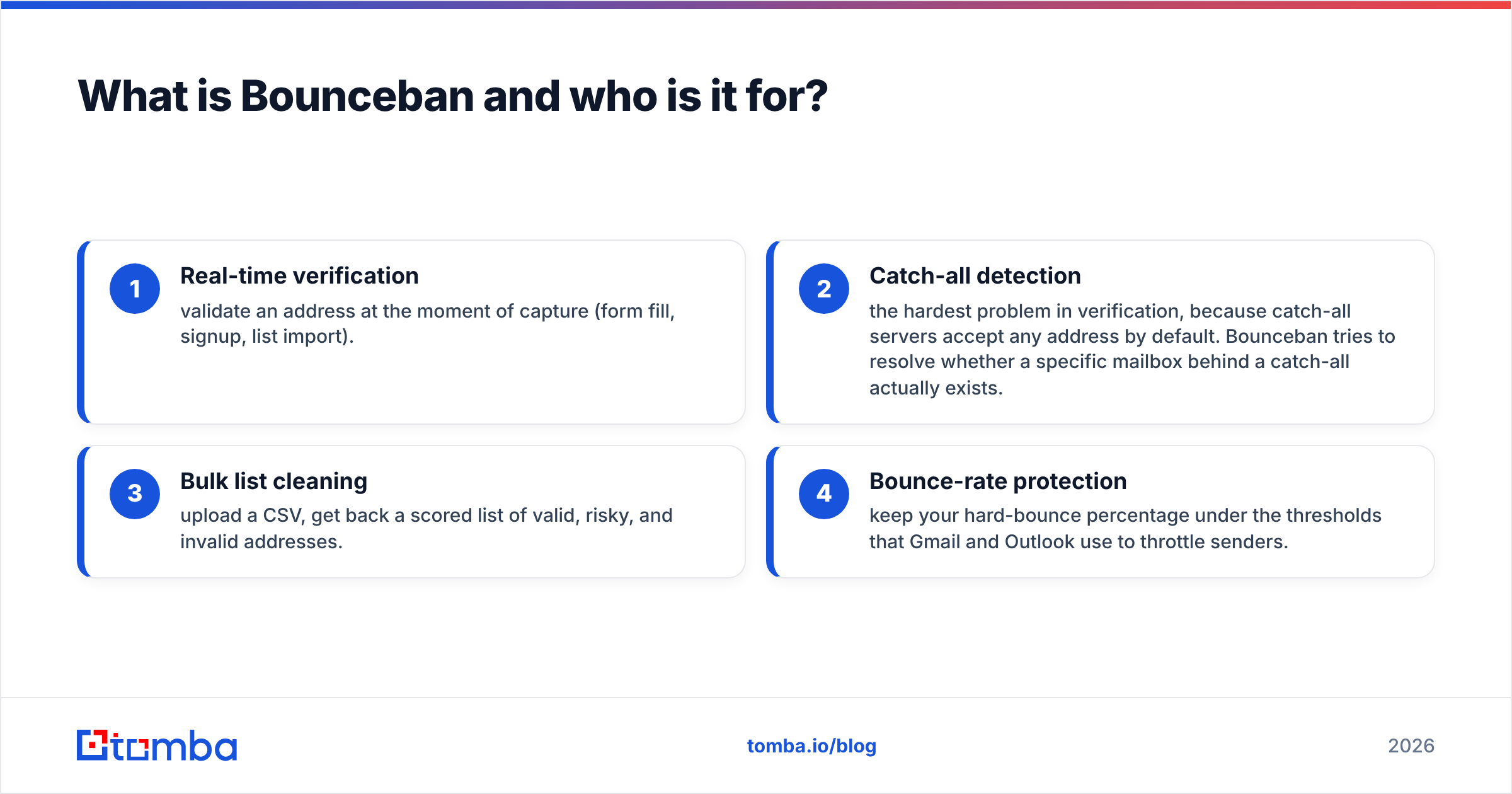
- Real-time verification — validate an address at the moment of capture (form fill, signup, list import).
- Catch-all detection — the hardest problem in verification, because catch-all servers accept any address by default. Bounceban tries to resolve whether a specific mailbox behind a catch-all actually exists.
- Bulk list cleaning — upload a CSV, get back a scored list of valid, risky, and invalid addresses.
- Bounce-rate protection — keep your hard-bounce percentage under the thresholds that Gmail and Outlook use to throttle senders.
Bounceban is for email marketers, SDR teams, and deliverability managers who already have a list and need to make sure it won't tank their domain reputation. It does not find new contacts. If your list is empty, Bounceban has nothing to do.

What is Zintlr and who is it for?#
Zintlr sits on the opposite end of the funnel. It's a B2B data and prospecting platform — closer in spirit to Apollo, Lusha, or Clearbit than to a verification tool. You go to Zintlr to get contacts, not to clean them.
Zintlr's pitch leans on a few pillars:
- Contact and company database — names, titles, emails, and firmographics you can search and filter by role, industry, or geography.
- Personality intelligence — its signature feature. Zintlr attempts to infer a prospect's communication style (think DISC-style profiling) so reps can tailor tone and messaging.
- Chrome extension — pull contact details while browsing LinkedIn or company sites.
- Intent and enrichment signals — context to help prioritize which accounts to work first.
Zintlr is for outbound sales reps and founders doing top-of-funnel prospecting who need raw contacts and behavioral hints to personalize at scale. Verification is a secondary concern — the data is only as fresh as the last database refresh, and any B2B database degrades over time as people change jobs.
How do Bounceban and Zintlr compare feature by feature?#
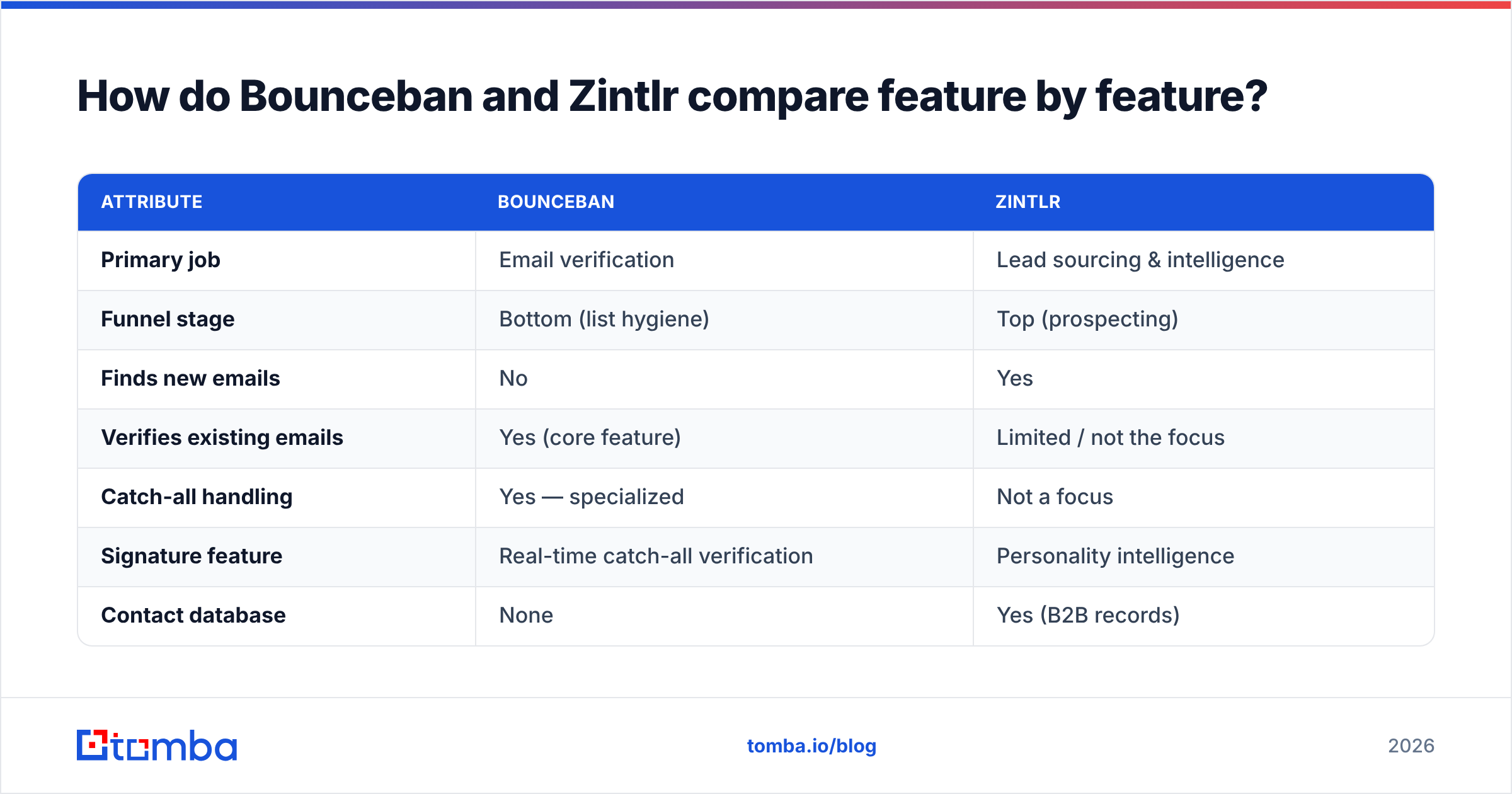
Here's the honest spec sheet. Notice how little the two columns actually overlap — that's the real story of this matchup.
| Attribute | Bounceban | Zintlr |
|---|---|---|
| Primary job | Email verification | Lead sourcing & intelligence |
| Funnel stage | Bottom (list hygiene) | Top (prospecting) |
| Finds new emails | No | Yes |
| Verifies existing emails | Yes (core feature) | Limited / not the focus |
| Catch-all handling | Yes — specialized | Not a focus |
| Signature feature | Real-time catch-all verification | Personality intelligence |
| Contact database | None | Yes (B2B records) |
| Chrome extension | Limited | Yes |
| Best for | Deliverability teams | Outbound SDRs & founders |
| Replaces the other? | No | No |
The takeaway: buying one does not let you cancel the other. Zintlr feeds the top of your funnel; Bounceban guards the bottom. If you only buy Zintlr, you'll eventually push unverified data into your sequencer and watch bounces climb. If you only buy Bounceban, you have nothing to verify until another tool hands you a list.
Is Bounceban better than Zintlr?#
Wrong question — they're not interchangeable. The better question is "which job am I trying to do right now?" Match the tool to the job:
- You have a list and need it clean → Bounceban. Verification is its entire reason to exist, and it specializes in the catch-all edge case that trips up generic verifiers.
- You have empty pipeline and need contacts → Zintlr. A verification tool can't conjure leads.
- You need both, repeatedly, every week → this is where two separate subscriptions start to feel like a tax. You're paying two vendors, syncing two exports, and reconciling two data formats.
For most growing teams, the third scenario is the real one. You don't want to think about verification and sourcing as separate purchases — you want a workflow where you find a contact and the email is already validated before it lands in your CRM. That's the gap a consolidated platform fills, and it's worth understanding why deliverability depends on getting both right.
Why does verification quality decide your deliverability?#
Conclusion first: bad data is the fastest way to get your domain throttled. Mailbox providers watch your bounce rate and spam complaints like a credit score. Cross the line and your messages quietly land in spam — for all recipients, not just the bad ones.
This is why list hygiene isn't optional. A reputable email verifier protects three things at once:
- Hard-bounce rate — keep it under ~2-3% or providers start throttling.
- Sender reputation — your domain's long-term standing with Gmail and Microsoft. Once damaged, it takes weeks to rebuild. See Google's own Postmaster guidelines for the thresholds that matter.
- Sequence ROI — every bounced email is a wasted send slot and a skewed open-rate metric.
Zintlr gives you contacts, but those contacts are point-in-time snapshots. Someone profiled six months ago may have switched companies, killing that email. Without a verification layer, you're sending to a graveyard. Bounceban solves that — but only if you remember to route every list through it, every time. The friction of remembering is exactly why bundled find-plus-verify workflows win.
For a deeper primer, the concept itself is worth bookmarking: email deliverability is the umbrella term for everything that determines whether your message reaches the inbox.
What does Bounceban vs Zintlr cost?#
Both tools price by usage, and both keep exact tiers behind sign-up walls that change often, so treat any number you read online as approximate and confirm on the vendor's own pricing page. The structural difference matters more than the dollar figure:
- Bounceban charges per verification credit. Your cost scales with how many addresses you clean. Predictable if your list size is stable, spiky if you import big lists occasionally.
- Zintlr charges for data access — typically seat-based plus credit limits on contact reveals. You pay for the database, then pay again (in credits) to extract from it.
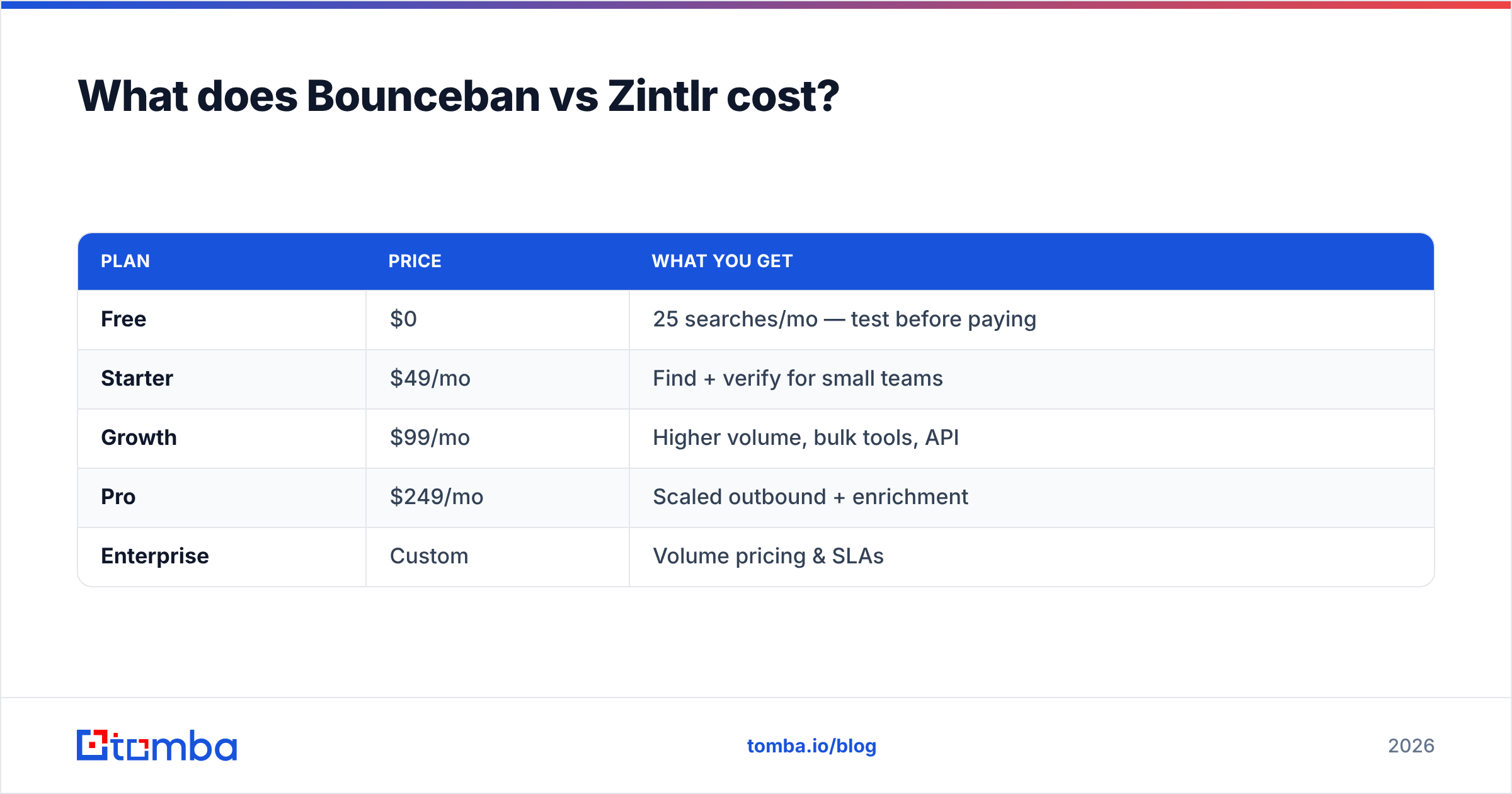
Stack them together and a two-person team can easily run two mid-tier subscriptions to cover one outbound motion. That's the hidden cost of the "two specialized tools" approach. Compare that to Tomba's pricing, where finding and verifying live under one plan:
| Plan | Price | What you get |
|---|---|---|
| Free | $0 | 25 searches/mo — test before paying |
| Starter | $49/mo | Find + verify for small teams |
| Growth | $99/mo | Higher volume, bulk tools, API |
| Pro | $249/mo | Scaled outbound + enrichment |
| Enterprise | Custom | Volume pricing & SLAs |
One bill, one workflow, find and verify in the same place. For teams tired of reconciling two vendors, the consolidation alone often pays for itself.
When should you use a combined find-and-verify tool instead?#
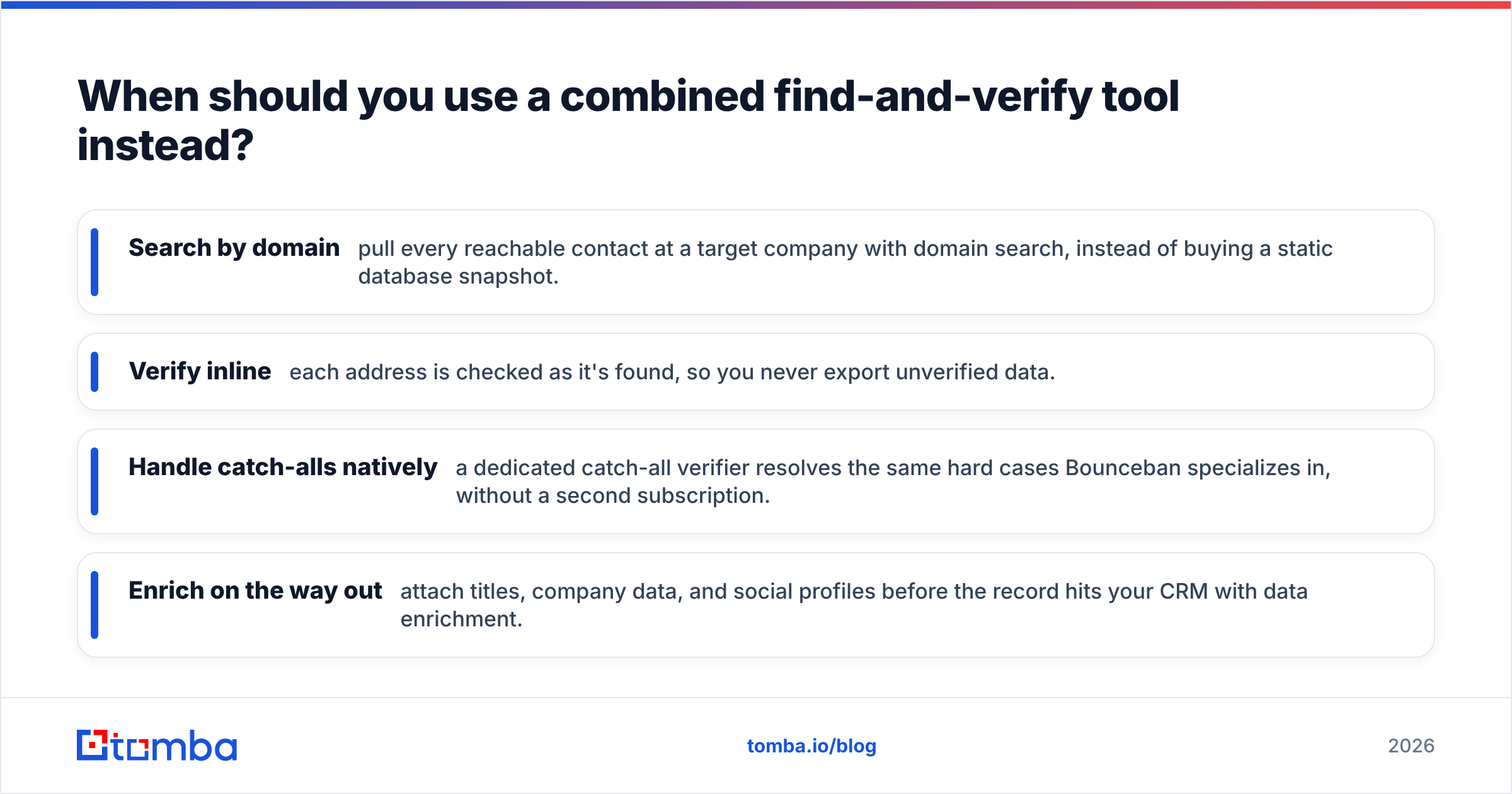
Use a combined platform when your outbound motion is continuous rather than occasional. If you prospect and send every week, the find → verify → export loop is your bottleneck, and running it across two tools adds friction at every handoff.
A unified approach looks like this:
- Search by domain — pull every reachable contact at a target company with domain search, instead of buying a static database snapshot.
- Verify inline — each address is checked as it's found, so you never export unverified data.
- Handle catch-alls natively — a dedicated catch-all verifier resolves the same hard cases Bounceban specializes in, without a second subscription.
- Enrich on the way out — attach titles, company data, and social profiles before the record hits your CRM with data enrichment.
This is the model Tomba is built around. It won't give you Zintlr's personality-profiling gimmick — that's a genuine Zintlr differentiator if behavioral tailoring is central to your playbook. But for the 90% of teams whose real need is "accurate contacts that won't bounce," one tool beats two.
Bounceban vs Zintlr: which should you pick?#
Here's the decision in plain terms:
- Pick Bounceban if you already have a strong lead source and your only gap is verification — especially if catch-all domains are wrecking your bounce rate. It's a focused, capable verifier.
- Pick Zintlr if your single biggest problem is finding people and you value personality-based personalization enough to pay a premium for it.
- Pick a consolidated tool like Tomba if you're doing both jobs regularly and don't want two contracts, two data exports, and two places where things break. You get an email finder, built-in verification, domain search, and enrichment in one workflow — with a free tier to test before you commit.
The "Bounceban vs Zintlr" framing assumes you must choose between sourcing and verifying. You don't. The smarter move is to ask whether you need them stitched together at all — and for most outbound teams in 2026, the answer is a single platform that does both.
The bottom line#
Bounceban and Zintlr aren't rivals — they're two halves of a workflow most teams end up paying for twice. Bounceban verifies, Zintlr sources, and neither replaces the other. If that two-tool tax sounds like your reality, try doing both jobs in one place. Start free with the Tomba Email Finder — 25 searches a month, find and verify in the same flow, no credit card to test whether one tool can replace your two.
// get started
Find, verify and enrich your first contacts today
Start on the free plan with 25 searches a month, then scale when your team is ready.
Free plan · No credit card required · GDPR & CCPA
// about the author