Bounceban vs ZoomInfo 2026: Which B2B Data Tool Wins?
Bounceban verifies catch-all emails; ZoomInfo sells a massive contact database. We compare accuracy, pricing, and fit so you pick the right tool in 2026 — plus a leaner third option.
Bounceban and ZoomInfo get lumped together in buying conversations, but they solve different problems. One cleans your list; the other sells you the list in the first place. Picking the wrong one wastes budget and tanks your deliverability. Here is how they actually compare in 2026.
TL;DR — Bounceban vs ZoomInfo in 30 seconds#
- Bounceban is a focused email verification tool built to crack catch-all and risky domains that other verifiers mark "unknown." It is cheap, fast, and narrow.
- ZoomInfo is a full B2B sales-intelligence platform: contacts, firmographics, intent data, org charts, and workflow tooling — sold on annual contracts that usually start in the five figures.
- They are not direct competitors. ZoomInfo generates contact data; Bounceban validates email addresses you already have.
- If you only need accurate emails verified, Bounceban wins on price. If you need a sourcing engine with intent signals, ZoomInfo is the heavier tool — at a heavier cost.
- A middle path exists: a pay-as-you-grow platform that both finds and verifies emails without an annual lock-in.
What are Bounceban and ZoomInfo?#
Bounceban is an email verification service. Its headline feature is catch-all verification — the ability to return a real verdict (valid or invalid) on domains configured to accept all incoming mail. Standard verifiers stall on catch-alls and return "unknown," which forces you to either gamble or discard the address. Bounceban runs deeper SMTP and inbox-placement checks to resolve those gray-area contacts. It is a single-purpose tool: you bring a list, it scores the list.
ZoomInfo is one of the largest B2B data platforms on the market. According to ZoomInfo's own site, the platform spans contact records, company firmographics, technographics, buying-intent signals, and an engagement suite for outreach. You do not bring a list to ZoomInfo — you build the list inside ZoomInfo by filtering its database, then push contacts into your CRM or sequencer.
The everyday analogy: Bounceban is a water filter, and ZoomInfo is the whole reservoir-plus-plumbing system. A filter is useless if you have no water source; a reservoir without a filter still ships you sediment. Knowing which problem you have is the entire decision.

Wait — that mental model matters because most teams searching "bounceban vs zoominfo" are really asking one of two different questions: "How do I clean my existing data?" or "Where do I get data in the first place?" The answer is rarely the same tool.
How do Bounceban and ZoomInfo differ?#
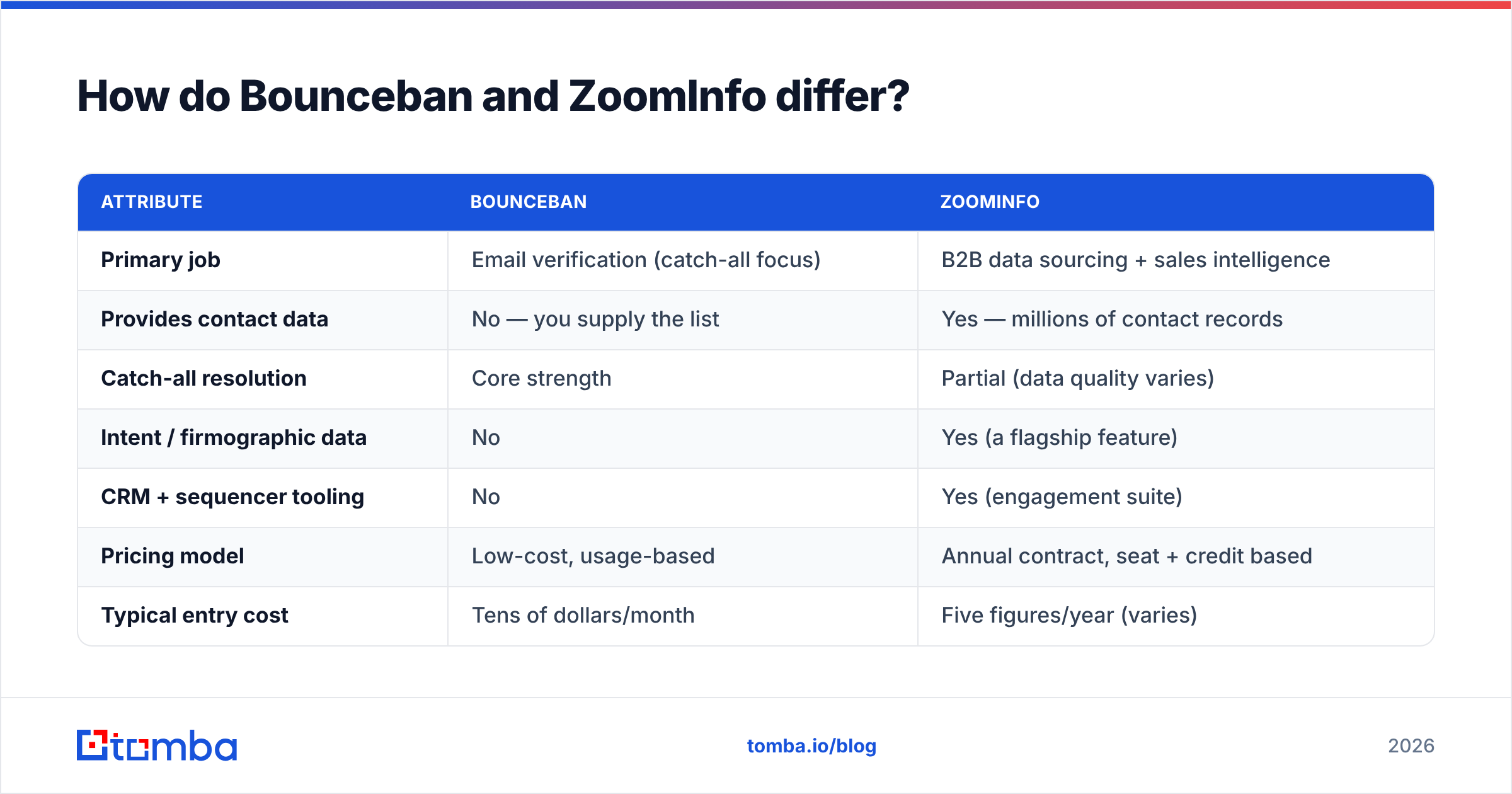
The fastest way to see the gap is feature-by-feature. These two products overlap on almost nothing except the word "email."
| Attribute | Bounceban | ZoomInfo |
|---|---|---|
| Primary job | Email verification (catch-all focus) | B2B data sourcing + sales intelligence |
| Provides contact data | No — you supply the list | Yes — millions of contact records |
| Catch-all resolution | Core strength | Partial (data quality varies) |
| Intent / firmographic data | No | Yes (a flagship feature) |
| CRM + sequencer tooling | No | Yes (engagement suite) |
| Pricing model | Low-cost, usage-based | Annual contract, seat + credit based |
| Typical entry cost | Tens of dollars/month | Five figures/year (varies) |
| Contract commitment | Minimal | Annual, often multi-year |
| Best for | Cleaning lists, protecting deliverability | Enterprise prospecting at scale |
Three differences drive most buying decisions:
- Direction of data flow. ZoomInfo pushes data out to you; Bounceban scores data you bring in. If your problem is "I have no leads," Bounceban cannot help. If your problem is "my leads bounce," ZoomInfo is an expensive fix.
- Catch-all depth. This is Bounceban's whole reason to exist. Large platforms like ZoomInfo carry catch-all addresses in their database too, and their verification is not always conclusive. A dedicated verifier or a strong catch-all verifier often resolves contacts the big database leaves ambiguous.
- Commitment. ZoomInfo is famous for annual contracts and procurement cycles. Reviews on G2 repeatedly cite contract rigidity and renewal pricing as the main friction. Bounceban is closer to a utility you turn on and off.
Is Bounceban better than ZoomInfo for email verification?#
For pure verification, yes — Bounceban is purpose-built and ZoomInfo is not. But "better at verification" is only half the question, because verification quality depends on what you feed in.
ZoomInfo's contact records are already partially validated when you export them, so a slice of ZoomInfo users never run a separate verifier. The catch is data decay: B2B contact data goes stale at roughly 22–30% per year as people change jobs, per widely cited industry research summarized by Gartner. Even a freshly exported ZoomInfo list benefits from a verification pass before a cold campaign, because a bounce rate above 2–3% damages your sender reputation regardless of where the address came from.
So the realistic stack for a ZoomInfo customer is often ZoomInfo for sourcing + a verifier for the final scrub. That is where Bounceban — or any solid email verifier — earns its keep. It is not Bounceban instead of ZoomInfo; it is Bounceban downstream of it.
If you do not have ZoomInfo and just need addresses verified, Bounceban handles catch-alls well and costs a fraction of a ZoomInfo seat. The weakness is scope: the moment you need the actual email addresses, company data, or phone numbers, you are back to needing a sourcing tool.

How much do Bounceban and ZoomInfo cost?#
Cost is where these tools diverge hardest, and it is usually the deciding factor.
- Bounceban uses transparent, usage-based pricing — you pay for the verifications you run, typically in the tens of dollars per month for normal volumes. No procurement call required.
- ZoomInfo does not publish list pricing. Real-world figures from buyers and review sites put entry packages in the $15,000+ per year range, climbing fast with seats, credits, and add-ons like intent data. It is sold through sales reps on annual terms.
The pricing question therefore reframes the whole comparison. You are not choosing between two $50 tools. You are choosing between a low-cost utility and an enterprise platform with a budget-line commitment. For a five-person SDR team, ZoomInfo can be the single largest software cost in the stack. For a solo founder, it is rarely justifiable.
This is exactly the gap that catches teams who searched "bounceban vs zoominfo" expecting a like-for-like duel. The honest answer: they sit at opposite ends of the price and scope spectrum, and most buyers actually want something in the middle.
Where does a tool like Tomba fit in this comparison?#
Tomba sits in the practical middle — it both finds and verifies emails, without ZoomInfo's contract or Bounceban's single-feature ceiling. That makes it a natural reference point when the two extremes do not fit.
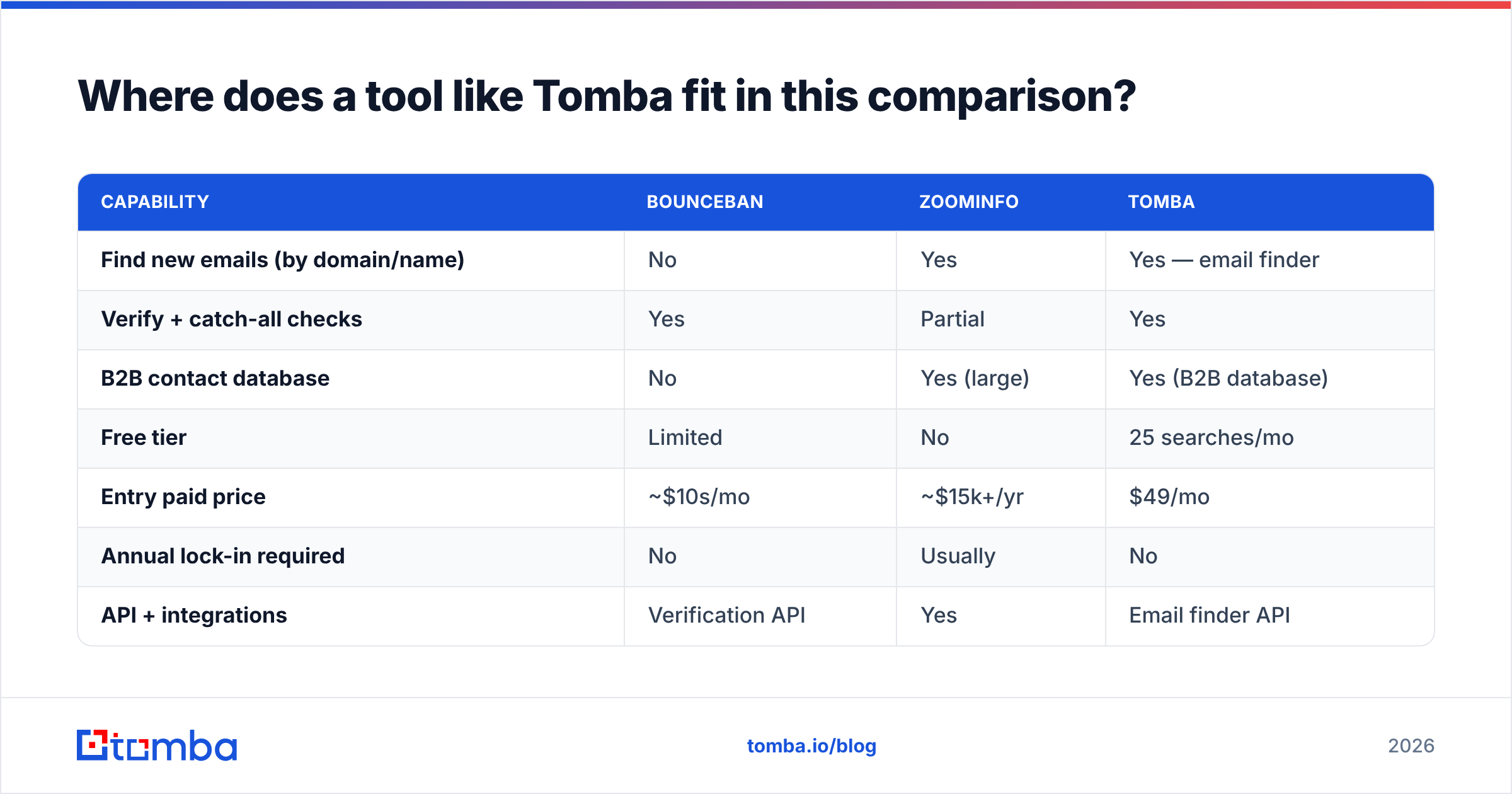
Here is the same comparison with Tomba added so you can see the spread:
| Capability | Bounceban | ZoomInfo | Tomba |
|---|---|---|---|
| Find new emails (by domain/name) | No | Yes | Yes — email finder |
| Verify + catch-all checks | Yes | Partial | Yes |
| B2B contact database | No | Yes (large) | Yes (B2B database) |
| Free tier | Limited | No | 25 searches/mo |
| Entry paid price | ~$10s/mo | ~$15k+/yr | $49/mo |
| Annual lock-in required | No | Usually | No |
| API + integrations | Verification API | Yes | Email finder API |
Where each tool genuinely wins:
- Choose Bounceban when you already have a data source and only need a sharp, cheap verifier that beats catch-alls.
- Choose ZoomInfo when you are an enterprise that needs intent data, org charts, and a database deep enough to justify five figures a year — and you have the procurement appetite for it.
- Choose a Tomba-style platform when you need to both find and verify professional emails on a pay-monthly basis, want a free tier to test accuracy first, and do not want an annual contract.
Tomba's pricing is published and simple: a free tier with 25 searches per month, then Starter at $49/mo, Growth at $99/mo, and Pro at $249/mo. You can see the full Tomba pricing breakdown without a sales call — which is itself the point of difference against ZoomInfo's quote-only model.
Which tool should you choose in 2026?#
Decide by starting with the question you actually have, not the tool names:
- "I have a list and it bounces." You need verification. Bounceban (or any focused verifier) is the cheapest fix. Run the list, drop the invalids, protect your domain.
- "I have no contacts and need to build a target account list with intent signals." That is ZoomInfo's home turf — if the budget exists. Nothing on the cheap end fully replicates its intent and org-chart depth.
- "I need to find emails and keep them clean, without a $15k contract." This is the most common SMB and mid-market case, and it is where a combined find-plus-verify platform like Tomba fits best.
A practical workflow for most teams: source contacts (from a database or by domain search), verify before sending, and only escalate to a full ZoomInfo seat when intent data and enterprise volume genuinely move the number. Buying ZoomInfo to solve a verification problem is overkill; buying only Bounceban when you have no data source solves nothing.
Frequently asked questions#
Is Bounceban a ZoomInfo competitor? Not really. Bounceban verifies emails you already have; ZoomInfo is a database that generates contacts. They are complementary more often than competitive — many teams use a verifier downstream of their data provider.
Does ZoomInfo verify its own emails? ZoomInfo applies validation to its records, but B2B data decays 20–30% a year, so a separate verification pass before cold outreach is still best practice to keep bounce rates under control.
What is the cheapest way to get verified B2B emails? For small volumes, a free tier plus a low-cost paid plan beats an enterprise contract. Tomba's free tier (25 searches/mo) lets you test find-and-verify accuracy before paying anything.
Can I replace ZoomInfo entirely with a verifier? No. A verifier scores addresses; it does not create them. To replace ZoomInfo you need a sourcing tool — a database or an email finder — not just verification.
The bottom line#
Bounceban vs ZoomInfo is not a fair fight because they are not the same kind of product. Bounceban is a precise, affordable verifier that excels at catch-alls. ZoomInfo is a deep, expensive data platform for enterprises that need intent and scale. Most teams searching for a winner actually want neither extreme — they want to find accurate professional emails and verify them without signing an annual contract.
If that is you, start with the Tomba Email Finder. Find emails by domain, name, or company, verify them in the same workflow, and test the accuracy on the free tier before you spend a dollar — no procurement call, no lock-in, just clean contacts you can actually email.
// get started
Find, verify and enrich your first contacts today
Start on the free plan with 25 searches a month, then scale when your team is ready.
Free plan · No credit card required · GDPR & CCPA
// about the author