Bounceless vs Apollo.io (2026): Email Data Tool Compared
Bounceless verifies lists; Apollo.io finds and sequences leads. See where each one wins on accuracy, pricing, and workflow — and the smarter third option.
You are comparing two tools that barely play the same sport. Bounceless is a focused email verification engine. Apollo.io is a sprawling sales intelligence platform with a database, sequencer, and dialer bolted together. Picking between them is less "which is better" and more "which job am I actually trying to do."
This guide breaks down where each tool earns its keep, where it quietly costs you money, and why a lot of teams end up running a separate finder-plus-verifier stack instead of either one.
TL;DR#
- Bounceless is a dedicated email verifier — strong at cleaning lists you already have, weak at building new ones.
- Apollo.io is an all-in-one prospecting platform — huge contact database plus sequencing, but its built-in verification and data freshness draw frequent complaints.
- Pricing differs in kind: Bounceless charges per verification credit; Apollo charges per seat with monthly export caps.
- Neither is a pure email finder. If your bottleneck is sourcing accurate, verified addresses by domain or name, a focused finder like Tomba usually beats both on cost-per-valid-email.
- Best combo for most teams: a precise finder + a real-time verifier, so you pay only for emails that actually land.
What is Bounceless?#
Bounceless is an email verification and list-cleaning service. You upload a list — exports from a CRM, a webinar signup sheet, a scraped spreadsheet — and it runs each address through syntax checks, MX record lookups, SMTP pinging, and spam-trap and disposable-domain detection. You get back a scored list: deliverable, risky, or undeliverable.
Think of Bounceless as a water filter. It does not dig the well or find the water; it makes sure what you already pulled up is safe to drink. That framing matters, because if you walk in expecting it to find new contacts, you will be disappointed — that is simply not what it does.
Its strengths are the classic verifier strengths: bulk processing, an API for real-time checks at form submission, and integrations with common ESPs. If you have a large, aging database and your bounce rate is creeping up, a tool in this category pays for itself fast by protecting your sender reputation.

What is Apollo.io?#
Apollo.io is a go-to-market platform built around a B2B contact database of a few hundred million records. On top of that database it stacks prospecting filters, email sequences, a dialer, a Chrome extension, and basic CRM-style tracking. According to Apollo's own site, the pitch is "find, contact, and close" in one place.
That breadth is the appeal and the catch. Apollo is excellent when you want a single login for the whole top-of-funnel motion: search a persona, push contacts into a sequence, and start sending. The friction shows up in data quality. Crowdsourced and community-contributed records age quickly, and Apollo's built-in verification is good enough for volume but not surgical. Reps routinely report bounced sends on contacts Apollo marked as valid, which is why many pair it with an external verifier anyway.
You can read independent user sentiment on G2's Apollo.io listing — the recurring themes are great coverage, uneven accuracy, and seat-based pricing that scales painfully.
Bounceless vs Apollo.io: the core difference#
Here is the cleanest way to see the contrast. These tools sit at different stages of the same pipeline.
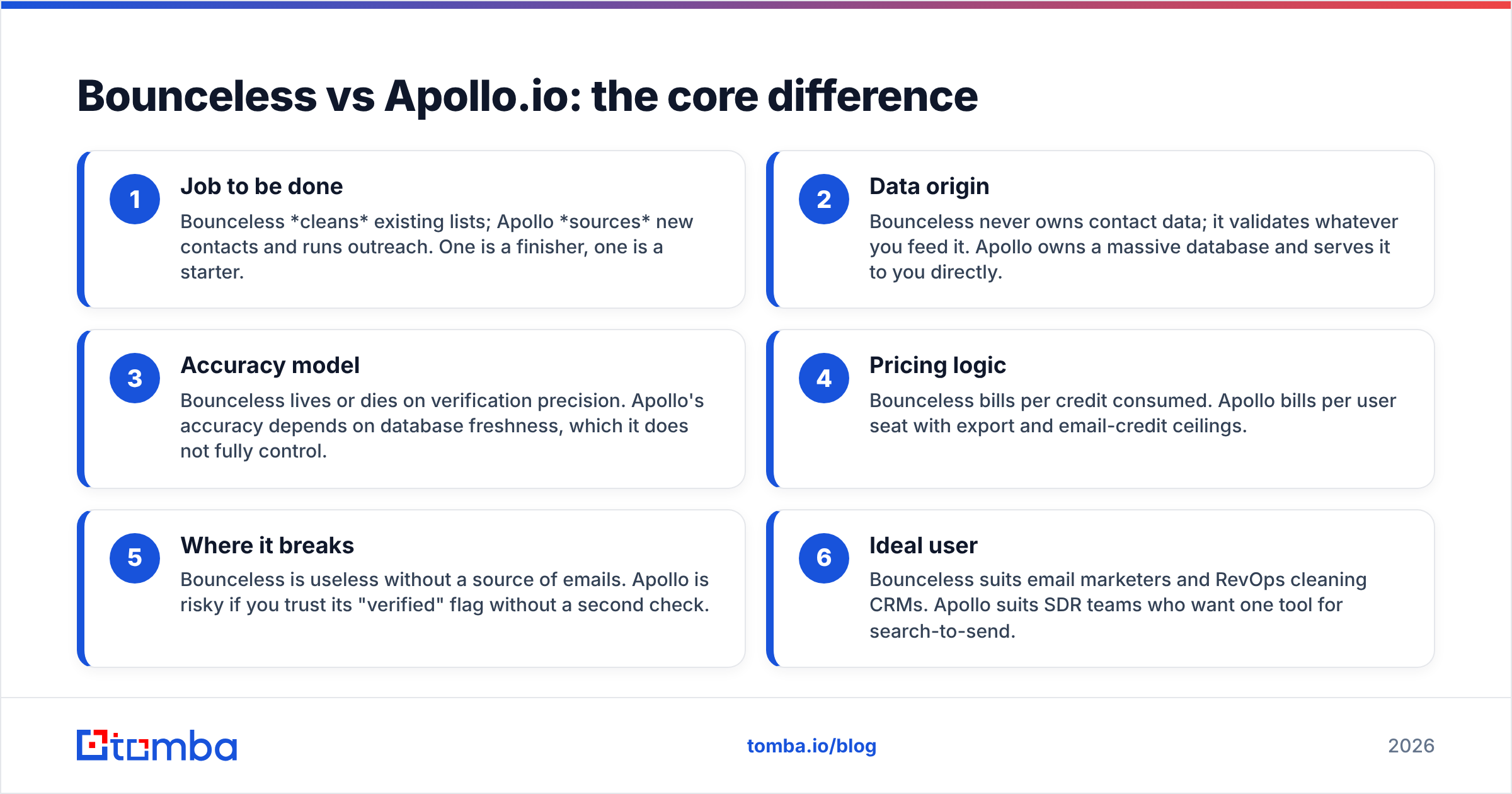
- Job to be done — Bounceless cleans existing lists; Apollo sources new contacts and runs outreach. One is a finisher, one is a starter.
- Data origin — Bounceless never owns contact data; it validates whatever you feed it. Apollo owns a massive database and serves it to you directly.
- Accuracy model — Bounceless lives or dies on verification precision. Apollo's accuracy depends on database freshness, which it does not fully control.
- Pricing logic — Bounceless bills per credit consumed. Apollo bills per user seat with export and email-credit ceilings.
- Where it breaks — Bounceless is useless without a source of emails. Apollo is risky if you trust its "verified" flag without a second check.
- Ideal user — Bounceless suits email marketers and RevOps cleaning CRMs. Apollo suits SDR teams who want one tool for search-to-send.
)
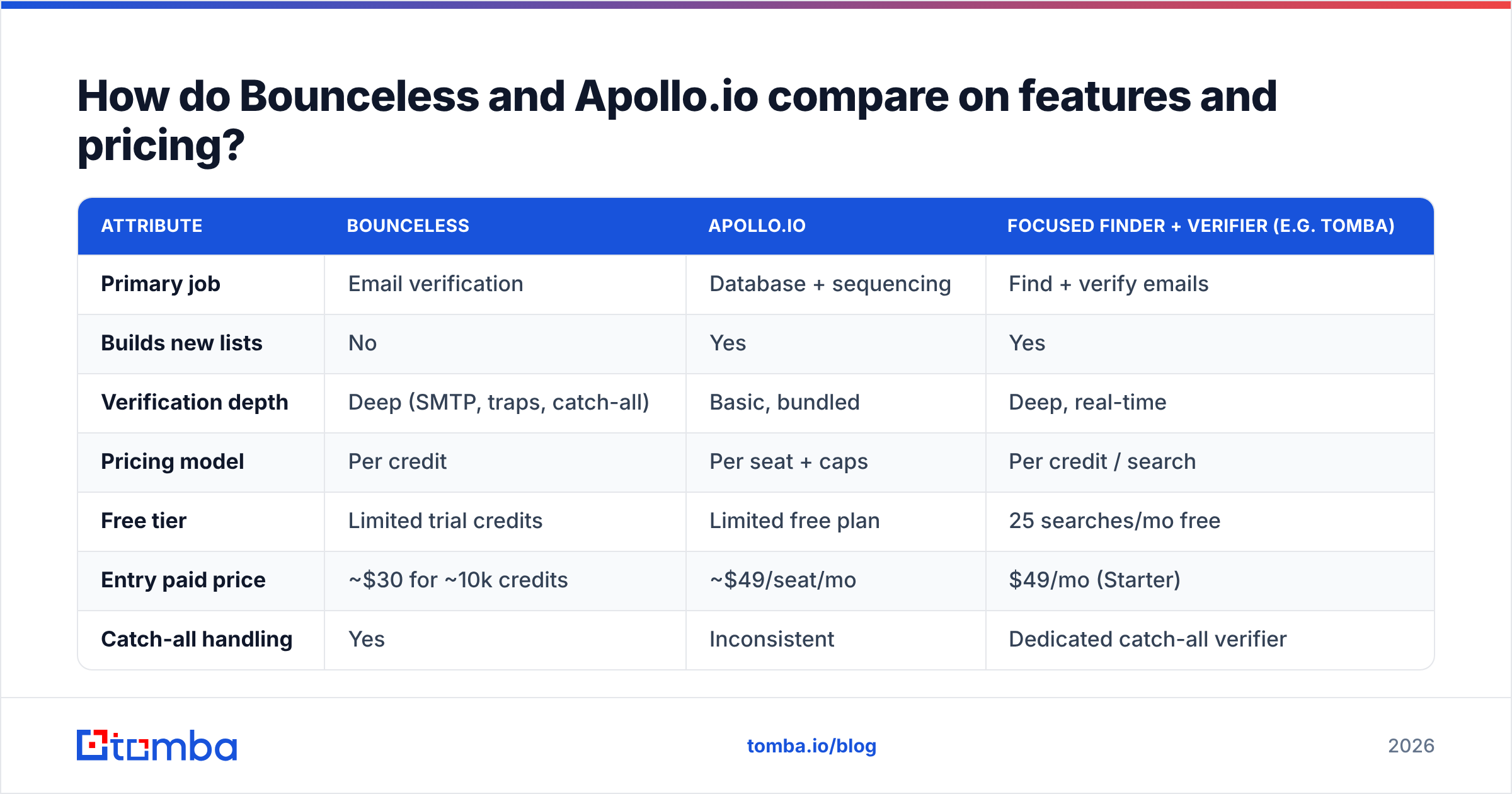
How do Bounceless and Apollo.io compare on features and pricing?#
| Attribute | Bounceless | Apollo.io | Focused finder + verifier (e.g. Tomba) |
|---|---|---|---|
| Primary job | Email verification | Database + sequencing | Find + verify emails |
| Builds new lists | No | Yes | Yes |
| Verification depth | Deep (SMTP, traps, catch-all) | Basic, bundled | Deep, real-time |
| Pricing model | Per credit | Per seat + caps | Per credit / search |
| Free tier | Limited trial credits | Limited free plan | 25 searches/mo free |
| Entry paid price | ~$30 for ~10k credits | ~$49/seat/mo | $49/mo (Starter) |
| Catch-all handling | Yes | Inconsistent | Dedicated catch-all verifier |
| Best for | List hygiene | Full outbound motion | Cost-per-valid-email |
A few honest notes on that table. Apollo's free plan is genuinely useful for testing, and its database depth is real — if you need 50,000 contacts in a niche vertical tomorrow, it delivers. Bounceless, meanwhile, is a sharper scalpel for verification than Apollo's bundled check will ever be. The trade-off is that you are now managing two contracts, two logins, and two billing models for what is conceptually one task: getting valid emails into a sequence.
If accuracy is your obsession, it helps to understand where contact data actually comes from before trusting any vendor's "verified" badge. Crowdsourced databases and verification engines fail in completely different ways.
Is Apollo.io's verification good enough on its own?#
Short answer: for low-stakes volume, yes; for deliverability-sensitive campaigns, no. Apollo verifies at the database layer, which means a contact flagged "verified" last quarter may have left the company by the time you send. Job changes alone churn roughly a quarter of B2B contact data every year. Apollo cannot re-check every record the instant you export it.
This is exactly the gap a dedicated verifier — or a finder with built-in real-time validation — closes. Running an email verifier on your Apollo exports before they hit your sequencer is common practice, and it is effectively an admission that Apollo's flag is a starting point, not a guarantee. The same logic applies to catch-all domains, where a generic "valid" verdict is meaningless without a proper catch-all verifier.
So if you are already going to bolt a verifier onto Apollo, the real question becomes: do you need Apollo's database at all, or would a precise finder-plus-verifier cover the whole job for less?
When should you pick a focused email finder instead?#
Pick a focused finder when your bottleneck is getting accurate emails per company or person, not running a full sequencer. This is where the Bounceless-vs-Apollo framing stops being useful, because the cheapest path to a clean, send-ready list is often neither.
A purpose-built email finder starts from a name and domain, derives the most likely address, and verifies it in real time before returning it. You are not paying per seat for a sequencer you do not use, and you are not paying for stale database records you then have to re-verify. You pay for valid emails, full stop.
This model shines in a few situations:
- Targeted outbound — you have a list of 300 dream accounts and need the right buyer at each, not 50,000 fuzzy matches.
- Domain sweeps — you want every reachable contact at a company, which a domain search returns directly.
- Enrichment — you have names or LinkedIn URLs and need to fill in verified emails at scale via bulk lookup.
- API-first workflows — you want to wire finding and verification into your own app through an email finder API.
)
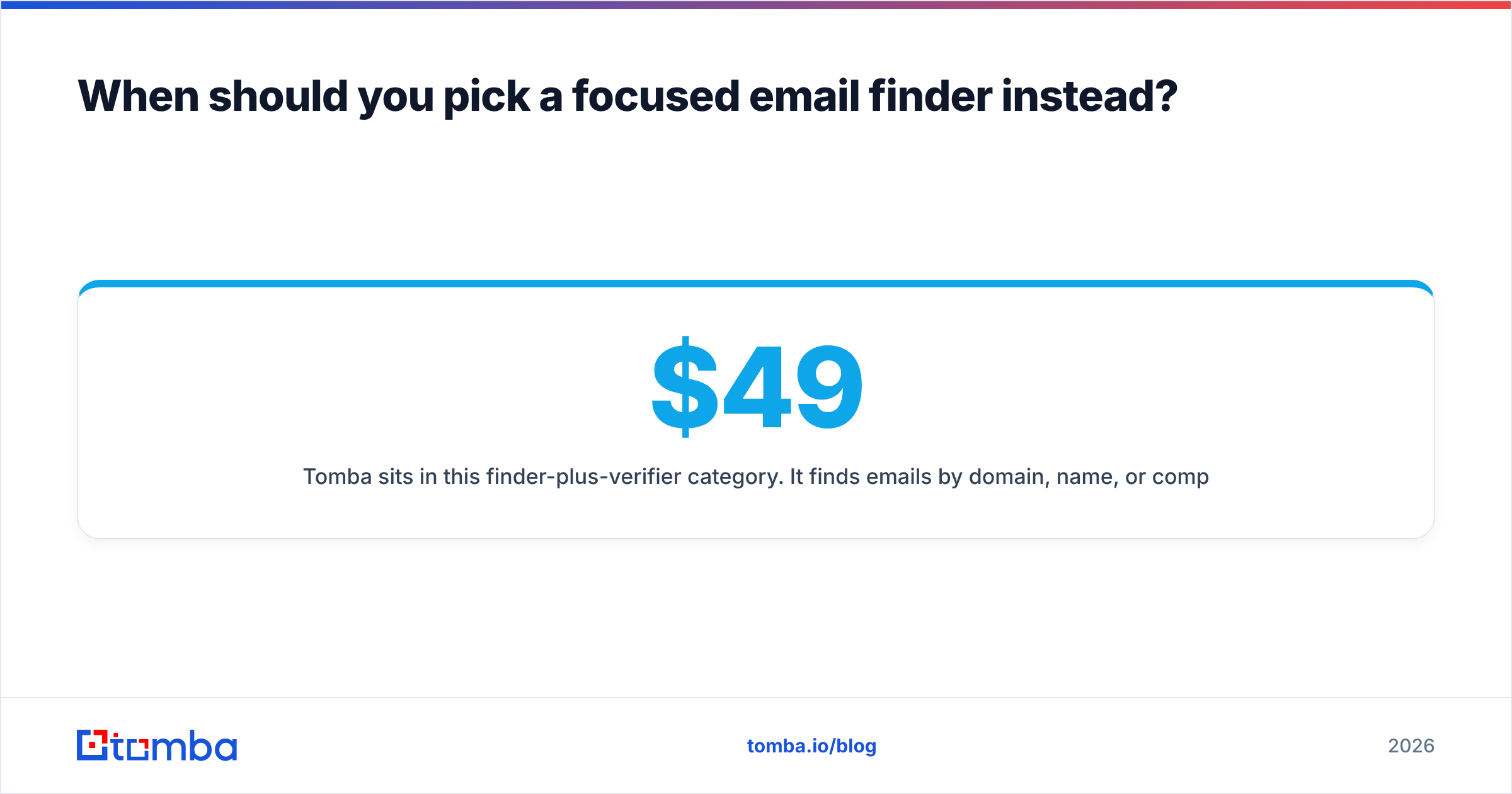
Tomba sits in this finder-plus-verifier category. It finds emails by domain, name, or company, verifies them as it goes, and handles catch-all domains and phone numbers in the same workflow. Pricing is credit-based and transparent: a Free tier with 25 searches per month, Starter at $49/mo, Growth at $99/mo, and Pro at $249/mo, with Enterprise custom. You can see full Tomba pricing without booking a demo — a contrast worth noting against seat-based platforms where the real cost only appears on a sales call.
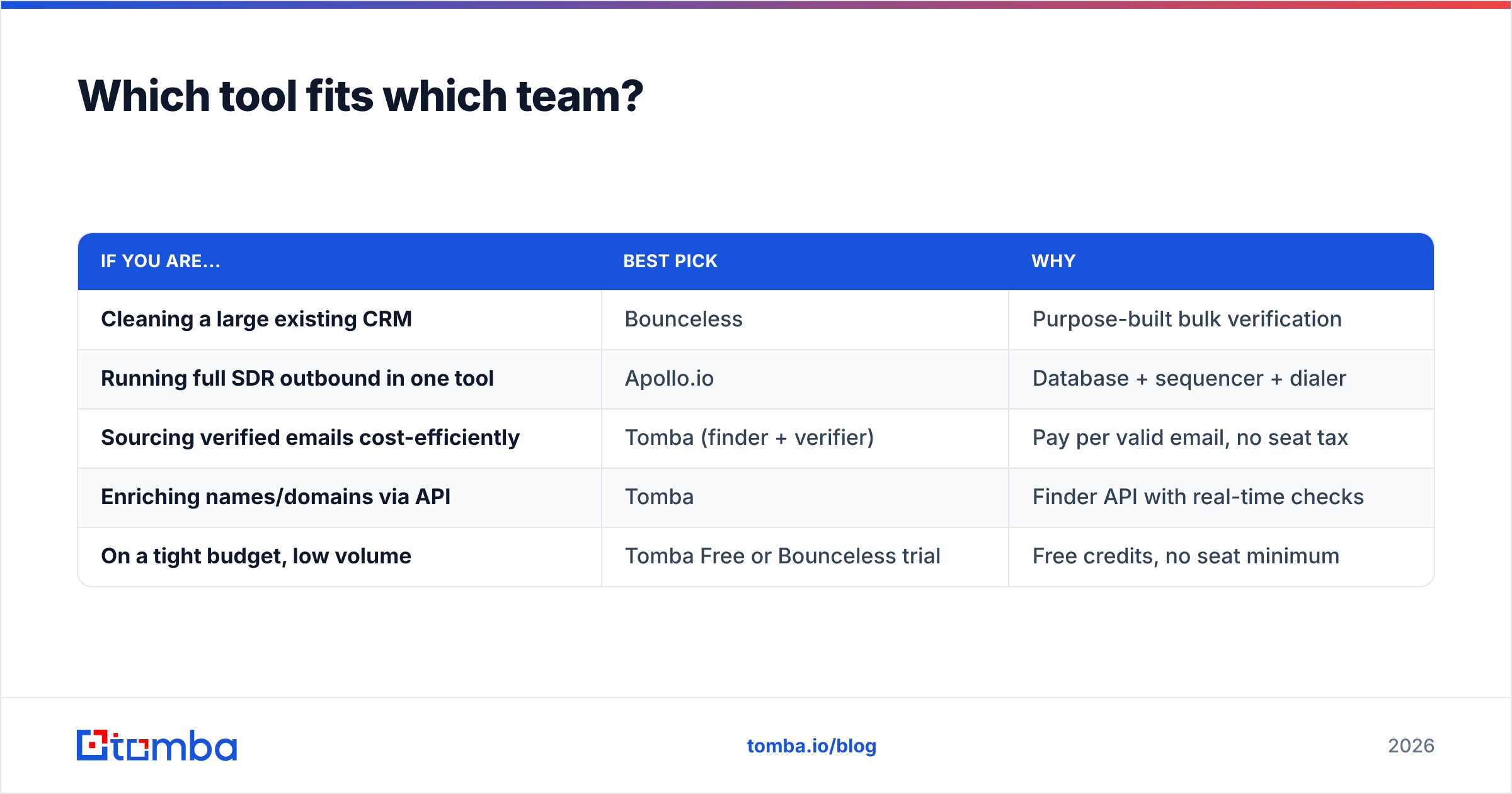
Which tool fits which team?#
| If you are... | Best pick | Why |
|---|---|---|
| Cleaning a large existing CRM | Bounceless | Purpose-built bulk verification |
| Running full SDR outbound in one tool | Apollo.io | Database + sequencer + dialer |
| Sourcing verified emails cost-efficiently | Tomba (finder + verifier) | Pay per valid email, no seat tax |
| Enriching names/domains via API | Tomba | Finder API with real-time checks |
| On a tight budget, low volume | Tomba Free or Bounceless trial | Free credits, no seat minimum |
The pattern is clear. Bounceless wins on hygiene, Apollo wins on breadth, and a focused finder wins on cost-per-valid-email and precision. Many high-performing teams actually run two of these together — for example, a finder to source and verify, plus a sequencer for the send. What they avoid is paying a premium platform price for data they then have to re-clean anyway.
What about deliverability and reputation?#
Whatever you choose, the goal is the same: keep bounce rates low so your domain stays trusted. Mailbox providers treat repeated hard bounces as a signal that you are not maintaining your list, and your email deliverability suffers across every campaign, not just the bad one.
Bounceless protects this directly by scrubbing dead addresses. Apollo protects it indirectly and imperfectly, which is why the verifier layer keeps reappearing in real workflows. A finder with verification baked in protects it from the start — the address is checked before it ever enters your sequencer, so you are not cleaning up after the fact. If deliverability is your top concern, validate at the point of acquisition, not the point of sending.
Final verdict: Bounceless vs Apollo.io#
Choose Bounceless if you already have lists and your single problem is bounce rate. It is a clean, focused verifier and it does that one job well.
Choose Apollo.io if you want an all-in-one cockpit for outbound and you can tolerate — and budget around — variable data accuracy plus seat-based pricing.
But if your actual goal is to put accurate, verified emails into your outreach for the lowest cost per valid contact, neither tool is the obvious winner. A focused finder-plus-verifier closes that gap without the seat tax or the second cleanup pass.
That is where Tomba fits. Start free with 25 searches a month on the Tomba Email Finder, find and verify addresses by domain or name in one step, and only scale up when the valid emails are already proving their worth. It is the simplest way to stop paying for data you have to re-check — and to spend your budget on contacts that actually reply.
// get started
Find, verify and enrich your first contacts today
Start on the free plan with 25 searches a month, then scale when your team is ready.
Free plan · No credit card required · GDPR & CCPA
// about the author