Bounceless vs Brandnav: Which Email Verifier Wins in 2026?
Bounceless vs Brandnav compared head-to-head on accuracy, catch-all handling, pricing, and speed — plus where a finder-plus-verifier stack beats both in 2026.
Choosing between Bounceless and Brandnav comes down to one question: which one keeps your bounce rate under 2% without draining your credits or your patience? Both are email verification tools aimed at marketers and sales teams who need clean lists before they hit send. They overlap heavily, but they price, scale, and handle edge cases differently — and neither one finds the emails for you in the first place.
This breakdown compares them on the things that actually move your deliverability needle, then shows where pairing verification with a proper finder closes the gap both leave open.
TL;DR#
- Bounceless leans toward marketers who want a clean dashboard, bulk list cleaning, and a deliverability score before a campaign. Pricing is pay-as-you-go plus monthly plans.
- Brandnav positions itself as a broader data-and-verification platform, bundling email checks with extra enrichment and lookup features at a competitive per-credit rate.
- Both verify syntax, MX records, SMTP responses, and flag catch-all domains — the headline accuracy claims (~98%) are within a rounding error of each other.
- Neither tool finds emails. If your list is thin, you still need an email finder feeding verified-ready addresses into the pipeline.
- For most teams, the smarter 2026 stack is finder + verifier in one place. That's where Tomba's combined workflow wins on cost-per-valid-contact.
What do Bounceless and Brandnav actually do?#
Both are email verification services. You upload a list (or hit an API), and they tell you which addresses are safe to mail and which will bounce, hurt your sender reputation, or land you in a spam trap.
Think of it like airport security for your contact list. Bad addresses get pulled aside before they ever board the plane (your campaign), so the flight lands cleanly instead of getting diverted to the spam folder.
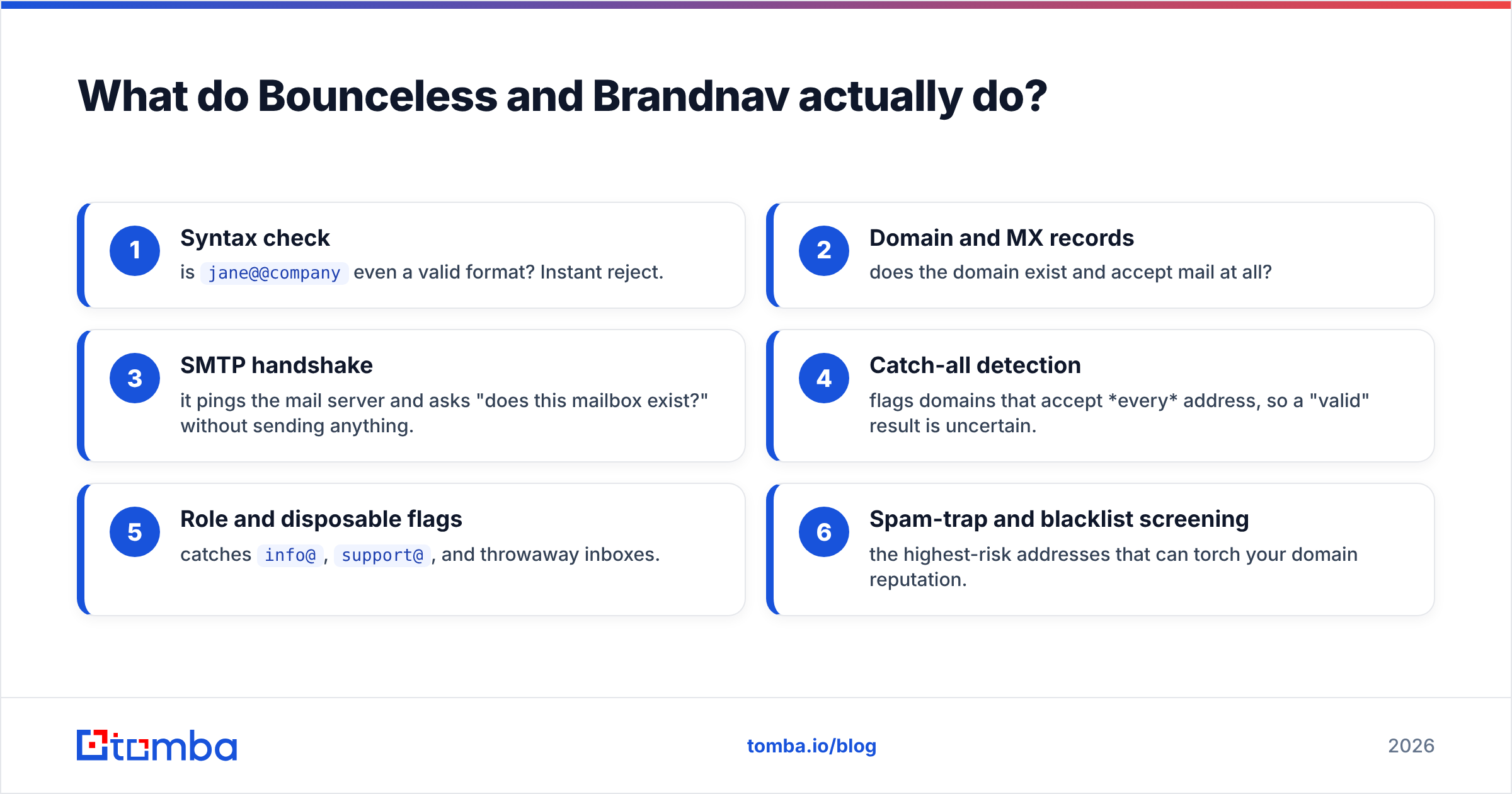
Under the hood, a verifier runs the same core checks:
- Syntax check — is
jane@@companyeven a valid format? Instant reject. - Domain and MX records — does the domain exist and accept mail at all?
- SMTP handshake — it pings the mail server and asks "does this mailbox exist?" without sending anything.
- Catch-all detection — flags domains that accept every address, so a "valid" result is uncertain.
- Role and disposable flags — catches
info@,support@, and throwaway inboxes. - Spam-trap and blacklist screening — the highest-risk addresses that can torch your domain reputation.
Bounceless and Brandnav both cover all six. The difference is in how they price those checks, how fast they chew through large lists, and how confidently they handle the gray zone — catch-all domains, which are the single biggest source of "I verified it and it still bounced" complaints.

How do Bounceless and Brandnav compare head-to-head?#
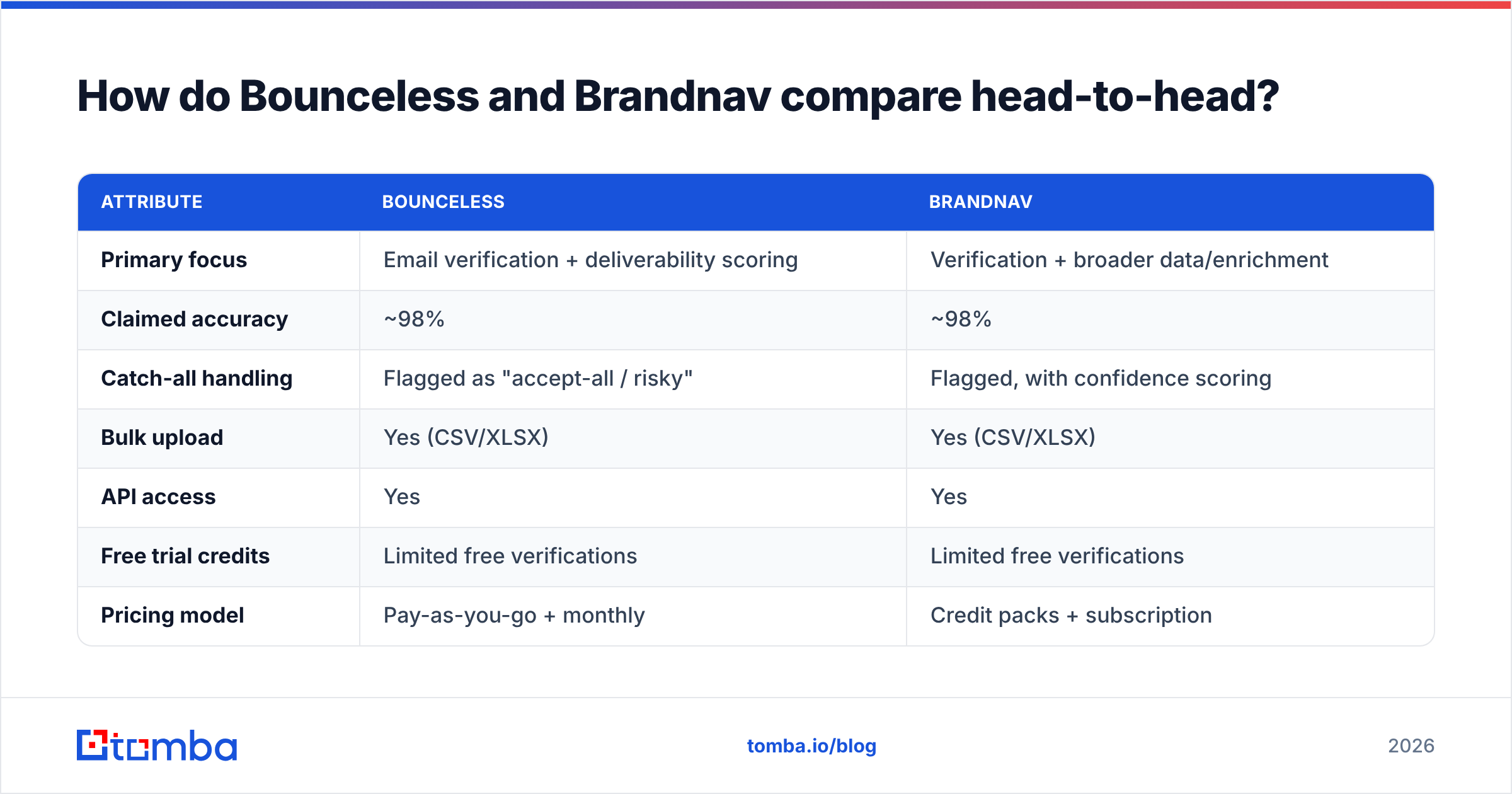
Here's the side-by-side on the attributes that matter when you're cleaning a real list, not reading a feature page.
| Attribute | Bounceless | Brandnav |
|---|---|---|
| Primary focus | Email verification + deliverability scoring | Verification + broader data/enrichment |
| Claimed accuracy | ~98% | ~98% |
| Catch-all handling | Flagged as "accept-all / risky" | Flagged, with confidence scoring |
| Bulk upload | Yes (CSV/XLSX) | Yes (CSV/XLSX) |
| API access | Yes | Yes |
| Free trial credits | Limited free verifications | Limited free verifications |
| Pricing model | Pay-as-you-go + monthly | Credit packs + subscription |
| Spam-trap removal | Yes | Yes |
| Email finding | No | Limited lookup, not a core finder |
| Best for | Marketers cleaning campaign lists | Teams wanting data + verify in one |
The takeaway: on raw verification, these tools are close enough that you should pick on price at your volume and how the catch-all results are presented, not on the marketing accuracy number. A "98% accuracy" claim is nearly meaningless without knowing how the vendor counts catch-all and "unknown" results — vendors that quietly mark every catch-all as "valid" can post a higher number while delivering worse real-world bounce rates.
Which one is more accurate on catch-all domains?#
Catch-all domains are where the two diverge most, and where most verifiers — including these two — hit their ceiling.
A catch-all (or "accept-all") server says yes to every address you test, whether the mailbox exists or not. So an SMTP handshake can't confirm anything. Roughly 15-20% of B2B domains are configured this way, which means a meaningful slice of your list lands in a "we can't be sure" bucket no matter which tool you use.
Bounceless flags these as risky and leaves the decision to you. Brandnav layers a confidence score on top, which helps you triage — but a score is still a probability, not a confirmation.
If catch-all domains make up a big share of your list, neither tool alone is enough. You want a dedicated catch-all verifier that combines SMTP signals with historical data and pattern matching to push more of those "unknown" addresses into a confident verdict. The fewer addresses stuck in limbo, the more of your list you can actually mail.
Rule of thumb: if more than 10% of your verified list comes back "unknown" or "accept-all," your verifier is the bottleneck — not your copy.
How do Bounceless and Brandnav price out?#
Pricing is the most practical reason to pick one over the other, because verification cost scales linearly with list size.
Both use a credit model where one credit equals one verified email. Bounceless offers pay-as-you-go packs alongside monthly subscriptions, which suits teams with spiky, campaign-driven volume. Brandnav bundles verification credits with its wider data toolset, so the per-credit math looks better if you'll actually use the extra lookup features — and worse if you only need clean verification.
A few cost realities to budget for:
- Catch-all and unknown results still cost credits. You pay to learn an address is uncertain.
- Re-verification is on you. Lists decay ~2-3% per month as people change jobs, so a list verified in January is measurably dirty by April.
- Bulk discounts matter more than headline price. At 100K+ verifications, tiered pricing dwarfs the per-credit rate.
Before committing, run the same 1,000-record sample through both free trials and compare not just the valid count but the unknown count. The tool that resolves more addresses confidently is cheaper per usable contact even if its sticker price is higher.
What both tools are missing: finding the emails#
Here's the gap neither Bounceless nor Brandnav fills well: they assume you already have the email addresses.
Verification is the second half of the job. The first half — turning a name, company, or domain into a real, mailable address — is what an email finder does. If your list is short, stale, or you're building outbound from scratch, a verifier just tells you how empty your pipeline is.
This is why the finder-plus-verifier workflow has become the default for serious teams in 2026:
- Find addresses by name, company, or domain search across your target accounts.
- Verify every result before it touches your sequencer.
- Enrich with role, seniority, and company data so segmentation isn't guesswork.
- Re-verify on a schedule to fight list decay.
Tomba runs all four steps in one platform. The email verifier handles syntax, MX, SMTP, and catch-all checks the same way Bounceless and Brandnav do — but it sits right next to the finder, so you're verifying addresses you just sourced instead of importing a list from somewhere else and hoping it's fresh. Transparency on data sources matters here too: knowing where an address came from is half of trusting the verdict.
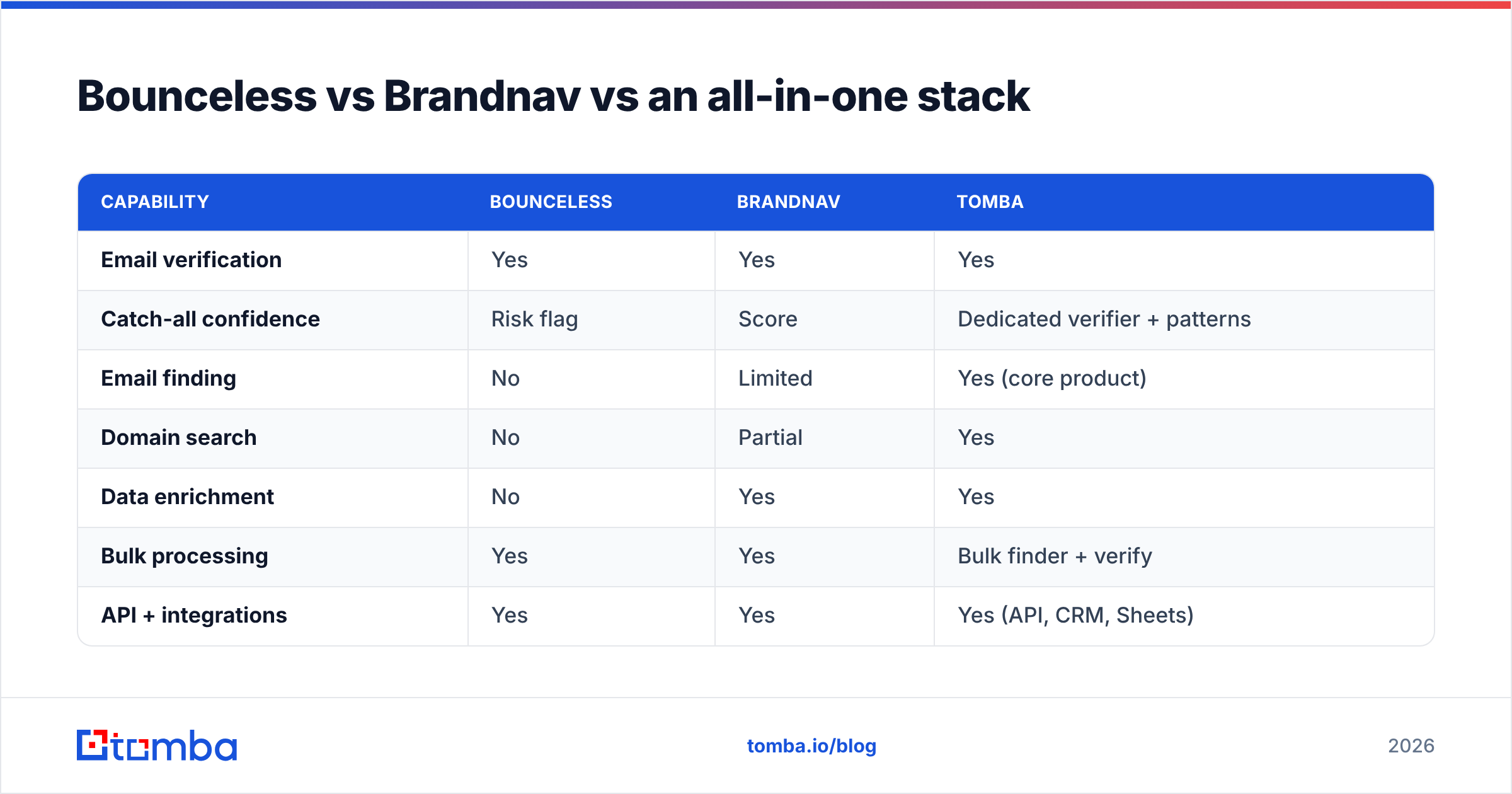
Bounceless vs Brandnav vs an all-in-one stack#
Stepping back, the real choice isn't Bounceless or Brandnav — it's "standalone verifier" vs "find-and-verify platform."
| Capability | Bounceless | Brandnav | Tomba |
|---|---|---|---|
| Email verification | Yes | Yes | Yes |
| Catch-all confidence | Risk flag | Score | Dedicated verifier + patterns |
| Email finding | No | Limited | Yes (core product) |
| Domain search | No | Partial | Yes |
| Data enrichment | No | Yes | Yes |
| Bulk processing | Yes | Yes | Bulk finder + verify |
| API + integrations | Yes | Yes | Yes (API, CRM, Sheets) |
| Free tier | Trial credits | Trial credits | 25 searches/mo |
| Entry paid plan | Monthly/PAYG | Credit packs | $49/mo Starter |
If you only ever clean lists someone else hands you, a standalone verifier like Bounceless or Brandnav is fine — pick whichever prices better at your volume and presents catch-all results in a way your team trusts. You can sanity-check any single address for free with a free email checker before committing to a plan.
But if you're sourcing contacts and keeping them clean, splitting that across two vendors means two bills, two APIs, and a hand-off step where freshness quietly degrades. Consolidating into one find-and-verify workflow is where the cost-per-valid-contact actually drops.
How to choose between them in practice#
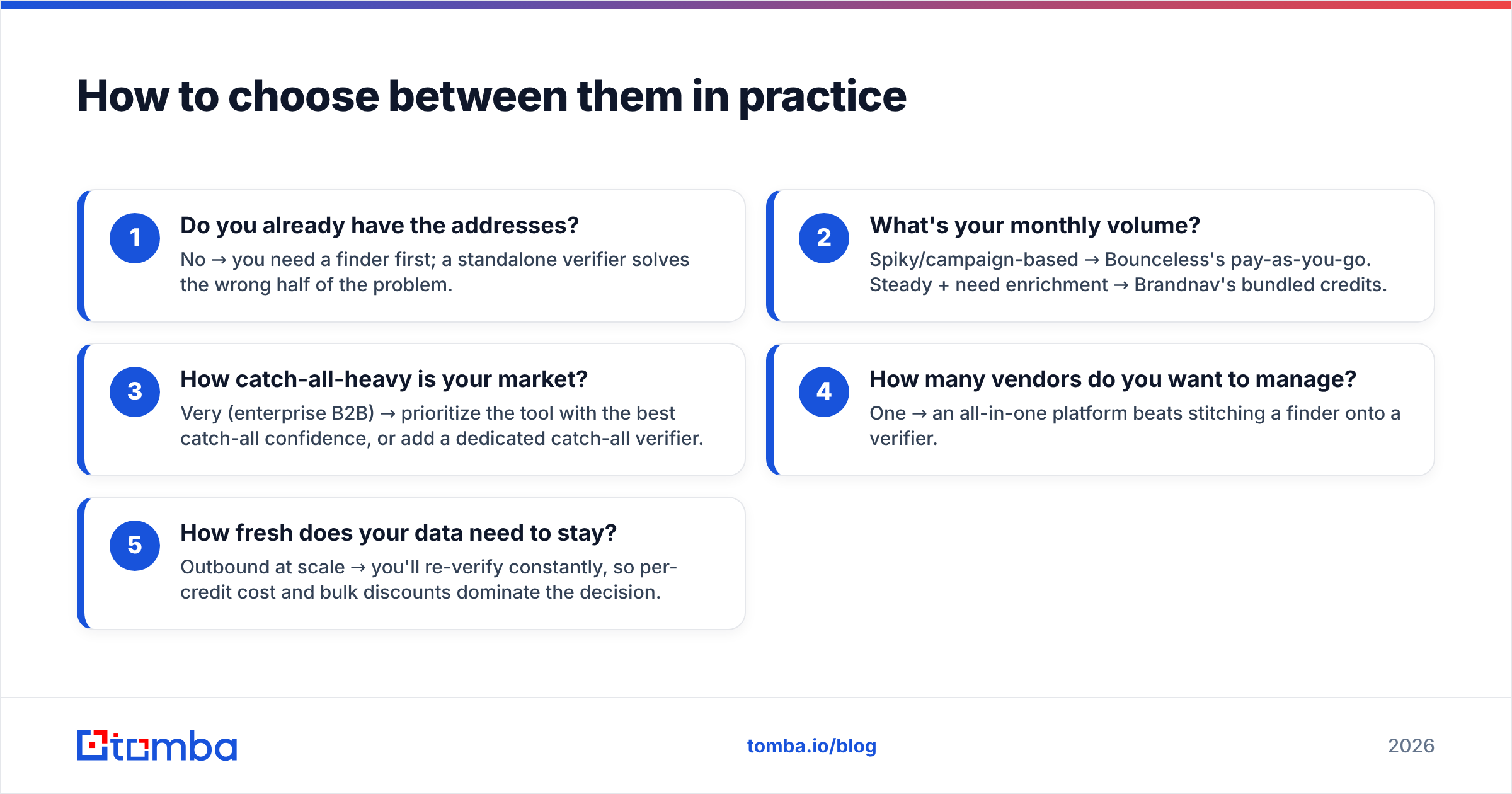
Work through these questions in order:
- Do you already have the addresses? No → you need a finder first; a standalone verifier solves the wrong half of the problem.
- What's your monthly volume? Spiky/campaign-based → Bounceless's pay-as-you-go. Steady + need enrichment → Brandnav's bundled credits.
- How catch-all-heavy is your market? Very (enterprise B2B) → prioritize the tool with the best catch-all confidence, or add a dedicated catch-all verifier.
- How many vendors do you want to manage? One → an all-in-one platform beats stitching a finder onto a verifier.
- How fresh does your data need to stay? Outbound at scale → you'll re-verify constantly, so per-credit cost and bulk discounts dominate the decision.
Don't over-index on the 98% accuracy line on either homepage. Validate with your own sample list, compare the unknown buckets, and check pricing at your real volume. You can read the full Tomba pricing breakdown to benchmark what an integrated finder-plus-verifier costs against running two standalone tools — the math usually favors consolidation once you factor in sourcing.
For an outside read on how users rate each tool's reliability and support, G2 carries verified reviews for the major email verification platforms, which is worth a scan before you commit budget.
The bottom line#
Bounceless and Brandnav are both competent email verifiers that will get your bounce rate down if you feed them a list. Bounceless edges ahead for marketers who want simple campaign-time list cleaning; Brandnav appeals to teams that want verification bundled with extra data. On core accuracy, it's a coin flip — decide on price at your volume and how each handles catch-all domains.
The bigger insight is that verification is only half the workflow. If you're building and maintaining outbound, the find-and-verify gap is what costs you deals — empty pipelines and stale lists don't get fixed by a cleaner verifier.
Start by sourcing accurate, ready-to-verify addresses with the Tomba Email Finder, then verify them in the same platform before they ever reach your sequencer. One workflow, one bill, and a lower cost per valid contact than running Bounceless or Brandnav on the side. Spin up the free tier — 25 searches a month — and clean your first list end to end before you pay for anything.
// get started
Find, verify and enrich your first contacts today
Start on the free plan with 25 searches a month, then scale when your team is ready.
Free plan · No credit card required · GDPR & CCPA
// about the author