Bounceless vs Kaspr 2026: Verification vs LinkedIn Data
Bounceless verifies email lists; Kaspr pulls phones and emails from LinkedIn. Here's which one fits your pipeline in 2026 — and where a single platform beats both.
Bounceless vs Kaspr: Which One Belongs in Your 2026 Stack?
If you put Bounceless and Kaspr in the same sentence, you're already a little confused — and that's not your fault. They get lumped together in "best lead tools" listicles, but they solve opposite ends of the same workflow. One cleans the list you already have. The other builds the list in the first place.
This breakdown sorts out what each tool actually does, what it costs in 2026, where the accuracy holds up, and when you'd be better off skipping both for a platform that finds and verifies in one pass.
TL;DR#
- Bounceless is an email verification tool. It scrubs existing lists for invalid, risky, and catch-all addresses to protect your sender reputation. It does not find new contacts.
- Kaspr is a LinkedIn prospecting tool. It pulls phone numbers and emails from LinkedIn profiles via a Chrome extension. It does not deeply verify the emails it returns.
- They are complements, not competitors. Using only Kaspr means sending to unverified data; using only Bounceless means you still need a source for contacts.
- Pricing differs in shape: Bounceless sells verification credits; Kaspr sells monthly phone/email credits tied to LinkedIn workflows.
- A combined platform like Tomba covers finding, verifying, and enriching in one tool — usually for less than running both subscriptions.
What is Bounceless?#
Bounceless is a bulk email verification service. You upload a list — exports from your CRM, a scraped spreadsheet, a newsletter dump — and it tells you which addresses are safe to mail.
Its core checks are the standard verification stack: syntax validation, MX record lookup, SMTP handshake, role-account detection (info@, sales@), disposable-domain flagging, and catch-all identification. The output is a categorized list: deliverable, undeliverable, risky, unknown. The goal is simple — keep your bounce rate low so mailbox providers keep trusting your domain.
What Bounceless does not do is generate contacts. If your spreadsheet is empty, Bounceless has nothing to work with. It's a filter, not a faucet.

Use Bounceless when you have volume but questionable quality: an old list, a purchased database, or scraped data you don't trust. Protecting sender reputation is its whole job, and it's reasonable at it.
What is Kaspr?#
Kaspr (kaspr.io) is a contact-data tool built around LinkedIn. You install its Chrome extension, open a prospect's profile, and Kaspr reveals their phone number and email address. It's especially known for European mobile-phone coverage, which makes it popular with SDRs who cold-call.
Kaspr also supports list building from LinkedIn Sales Navigator searches, basic enrichment, and workflow features like sequences and CRM sync on higher tiers. The pitch is speed: see a profile, grab the contact, push it to your pipeline.
The catch is verification depth. Kaspr surfaces data from aggregated sources, but it isn't a dedicated email verification engine. The emails it returns can still bounce, and many teams run Kaspr exports through a separate verifier before sending — which is exactly the gap that creates the "Bounceless and Kaspr" stack instead of "Bounceless vs Kaspr."
Bounceless vs Kaspr: How do they actually compare?#
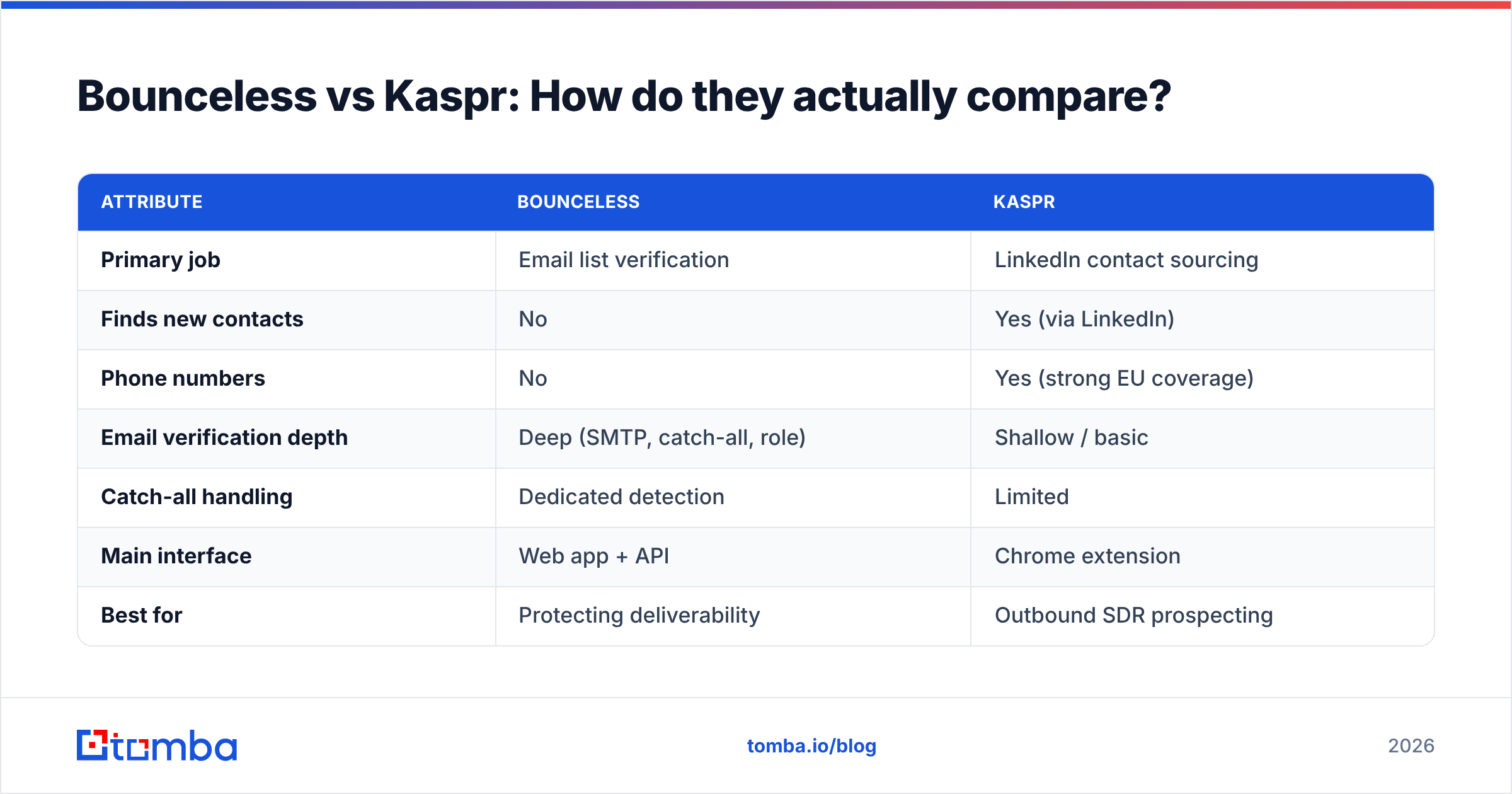
Here's the honest side-by-side. Notice that most rows are "one does it, the other doesn't" — that's the real story.
| Attribute | Bounceless | Kaspr |
|---|---|---|
| Primary job | Email list verification | LinkedIn contact sourcing |
| Finds new contacts | No | Yes (via LinkedIn) |
| Phone numbers | No | Yes (strong EU coverage) |
| Email verification depth | Deep (SMTP, catch-all, role) | Shallow / basic |
| Catch-all handling | Dedicated detection | Limited |
| Main interface | Web app + API | Chrome extension |
| Best for | Protecting deliverability | Outbound SDR prospecting |
| Pricing model | Verification credits | Monthly phone/email credits |
| Standalone use | Needs a data source | Needs a verifier |
The takeaway: if you only buy one, you've solved half the problem. Kaspr alone ships unverified emails into your sequencer. Bounceless alone leaves you with a clean tool and no list to clean.
Is Kaspr better than Bounceless?#
Wrong question — they're not interchangeable. The right question is which gap is bigger for you right now.
- If your pain is empty pipeline: you need contacts, so Kaspr (or any finder) beats Bounceless. A verifier can't create leads.
- If your pain is bouncing campaigns: you need to clean what you have, so Bounceless beats Kaspr. Kaspr won't meaningfully lower your bounce rate.
- If your pain is both — and for most outbound teams it is — you'll end up paying for two tools that each do one job, plus the manual work of moving data between them.
That third scenario is where the "vs" framing falls apart, and where a unified platform starts to look obviously cheaper.
How much do Bounceless and Kaspr cost in 2026?#
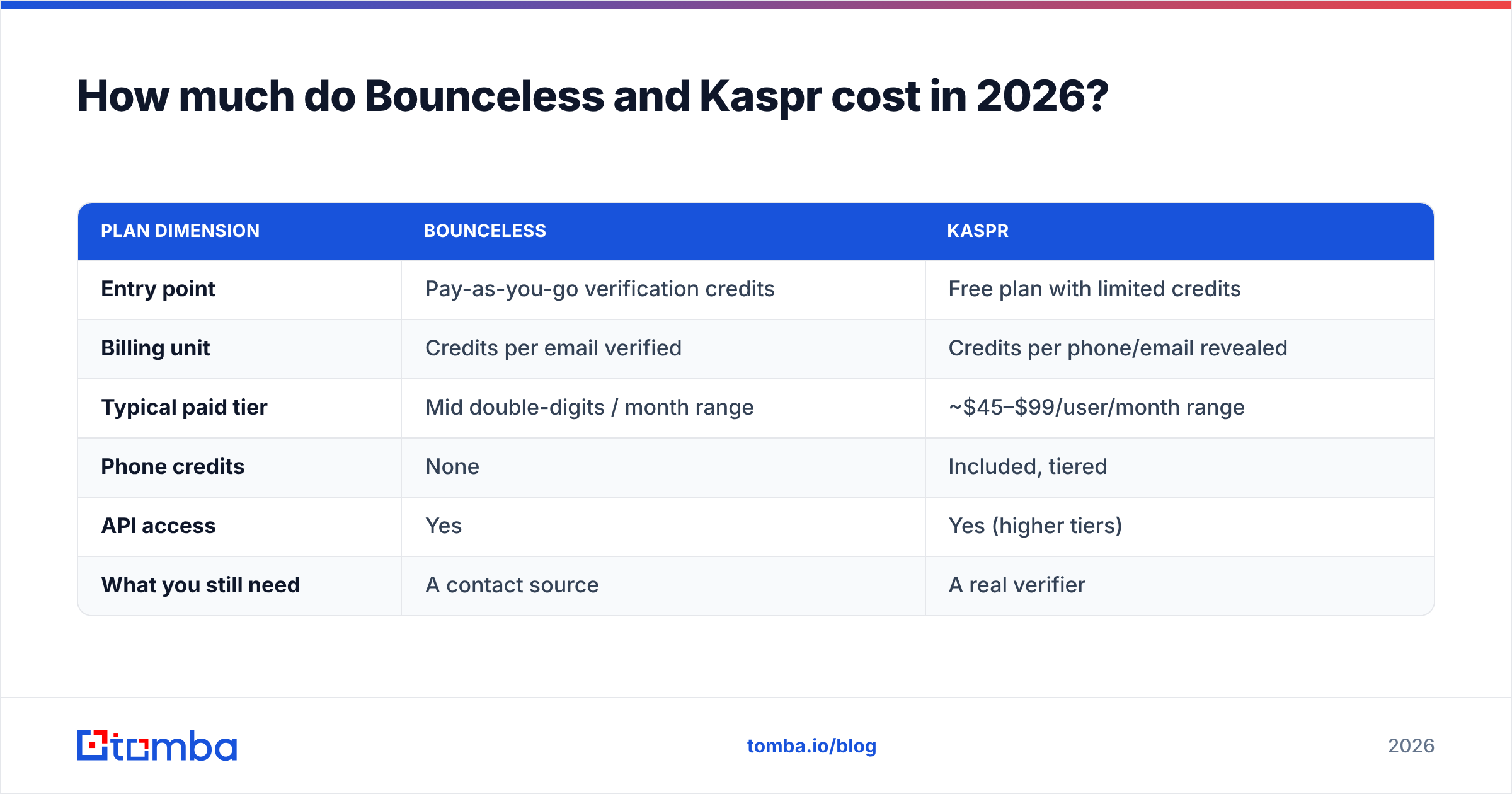
Both use credit-based pricing, but the credits mean different things — a Kaspr credit reveals a contact, a Bounceless credit verifies one address. That makes direct dollar comparison tricky, so compare on job done, not credit count.
| Plan dimension | Bounceless | Kaspr |
|---|---|---|
| Entry point | Pay-as-you-go verification credits | Free plan with limited credits |
| Billing unit | Credits per email verified | Credits per phone/email revealed |
| Typical paid tier | Mid double-digits / month range | ~$45–$99/user/month range |
| Phone credits | None | Included, tiered |
| API access | Yes | Yes (higher tiers) |
| What you still need | A contact source | A real verifier |
Pricing on both tools shifts, so confirm current numbers on their sites before you buy. The structural point holds regardless of the exact figures: two specialized subscriptions cost more than one platform that does both, and they add a data-handoff tax — exports, re-imports, dedupe — that never shows up on the invoice but shows up in your week.
Where does Tomba fit in the Bounceless vs Kaspr debate?#
Tomba collapses the two jobs into one workflow: it finds professional emails and verifies them in the same step, then enriches the record. Instead of sourcing in Kaspr, exporting, re-uploading to Bounceless, and stitching results back together, you get a deliverable contact out of one tool.
Concretely, where Bounceless and Kaspr each cover one lane, Tomba covers the lane and the bridge:
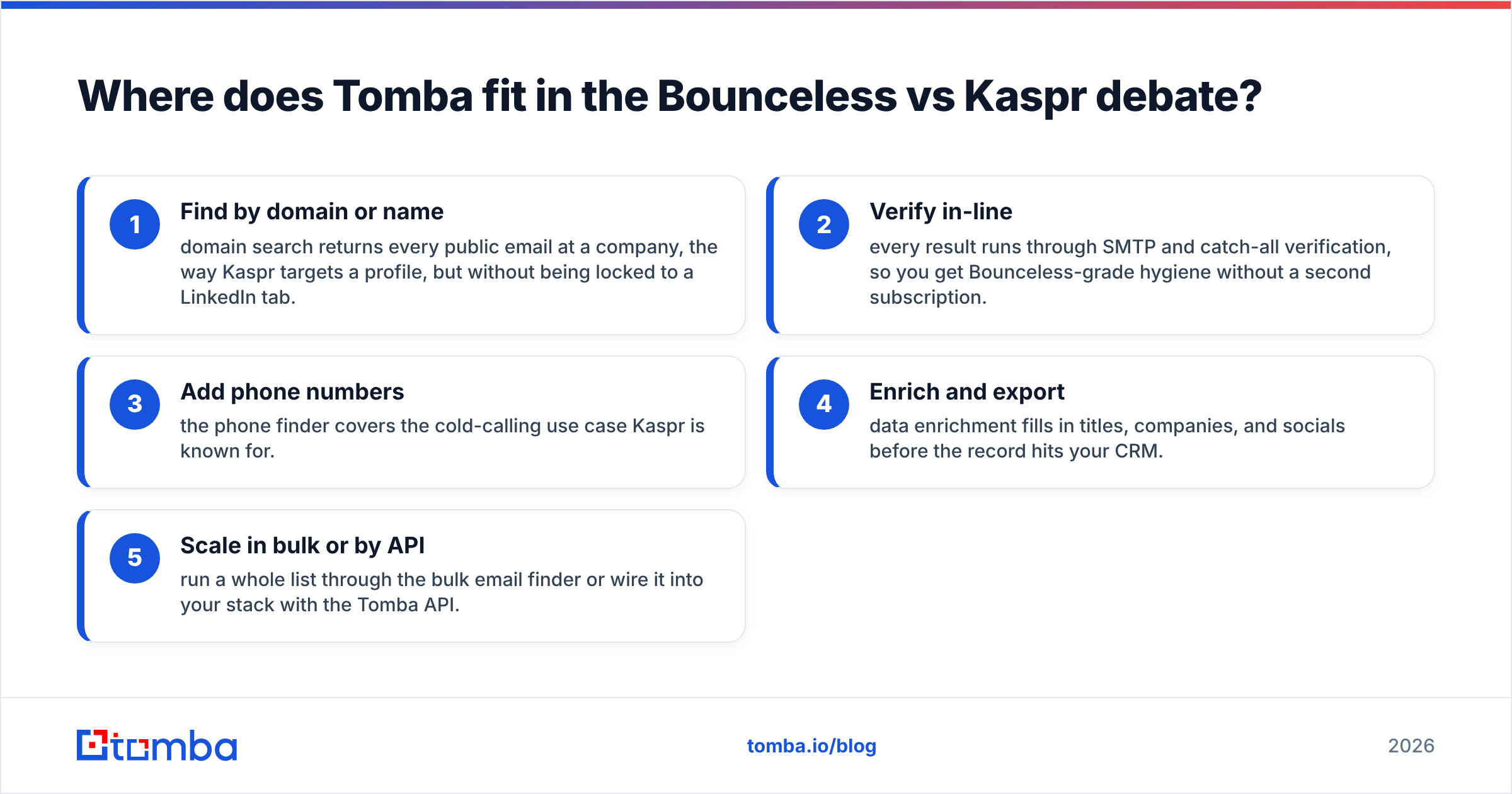
- Find by domain or name — domain search returns every public email at a company, the way Kaspr targets a profile, but without being locked to a LinkedIn tab.
- Verify in-line — every result runs through SMTP and catch-all verification, so you get Bounceless-grade hygiene without a second subscription.
- Add phone numbers — the phone finder covers the cold-calling use case Kaspr is known for.
- Enrich and export — data enrichment fills in titles, companies, and socials before the record hits your CRM.
- Scale in bulk or by API — run a whole list through the bulk email finder or wire it into your stack with the Tomba API.
The result isn't "a cheaper Kaspr" or "a cheaper Bounceless." It's one fewer integration to maintain and one fewer place for data to rot between exports.
Which tool should you choose?#
Match the tool to the job you're actually missing.
| Your situation | Best pick |
|---|---|
| Clean a large existing list, nothing else | Bounceless |
| Pull EU mobile numbers off LinkedIn all day | Kaspr |
| Find verified B2B emails at scale | Tomba |
| Find + verify + call from one tool | Tomba |
| Replace a two-tool stack to cut cost | Tomba |
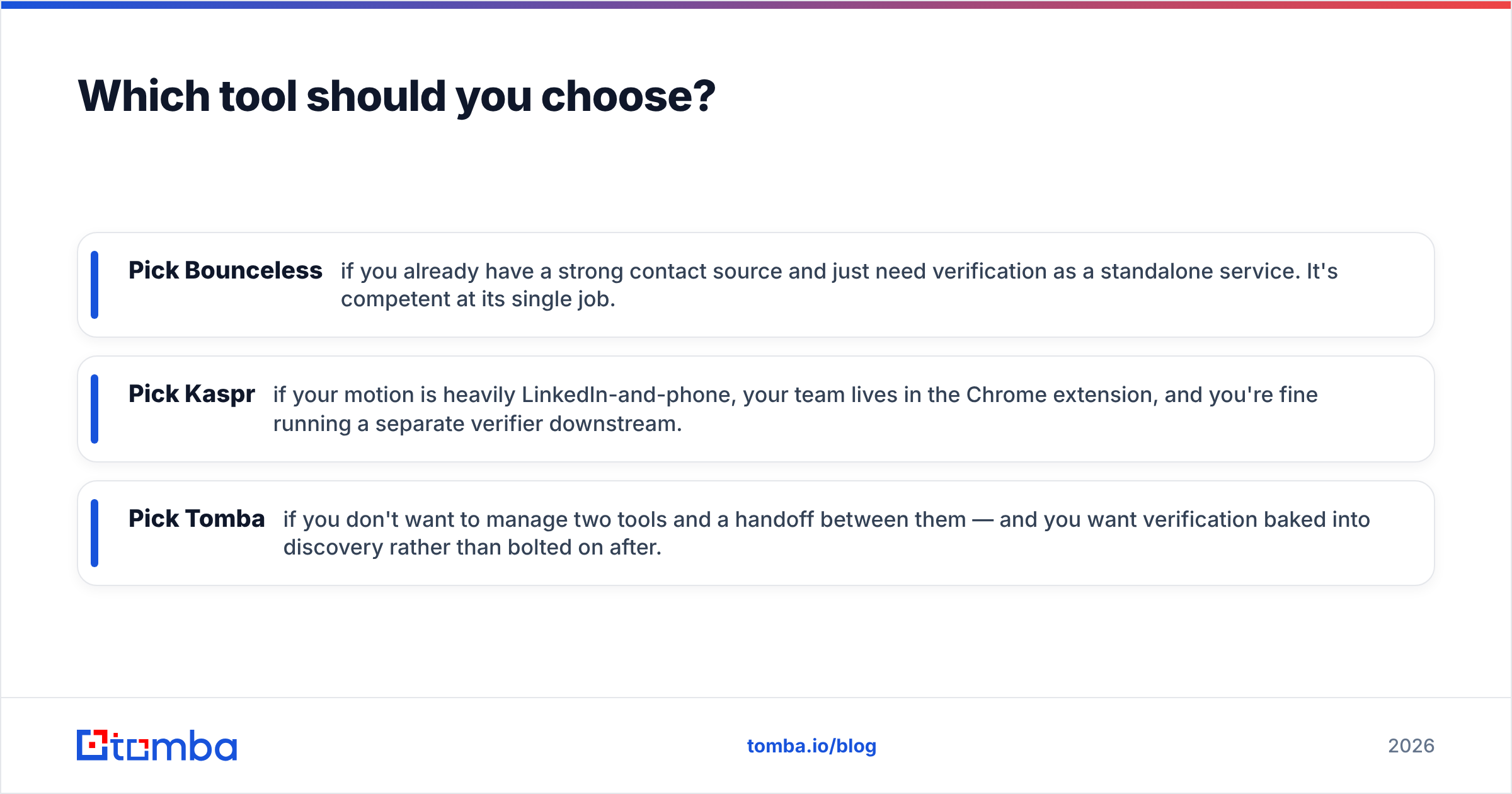
- Pick Bounceless if you already have a strong contact source and just need verification as a standalone service. It's competent at its single job.
- Pick Kaspr if your motion is heavily LinkedIn-and-phone, your team lives in the Chrome extension, and you're fine running a separate verifier downstream.
- Pick Tomba if you don't want to manage two tools and a handoff between them — and you want verification baked into discovery rather than bolted on after.
Before committing to any of them, read independent reviews on G2 and check verification claims against bounceless.io and kaspr.io directly. Tool capabilities change quarter to quarter; trust the current docs over any listicle.
Frequently asked questions#
Is Bounceless a competitor to Kaspr? Not really. Bounceless verifies emails; Kaspr finds contacts on LinkedIn. They're more often used together than chosen against each other — which is the strongest argument for a single platform that does both.
Does Kaspr verify its emails? Kaspr does basic checks, but it isn't a dedicated verification engine like Bounceless. Many teams still run Kaspr exports through a verifier before launching a campaign.
Can one tool replace both? Yes. A platform that finds and verifies in the same step — like Tomba — covers Kaspr's sourcing job and Bounceless's hygiene job without the export-import shuffle.
What about pricing? Bounceless bills verification credits; Kaspr bills phone/email reveal credits. Running both means two subscriptions. Compare that combined cost against a single platform's pricing before deciding.
The bottom line#
Bounceless vs Kaspr isn't a fair fight because they're not fighting — one fills your list, the other cleans it, and a real outbound motion needs both. If you're happy maintaining two tools and the bridge between them, buy the specialist for each lane. If you'd rather find a verified, callable contact in a single pass, that's the case for consolidating.
Start with the Tomba Email Finder: find professional emails by domain, name, or company, get them verified inline, and add phone numbers and enrichment without a second login. One tool, one workflow, one bill — and a list that's clean before it ever reaches your sequencer.
// get started
Find, verify and enrich your first contacts today
Start on the free plan with 25 searches a month, then scale when your team is ready.
Free plan · No credit card required · GDPR & CCPA
// about the author