Bounceless vs Limeleads 2026: Verifier vs Lead Database
Bounceless verifies emails; Limeleads builds B2B lists. We compare pricing, accuracy, and data depth so you pick the right tool — or skip both for one stack.
You typed "Bounceless vs Limeleads" into a search bar because you want clean, deliverable B2B contacts. Here is the catch most comparison posts bury: these two tools do not actually do the same job. One cleans lists you already have. The other sells you lists you do not have yet. Pick the wrong one and you either pay to verify data you never collected, or you collect data you never verify.
This guide breaks down what each tool is, where it wins, what it costs in 2026, and how to decide — without the vendor spin.
TL;DR — Bounceless vs Limeleads at a glance#
- Bounceless is an email verification and list-cleaning service. You bring emails; it tells you which ones bounce.
- Limeleads is a B2B lead database. You search by industry, title, and location; it hands you company contacts to export.
- They solve different halves of the same workflow — sourcing versus hygiene — so "which is better" depends on which gap you have.
- Pricing models differ: Bounceless sells verification credits; Limeleads sells lead-export credits. Neither bundles both well.
- If you want sourcing and verification in one place, a combined platform like Tomba usually beats running two single-purpose tools.
What is Bounceless?#
Bounceless is an email verification platform. Its core promise is simple: upload a list of email addresses, and it flags the ones that will bounce, the spam traps, the role accounts (info@, sales@), and the risky catch-all domains. You download a cleaned list and send with confidence.
Think of it like a metal detector at airport security. It does not give you passengers — it just decides who is safe to let through. Bounceless runs SMTP checks, syntax validation, MX record lookups, and disposable-domain detection. It offers a bulk uploader and a real-time API so you can verify addresses at the point of signup.
What Bounceless does not do well is generate new contacts. It is a hygiene layer, not a prospecting engine. If your list is empty, Bounceless has nothing to clean.

What is Limeleads?#
Limeleads is a B2B lead-generation database. You filter by industry, company size, job title, location, and revenue, then export the matching contacts — names, company emails, phone numbers, and firmographics — to CSV or your CRM.
If Bounceless is the metal detector, Limeleads is the directory of passengers in the first place. It is built for sales reps and marketers who need to fill a pipeline, not clean one. Limeleads markets itself on verified-at-export data and a credit system where you only spend credits on leads you actually download.
The weakness is the mirror image of Bounceless: Limeleads gives you contacts, but its built-in verification is shallow. Database emails decay roughly 22–30% per year as people change jobs, so a "verified" list from any provider still needs a fresh check before you send at volume.

How do Bounceless and Limeleads compare on features?#
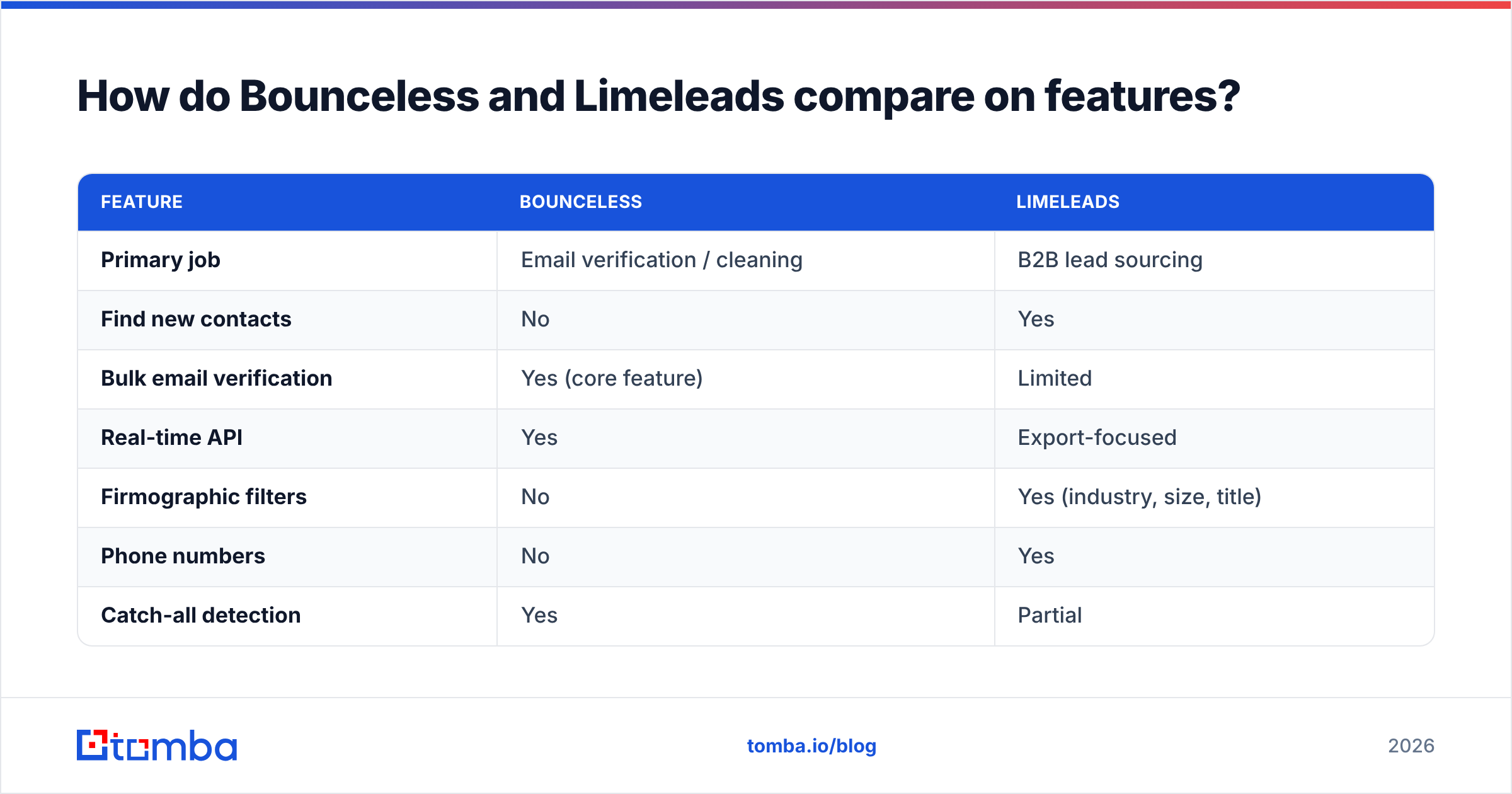
Here is the honest side-by-side. The point is not that one tool loses — it is that they barely overlap.
| Feature | Bounceless | Limeleads |
|---|---|---|
| Primary job | Email verification / cleaning | B2B lead sourcing |
| Find new contacts | No | Yes |
| Bulk email verification | Yes (core feature) | Limited |
| Real-time API | Yes | Export-focused |
| Firmographic filters | No | Yes (industry, size, title) |
| Phone numbers | No | Yes |
| Catch-all detection | Yes | Partial |
| CRM export | Via file | Native CSV / CRM |
| Best for | Cleaning existing lists | Building new lists |
The takeaway: if you already have a list, Bounceless is the relevant tool. If you have an empty CRM, Limeleads is. Asking which is "better" is like asking whether a sink or a faucet is better — you need both to wash your hands.
Which one should you choose for cold outreach?#
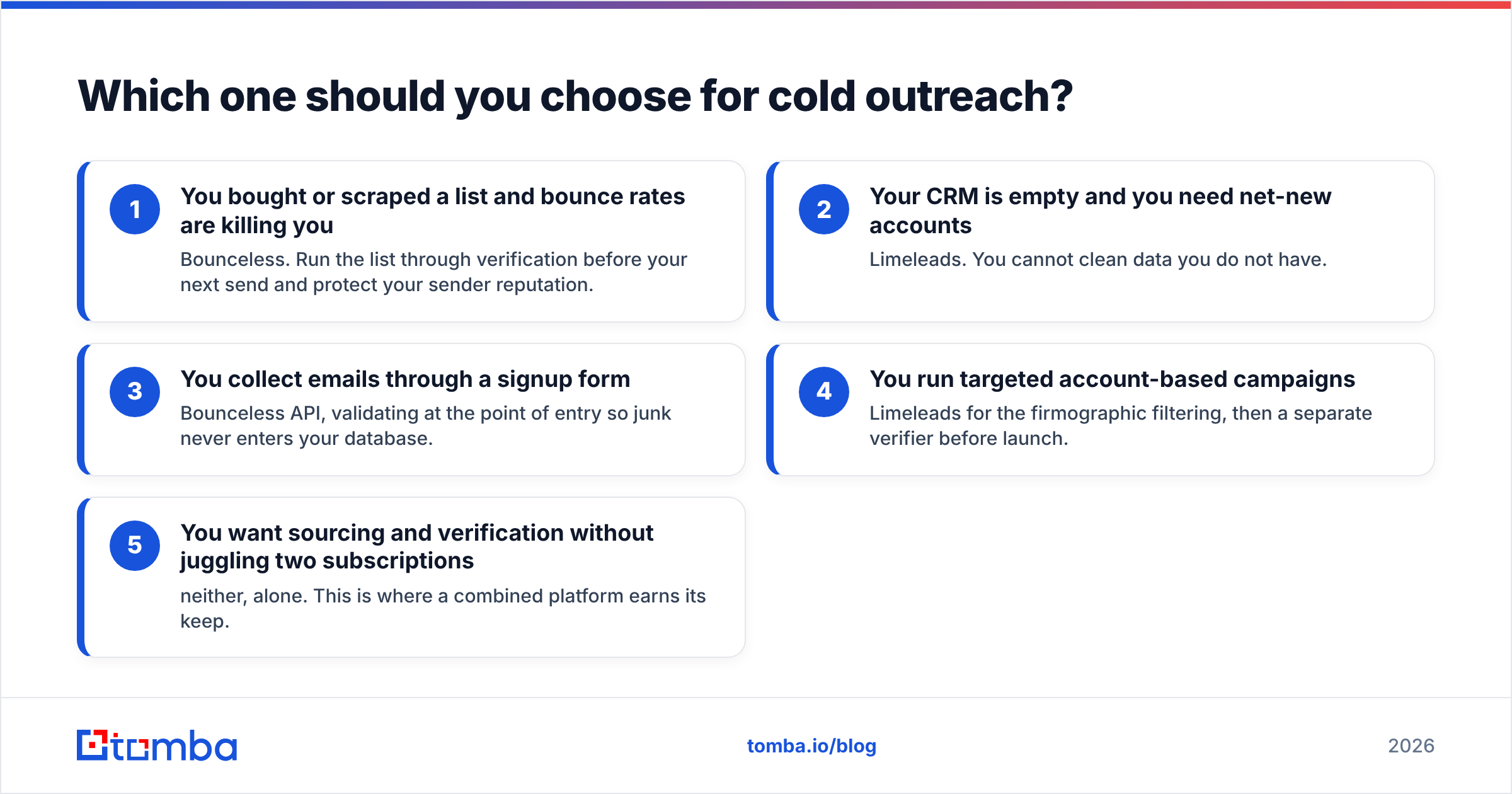
Choose based on the gap you actually have, not on which brand ranks higher. Here is the decision in five concrete scenarios:
- You bought or scraped a list and bounce rates are killing you — Bounceless. Run the list through verification before your next send and protect your sender reputation.
- Your CRM is empty and you need net-new accounts — Limeleads. You cannot clean data you do not have.
- You collect emails through a signup form — Bounceless API, validating at the point of entry so junk never enters your database.
- You run targeted account-based campaigns — Limeleads for the firmographic filtering, then a separate verifier before launch.
- You want sourcing and verification without juggling two subscriptions — neither, alone. This is where a combined platform earns its keep.
That last scenario is the one most teams actually live in, and it is the reason the "Bounceless vs Limeleads" framing is a little misleading. You usually need the job of both.

How much do Bounceless and Limeleads cost in 2026?#
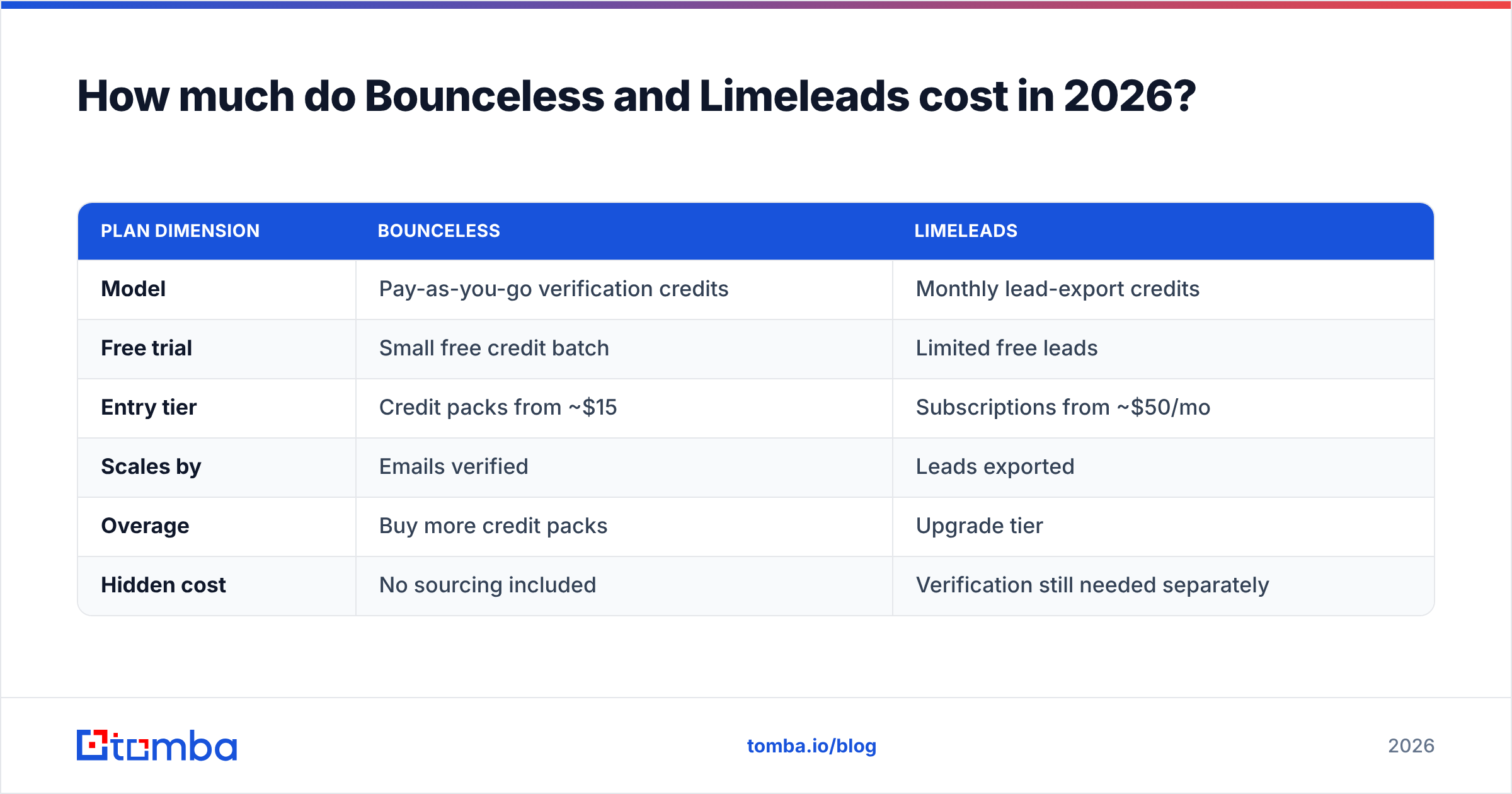
Pricing is where the two diverge most, because you are buying different units. Bounceless sells verification credits (one credit ≈ one email checked). Limeleads sells lead-export credits (one credit ≈ one contact revealed). Always confirm current numbers on each vendor's own pricing page, but the structure looks like this:
| Plan dimension | Bounceless | Limeleads |
|---|---|---|
| Model | Pay-as-you-go verification credits | Monthly lead-export credits |
| Free trial | Small free credit batch | Limited free leads |
| Entry tier | Credit packs from ~$15 | Subscriptions from ~$50/mo |
| Scales by | Emails verified | Leads exported |
| Overage | Buy more credit packs | Upgrade tier |
| Hidden cost | No sourcing included | Verification still needed separately |
Add the two together and the "real" cost of the Bounceless-plus-Limeleads stack is two subscriptions, two logins, and two billing cycles to reconcile. For many teams that is more than a single combined tool. For context, Tomba pricing starts at a Free tier with 25 searches per month, then Starter at $49/mo and Growth at $99/mo — covering finding and verifying in one bill.
Is there a tool that does both sourcing and verification?#
Yes — and this is the practical resolution to the whole comparison. Instead of pairing a verifier with a separate database, an all-in-one prospecting platform handles the full chain: find the contact, confirm the address, enrich the record, export to your CRM.
Tomba is built around this exact workflow. Its email finder sources professional addresses by name, company, or domain — that covers the Limeleads job. Its email verifier runs SMTP, syntax, and catch-all checks — that covers the Bounceless job. A catch-all verifier handles the risky domains that trip up single-purpose cleaners, and bulk processing lets you do thousands at once.
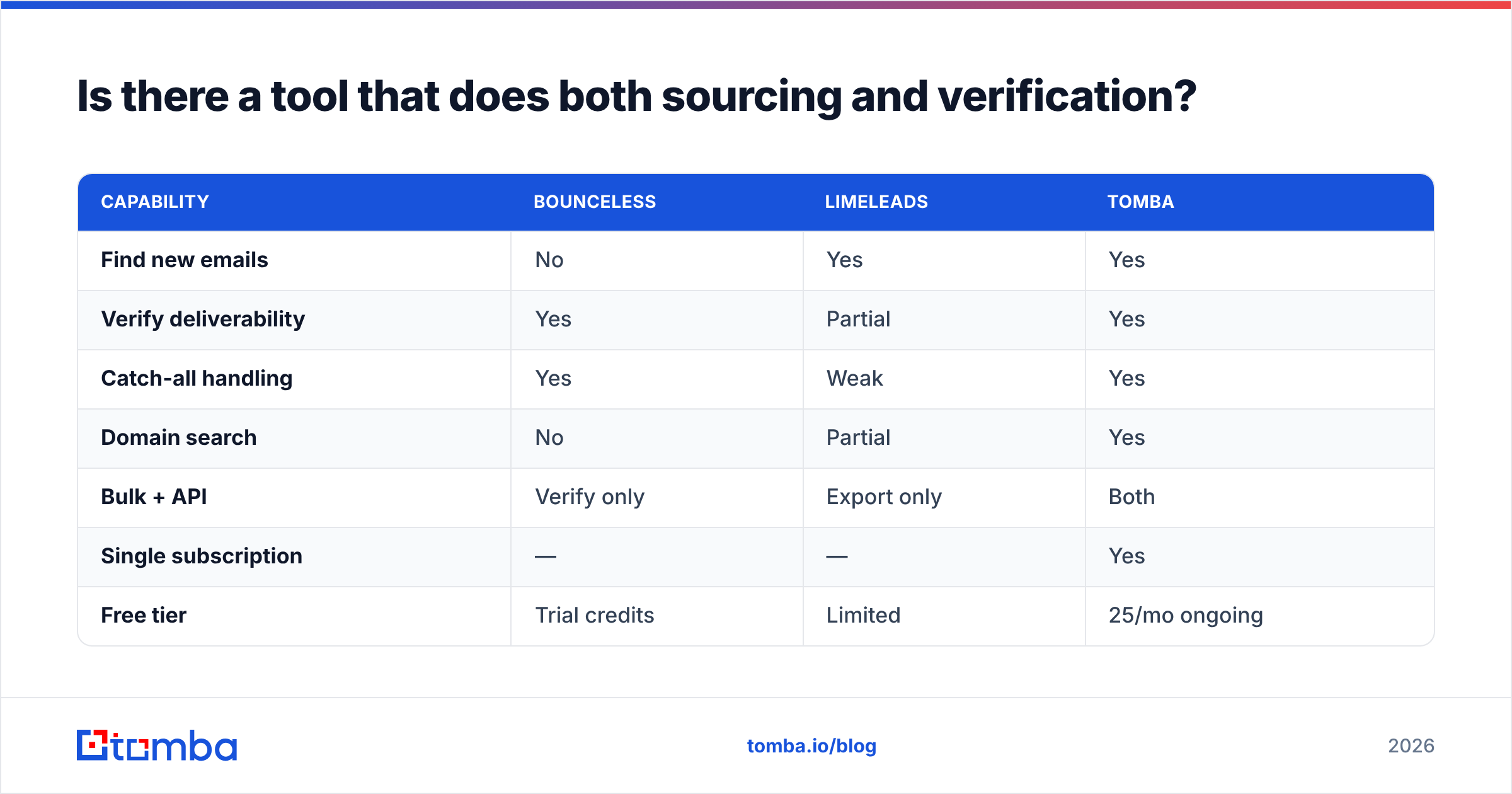
Here is how the three approaches stack up:
| Capability | Bounceless | Limeleads | Tomba |
|---|---|---|---|
| Find new emails | No | Yes | Yes |
| Verify deliverability | Yes | Partial | Yes |
| Catch-all handling | Yes | Weak | Yes |
| Domain search | No | Partial | Yes |
| Bulk + API | Verify only | Export only | Both |
| Single subscription | — | — | Yes |
| Free tier | Trial credits | Limited | 25/mo ongoing |
This is not to say Bounceless or Limeleads are bad at their jobs. Bounceless is a competent verifier; Limeleads is a usable database. The argument is narrower: if your real need is the whole pipeline, two narrow tools cost more and add friction versus one that spans both.
What about data accuracy and deliverability?#
Accuracy is the metric that actually decides whether outreach lands. Three things matter, and they apply no matter which tool you choose:
- Freshness. A B2B email is only as good as its last verification. Even a database that promises "verified" leads decays month over month. Re-verify before any campaign over a few hundred sends.
- Catch-all domains. Many corporate domains accept every address at the SMTP layer, so a naive verifier marks them "valid" when they are actually unknown. A real catch-all finder flags these instead of giving false confidence.
- Source transparency. Know where your data comes from. Tomba documents its data sources publicly, which matters for compliance and for trusting the result.
Whatever you pick, the deliverability rule is the same: verify close to send time, throttle new domains, and watch your bounce rate like a hawk. A clean list with a 2% bounce rate beats a giant list at 12% every time — high bounces wreck email deliverability and can land your domain on a blacklist.
For independent reviews of all three tools, cross-check user ratings on G2 and Capterra before committing, and read each vendor's own claims at bounceless.io and limeleads.com so you are comparing current features, not last year's.
Bounceless vs Limeleads: the verdict#
There is no single winner because they are not really competitors — they are two stages of one process.
- Pick Bounceless if your only problem is dirty lists and high bounce rates. It is a focused, reliable verifier.
- Pick Limeleads if your only problem is an empty pipeline and you need a B2B database to source from.
- Pick neither alone if — like most teams — you need both sourcing and verification, because running two subscriptions costs more money, more time, and more context-switching than a combined platform.
The "vs" in "Bounceless vs Limeleads" assumes you must choose one side. In practice the smarter move is to recognize you need the job of both, then decide whether two specialized tools or one unified stack serves that better.
Get sourcing and verification in one place#
If this comparison left you realizing you need to find emails and verify them, skip the two-tool tax. The Tomba Email Finder sources professional addresses by name, company, or domain, then verifies deliverability and flags catch-alls before you ever hit send — all under one pricing plan that starts free with 25 searches a month. Build the list and clean it in the same workflow, export straight to your CRM, and spend your time on outreach instead of reconciling two dashboards. Start on the free tier, run a real campaign, and measure the bounce rate yourself.
// get started
Find, verify and enrich your first contacts today
Start on the free plan with 25 searches a month, then scale when your team is ready.
Free plan · No credit card required · GDPR & CCPA
// about the author