Bounceless vs ListKit 2026: Which B2B Data Tool Wins?
Bounceless cleans the lists you already have. ListKit builds new ones. Here's how the two stack up on accuracy, coverage, and price for 2026 outbound.
Bounceless vs ListKit is one of those matchups that looks like a fair fight and isn't — because the two tools solve different halves of the same problem. One scrubs the data you already own. The other hands you brand-new contacts. Picking between them without understanding that split is how teams end up paying twice for half a workflow.
This breakdown shows you exactly where each tool earns its keep, what it costs in 2026, and when you actually need a third option that does both jobs at once.
TL;DR#
- Bounceless is an email verifier. It takes a list you already have and tells you which addresses are safe to send to. It does not source new leads.
- ListKit is a B2B data platform. It builds fresh, filtered prospect lists with emails and phone numbers, with verification baked in. It is not a standalone cleaning service.
- They are complementary, not interchangeable. If your real problem is "my list bounces," buy a verifier. If it's "I have no list," buy a data platform.
- Pricing models differ sharply. Bounceless sells credits you burn per check; ListKit sells monthly export quotas. Cost per usable lead is what matters, not sticker price.
- A combined finder-plus-verifier like Tomba's email finder often replaces both for lean outbound teams that want sourcing and validation in one bill.
What are Bounceless and ListKit?#
Bounceless is an email verification service. You upload a list — exports from a CRM, a scraped spreadsheet, a years-old newsletter database — and Bounceless runs each address through syntax checks, MX-record lookups, SMTP pings, and spam-trap and disposable-domain filters. What comes back is a verdict per address: deliverable, risky, or invalid. Its whole reason for existing is to stop you from torching your sender reputation on dead inboxes.
ListKit sits one step earlier in the funnel. It is a prospecting database: you filter by job title, industry, headcount, technology, location, and intent signals, then export contacts with emails and direct-dial numbers attached. ListKit grew out of the cold-email agency world, so it leans hard on "triple-verified" emails and tight integration with sending tools. The pitch isn't "clean your list" — it's "here's a list worth sending to in the first place."
So the honest framing of Bounceless vs ListKit is verifier versus data source. Confusing the two is like comparing a water filter to a well.
Here is the core distinction, by job:
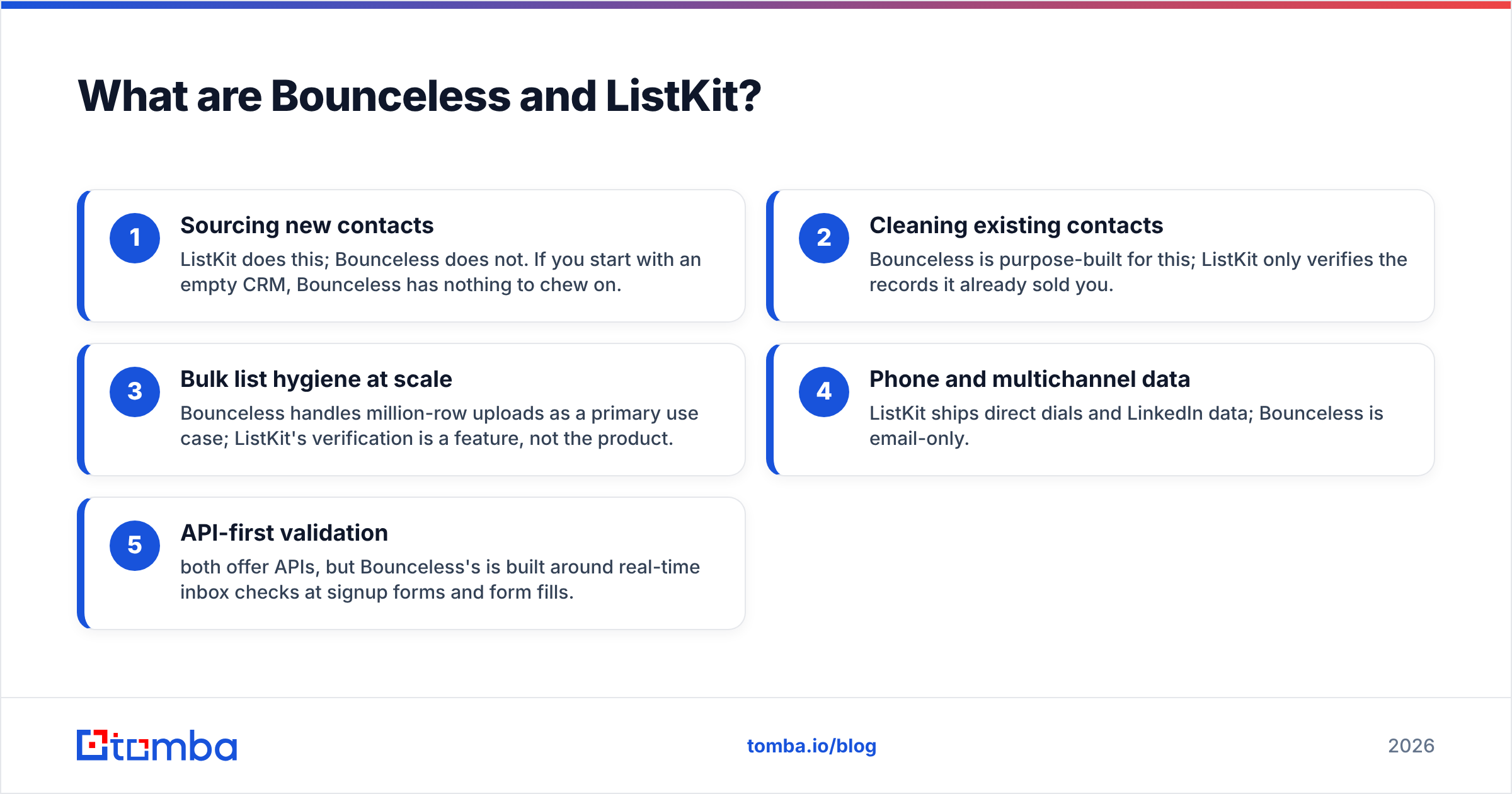
- Sourcing new contacts — ListKit does this; Bounceless does not. If you start with an empty CRM, Bounceless has nothing to chew on.
- Cleaning existing contacts — Bounceless is purpose-built for this; ListKit only verifies the records it already sold you.
- Bulk list hygiene at scale — Bounceless handles million-row uploads as a primary use case; ListKit's verification is a feature, not the product.
- Phone and multichannel data — ListKit ships direct dials and LinkedIn data; Bounceless is email-only.
- API-first validation — both offer APIs, but Bounceless's is built around real-time inbox checks at signup forms and form fills.

How do Bounceless and ListKit differ?#
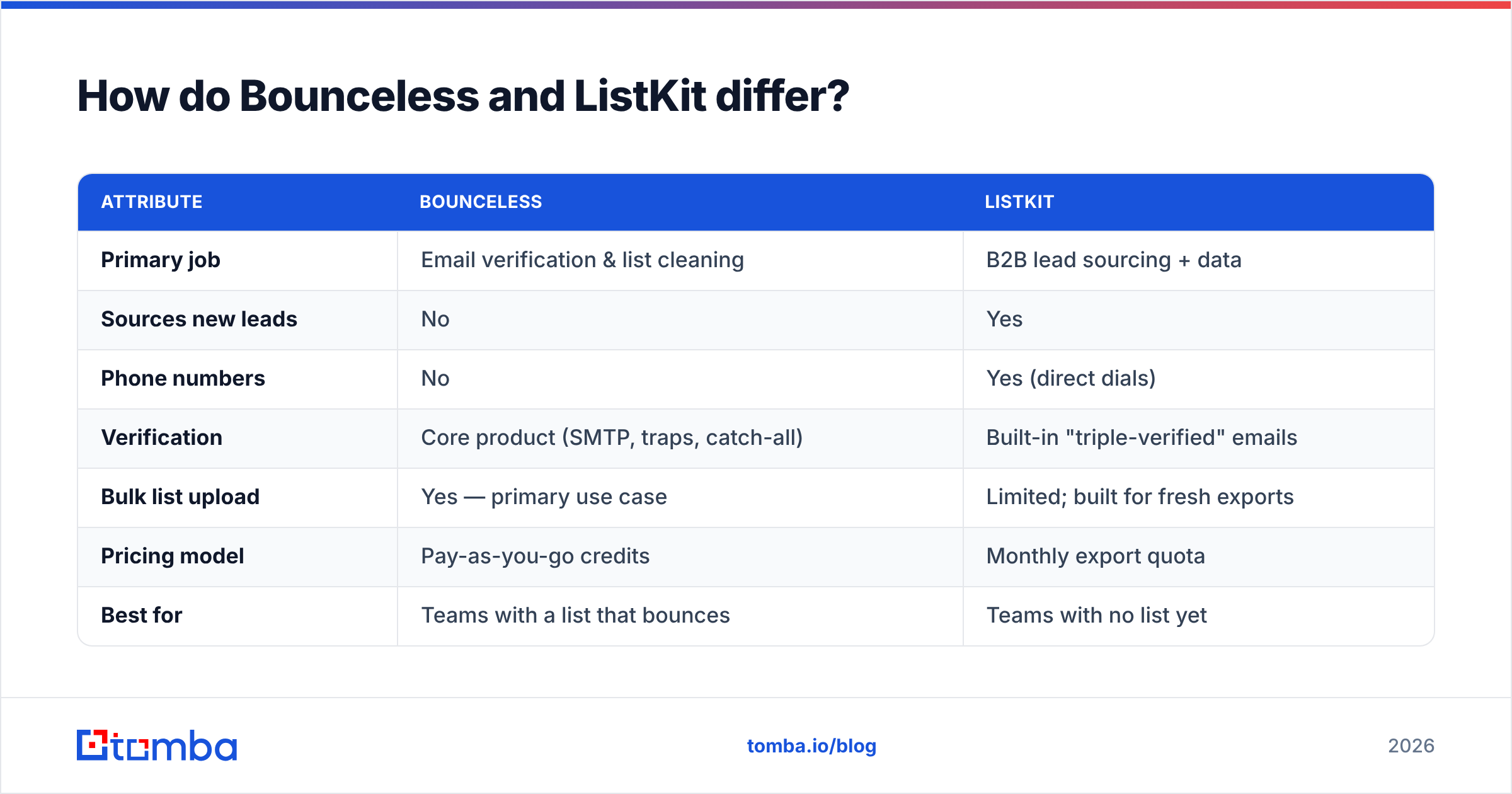
The fastest way to see the gap is side by side. These are the attributes that change which tool belongs in your stack.
| Attribute | Bounceless | ListKit |
|---|---|---|
| Primary job | Email verification & list cleaning | B2B lead sourcing + data |
| Sources new leads | No | Yes |
| Phone numbers | No | Yes (direct dials) |
| Verification | Core product (SMTP, traps, catch-all) | Built-in "triple-verified" emails |
| Bulk list upload | Yes — primary use case | Limited; built for fresh exports |
| Pricing model | Pay-as-you-go credits | Monthly export quota |
| Best for | Teams with a list that bounces | Teams with no list yet |
| API | Real-time + bulk | Export + enrichment |
The table makes the decision almost mechanical. If your column-of-pain is "bounce rate," you're shopping for Bounceless or another verifier. If it's "not enough prospects," you're shopping for ListKit. Buying the wrong one feels like progress for about a week, then you hit the wall the tool was never built to climb.
One nuance worth flagging: ListKit's verification reduces — but does not eliminate — the need for a separate cleaner. Any database ages. A contact verified the day you exported it can change jobs the following month. Teams running high volume often still pass ListKit exports through a dedicated verifier before a big send, especially for catch-all domains where even good data providers hedge their bets.
Is Bounceless better than ListKit for accuracy?#
For pure verification accuracy, Bounceless is doing the more specialized job, so on its home turf it should perform well — that's the entire product. But "accuracy" means two different things depending on which tool you ask about.
For Bounceless, accuracy is about catch rate and false positives: how many dead addresses it flags, and how many good ones it wrongly kills. A verifier that's too aggressive quietly deletes reachable buyers; one that's too lax lets bounces through. The number you should ask any verifier vendor for is their handling of catch-all and accept-all domains, because that's where most tools fudge the result with a vague "risky" label.
For ListKit, accuracy is about data freshness and match rate: when it claims "this is the VP of Sales at company X and this is her email," how often is that true today? Even a triple-verification process is only as current as the underlying database. Job changes, mergers, and domain migrations decay B2B data at roughly 2–2.5% per month, which compounds fast over a year.
So neither tool is "more accurate" in the abstract. Bounceless is more accurate at judging an address you hand it. ListKit is responsible for the accuracy of an address it generates. The trap is assuming ListKit's built-in verification removes your hygiene step entirely — it shrinks it, it doesn't delete it. If you care about where contact data actually comes from, it's worth understanding how providers source and refresh data before trusting any single vendor's "verified" stamp.
How much do Bounceless and ListKit cost in 2026?#
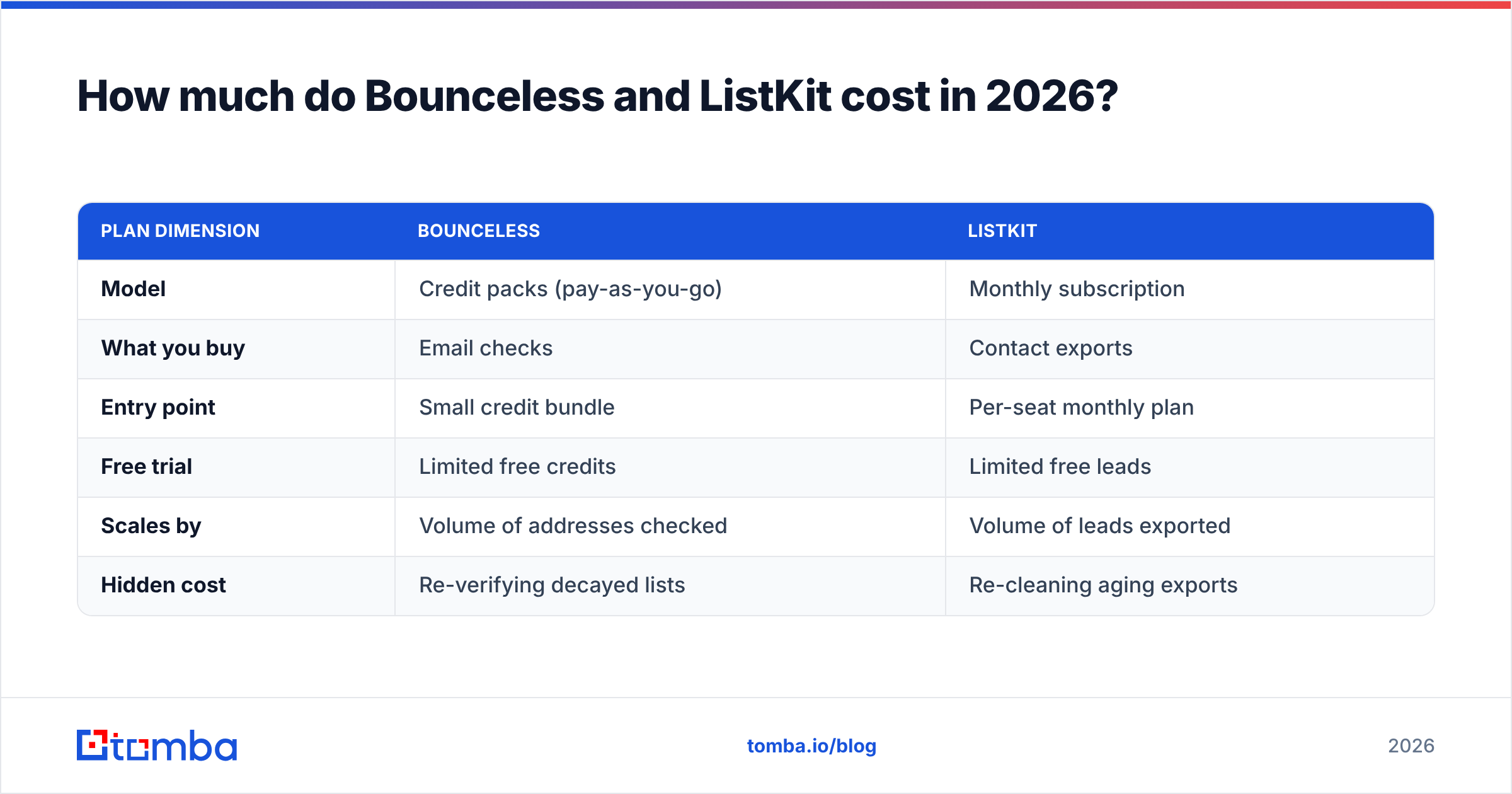
Pricing is where the comparison gets slippery, because the two tools meter completely different things. Bounceless charges per verification credit. ListKit charges for a monthly bucket of exported contacts. Comparing the headline numbers is meaningless; you have to compare cost per usable, deliverable lead.
| Plan dimension | Bounceless | ListKit |
|---|---|---|
| Model | Credit packs (pay-as-you-go) | Monthly subscription |
| What you buy | Email checks | Contact exports |
| Entry point | Small credit bundle | Per-seat monthly plan |
| Free trial | Limited free credits | Limited free leads |
| Scales by | Volume of addresses checked | Volume of leads exported |
| Hidden cost | Re-verifying decayed lists | Re-cleaning aging exports |
The "hidden cost" row is the one most teams miss. With Bounceless, you pay again every time a list ages and needs re-checking. With ListKit, you pay for export volume, then often pay a second vendor to verify those exports before a real campaign. Two tools, two bills, two integration points.
That's the math that pushes a lot of lean teams toward consolidation. A platform that finds and verifies in one motion collapses two line items into one. For context on how that bundling changes the per-lead economics, the Tomba pricing tiers — Free (25 searches), Starter at $49/mo, Growth at $99/mo, and Pro at $249/mo — fold finding, verifying, and enrichment into a single plan rather than metering them separately.

Which tool should you choose for cold email?#
Pick based on the bottleneck you actually have, not the one that's easiest to shop for.
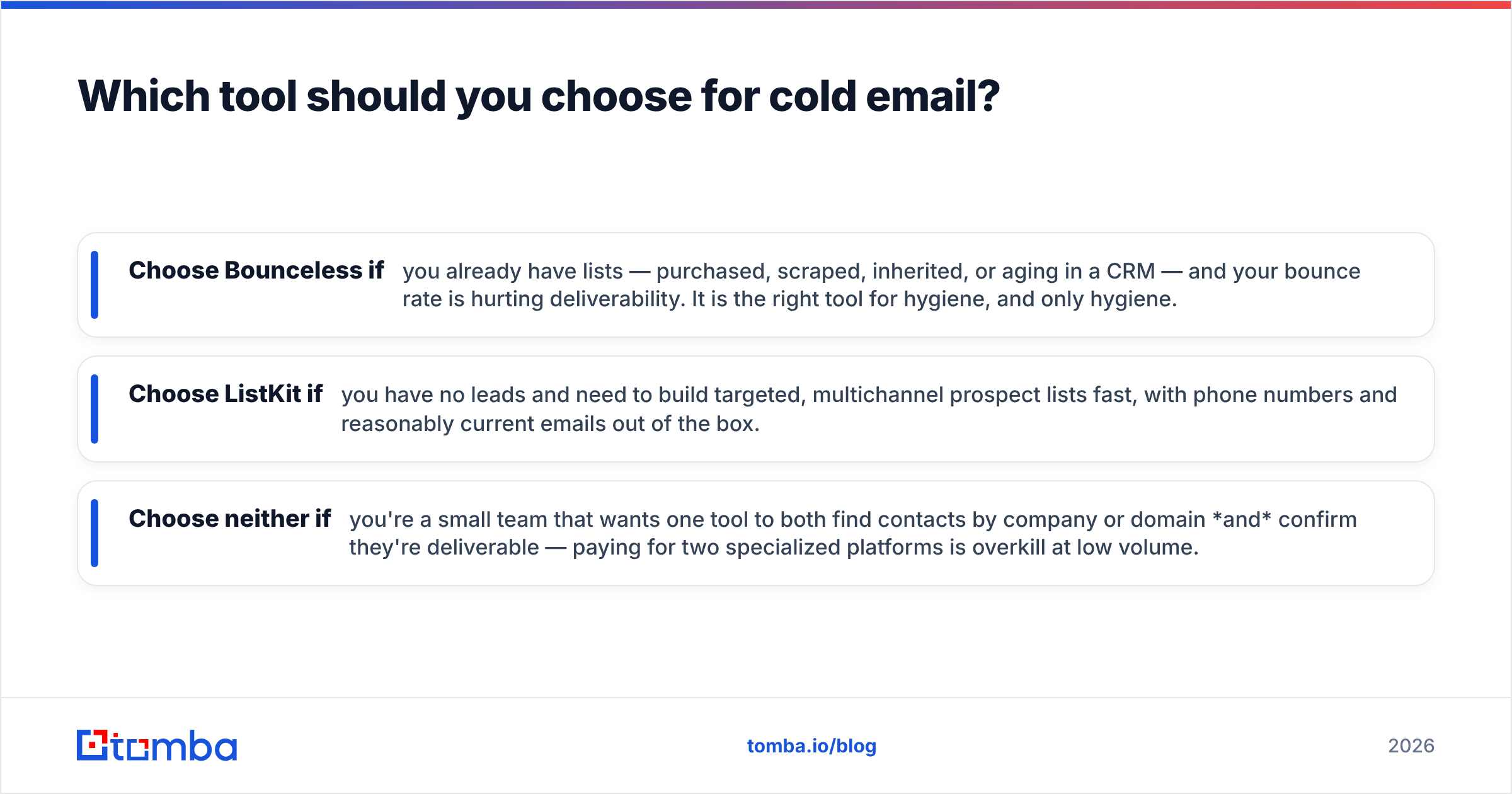
- Choose Bounceless if you already have lists — purchased, scraped, inherited, or aging in a CRM — and your bounce rate is hurting deliverability. It is the right tool for hygiene, and only hygiene.
- Choose ListKit if you have no leads and need to build targeted, multichannel prospect lists fast, with phone numbers and reasonably current emails out of the box.
- Choose neither if you're a small team that wants one tool to both find contacts by company or domain and confirm they're deliverable — paying for two specialized platforms is overkill at low volume.
For most early-stage outbound teams, the friction isn't a missing verifier or a missing database in isolation. It's the seam between them: export from one tool, import to another, reconcile the formats, eat two subscriptions. That seam is exactly where a combined finder shines.
If you want to test the consolidated approach, you can pull contacts straight from a target company using domain search, or clean an entire spreadsheet at once with a bulk email finder that verifies as it goes — no second tool in the loop.
Where does Tomba fit in the Bounceless vs ListKit decision?#
Tomba is the option that does both jobs the other two split. It finds professional email addresses by name, domain, or company — the sourcing job ListKit owns — and verifies them with SMTP and catch-all checks before you ever export — the hygiene job Bounceless owns. One platform, one bill, one API.
That doesn't make Bounceless or ListKit bad tools. If you run verification at massive scale across many disparate sources, a dedicated verifier like Bounceless is a defensible specialist purchase. If you live and breathe high-volume multichannel prospecting with direct dials, ListKit's data depth is real. Specialists win at scale.
But the majority of teams reading a Bounceless vs ListKit comparison aren't at that scale yet. They're trying to build clean, sendable lists without stitching three subscriptions together. For them, the honest answer is that the "versus" framing is a false choice — the actual question is whether you need a verifier, a data source, or one tool that handles both.
You can sanity-check any vendor's claims against third-party reviews on G2, read each tool's own docs at bounceless.io and listkit.io, and then decide which seam in your workflow is worth paying to close.
Frequently asked questions#
Is Bounceless a lead generation tool? No. Bounceless verifies email addresses you already have. It does not source new contacts, so it can't replace a data platform like ListKit.
Does ListKit verify its own emails? Yes, ListKit advertises triple-verified emails. But because B2B data decays every month, high-volume senders often still run exports through a dedicated verifier before large campaigns.
Can one tool replace both Bounceless and ListKit? For most small and mid-size outbound teams, yes — a combined finder-and-verifier handles both sourcing and hygiene in one workflow, which removes the second subscription and the export-import seam between tools.
Which is cheaper, Bounceless or ListKit? They meter different things — credits versus export quota — so the only fair comparison is cost per deliverable lead, including the hidden cost of re-verifying or re-sourcing decayed data.
The bottom line#
Stop framing it as Bounceless vs ListKit and start with your bottleneck: if your list bounces, you need a verifier; if you have no list, you need a data source; if you need both without two bills, you need a tool that finds and verifies in one pass.
That last case is where Tomba's Email Finder earns its place — source professional emails by domain, name, or company, get them SMTP-verified before export, and skip the two-vendor tax entirely. Start on the free tier with 25 searches and see whether one platform closes the seam that Bounceless and ListKit leave open.
// get started
Find, verify and enrich your first contacts today
Start on the free plan with 25 searches a month, then scale when your team is ready.
Free plan · No credit card required · GDPR & CCPA
// about the author