Bounceless vs Seamless.AI 2026: Which B2B Data Tool Wins?
Bounceless cleans your list; Seamless.AI builds it. We break down accuracy, pricing, and use cases so you know which tool fits your 2026 outbound stack — and where a third option beats both.
Picking between Bounceless and Seamless.AI feels like a fair fight until you realize they're not playing the same sport. One scrubs the list you already have. The other tries to hand you a brand-new one. If you buy the wrong one, you either pay for prospecting you don't need or for cleaning data you don't have yet.
This guide settles it: what each tool actually does, where each one is strong, what they cost in 2026, and which scenario points to which product. We'll also be honest about where a single combined platform beats running two subscriptions.
TL;DR#
- Bounceless is an email verification tool. It takes a list you already own and tells you which addresses are deliverable, risky, or dead. It does not find new contacts.
- Seamless.AI is a prospecting/sales-intelligence platform. It builds contact lists from a real-time search engine, with emails and phone numbers, plus a Chrome extension and CRM sync.
- They solve opposite halves of the same problem. Bounceless cleans; Seamless.AI sources. Comparing them directly only makes sense if you're deciding which gap to fill first.
- Accuracy claims differ wildly. Verification tools live or die on bounce rate; prospecting tools live or die on contact match rate. Don't compare the two numbers as if they mean the same thing.
- If you want both jobs done in one place, an all-in-one finder-plus-verifier like Tomba removes the need to stitch two vendors together.
What is Bounceless?#
Bounceless is a dedicated email verifier. You upload a list — CSV, CRM export, form submissions — and it runs each address through syntax checks, MX-record lookups, SMTP pings, and spam-trap and disposable-domain detection. The output is a cleaned file tagged deliverable, risky (catch-all), or undeliverable.
Think of Bounceless like a bouncer at the door of your email campaign. It doesn't invite anyone; it just decides who gets in so your sender reputation stays intact. That matters because every hard bounce chips away at your domain's standing with inbox providers, and a few percent of bad addresses can tank an entire send.
Where Bounceless fits:
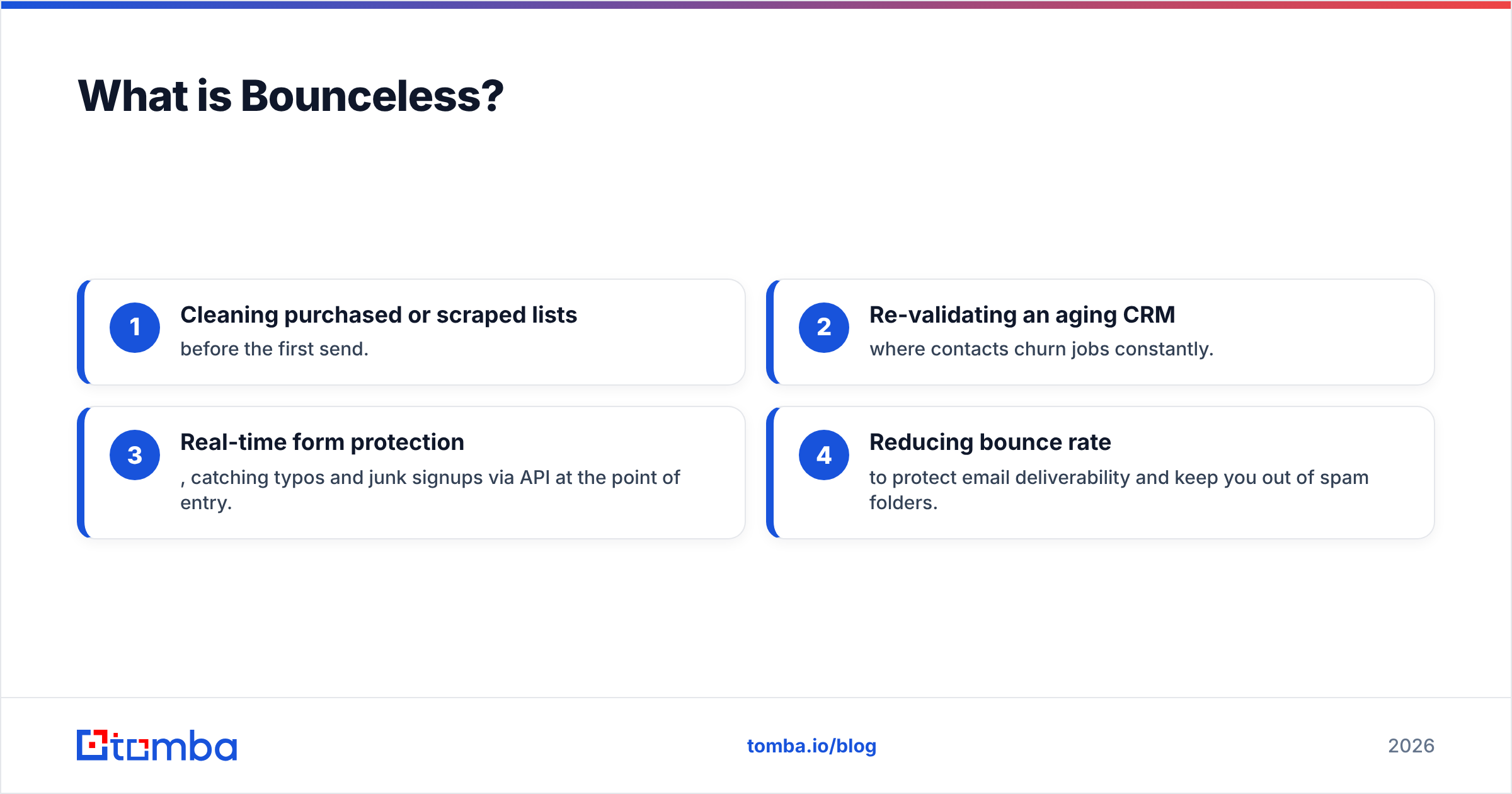
- Cleaning purchased or scraped lists before the first send.
- Re-validating an aging CRM where contacts churn jobs constantly.
- Real-time form protection, catching typos and junk signups via API at the point of entry.
- Reducing bounce rate to protect email deliverability and keep you out of spam folders.
What Bounceless explicitly does not do: it won't find an email address you don't already have. If your list is empty, Bounceless has nothing to work with.
What is Seamless.AI?#
Seamless.AI is a sales lead and contact-data platform. Its pitch is a "real-time search engine" for B2B contacts: you search by title, company, industry, or location, and it returns prospects with emails, direct dials, and company data. A Chrome extension pulls contacts off LinkedIn and company sites, and it syncs into CRMs like Salesforce and HubSpot.
If Bounceless is the bouncer, Seamless.AI is the recruiter standing outside trying to bring new people to the party. It builds pipeline from scratch. According to Seamless.AI, the platform also layers on enrichment, buyer-intent signals, and data-append features on higher tiers.
Where Seamless.AI fits:
- Net-new prospecting when you need volume and don't have a list.
- Account-based outreach, building targeted contact sets around named companies.
- Filling CRM gaps with phone numbers and firmographics.
- Teams that live in LinkedIn and want a one-click capture extension.
The trade-off is the one every prospecting database carries: contact data decays fast, match rates vary by industry, and you still need a verification step before you hit send. Seamless includes some validation, but heavy senders routinely run a separate verifier on exported lists anyway.
Bounceless vs Seamless.AI: how do they compare?#
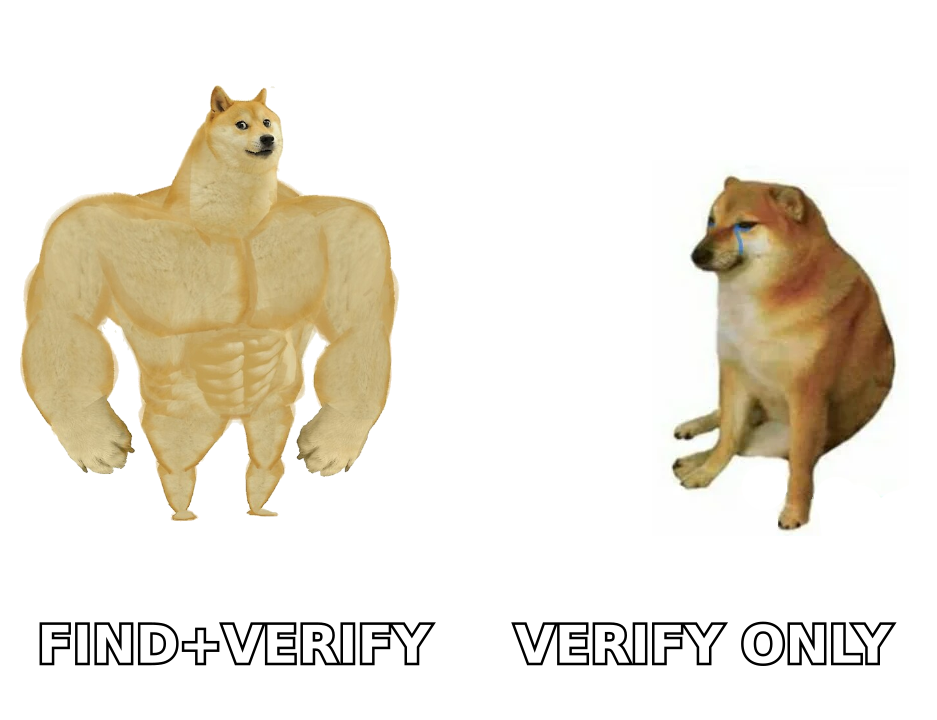
Here's the core distinction in one table. Notice that most rows aren't "better/worse" — they're "different job."
| Attribute | Bounceless | Seamless.AI |
|---|---|---|
| Primary job | Email verification | Prospecting / contact data |
| Finds new contacts | No | Yes |
| Verifies existing emails | Yes (core feature) | Partial / secondary |
| Phone numbers | No | Yes |
| Chrome extension | Limited | Yes (core feature) |
| CRM sync | Via integrations | Native (Salesforce, HubSpot) |
| Best for | List hygiene, low bounce rate | Net-new pipeline |
| Pricing model | Per-credit / volume | Annual seat-based, quote-driven |
| Free option | Free trial credits | Limited free credits |
The practical reading: if your problem is "my emails bounce," Bounceless is the targeted fix. If your problem is "I have no one to email," Seamless.AI is the targeted fix. Buying Seamless.AI to solve a bounce problem is overkill; buying Bounceless to solve an empty-pipeline problem solves nothing.
Accuracy: two different numbers#
People say "which is more accurate?" but the two tools measure different things:
- Bounceless accuracy = how reliably it predicts whether an address will bounce. The benchmark is real-world bounce rate after cleaning. A good verifier keeps you under ~2-3% bounces.
- Seamless.AI accuracy = match rate and data freshness — what share of returned emails and phones are correct and current. Prospecting databases vary a lot here, and independent reviews on G2 report mixed experiences depending on industry and seniority of the contact.
You can't pit a 98% "deliverability prediction" against a 70% "contact match rate" — they answer different questions. The honest takeaway: use a verifier to grade a prospecting tool's output, not to replace it.
What does each one cost in 2026?#
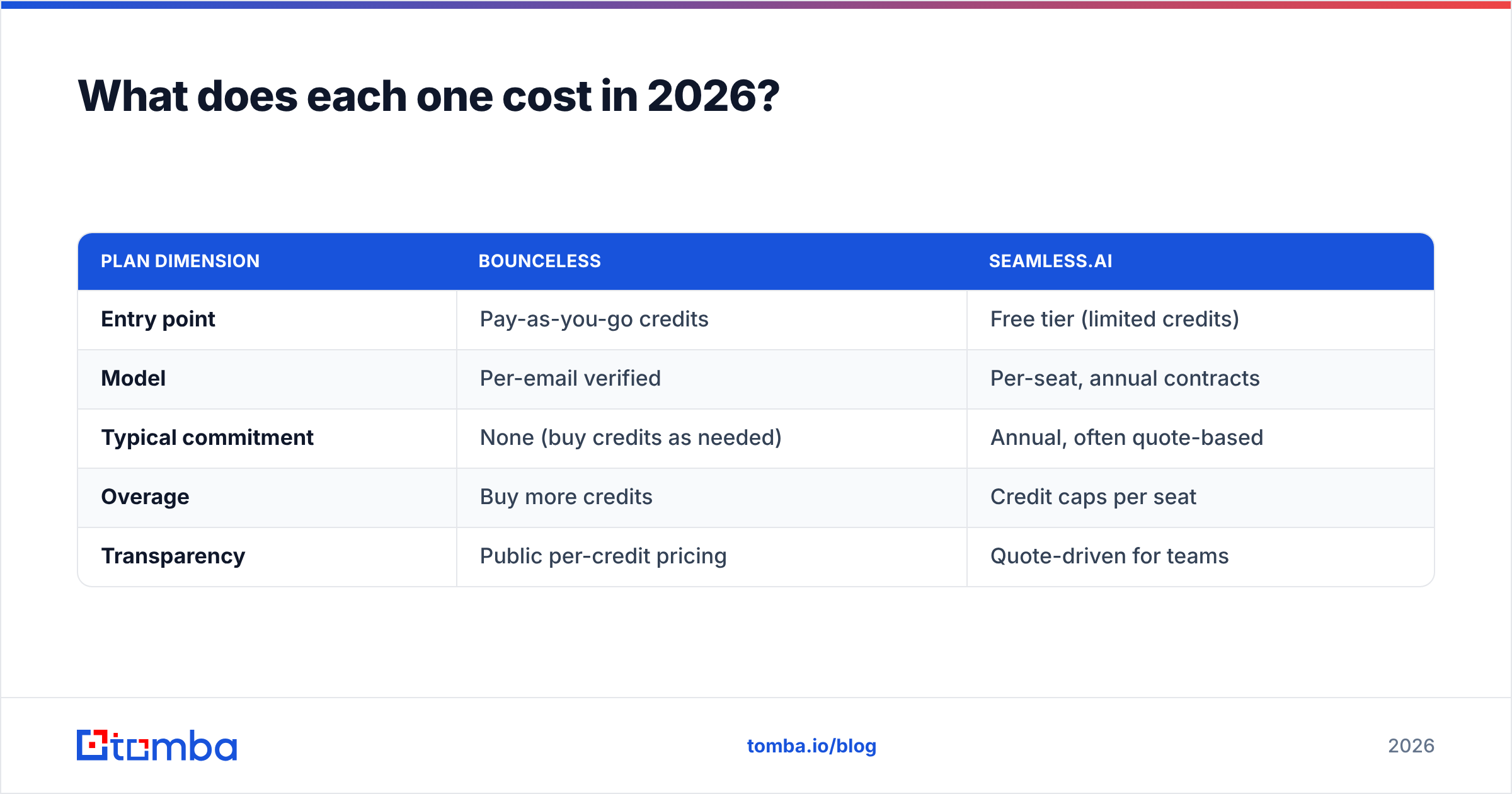
Pricing is where the two diverge most in feel. Verification tools sell credits; prospecting platforms sell seats.
| Plan dimension | Bounceless | Seamless.AI |
|---|---|---|
| Entry point | Pay-as-you-go credits | Free tier (limited credits) |
| Model | Per-email verified | Per-seat, annual contracts |
| Typical commitment | None (buy credits as needed) | Annual, often quote-based |
| Overage | Buy more credits | Credit caps per seat |
| Transparency | Public per-credit pricing | Quote-driven for teams |
Verification credits are cheap per unit because the work is computational. Prospecting seats cost more because you're paying for an actively maintained contact database and ongoing data acquisition. Neither is "expensive" in a vacuum — it depends on whether you're paying for the job you actually have.
If you're comparing total cost of an outbound stack, remember the hidden line item: running a finder and a separate verifier means two bills, two logins, two integrations. That's the gap an all-in-one closes — and it's worth pricing out against transparent, single-vendor Tomba pricing before you commit to two annual contracts.
When should you choose Bounceless?#
Choose Bounceless (or any focused verifier) when:
- You already have lists and your only pain is bounce rate and deliverability.
- You run high-volume sends and need to protect sender reputation.
- You want real-time form validation via API.
- You don't need new contacts, phone numbers, or prospecting workflows.
It's a precision instrument. If list hygiene is the entire job, a dedicated verifier does it well and cheaply.
When should you choose Seamless.AI?#
Choose Seamless.AI when:
- You need net-new contacts and have little or no existing list.
- Phone numbers and direct dials matter to your motion.
- Your reps work primarily inside LinkedIn and want a capture extension.
- You want native CRM enrichment baked into prospecting.
It's a pipeline-building engine. Just budget for a verification pass on exports if you send at scale, and expect match rates to swing by vertical.

Is there a tool that does both jobs?#
Yes — and it's the reason this "versus" often dissolves in practice. If you find yourself wanting Seamless.AI to source contacts and Bounceless to clean them, you're describing one combined workflow that two separate vendors force you to stitch together.
Tomba was built around that exact combination: find the address, then verify it before it ever reaches your sequence. Instead of exporting from a prospecting tool and re-importing into a verifier, the find-and-verify step happens in one pass.
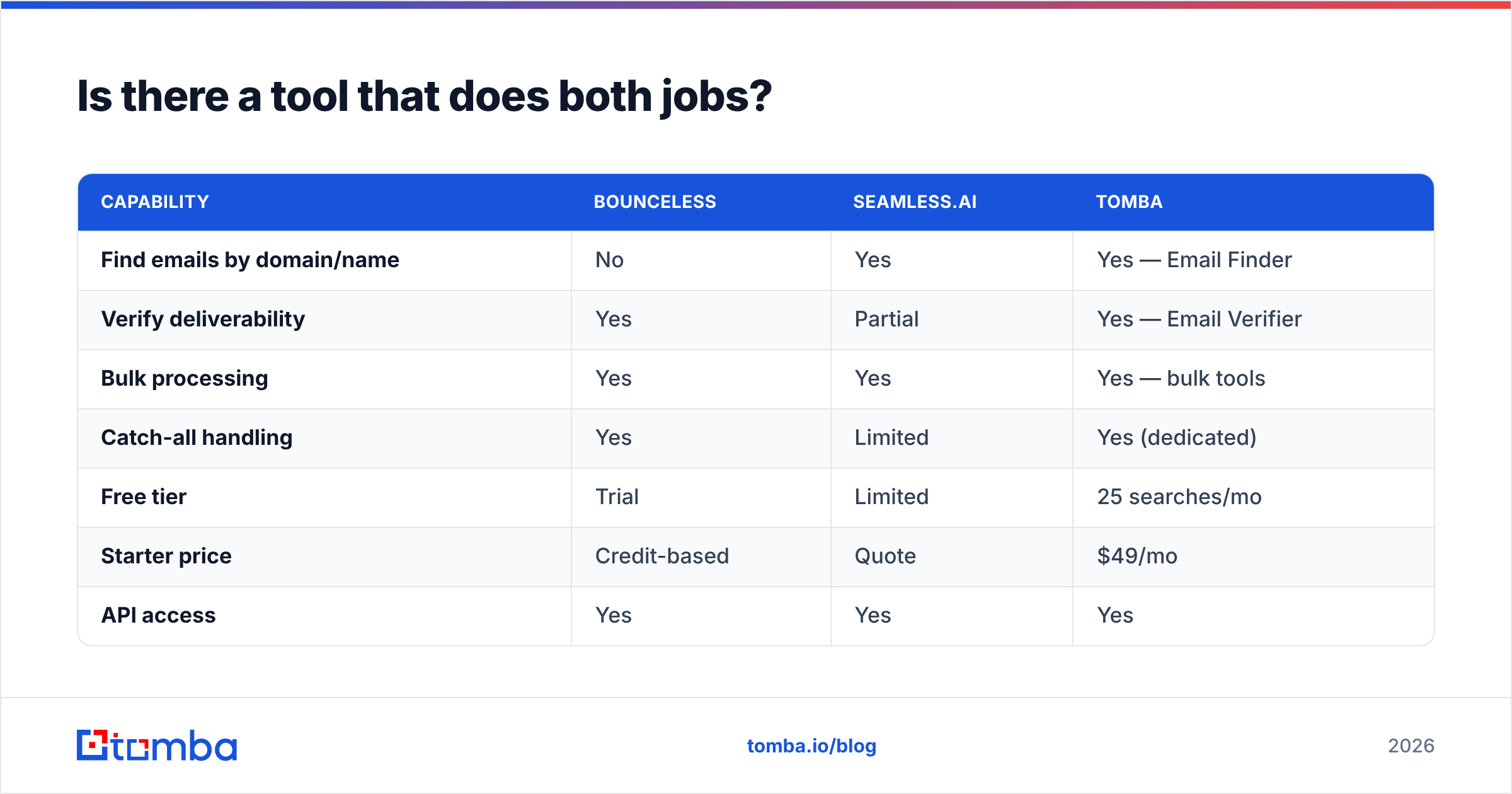
| Capability | Bounceless | Seamless.AI | Tomba |
|---|---|---|---|
| Find emails by domain/name | No | Yes | Yes — Email Finder |
| Verify deliverability | Yes | Partial | Yes — Email Verifier |
| Bulk processing | Yes | Yes | Yes — bulk tools |
| Catch-all handling | Yes | Limited | Yes (dedicated) |
| Free tier | Trial | Limited | 25 searches/mo |
| Starter price | Credit-based | Quote | $49/mo |
| API access | Yes | Yes | Yes |
Tomba's structure is deliberately modular: the email finder sources addresses by domain, name, or company; the verifier grades them; catch-all detection and bulk processing handle scale. You can start free with 25 searches a month, then move to Starter at $49/mo, Growth at $99/mo, or Pro at $249/mo as volume grows — no annual quote dance to get a number.
The point isn't that Tomba beats Bounceless at pure verification benchmarks or Seamless.AI at raw database size. It's that most teams don't actually want two specialist tools — they want the address found and confirmed deliverable, in one motion, on one bill.
Which should you actually buy?#
Decide by your real bottleneck, not by feature lists:
- "My list bounces." → A verifier. Bounceless does this job cleanly.
- "I have no list." → A prospecting tool. Seamless.AI builds pipeline.
- "I need to find contacts and keep bounces low." → An all-in-one. This is where running Bounceless plus Seamless.AI together becomes two bills for one workflow, and where Tomba consolidates the stack.
- "I'm cost-conscious and send at scale." → Price the full stack, not one tool. Transparent per-seat or per-credit pricing usually beats quote-gated annual contracts for predictability.
The "Bounceless vs Seamless.AI" framing assumes you must pick a side. In reality you're choosing which half of the find-and-verify pipeline to solve — and increasingly, teams skip the choice by solving both at once.
Final verdict#
Bounceless wins if verification is your only job. Seamless.AI wins if sourcing net-new contacts is your only job. But outbound rarely splits that cleanly — you need accurate addresses and you need them to land. That's the case for an integrated platform.
If you're tired of exporting from one tool to clean in another, start with Tomba's Email Finder. Find professional emails by domain, name, or company, verify deliverability in the same flow, and scale from a free 25-search tier up through plans built for real outbound volume — without juggling two vendors to do one job. Try it free, then upgrade only when your pipeline does.
// get started
Find, verify and enrich your first contacts today
Start on the free plan with 25 searches a month, then scale when your team is ready.
Free plan · No credit card required · GDPR & CCPA
// about the author