Bounceless vs SignalHire 2026: Verifier or Finder?
Bounceless verifies email lists; SignalHire finds contacts. We compare accuracy, pricing, and use cases so you know which one your pipeline actually needs in 2026.
Bounceless and SignalHire get lumped together in "best contact data tools" lists, but they solve opposite halves of the same problem. One cleans the list you already have. The other builds the list in the first place. Picking between them without knowing that difference is how teams end up paying for two subscriptions when they needed one — or one when they needed neither.
This guide breaks down what each tool actually does, where each wins, what they cost in 2026, and when a single combined platform beats running both.
TL;DR#
- Bounceless is an email verifier. It takes a list you already have and tells you which addresses are valid, risky, or dead. It does not find new contacts.
- SignalHire is a contact finder. It surfaces emails and phone numbers from profiles and company pages. Verification is a secondary feature, not its core strength.
- They are not direct competitors. If you have a list and need it clean, lean Bounceless. If you have no list and need contacts, lean SignalHire.
- Pricing models differ sharply: Bounceless sells verification credits; SignalHire sells contact-reveal credits with a recruiting-heavy bias.
- Running both is common but wasteful. A combined find-plus-verify platform like Tomba usually covers both jobs at one price point.
What is Bounceless?#
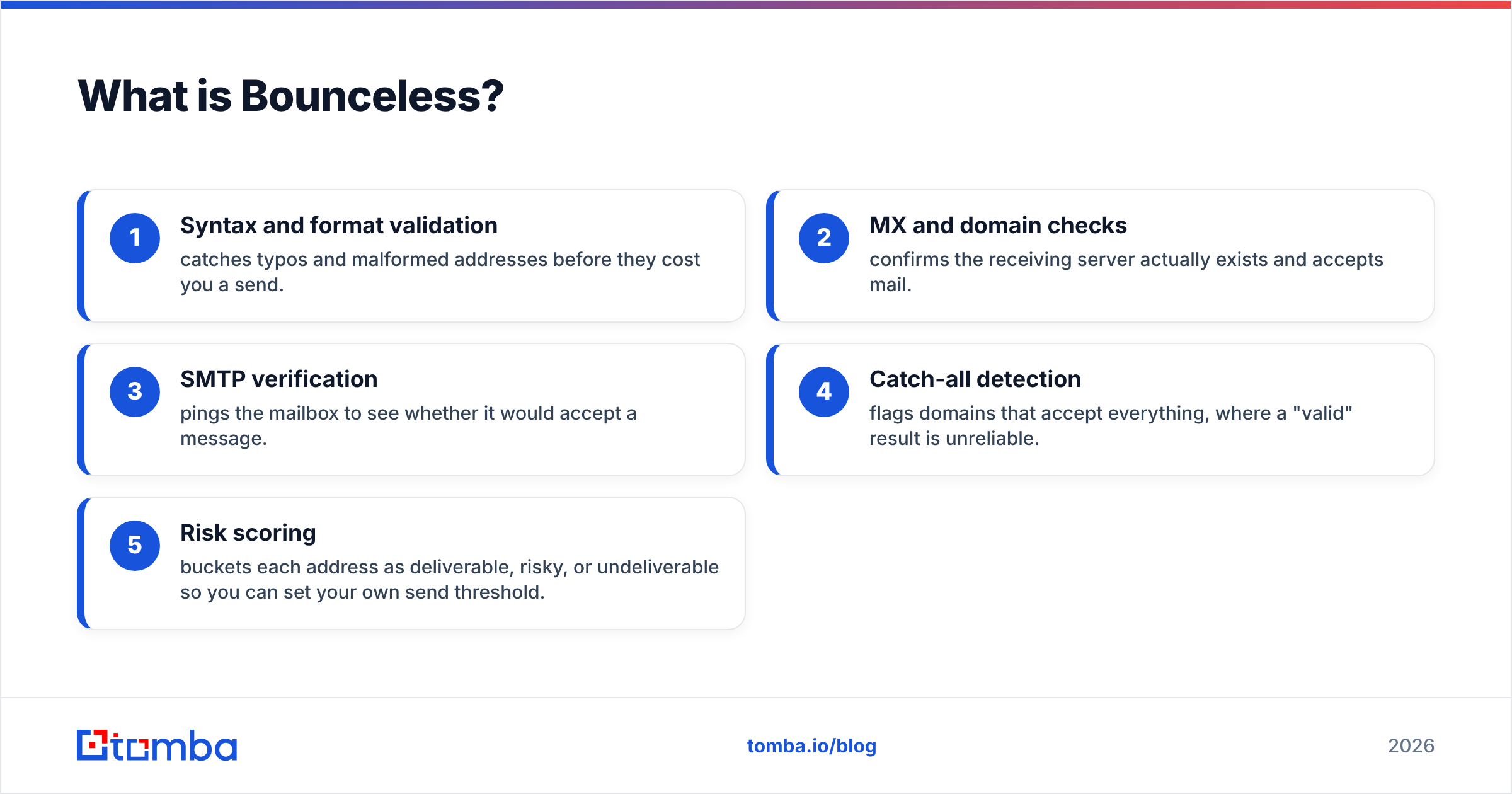
Bounceless is a dedicated email verifier. You upload a list — a CSV export, a CRM segment, a newsletter file — and it runs each address through a chain of checks: syntax, domain and MX records, SMTP handshake, role-account detection, disposable-domain filtering, and catch-all identification. The output is a scored list you can safely send to.
Think of Bounceless as a water-quality test, not a well. It tells you whether what you already pumped is drinkable. It will never dig you a new source.
Its core checks include:
- Syntax and format validation — catches typos and malformed addresses before they cost you a send.
- MX and domain checks — confirms the receiving server actually exists and accepts mail.
- SMTP verification — pings the mailbox to see whether it would accept a message.
- Catch-all detection — flags domains that accept everything, where a "valid" result is unreliable.
- Risk scoring — buckets each address as deliverable, risky, or undeliverable so you can set your own send threshold.
That focus makes Bounceless strong at one job: protecting email deliverability by stripping out the addresses that trigger bounces and spam-trap hits. It is a list-hygiene tool, full stop.
)
What is SignalHire?#
SignalHire is a contact-discovery platform built largely for recruiters and sales teams. You search by person, company, or role, and it reveals email addresses and phone numbers tied to those profiles. It leans heavily on browser-extension workflows — you pull contacts while browsing professional networks and company sites — and it includes an applicant-tracking layer that recruiters use to manage candidates.
If Bounceless tests your well water, SignalHire drills new wells. Its job is to produce contacts that did not exist in your database five minutes ago.
SignalHire does include a verification step on the data it returns, but that verification exists to make its own reveals usable — it is not designed as a standalone hygiene engine for lists you sourced elsewhere. Uploading a 200,000-row cold list to SignalHire purely to clean it is using the wrong tool.
You can review its positioning on the SignalHire site and cross-check user feedback on G2 before committing.
Bounceless vs SignalHire: how do they compare?#
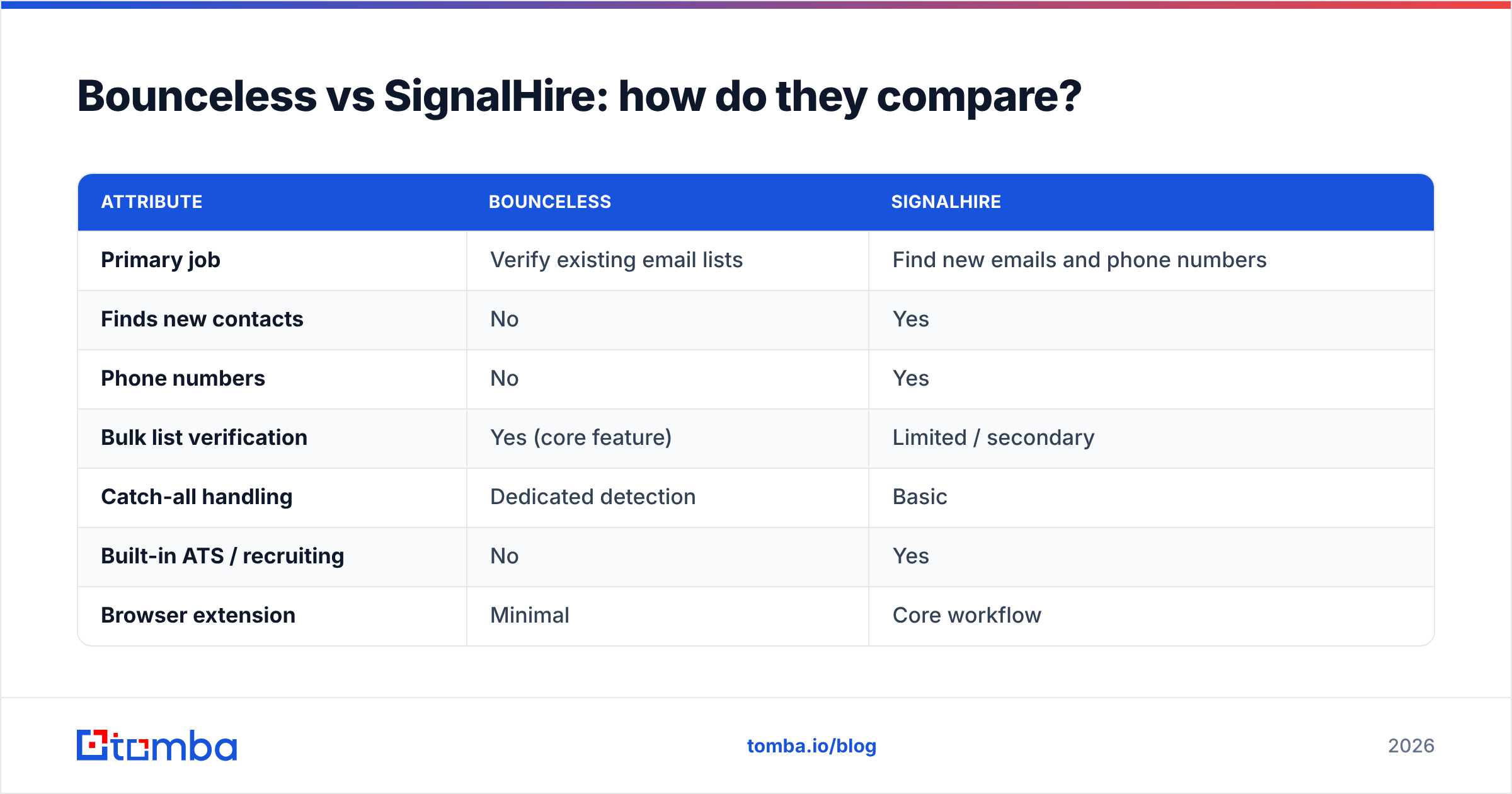
Here is the side-by-side. The headline takeaway is that these tools barely overlap — they sit on opposite ends of the contact-data workflow.
| Attribute | Bounceless | SignalHire |
|---|---|---|
| Primary job | Verify existing email lists | Find new emails and phone numbers |
| Finds new contacts | No | Yes |
| Phone numbers | No | Yes |
| Bulk list verification | Yes (core feature) | Limited / secondary |
| Catch-all handling | Dedicated detection | Basic |
| Built-in ATS / recruiting | No | Yes |
| Browser extension | Minimal | Core workflow |
| API access | Yes | Yes |
| Best fit | Email marketers, deliverability teams | Recruiters, sales prospectors |
| Pricing model | Verification credits | Contact-reveal credits |
The pattern is clear: Bounceless is depth-first on verification, SignalHire is breadth-first on discovery. Neither one does the other's job well, which is exactly why so many teams end up subscribing to both.
Which one is more accurate?#
It depends on what you mean by accuracy, because each tool measures something different.
For verification accuracy — "is this address real and deliverable?" — a dedicated verifier like Bounceless has the edge over SignalHire's secondary verification layer. Verification specialists invest in SMTP infrastructure, retry logic, and catch-all handling that a finder treats as a side feature.
For discovery accuracy — "is this the right person's real email?" — SignalHire competes, but reveal quality varies by region and seniority. Phone-number accuracy in particular is uneven across data providers industry-wide.
The catch nobody markets loudly: a found email is only useful if it is also verified, and a verified email is useless if you never found it. Accuracy is a two-step chain. Optimizing one link while ignoring the other is where most list quality quietly dies. This is why benchmarking a finder against a verifier produces a false comparison — you are scoring a sprinter against a swimmer.
If accuracy across the whole chain matters to you, the right question is not "Bounceless or SignalHire" but "which tool finds and verifies in one pass." That is the gap a combined platform fills, and where data sources and verification depth both matter at once.
What do Bounceless and SignalHire cost in 2026?#
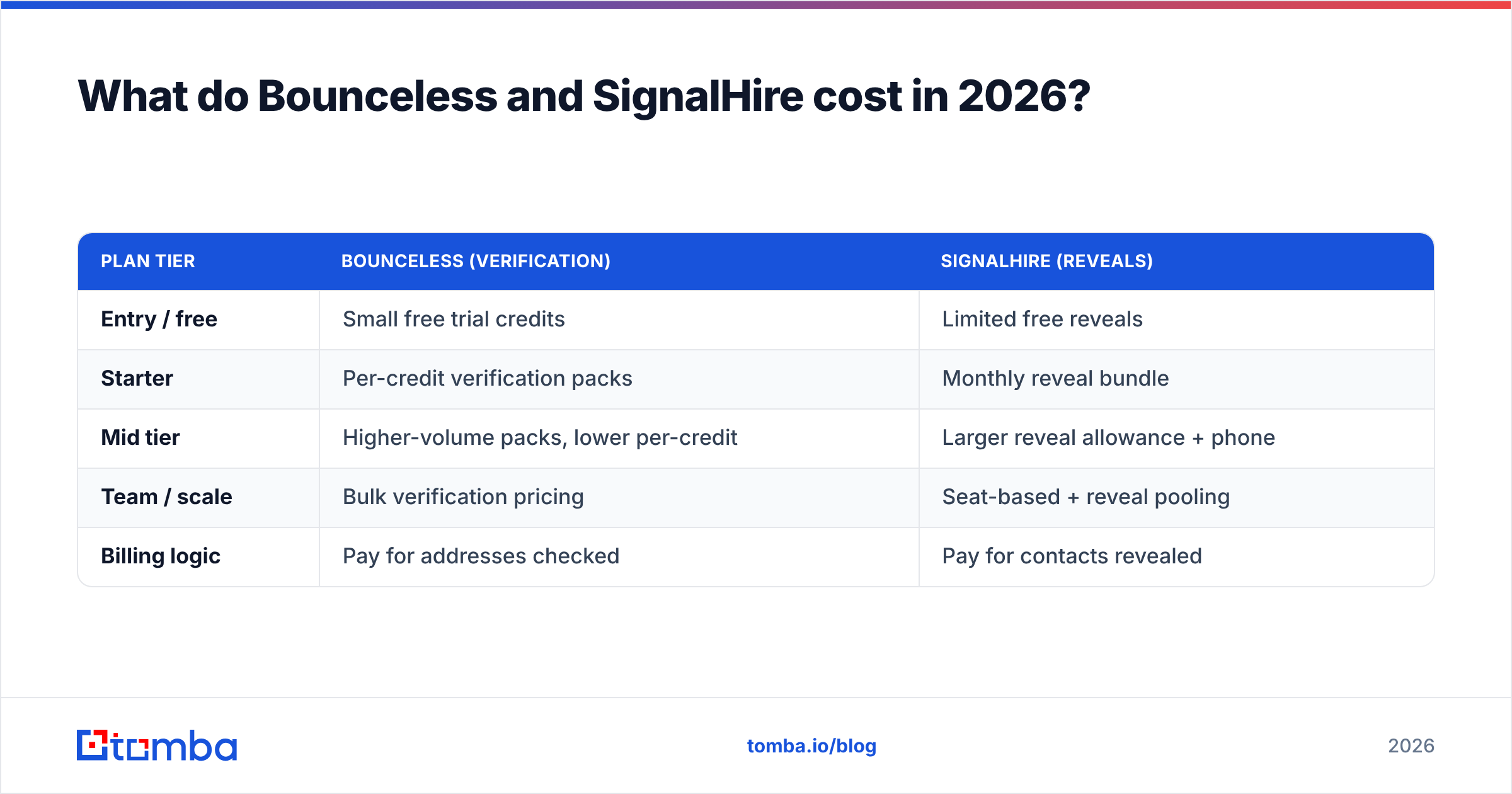
Both use credit-based pricing, but the credits buy different things, which makes direct dollar comparison misleading.
| Plan tier | Bounceless (verification) | SignalHire (reveals) |
|---|---|---|
| Entry / free | Small free trial credits | Limited free reveals |
| Starter | Per-credit verification packs | Monthly reveal bundle |
| Mid tier | Higher-volume packs, lower per-credit | Larger reveal allowance + phone |
| Team / scale | Bulk verification pricing | Seat-based + reveal pooling |
| Billing logic | Pay for addresses checked | Pay for contacts revealed |
A Bounceless credit is consumed when you verify an address. A SignalHire credit is consumed when you reveal a contact. So if your workflow is "find 1,000 leads, then verify 1,000 leads," you are buying two different credit pools from two vendors — and paying twice to touch the same 1,000 records.
That double-spend is the real cost story. Before you commit, map your monthly volume against both credit types and compare it to a single platform's blended rate. You can sanity-check that math against transparent Tomba pricing, where finding and verifying draw from one balance.
)
When should you choose Bounceless?#
Choose Bounceless — or any dedicated verifier — when:
- You already have a sizable list and your only problem is bounce rate.
- You run high-volume email marketing and need to protect sender reputation.
- You inherited an old database and need a one-time deep clean before re-engaging.
- Your contacts come from form fills, events, or imports — not from prospecting.
In these cases you do not need discovery at all. You need hygiene, and a focused verifier is a clean fit. Just be aware it is a single-purpose purchase: the day you need to find contacts, Bounceless cannot help.
When should you choose SignalHire?#
Choose SignalHire when:
- You are a recruiter sourcing candidates and want emails plus phone numbers from profiles.
- Your sales motion depends on building net-new contact lists from scratch.
- You live in the browser extension and want one-click reveals while you research.
- You value an ATS-style layer to track sourced people.
SignalHire shines in recruiting and outbound prospecting where the bottleneck is getting contacts. It is a weaker choice if your real problem is cleaning a list you already own, because you would be paying reveal credits for verification work.
Is there a better alternative to running both?#
Yes — for most B2B teams, a single find-and-verify platform removes the two-subscription tax entirely.
The reason teams end up with both Bounceless and SignalHire is structural: finders do not verify deeply, and verifiers do not find. So you buy one of each and stitch them together with CSV exports. That works, but it doubles your tooling cost, splits your data across vendors, and adds manual handoff steps between "found" and "verified."
A combined platform collapses that chain. With Tomba you can:
- Find emails by name, company, or domain using the email finder and domain search.
- Verify every address in the same workflow with the built-in email verifier, including catch-all handling.
- Work in bulk without exporting between tools.
- Hit one API instead of integrating two vendors and reconciling formats.
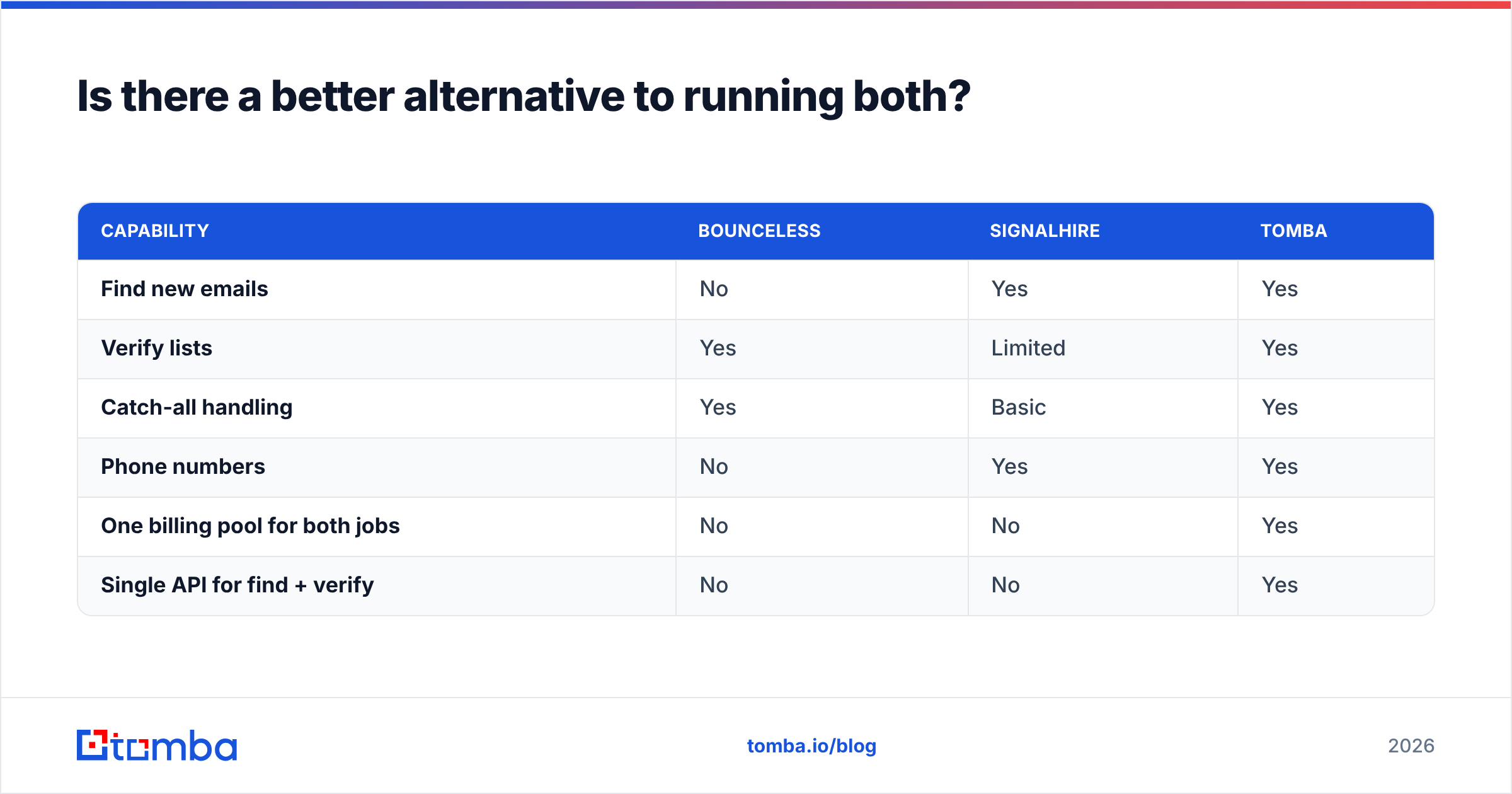
Here is how the three approaches stack up on the jobs that actually matter:
| Capability | Bounceless | SignalHire | Tomba |
|---|---|---|---|
| Find new emails | No | Yes | Yes |
| Verify lists | Yes | Limited | Yes |
| Catch-all handling | Yes | Basic | Yes |
| Phone numbers | No | Yes | Yes |
| One billing pool for both jobs | No | No | Yes |
| Single API for find + verify | No | No | Yes |
This is not to say Bounceless or SignalHire are bad tools — they are good at their respective halves. The point is that buying two halves to get one whole is rarely the efficient path when a whole product exists at a single price point. Compare Tomba's free tier (25 searches/month), Starter at $49/mo, Growth at $99/mo, and Pro at $249/mo against the combined cost of a verifier plus a finder subscription and the difference usually pays for itself in the first month.
How do you decide quickly?#
Run this three-question test:
- Do you already have the list? If yes, you need verification → a verifier like Bounceless covers it.
- Do you need to build the list? If yes, you need discovery → a finder like SignalHire (or Tomba) covers it.
- Do you need both, every month? If yes, stop buying two tools → a combined platform is cheaper and cleaner.
Most growing B2B teams answer "yes" to question three within a quarter. That is the moment the Bounceless-vs-SignalHire framing stops being the right question, and "find and verify in one place" becomes the answer.
The bottom line#
Bounceless and SignalHire are not rivals — they are two ends of one workflow. Bounceless verifies what you have; SignalHire finds what you lack. Choose the verifier if hygiene is your only gap, the finder if discovery is your only gap, and a combined platform the moment you need both on a recurring basis.
If your pipeline depends on finding accurate contacts and keeping them deliverable, start with the Tomba Email Finder. It pairs domain-level discovery with real-time verification so the address you find is the address that lands — no second subscription, no CSV ping-pong, one credit pool for the whole job. Spin up the free tier, run a real list through it, and see whether you still need two tools at all.
// get started
Find, verify and enrich your first contacts today
Start on the free plan with 25 searches a month, then scale when your team is ready.
Free plan · No credit card required · GDPR & CCPA
// about the author