Bouncer vs Zintlr 2026: Email Verifier vs Sales Intel
Bouncer cleans your list, Zintlr builds it. Here's an honest 2026 breakdown of where each tool wins, where both fall short, and what a leaner stack looks like.
TL;DR
- Bouncer and Zintlr solve different problems. Bouncer is a focused email verification tool that cleans lists you already have. Zintlr is a B2B sales intelligence platform that helps you find prospects in the first place.
- If your pain is bounce rates, Bouncer is the better fit. If your pain is empty pipeline, Zintlr (or a finder + database) is what you actually need.
- Neither tool does the full job alone. You typically need find → enrich → verify, and each of these tools only owns one slice.
- Pricing models differ sharply: Bouncer leans pay-as-you-go per email checked; Zintlr sells seat-based intelligence subscriptions.
- A consolidated stack like Tomba covers finding, enrichment, and email verification under one roof, which is worth weighing before you buy two separate tools.
What are Bouncer and Zintlr, really?#
Short answer: they sit at opposite ends of the outbound workflow.
Think of building a cold outreach campaign like cooking dinner. Zintlr is the grocery run — it helps you find the ingredients (companies, contacts, intent signals). Bouncer is washing the vegetables — it makes sure what you bought is clean and safe before it hits the pan. You can't skip either step, but they are not interchangeable, and buying two graters when you needed a knife is how budgets get wasted.
Bouncer (usebouncer.com) is an email verification and deliverability tool. You upload a list, it checks each address against syntax rules, MX records, SMTP responses, and known traps, then tells you which addresses are deliverable, risky, or undeliverable. Its whole reason to exist is protecting your sender reputation by stopping bad addresses before they bounce.
Zintlr (zintlr.com) is a B2B sales intelligence and prospecting platform. It gives you a contact database, company data, and personality/behavioral insights aimed at helping reps research and reach decision-makers. Its job is generating and enriching a list, not scrubbing one.
So "Bouncer vs Zintlr" is less a head-to-head and more a question of which stage of your funnel is currently broken.
Bouncer vs Zintlr: the core difference at a glance#
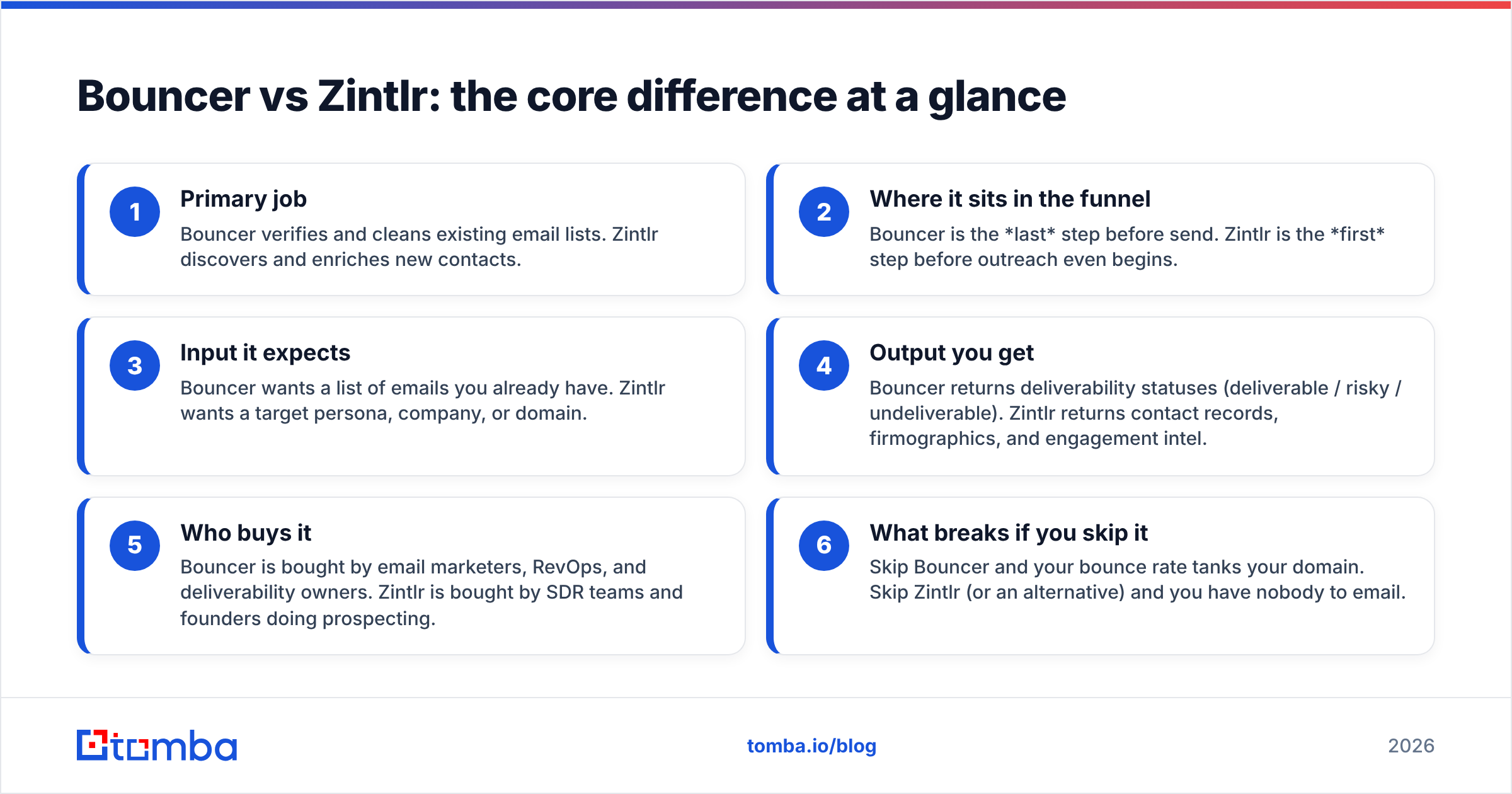
Here's the structured breakdown of where each tool actually operates:
- Primary job — Bouncer verifies and cleans existing email lists. Zintlr discovers and enriches new contacts.
- Where it sits in the funnel — Bouncer is the last step before send. Zintlr is the first step before outreach even begins.
- Input it expects — Bouncer wants a list of emails you already have. Zintlr wants a target persona, company, or domain.
- Output you get — Bouncer returns deliverability statuses (deliverable / risky / undeliverable). Zintlr returns contact records, firmographics, and engagement intel.
- Who buys it — Bouncer is bought by email marketers, RevOps, and deliverability owners. Zintlr is bought by SDR teams and founders doing prospecting.
- What breaks if you skip it — Skip Bouncer and your bounce rate tanks your domain. Skip Zintlr (or an alternative) and you have nobody to email.
How do Bouncer and Zintlr compare on features?#
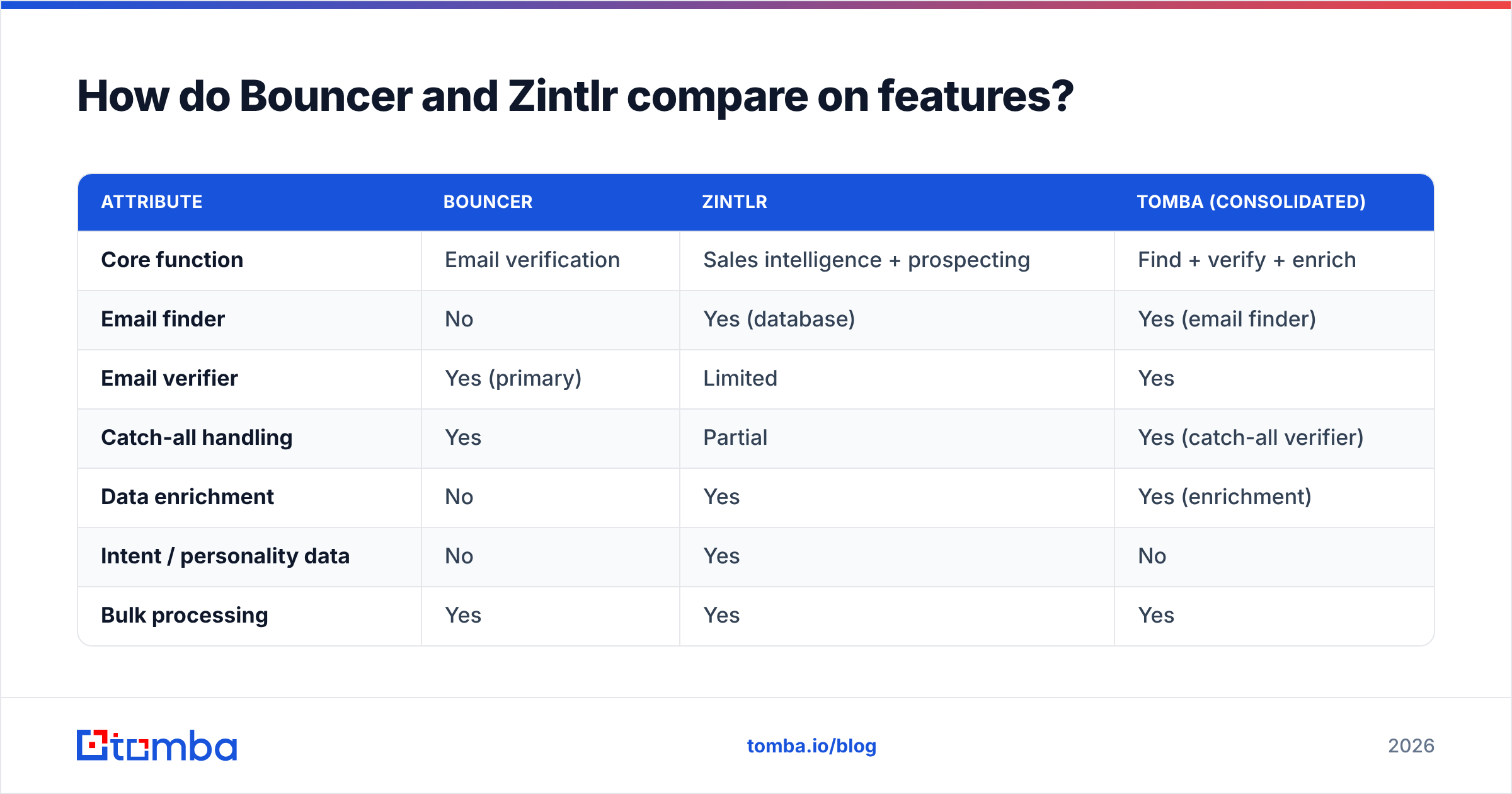
| Attribute | Bouncer | Zintlr | Tomba (consolidated) |
|---|---|---|---|
| Core function | Email verification | Sales intelligence + prospecting | Find + verify + enrich |
| Email finder | No | Yes (database) | Yes (email finder) |
| Email verifier | Yes (primary) | Limited | Yes |
| Catch-all handling | Yes | Partial | Yes (catch-all verifier) |
| Data enrichment | No | Yes | Yes (enrichment) |
| Intent / personality data | No | Yes | No |
| Bulk processing | Yes | Yes | Yes |
| API access | Yes | Yes | Yes (Tomba API) |
| Free tier | Trial credits | Limited trial | 25 searches/mo free |
| Best for | List hygiene | Net-new prospecting | End-to-end pipeline |
The pattern is clear: Bouncer is deep but narrow, Zintlr is broad on the discovery side, and a consolidated platform tries to remove the seams between stages.
)
Wait — that's the point of the meme above: one strong, consolidated workflow beats bolting point tools together and hoping the handoffs hold.
Which one is more accurate?#
They're measuring different things, so "accuracy" means two different claims.
For Bouncer, accuracy is about verification precision — how reliably it labels an address as deliverable without false positives (saying an address is good when it bounces) or false negatives (flagging a good address as risky). Bouncer publishes strong deliverability claims and is well-reviewed for this on G2, and for pure list-cleaning it does the job most teams need.
For Zintlr, accuracy is about data freshness and match rate — what percentage of contacts it can find for a given target, and how current the emails and phone numbers are. Sales intelligence databases live and die on this, and like every database vendor, real-world match rates vary by region, seniority, and industry. Treat any headline "95% accurate" number — from any vendor — as a best case, not a guarantee.
The honest takeaway: Bouncer's verification is more battle-tested as a single-purpose engine, while Zintlr's database accuracy is harder to pin down because it depends entirely on which slice of the market you sell into. If accuracy of deliverability is your worry, verification is the lever — and you can get verification without committing to either by testing a free email checker first.
How does pricing compare for Bouncer vs Zintlr?#
Pricing philosophy is where these two diverge hardest.
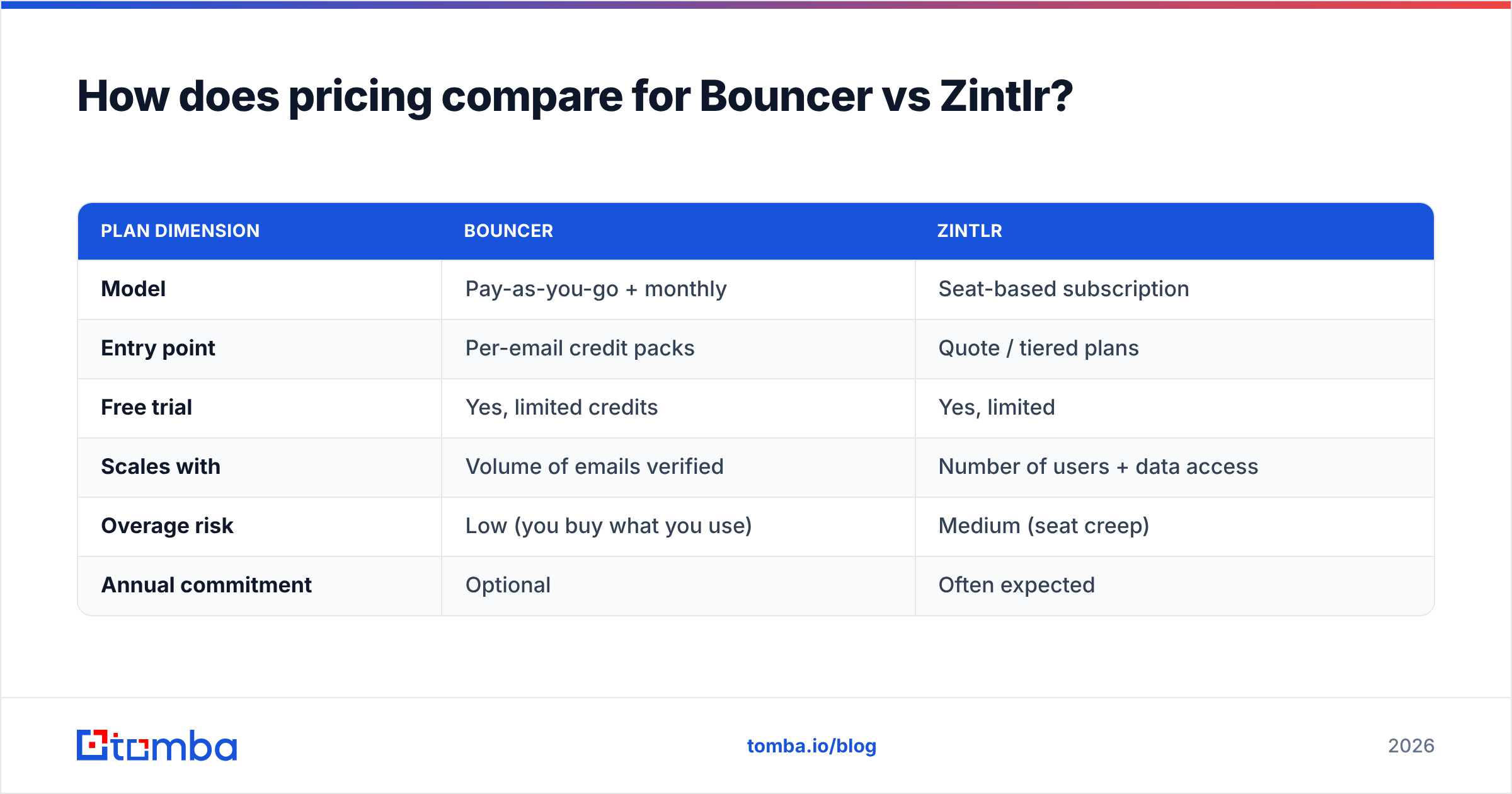
| Plan dimension | Bouncer | Zintlr |
|---|---|---|
| Model | Pay-as-you-go + monthly | Seat-based subscription |
| Entry point | Per-email credit packs | Quote / tiered plans |
| Free trial | Yes, limited credits | Yes, limited |
| Scales with | Volume of emails verified | Number of users + data access |
| Overage risk | Low (you buy what you use) | Medium (seat creep) |
| Annual commitment | Optional | Often expected |
Bouncer's pay-as-you-go approach is friendly for spiky usage — you verify a big list once a quarter and pay only for that. Zintlr's seat-based model makes sense if you have a team of SDRs hammering the database daily, but it gets expensive if only one or two people actually use it.
The hidden cost in either case is the second tool you'll still need to buy. Bouncer doesn't find emails; Zintlr's verification is not its strength. Run both and you're paying two vendors, learning two dashboards, and maintaining two API integrations. Compare that against consolidated Tomba pricing — Free (25 searches/mo), Starter $49/mo, Growth $99/mo, Pro $249/mo — where finding, verifying, and enriching all live behind one bill.
)
When should you choose Bouncer?#
Choose Bouncer when:
- You already have lists from events, signups, an old CRM, or a finder — and you need them clean before sending.
- Deliverability is your active fire. Bounce rates are climbing, your domain reputation is slipping, and you need a focused tool to stop the bleeding.
- You verify in bursts. Pay-as-you-go suits teams that clean a large list occasionally rather than continuously.
- You want a narrow, reliable tool and are happy to pair it with a separate source of contacts.
Bouncer is a good email verifier. The case against it is never quality — it's scope. It is one ingredient, not the meal. If you're shopping at this layer, it's worth seeing how a built-in verifier compares; here's the Bouncer alternative angle if you'd rather not run a standalone tool.
When should you choose Zintlr?#
Choose Zintlr when:
- Your pipeline is empty and the bottleneck is finding the right people, not cleaning a list.
- Your reps want research depth — personality insights, company context, and engagement signals to personalize outreach.
- You have a team large enough to justify seat-based pricing and to actually use the database daily.
- You sell into segments Zintlr covers well. Database value is regional and vertical-specific, so validate match rates on your real ICP during the trial.
Zintlr is solving the front of the funnel. But note what it doesn't fully own: clean, verified email at the moment of send. Most teams running a sales-intelligence platform still bolt on a dedicated verification step before launching a sequence — which loops you right back to needing two tools.
Is there a way to avoid buying both?#
Yes — and this is the strategic point most "X vs Y" posts skip.
The outbound workflow is find → enrich → verify → send. Bouncer owns "verify." Zintlr owns "find" (and some "enrich"). Neither covers the full chain, so the realistic comparison isn't Bouncer vs Zintlr — it's Bouncer + Zintlr versus a single platform that does all three.
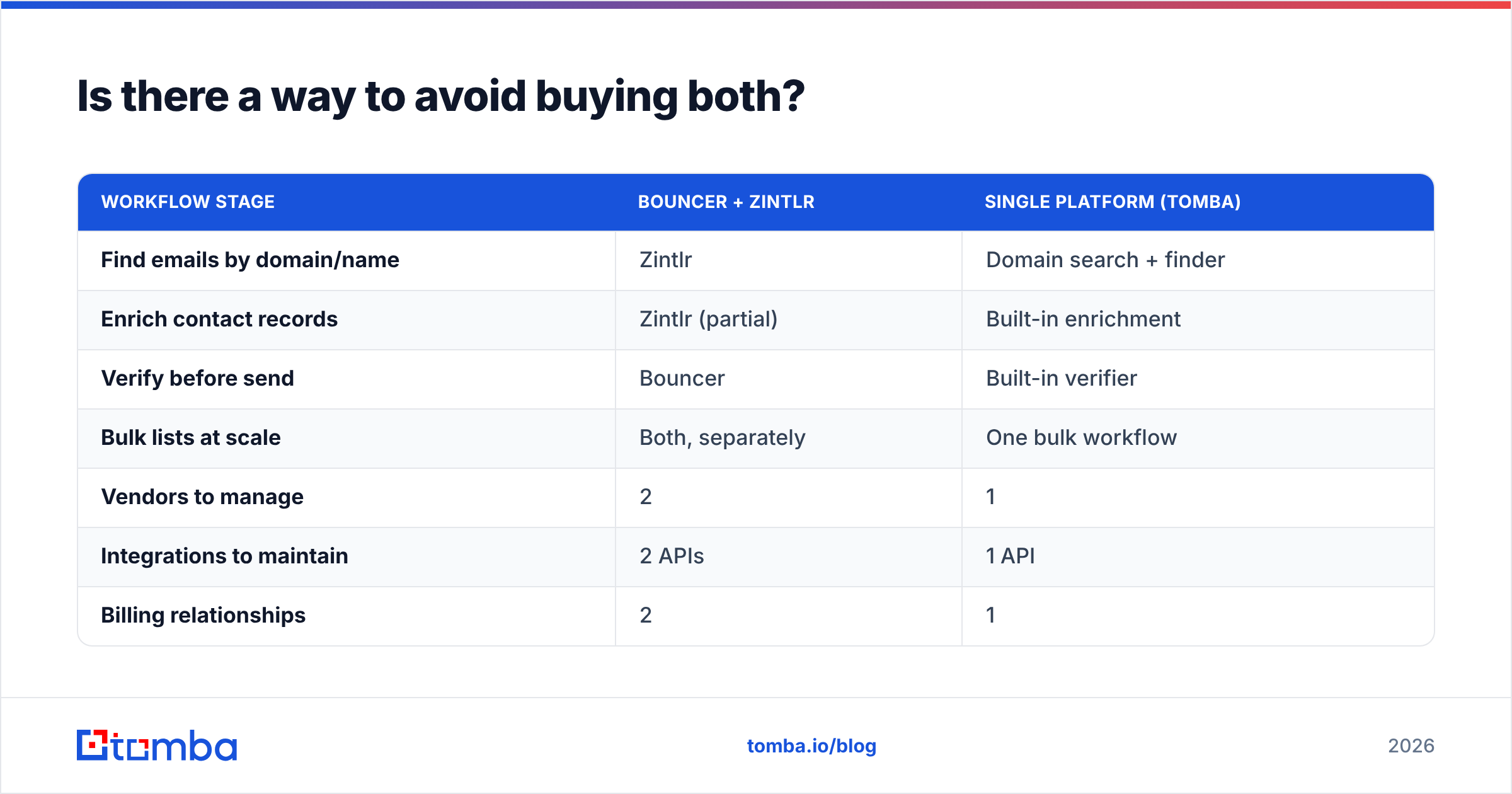
Here's how the consolidated approach stacks up against running both point tools:
| Workflow stage | Bouncer + Zintlr | Single platform (Tomba) |
|---|---|---|
| Find emails by domain/name | Zintlr | Domain search + finder |
| Enrich contact records | Zintlr (partial) | Built-in enrichment |
| Verify before send | Bouncer | Built-in verifier |
| Bulk lists at scale | Both, separately | One bulk workflow |
| Vendors to manage | 2 | 1 |
| Integrations to maintain | 2 APIs | 1 API |
| Billing relationships | 2 | 1 |
A consolidated platform won't beat Zintlr on personality/intent data — that's a specialized layer Tomba doesn't try to own, and if intent insights are core to your motion, Zintlr earns its seat. But for the find-and-verify backbone that most outbound teams actually run on, collapsing two vendors into one removes the handoff failures, the duplicate billing, and the "which tool has the source of truth" arguments that quietly eat RevOps time.
What does the verdict actually depend on?#
The conclusion first: there is no universal winner, because Bouncer and Zintlr aren't competitors — they're neighbors.
- If your only problem is bounce rates and list hygiene, Bouncer is the cleaner, more focused buy.
- If your only problem is not having enough qualified contacts, Zintlr (or another sales-intelligence source) is what moves the needle.
- If your problem is both — which it usually is — then buying two single-purpose tools is the expensive path, and a consolidated finder-plus-verifier is worth a serious look before you sign two contracts.
The trap is framing this as a duel and picking one, only to discover three months later that you bought the grocery store but forgot the knife (or vice versa). Map your actual funnel gap first, then buy to that gap.
Where does Tomba fit?#
If your real need is the find → verify → enrich backbone in one place — without stitching Zintlr's discovery to Bouncer's cleaning across two bills and two APIs — start with the Tomba Email Finder. It locates professional email addresses by domain, name, or company, runs verification on the same platform, and enriches the records you pull, so a contact goes from "discovered" to "safe to send" without leaving the dashboard. There's a free tier (25 searches/mo) to test it against your real ICP before you commit, and the Tomba API drops the whole workflow into your existing stack. Pair it with a specialist like Zintlr only if intent and personality data are central to your motion — otherwise, one platform is very likely all the backbone you need.
// get started
Find, verify and enrich your first contacts today
Start on the free plan with 25 searches a month, then scale when your team is ready.
Free plan · No credit card required · GDPR & CCPA
// about the author