Bouncer vs ZoomInfo 2026: Email Verification vs B2B Data
Bouncer cleans your list; ZoomInfo builds it. We break down the real Bouncer vs ZoomInfo trade-off on accuracy, pricing, and fit — plus a cheaper hybrid.
Comparing Bouncer vs ZoomInfo feels like comparing a dishwasher to a grocery store. One cleans what you already have; the other stocks the shelves. They get lumped together in "best B2B tools" lists, but they solve opposite ends of the same pipeline — and buying the wrong one wastes thousands of dollars and a quarter of pipeline.
This guide separates the two, shows where each actually earns its price, and explains the hybrid most teams quietly run instead of paying for either at full freight.
TL;DR#
- Bouncer is an email verification tool. It tells you whether an address will bounce. It does not find new contacts.
- ZoomInfo is a B2B data and sales-intelligence platform. It finds contacts, firmographics, and intent signals — but it is expensive, annual-contract only, and its data ages fast.
- They are not direct competitors. Bouncer cleans lists; ZoomInfo builds them. Many teams need a finder and a verifier, which is neither tool's full job.
- Pricing gap is huge: Bouncer is pay-as-you-go from a few dollars per thousand checks; ZoomInfo routinely lands at $15,000+/year on annual lock-in.
- The cheaper middle path: a combined finder-plus-verifier like Tomba covers discovery and validation from $49/mo without a 12-month contract.
What is the real difference between Bouncer and ZoomInfo?#
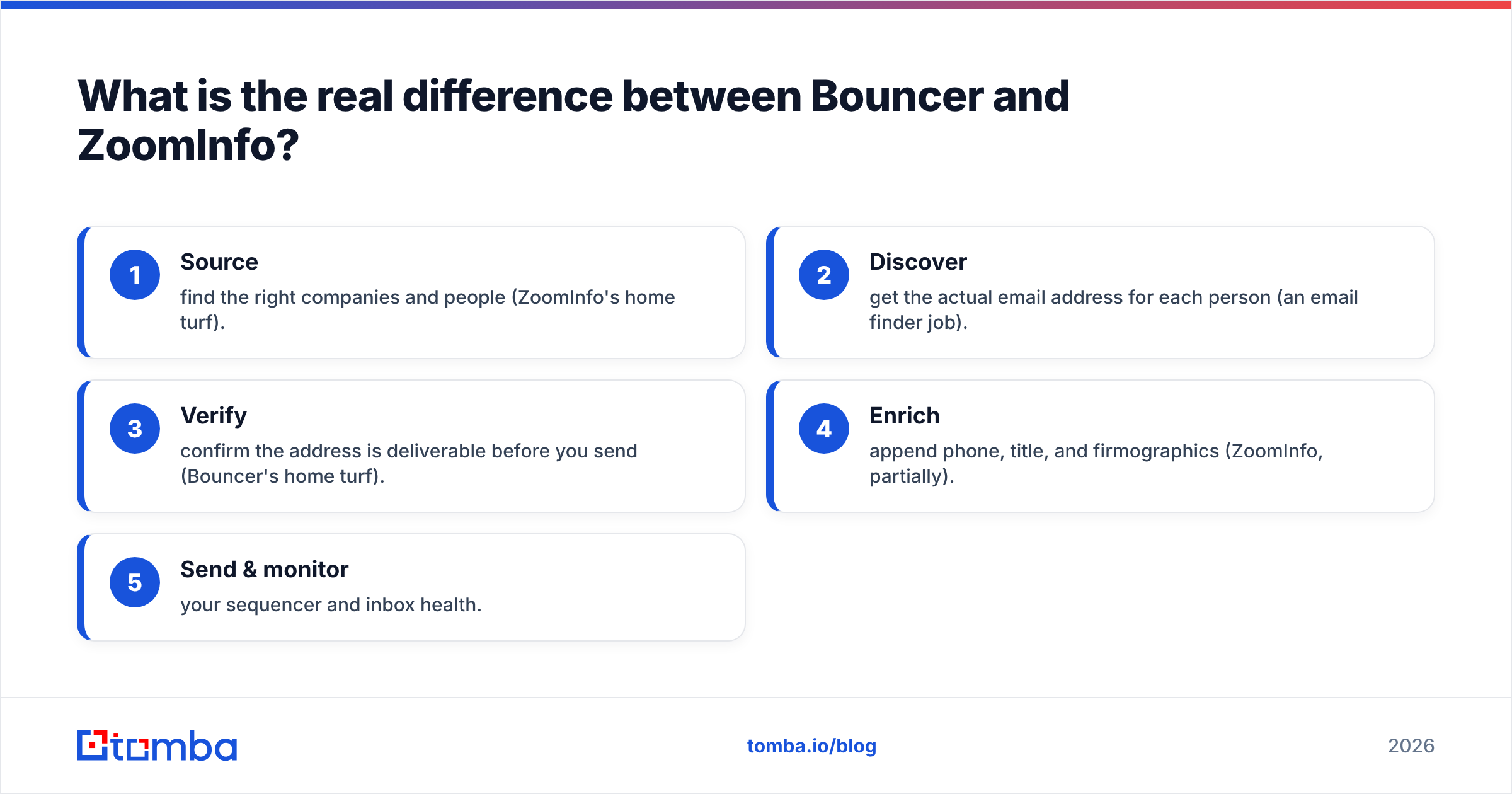
The conclusion first: Bouncer verifies, ZoomInfo discovers. If you already have a list and worry about bounces, that is a Bouncer problem. If you have an empty CRM and need names, titles, and companies, that is a ZoomInfo problem. Choosing between them only makes sense once you know which problem you actually have.
Here is the pipeline they sit in:
- Source — find the right companies and people (ZoomInfo's home turf).
- Discover — get the actual email address for each person (an email finder job).
- Verify — confirm the address is deliverable before you send (Bouncer's home turf).
- Enrich — append phone, title, and firmographics (ZoomInfo, partially).
- Send & monitor — your sequencer and inbox health.
Bouncer owns step 3. ZoomInfo owns steps 1 and 4, and claims step 2. Neither covers the whole line, which is why the "vs" framing is slightly misleading — and why so many teams end up paying for two or three tools.

What is Bouncer and who is it for?#
Bouncer (usebouncer.com) is a dedicated email verification and deliverability tool. You upload a list — or hit the API — and it checks each address through syntax validation, MX-record lookups, SMTP probing, and risk scoring. The output sorts every address into deliverable, undeliverable, risky, or unknown.
What Bouncer does well:
- High verification accuracy with a low false-positive rate on standard mailboxes.
- Toxicity and risk detection — spot traps, complainers, and disposable domains before they tank your sender reputation.
- A genuinely usable catch-all verifier layer, which is where most cheap verifiers fall apart.
- Pay-as-you-go credits with no forced annual contract — you buy what you need.
- Privacy posture (SOC 2, GDPR) that survives procurement review.
What Bouncer does not do: find a single new contact. If your list is empty, Bouncer has nothing to clean. It is a finishing tool, not a sourcing tool. Teams that love Bouncer usually already have a steady inflow of raw addresses — from a finder, a form, an export, or a scrape — and need to scrub them before they hit the sequencer.
What is ZoomInfo and who is it for?#
ZoomInfo (zoominfo.com) is the enterprise heavyweight of B2B data. It is a full sales-intelligence platform: a contact and company database, intent data, org charts, technographics, workflow automation, and a stack of CRM integrations. Its database runs into the hundreds of millions of contacts.
Where ZoomInfo earns its keep:
- Breadth of firmographic and technographic data — company size, revenue, tech stack, hierarchy.
- Intent signals that flag accounts researching your category right now.
- Deep Salesforce integration and enrichment workflows baked into the CRM.
- Scale — for a 50-rep org blanketing a market, the coverage is hard to match.
The catches are real and well documented on review sites like G2:
- Annual contracts only, frequently starting around $15,000/year and climbing fast with seats and add-ons.
- Aggressive renewal and overage terms that surprise smaller teams.
- Data decay — B2B contact data rots at roughly 2–3% per month, so even a great database needs constant verification you still have to do (or pay extra for).
- Overkill for SMBs — most of the platform goes unused if you are a five-person team running targeted outbound.
ZoomInfo is for funded, multi-rep sales orgs that will use the intent data and the org charts. For a lean team that just needs accurate emails, it is a Ferrari bought to drive to the mailbox.
How do Bouncer and ZoomInfo compare side by side?#
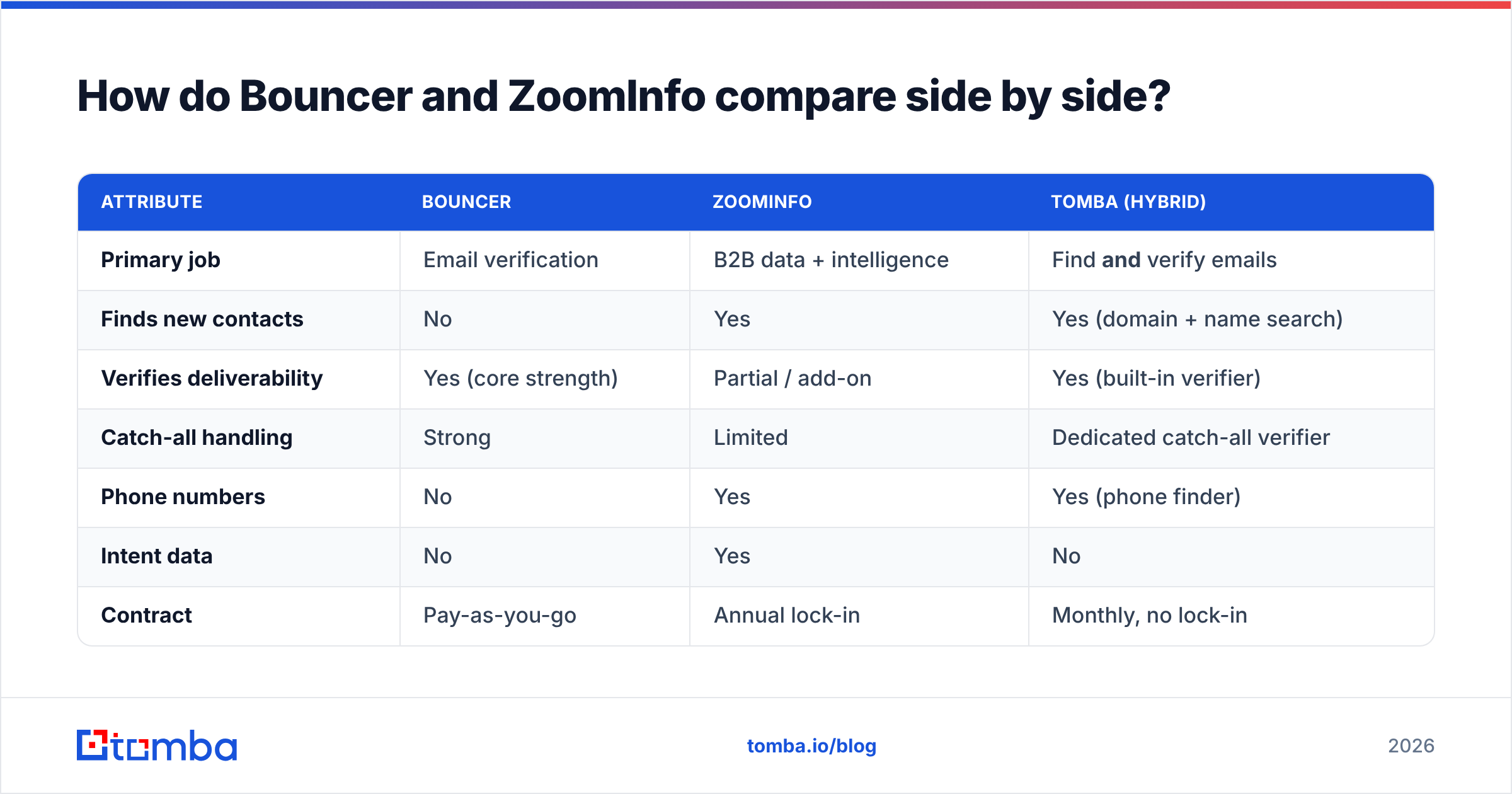
| Attribute | Bouncer | ZoomInfo | Tomba (hybrid) |
|---|---|---|---|
| Primary job | Email verification | B2B data + intelligence | Find and verify emails |
| Finds new contacts | No | Yes | Yes (domain + name search) |
| Verifies deliverability | Yes (core strength) | Partial / add-on | Yes (built-in verifier) |
| Catch-all handling | Strong | Limited | Dedicated catch-all verifier |
| Phone numbers | No | Yes | Yes (phone finder) |
| Intent data | No | Yes | No |
| Contract | Pay-as-you-go | Annual lock-in | Monthly, no lock-in |
| Entry price | ~$8 / 1k credits | ~$15,000+/yr | $49/mo |
| Free tier | Limited trial | No | 25 searches/mo |
| Best for | Cleaning existing lists | Enterprise market coverage | SMB & mid-market outbound |
Read the table by your bottleneck, not by feature count. If your bounce rate is the fire, Bouncer puts it out cheaply. If your CRM is empty, neither Bouncer nor a pure verifier helps — you need discovery, and that is where the comparison usually breaks toward a finder.
Is Bouncer better than ZoomInfo for deliverability?#
Yes — and it is not close, because deliverability is not what ZoomInfo is built to do. Bouncer's entire reason to exist is keeping your bounce rate under the ~2% threshold that mailbox providers use as a spam signal. ZoomInfo gives you addresses; it does not aggressively re-verify each one at send time, which is why teams routinely run ZoomInfo exports through a verifier before sending.
That is the dirty secret of the "ZoomInfo replaces a verifier" pitch: it does not. A contact that was valid when ZoomInfo last refreshed it may be a former employee today. Sending to it bounces, and bounces compound into reputation damage. Whether you use Bouncer, a built-in email verifier, or anything else, verification is a step you still own after ZoomInfo hands you data.
If protecting sender reputation is your priority, a verification layer is non-negotiable — and that layer is cheap relative to a data subscription.
Where does ZoomInfo clearly win?#
Be honest about it: for large, well-funded sales orgs, ZoomInfo does things Bouncer never attempts.
- Total addressable market mapping — pull every company in a segment with revenue, headcount, and tech filters.
- Buying-intent timing — reach accounts while they are actively researching, not cold.
- Org-chart navigation — find the economic buyer above the champion you already know.
- Enrichment at CRM scale — auto-append fields across thousands of existing records.
If you have the budget, the headcount to use it, and a motion that depends on intent and account intelligence, ZoomInfo is a category leader for a reason. The problem is almost never capability — it is whether you will use enough of the platform to justify a five-figure annual commitment.
How much do Bouncer and ZoomInfo cost in 2026?#
This is where most decisions actually get made. Bouncer is consumption-priced — you pay per verification, scaling down per thousand as volume rises, with no annual handcuffs. ZoomInfo is a seat-plus-platform annual contract, and the sticker you see in a demo is rarely the renewal you sign.
For a small or mid-market team, the gap is stark. You can verify a six-figure list on Bouncer for a few hundred dollars, while a single ZoomInfo seat can cost more than your entire annual tooling budget. That asymmetry is exactly why the "do I even need a full data platform?" question is worth asking before you sign.

If the honest answer is "I mostly just need accurate emails for the accounts I already target," you are paying enterprise prices for a fraction of the value. That is the gap a hybrid finder-verifier fills.
Do you actually need both — or is there a third option?#
Here is the move most lean teams make: skip the ZoomInfo-vs-Bouncer dilemma entirely and run a single tool that finds and verifies in one pass. You still get discovery (the ZoomInfo job) and clean lists (the Bouncer job) without buying two subscriptions or signing an annual contract.
Tomba is built for exactly this middle. It combines:
- Email Finder — get a verified address from a name and domain, the discovery step ZoomInfo charges a platform fee for.
- Domain Search — pull every public email pattern at a target company in one query.
- Built-in verification and a catch-all verifier — the Bouncer job, included, so addresses are validated as they are found.
- Bulk processing and an email finder API for programmatic enrichment.
- Phone finder for direct dials when email is not enough.
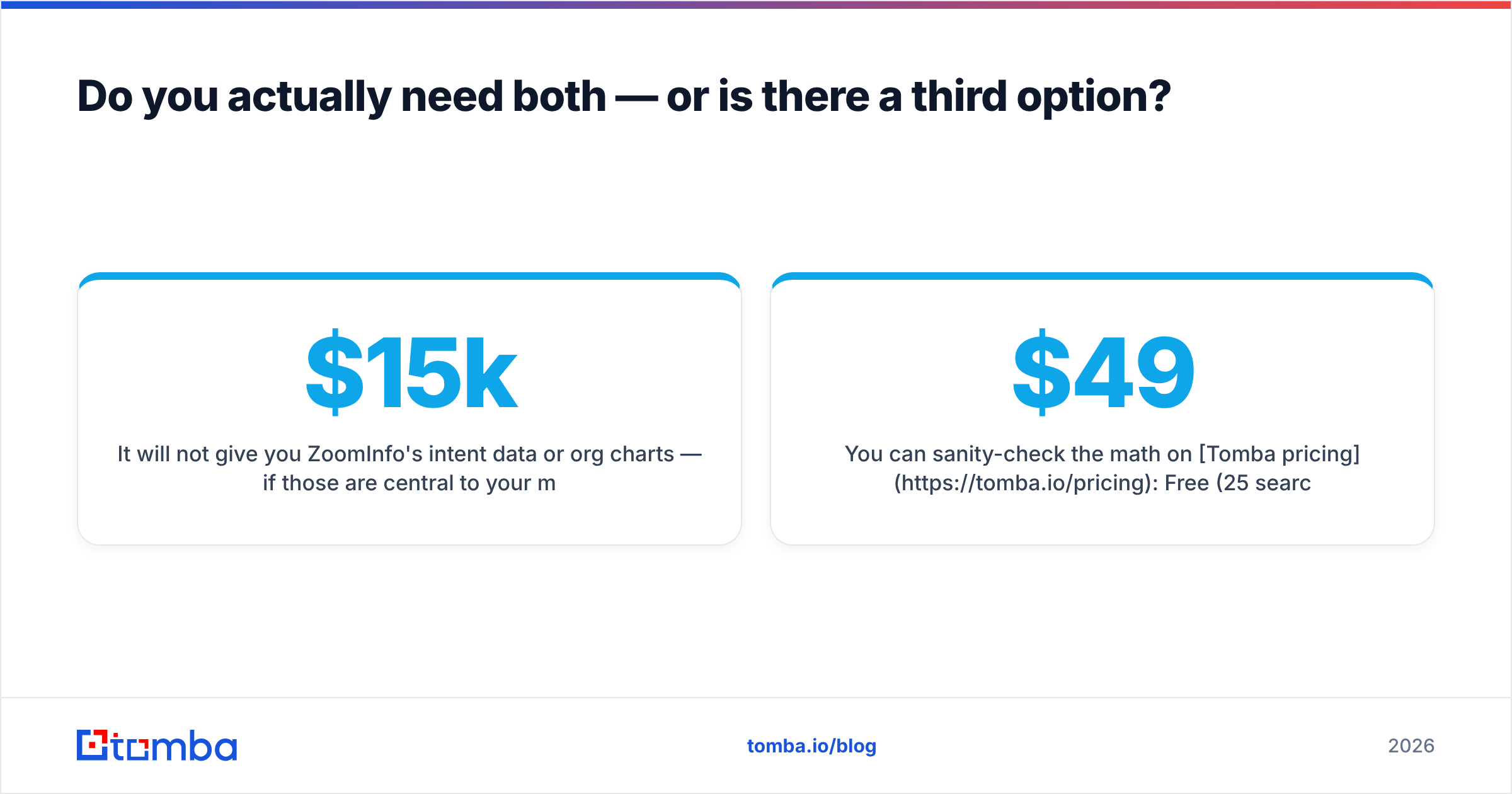
It will not give you ZoomInfo's intent data or org charts — if those are central to your motion, ZoomInfo stays on the table. But for teams whose real need is "accurate contacts I can email without bouncing," paying for find-and-verify in one place beats stitching a $15k data platform to a separate verifier.
You can sanity-check the math on Tomba pricing: Free (25 searches/mo), Starter $49/mo, Growth $99/mo, Pro $249/mo, Enterprise custom — monthly, cancel anytime.
Which should you choose?#
Match the tool to your actual bottleneck:
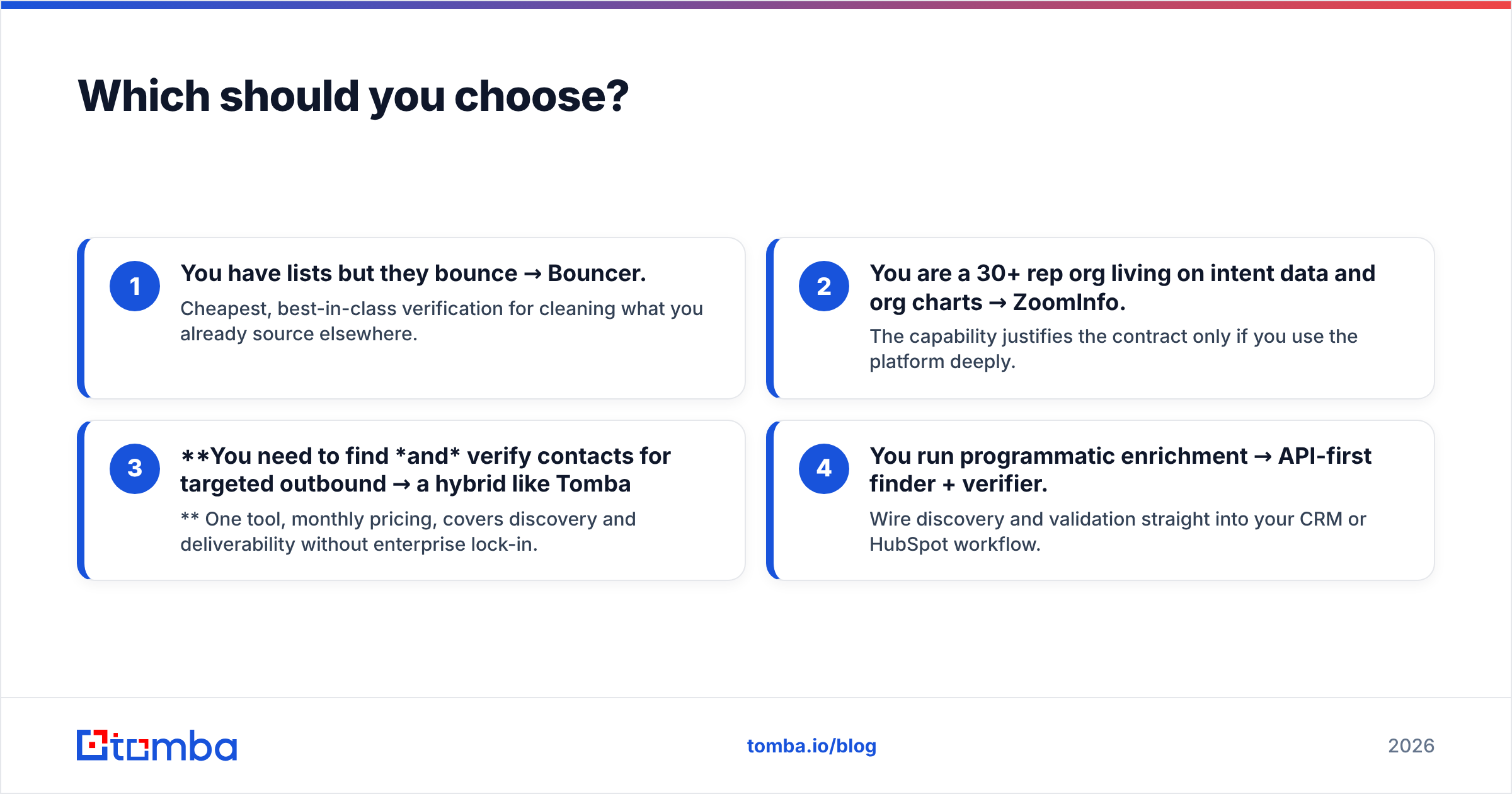
- You have lists but they bounce → Bouncer. Cheapest, best-in-class verification for cleaning what you already source elsewhere.
- You are a 30+ rep org living on intent data and org charts → ZoomInfo. The capability justifies the contract only if you use the platform deeply.
- You need to find and verify contacts for targeted outbound → a hybrid like Tomba. One tool, monthly pricing, covers discovery and deliverability without enterprise lock-in.
- You run programmatic enrichment → API-first finder + verifier. Wire discovery and validation straight into your CRM or HubSpot workflow.
The mistake is treating "Bouncer vs ZoomInfo" as one decision. They are two different line items solving two different problems, and for most teams the smartest spend is neither at full price.
Frequently asked questions#
Is Bouncer a ZoomInfo competitor? Not really. Bouncer verifies email deliverability; ZoomInfo sources contact and company data. They overlap only at the edges. A closer competitor to ZoomInfo on the discovery side is an email finder; a closer competitor to Bouncer is a standalone email verifier.
Can ZoomInfo replace an email verifier? No. ZoomInfo's data decays like all B2B data, so you should still verify exports before sending. Treat verification as a separate, mandatory step regardless of where the data came from.
What is the cheapest way to get verified emails? A combined finder-verifier on a monthly plan. You avoid both ZoomInfo's annual contract and the need to pay separately for a verifier, since validation is built into the discovery step.
Does Bouncer find phone numbers? No. Bouncer is email-only. For direct dials you need a phone finder or a platform like ZoomInfo that includes phone data.
The bottom line#
Bouncer and ZoomInfo are not rivals — they are two stages of the same pipeline, priced worlds apart. Buy Bouncer to clean lists, buy ZoomInfo to map a market at enterprise scale, and recognize that most teams sitting in the middle need find plus verify without either bill.
If that is you, start with the Tomba Email Finder. Discover verified, deliverable emails by name or domain, validate catch-alls, and export clean lists — from a free tier up through plans that stay under what a single ZoomInfo seat costs. Run a search, check the accuracy against your own targets, and decide with data instead of a sales demo.
// get started
Find, verify and enrich your first contacts today
Start on the free plan with 25 searches a month, then scale when your team is ready.
Free plan · No credit card required · GDPR & CCPA
// about the author