Bounceremove vs Dealsignal: Best B2B Data Tool for 2026?
Bounceremove cleans your list; Dealsignal builds it. We compare accuracy, pricing, and workflow fit so you know which one your 2026 outbound motion actually needs.
You typed "Bounceremove vs Dealsignal" into a search bar because two vendors are sitting in two browser tabs and your budget only stretches to one. The honest answer is that they barely compete. One scrubs the list you already have; the other sells you a brand-new list. Picking between them without understanding that split is how teams end up paying for a tool that solves a problem they don't have.
This guide breaks down what each tool actually does, where they overlap, what they cost, and which job you're really trying to get done.
TL;DR#
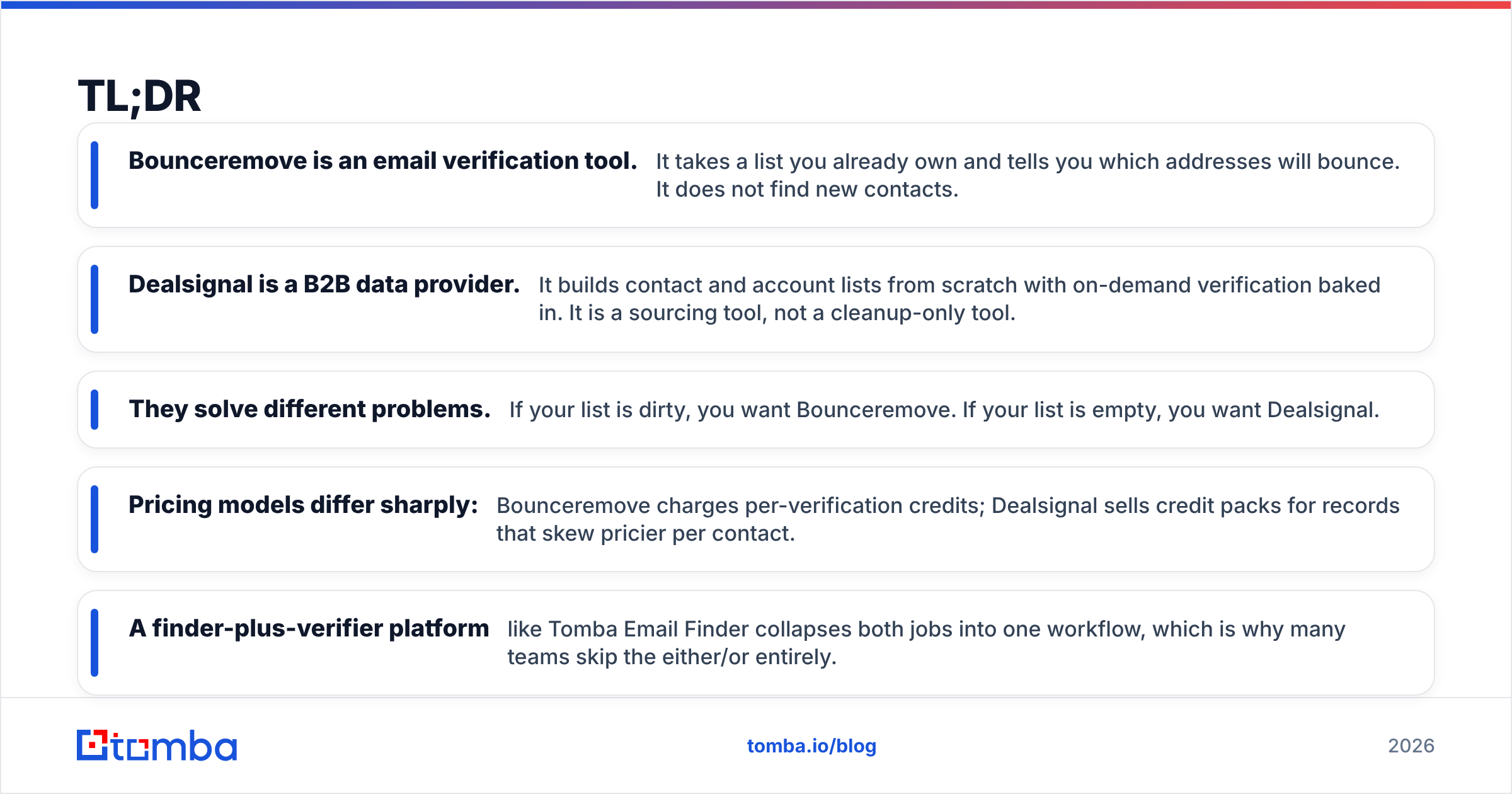
- Bounceremove is an email verification tool. It takes a list you already own and tells you which addresses will bounce. It does not find new contacts.
- Dealsignal is a B2B data provider. It builds contact and account lists from scratch with on-demand verification baked in. It is a sourcing tool, not a cleanup-only tool.
- They solve different problems. If your list is dirty, you want Bounceremove. If your list is empty, you want Dealsignal.
- Pricing models differ sharply: Bounceremove charges per-verification credits; Dealsignal sells credit packs for records that skew pricier per contact.
- A finder-plus-verifier platform like Tomba Email Finder collapses both jobs into one workflow, which is why many teams skip the either/or entirely.
What is Bounceremove?#
Bounceremove is a bulk email verifier. Think of it as the bouncer at the door of your email campaign: every address on your list walks up, and Bounceremove checks the ID before letting it through. Invalid, risky, and catch-all addresses get flagged so they never reach your sending platform.
Technically, it runs the standard verification stack: syntax checks, MX record lookups, SMTP handshake probes, and disposable-domain and role-account detection. You upload a CSV (or hit the API), it processes the list, and you download a file segmented into deliverable, risky, and undeliverable.
What Bounceremove does not do is find anyone. If you hand it an empty spreadsheet, it has nothing to chew on. It assumes you already sourced your contacts somewhere else — a scrape, an export, a trade-show badge dump — and now you need that pile cleaned before you send.
That single-purpose focus is the whole pitch. It's fast, it's cheap per check, and it keeps your bounce rate low, which protects your sender reputation and keeps you out of spam folders.

Wait — that meme is the point: piping a raw CSV through a manual cleanup step feels strong until you realize an API-native workflow does the same job without the upload-download shuffle.

What is Dealsignal?#
Dealsignal is a B2B contact and account database. Instead of cleaning your list, it is the list. You set filters — industry, title, company size, location, technologies used — and Dealsignal returns matching contacts with emails and direct-dial phone numbers attached.
The platform's differentiator is on-demand verification: rather than serving stale records from a cache, Dealsignal claims to re-verify contact details at the point you pull them, aiming for high deliverability on freshly sourced data. It positions itself against the likes of ZoomInfo and Lusha as a more affordable account-based-marketing data source.
So Dealsignal sits one step earlier in the funnel than Bounceremove. It answers "who should I email?" not "will this email bounce?" You can read more about how database-style sourcing works on the Tomba B2B database page, which follows the same find-then-enrich pattern.
The catch with any pure data provider is that you're trusting their coverage and freshness. Data decays — people change jobs at roughly 30% per year — so a record sourced in January can be wrong by June regardless of how it was verified on day one.
Bounceremove vs Dealsignal: how do they compare?#
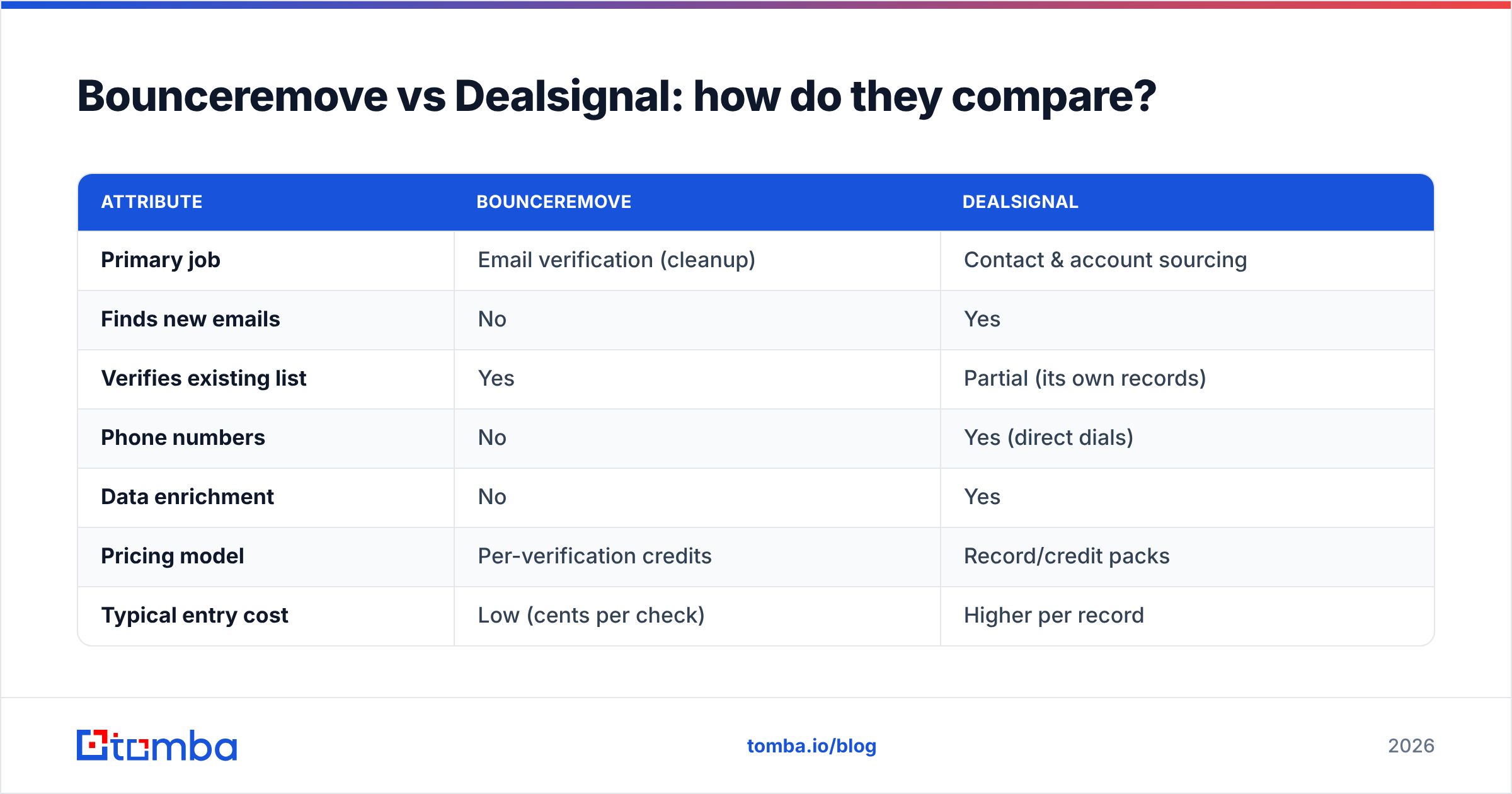
Here's the head-to-head on the attributes that actually drive a buying decision.
| Attribute | Bounceremove | Dealsignal |
|---|---|---|
| Primary job | Email verification (cleanup) | Contact & account sourcing |
| Finds new emails | No | Yes |
| Verifies existing list | Yes | Partial (its own records) |
| Phone numbers | No | Yes (direct dials) |
| Data enrichment | No | Yes |
| Pricing model | Per-verification credits | Record/credit packs |
| Typical entry cost | Low (cents per check) | Higher per record |
| Best for | Lowering bounce rate | Building a target list |
| API access | Yes | Yes |
| Free trial | Limited credits | Demo/trial credits |
The table makes the real question obvious: you're not choosing the "better tool," you're diagnosing which problem you have. Two teams with the same budget should buy different products here.
When Bounceremove is the right call#
- You already have a big list. A scraped or exported pile of addresses that's never been validated is exactly what Bounceremove exists for.
- Your bounce rate is climbing. If mailbox providers are starting to throttle you, scrubbing before each send is the fastest fix.
- You don't need new contacts. Your sourcing is handled elsewhere and you just need a deliverability gate.
- You want the cheapest possible per-check cost. Single-purpose verifiers usually undercut full platforms on raw verification price.
When Dealsignal is the right call#
- You're starting from zero. No list, no CRM exports, just an ideal-customer profile in your head.
- You need phone numbers too. Direct dials matter for a calling motion, and verifiers can't give you those.
- You want account-level targeting. Filtering by firmographics and technographics is sourcing work, not cleanup work.
- You're replacing an expensive incumbent. Teams shopping a Clearbit alternative or a cheaper ZoomInfo often land on data providers like this.
Which is more accurate?#
Accuracy means different things for each tool, so a single leaderboard would be misleading.
For Bounceremove, accuracy is bounce prediction: of the addresses it labels "deliverable," how many actually land? Good verifiers cluster in the 95–99% range on clean syntax, with catch-all domains being the universal weak spot — no SMTP probe can fully confirm an address on a server that accepts everything. That's why a dedicated catch-all verifier matters if catch-all domains are common in your market.
For Dealsignal, accuracy is data correctness at the source: is this the right person, in the right role, with a current email and phone? Here the enemy is decay, not syntax. A provider can verify a record perfectly and still be wrong three months later because the contact got promoted or laid off.
The practical implication: even if you buy from Dealsignal, you should re-verify the list before a big send, because sourced-then-shelved data drifts. And if you only run Bounceremove, you're protecting deliverability but doing nothing about whether the person is still reachable. Neither tool fully covers the other's blind spot, which is the core limitation of buying just one.
For a deeper look at how verification confidence is scored, the Tomba data sources page explains the signals that separate a confident match from a guess. Independent reviews on G2 are also worth scanning before you commit, since vendor-reported accuracy numbers are rarely audited.
How much do they cost in 2026?#
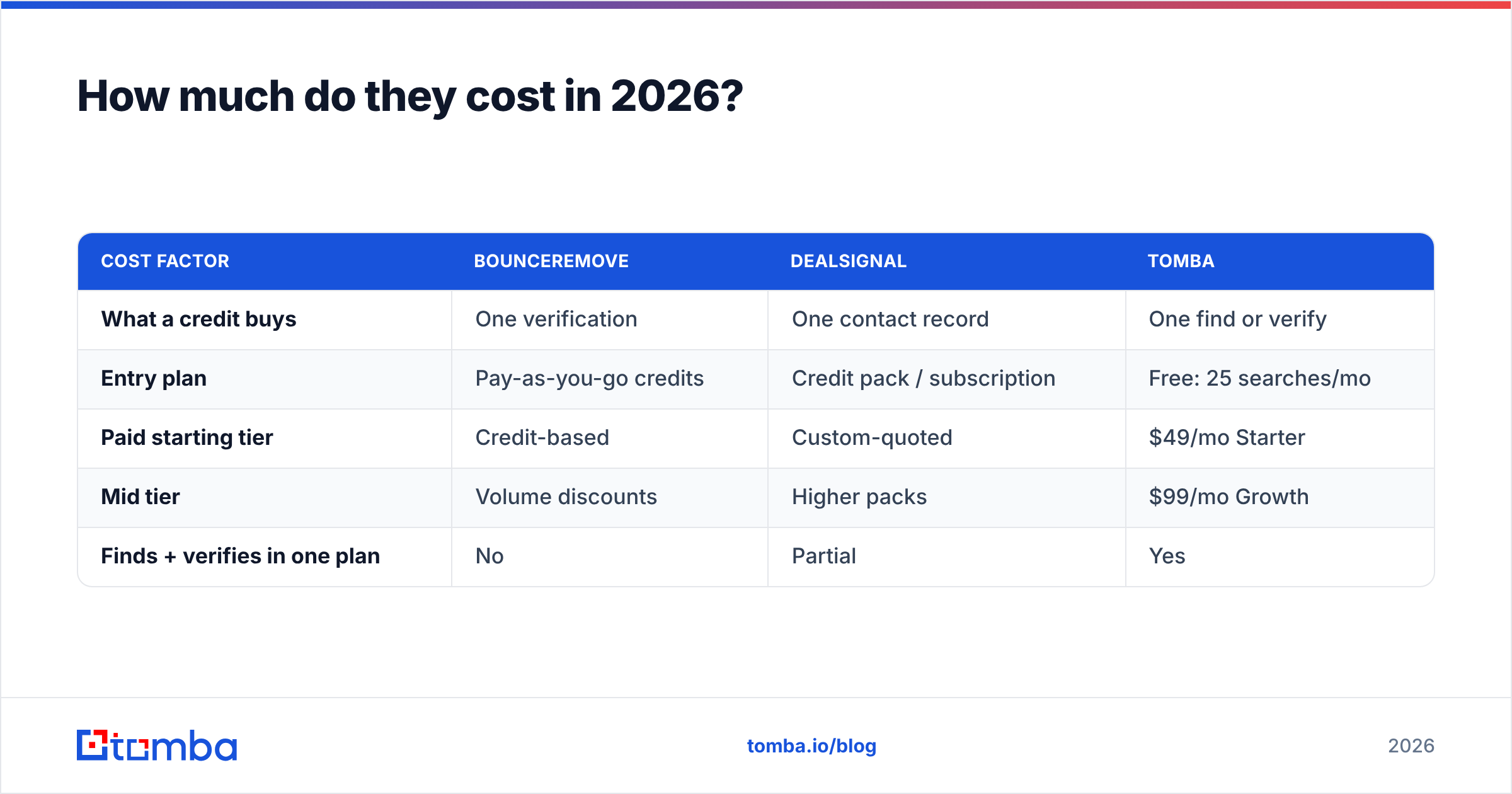
Pricing structure is where the two diverge hardest, and where the "which is cheaper" question gets a frustrating "it depends."
Bounceremove uses per-verification credits: you buy a block, each address checked burns one credit, and the unit cost drops as you buy larger blocks. Verification is a commodity, so the price per check is low — fractions of a cent at volume.
Dealsignal uses record-based credits: you pay to unlock a contact with its full profile, and a single enriched record (email + phone + firmographics) costs far more than a single verification check, because you're buying sourced intelligence, not a yes/no.
| Cost factor | Bounceremove | Dealsignal | Tomba |
|---|---|---|---|
| What a credit buys | One verification | One contact record | One find or verify |
| Entry plan | Pay-as-you-go credits | Credit pack / subscription | Free: 25 searches/mo |
| Paid starting tier | Credit-based | Custom-quoted | $49/mo Starter |
| Mid tier | Volume discounts | Higher packs | $99/mo Growth |
| Finds + verifies in one plan | No | Partial | Yes |
A quick gut check: if you process 50,000 existing addresses a month, Bounceremove's per-check model wins on price. If you need to build 5,000 brand-new verified contacts a month, you're in Dealsignal's lane and paying record prices. Trying to do both with one of them means either paying record prices to verify, or having nothing to verify in the first place.
You can compare a unified credit model against both on the Tomba pricing page, where finding and verifying draw from the same balance.
Is there a tool that does both?#
Yes — and that's the reason a lot of teams never finish the Bounceremove vs Dealsignal debate. The split between "find" and "verify" is an artifact of buying point tools, not a law of nature.
A combined platform like Tomba runs the full sequence in one place: domain search to pull every email pattern at a target company, the email finder to resolve a specific name into an address, and built-in email verification to confirm deliverability before the address ever reaches your sequencer. For calling motions, the phone finder covers the direct-dial gap that pure verifiers can't touch.
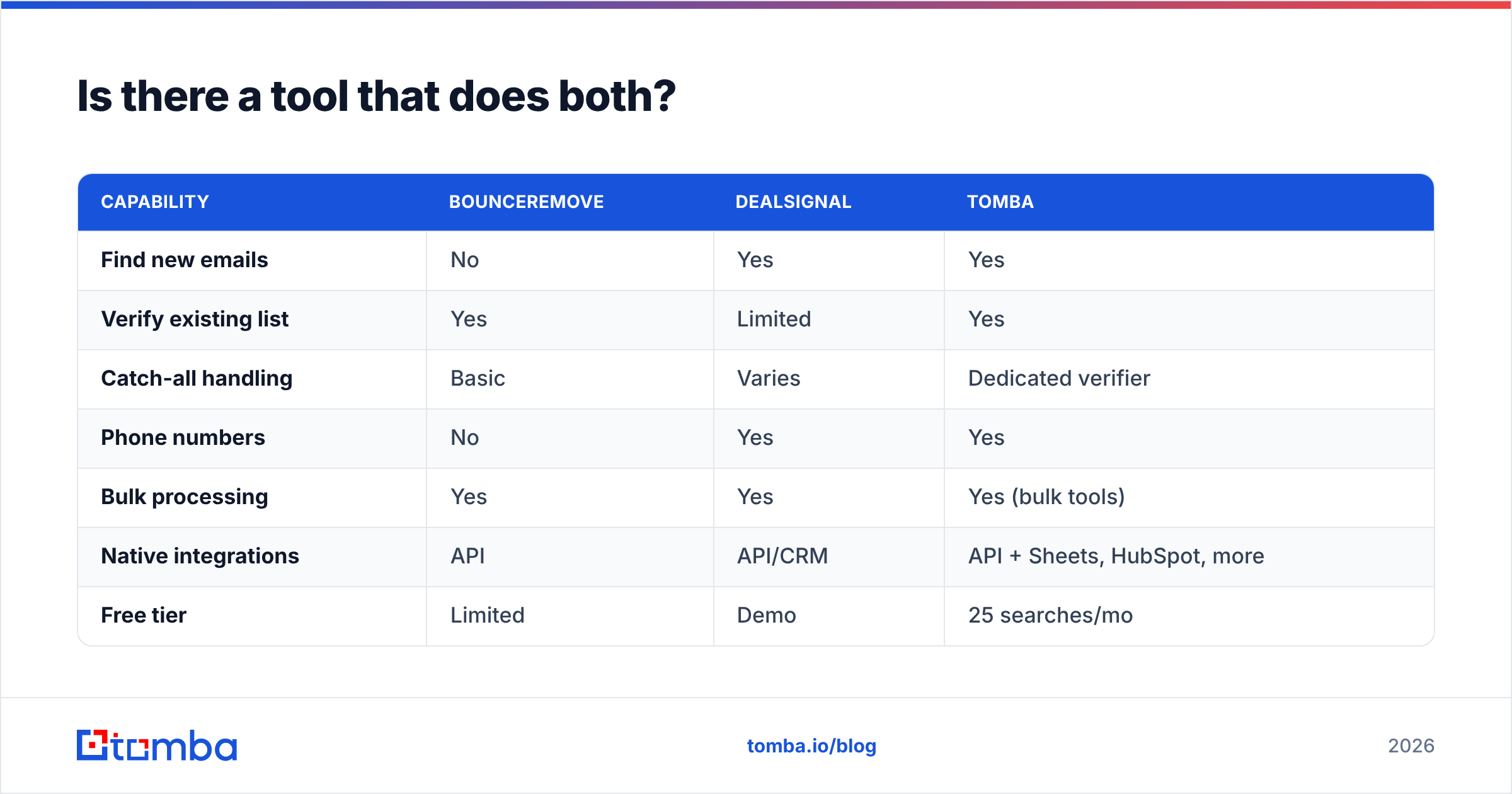
Here's how the three stack up on coverage:
| Capability | Bounceremove | Dealsignal | Tomba |
|---|---|---|---|
| Find new emails | No | Yes | Yes |
| Verify existing list | Yes | Limited | Yes |
| Catch-all handling | Basic | Varies | Dedicated verifier |
| Phone numbers | No | Yes | Yes |
| Bulk processing | Yes | Yes | Yes (bulk tools) |
| Native integrations | API | API/CRM | API + Sheets, HubSpot, more |
| Free tier | Limited | Demo | 25 searches/mo |
The advantage isn't just feature count — it's workflow. When finding and verifying live in the same system, a sourced address is checked the instant it's created, so the decay problem and the bounce problem get solved in a single pass instead of two purchases and two CSV round-trips.
So which should you choose?#
Conclusion first: match the tool to the gap in your funnel, not to the brand with the louder homepage.
- Pick Bounceremove if you have a list and only need it clean. It's a focused, low-cost deliverability gate, and nothing more.
- Pick Dealsignal if you have no list and need account-targeted contacts with phone numbers, and you're comfortable re-verifying as the data ages.
- Pick a combined platform if you'd rather not run two subscriptions, two billing models, and two exports to cover one outbound motion.
Most growing teams discover that the "find vs verify" wall they were trying to budget around dissolves the moment one tool does both. Buying a verifier and a separate data provider is two line items solving halves of the same problem.
If that's your situation, start with the Tomba Email Finder. The free tier gives you 25 searches a month to test real accuracy against your own target accounts, every result is verified before it reaches you, and finding plus verifying draw from a single credit balance — so you stop paying record prices to clean a list, or verification prices to source one. Run your hardest 25 lookups through it before you sign anything else, and let the hit rate make the decision for you.
// get started
Find, verify and enrich your first contacts today
Start on the free plan with 25 searches a month, then scale when your team is ready.
Free plan · No credit card required · GDPR & CCPA
// about the author