Bounceremove vs Forager: Which Email Tool Wins in 2026?
Bounceremove cleans bounces, Forager finds B2B contacts. Here's an honest 2026 breakdown of accuracy, pricing, and which one actually fits your outbound stack.
TL;DR
- Bounceremove is a focused email-verification/bounce-cleaning tool — it tells you which addresses are safe to send to. It does not find new contacts.
- Forager leans the other way: it's a B2B data and email-finding platform built to source fresh contacts, not to deep-clean a list you already own.
- They solve different problems, so "which is better" depends on whether your bottleneck is dirty lists or empty pipelines.
- For most outbound teams, you end up needing both jobs done — and paying two vendors gets expensive fast.
- A single platform that finds and verifies (like Tomba Email Finder) usually beats stitching two single-purpose tools together.
If you're weighing bounceremove vs forager, the honest answer is that you're comparing a scalpel to a fishing net. This post breaks down what each does well, where each falls short, and how to decide without wasting a month of trial credits.
What is Bounceremove and what is Forager?#
Bounceremove is an email verification tool. You upload a list, it pings each address through syntax checks, MX-record lookups, and SMTP handshakes, then hands back a verdict: valid, invalid, risky, or catch-all. Its entire reason to exist is protecting your sender reputation by stripping addresses that would bounce.
Forager is a B2B data and email-finding platform. Its job is the opposite end of the funnel: take a name, a company, or a domain and return a working contact. Think prospect sourcing, enrichment, and list-building rather than list-cleaning.
Here's the everyday analogy: Bounceremove is the bouncer checking IDs at the door — it removes people who shouldn't get in. Forager is the promoter out on the street bringing new people to the door. Useful jobs, but they're not the same job, and hiring one doesn't cover the other.
That distinction matters because a lot of "X vs Y" searches assume the two tools are interchangeable. They aren't. The real question is which gap in your workflow is costing you more right now.

How do Bounceremove and Forager compare at a glance?#
| Attribute | Bounceremove | Forager | Tomba |
|---|---|---|---|
| Primary job | Email verification / bounce removal | Email finding & B2B data | Find and verify |
| Finds new contacts | No | Yes | Yes |
| Verifies existing lists | Yes | Limited | Yes (dedicated email verifier) |
| Catch-all handling | Basic flag | Varies | Catch-all verifier |
| Domain/company search | No | Yes | Yes (domain search) |
| Bulk processing | Yes | Yes | Bulk finder + verify |
| API access | Yes | Yes | Tomba API |
| Free tier | Limited trial | Limited trial | 25 searches/mo free |
| Best for | Cleaning a list you own | Building a list from scratch | Doing both in one place |
The table makes the split obvious. If your spreadsheet is already full of addresses and you just need to know which ones are safe, Bounceremove covers it. If your spreadsheet is empty, Bounceremove can't help you — that's Forager's lane. And if you need both, you're staring at two subscriptions, two dashboards, and two CSV exports to reconcile.

Is Bounceremove better than Forager for accuracy?#
Conclusion first: they're measuring different things, so a raw accuracy number doesn't transfer between them.
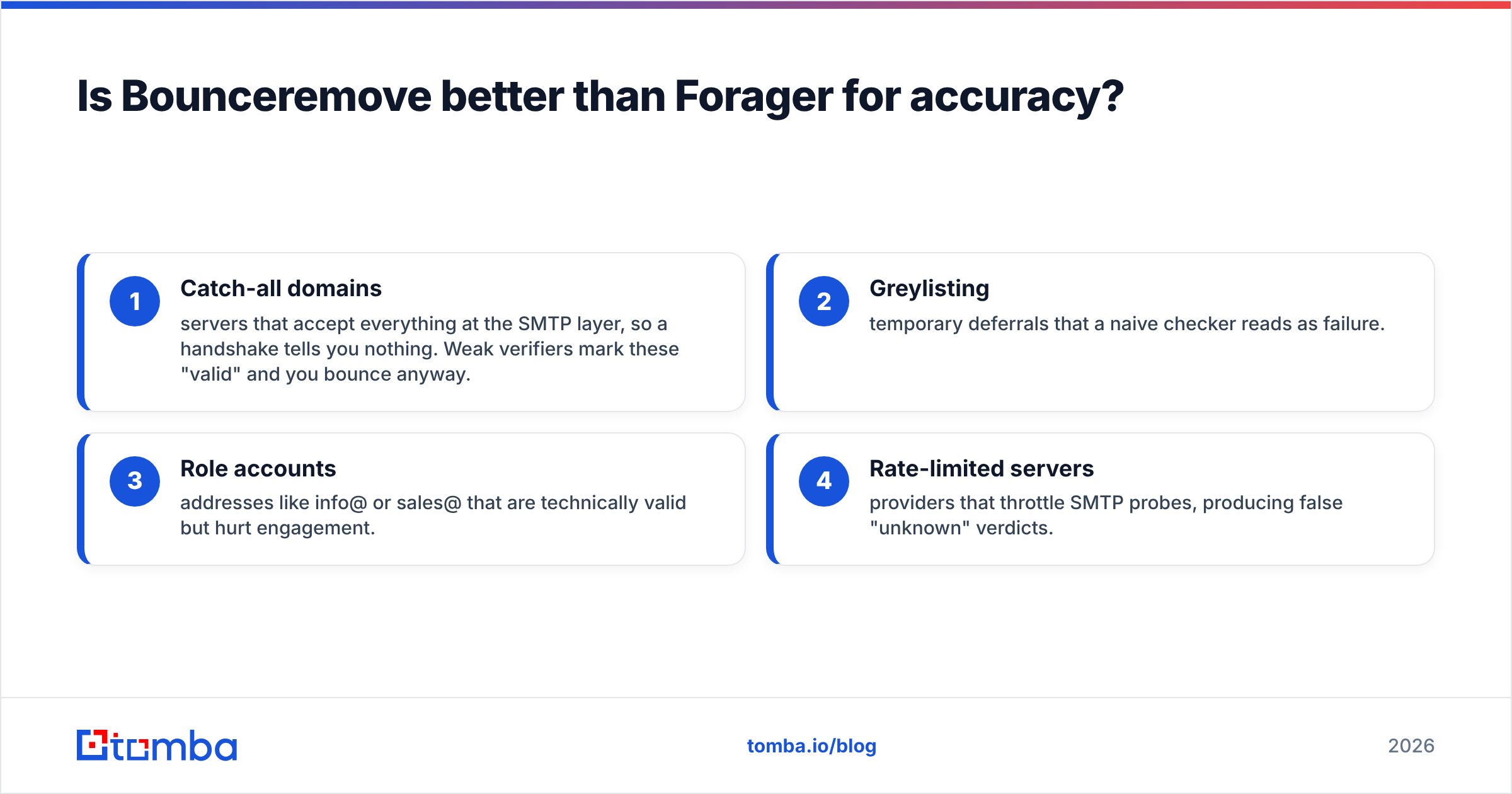
For Bounceremove, accuracy means verification precision — when it says "valid," does the email actually deliver, and when it says "invalid," is it really dead? Verification accuracy is dominated by how the tool handles edge cases:
- Catch-all domains — servers that accept everything at the SMTP layer, so a handshake tells you nothing. Weak verifiers mark these "valid" and you bounce anyway.
- Greylisting — temporary deferrals that a naive checker reads as failure.
- Role accounts — addresses like info@ or sales@ that are technically valid but hurt engagement.
- Rate-limited servers — providers that throttle SMTP probes, producing false "unknown" verdicts.
For Forager, accuracy means match rate and freshness — out of 100 prospects, how many real, current emails does it return, and how stale is the underlying data? A finder that returns an address from a job someone left 18 months ago is "accurate" on paper and useless in practice.
So when you compare bounceremove vs forager on accuracy, you're really asking two separate questions. The tool that wins depends on which number you actually need. This is exactly why combined platforms publish both match-rate and verification-confidence scores — a finder result is only as good as the verification behind it. You can read how a unified provider sources and scores data on Tomba's data sources page.

How does pricing compare between Bounceremove and Forager?#
Pricing models reflect the split. Verification tools like Bounceremove typically charge per credit consumed (one credit per address checked), often with pay-as-you-go packs. Data platforms like Forager typically charge a monthly seat or volume tier because sourcing and enriching contacts is an ongoing cost, not a one-time clean.
That creates a hidden trap when you run both: you pay a recurring data subscription and burn verification credits on top — and you pay twice for the same contact, once to find it and once to confirm it's real.
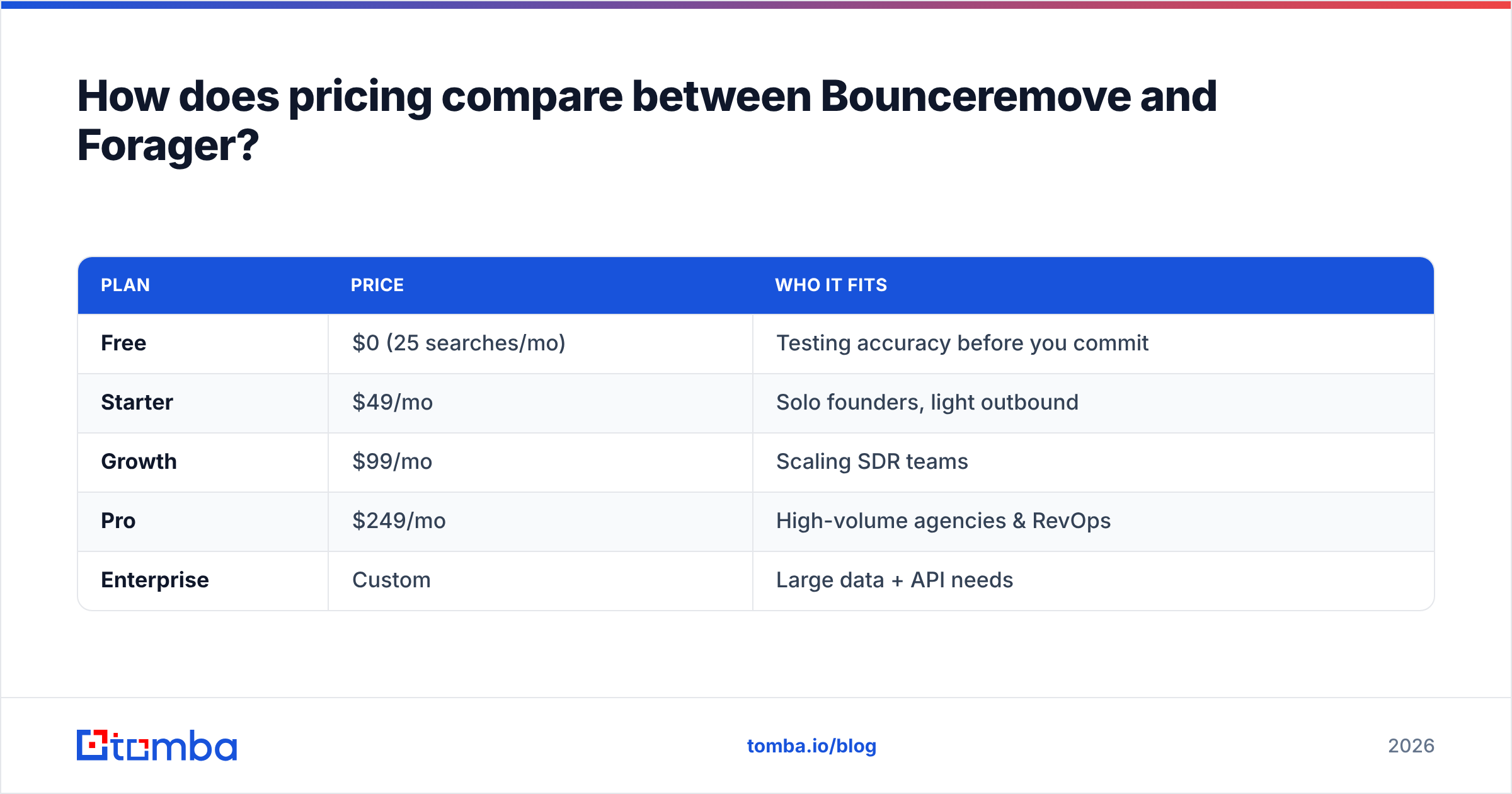
For reference, a combined platform collapses that into one bill. Tomba pricing runs:
| Plan | Price | Who it fits |
|---|---|---|
| Free | $0 (25 searches/mo) | Testing accuracy before you commit |
| Starter | $49/mo | Solo founders, light outbound |
| Growth | $99/mo | Scaling SDR teams |
| Pro | $249/mo | High-volume agencies & RevOps |
| Enterprise | Custom | Large data + API needs |
The point isn't that one number is lower than another — vendors move prices constantly. The point is that one platform doing find-and-verify means one credit pool, not two meters running at once. Before you commit to either single-purpose tool, price out the combined monthly cost of solving the whole problem, not just the half each tool covers.

When should you pick Bounceremove?#
Pick a verification-first tool like Bounceremove when list hygiene is your actual problem:
- You already own a large list (newsletter exports, old CRM records, purchased data) and bounce rates are climbing.
- You're seeing deliverability drops and need to protect your sender reputation before the next campaign.
- You don't need new contacts right now — you need the ones you have to be trustworthy.
- You're feeding a high-volume ESP that penalizes hard bounces (most of them do).
In that scenario, a dedicated verifier earns its keep. Mailing to a dirty list is the fastest way to land on a blocklist, and a good verification pass routinely cuts bounce rates from double digits down to under 2%. If that's your situation, a focused verifier — or Tomba's own email verifier — is the right shape of tool.
What Bounceremove won't do is grow your pipeline. If you finish cleaning and your list is now accurate but small, you've solved hygiene and inherited a new problem: not enough contacts.
When should you pick Forager?#
Pick a finder-first tool like Forager when an empty pipeline is your bottleneck:
- You're starting outbound from scratch and need to build target lists by company, role, or domain.
- You have a list of companies but no contacts at them, and you need decision-maker emails.
- You're enriching thin CRM records with missing email and firmographic data.
- Your SDRs spend more time hunting for addresses than actually sending.
This is classic prospecting territory. A finder turns "I want to reach the VP of Marketing at these 200 companies" into an actual contact list. If that's the job, a data platform fits — as does Tomba's domain search, which pulls every public email pattern at a company in one query, or the bulk email finder for running hundreds of lookups at once.
The catch mirrors Bounceremove's: a pure finder gives you contacts, but freshly-sourced emails still need verification before you send. Skip that step and you're back to bounces — which is the problem you'd buy Bounceremove to fix. See the loop?
Bounceremove vs Forager: which one actually wins?#
Neither — and that's the honest verdict. The two tools sit at opposite ends of the same funnel, so picking one leaves the other half of your workflow exposed.
- Choose Bounceremove if you only ever need to clean lists you already own and will never source new contacts. Rare, but it happens.
- Choose Forager if you only ever need to source contacts and have a separate verification step you trust. Also possible.
- Choose a combined platform if, like most teams, you need both jobs done reliably and don't want to babysit two vendors, two APIs, and two CSV reconciliations.
Most real outbound motions need find → verify → send as one continuous flow. Every handoff between separate tools is a place where data goes stale, formats break, and credits get double-spent. Industry analysts have flagged tool sprawl as a top revenue-operations drag for years — independent reviews on G2 and the buyer's guides at HubSpot both point the same direction: consolidate where the jobs are adjacent. For the deeper mechanics of deliverability that verification protects, the Wikipedia overview of email bounces is a solid neutral primer.
That's the case for a unified tool. You find the contact, the same system verifies it on the spot, and you export a list that's both new and clean — without paying two meters or trusting two accuracy scores you can't cross-check.
Frequently asked questions#
Is Bounceremove the same as an email finder? No. Bounceremove verifies addresses you already have; it does not discover new ones. For finding, you need a tool like Forager or an email finder.
Can Forager verify my existing list? Forager is built for sourcing, not deep list-cleaning. Verification features on finder-first tools tend to be lighter than a dedicated verifier's catch-all and SMTP handling.
Do I really need both find and verify? For most outbound, yes. New contacts must be verified before sending, and old lists decay and need re-checking. That's why combined platforms exist.
Which is cheaper, two tools or one? Almost always one. Two subscriptions plus overlapping credits cost more than a single plan that covers both jobs — and you avoid paying twice per contact.
The bottom line#
Stop framing it as bounceremove vs forager like they're rivals — they're two halves of one pipeline. Bounceremove keeps your list clean; Forager fills it. The moment you need both (and you will), running two tools means two bills, two dashboards, and two accuracy numbers you can't reconcile.
That's the gap Tomba Email Finder is built to close. Find verified, decision-maker emails by name, company, or domain — then verify them in the same flow, on one credit pool, with one API. Start free with 25 searches a month, test the accuracy against your own list, and skip the two-vendor tax. Find it, verify it, send it — in one place.
// get started
Find, verify and enrich your first contacts today
Start on the free plan with 25 searches a month, then scale when your team is ready.
Free plan · No credit card required · GDPR & CCPA
// about the author