Bounceremove vs Getprospect: 2026 Email Tool Comparison
Bounceremove cleans bounces, Getprospect finds and verifies leads. Here is an honest 2026 breakdown of accuracy, pricing, and which one your pipeline actually needs.
Choosing between Bounceremove and Getprospect is really a question about what stage of the pipeline is hurting you. One tool scrubs a list you already have. The other builds the list in the first place. Comparing them head-to-head only makes sense once you know which problem you are actually solving.
TL;DR#
- Bounceremove is a focused email verification / list-cleaning tool. You bring a list, it flags risky and invalid addresses before you send.
- Getprospect is a lead-generation suite first: a LinkedIn-driven email finder with verification bolted on, plus a built-in B2B database.
- They overlap only on verification. For finding contacts, Getprospect wins by design; for pure list hygiene, Bounceremove is simpler.
- Neither covers the full find → verify → enrich → export loop as cheaply as a combined platform. That is where Tomba fits, with a free tier and $49/mo Starter.
- Pick by job: cleaning a static list, sourcing net-new leads, or running both continuously. We map each below.
What is Bounceremove?#
Bounceremove is a single-purpose email verification service. Its job is to take a list of addresses you already collected — from a signup form, an old CRM export, a scraped sheet — and tell you which ones are safe to email. It runs syntax checks, MX-record lookups, SMTP handshakes, and disposable/role-account detection, then returns a clean list and a risk score per address.
If you have ever watched a campaign get throttled because 15% of your list hard-bounced, you already understand the value. Think of Bounceremove as a metal detector you sweep over a beach before you start digging: it does not find the treasure, it just stops you wasting effort on junk. The output protects your sender reputation and keeps you out of spam traps.
What Bounceremove does not do is generate contacts. There is no LinkedIn extraction, no domain search, no database to pull net-new prospects from. It assumes you already have emails.
)
What is Getprospect?#
Getprospect is a lead-generation platform built around an email finder. Its center of gravity is the LinkedIn workflow: you browse profiles or company pages, and Getprospect surfaces likely business emails, then verifies them. It ships with a Chrome extension, a B2B contact database you can filter by title/industry/size, list management, and basic CRM-style organization.
Verification exists inside Getprospect, but it is a supporting feature, not the headline. The product is designed to answer "who should I email and what is their address" rather than "is this list I already have clean."
So the honest framing is this: Bounceremove and Getprospect are not really the same category of tool. One is a verifier. The other is a prospecting engine that happens to verify. The comparison below treats them on the dimensions where buyers actually weigh them against each other.
Bounceremove vs Getprospect: core comparison#
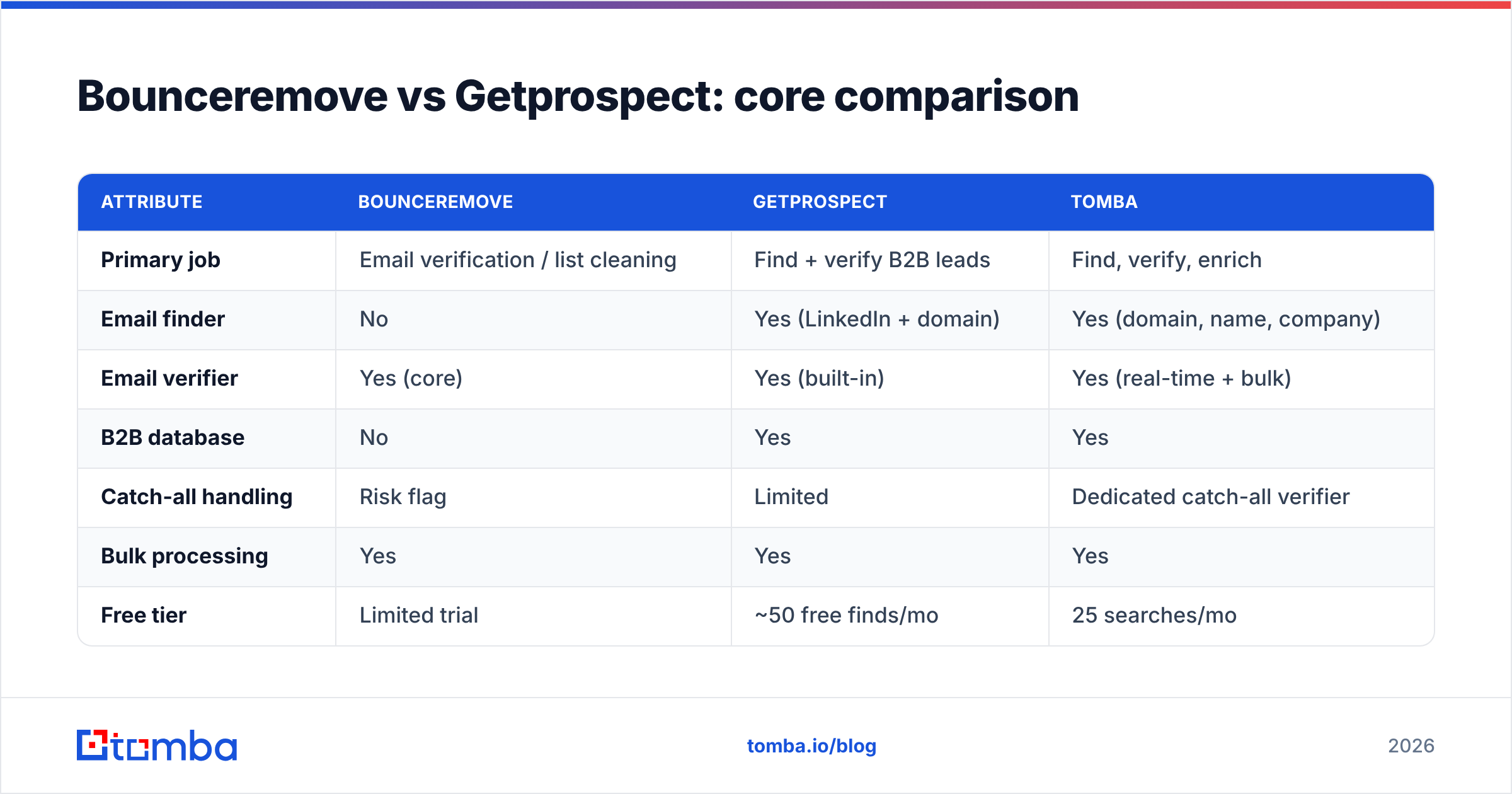
| Attribute | Bounceremove | Getprospect | Tomba |
|---|---|---|---|
| Primary job | Email verification / list cleaning | Find + verify B2B leads | Find, verify, enrich |
| Email finder | No | Yes (LinkedIn + domain) | Yes (domain, name, company) |
| Email verifier | Yes (core) | Yes (built-in) | Yes (real-time + bulk) |
| B2B database | No | Yes | Yes |
| Catch-all handling | Risk flag | Limited | Dedicated catch-all verifier |
| Bulk processing | Yes | Yes | Yes |
| Free tier | Limited trial | ~50 free finds/mo | 25 searches/mo |
| Entry paid price | Volume-based credits | ~$49/mo range | $49/mo Starter |
| API access | Yes | Yes | Yes (full REST API) |
| Best for | Cleaning existing lists | LinkedIn prospecting | End-to-end pipeline |
Two things stand out. First, only Getprospect and Tomba actually find emails — Bounceremove is downstream of that. Second, every serious workflow eventually needs both halves, which is why teams often end up stacking a finder with a verifier and paying twice.
Is Getprospect better than Bounceremove?#
Better at what? That is the only useful version of the question.
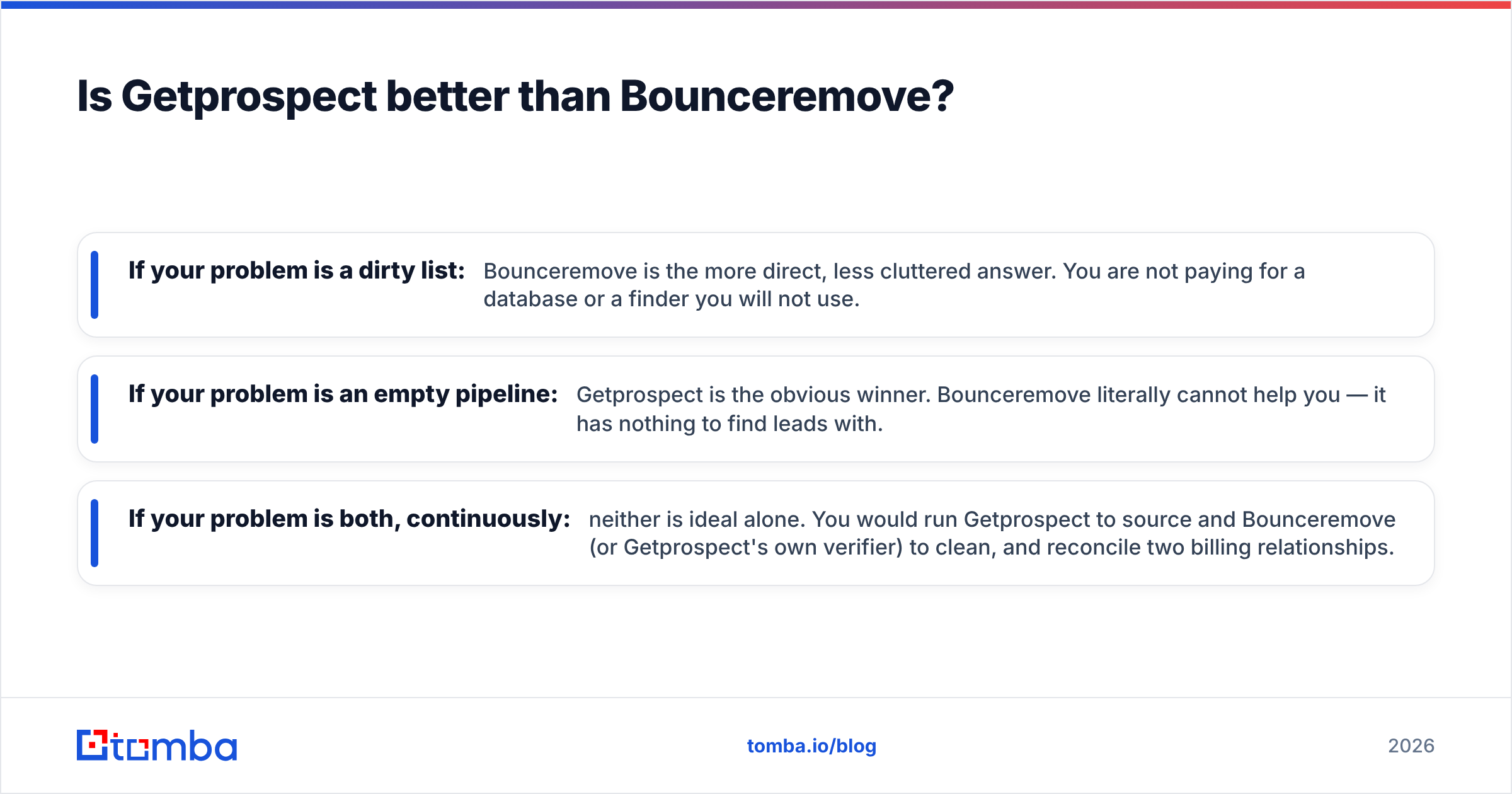
- If your problem is a dirty list: Bounceremove is the more direct, less cluttered answer. You are not paying for a database or a finder you will not use.
- If your problem is an empty pipeline: Getprospect is the obvious winner. Bounceremove literally cannot help you — it has nothing to find leads with.
- If your problem is both, continuously: neither is ideal alone. You would run Getprospect to source and Bounceremove (or Getprospect's own verifier) to clean, and reconcile two billing relationships.
Here is the trap teams fall into: they buy a finder, discover its verification is mediocre, then bolt on a standalone verifier, then realize the finder's database is thin and add a third tool. The stack grows because each tool was scoped to one slice.
)
How accurate are these tools?#
Accuracy is where most of the buying decision should live, because a cheap tool that returns 20% bad data is expensive in deliverability damage.
A few practical points on reading any vendor's accuracy claim:
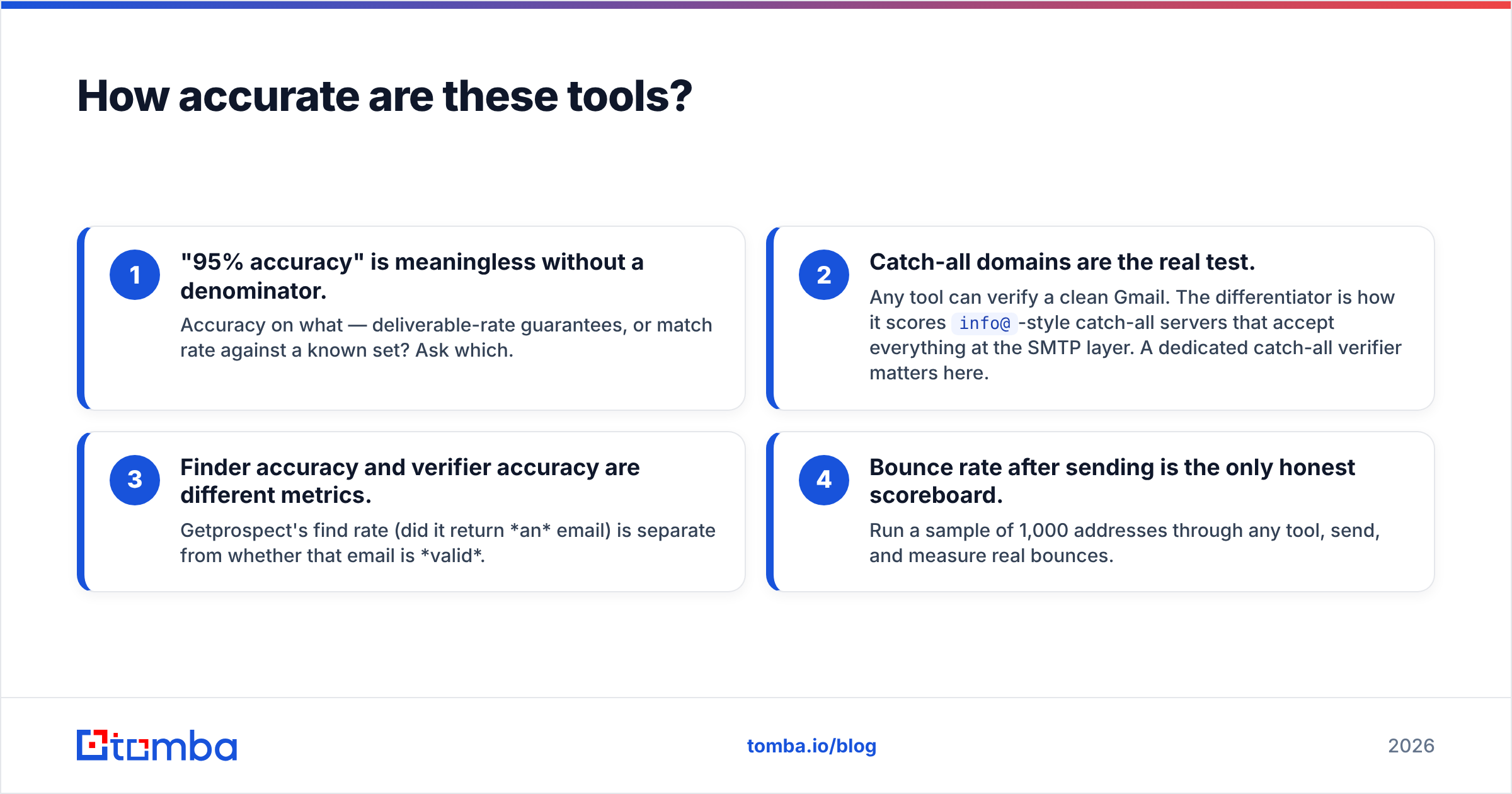
- "95% accuracy" is meaningless without a denominator. Accuracy on what — deliverable-rate guarantees, or match rate against a known set? Ask which.
- Catch-all domains are the real test. Any tool can verify a clean Gmail. The differentiator is how it scores
info@-style catch-all servers that accept everything at the SMTP layer. A dedicated catch-all verifier matters here. - Finder accuracy and verifier accuracy are different metrics. Getprospect's find rate (did it return an email) is separate from whether that email is valid.
- Bounce rate after sending is the only honest scoreboard. Run a sample of 1,000 addresses through any tool, send, and measure real bounces.
Bounceremove, being verification-only, lives or dies on this dimension and is reasonably tuned for it. Getprospect's verification is acceptable but secondary to its finding. Independent review aggregators like G2 are a better sanity check than any single vendor page — read the one-star reviews, not the five-star ones.

For teams that want one accuracy benchmark across both finding and verifying, this is exactly the gap Tomba targets — its email verifier runs real-time SMTP checks, and its data sourcing is documented openly at our data.
What about pricing?#
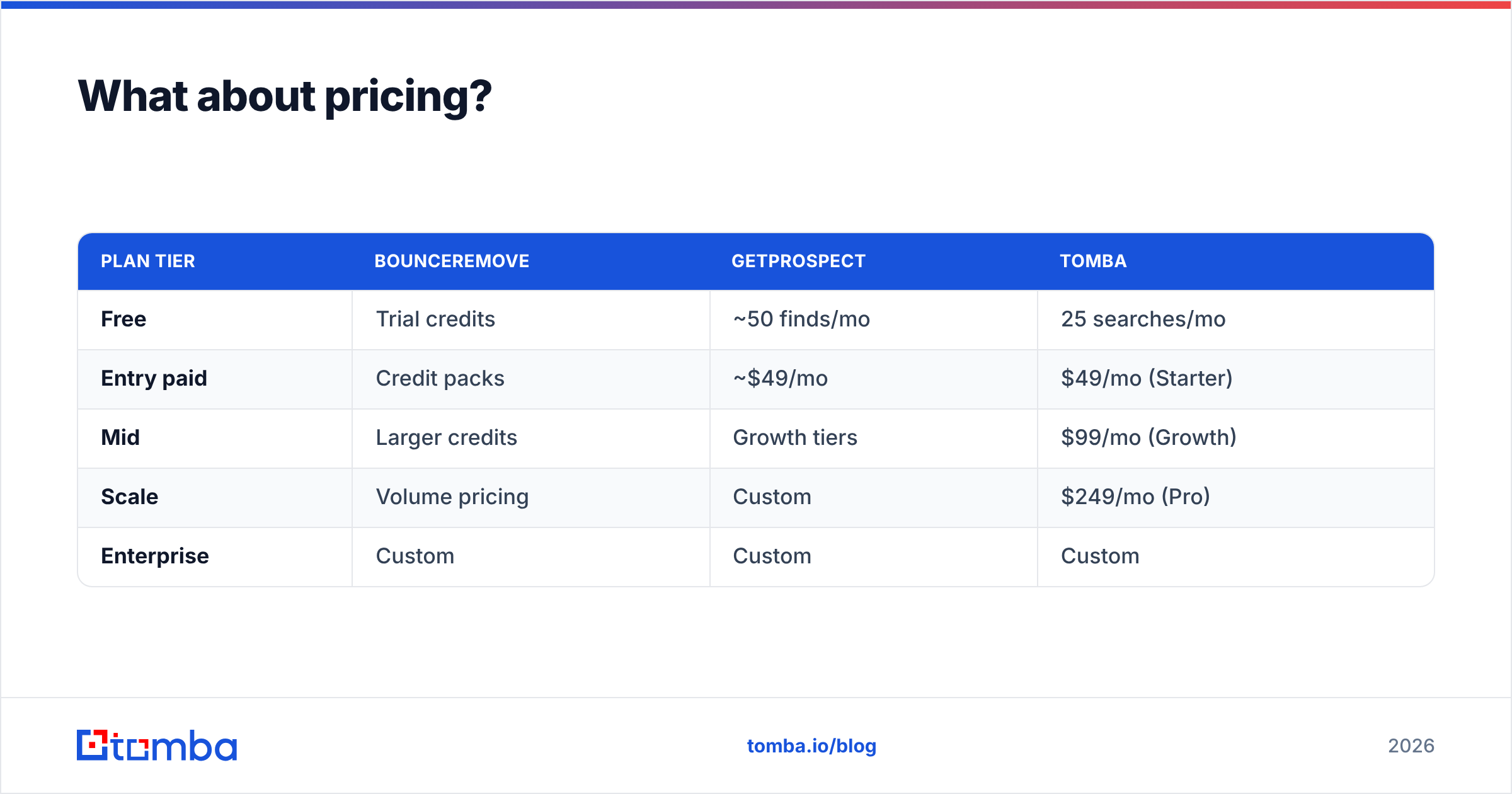
Pricing models differ enough that a flat "cheaper" verdict misleads.
| Plan tier | Bounceremove | Getprospect | Tomba |
|---|---|---|---|
| Free | Trial credits | ~50 finds/mo | 25 searches/mo |
| Entry paid | Credit packs | ~$49/mo | $49/mo (Starter) |
| Mid | Larger credits | Growth tiers | $99/mo (Growth) |
| Scale | Volume pricing | Custom | $249/mo (Pro) |
| Enterprise | Custom | Custom | Custom |
Bounceremove typically sells verification credits, which is efficient if cleaning is occasional and bursty — you buy when you need it. Getprospect uses monthly seat/credit subscriptions geared to ongoing prospecting. Tomba's plans (see full Tomba pricing) bundle finding, verification, and enrichment under one credit pool, which removes the two-tool reconciliation problem.
The cost question is not "which sticker is lower." It is "what is my fully loaded cost once I have all the capabilities I need." A $0.001/verification tool plus a $49/mo finder plus enrichment is three line items. One platform is one.
When should you stack tools vs consolidate?#
Stacking is genuinely correct in some cases:
- You already own a great finder and only need verification → add Bounceremove, done.
- Your verification volume is enormous and specialized pricing beats a bundled plan → a dedicated verifier can win on unit economics.
- Compliance requires separation of sourcing and validation vendors.
Consolidation wins when:
- You are early and want fewer logins, invoices, and integration points.
- Your data needs to flow find → verify → enrich → CRM without CSV gymnastics.
- You want one bulk email finder run to output clean, enriched rows.
Most small and mid-size B2B teams are in the consolidation camp and only think they need three tools because that is how they started.
Which should you choose?#
Decide by the dominant job, not the feature list:
- Choose Bounceremove if you have lists and only need them cleaned. It is focused and does that one thing without making you pay for a database.
- Choose Getprospect if LinkedIn prospecting is your daily motion and built-in verification is "good enough." Its finder and database earn their keep.
- Choose a consolidated platform like Tomba if you want the whole loop — find email addresses, verify them, run catch-all checks, and enrich — on one bill with a real email finder API when you outgrow the UI.
There is no universally "best" answer here. There is a best fit for your current bottleneck, and that bottleneck changes as you scale.
The bottom line#
Bounceremove and Getprospect solve adjacent problems that are easy to confuse. Bounceremove protects deliverability on lists you have. Getprospect builds the lists. If you only ever needed one of those forever, buy the specialist. But pipelines are not static — today's clean-up problem becomes tomorrow's sourcing problem, then an enrichment problem.
That is the case for starting with a platform that already spans find, verify, and enrich. Try the Tomba Email Finder free with 25 searches a month, run a sample of your real prospects through both the finder and verifier, and measure the post-send bounce rate yourself. Let the numbers, not the marketing page, pick your tool.
// get started
Find, verify and enrich your first contacts today
Start on the free plan with 25 searches a month, then scale when your team is ready.
Free plan · No credit card required · GDPR & CCPA
// about the author