Bounceremove vs Leadsrush: Which Email Tool Wins in 2026?
A neutral, head-to-head breakdown of Bounceremove vs Leadsrush in 2026 — accuracy, pricing, data coverage, and which one actually belongs in your prospecting stack.
Choosing between Bounceremove and Leadsrush usually comes down to one question you can't answer from a pricing page: does the tool actually give you contacts you can email without torching your sender reputation? Both products promise clean, deliverable B2B data. They go about it in very different ways, and that difference decides whether your next campaign lands in the inbox or the spam folder.
This is a neutral, attribute-by-attribute comparison. No marketing fluff, no "both are great, pick what feels right." By the end you'll know which tool fits a bounce-cleaning workflow, which fits net-new prospecting, and where a combined finder-plus-verifier approach beats buying either one in isolation.
TL;DR — Bounceremove vs Leadsrush in one screen#
- Bounceremove is built around list hygiene: you feed it an existing email list and it removes invalid, risky, and catch-all addresses. It is a verifier first, a data source second.
- Leadsrush is built around discovery: it finds net-new contacts by company, role, and domain, then layers on basic verification. It is a finder first, a verifier second.
- Accuracy is close on clean lists, but Leadsrush's self-sourced data carries more risk on catch-all domains, while Bounceremove can't generate leads you don't already have.
- Pricing favors Bounceremove for one-off cleanups and Leadsrush for ongoing prospecting volume — neither is cheap at scale.
- The honest verdict: most teams need both jobs done, and stitching two single-purpose tools together is slower and pricier than one platform that finds and verifies. That's the case we make for Tomba at the end.
What is Bounceremove and who is it for?#
Bounceremove is an email verification and list-cleaning tool. Its core job is taking a list you already own — exported from a CRM, a webinar signup, a scraped spreadsheet — and telling you which addresses are safe to send to.
A typical run sorts your list into buckets: valid, invalid, accept-all (catch-all), disposable, role-based (like info@ or sales@), and unknown. You then suppress the junk before it ever reaches your email service provider. The payoff is a lower bounce rate, which protects your sender reputation and keeps your domain out of trouble.
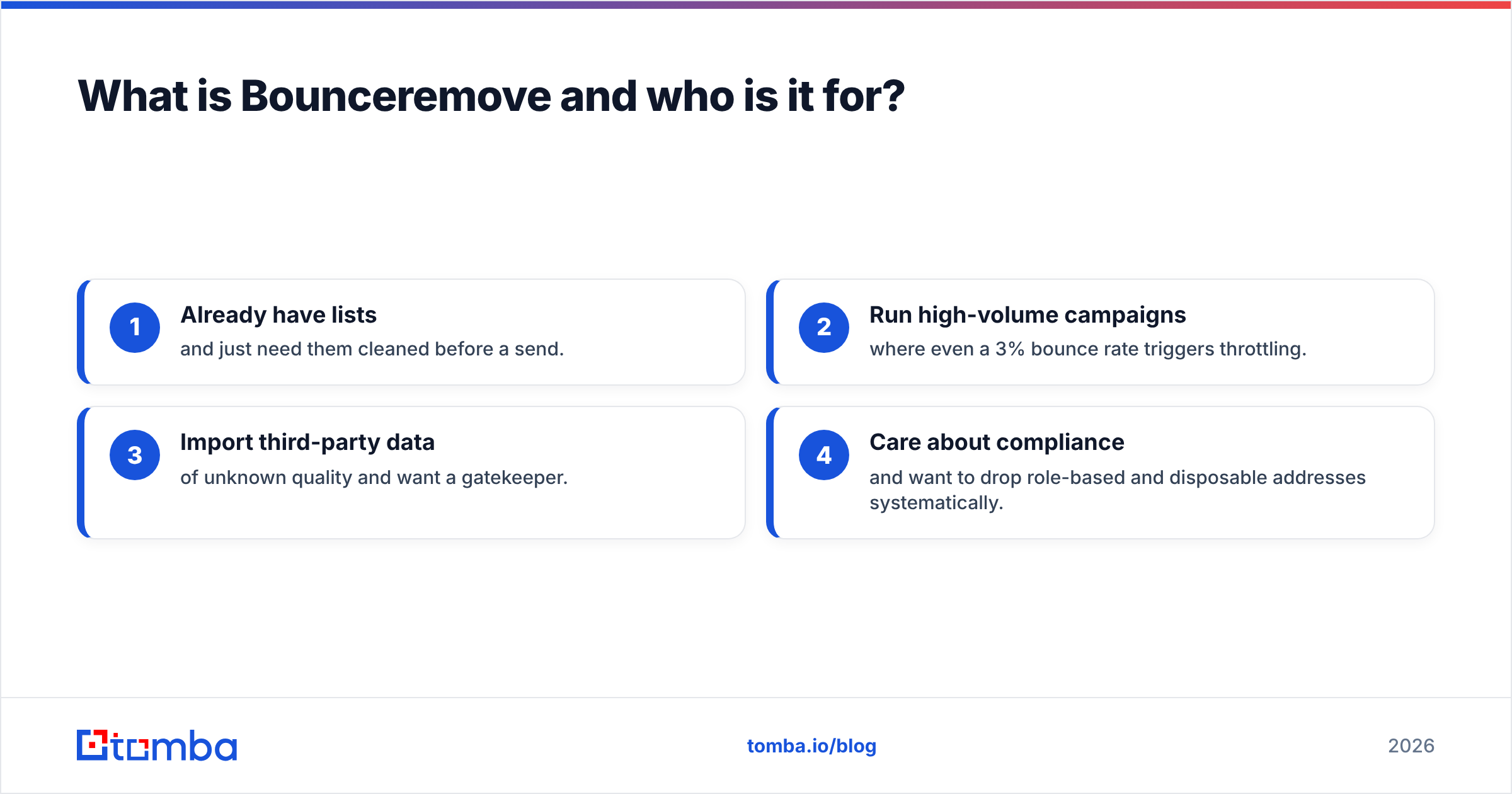
Bounceremove is a strong fit if you:
- Already have lists and just need them cleaned before a send.
- Run high-volume campaigns where even a 3% bounce rate triggers throttling.
- Import third-party data of unknown quality and want a gatekeeper.
- Care about compliance and want to drop role-based and disposable addresses systematically.
What it does not do is find anyone. If your spreadsheet is empty, Bounceremove has nothing to work with.
What is Leadsrush and who is it for?#
Leadsrush sits on the opposite end of the workflow. It's a lead-generation and email-finding tool: you tell it the kind of company and role you want to reach, and it returns contacts with email addresses, job titles, and sometimes phone numbers or LinkedIn URLs.
Leadsrush leans on a self-built B2B database plus pattern-based discovery — it guesses likely email formats for a domain and tries to confirm them. For teams starting from zero, that's the entire value: you go from "I want to reach SaaS marketing directors in Germany" to a list of names and addresses in minutes.
Leadsrush is a strong fit if you:
- Need net-new contacts, not just cleanup of existing ones.
- Prospect continuously and want a steady pipeline of fresh leads.
- Target by firmographics — industry, headcount, geography, role.
- Want one tool for both discovery and a first pass at verification.
The trade-off is data confidence. Self-sourced and pattern-guessed emails are only as good as the verification behind them, and discovery tools historically run looser on catch-all domains where a server accepts everything and confirms nothing.
Bounceremove vs Leadsrush: the core comparison table#
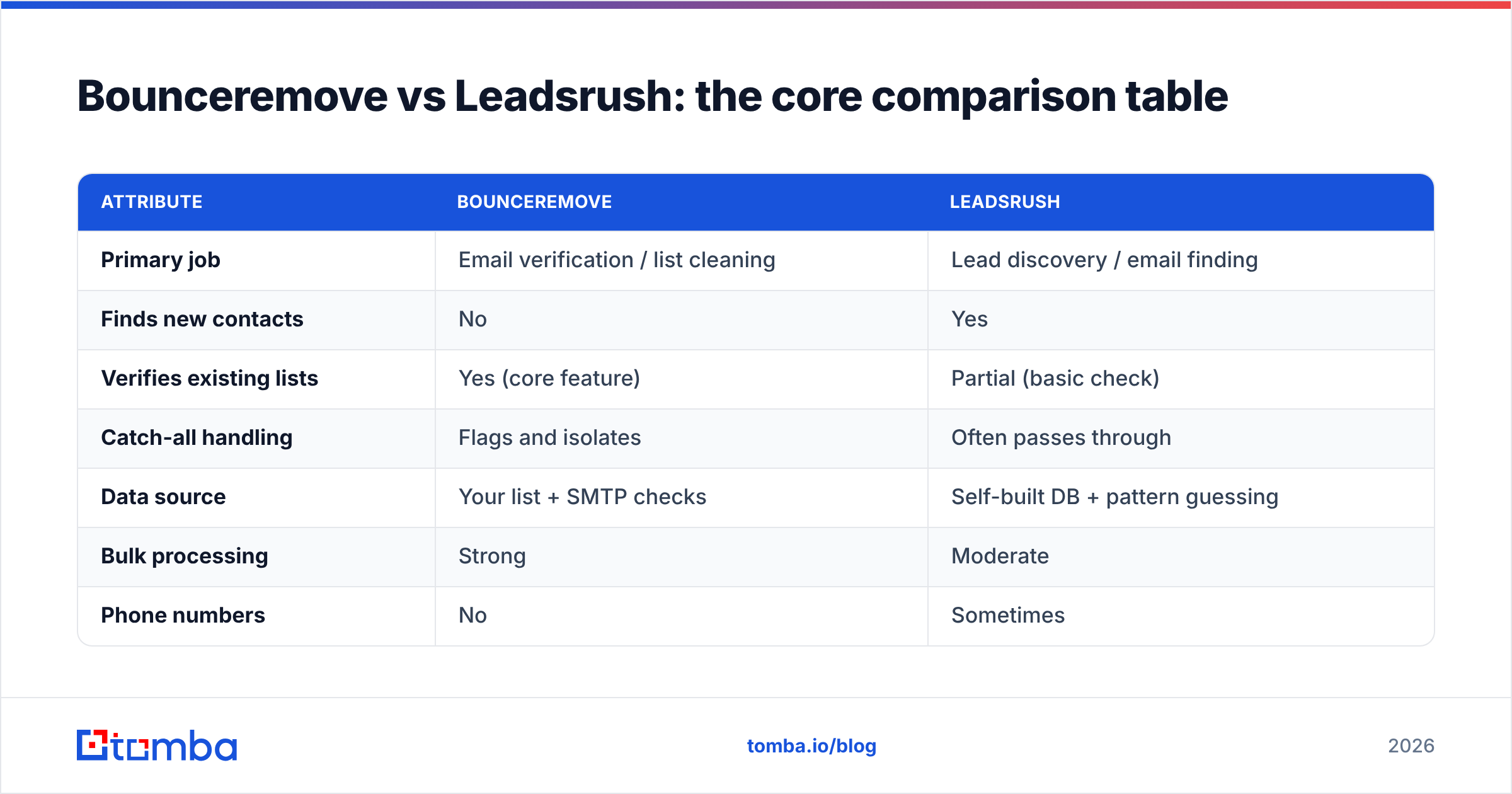
Here's the head-to-head on the attributes that actually change your results. Treat the numbers as representative of each tool's published positioning and typical mid-tier plans rather than a locked quote — always confirm current figures on the vendor's own page.
| Attribute | Bounceremove | Leadsrush |
|---|---|---|
| Primary job | Email verification / list cleaning | Lead discovery / email finding |
| Finds new contacts | No | Yes |
| Verifies existing lists | Yes (core feature) | Partial (basic check) |
| Catch-all handling | Flags and isolates | Often passes through |
| Data source | Your list + SMTP checks | Self-built DB + pattern guessing |
| Bulk processing | Strong | Moderate |
| Phone numbers | No | Sometimes |
| Best for | Hygiene before a send | Building lists from scratch |
| Entry pricing | ~$29–$49 one-off / mo | ~$49–$99/mo subscription |
| Free tier | Limited credits | Limited credits |
The table makes the real distinction obvious: these tools barely overlap. Comparing them directly is a bit like comparing a water filter to a well. One cleans what you have; the other finds the source. Which is why the smartest question isn't "which one," but "do I actually need both functions" — and most outbound teams do.
Is Bounceremove more accurate than Leadsrush?#
On a clean, single-mailbox domain, accuracy between a dedicated verifier and a finder's built-in check is closer than you'd think — both can confirm a live mailbox with an SMTP handshake. The gap opens on the hard cases.
Bounceremove's advantage is depth on verification. Because that's its whole product, it invests in catch-all detection, greylisting retries, and disposable-domain databases. When it marks an address "risky," that label is doing real work.
Leadsrush's advantage is breadth on discovery. It can surface contacts that simply don't exist in any list you own. But discovery tools face a structural problem: when they guess firstname.lastname@company.com and the server is catch-all, there's no way to confirm the mailbox exists. Many finders report these as valid anyway. That's the single biggest source of "verified" emails that still bounce.
If you want to understand why catch-all domains break so many tools, our breakdown of catch-all verification walks through the SMTP behavior in plain terms. The short version: a tool that can't reason about catch-alls will inflate its own accuracy numbers, and you'll pay for it in bounces.
For an independent read on either vendor's real-world accuracy, cross-check user reviews on G2 and Capterra before you commit — self-reported accuracy claims and verified-buyer reviews often tell different stories.
How do Bounceremove and Leadsrush price out at scale?#
Pricing is where the "two single-purpose tools" problem starts to bite. A verifier like Bounceremove typically sells credits or one-off cleanup packages, which is fair if you clean a list once a quarter. A finder like Leadsrush sells monthly subscriptions, because prospecting is continuous.
The trap is needing both. If you run outbound seriously, you're discovering new contacts and cleaning lists every single week. Stacking two subscriptions means two bills, two credit pools that don't share, two integrations to maintain, and a manual hand-off step where you export from one and import to the other.
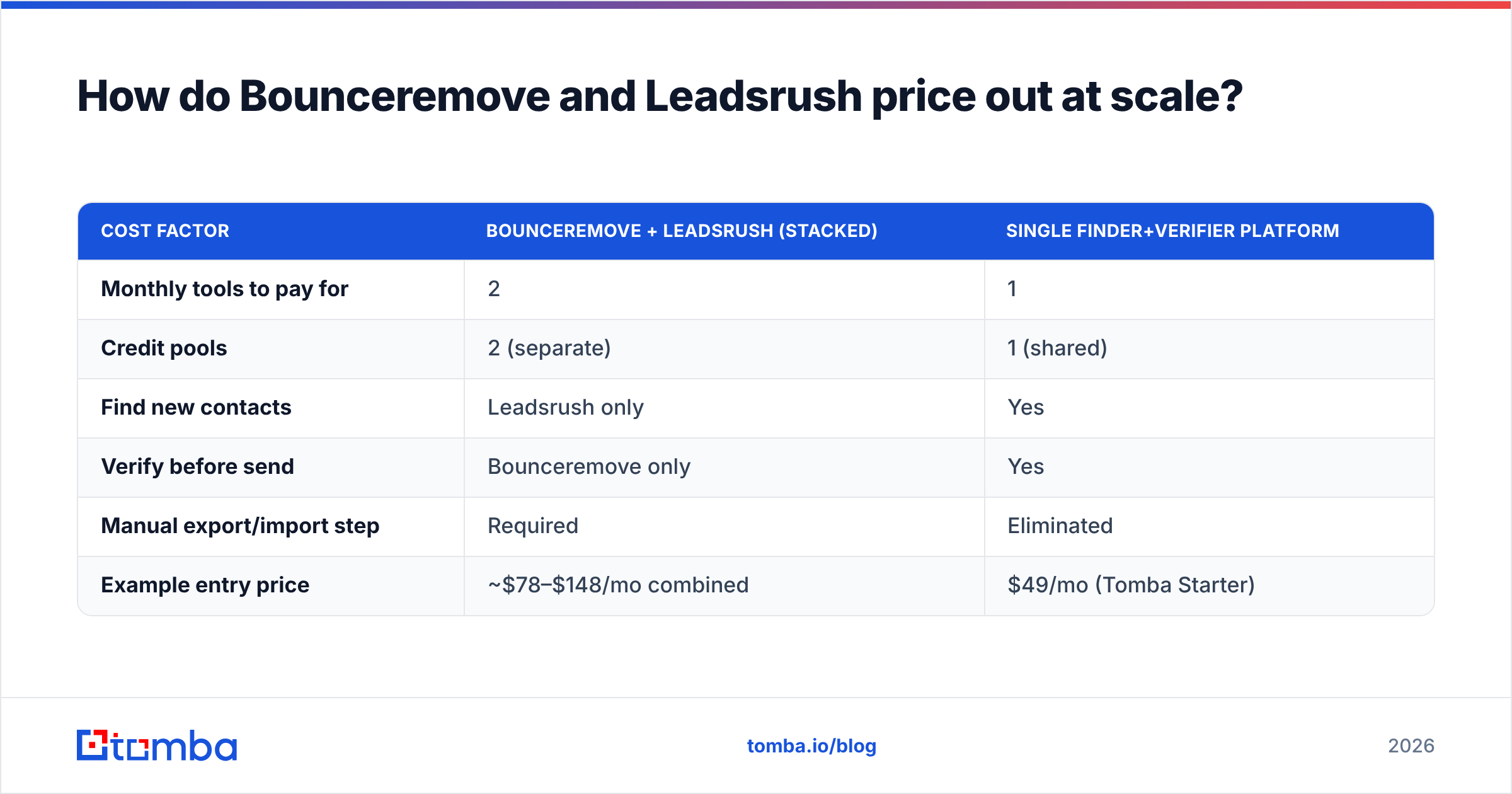
That's the context for looking at a combined platform. Here's how the math tends to shake out:
| Cost factor | Bounceremove + Leadsrush (stacked) | Single finder+verifier platform |
|---|---|---|
| Monthly tools to pay for | 2 | 1 |
| Credit pools | 2 (separate) | 1 (shared) |
| Find new contacts | Leadsrush only | Yes |
| Verify before send | Bounceremove only | Yes |
| Manual export/import step | Required | Eliminated |
| Example entry price | ~$78–$148/mo combined | $49/mo (Tomba Starter) |
When one platform's starting tier costs less than running two narrow tools, the "best of breed" argument gets weak fast — especially when the integrated option also kills the export/import busywork.
Where does a finder-plus-verifier platform fit?#
This is the part the two-tool comparison hides. The reason Bounceremove vs Leadsrush feels like a hard choice is that you're being asked to pick half of a workflow. Real outbound needs both halves running together.
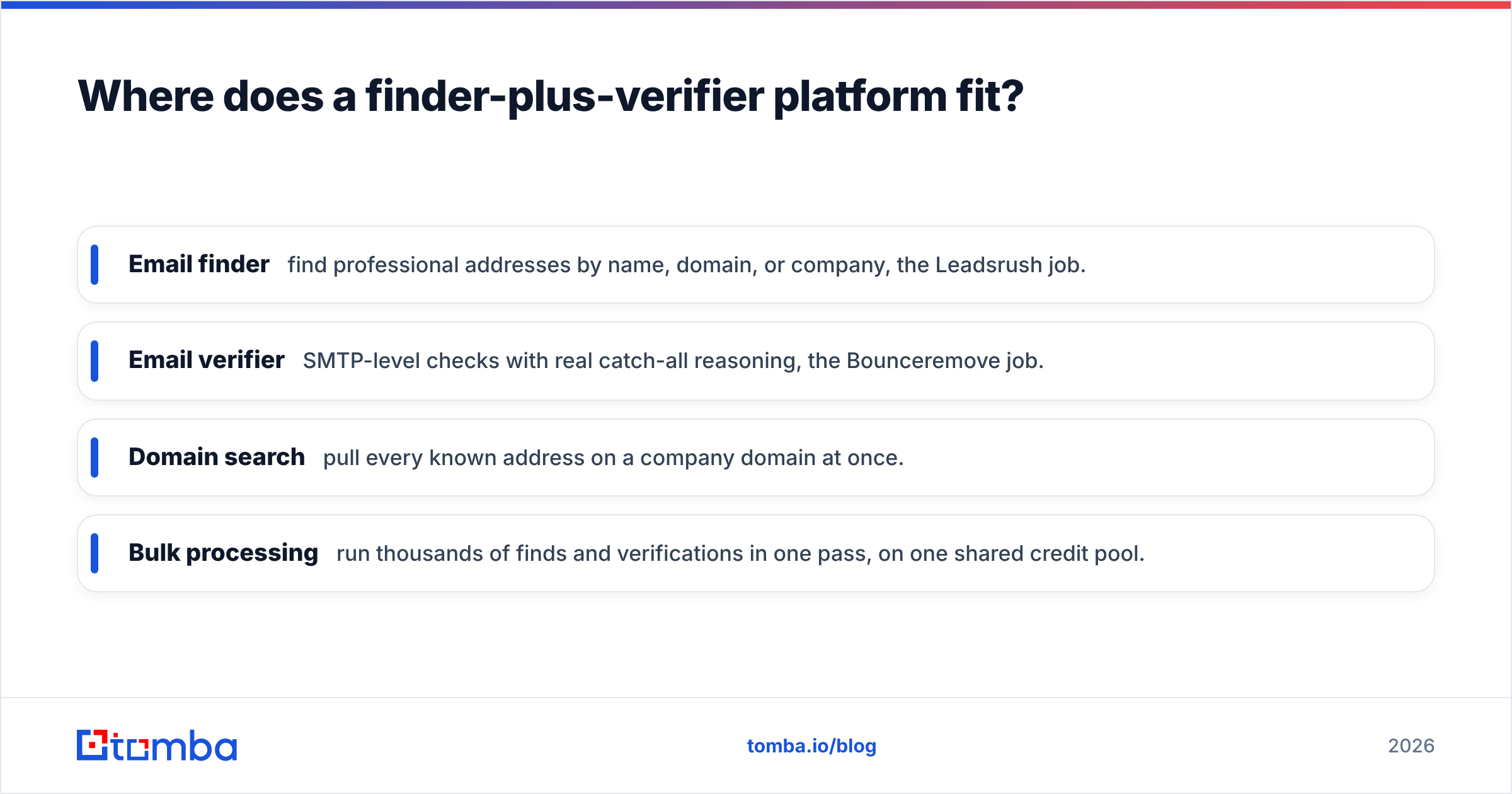
A combined platform handles the full loop: discover the contact, confirm the mailbox is live, and only then hand it to your sequencer. Tomba is built for exactly this loop:
- Email finder — find professional addresses by name, domain, or company, the Leadsrush job.
- Email verifier — SMTP-level checks with real catch-all reasoning, the Bounceremove job.
- Domain search — pull every known address on a company domain at once.
- Bulk processing — run thousands of finds and verifications in one pass, on one shared credit pool.
Because find and verify live in the same system, every discovered email is verified before it reaches you — no export, no second subscription, no guessing whether the "valid" label came from a tool that actually checks catch-alls. For teams that care where data comes from, Tomba documents its data sources openly, which matters more than any single accuracy percentage on a landing page.
Which tool should you choose in 2026?#
Pick based on the job in front of you, not the brand:
- Choose Bounceremove if you already have all the lists you'll ever need and your only problem is bounce rate. It's a focused, capable verifier for one-off hygiene.
- Choose Leadsrush if you have zero data and pure discovery volume is the bottleneck — and you're willing to verify its output somewhere else before sending.
- Choose a combined platform like Tomba if you do both jobs regularly, which describes nearly every active sales and marketing team. One subscription, one shared credit pool, verified-on-discovery data, and no manual hand-off.
The honest framing: Bounceremove and Leadsrush each do one half of the prospecting loop well. Buying both to cover the whole loop costs more and adds friction than buying one tool that closes the loop itself. Wikipedia's primer on email address verification is a useful neutral reference if you want to understand the underlying mechanics before you decide.
How do you migrate without losing data quality?#
If you're switching from a stacked Bounceremove-plus-Leadsrush setup, do it in three controlled steps:
- Export your existing verified list and re-run a sample (a few hundred rows) through the new platform's verifier to benchmark agreement. If the new tool flags risky addresses the old stack passed, that's a quality gain, not a problem.
- Rebuild one prospecting search you run often and compare the contact count and verified-rate side by side.
- Move your bulk workflow last, once the sample checks pass, so your live campaigns never run on unverified data during the transition.
This sequence protects deliverability while you test, and it surfaces accuracy differences with evidence instead of vendor claims.
The bottom line#
Bounceremove vs Leadsrush isn't really a fight between two competitors — it's a fork between two halves of the same job. Bounceremove cleans the lists you have; Leadsrush finds the contacts you don't. If you only ever need one of those things, buy the specialist. If you need both — and most teams running outbound in 2026 do — running two narrow tools is the expensive, slow way to get there.
Skip the export-import shuffle and the double subscription. Start with the Tomba Email Finder to discover and verify contacts in a single workflow, on a free tier of 25 searches a month, scaling to a $49/mo Starter plan when you're ready. Find it, verify it, send it — without ever leaving one tool.
// get started
Find, verify and enrich your first contacts today
Start on the free plan with 25 searches a month, then scale when your team is ready.
Free plan · No credit card required · GDPR & CCPA
// about the author