Bounceremove vs ZoomInfo 2026: Which B2B Data Tool Wins?
Bounceremove cleans bounce-prone lists; ZoomInfo sells a giant contact database. We compare price, accuracy, and fit so you pick the right tool in 2026.
Bounceremove vs ZoomInfo: Picking the Right B2B Data Tool in 2026
You are comparing two tools that solve different halves of the same problem, and the marketing copy makes that hard to see. Bounceremove is built to clean a list you already have. ZoomInfo is built to hand you a list you do not have yet. Treating them as direct rivals leads to overspending on one and under-using the other.
This guide breaks down where each one actually earns its keep, what they cost, and where a focused alternative beats both.
TL;DR#
- Bounceremove is an email verification tool. Its job is to scrub invalid, risky, and catch-all addresses out of an existing list before you send.
- ZoomInfo is a full B2B data platform — contact and company records, intent signals, org charts, and enrichment — priced for mid-market and enterprise teams.
- They are complementary, not interchangeable. ZoomInfo finds contacts; Bounceremove (or any verifier) keeps your sender reputation clean. Many teams run both and overpay for the overlap.
- Pricing gap is huge. Bounceremove is pay-as-you-go cheap; ZoomInfo contracts routinely run five figures a year with annual commitments.
- If you mainly need accurate emails plus verification in one place, a finder-plus-verifier like Tomba covers ~80% of the workflow at a fraction of ZoomInfo's cost.
What is Bounceremove?#
Bounceremove is a single-purpose email verification service. You upload a list, it checks each address, and it returns a cleaned file flagged by status: valid, invalid, accept-all (catch-all), disposable, and unknown. The goal is simple — stop bounces before they wreck your email deliverability and your domain reputation.
What it does well:
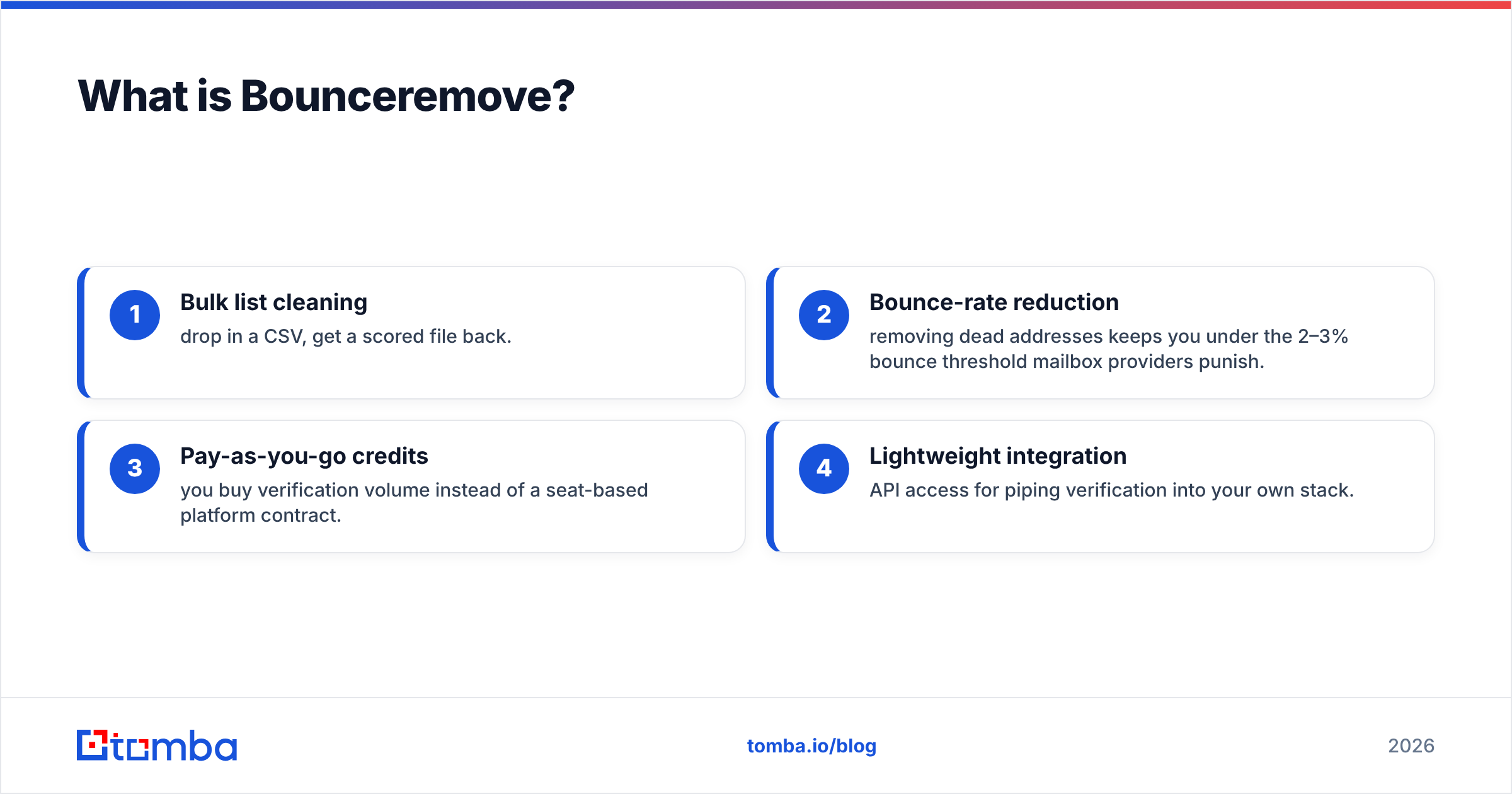
- Bulk list cleaning — drop in a CSV, get a scored file back.
- Bounce-rate reduction — removing dead addresses keeps you under the 2–3% bounce threshold mailbox providers punish.
- Pay-as-you-go credits — you buy verification volume instead of a seat-based platform contract.
- Lightweight integration — API access for piping verification into your own stack.
What it does not do: it does not find anyone. Bounceremove assumes you already sourced the addresses somewhere else. It is the dish-washing step after the meal, not the grocery run.

What is ZoomInfo?#
ZoomInfo is a sales-intelligence platform — one of the largest commercial B2B databases on the market. It is the opposite end of the workflow from a verifier. Instead of cleaning your data, it sells you the raw material.
Core capabilities:
- Contact and company database — hundreds of millions of records with titles, direct dials, and firmographics.
- Intent data — signals showing which companies are researching topics related to your product.
- Org charts and hierarchies — see reporting structures inside target accounts.
- Enrichment — append missing fields to records you already own, similar in spirit to Tomba's own data enrichment.
- Workflow tooling — sequences, scoops (trigger alerts), and deep CRM sync.
ZoomInfo is powerful and broad. It is also priced and contracted like enterprise software: annual commitments, seat minimums, and credit caps that gate how much data you can actually export. For a two-person startup, that weight is usually overkill. For a 40-rep sales org running account-based plays, it can be the backbone.
Bounceremove vs ZoomInfo: how do they compare?#
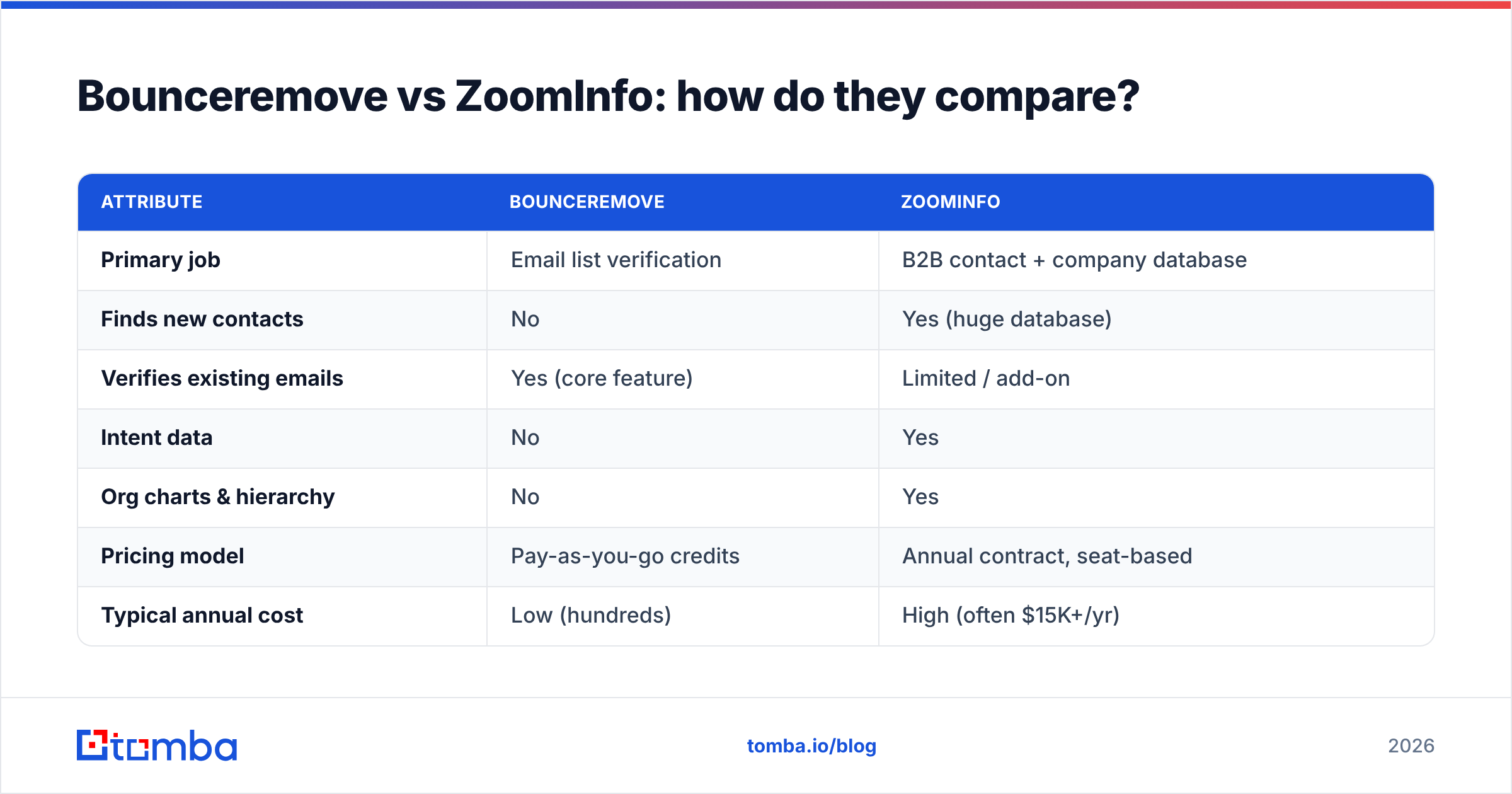
Here is the head-to-head. Notice that most rows favor one tool because the other was never trying to compete there.
| Attribute | Bounceremove | ZoomInfo |
|---|---|---|
| Primary job | Email list verification | B2B contact + company database |
| Finds new contacts | No | Yes (huge database) |
| Verifies existing emails | Yes (core feature) | Limited / add-on |
| Intent data | No | Yes |
| Org charts & hierarchy | No | Yes |
| Pricing model | Pay-as-you-go credits | Annual contract, seat-based |
| Typical annual cost | Low (hundreds) | High (often $15K+/yr) |
| Contract commitment | None | Usually 12 months |
| Best for | Cleaning lists before send | Enterprise prospecting at scale |
| Setup complexity | Minimal | Onboarding + admin |
The honest read: if you put these two in a ring, they mostly miss each other. Bounceremove wins on cost and simplicity for cleaning. ZoomInfo wins on raw data breadth. The real question is not "which is better" but "which job am I actually trying to do?"
)
Is ZoomInfo worth the price over a verifier?#
It depends entirely on whether you need data acquisition or data hygiene.
Choose ZoomInfo if:
- You run account-based outbound and need org charts, intent, and direct dials.
- You have budget for a five-figure annual contract and reps who will use it daily.
- Your bottleneck is finding enough qualified contacts, not cleaning them.
ZoomInfo is overkill if:
- You already source contacts (from LinkedIn, events, your own domain search, or inbound) and just need them verified.
- You send in bursts and cannot justify a yearly commitment.
- Most of your "data problem" is actually a bounce problem.
According to user reviews aggregated on G2, ZoomInfo's most common complaints are price and rigid annual contracts — not data quality. That tells you the platform delivers value, but only at a scale that justifies the spend. Below that scale you are paying enterprise rates for features you never open.
Where does a finder-plus-verifier fit?#
Most teams discover a third option after pricing these two: a tool that both finds and verifies emails without an enterprise contract. That is the lane Tomba sits in.
The practical workflow looks like this:
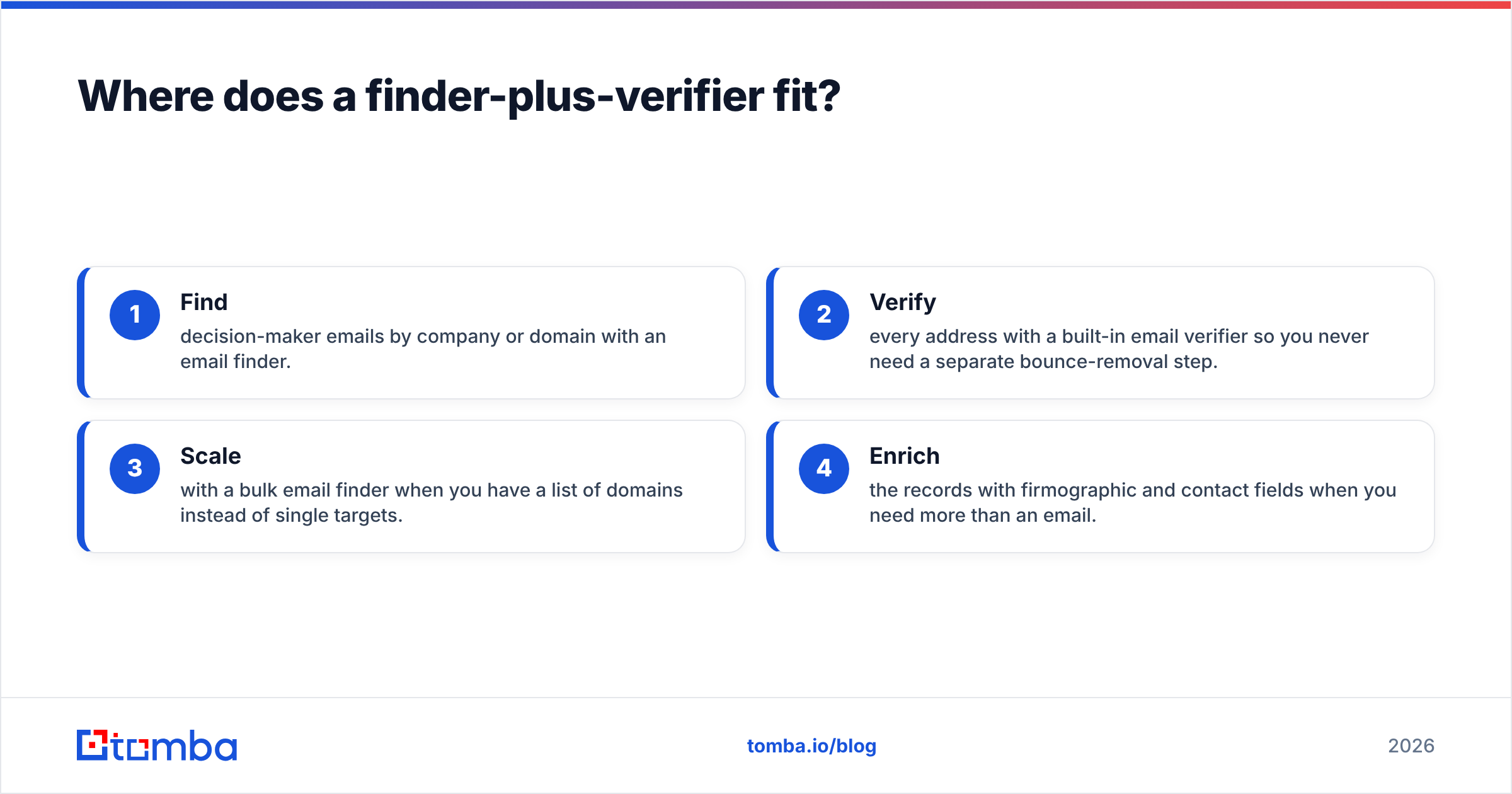
- Find decision-maker emails by company or domain with an email finder.
- Verify every address with a built-in email verifier so you never need a separate bounce-removal step.
- Scale with a bulk email finder when you have a list of domains instead of single targets.
- Enrich the records with firmographic and contact fields when you need more than an email.
This collapses the "ZoomInfo to find + Bounceremove to clean" two-tool stack into one workflow. You lose ZoomInfo's intent data and org charts — real features that matter at enterprise scale — but you gain a far lower price and no annual lock-in.
)
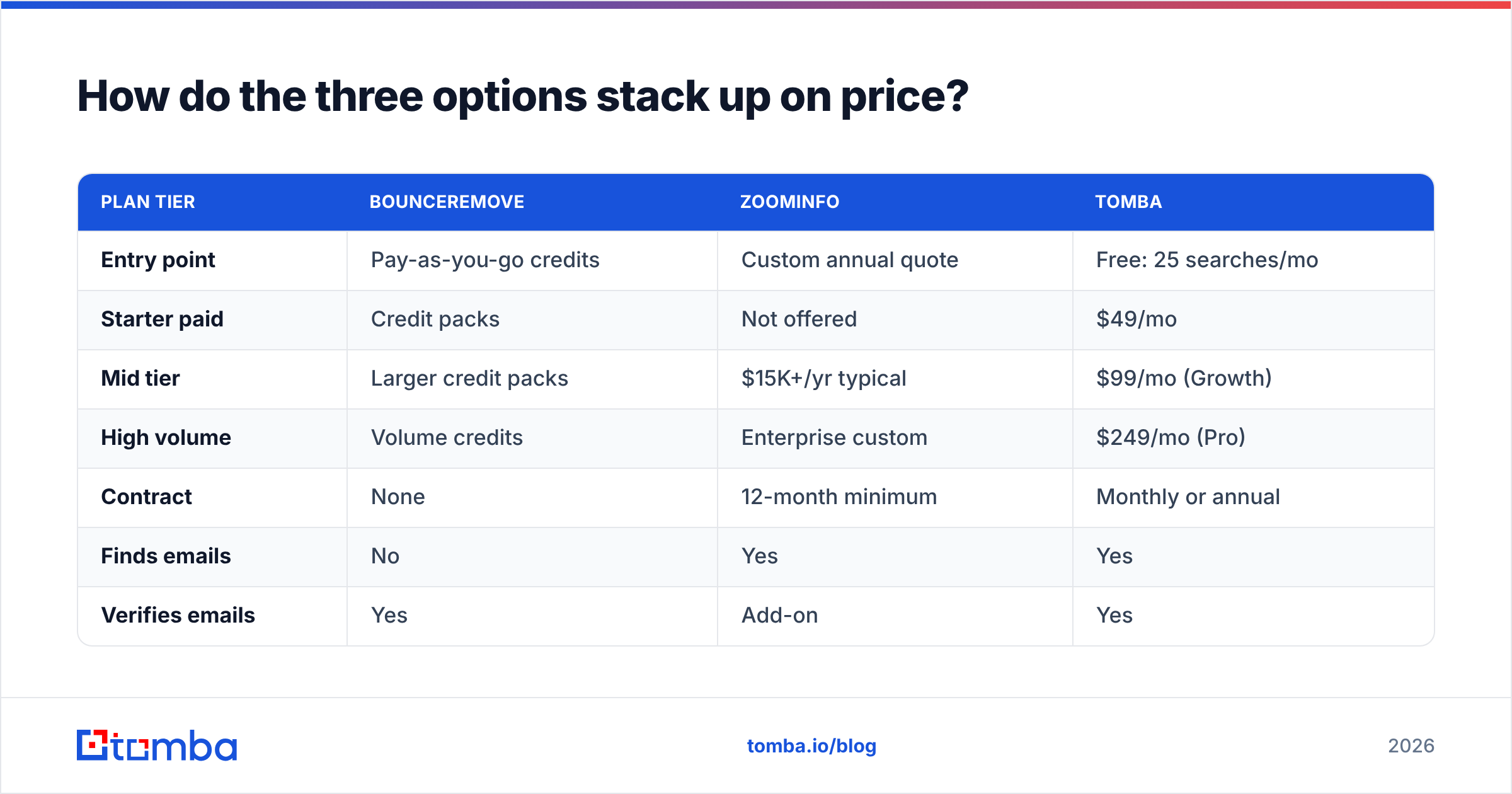
How do the three options stack up on price?#
Cost is where the decision usually gets made, so let's be concrete.
| Plan tier | Bounceremove | ZoomInfo | Tomba |
|---|---|---|---|
| Entry point | Pay-as-you-go credits | Custom annual quote | Free: 25 searches/mo |
| Starter paid | Credit packs | Not offered | $49/mo |
| Mid tier | Larger credit packs | $15K+/yr typical | $99/mo (Growth) |
| High volume | Volume credits | Enterprise custom | $249/mo (Pro) |
| Contract | None | 12-month minimum | Monthly or annual |
| Finds emails | No | Yes | Yes |
| Verifies emails | Yes | Add-on | Yes |
A few takeaways:
- Bounceremove and Tomba both avoid the annual handcuffs that define ZoomInfo contracts.
- Tomba is the only column that both finds and verifies at a published, self-serve price — see full Tomba pricing for current tiers.
- ZoomInfo's value scales with team size. Spread across 30 reps, the cost per seat looks reasonable. For a small team it does not.
Note the starter price: Tomba's paid entry is $49/mo, not the $39 figure that floats around in older comparison posts. Always check the live pricing page before budgeting.
Which tool should you actually pick?#
Match the tool to the bottleneck, not the brand.
- Your lists bounce too much, but you already have contacts. Bounceremove or any standalone verifier does the job cheaply. You do not need a database platform.
- You cannot find enough qualified accounts and you sell to enterprise. ZoomInfo earns its price through intent data, direct dials, and org charts. Budget for the annual contract.
- You need accurate emails for outbound and want verification baked in, without enterprise overhead. A finder-plus-verifier like Tomba is the most efficient single purchase — it replaces the find-then-clean two-tool stack for most SMB and mid-market teams.
A useful gut check: if you removed ZoomInfo tomorrow, would your problem be "I have no contacts" or "my contacts bounce"? The first answer points to ZoomInfo. The second points to a verifier — and if you are honest that you also need to source those contacts, it points to a combined finder-and-verifier.
For teams that also need to reach prospects by phone, layering in a phone finder closes the gap ZoomInfo's direct-dials would otherwise own — again, without the annual commitment.
The bottom line#
Bounceremove and ZoomInfo are not really competitors. Bounceremove keeps an existing list clean; ZoomInfo builds the list in the first place. Buying one expecting it to do the other's job is the most common mistake here. Decide which half of the problem is actually hurting you, and price accordingly.
If your real need is the middle ground most teams land on — accurate, verified emails for outbound without a five-figure contract — start with the Tomba Email Finder. Find decision-maker addresses by name, company, or domain, verify them in the same workflow, and skip the separate bounce-removal step entirely. The free tier gives you 25 searches a month to test accuracy on your own target accounts before you spend a cent. Cross-reference results against ZoomInfo or HubSpot's free tools, confirm the quality, then scale on a plan that bills monthly instead of annually.
// get started
Find, verify and enrich your first contacts today
Start on the free plan with 25 searches a month, then scale when your team is ready.
Free plan · No credit card required · GDPR & CCPA
// about the author