BounceShield Pricing, Reviews, Pros and Cons (2026 Guide)
A neutral 2026 breakdown of BounceShield: pricing tiers, real-world accuracy, user reviews, the honest pros and cons, and how it stacks up against alternatives for protecting your bounce rate.
TL;DR
- BounceShield is an email verification and bounce-protection tool that screens addresses before you send, aiming to keep your hard bounce rate under the 2% danger line.
- Pricing is credit-based and competitive at low volumes, but per-credit cost climbs faster than several alternatives once you cross ~50k verifications/month — always confirm current tiers on the vendor page.
- Reviews are mixed: users praise the clean UI and API, but flag catch-all handling and support response times as weak spots.
- Pros: simple onboarding, decent core accuracy, real-time API. Cons: thin enrichment, limited free tier, opaque catch-all results.
- If you want verification plus finding and enrichment in one bill, a platform like Tomba covers more of the workflow for a similar spend.
What is BounceShield and who is it for?#
BounceShield is a standalone email verification service. You feed it a list (or call its API in real time), and it tells you whether each address is deliverable, risky, or invalid before your campaign ever touches a mailbox provider. Think of it like a bouncer at a club door: it checks IDs so the troublemakers — dead inboxes, spam traps, typo domains — never get inside and start fights with your sender reputation.
This BounceShield pricing reviews pros and cons guide is written for the person who already knows why verification matters and now needs to decide whether this specific tool earns a line item in the budget. If you send cold outreach, run a newsletter above a few thousand subscribers, or manage email deliverability for a team, a verifier is no longer optional — but the right one depends on volume, workflow, and what else you need alongside it.
A quick framing of where bounce protection sits in the stack:
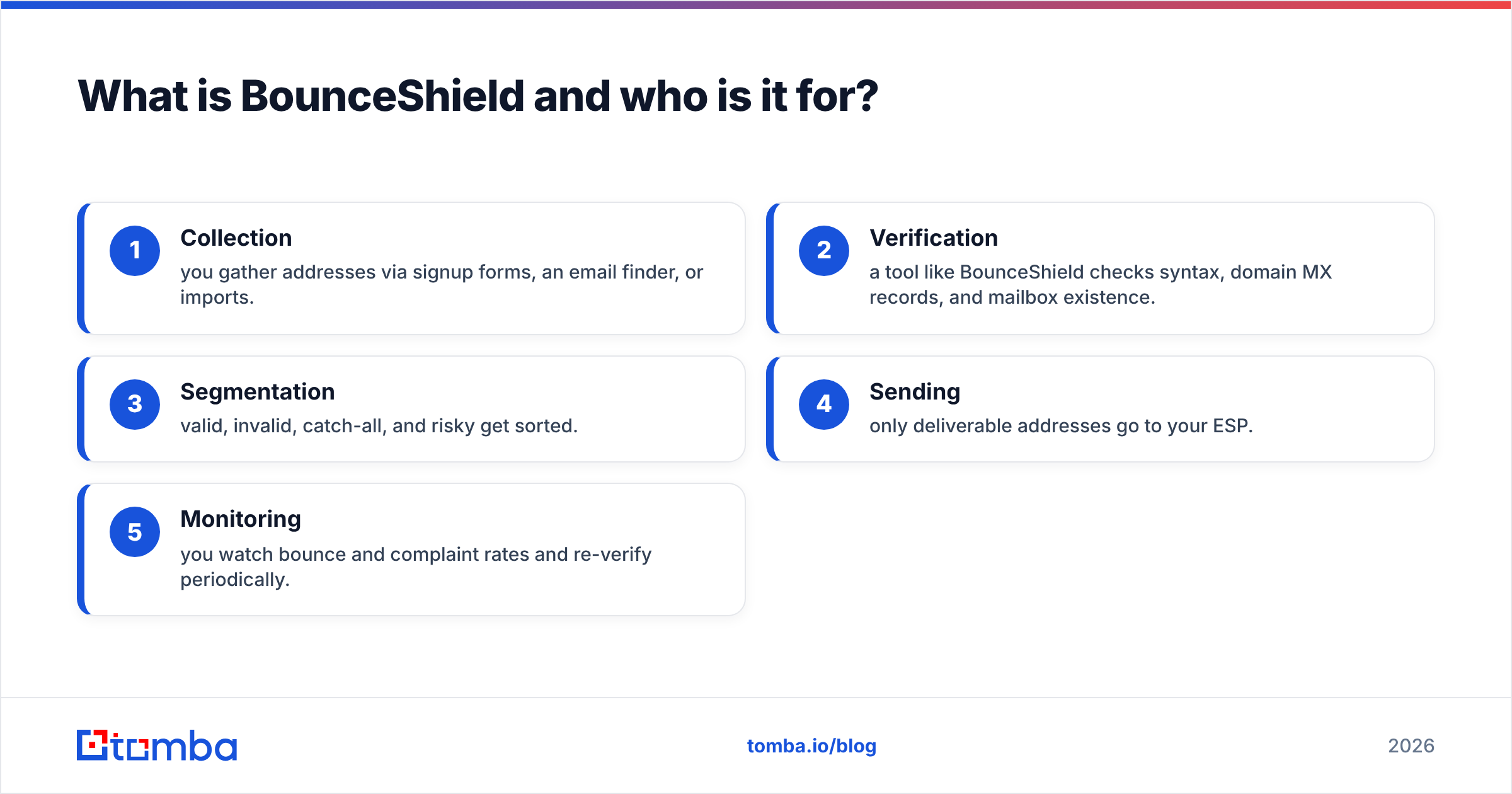
- Collection — you gather addresses via signup forms, an email finder, or imports.
- Verification — a tool like BounceShield checks syntax, domain MX records, and mailbox existence.
- Segmentation — valid, invalid, catch-all, and risky get sorted.
- Sending — only deliverable addresses go to your ESP.
- Monitoring — you watch bounce and complaint rates and re-verify periodically.
BounceShield concentrates almost entirely on step 2. That focus is its biggest strength and, depending on your needs, its biggest limitation.

How much does BounceShield cost?#
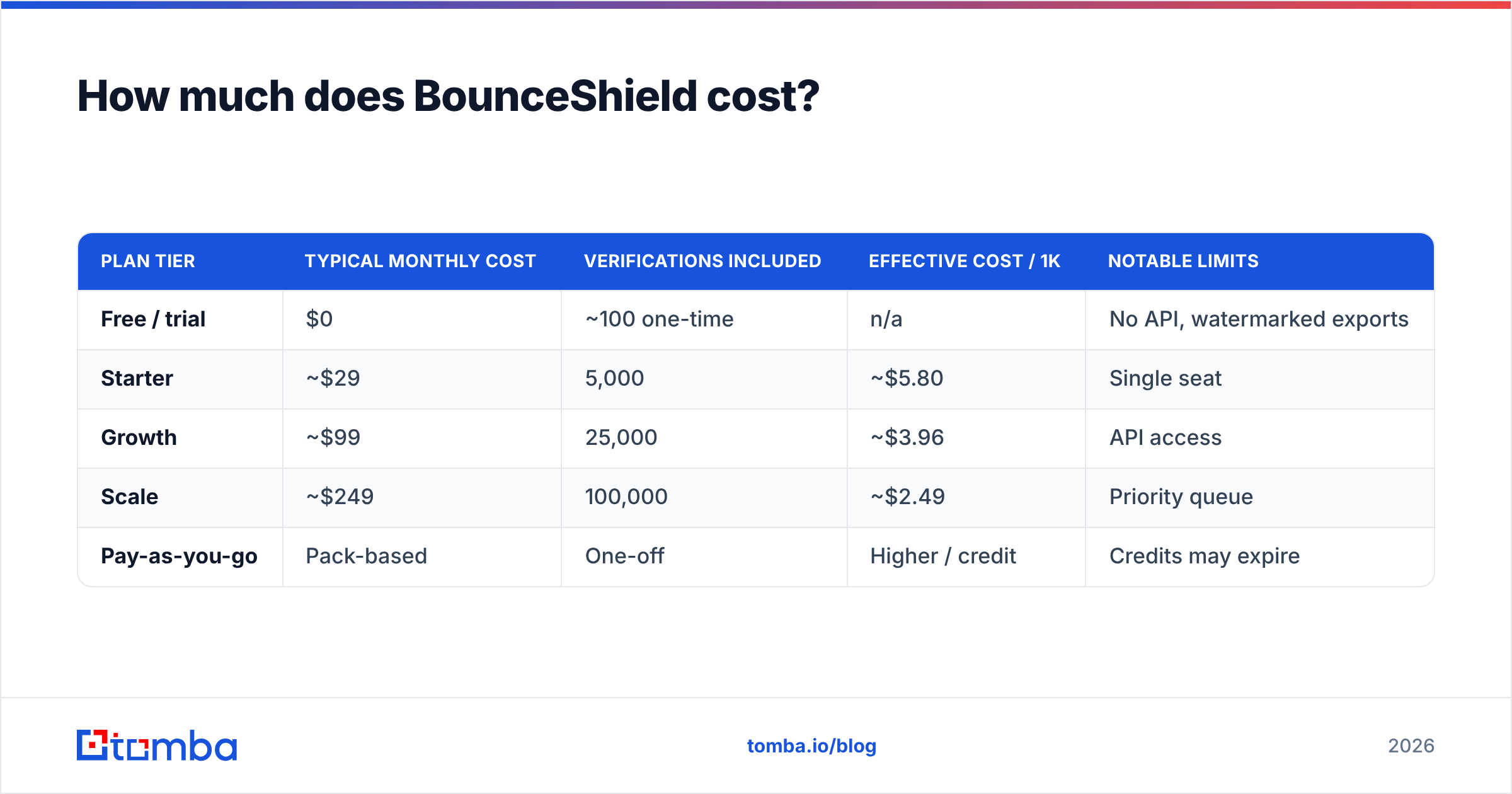
BounceShield uses a credit model: one credit equals one verification, and credits are sold in monthly subscriptions or one-off packs. That structure is standard for the category, so the real question is cost-per-credit at your volume.
Pricing in this market shifts often, so treat the figures below as a representative snapshot at the time of writing and confirm live numbers before you buy. The pattern that matters more than any single price is the curve: cheap to start, with per-credit cost dropping at higher tiers but rarely as steeply as bulk-focused competitors.
| Plan tier | Typical monthly cost | Verifications included | Effective cost / 1k | Notable limits |
|---|---|---|---|---|
| Free / trial | $0 | ~100 one-time | n/a | No API, watermarked exports |
| Starter | ~$29 | 5,000 | ~$5.80 | Single seat |
| Growth | ~$99 | 25,000 | ~$3.96 | API access |
| Scale | ~$249 | 100,000 | ~$2.49 | Priority queue |
| Pay-as-you-go | Pack-based | One-off | Higher / credit | Credits may expire |
A few honest takeaways:
- The free tier is thin. ~100 verifications is enough to test the UI, not to validate accuracy on a real list. Compare that to verifiers that hand out 100–1,000 monthly credits indefinitely.
- Credits can expire. On subscription plans, unused monthly credits typically don't roll over — a real cost if your sending is seasonal.
- API is gated behind a mid-tier plan. If you need real-time verification at signup, budget for at least the Growth-equivalent tier.
For reference on a finder-plus-verifier platform, Tomba pricing runs Free (25 searches/mo), Starter $49/mo, Growth $99/mo, and Pro $249/mo — but those credits cover finding and verification and enrichment, not verification alone.
Is BounceShield accurate enough?#
Accuracy is the only metric that justifies a verifier's existence, and BounceShield lands in the "good, not class-leading" band based on aggregated user reports. For standard B2B and B2C domains — Gmail, Outlook, corporate Google Workspace — its valid/invalid calls are reliable and its hard-bounce protection does what it promises.
Where it gets shakier is the catch-all problem. A catch-all domain accepts mail to any address at that domain, so the server can't tell you whether jane@company.com actually exists. Every verifier struggles here, but the good ones give you a confidence score or a separate catch-all verifier pass. BounceShield tends to bucket these as "risky/unknown" without much nuance, which leaves you guessing on a chunk of B2B lists where catch-alls are common.
For an apples-to-apples accuracy comparison, third-party review sites like G2 and Capterra aggregate verified user ratings across the category — worth scanning before you commit, since vendor-published accuracy claims rarely use the same test methodology.
What do BounceShield reviews say?#
Pulling together the recurring themes from public reviews, the picture is consistent:
What users like:
- Clean, fast UI — uploading a CSV and getting a segmented result file is genuinely painless.
- Solid core deliverability calls — for mainstream domains, hard-bounce reduction is real and measurable.
- Straightforward API docs — developers report quick integration for real-time checks at form submission.
What users criticize:
- Catch-all ambiguity — the most common complaint; "risky" results that don't help you decide.
- Support latency — slower-than-expected responses on lower tiers, with priority support effectively paywalled.
- No real enrichment — it verifies, but it won't append job titles, company data, or phone numbers.
- Credit expiry friction — several reviewers were surprised that monthly credits reset.
None of these are dealbreakers on their own. Together, they paint BounceShield as a competent single-purpose tool rather than a platform. If verification is all you need and your lists are mostly mainstream domains, the reviews are encouraging. If you're juggling finding, verifying, and enriching, you'll feel the gaps.
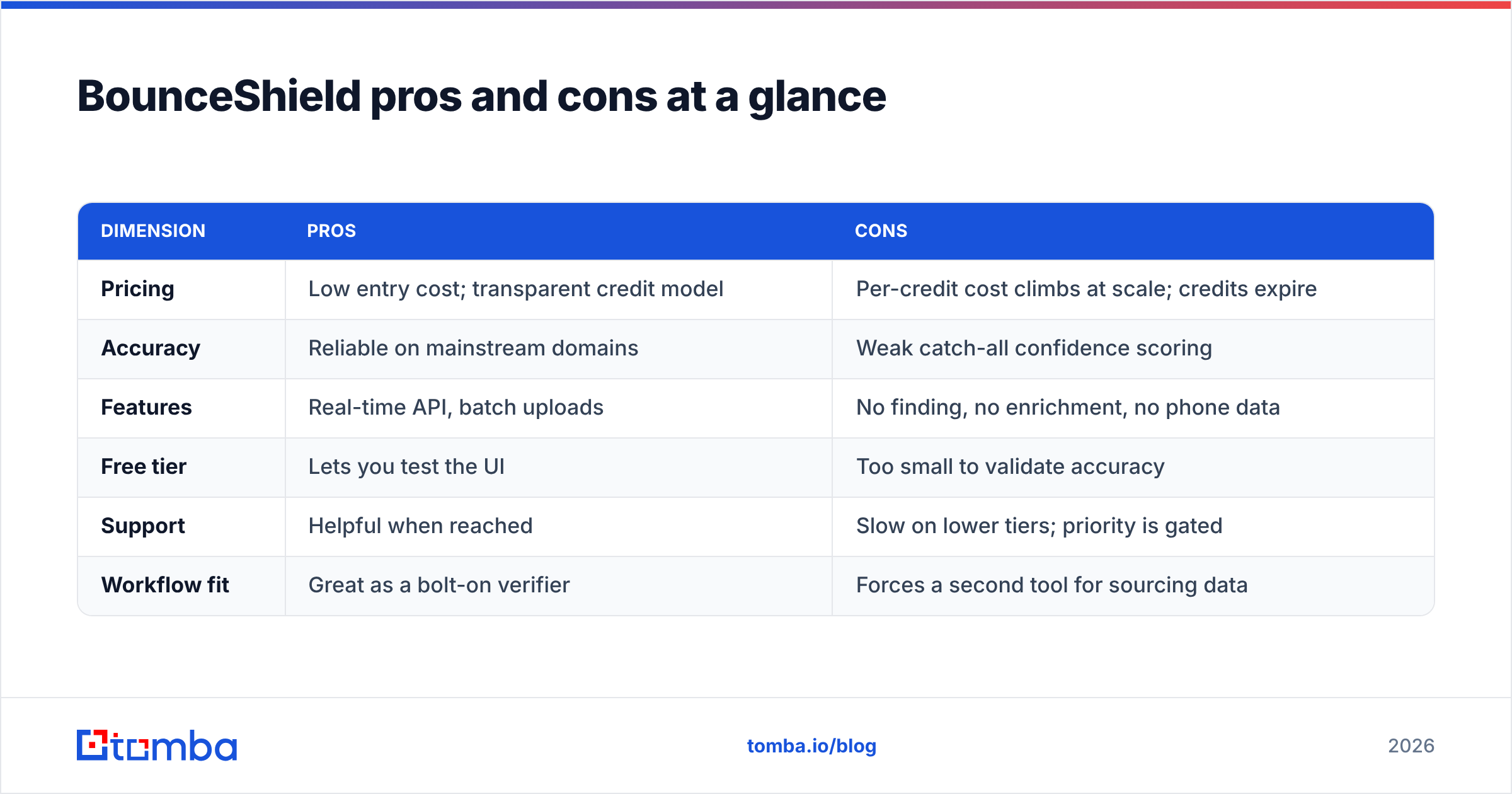
BounceShield pros and cons at a glance#
Here's the honest ledger, summarizing the pricing reviews pros and cons for BounceShield in one place:
| Dimension | Pros | Cons |
|---|---|---|
| Pricing | Low entry cost; transparent credit model | Per-credit cost climbs at scale; credits expire |
| Accuracy | Reliable on mainstream domains | Weak catch-all confidence scoring |
| Features | Real-time API, batch uploads | No finding, no enrichment, no phone data |
| Free tier | Lets you test the UI | Too small to validate accuracy |
| Support | Helpful when reached | Slow on lower tiers; priority is gated |
| Workflow fit | Great as a bolt-on verifier | Forces a second tool for sourcing data |
How does BounceShield compare to alternatives?#
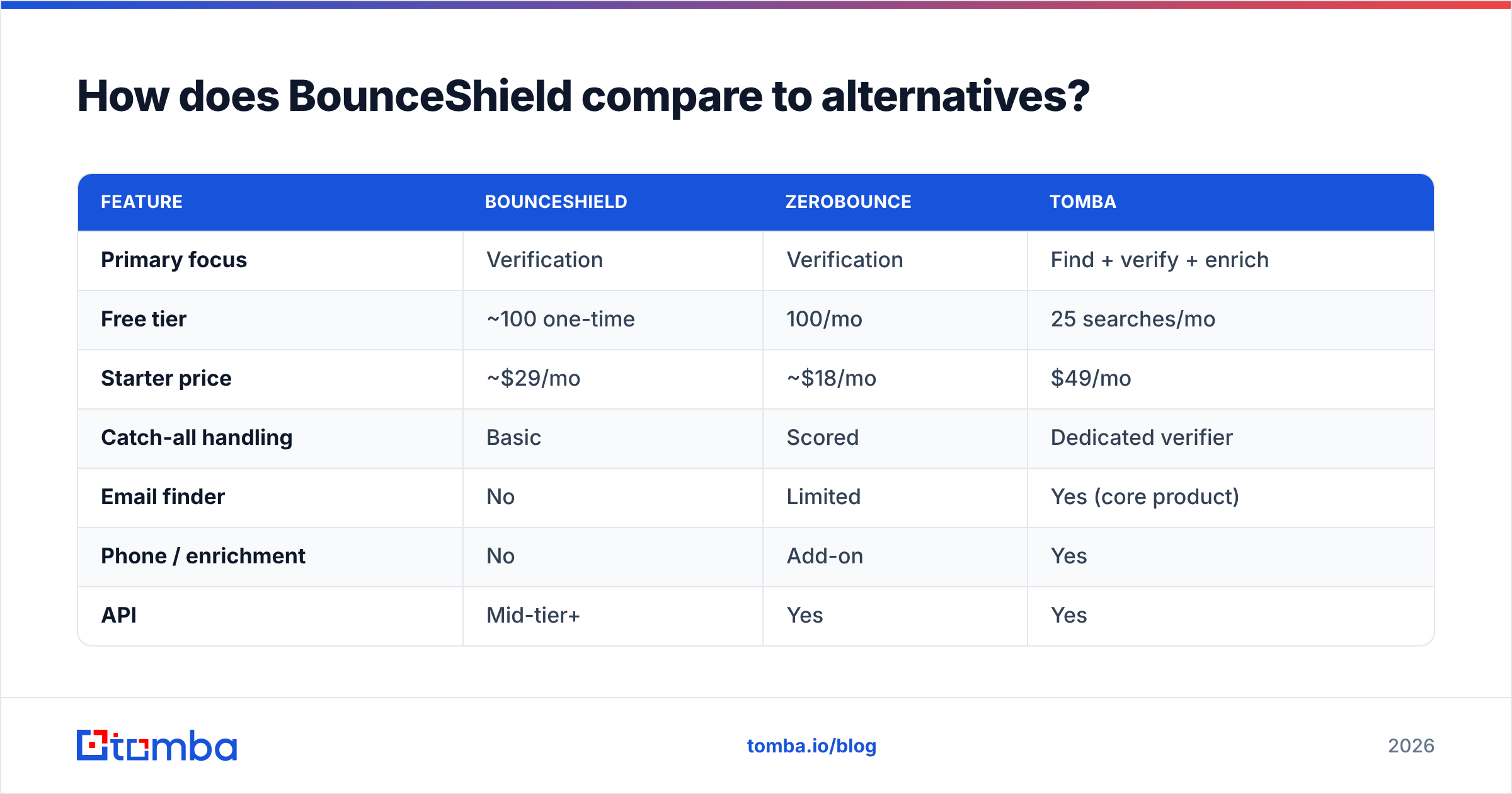
BounceShield competes in a crowded field. The decision usually comes down to whether you want a pure verifier or an all-in-one data platform. Here's how it lines up against two common reference points:
| Feature | BounceShield | ZeroBounce | Tomba |
|---|---|---|---|
| Primary focus | Verification | Verification | Find + verify + enrich |
| Free tier | ~100 one-time | 100/mo | 25 searches/mo |
| Starter price | ~$29/mo | ~$18/mo | $49/mo |
| Catch-all handling | Basic | Scored | Dedicated verifier |
| Email finder | No | Limited | Yes (core product) |
| Phone / enrichment | No | Add-on | Yes |
| API | Mid-tier+ | Yes | Yes |
If you only ever clean lists you already own, a focused verifier — BounceShield or a ZeroBounce alternative — is reasonable. But most teams that verify also need to source contacts. Paying two subscriptions (one to find, one to verify) usually costs more than a single platform that does both, and it doubles the integration work.

This is where the math shifts. Tomba's email verifier runs on the same credits as its email finder and enrichment, so a single Growth plan at $99/mo covers the entire collect-verify-enrich loop instead of just one slice of it. For teams running outbound at scale, consolidating the stack often beats stacking point tools — both on cost and on the time you spend wiring APIs together.
When should you choose BounceShield anyway?#
Conclusion first: pick BounceShield when verification is a standalone, recurring chore and you don't need anything else from the tool.
Concretely, it's a good fit if:
- You own a large existing list (newsletter, CRM export) and just need periodic hygiene passes.
- Your domains are mostly mainstream — Gmail, Outlook, Workspace — where catch-all ambiguity rarely bites.
- You already have a sourcing tool and don't want to migrate it.
- You need a cheap real-time API for a signup form and your monthly volume is modest.
It's the wrong call if you're sourcing new contacts every week, if your lists are catch-all-heavy B2B domains, or if you'd rather pay one bill than three. In those cases, the per-credit savings evaporate against the overhead of running multiple tools. Industry guidance on keeping a healthy bounce rate is consistent across providers like HubSpot — stay under 2% hard bounces — and the cheapest way to hit that target is usually verifying at the moment you collect the address, not weeks later.
How do you keep bounce rates low without overpaying?#
The bounce-protection playbook is the same regardless of which tool you choose:
- Verify at the point of capture. Real-time API checks at signup stop bad addresses before they ever enter your list.
- Re-verify before every major send. Inboxes go stale; a 6-month-old "valid" address may now be dead.
- Handle catch-alls deliberately. Segment them out and either skip or send with caution — don't treat them as confirmed.
- Watch your sender reputation. Verification protects it, but warmup and content matter too. Monitor sender reputation alongside bounce metrics.
- Don't over-buy credits. Match your plan to actual monthly volume; expiring credits are pure waste.
BounceShield handles steps 1–3 competently for mainstream lists. The catch-all weakness is the one place where a dedicated catch-all verifier gives you a cleaner answer, and the absence of sourcing means steps in your wider funnel still live elsewhere.
The bottom line#
BounceShield is a capable, no-frills verifier that does its one job well for standard domains and modest volumes. The pricing is fair at the entry level, the reviews are broadly positive on the core experience, and the cons — catch-all ambiguity, no enrichment, gated support — are predictable for a single-purpose tool. If verification is genuinely the only box you need to tick, it's a defensible choice.
But if you're sourcing, verifying, and enriching contacts as part of one outbound motion, paying for verification in isolation rarely pencils out. Consolidating the workflow into a platform that finds and validates addresses on the same credit pool usually means fewer bills, fewer integrations, and a cleaner list end to end.
Ready to find and verify in one place? Start with the Tomba Email Finder — surface professional emails by name, company, or domain, verify them before you send, and skip the second subscription. The free tier lets you test real accuracy on your own targets before you spend a cent, and every plan covers finding, verification, and enrichment on shared credits. Clean lists, lower bounces, one bill.
// get started
Find, verify and enrich your first contacts today
Start on the free plan with 25 searches a month, then scale when your team is ready.
Free plan · No credit card required · GDPR & CCPA
// about the author