Bounceshield vs Bytemine (2026): Full Feature Comparison
Choosing between Bounceshield and Bytemine? We compare accuracy, pricing, data coverage, and real-world fit to help you decide which B2B email and data tool earns your budget in 2026.
You have two shortlisted tools, one budget line, and a quota that does not care which logo you pick. Bounceshield and Bytemine both promise clean B2B contact data, but they solve slightly different problems and price them very differently. This comparison cuts through the marketing copy so you can match the tool to the way your team actually prospects.
TL;DR — Bounceshield vs Bytemine at a glance#
- Bounceshield leans into email verification and deliverability protection. It shines when your problem is bounce rates, not finding new contacts.
- Bytemine is a broader data-mining and lead-enrichment play, with a bigger contact database but more variable accuracy.
- Accuracy is close on common business domains; the gap widens on catch-all domains and smaller companies, where verification depth matters most.
- Pricing favors Bounceshield for verification-only teams and Bytemine for high-volume list builders — but both can get expensive at scale.
- If your real need is finding accurate emails (not just cleaning a list), a dedicated email finder like Tomba often beats either tool on cost per valid contact.
What are Bounceshield and Bytemine?#
Bounceshield positions itself as a deliverability-first platform. Its core jobs are verifying email addresses, catching risky or invalid contacts before you send, and protecting your sender reputation. Think of it as a bouncer at the door of your mail server — its whole purpose is keeping bad addresses out so your campaigns reach real inboxes.
Bytemine takes the opposite starting point. It is built around a large prospect database and enrichment engine. You search by company, role, or industry, then export contacts with firmographic and technographic fields attached. The mental model here is a mine, not a gate: you dig through a big pile of raw data and surface the records that match your ICP.
That difference in DNA explains almost every trade-off below. One tool is optimized to clean, the other to collect. Few teams need only one of those jobs, which is why the comparison rarely ends with a clean winner.
How do Bounceshield and Bytemine compare on features?#
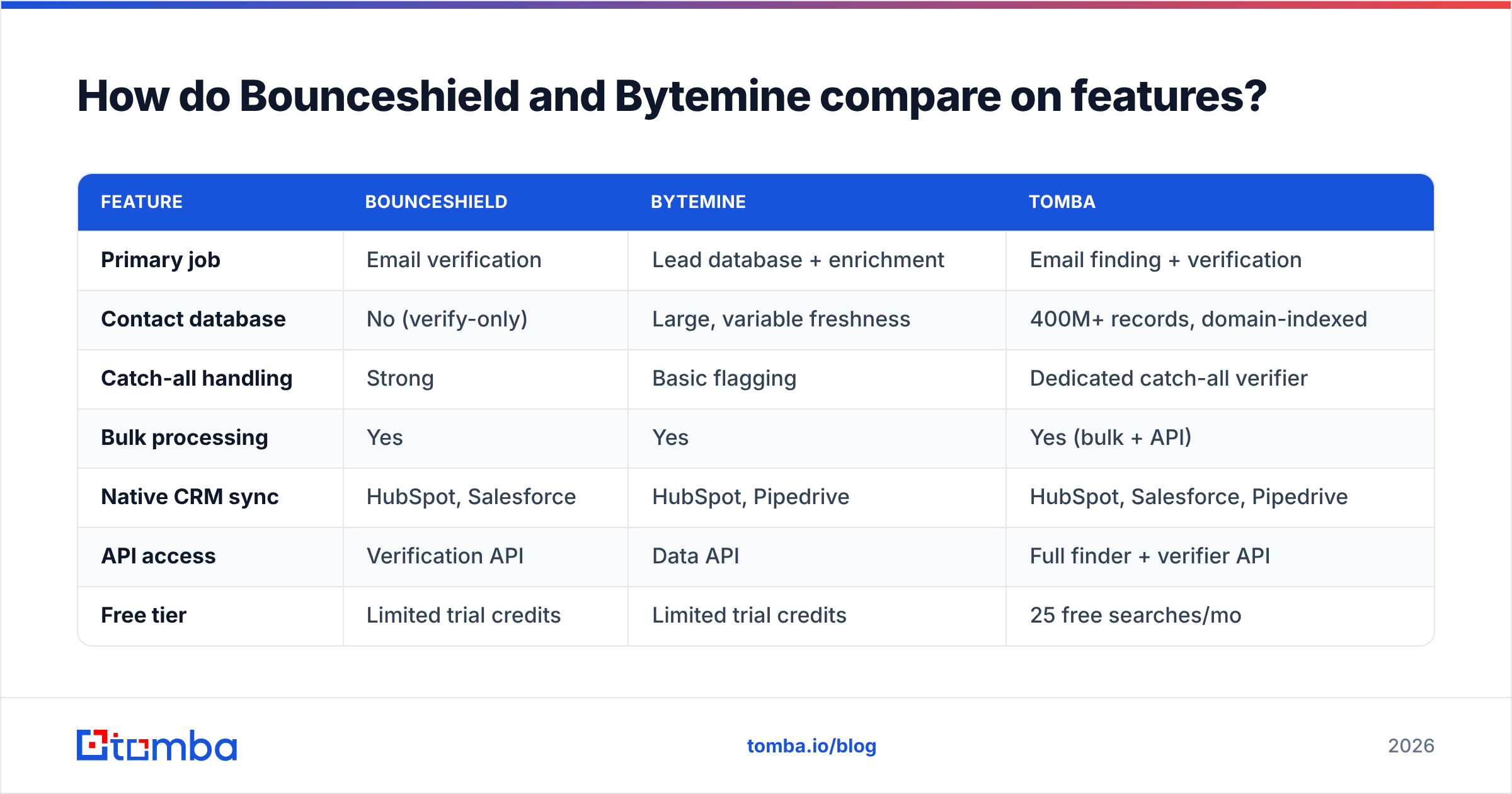
Here is the side-by-side on the attributes that actually change your day-to-day workflow.
| Feature | Bounceshield | Bytemine | Tomba |
|---|---|---|---|
| Primary job | Email verification | Lead database + enrichment | Email finding + verification |
| Contact database | No (verify-only) | Large, variable freshness | 400M+ records, domain-indexed |
| Catch-all handling | Strong | Basic flagging | Dedicated catch-all verifier |
| Bulk processing | Yes | Yes | Yes (bulk + API) |
| Native CRM sync | HubSpot, Salesforce | HubSpot, Pipedrive | HubSpot, Salesforce, Pipedrive |
| API access | Verification API | Data API | Full finder + verifier API |
| Free tier | Limited trial credits | Limited trial credits | 25 free searches/mo |
| Starter price | ~$59/mo | ~$79/mo | $49/mo |
The pattern is clear. Bounceshield is the deeper specialist on verification; Bytemine wins on raw database breadth; and a finder-first platform like Tomba sits in the middle by doing both jobs in one workflow. If your pipeline already has contacts and you just need them validated, Bounceshield's depth is genuinely useful. If you are starting from an empty list, Bytemine or a dedicated finder is the better entry point.

Which tool is more accurate?#
Accuracy is the only metric that matters once both tools clear your feature checklist. A "verified" email that still bounces costs you a sending slot, a reply, and a sliver of sender reputation you can't easily rebuild.
On standard corporate domains — companies with clean MX records and no catch-all — Bounceshield and Bytemine perform similarly. The divergence appears in three places:
- Catch-all domains. Bounceshield's verification layer is more aggressive about classifying risk, so you get fewer false "valid" results. Bytemine tends to mark catch-alls as deliverable, which inflates your usable count on paper but raises real bounces.
- Small and mid-market companies. Database tools like Bytemine are densest on enterprise records. Coverage thins out for sub-200-employee firms, where guess-and-verify finders often do better.
- Data freshness. Bytemine's records can lag after job changes. Bounceshield doesn't store contacts, so it only tells you whether an address you already have is live — not whether the person still works there.

The practical takeaway: verification depth and database freshness are different forms of accuracy. Bounceshield owns the first; neither tool fully owns the second. If you want to sanity-check any single address yourself, run it through a free email verifier before trusting a bulk export.
How does pricing compare?#
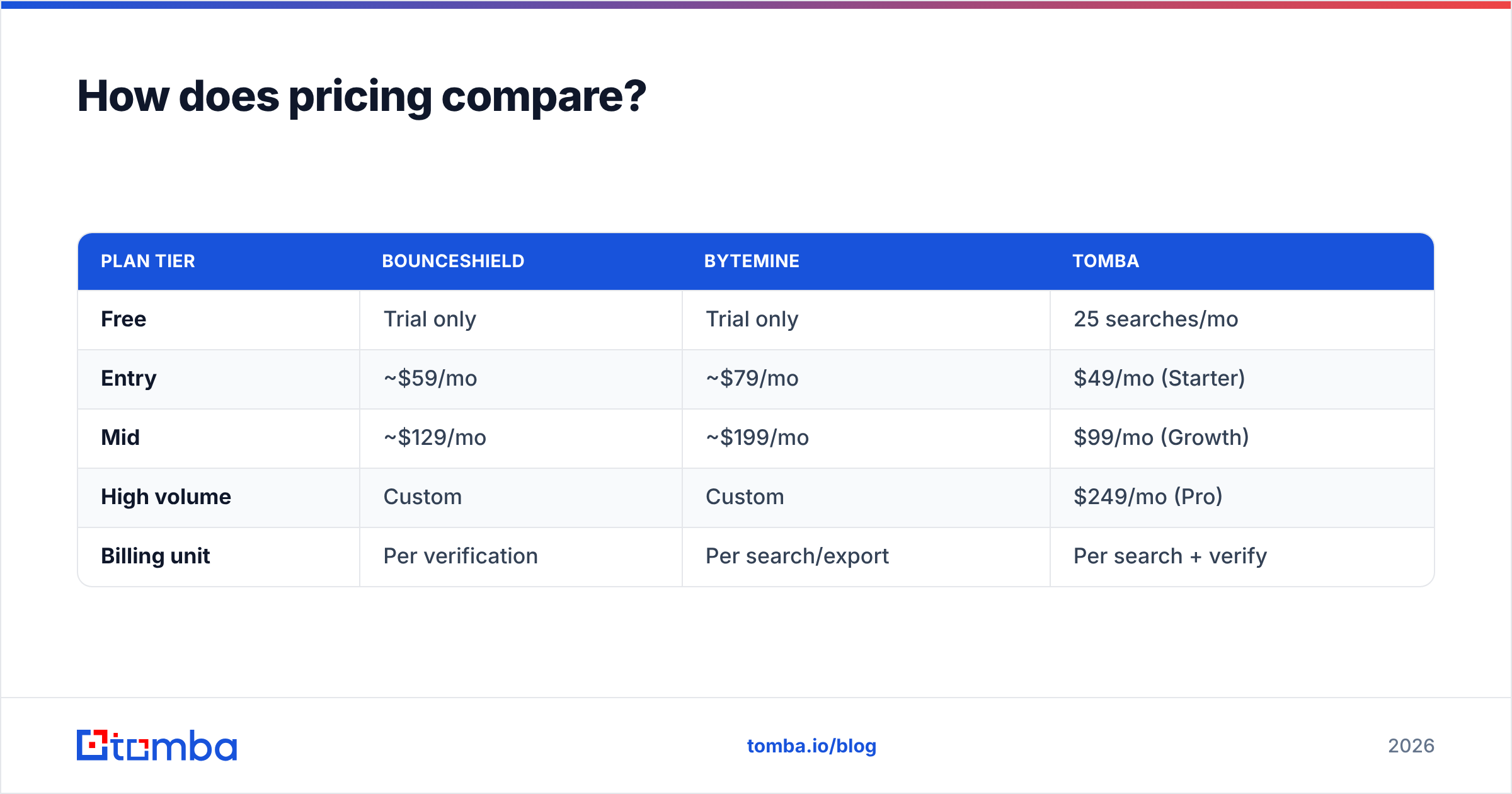
Both vendors use credit-based tiers, which makes apples-to-apples comparison harder than it should be. A "credit" in Bounceshield buys one verification; in Bytemine it can mean a search, an enrichment, or an export depending on the action.
| Plan tier | Bounceshield | Bytemine | Tomba |
|---|---|---|---|
| Free | Trial only | Trial only | 25 searches/mo |
| Entry | ~$59/mo | ~$79/mo | $49/mo (Starter) |
| Mid | ~$129/mo | ~$199/mo | $99/mo (Growth) |
| High volume | Custom | Custom | $249/mo (Pro) |
| Billing unit | Per verification | Per search/export | Per search + verify |
Two things stand out. First, Bytemine's higher entry price reflects the cost of maintaining a database, not better output quality. Second, "verify-only" pricing like Bounceshield's looks cheap until you realize you still need a separate source for the contacts themselves — so your true cost is two subscriptions, not one.
This is where a combined finder-and-verifier changes the math. When one credit both finds and validates an address, your cost per usable contact drops, even if the sticker price looks similar. Compare the full breakdown on the Tomba pricing page against whichever vendor quote you're holding.
Is Bounceshield better than Bytemine?#
It depends entirely on which problem is bleeding your pipeline.
Choose Bounceshield if:
- Your bounce rate is the fire you need to put out today.
- You already have a contact source and just need a deliverability gate.
- You run high-volume campaigns where reputation protection pays for itself.
Choose Bytemine if:
- You're building lists from scratch and value database breadth.
- Your ICP skews enterprise, where Bytemine's coverage is densest.
- You want firmographic and technographic enrichment in the same tool.
Consider neither if:
- You need accurate new emails at low cost per contact.
- You're a small team that can't justify two overlapping subscriptions.
- You want finding, verification, and enrichment in one billable workflow.
That third bucket is larger than most buyers expect. A lot of teams shortlist a verifier and a database separately, then discover a single email-finder platform covers both jobs at a lower blended cost.

Where does Tomba fit in this comparison?#
Tomba is an email-finder-first platform that folds verification, domain search, and enrichment into the same flow. Instead of buying a database for collection and a verifier for cleaning, you find an address by name or company and Tomba validates it in the same step.
The differences that matter against Bounceshield and Bytemine:
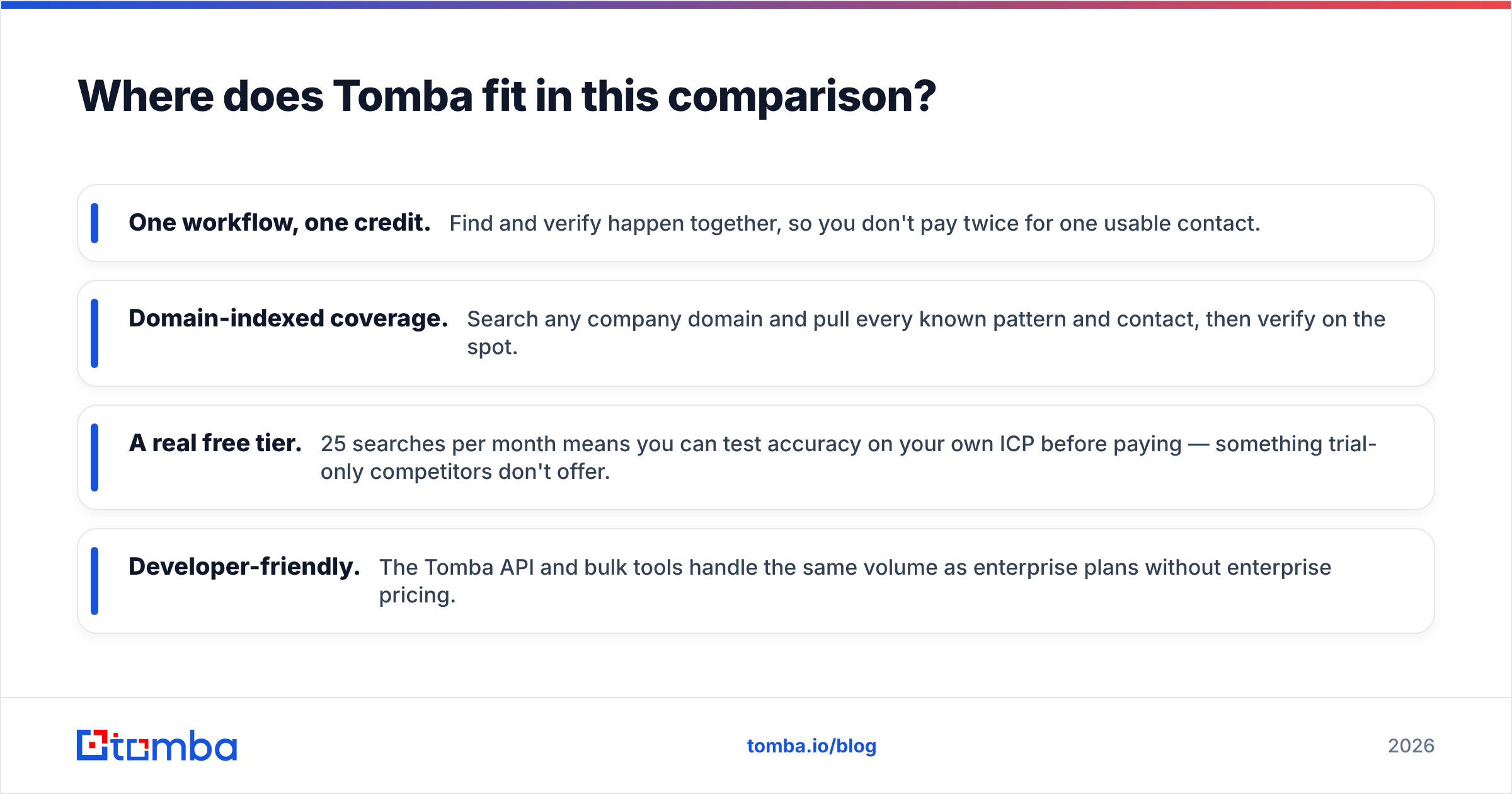
- One workflow, one credit. Find and verify happen together, so you don't pay twice for one usable contact.
- Domain-indexed coverage. Search any company domain and pull every known pattern and contact, then verify on the spot.
- A real free tier. 25 searches per month means you can test accuracy on your own ICP before paying — something trial-only competitors don't offer.
- Developer-friendly. The Tomba API and bulk tools handle the same volume as enterprise plans without enterprise pricing.
None of this makes Bounceshield's verification depth irrelevant — if deliverability is your only problem, a specialist is a reasonable buy. But for the common case of "I need accurate emails I can actually send to," a finder that verifies inline removes a whole tool from your stack.
What should you check before you commit?#
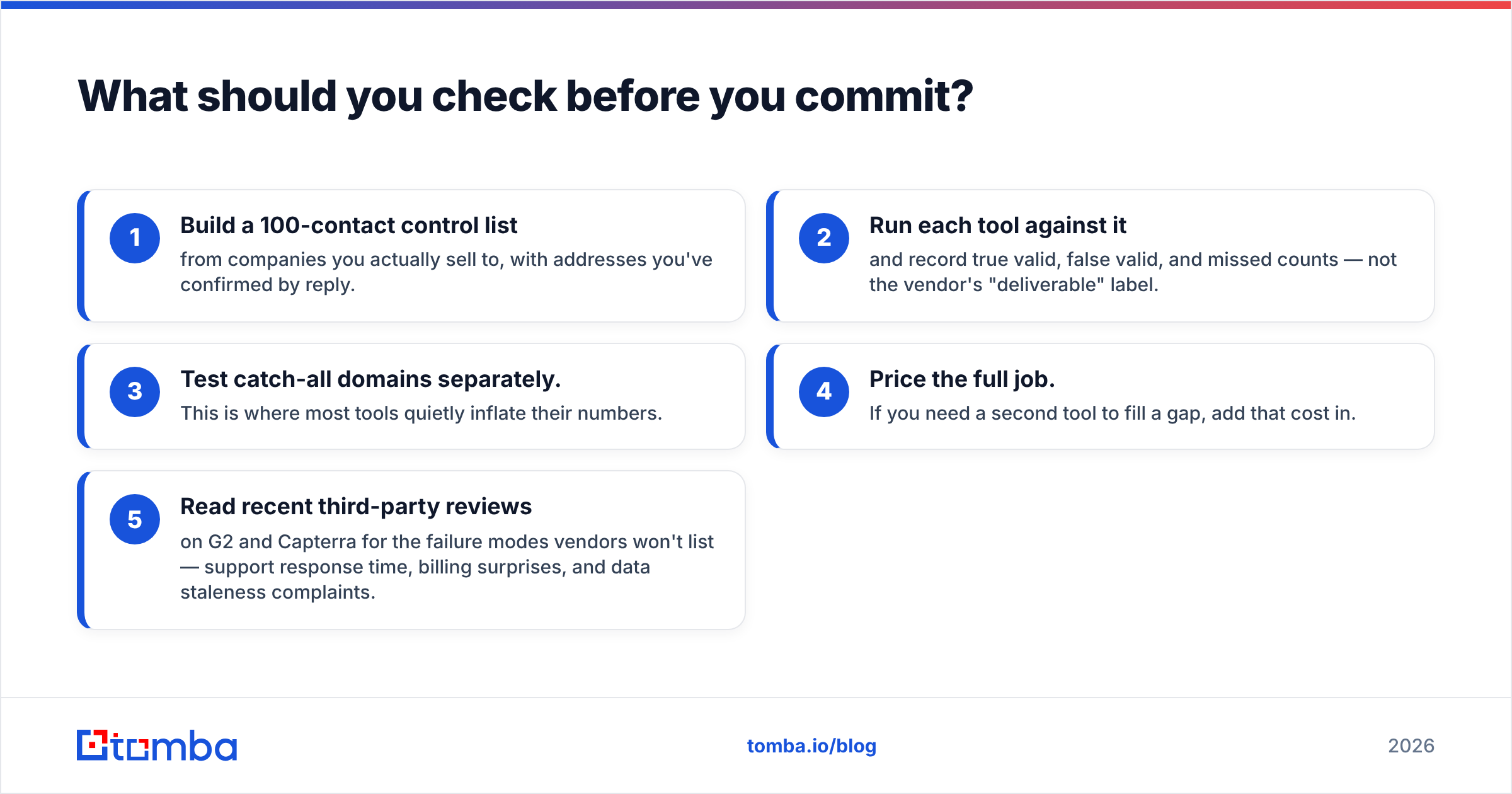
Before signing any annual contract, run the same five-step test on each tool. Vendor benchmarks are run on vendor-friendly data; your ICP is the only sample that counts.
- Build a 100-contact control list from companies you actually sell to, with addresses you've confirmed by reply.
- Run each tool against it and record true valid, false valid, and missed counts — not the vendor's "deliverable" label.
- Test catch-all domains separately. This is where most tools quietly inflate their numbers.
- Price the full job. If you need a second tool to fill a gap, add that cost in.
- Read recent third-party reviews on G2 and Capterra for the failure modes vendors won't list — support response time, billing surprises, and data staleness complaints.
For background on how deliverability scoring works under the hood, the email deliverability overview is a neutral primer worth skimming before you trust any vendor's accuracy claims.
Frequently asked questions#
Is Bounceshield or Bytemine better for cold outreach? For cold outreach you need both fresh contacts and a clean list. Bytemine gives you the contacts; Bounceshield protects deliverability. Used alone, each leaves a gap — which is why many cold-email teams prefer a combined finder-and-verifier.
Can I use Bounceshield without a separate database? Not really. Bounceshield verifies addresses you already have; it doesn't source new ones. You'll need a database, scraper, or email finder feeding it.
Does Bytemine verify emails before export? It flags risk levels but its verification is lighter than a dedicated verifier's. Expect to re-verify exports before any high-volume send.
Which is cheapest? On sticker price, Bounceshield's entry tier is lower, but its true cost includes a second tool for finding contacts. Measured per usable contact, a combined platform like Tomba at $49/mo is usually the lowest blended cost.
The bottom line#
Bounceshield wins on verification depth, Bytemine wins on database breadth, and neither alone covers the full find-then-verify job most B2B teams actually run. If your only headache is bounces, buy the specialist. If you're building lists at enterprise scale, the database tool earns its price.
But if you want accurate, verified emails without stacking two subscriptions, start with a finder that does both. Spin up the free tier of the Tomba Email Finder, run it against your own 100-contact control list, and compare the cost per valid contact — not per credit — against whatever quote Bounceshield or Bytemine sent you. The tool that wins that test is the one that deserves your budget in 2026.
Ready to find emails that actually work?
Join 150,000+ professionals who stopped guessing and started sending. Free credits on signup — no credit card required.
Get the Tomba newsletter
Practical outbound tactics and product updates — once every two weeks.
About the author