Bounceshield vs Clodura.ai 2026: B2B Data Tools Compared
Bounceshield protects deliverability; Clodura.ai builds pipeline. Here's an honest 2026 breakdown of which B2B tool fits your stack — and where a leaner option wins.
Bounceshield vs Clodura.ai: Which B2B Tool Actually Earns Its Seat?
You are not really choosing between two versions of the same product. You are choosing between two different jobs. Bounceshield wants to keep your sender reputation intact by stopping bad addresses before they bounce. Clodura.ai wants to fill your pipeline with prospects, intent signals, and sequences. Comparing them head-to-head only makes sense once you decide which problem is bleeding revenue right now.
TL;DR — The Short Version#
- Bounceshield is built around email hygiene: catching invalid, risky, and catch-all addresses so your bounce rate stays low and your domain reputation survives.
- Clodura.ai is a sales-intelligence and prospecting platform: a B2B contact database, intent data, and built-in cadences for outbound teams.
- They overlap only at the edges. If your problem is "my cold emails bounce," lean hygiene. If your problem is "I have no one to email," lean intelligence.
- Most teams end up paying for both, plus a finder — which is where a consolidated tool like Tomba quietly saves a budget line.
- Pricing, accuracy guarantees, and data freshness differ enough that the wrong pick costs you either deliverability or pipeline.
What Is Bounceshield?#
Bounceshield positions itself as a deliverability guardrail. The core promise is simple: run every address through validation before it hits your sending tool, and you stop spam traps, typos, and dead mailboxes from torching your reputation.
In practice that means syntax checks, MX record lookups, SMTP handshake probing, role-account detection (think info@ or sales@), and an attempt at the hardest category of all — catch-all domains, where the server accepts everything and tells you nothing. A good verifier scores these by risk rather than pretending a binary valid/invalid answer exists.
If you have never thought hard about why a 4% bounce rate quietly tanks your open rates, it helps to understand email deliverability as a trust score. Mailbox providers watch how often you hit dead addresses. Cross a threshold and they start routing you to spam — for everyone on your domain, not just the bad list.
Where Bounceshield is strongest:
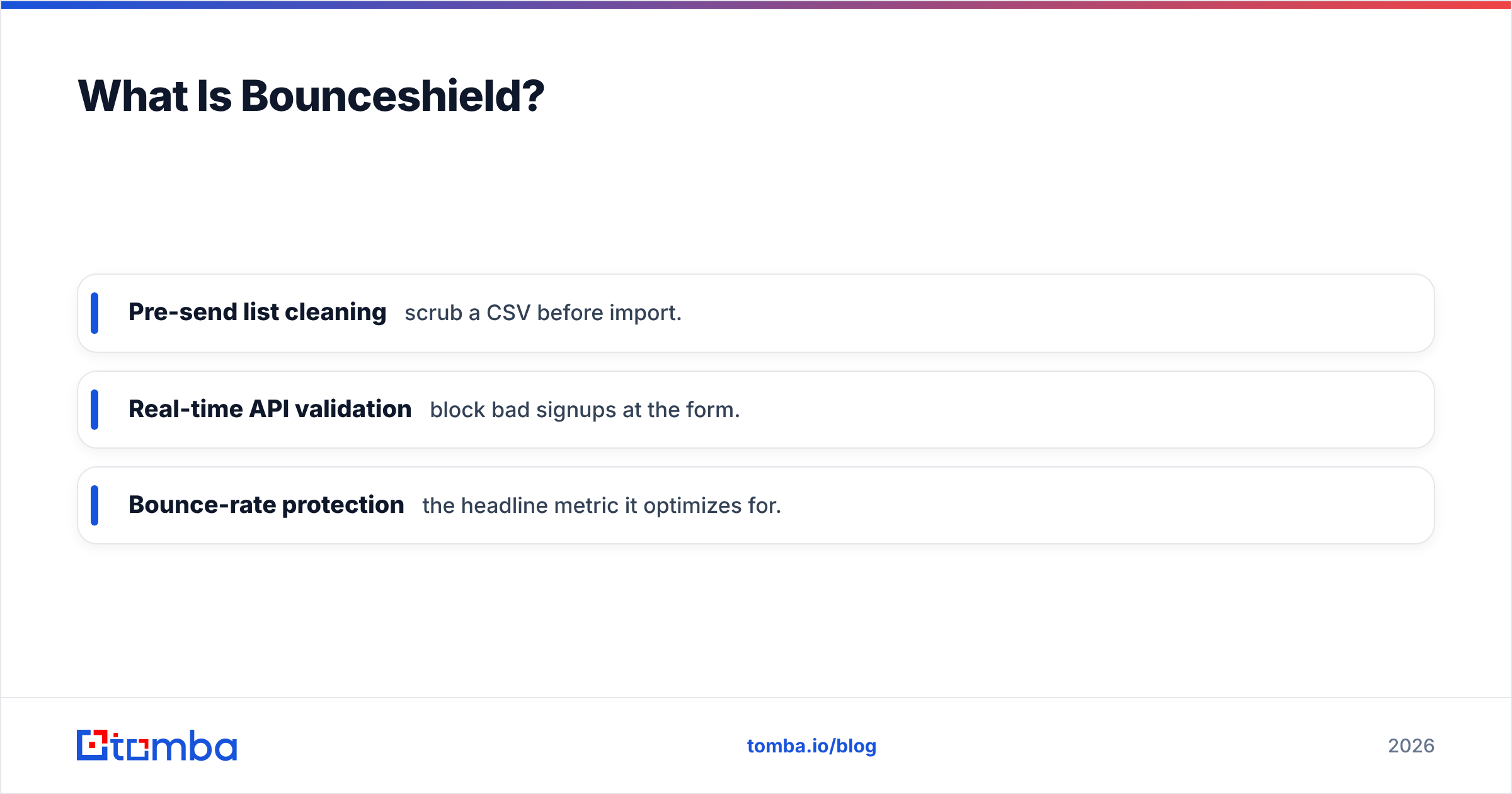
- Pre-send list cleaning — scrub a CSV before import.
- Real-time API validation — block bad signups at the form.
- Bounce-rate protection — the headline metric it optimizes for.
Where it stops: Bounceshield does not find you new prospects. It assumes you already have addresses. It is a filter, not a faucet.
What Is Clodura.ai?#
Clodura.ai sits at the opposite end of the funnel. It is a sales-intelligence platform — a database of companies and contacts paired with technographic data, org charts, intent signals, and a sequencing engine so you can prospect and send from one place. You can read their own framing on the Clodura.ai homepage.
The pitch is consolidation for outbound: find an account, find the decision-makers, see what tech they run, get an email and a direct dial, then drop them into a cadence. For a small SDR team that does not want to stitch five tools together, that is genuinely appealing.
The trade-off is the one every all-in-one platform makes. Breadth costs depth. A database that covers prospecting, intent, and sending rarely matches a specialist on any single axis — especially email accuracy and verification, which is exactly the gap Bounceshield exists to fill. Many Clodura users still run exported lists through a dedicated verifier before sending, which tells you something.
Bounceshield vs Cloduraai: Side-by-Side#
Here is the honest comparison. These are different categories, so read the "primary job" row first — it reframes everything below it.
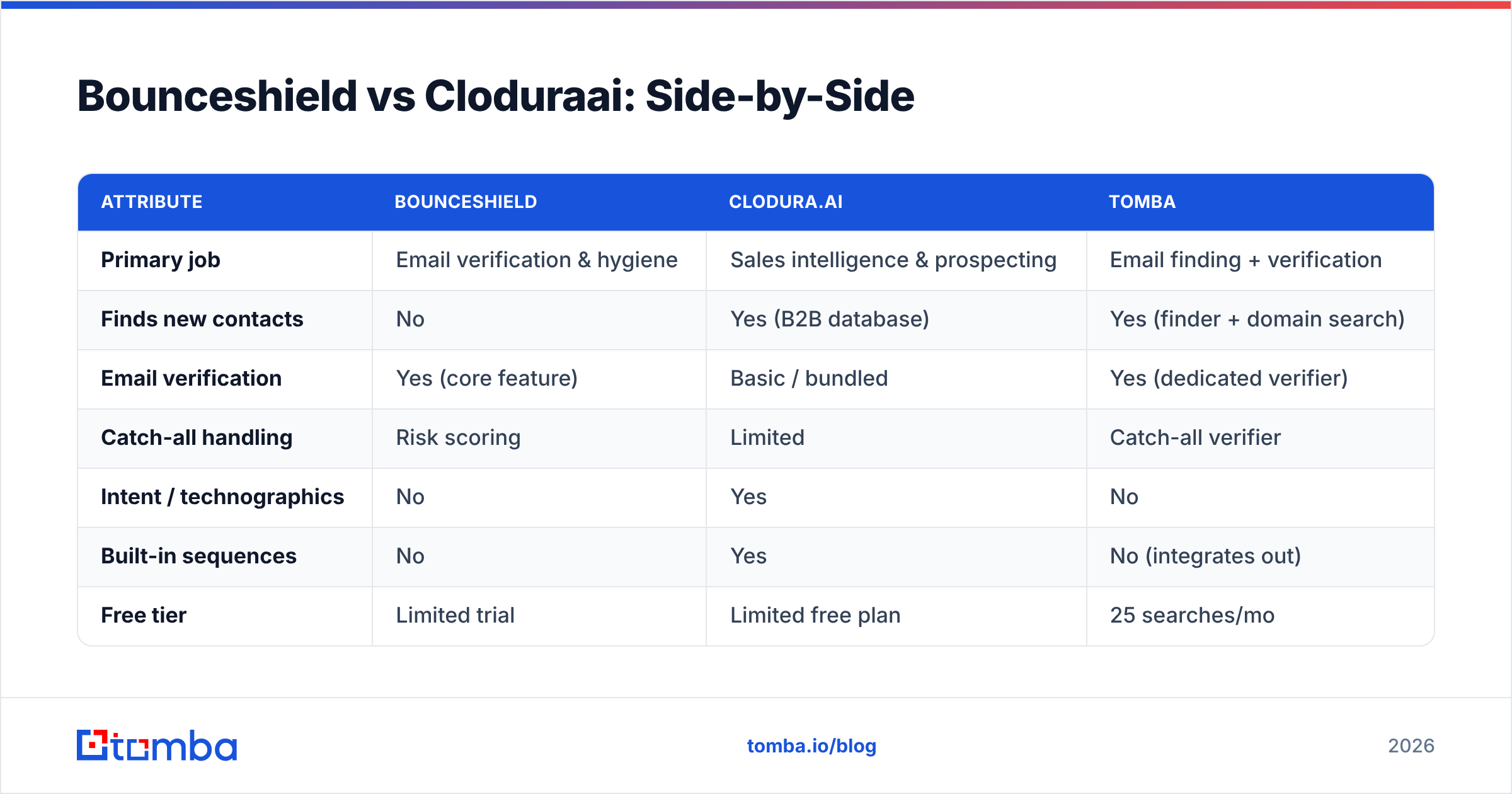
| Attribute | Bounceshield | Clodura.ai | Tomba |
|---|---|---|---|
| Primary job | Email verification & hygiene | Sales intelligence & prospecting | Email finding + verification |
| Finds new contacts | No | Yes (B2B database) | Yes (finder + domain search) |
| Email verification | Yes (core feature) | Basic / bundled | Yes (dedicated verifier) |
| Catch-all handling | Risk scoring | Limited | Catch-all verifier |
| Intent / technographics | No | Yes | No |
| Built-in sequences | No | Yes | No (integrates out) |
| Free tier | Limited trial | Limited free plan | 25 searches/mo |
| Entry paid price | Mid-tier | Higher (platform pricing) | $49/mo Starter |
| Best for | Protecting deliverability | All-in-one outbound | Accurate contact data |
| API access | Yes | Yes | Yes (REST API) |
The pattern is clear. Bounceshield wins on hygiene depth, Clodura wins on breadth of data and workflow, and a focused finder-plus-verifier wins on cost-per-accurate-contact. None of them does all three jobs at expert level, which is why your stack matters more than any single logo.
Is Bounceshield Better Than Clodura.ai?#
Better at what, exactly. That is not a dodge — it is the whole answer.
Choose Bounceshield if:
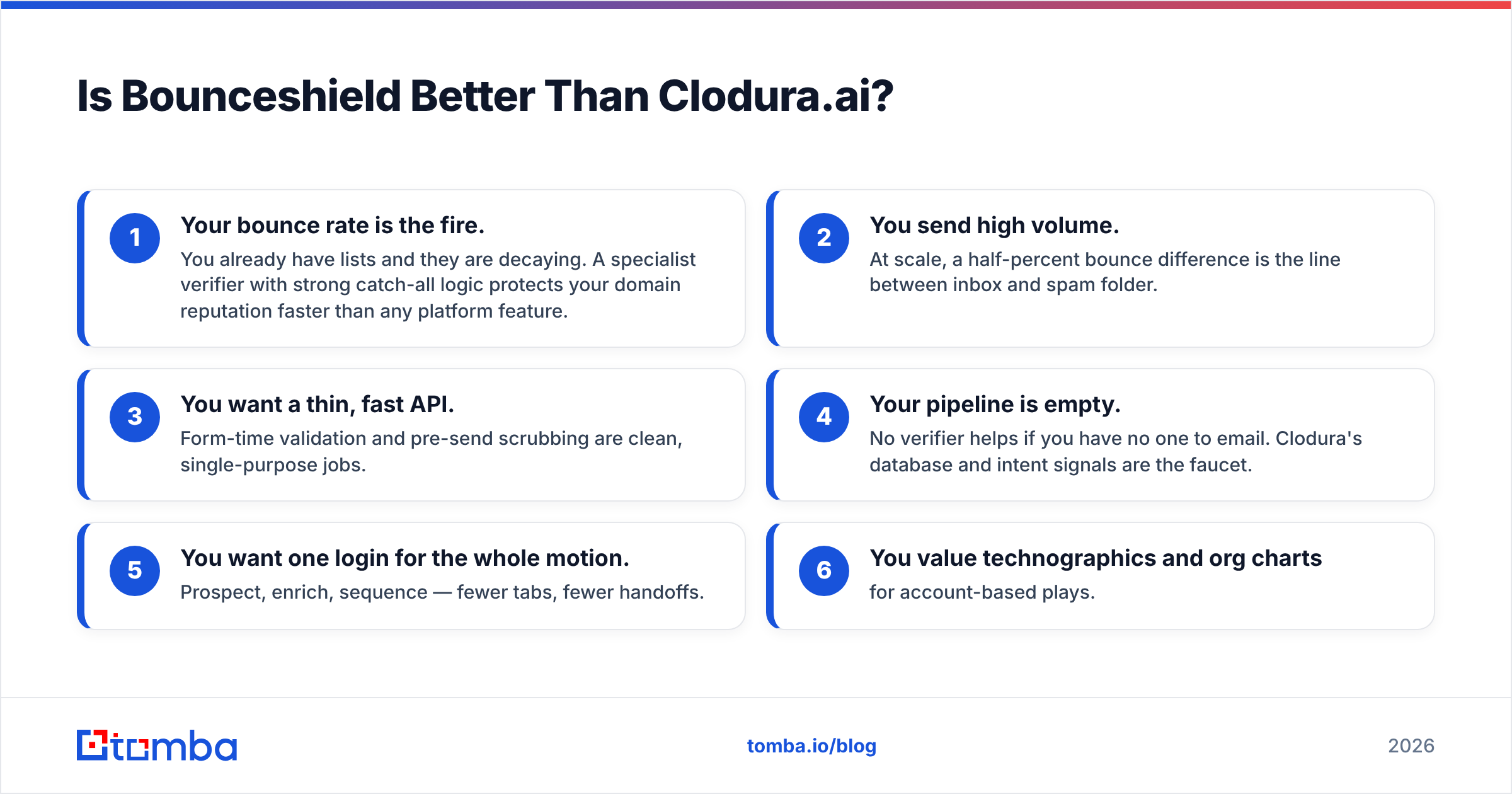
- Your bounce rate is the fire. You already have lists and they are decaying. A specialist verifier with strong catch-all logic protects your domain reputation faster than any platform feature.
- You send high volume. At scale, a half-percent bounce difference is the line between inbox and spam folder.
- You want a thin, fast API. Form-time validation and pre-send scrubbing are clean, single-purpose jobs.
Choose Clodura.ai if:
- Your pipeline is empty. No verifier helps if you have no one to email. Clodura's database and intent signals are the faucet.
- You want one login for the whole motion. Prospect, enrich, sequence — fewer tabs, fewer handoffs.
- You value technographics and org charts for account-based plays.
The mistake teams make is buying one when they needed the other. A verifier will not rescue an empty pipeline, and a sales-intelligence platform will not save a reputation already on a blocklist. Diagnose the bleed first.
How Accurate Is the Data — And Why It Matters Most#
Accuracy is where these tools quietly diverge, and it is the metric that actually drives ROI. A finder that returns 1,000 addresses at 70% accuracy hands you 300 bounces. A finder that returns 800 at 95% hands you 40. The second list is smaller and worth more.
Clodura's database is broad, but like every large B2B database it ages. Contacts change jobs, domains migrate, and patterns shift. Independent reviews on G2 consistently show that database freshness — not raw record count — is what separates usable data from list bloat. Bounceshield does not have this problem because it does not claim to find data; it just judges what you feed it.
This is the case for verifying everything regardless of source. Even premium database exports should run through an email verifier before they touch your sending tool. And catch-all domains — the ones that accept every address at the server — need a dedicated catch-all verifier to score risk, because a plain SMTP check can't resolve them.
For analyst context on how the broader sales-intelligence category is evaluated, Gartner tracks these vendors under revenue and sales-engagement technology — useful if you are building a business case for spend.
What Does Each One Cost in 2026?#
Bounceshield prices like a utility — pay per verification or a monthly credit bucket, scaling with volume. Clodura prices like a platform — seat-based with tiers that bundle database access, intent, and sequencing, which pushes the entry point higher because you are buying the whole suite whether or not you use every part.
The hidden cost is the stack itself. A common 2026 outbound setup looks like this:
- A prospecting/database tool (Clodura or similar)
- A dedicated verifier (Bounceshield or similar)
- A separate email finder for gaps the database misses
- A sequencing/sending tool
That is three or four invoices for one job: get accurate contacts into a sequence. When you total it, the per-contact cost balloons. This is exactly the consolidation argument — and where Tomba pricing is worth a look, because the finder and verifier live under one roof starting at $49/mo Starter (with a free tier of 25 searches to test accuracy before you commit a card).
Where Does Tomba Fit Between Them?#
Tomba is not trying to be Clodura and it is not trying to be only Bounceshield. It sits in the high-value middle: finding accurate professional emails and verifying them in the same workflow.
Practically, that covers the two jobs most teams actually repeat daily:
- Find the address. Use the email finder by name and company, or run domain search to pull every public address at a company at once.
- Trust the address. Verification and catch-all scoring are built in, so the list you export is already clean — no second vendor, no second export.
You still bring your own sequencing tool, and if you need deep intent data and org charts, a platform like Clodura adds value on top. But the expensive, error-prone middle — finding a real email and confirming it won't bounce — is handled in one place. For most outbound teams, that is 80% of the daily grind and the part where bad data costs the most.
A Simple Decision Framework#
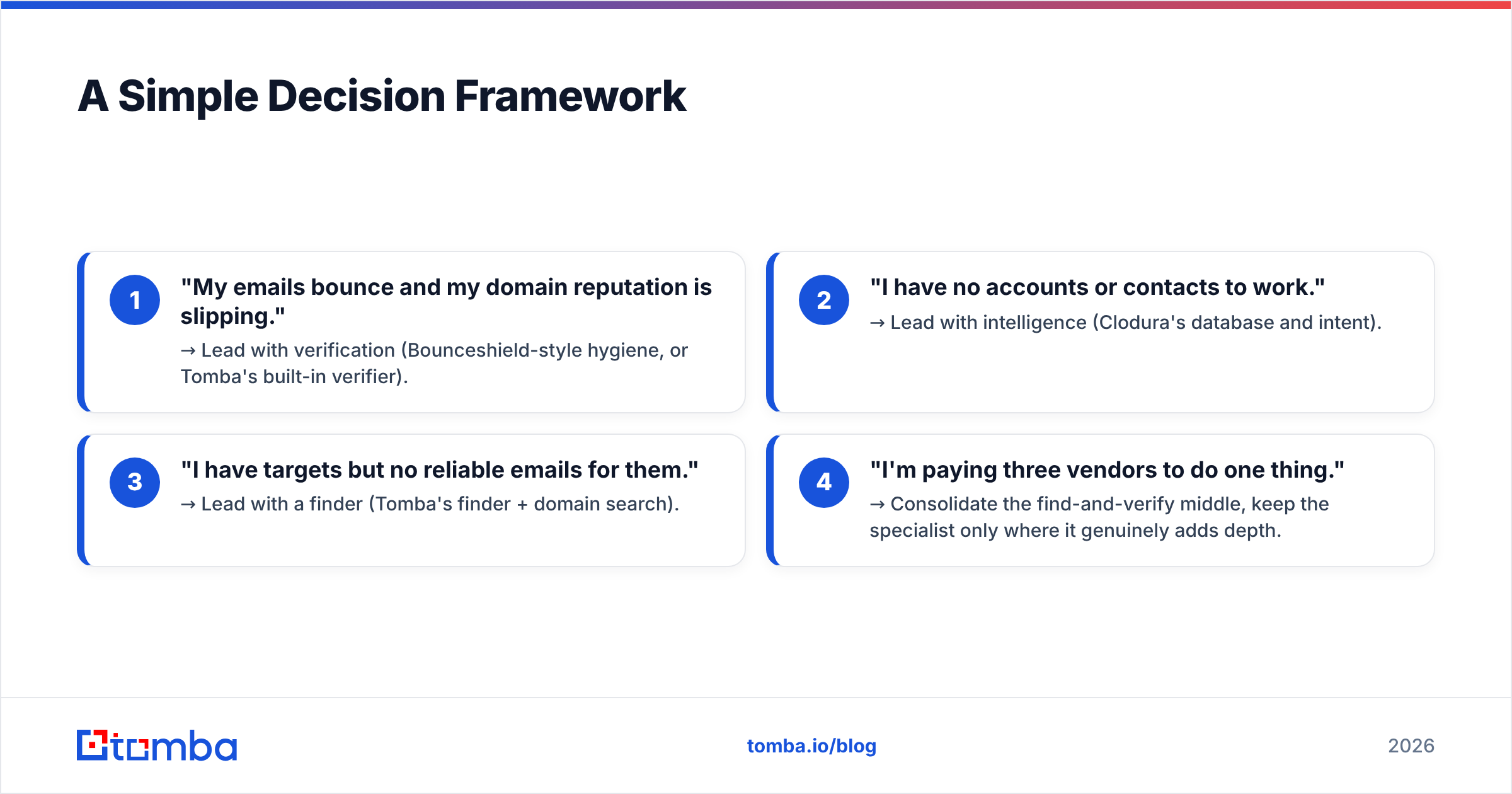
Don't pick a logo. Pick based on which sentence describes your week:
- "My emails bounce and my domain reputation is slipping." → Lead with verification (Bounceshield-style hygiene, or Tomba's built-in verifier).
- "I have no accounts or contacts to work." → Lead with intelligence (Clodura's database and intent).
- "I have targets but no reliable emails for them." → Lead with a finder (Tomba's finder + domain search).
- "I'm paying three vendors to do one thing." → Consolidate the find-and-verify middle, keep the specialist only where it genuinely adds depth.
Most teams discover they are in bucket 3 or 4, not bucket 1 or 2. They assume they need a giant platform or a pure verifier, when what they actually repeat every day is "find this person's email and make sure it's real."
Frequently Asked Questions#
Is Bounceshield an email finder? No. Bounceshield validates addresses you already have. It does not generate new contacts. Pair it with a finder if you need both jobs.
Does Clodura.ai verify emails? It includes basic verification as part of the platform, but many users still run exports through a dedicated verifier before sending, especially for catch-all domains.
Can I replace both with one tool? Partly. For the find-and-verify core, yes — a tool like Tomba covers it. For deep intent data, org charts, and built-in sequencing, you'd still want a platform like Clodura on top.
What bounce rate is safe? Keep it under 2%, ideally under 1%. Above that, mailbox providers begin throttling and filtering your domain, which hurts every sender on it.
Which is cheaper? A verifier-only tool is the cheapest single line item, but the total stack cost matters more. Consolidating find-and-verify usually beats buying a database, a verifier, and a finder separately.
The Bottom Line#
Bounceshield and Clodura.ai are not rivals so much as two halves of a problem. One protects the addresses you send to; the other helps you find people worth sending to. Buy the one that matches your current bleed — and resist paying platform prices for a job a focused tool does cleaner.
If your real, daily need is finding accurate professional emails and knowing they won't bounce before you hit send, start with the Tomba Email Finder. Spin up the free tier, run your toughest 25 lookups, and judge it on accuracy — not on a feature list. That is the only benchmark that pays you back.
// get started
Find, verify and enrich your first contacts today
Start on the free plan with 25 searches a month, then scale when your team is ready.
Free plan · No credit card required · GDPR & CCPA
// about the author