Bounceshield vs Datanyze: Which Is Better in 2026?
Bounceshield guards sender reputation; Datanyze sells technographics and contact data. Here's how the two stack up on accuracy, pricing, and real-world B2B prospecting in 2026.
You typed "bounceshield vs datanyze" into a search bar because you're trying to solve one of two problems: stop your cold emails from bouncing, or find more accurate B2B contact data. The confusing part is that these two tools barely overlap. One is a verification-and-deliverability play. The other is a technographics-and-contact-intelligence play. Picking between them as if they're interchangeable is how teams end up paying for the wrong thing.
This breakdown cuts through it. You'll get a clear definition of each tool, a side-by-side table, honest pricing math, and a recommendation based on what you're actually trying to do.
TL;DR — Bounceshield vs Datanyze at a Glance#
- Bounceshield is built around email verification and bounce protection — its job is to keep invalid addresses out of your send list and protect sender reputation.
- Datanyze is a sales-intelligence and technographics tool — it surfaces company tech stacks plus contact emails and phone numbers, mostly through a Chrome extension.
- They solve different problems: Bounceshield cleans lists, Datanyze builds them. Many teams need both functions, not one or the other.
- On price-to-coverage, neither is the most efficient option in 2026 — a combined finder-plus-verifier platform usually wins on cost per usable contact.
- If you want finding and verification in one place with transparent pricing, a tool like Tomba Email Finder covers both jobs at a lower blended cost.
What Is Bounceshield?#
Bounceshield is an email verification and deliverability tool. Its core promise is simple: feed it a list of email addresses, and it tells you which ones are safe to send to. It checks syntax, domain MX records, mailbox existence, and flags risky categories like disposable addresses, role accounts (info@, sales@), and catch-all domains.
The point of a verifier is to protect your sender reputation. Every hard bounce signals to mailbox providers that you don't maintain clean lists, and enough of them push your messages to spam. Strong email deliverability starts with not emailing dead addresses in the first place. That's the lane Bounceshield plays in — it's a defensive tool that sits at the end of your prospecting workflow, right before you hit send.
What Bounceshield does not do well is find new contacts. It validates addresses you already have. If your list is empty, a verifier gives you nothing to work with.
What Is Datanyze?#
Datanyze is a sales-intelligence platform best known for technographics — data about what software and technologies a company uses. Sales reps use it to qualify accounts ("they run Shopify and HubSpot, so they're a fit") and to grab contact details on the fly. The flagship feature is a Chrome extension that surfaces emails and phone numbers as you browse LinkedIn profiles and company websites. You can read more about the product on the official Datanyze site.
Datanyze leans toward the finding and qualifying side of the funnel. It's a prospecting and account-research tool, not a list-hygiene tool. Its verification is light — it provides contact data but doesn't position itself as a dedicated bounce-protection engine the way Bounceshield does.
So the real "bounceshield vs datanyze" question isn't "which is better" — it's "which job am I hiring a tool to do?"
Bounceshield vs Datanyze: How Do They Differ?#
Here's the structural difference laid out by job-to-be-done. Read this before you look at any pricing page.
- Primary function — Bounceshield verifies and protects; Datanyze finds and qualifies. Different ends of the funnel.
- Data direction — Bounceshield takes a list in and scores it; Datanyze generates contacts out from company and profile research.
- Best-fit user — Bounceshield suits email marketers and SDR ops cleaning send lists; Datanyze suits AEs and researchers building target-account lists.
- Workflow placement — Bounceshield is a final gate before sending; Datanyze is a first step during prospecting.
- What's missing — Bounceshield has no discovery; Datanyze has no serious verification. Run either alone and you've got a gap.
Bounceshield vs Datanyze: Feature Comparison Table#
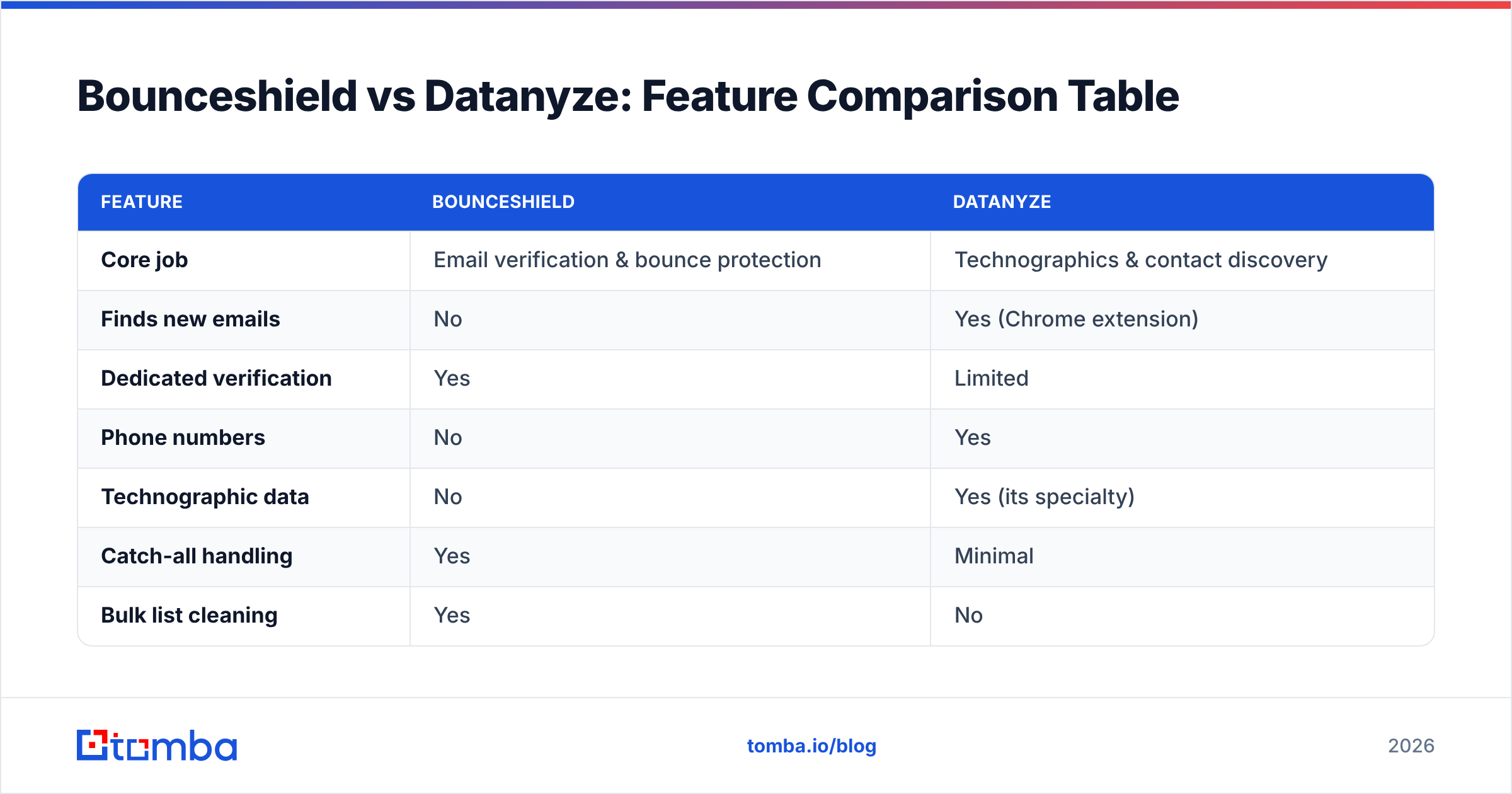
| Feature | Bounceshield | Datanyze |
|---|---|---|
| Core job | Email verification & bounce protection | Technographics & contact discovery |
| Finds new emails | No | Yes (Chrome extension) |
| Dedicated verification | Yes | Limited |
| Phone numbers | No | Yes |
| Technographic data | No | Yes (its specialty) |
| Catch-all handling | Yes | Minimal |
| Bulk list cleaning | Yes | No |
| Best for | List hygiene, deliverability | Account research, prospecting |
| Typical entry price | Mid-tier subscription | ~$29–$55/mo per seat |
The table makes the core point obvious: there is barely any feature overlap. Comparing them is like comparing a water filter to a well. One cleans what you have; the other gives you something to clean.
Which Tool Has Better Accuracy?#
Accuracy means two different things here, so judge each tool on its own metric.
For Bounceshield, accuracy is about catch rate and false positives — does it correctly flag dead mailboxes without wrongly killing good ones? A verifier that's too aggressive on catch-all domains will mark valid contacts as risky and shrink your reachable audience. A weak one lets bounces through. The hard part of verification is catch-all domains, where the server accepts everything at the SMTP layer and you need deeper signal to judge a real mailbox.
For Datanyze, accuracy is about contact-data freshness — is the email it surfaces still valid, and is the person still at that company? B2B data decays fast; people change jobs constantly, so any contact database is fighting entropy every month. Where your data comes from and how often it's refreshed matters more than headline database size. (Tomba documents its data sources publicly, which is the kind of transparency worth demanding from any vendor.)

The benchmark above is why blending tools matters: discovery accuracy and verification accuracy are separate problems, and the best result comes from a platform that handles both rather than bolting a finder onto a verifier from a different vendor.
Bounceshield vs Datanyze: Pricing Reality#
Neither tool publishes the kind of transparent, all-in pricing that makes budgeting easy, and that's the catch.
Datanyze has historically sold a low-cost individual plan (around $29–$55 per month per seat) with monthly credit caps for contact views. That's cheap to start, but credits run out fast for a busy SDR, and you're still paying separately for any real verification.
Bounceshield, like most verification tools, prices by volume — packs of credits or a monthly tier tied to how many addresses you clean. On its own that's reasonable, but stack it on top of a discovery tool and you're now paying two vendors to do half a job each.
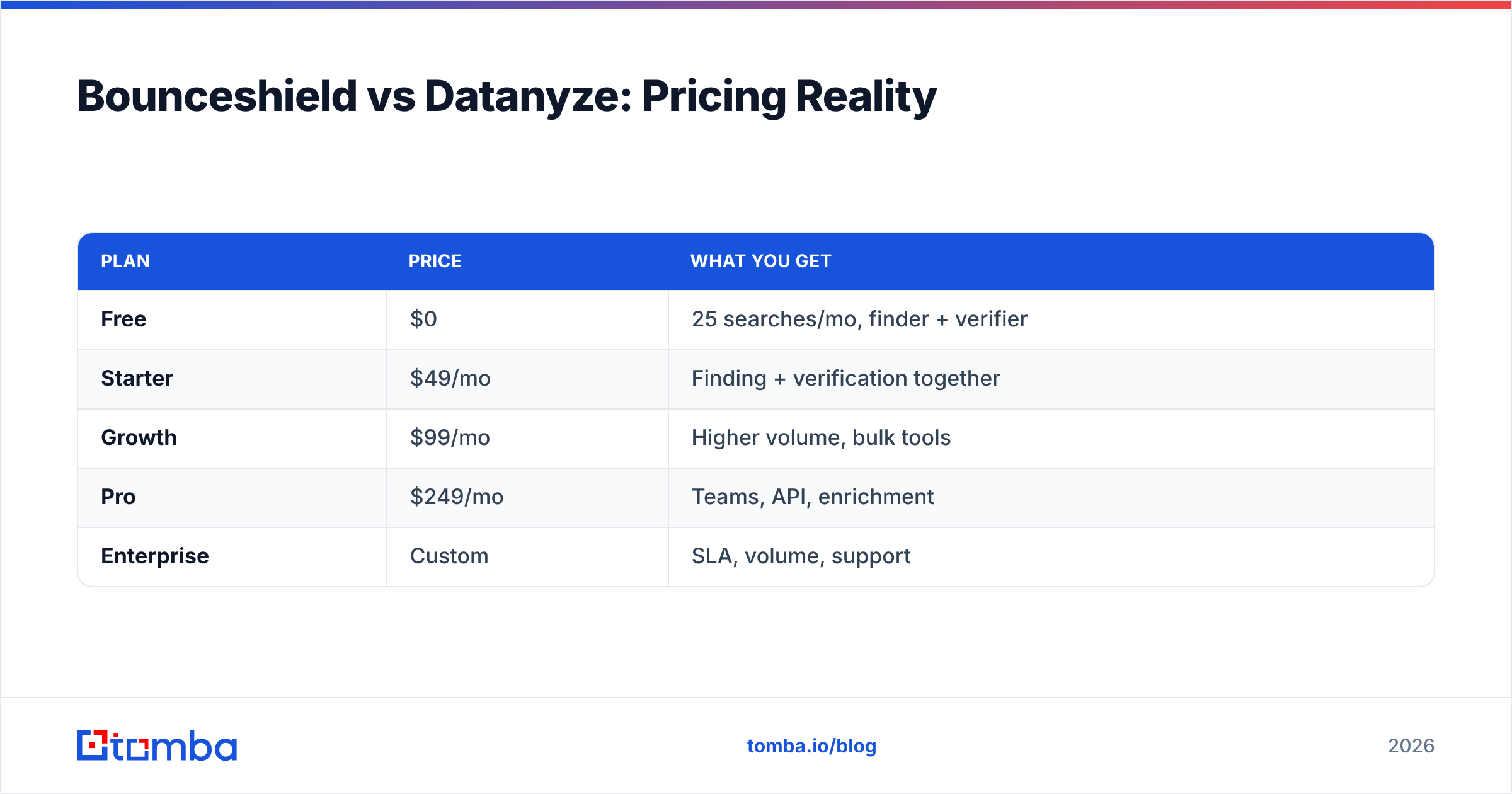
Run the math on the combined stack. If you pay for Datanyze seats plus a separate verifier, you're often above what an integrated platform charges for both. For comparison, here's how a combined finder-plus-verifier approach is priced:
| Plan | Price | What you get |
|---|---|---|
| Free | $0 | 25 searches/mo, finder + verifier |
| Starter | $49/mo | Finding + verification together |
| Growth | $99/mo | Higher volume, bulk tools |
| Pro | $249/mo | Teams, API, enrichment |
| Enterprise | Custom | SLA, volume, support |
You can see full Tomba pricing for the details, but the structural point stands: one subscription that both finds and verifies usually beats two subscriptions that each do one.
Do You Actually Need Both Functions?#
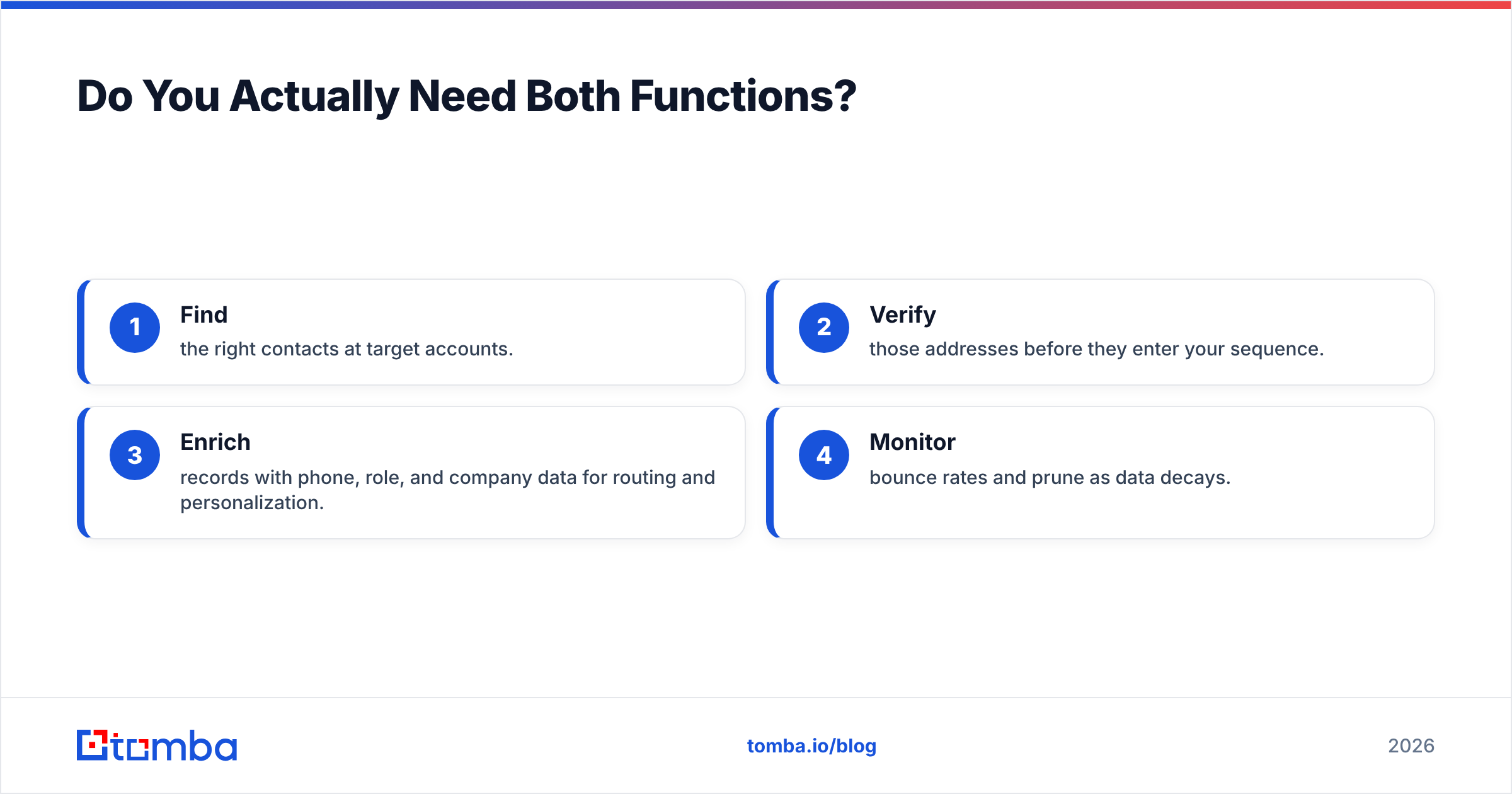
Yes — and that's the trap of framing this as bounceshield vs datanyze. A healthy outbound motion needs both discovery and verification working together:
- Find the right contacts at target accounts.
- Verify those addresses before they enter your sequence.
- Enrich records with phone, role, and company data for routing and personalization.
- Monitor bounce rates and prune as data decays.
If you buy Bounceshield, you've covered step 2 and nothing else. If you buy Datanyze, you've covered step 1 (and some of 3) but left step 2 thin. Either choice alone forces a second purchase. That's the hidden cost most "X vs Y" comparisons skip.
This is also why dedicated single-purpose tools keep losing ground to platforms. Buyers got tired of stitching a finder, a verifier, and an enrichment provider into one fragile workflow with three bills and three logins.
Where Does Tomba Fit in the Bounceshield vs Datanyze Debate?#
Tomba is the integrated alternative that does both jobs these two tools split between them. Its email finder discovers professional addresses by name, company, or domain, and its built-in email verifier validates them in the same workflow — including a catch-all verifier for the hardest-to-judge domains. You can also run domain search to pull every public email pattern at a company, the way Datanyze's research workflow promises but inside one transparent platform.
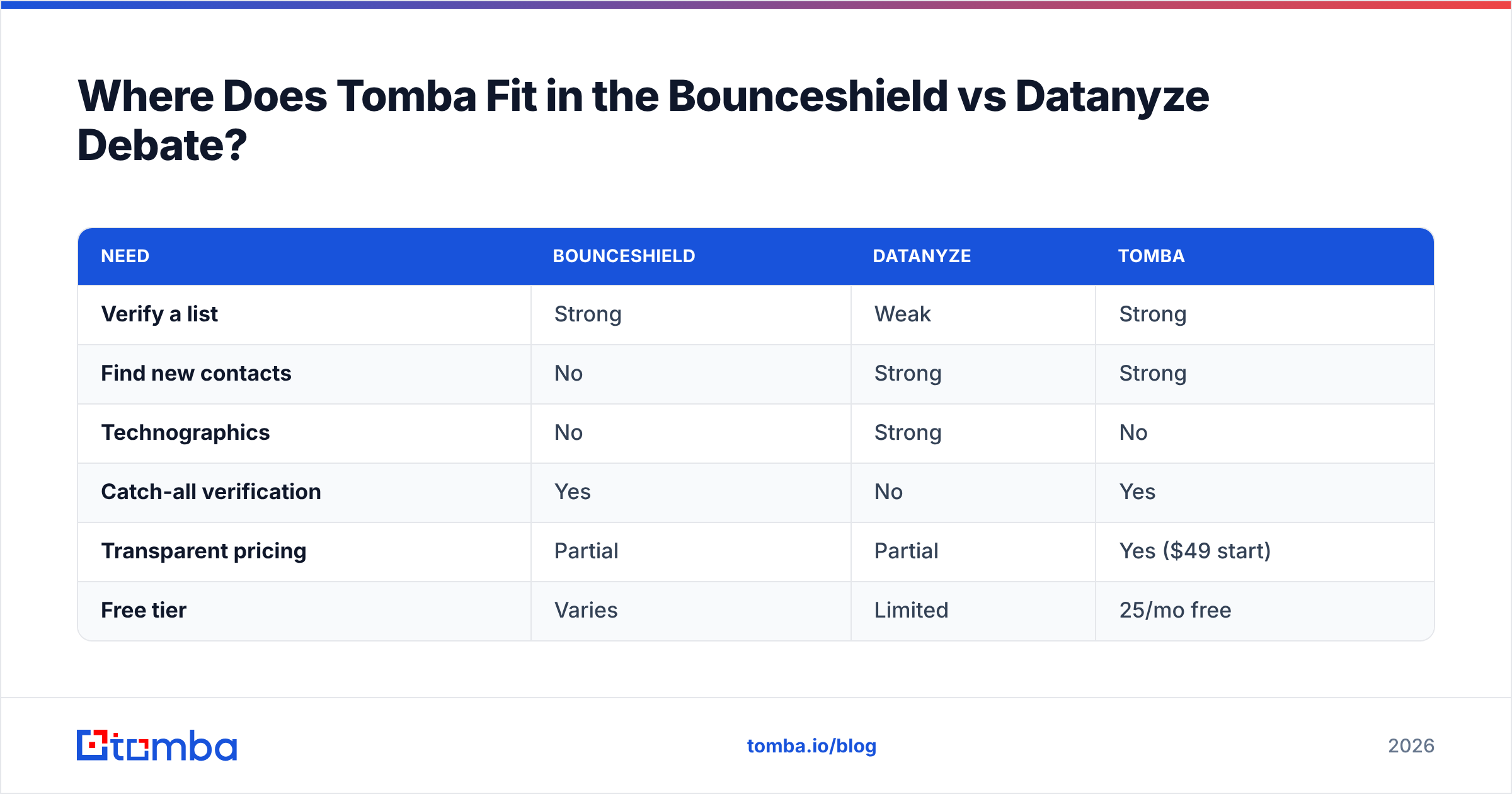
Here's the honest positioning:
| Need | Bounceshield | Datanyze | Tomba |
|---|---|---|---|
| Verify a list | Strong | Weak | Strong |
| Find new contacts | No | Strong | Strong |
| Technographics | No | Strong | No |
| Catch-all verification | Yes | No | Yes |
| Transparent pricing | Partial | Partial | Yes ($49 start) |
| Free tier | Varies | Limited | 25/mo free |
Tomba doesn't try to be a technographics tool — if deep tech-stack data is your single must-have, Datanyze still owns that niche. But for the far more common need — finding accurate B2B emails and keeping your list clean — Tomba covers both Bounceshield's and Datanyze's core contact jobs in one subscription.
When Should You Pick Each Tool?#
Pick Bounceshield if: you already have large lists from another source and your only problem is bounce rate and deliverability. You're not prospecting — you're cleaning.
Pick Datanyze if: technographic targeting is central to your strategy — you qualify accounts by their software stack — and you can tolerate lighter verification plus credit caps.
Pick an integrated platform like Tomba if: you want to find and verify contacts without paying two vendors, you value transparent per-month pricing, and you'd rather have one B2B database and one API than a duct-taped stack. Check independent reviews on G2 to validate any vendor's claims before you commit.
The Bottom Line on Bounceshield vs Datanyze#
These tools aren't really competitors — they're two halves of a complete workflow. Bounceshield protects deliverability; Datanyze fuels prospecting. Buy one and you'll shop for the other within a quarter.
The smarter move in 2026 is to stop thinking in "bounceshield vs datanyze" terms and ask instead: what's the cheapest reliable way to find accurate contacts and keep my list clean? For most B2B teams, that's a single integrated platform, not two specialized subscriptions.
Start free with the Tomba Email Finder — 25 searches a month, no card required — and run a side-by-side test on your own target accounts. Find the contacts, verify them in the same dashboard, and compare cost per usable email against the two-tool stack you're considering. Let the results, not the marketing, decide your stack.
Ready to find emails that actually work?
Join 150,000+ professionals who stopped guessing and started sending. Free credits on signup — no credit card required.
Get the Tomba newsletter
Practical outbound tactics and product updates — once every two weeks.
About the author