Bounceshield vs DiscoverOrg 2026: Data Accuracy & Pricing Compared
BounceShield protects deliverability, DiscoverOrg sells enterprise sales intelligence. We compare data accuracy, pricing, and fit so you pick the right stack in 2026.
You're comparing BounceShield vs DiscoverOrg because you've hit the same wall most revenue teams hit: bad data is killing your outbound. But these two tools fight that problem from opposite ends. One cleans the list you already have. The other sells you a bigger list. Knowing which gap you actually need to fill saves you thousands of dollars and months of wasted sequences.
TL;DR — Which one do you need?#
- BounceShield is an email verification and bounce-protection layer. It tells you whether the addresses you already own are deliverable. It does not find new contacts.
- DiscoverOrg (now folded into ZoomInfo) is enterprise B2B sales intelligence — org charts, technographics, intent data, and contact records. It's powerful, slow to buy, and priced for mid-market and enterprise.
- They're complementary, not competitors: DiscoverOrg supplies leads, BounceShield (or any verifier) protects deliverability before you send.
- If your real problem is finding accurate, ready-to-use emails without a $25k+ annual contract, neither is the lean answer — a focused email finder plus built-in verification covers both jobs.
- Pricing gap is enormous: verification tools run pay-as-you-go or low monthly; DiscoverOrg-class platforms start in the five figures per year.
What is BounceShield?#
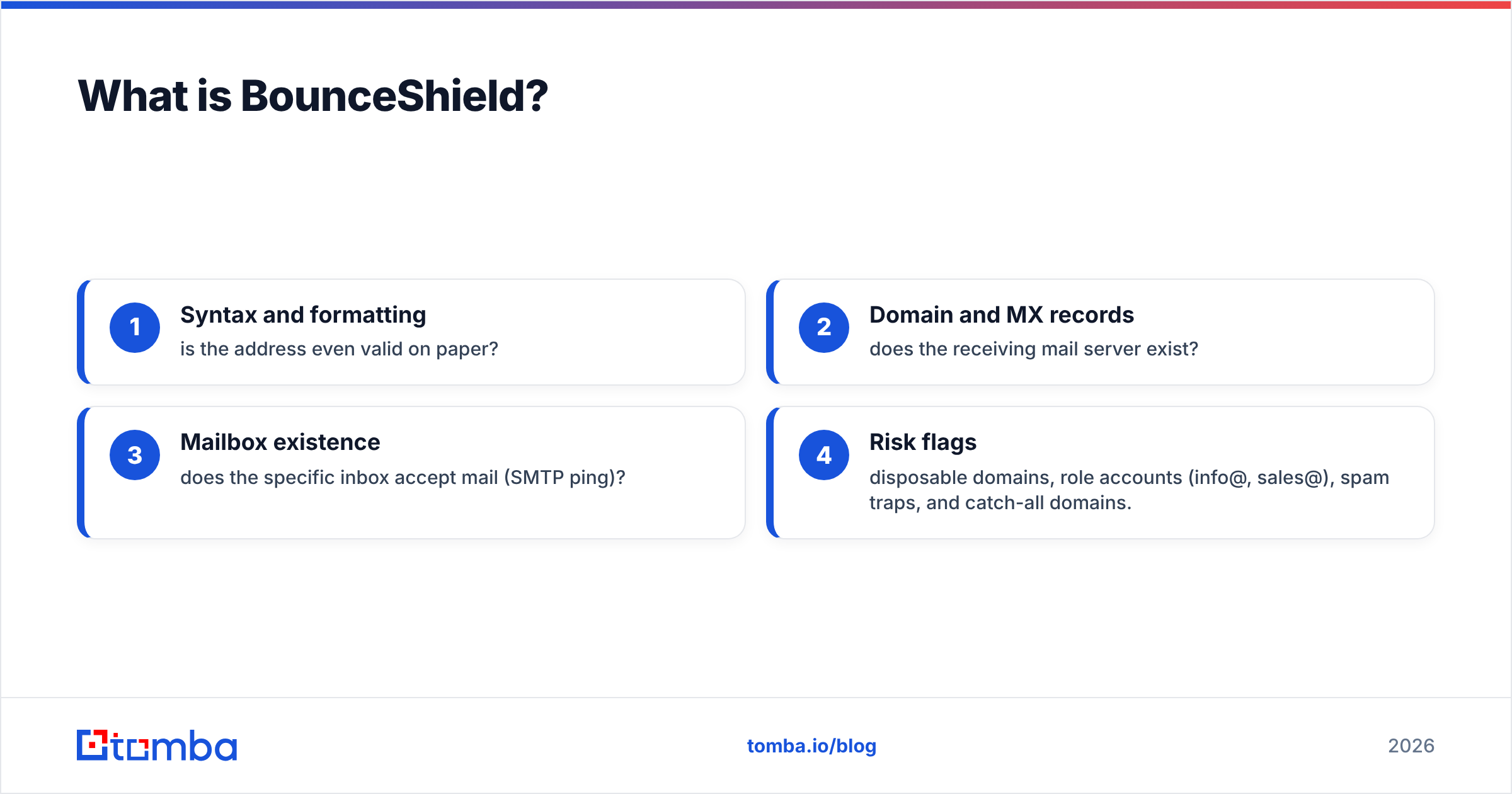
BounceShield is positioned as a deliverability-protection tool. Think of it as the bouncer at the door of your email list: before a message goes out, it checks whether each address is real, active, and safe to mail. The goal is to stop hard bounces before they happen, because a high bounce rate is the fastest way to wreck your sender reputation and land in spam.
A verification layer like this typically checks:
- Syntax and formatting — is the address even valid on paper?
- Domain and MX records — does the receiving mail server exist?
- Mailbox existence — does the specific inbox accept mail (SMTP ping)?
- Risk flags — disposable domains, role accounts (info@, sales@), spam traps, and catch-all domains.
What BounceShield does not do is generate net-new contacts. If your CRM is empty, a verifier has nothing to verify. That's the core thing to understand before you weigh it against DiscoverOrg, which lives at the opposite end of the pipeline.

If deliverability is your bottleneck, the verification job is well understood — see how a dedicated email verifier handles the same checks, including the trickier catch-all verification that most cheap tools skip.
What is DiscoverOrg?#
DiscoverOrg is a B2B sales intelligence platform built for teams that need deep account data, not just contact lists. It made its name with human-verified org charts and detailed company profiles, and after merging with ZoomInfo it became part of the largest commercial contact database on the market. You can read the corporate background on Wikipedia's ZoomInfo entry.
Where a verifier answers "is this email good?", DiscoverOrg answers "who should I be emailing, at which company, and why now?" Its strengths are:
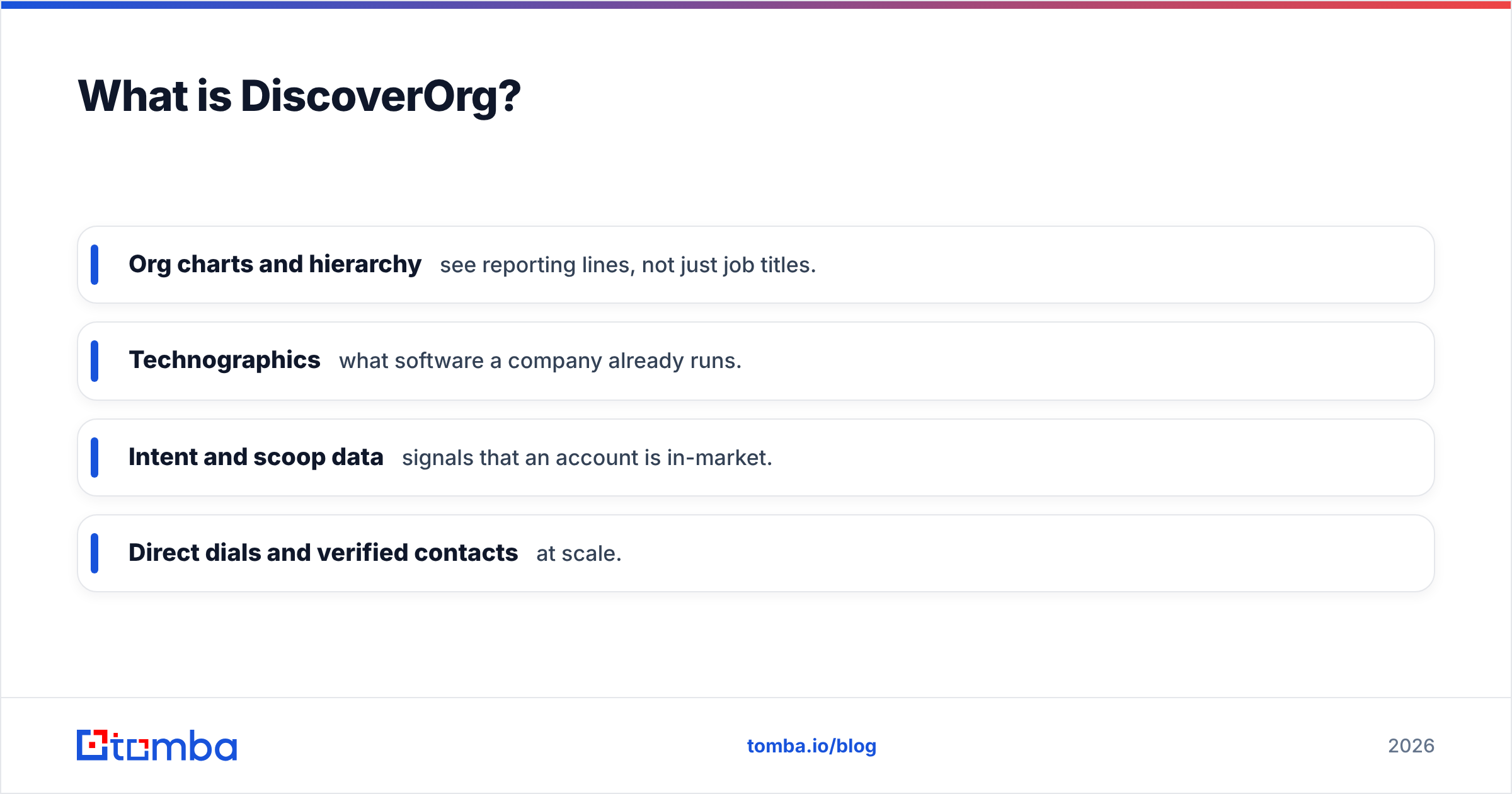
- Org charts and hierarchy — see reporting lines, not just job titles.
- Technographics — what software a company already runs.
- Intent and scoop data — signals that an account is in-market.
- Direct dials and verified contacts at scale.
That depth is real, and for large enterprise revenue operations teams it justifies the price. But it comes with annual contracts, seat minimums, and a procurement cycle. You don't "try DiscoverOrg this afternoon" the way you spin up a verifier or an email finder.
Bounceshield vs DiscoverOrg: how do they actually compare?#
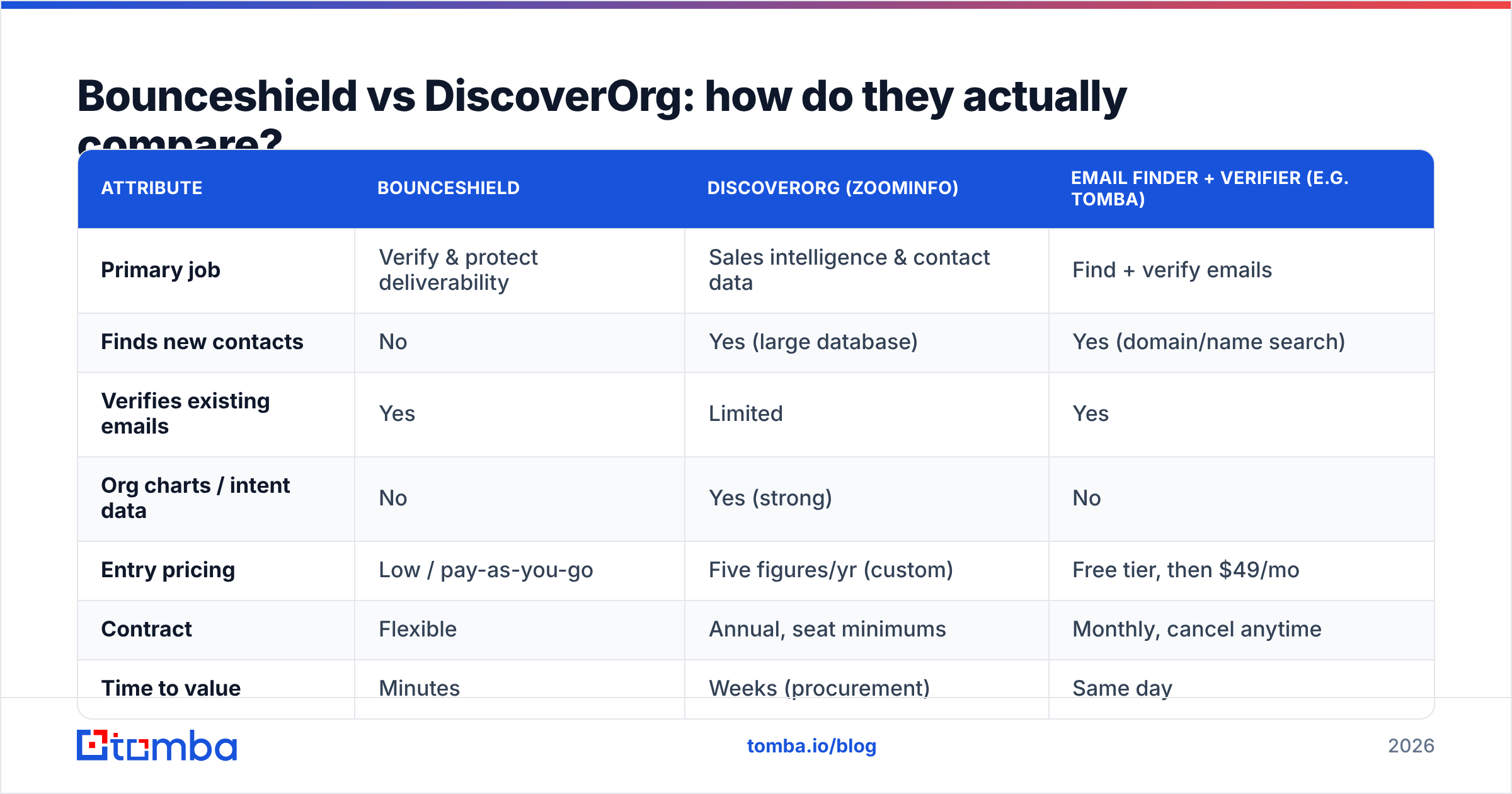
Here's the honest framing — these tools solve different problems, so the comparison is really about which problem you have. The table below lines them up on the attributes that matter, with a lean third option (a dedicated email finder + verifier) for teams who want both jobs done without enterprise overhead.
| Attribute | BounceShield | DiscoverOrg (ZoomInfo) | Email finder + verifier (e.g. Tomba) |
|---|---|---|---|
| Primary job | Verify & protect deliverability | Sales intelligence & contact data | Find + verify emails |
| Finds new contacts | No | Yes (large database) | Yes (domain/name search) |
| Verifies existing emails | Yes | Limited | Yes |
| Org charts / intent data | No | Yes (strong) | No |
| Entry pricing | Low / pay-as-you-go | Five figures/yr (custom) | Free tier, then $49/mo |
| Contract | Flexible | Annual, seat minimums | Monthly, cancel anytime |
| Time to value | Minutes | Weeks (procurement) | Same day |
| Best for | Cleaning known lists | Enterprise ABM teams | SMB–mid-market outbound |
The pattern is clear: BounceShield is a narrow utility, DiscoverOrg is a heavyweight platform, and most growing teams sit uncomfortably between them — needing accurate emails and clean deliverability without an enterprise budget.

Which problem are you actually solving?#
Conclusion first: pick based on where your pipeline leaks, not on which brand sounds bigger.
You have a list but high bounce rates. Your problem is deliverability. A verifier — BounceShield or an equivalent — is the right tool. You don't need DiscoverOrg's $25k platform to fix a 12% bounce rate. Run the list through verification, suppress the risky addresses, and protect your email deliverability before the next send.
You have no list, or a thin one. Your problem is sourcing. Verification is useless with an empty CRM. This is where DiscoverOrg shines for enterprise, or where a self-serve domain search gets you company-wide contacts in minutes for a fraction of the cost.
You need both, on a real budget. This is the common case — and it's why neither tool alone is ideal. You want to find the right people and confirm the emails land. A platform that bundles finding and verification removes the need to stitch two vendors together.
How accurate is the data?#
Accuracy is where the money is, so be skeptical of every vendor's marketing number. Verification accuracy (BounceShield's domain) and database accuracy (DiscoverOrg's domain) are measured differently.
For a verifier, accuracy means: of the addresses it marked "valid," how many actually delivered? The hard part is catch-all domains, which accept all mail at the server level and make true validation difficult. Tools that confidently mark catch-alls as "valid" inflate their numbers. A serious workflow treats catch-alls separately — which is exactly why a dedicated catch-all finder exists.
For a database like DiscoverOrg, accuracy means: how current and correct is each contact record? B2B data decays fast — people change jobs constantly, so even human-verified records go stale. ZoomInfo/DiscoverOrg invests heavily here, which is part of what you pay for. You can sanity-check vendor claims against third-party reviews on G2 rather than trusting datasheets.
The practical takeaway: whatever you source, verify before you send. Even premium databases ship dead addresses, and a cheap verification pass protects the reputation you can't easily rebuild. Tomba documents where its data comes from so you can judge accuracy on evidence, not adjectives.

What about pricing — and the hidden costs?#
The pricing gap between these tools is the single biggest decision factor, and it's wider than most buyers expect.
BounceShield-class verifiers are usually pay-as-you-go or low monthly subscriptions. You pay per credit or per verification, which keeps costs proportional to volume. Good for spiky usage, easy to budget.
DiscoverOrg / ZoomInfo is enterprise SaaS. Expect annual contracts that commonly start in the five figures, seat minimums, and add-ons for intent or technographic modules. The platform is genuinely capable, but you're committing budget and a procurement process before you see a single email. Vendors publish ranges and reviews on sites like Capterra if you want ballpark figures before sales calls.
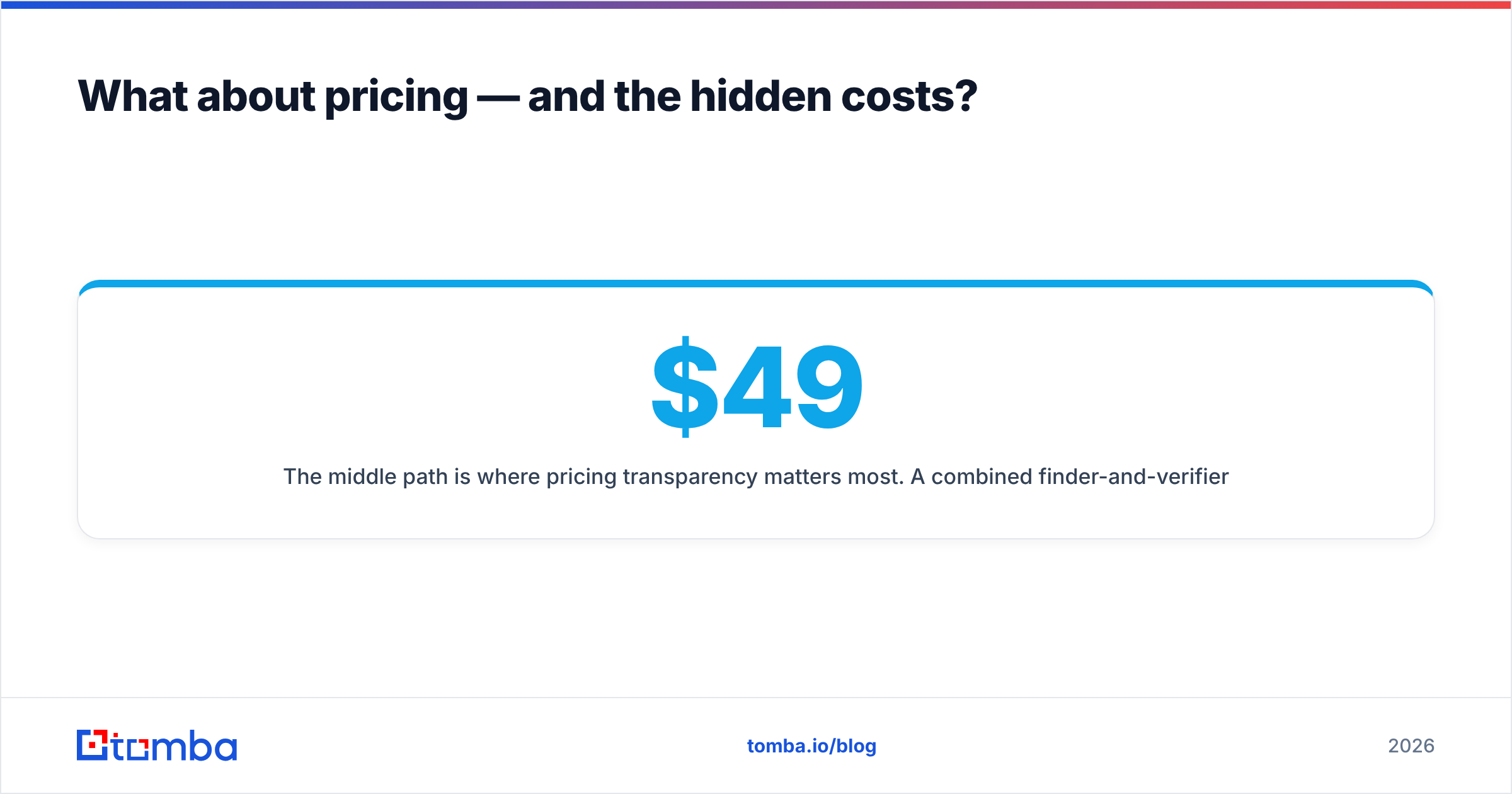
The middle path is where pricing transparency matters most. A combined finder-and-verifier like Tomba runs a free tier (25 searches/month) and then $49/mo Starter, $99/mo Growth, $249/mo Pro — see full Tomba pricing. That covers both sourcing and verification for less than the monthly overage on an enterprise contract.

Hidden costs to watch for in any comparison:
- Wasted sends from unverified data hurting domain reputation (real cost: future deliverability).
- Seat sprawl on enterprise platforms — you pay per user whether they log in or not.
- Integration tax — stitching a separate finder and verifier together adds engineering time. A single email finder API avoids that.
Can you combine sourcing and verification in one stack?#
Yes — and for most teams that's the smarter architecture than buying BounceShield and DiscoverOrg separately.
The ideal pipeline does three things in sequence:
- Find the right contacts by company or name (the DiscoverOrg job, minus the enterprise contract).
- Verify every address before it enters a sequence (the BounceShield job).
- Enrich records with role, company, and social data so reps personalize fast.
Running these through one provider means one credit pool, one API, one support contact. Tomba covers all three: domain and name search to find, verification (including catch-all handling) to protect deliverability, and data enrichment to round out records. For high volume, the bulk email finder processes whole lists at once.
That doesn't mean DiscoverOrg is wrong — if you're a large ABM team that lives on org charts and intent signals, its depth is hard to replicate. But if you picked up this comparison because outbound data is expensive and your emails bounce, you probably need the lean combined stack, not two specialist vendors.
Bounceshield vs DiscoverOrg: the verdict#
- Choose BounceShield if you already have lists and only need to stop bounces and protect sender reputation.
- Choose DiscoverOrg if you're enterprise, run account-based marketing, and need org charts, technographics, and intent data — and have the budget and procurement runway.
- Choose a combined finder + verifier if you need accurate emails and clean deliverability without an annual contract — the situation most SMB and mid-market teams are actually in.
The mistake is treating this as one-or-the-other when the two tools do different jobs. Map the choice to your pipeline leak: sourcing, deliverability, or both.
Start finding verified emails today#
If your real need is accurate contacts that actually deliver — without a five-figure contract — start with the Tomba Email Finder. Search by domain or name, verify every address before you send, and enrich records in the same workflow. The free tier gives you 25 searches a month to test accuracy on your own target accounts, and paid plans start at $49/mo when you're ready to scale. Find the right people, confirm the emails land, and keep your sender reputation intact — in one stack instead of two.
// get started
Find, verify and enrich your first contacts today
Start on the free plan with 25 searches a month, then scale when your team is ready.
Free plan · No credit card required · GDPR & CCPA
// about the author