Bounceshield vs Generect: The 2026 B2B Data Showdown
Bounceshield and Generect both promise cleaner data and better outreach — but they solve different problems. Here's how they actually compare in 2026, and where each one wins.
You typed "Bounceshield vs Generect" into a search bar because you have a budget, a quota, and a list that keeps bouncing. Fair enough. The honest answer is that these two tools are not really competitors — they sit on opposite ends of the same outbound problem. One helps you find leads. The other helps you protect the inbox you send to. Below is a straight comparison of what each does, where each falls short, and how to decide which (if either) belongs in your 2026 stack.
TL;DR#
- Generect is a lead-generation and B2B data platform: it sources contacts, company data, and verified emails, often with a LinkedIn-first workflow.
- Bounceshield is a deliverability play: email verification and bounce protection meant to keep your sender reputation clean before you hit send.
- They overlap only at one point — email accuracy — and even there they approach it from different directions.
- If you need both sourcing and verification without juggling two subscriptions, an all-in-one finder like Tomba Email Finder covers the full loop.
- Pick on the job to be done: building a pipeline (Generect), defending your domain (Bounceshield), or doing both in one place (Tomba).
What is Generect?#
Generect is a B2B lead-generation tool built around real-time data. Instead of selling you a static database that decays the moment it's exported, it pulls and verifies contact records when you request them — name, role, company, and email — frequently tied to a LinkedIn-driven search workflow. The pitch is "fresh leads, verified on demand," which appeals to SDR teams and agencies that burn through lists quickly.
In practice, you use Generect to build the top of your funnel: define an ICP, pull matching contacts, and push them into your sequencer or CRM. Its strength is breadth of sourcing. Its weakness, like every sourcing tool, is that "verified on demand" still means you're trusting their match logic on the day you pull.
What is Bounceshield?#
Bounceshield is an email verification and deliverability tool. Its job starts after you have a list. You feed it the addresses you already collected — from a form, a scrape, an export, or a tool like Generect — and it checks each one for syntax errors, dead mailboxes, role accounts, spam traps, and catch-all domains. The goal is a lower bounce rate and a protected sender reputation.
Think of Bounceshield as the bouncer at the door of your sending domain. It doesn't bring guests to the party (that's Generect's job) — it just stops the ones who'll trash the place. If your bounce rate creeps over 2–3%, mailbox providers start throttling you, and a verifier is the cheapest insurance against that.

Bounceshield vs Generect: the core difference#
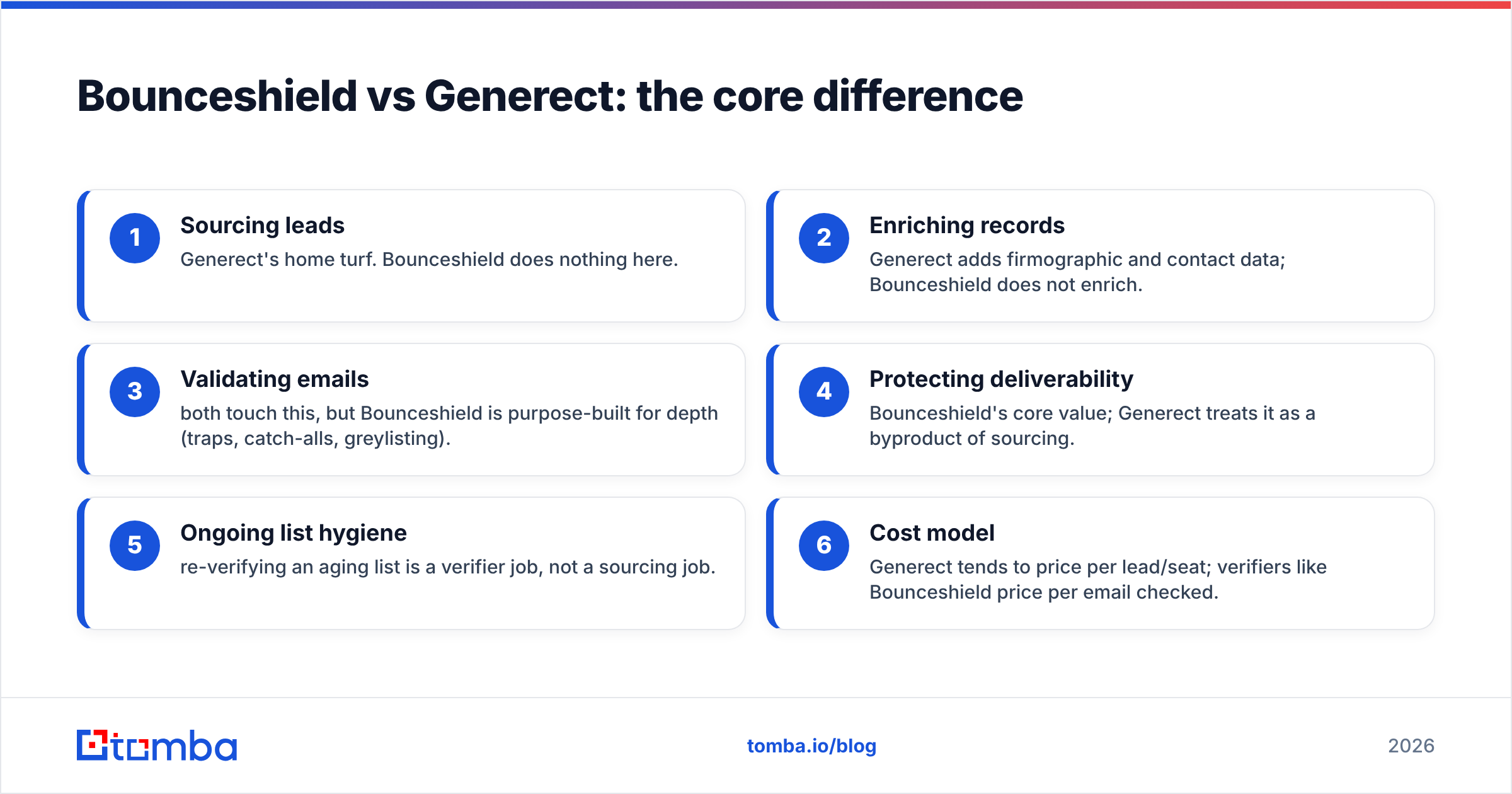
Here's the one-paragraph version: Generect is offense, Bounceshield is defense. You don't really choose between them any more than you choose between a striker and a goalkeeper. The confusion comes from the fact that both touch "email accuracy," so they show up in the same searches.
To make the distinction concrete, here's where each tool actually operates in your outbound workflow:
- Sourcing leads — Generect's home turf. Bounceshield does nothing here.
- Enriching records — Generect adds firmographic and contact data; Bounceshield does not enrich.
- Validating emails — both touch this, but Bounceshield is purpose-built for depth (traps, catch-alls, greylisting).
- Protecting deliverability — Bounceshield's core value; Generect treats it as a byproduct of sourcing.
- Ongoing list hygiene — re-verifying an aging list is a verifier job, not a sourcing job.
- Cost model — Generect tends to price per lead/seat; verifiers like Bounceshield price per email checked.
If your problem is "I have no leads," reaching for a verifier is solving the wrong half. If your problem is "my leads bounce," more sourcing only pours bad water into a leaky bucket faster.
How do Bounceshield and Generect compare on features?#
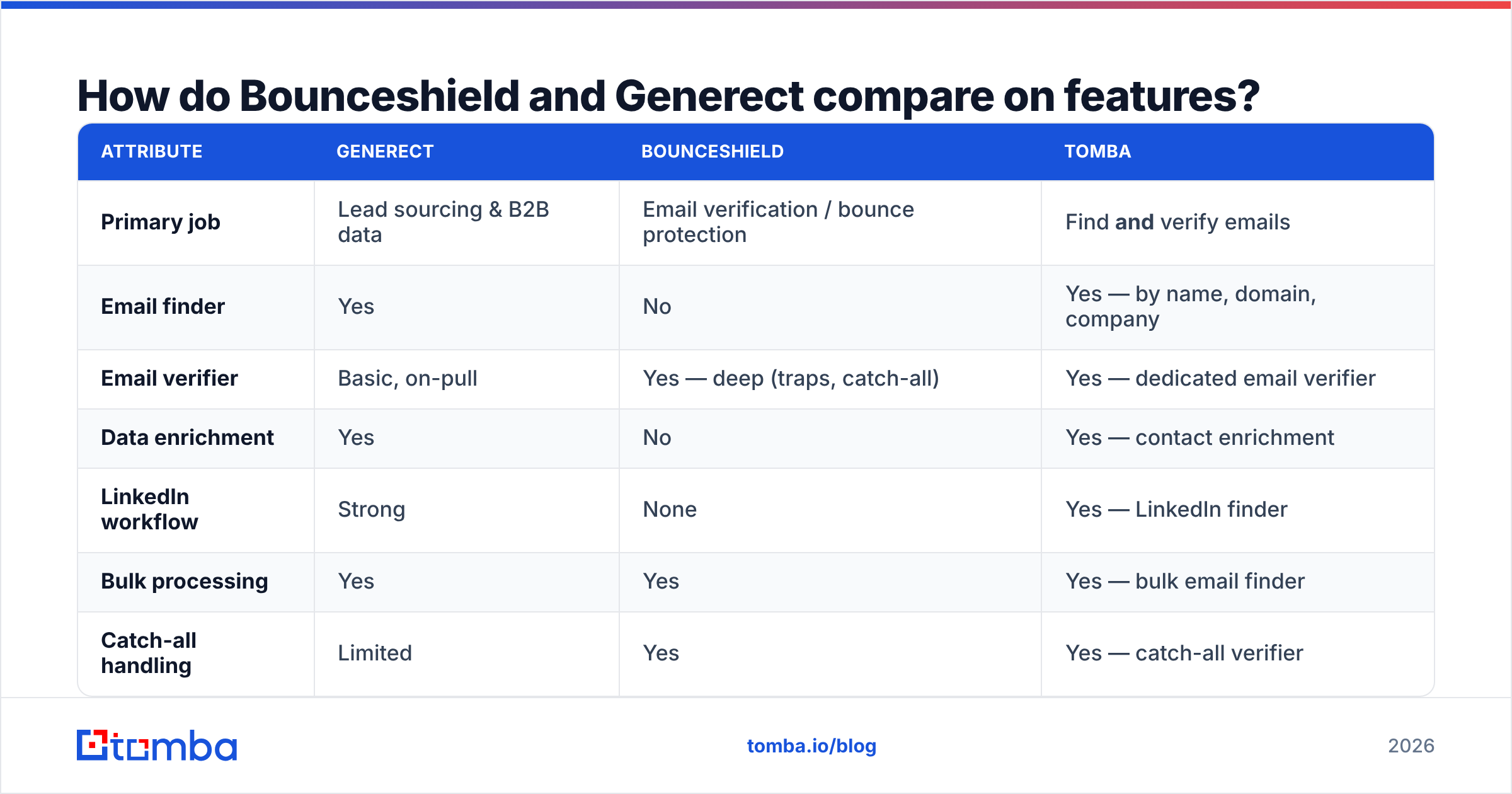
| Attribute | Generect | Bounceshield | Tomba |
|---|---|---|---|
| Primary job | Lead sourcing & B2B data | Email verification / bounce protection | Find and verify emails |
| Email finder | Yes | No | Yes — by name, domain, company |
| Email verifier | Basic, on-pull | Yes — deep (traps, catch-all) | Yes — dedicated email verifier |
| Data enrichment | Yes | No | Yes — contact enrichment |
| LinkedIn workflow | Strong | None | Yes — LinkedIn finder |
| Bulk processing | Yes | Yes | Yes — bulk email finder |
| Catch-all handling | Limited | Yes | Yes — catch-all verifier |
| Free tier | Limited trial | Limited trial | 25 searches/mo free |
| Best for | Building pipeline | Protecting domain | Full find-to-verify loop |
The pattern is clear: each specialist wins inside its lane and is blank outside it. That's not a knock — focused tools are often excellent at their one thing. The cost is integration overhead. You end up paying two vendors, syncing two exports, and reconciling two definitions of "valid."
Is Bounceshield or Generect better for cold email accuracy?#
Neither, on its own, gives you a clean cold-email list end to end — and that's the real takeaway.
Run the workflow in your head. With Generect, you pull 500 contacts. The emails are verified "on pull," but B2B data decays at roughly 2–3% per month as people change jobs, so a list sourced even a few weeks ago has drifted. You still want a verification pass before a big send.
With Bounceshield, you can verify those 500 addresses to a high confidence level — but you had to get the 500 from somewhere first. The verifier is blind to people you haven't found yet.
So the "accurate cold email list" requires both motions: find, then verify, ideally close together in time so the data doesn't age between steps. According to deliverability guidance from providers like HubSpot, keeping hard bounces under ~2% is what protects your sending reputation — and you only hit that number when sourcing and verification are tightly coupled, not bolted together across two tools weeks apart.
This is exactly the seam where a combined platform changes the math. When the same system that finds the address also verifies it in the same call, there's no decay window and no export-reconcile dance.
Where does Tomba fit between them?#
Tomba collapses the find-and-verify loop into one workflow, which is why it shows up as an alternative to both a sourcing tool and a verifier. You search for a contact by name, domain, or company; Tomba returns the email with a confidence score; and the email verifier runs SMTP-level checks — including catch-all detection — before that address ever reaches your sequencer.
A few specifics that matter when you're comparing line items:
- One subscription, both jobs. No separate sourcing and verification bills, no CSV shuffling between vendors.
- Verification at the point of discovery. The email is checked when it's found, so you're not verifying a list that already aged a month in a spreadsheet.
- Transparent sourcing. Tomba documents where its data comes from, which matters for compliance reviews and for trusting the match.
- Scales to bulk. Upload a domain list and run bulk email finder plus verification in one pass.
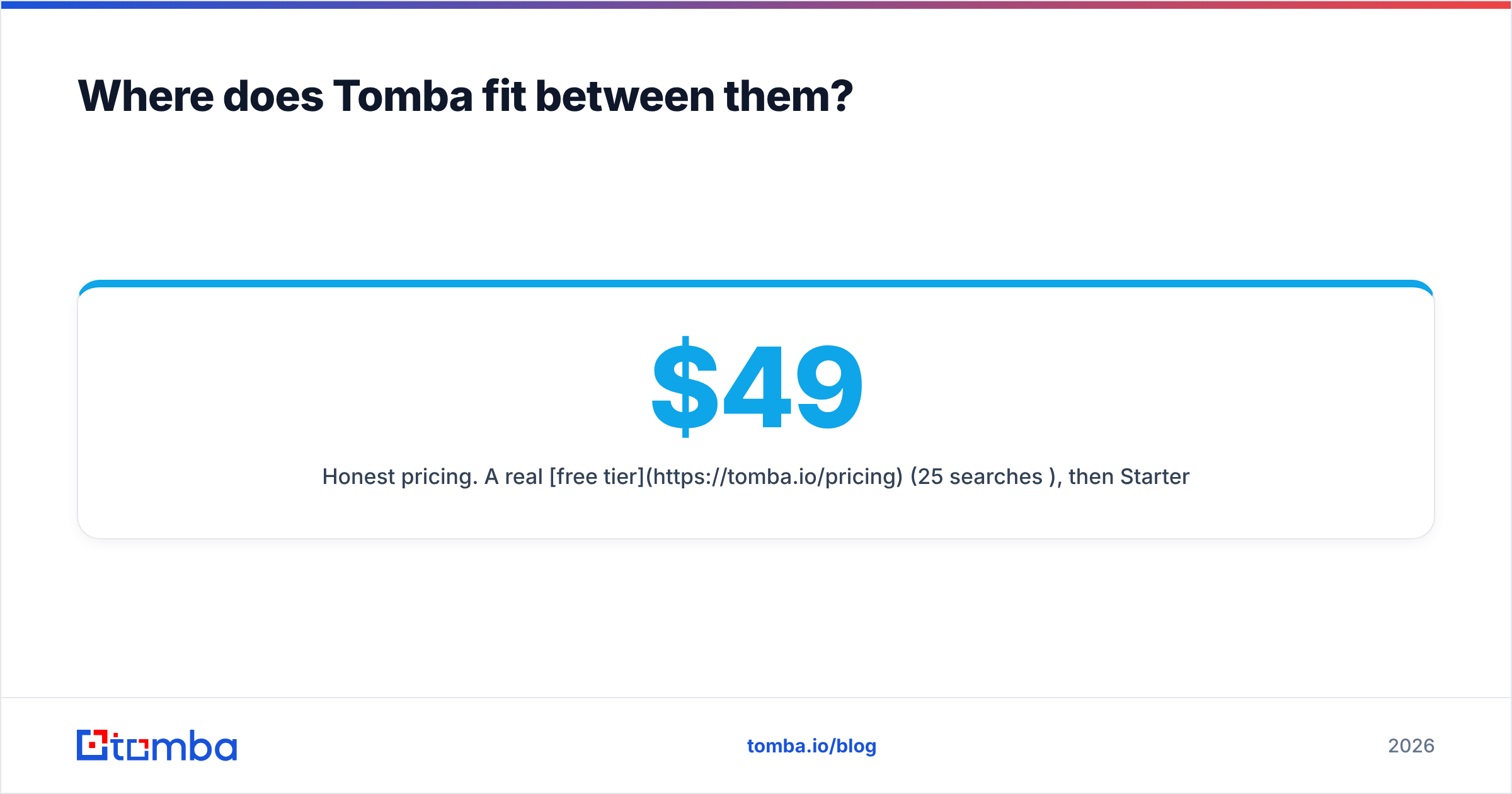
- Honest pricing. A real free tier (25 searches/month), then Starter at $49/mo, Growth at $99/mo, and Pro at $249/mo — no per-lead surprise metering.
That doesn't make the specialists wrong. If you already run a mature sourcing engine and only need a verification layer, a dedicated verifier is a clean bolt-on. If you have a clean list and only need volume sourcing, a lead tool fits. Tomba's argument is narrower and more practical: most teams under a certain size don't want to operate two tools to do one job.
How should you choose between Bounceshield and Generect?#
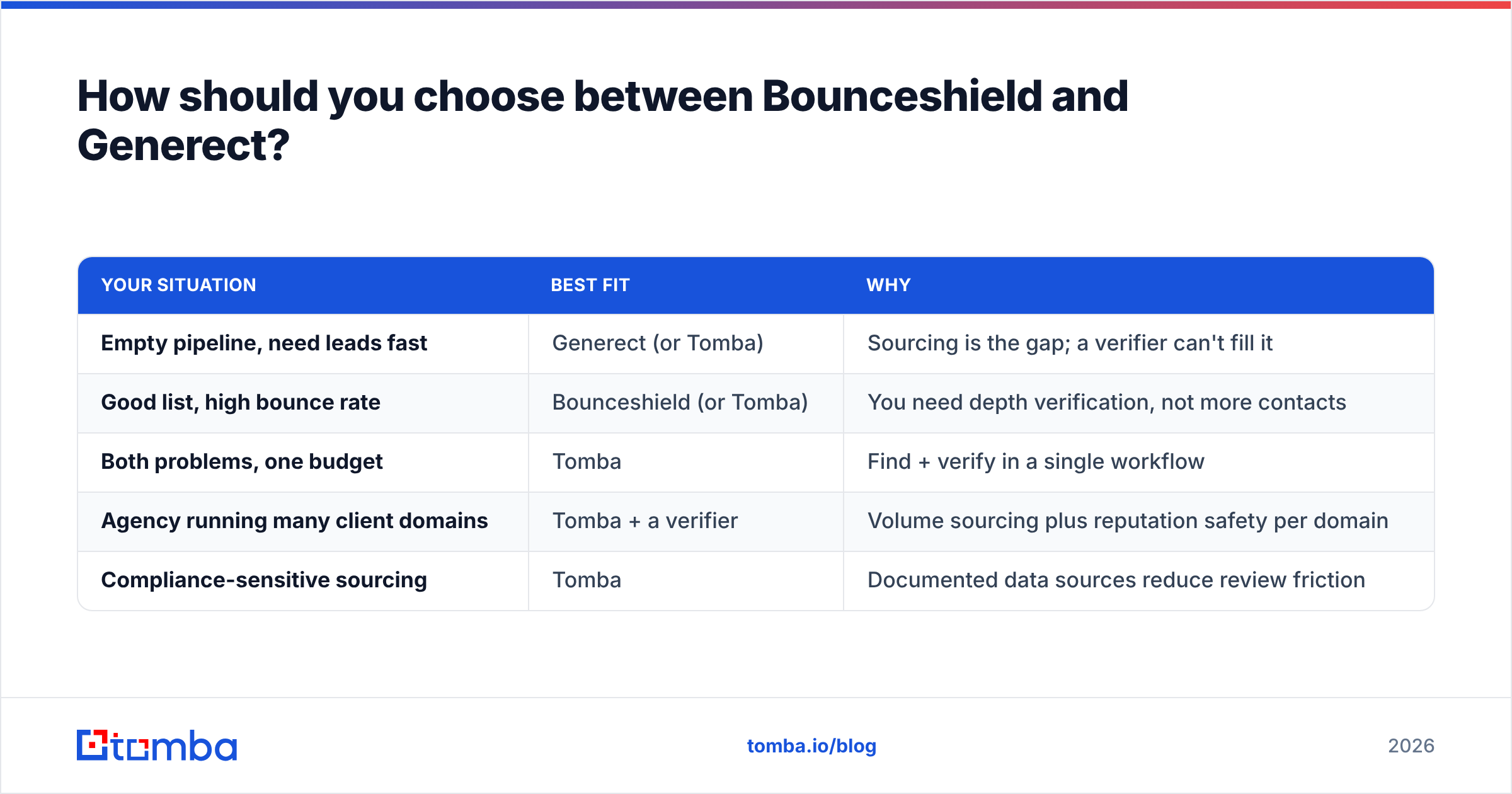
Decide by the bottleneck you actually have right now, not the one a vendor's landing page tells you to worry about.
| Your situation | Best fit | Why |
|---|---|---|
| Empty pipeline, need leads fast | Generect (or Tomba) | Sourcing is the gap; a verifier can't fill it |
| Good list, high bounce rate | Bounceshield (or Tomba) | You need depth verification, not more contacts |
| Both problems, one budget | Tomba | Find + verify in a single workflow |
| Agency running many client domains | Tomba + a verifier | Volume sourcing plus reputation safety per domain |
| Compliance-sensitive sourcing | Tomba | Documented data sources reduce review friction |
A useful gut check: if you can't articulate which of "find" or "verify" is your real constraint, you're probably leaking on both — and that's the case where consolidating into one find-to-verify tool saves the most time and money.
For an outside read on either vendor before you commit, pull up current reviews on G2 and the official Generect site so you're comparing live pricing and feature claims rather than a stale blog snapshot. Tool roadmaps move quarter to quarter, and a "vs" article — including this one — is a starting point, not a contract.
What about price and total cost?#
Sticker price rarely tells the real story; the hidden cost is the second tool you didn't budget for. A sourcing-only tool means you'll still pay a verifier to keep bounces down. A verifier-only tool means you'll still pay a sourcing tool to fill the funnel. Two subscriptions, two onboarding curves, two support queues.
When you tally it that way, an all-in-one's flat tier often undercuts the combined bill of a specialist sourcing tool plus a specialist verifier — and it removes the integration tax entirely. Run your own numbers: take your monthly lead volume, price it on Generect's per-lead or seat model, add a verifier's per-email rate for the same volume, and compare that total against a single Tomba plan. For most teams sending under a few thousand emails a month, the consolidated option wins on both cost and operational sanity.
The verdict#
Bounceshield vs Generect isn't a real fight — it's a category mistake. Generect builds your list; Bounceshield protects your sending; and you genuinely need both motions to run cold outreach that lands. If you want them as separate best-of-breed tools, buy both and wire them together. If you'd rather not run two subscriptions to accomplish one outcome, that's the gap a combined finder-and-verifier fills.
Start where your pipeline actually leaks. If you're not sure your contacts are real before you hit send, run them through Tomba's email finder and verifier — find the address, confirm it's deliverable, and skip the second vendor entirely. The free tier gives you 25 searches a month to test the workflow against your own list before you spend a dollar.
// get started
Find, verify and enrich your first contacts today
Start on the free plan with 25 searches a month, then scale when your team is ready.
Free plan · No credit card required · GDPR & CCPA
// about the author