Bounceshield vs Kaspr 2026: Email Verify vs Prospecting
Bounceshield protects deliverability; Kaspr finds contacts. They solve different problems—here's how they compare in 2026 and when you actually need both.
TL;DR
- Bounceshield and Kaspr are not really competitors — Bounceshield is an email verification / bounce-protection layer, while Kaspr is a LinkedIn-first contact-data tool for finding emails and phone numbers.
- Pick Bounceshield if your only problem is dirty lists and high bounce rates killing your sender reputation.
- Pick Kaspr if you live in LinkedIn and need fresh phone numbers and emails for prospecting.
- Pick Tomba if you want both sides in one place — finding and verifying contacts — at predictable pricing starting at $49/mo.
- The real question isn't "which one," it's "which job am I solving?" This guide maps each tool to the job.
What are Bounceshield and Kaspr, really?#
Here's the conclusion first: these two tools sit at opposite ends of the outbound pipeline, so comparing them head-to-head is like comparing a smoke detector to a grocery delivery service. Both are useful. They do completely different jobs.
Think of your outbound motion as a kitchen. Kaspr is the supplier that brings raw ingredients to your door — names, emails, and phone numbers pulled mostly from LinkedIn profiles. Bounceshield is the food-safety inspector that checks whether those ingredients are still fresh before you cook with them, so you don't serve a bounced email to your mail server and poison your sender reputation.
Technically:
- Kaspr is a B2B prospecting tool built around a LinkedIn Chrome extension. You open a profile, click the extension, and it reveals contact data — phone numbers especially, plus business emails — which you can push into your CRM or sequencing tool.
- Bounceshield is an email verification and bounce-protection service. You feed it a list (or hit its API in real time at signup forms and before sends), and it tells you which addresses are valid, risky, catch-all, or dead, so your bounce rate stays low.
If you only remember one thing: Kaspr gets you the contact, Bounceshield checks the contact, and you usually need both functions to run cold outreach safely.
)
How do Bounceshield and Kaspr compare at the core?#
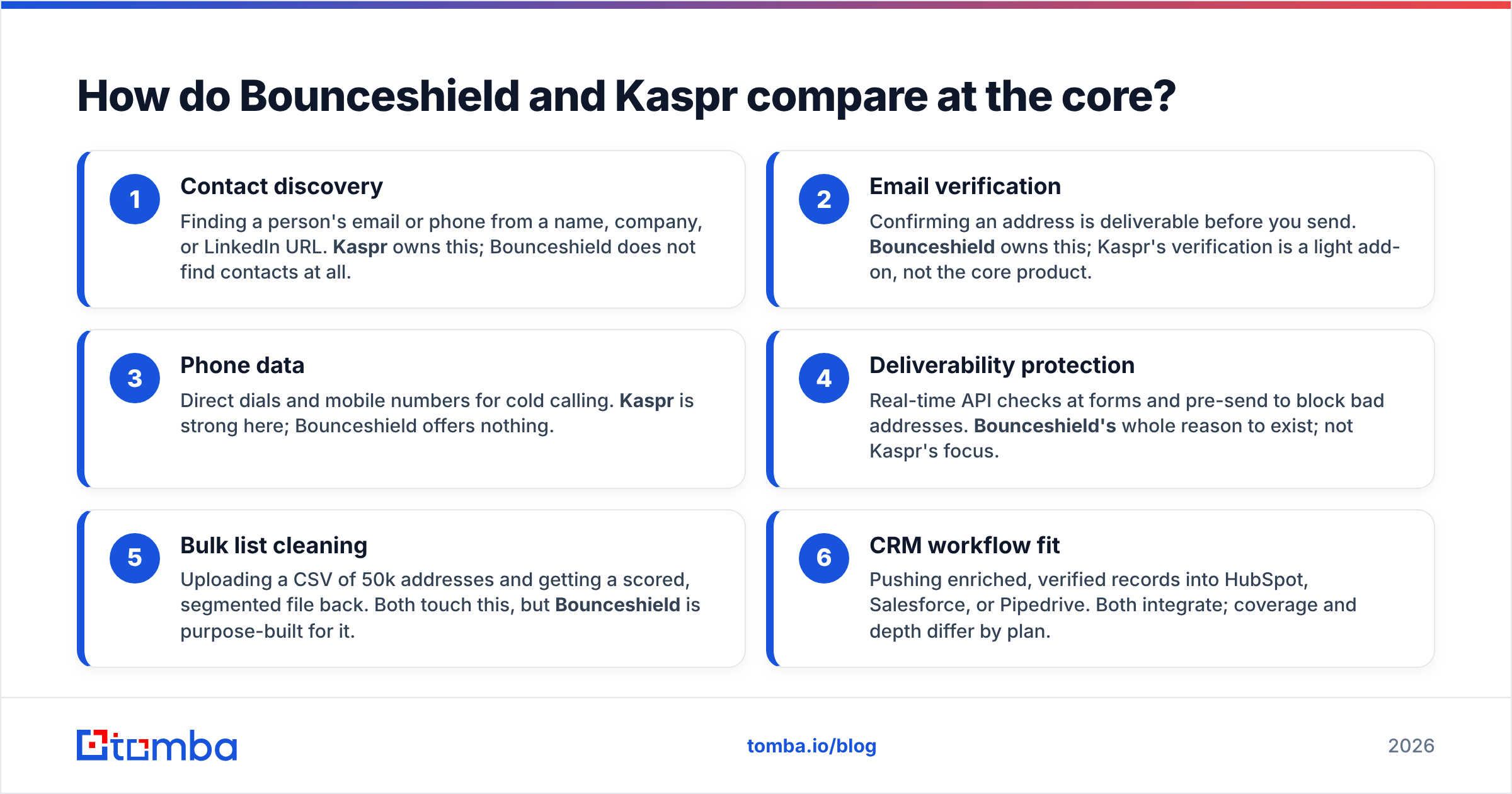
Because the two tools solve different jobs, the most useful way to compare them is by function, not by feature checklists. Here is where each one actually earns its keep:
- Contact discovery — Finding a person's email or phone from a name, company, or LinkedIn URL. Kaspr owns this; Bounceshield does not find contacts at all.
- Email verification — Confirming an address is deliverable before you send. Bounceshield owns this; Kaspr's verification is a light add-on, not the core product.
- Phone data — Direct dials and mobile numbers for cold calling. Kaspr is strong here; Bounceshield offers nothing.
- Deliverability protection — Real-time API checks at forms and pre-send to block bad addresses. Bounceshield's whole reason to exist; not Kaspr's focus.
- Bulk list cleaning — Uploading a CSV of 50k addresses and getting a scored, segmented file back. Both touch this, but Bounceshield is purpose-built for it.
- CRM workflow fit — Pushing enriched, verified records into HubSpot, Salesforce, or Pipedrive. Both integrate; coverage and depth differ by plan.
Notice that only one row overlaps meaningfully (bulk cleaning), and even there they approach it from different angles. That overlap is exactly why people search "Bounceshield vs Kaspr" — and usually walk away realizing they were asking the wrong question.
Which tool wins on features and pricing?#
Let's put the two side by side, and add Tomba as the reference point that covers both jobs. Pricing for third-party tools changes often, so treat their numbers as directional and confirm on each vendor's site; Tomba's figures are current.
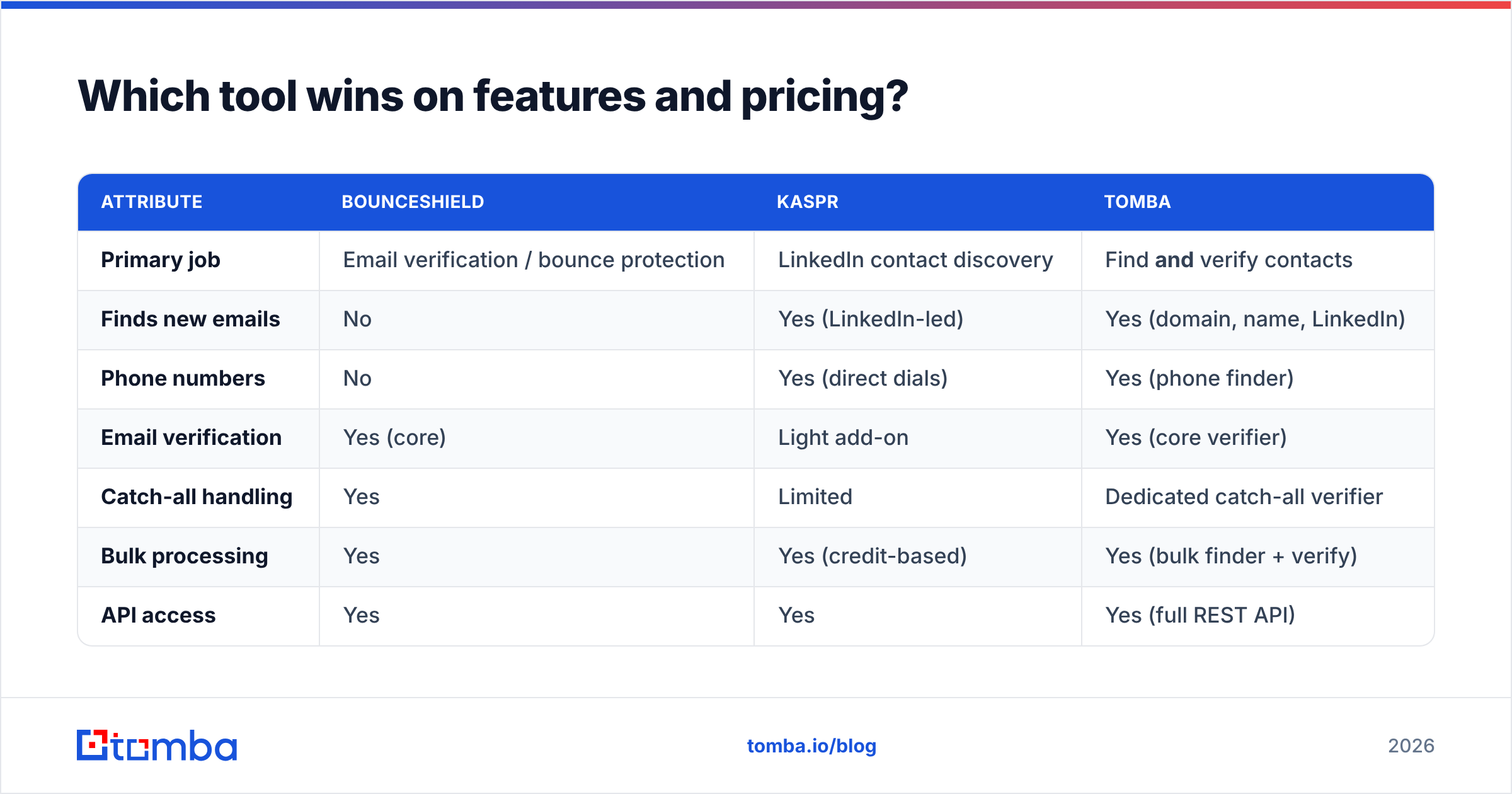
| Attribute | Bounceshield | Kaspr | Tomba |
|---|---|---|---|
| Primary job | Email verification / bounce protection | LinkedIn contact discovery | Find and verify contacts |
| Finds new emails | No | Yes (LinkedIn-led) | Yes (domain, name, LinkedIn) |
| Phone numbers | No | Yes (direct dials) | Yes (phone finder) |
| Email verification | Yes (core) | Light add-on | Yes (core verifier) |
| Catch-all handling | Yes | Limited | Dedicated catch-all verifier |
| Bulk processing | Yes | Yes (credit-based) | Yes (bulk finder + verify) |
| API access | Yes | Yes | Yes (full REST API) |
| Free tier | Limited trial | Limited credits | 25 searches/mo free |
| Entry paid price | Varies (verify-only) | Varies (credit packs) | $49/mo Starter |
| Best for | List hygiene | LinkedIn prospecting | End-to-end outbound |
The honest read: Bounceshield wins on pure verification depth, Kaspr wins on LinkedIn-sourced phone numbers, and Tomba wins on coverage — it does the finding job and the verification job without forcing you to buy and stitch together two subscriptions.
If your stack is already heavy, run a quick gut-check before adding either: do you have a finding gap, a verifying gap, or both? You can compare current Tomba pricing against what you'd pay for Bounceshield plus Kaspr together — for many teams the bundled cost of two single-purpose tools exceeds one platform that does both.
Is Bounceshield better than Kaspr for deliverability?#
Yes — for deliverability specifically, Bounceshield is the better-aimed tool, because that is its job.
Deliverability is the discipline of getting your email into the inbox instead of spam or a hard bounce. A spike in bounces tells mailbox providers your list is dirty, and that quietly tanks your sender reputation for every future send. Bounceshield attacks this at the source: it verifies addresses in real time before they ever enter your sending pool.
Kaspr, by contrast, isn't trying to win the deliverability fight. Its verification exists so the contacts it surfaces aren't obviously broken — not to protect a 200k-address newsletter from blacklisting. If you push raw Kaspr exports straight into a cold sequence without a real verification pass, you'll still see bounces.
But "Bounceshield is better at verification" doesn't mean "Bounceshield is better for you." If you don't have contacts yet, the best verifier in the world cleans an empty list. That's the trap of the head-to-head framing. A dedicated email verifier only matters once you have addresses worth verifying — which is the part Kaspr (or Tomba) handles upstream.
For the deliverability fundamentals behind all this — SPF, DKIM, reputation, and bounce thresholds — vendor-neutral primers like HubSpot's deliverability guides and peer reviews on G2 are worth a read before you commit budget.
Is Kaspr better than Bounceshield for prospecting?#
Yes — for filling the top of your funnel from LinkedIn, Kaspr is clearly the stronger of the two, because Bounceshield doesn't prospect at all.
Kaspr's sweet spot is the SDR who works LinkedIn Sales Navigator daily. You build a list of target profiles, run Kaspr, and pull direct dials and business emails into your sequencer. For phone-heavy motions — recruiting, high-ticket B2B, anything where you call before you email — that direct-dial coverage is the draw.
Where Kaspr gets expensive is the credit model. Phone and email reveals burn credits, and at scale the per-contact cost climbs fast. It's also LinkedIn-centric: if your ICP isn't well-represented on LinkedIn, coverage thins out.
This is where a domain-first approach complements (or replaces) the profile-by-profile grind. Tools like the domain search workflow let you pull every known address at a target company in one query — useful when you're going account-based rather than person-by-person. And for LinkedIn specifically, a dedicated LinkedIn finder covers the same source without the steep per-credit math.
)
When do you actually need both — or neither?#
Conclusion first: most teams running real volume need both functions, which is exactly the argument for a single platform instead of two narrow ones.
Here's the decision logic:
- You have lists but high bounce rates → you have a verification gap. Bounceshield (or Tomba's verifier) solves it. You don't need Kaspr yet.
- You have targets but no contact data → you have a discovery gap. Kaspr (or Tomba's finder) solves it. A standalone verifier won't help until you've found contacts.
- You're scaling cold outbound → you have both gaps. This is where running Bounceshield + Kaspr as two subscriptions starts to feel like duct tape, and a combined platform wins on cost and workflow.
- You're doing light, occasional outreach → you may need neither paid tool. A free tier (Tomba gives 25 searches/mo) plus manual verification may carry you until volume justifies a subscription.
The two-tool stack has a hidden tax beyond price: data hand-offs. Every time a contact leaves Kaspr, gets verified somewhere else, and lands in your CRM, you risk format mismatches, duplicate records, and stale fields. One platform that finds, verifies, and enriches in the same pass removes those seams. That's the practical case for consolidating with an email finder that has verification built in rather than bolted on.
How do Bounceshield, Kaspr, and Tomba differ on data sourcing?#
Where a tool gets its data shapes everything downstream — accuracy, freshness, and how legally clean it is for your region.
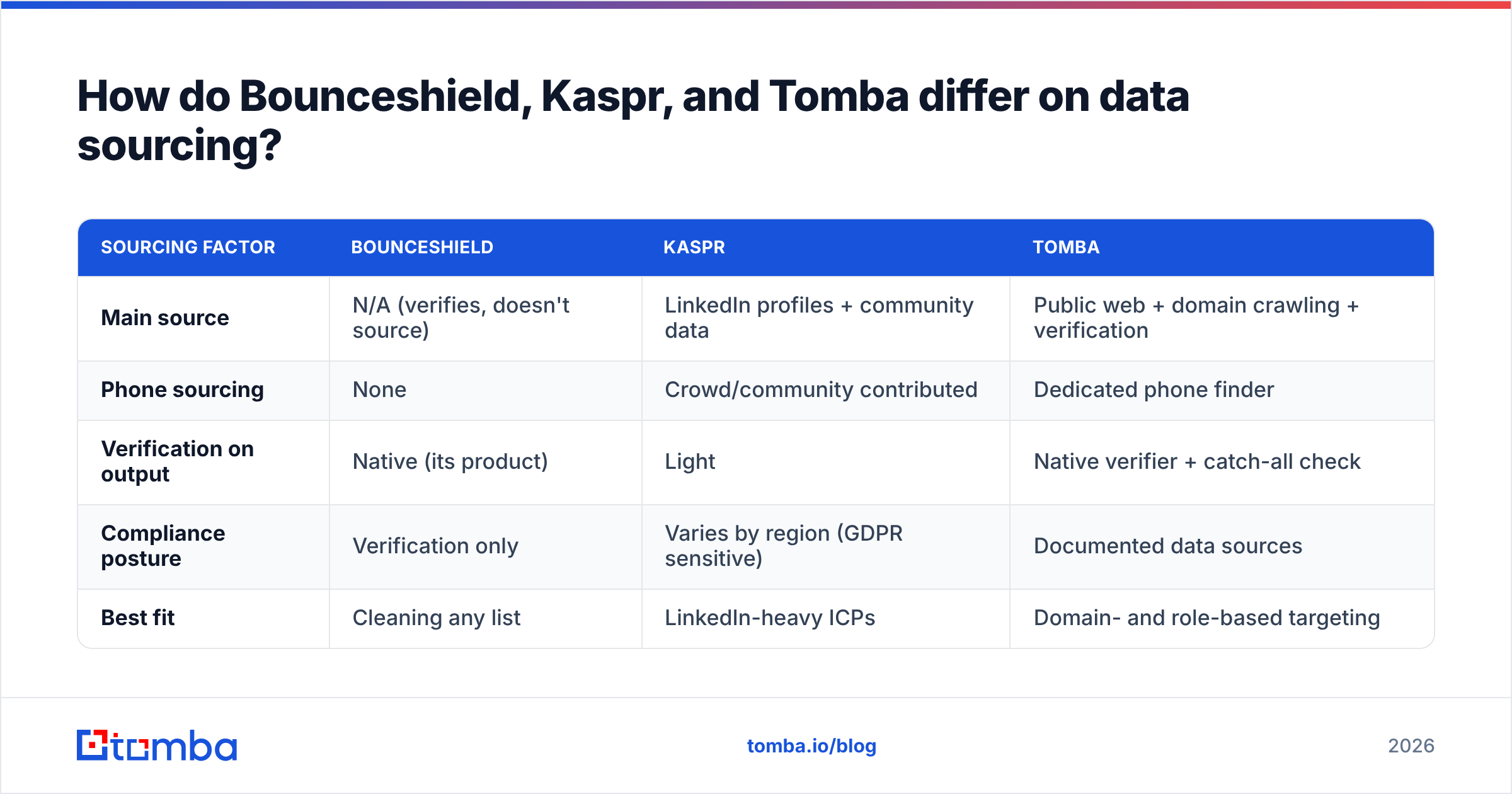
| Sourcing factor | Bounceshield | Kaspr | Tomba |
|---|---|---|---|
| Main source | N/A (verifies, doesn't source) | LinkedIn profiles + community data | Public web + domain crawling + verification |
| Phone sourcing | None | Crowd/community contributed | Dedicated phone finder |
| Verification on output | Native (its product) | Light | Native verifier + catch-all check |
| Compliance posture | Verification only | Varies by region (GDPR sensitive) | Documented data sources |
| Best fit | Cleaning any list | LinkedIn-heavy ICPs | Domain- and role-based targeting |
Two takeaways. First, Bounceshield has no sourcing column to speak of — it's downstream of whoever found the contact. Second, Kaspr's community-contributed model is what gives it strong phone coverage but also makes regional compliance something you should review with your legal team, especially under GDPR. Tomba leans on public web data plus crawling, and publishes where its data sources come from — useful when procurement asks how a contact ended up in your CRM.
For phone-specific motions, it's also worth separating finding a number from validating it. A number that's found but disconnected wastes a dialer slot just like a dead email wastes a send — which is why a phone finder paired with validation beats a raw export every time.
Bounceshield vs Kaspr: which should you choose in 2026?#
Quick answer by scenario:
- Choose Bounceshield if you already have a contact source you trust and your single biggest pain is bounce rate and sender reputation. It's a focused, do-one-thing-well verification layer.
- Choose Kaspr if you're a LinkedIn-native SDR team that lives on direct dials and you're comfortable managing a credit budget.
- Choose Tomba if you'd rather not run two subscriptions to cover one pipeline. You get email finding, verification, catch-all checks, phone data, and enrichment under one Tomba plan, starting free and scaling to $49/mo Starter, $99/mo Growth, and $249/mo Pro.
The "vs" framing assumes you must pick a side. You don't. You must pick the job. If your job is only verification, Bounceshield is reasonable. If it's only LinkedIn prospecting, Kaspr is reasonable. If your job is "run reliable outbound end to end" — which it usually is — neither single-purpose tool covers it, and a platform that does both is the cheaper, cleaner answer.
For the official feature lists as you finalize, check each vendor directly — Kaspr's site for its current credit plans, and verified-buyer reviews on G2 for real deliverability and coverage feedback.
The bottom line#
Bounceshield and Kaspr aren't rivals — they're two halves of a pipeline. Bounceshield keeps your sends clean; Kaspr fills your list from LinkedIn. The moment you need both halves working together is the moment two subscriptions start costing more than one platform.
That's where Tomba fits. The Tomba Email Finder finds professional emails by domain, name, or company, then verifies them in the same flow — with catch-all detection, phone lookup, bulk processing, and a full API behind it. Start on the free tier with 25 searches a month, find and verify your first list without juggling two tools, and upgrade only when volume demands it. Stop choosing between finding contacts and trusting them. Do both, in one place.
// get started
Find, verify and enrich your first contacts today
Start on the free plan with 25 searches a month, then scale when your team is ready.
Free plan · No credit card required · GDPR & CCPA
// about the author