Bounceshield vs Lead411: Accuracy & Pricing Compared (2026)
Bounceshield verifies emails; Lead411 sells B2B contact data. We compare accuracy, pricing, and use cases so you pick the right tool — and where a dedicated finder beats both.
Bounceshield vs Lead411: Accuracy & Pricing Compared (2026)
You are not really comparing two versions of the same thing. Bounceshield and Lead411 sit at opposite ends of the B2B data pipeline, and most teams who type "bounceshield vs lead411" into a search bar are actually trying to answer a different question: do I need to clean the list I already have, or do I need to build a list from scratch?
This post settles that. We break down what each tool does, where each one is genuinely strong, where the marketing oversells, and where a dedicated email finder and verifier beats both on cost per usable contact.
TL;DR#
- Bounceshield is an email verification tool. It checks whether addresses you already have are deliverable. It does not build prospecting lists.
- Lead411 is a B2B sales intelligence platform. It sells contact and company records, intent data, and triggers — a database you search, not a list you clean.
- They solve different problems. Comparing them head-to-head only makes sense if you are deciding which layer of your stack to buy first.
- Pricing models differ sharply. Bounceshield charges per verification credit; Lead411 sells annual seats with export caps.
- For most SMB and mid-market teams, a combined finder-plus-verifier like Tomba covers both jobs at a lower blended cost than buying a database seat and a separate verifier.
What is Bounceshield?#
Bounceshield is a bulk email verification service. You feed it a list of addresses — from a CSV, a CRM export, or an API call — and it returns a deliverability verdict for each one: valid, invalid, risky, catch-all, or unknown.
The core job is reducing bounce rates. Every cold email you send to a dead address chips away at your sender reputation, and once mailbox providers start throttling you, even your good emails land in spam. Verification is the cheapest insurance against that.
What Bounceshield does not do is find new contacts. If your spreadsheet is empty, a verifier has nothing to chew on. That is the single most important thing to understand before you buy: a verifier is a filter, not a faucet.

Typical verification checks under the hood include syntax validation, MX-record lookups, SMTP handshake probes, role-account detection (info@, sales@), disposable-domain flagging, and catch-all detection. If you want to understand how catch-all domains specifically break naive verifiers, the catch-all verifier explainer is a good primer — catch-alls accept every address at the SMTP layer, so a "valid" verdict there is often a guess dressed up as a fact.
What is Lead411?#
Lead411 is a B2B sales intelligence and contact database. Instead of cleaning a list, you build one: search by industry, title, location, company size, technology stack, or growth signal, then export the matching contacts with emails and direct-dial phone numbers.
Lead411's pitch leans heavily on intent data and growth triggers — alerts when a company raises funding, hires aggressively, or shows buying signals for your category. For outbound teams that want to time their outreach, that timing layer is the real product, not just the raw records. You can see how the market positions it on G2 and on the official Lead411 site.
The trade-off is the model. Sales intelligence platforms sell annual contracts with export limits — you might have "unlimited views" but only a few thousand exports per year. The sticker price and the usable-contact price are rarely the same number, which matters a lot when you compare it to a credit-based finder.
Bounceshield vs Lead411: how do they actually compare?#
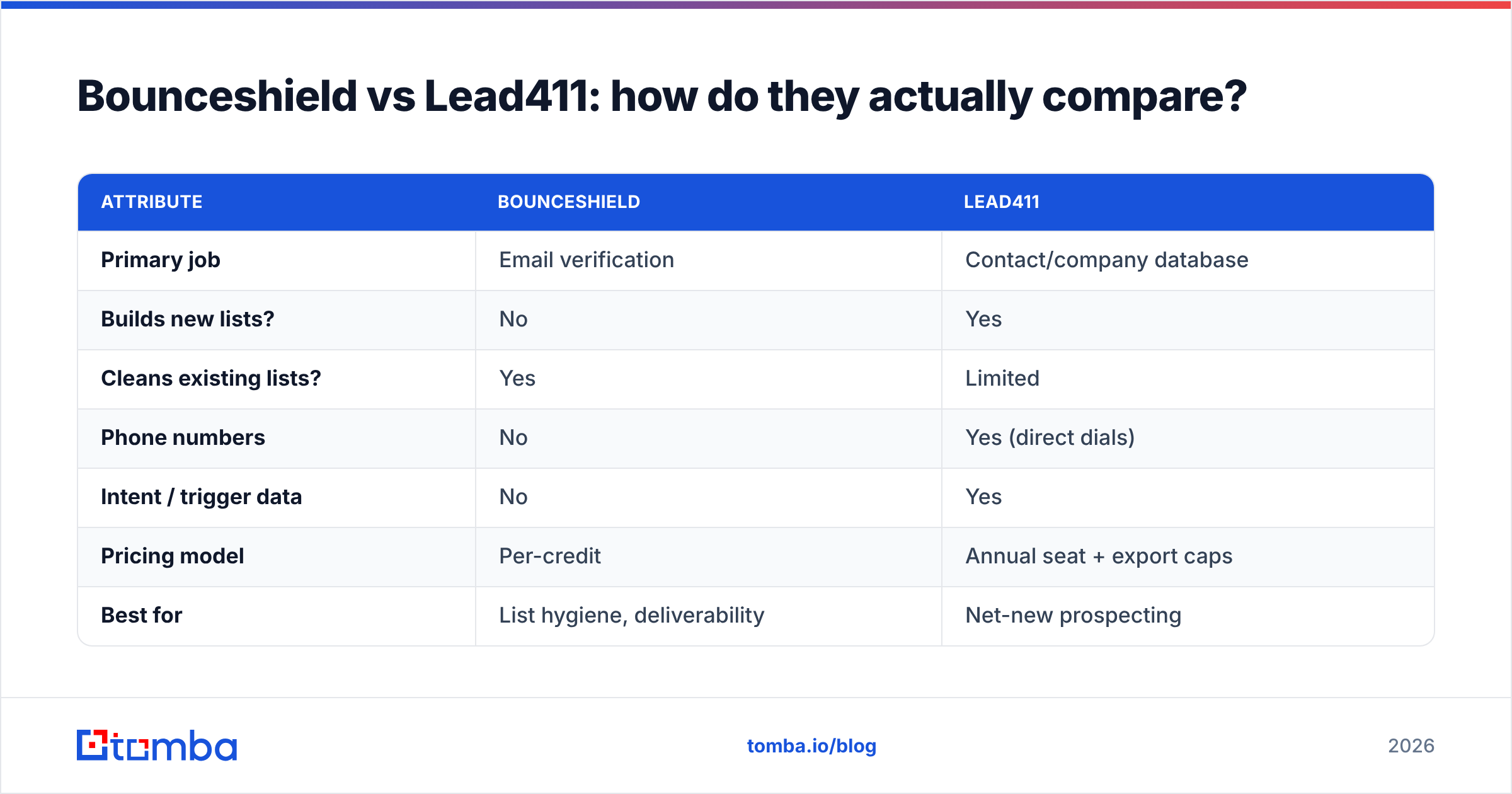
Here is the head-to-head on the attributes that decide which tool earns a slot in your budget.
| Attribute | Bounceshield | Lead411 |
|---|---|---|
| Primary job | Email verification | Contact/company database |
| Builds new lists? | No | Yes |
| Cleans existing lists? | Yes | Limited |
| Phone numbers | No | Yes (direct dials) |
| Intent / trigger data | No | Yes |
| Pricing model | Per-credit | Annual seat + export caps |
| Best for | List hygiene, deliverability | Net-new prospecting |
| Free tier | Limited trial | Demo / limited trial |
| API access | Yes | Yes (higher tiers) |
The pattern is clear: these are complementary, not competing. A mature outbound motion needs both a faucet (find contacts) and a filter (verify them). The strategic question is whether you buy two specialist tools or one platform that does both well enough.
Where Bounceshield wins#
- You already own a large list — a CRM export, a trade-show scan, a years-old newsletter base — and you need to know what is still deliverable before you mail it.
- Your bottleneck is bounce rate and inbox placement, not lead volume.
- You want pay-as-you-go pricing tied to actual usage rather than an annual commitment.
Where Lead411 wins#
- You are starting from zero and need net-new accounts and contacts in a defined territory.
- Direct-dial phone numbers matter to your motion (think SDRs running parallel call-and-email plays).
- You want intent signals to prioritize which accounts to work this quarter.
Is accuracy better with Bounceshield or Lead411?#
Accuracy means two different things here, and conflating them is how teams waste money.
For Bounceshield, accuracy = verification precision: when it says "valid," how often does the email actually accept mail? Good verifiers land in the 95%+ range on non-catch-all domains. The honest weak spot for every verifier is catch-all domains, where SMTP-level checks can't distinguish a real mailbox from a wildcard.
For Lead411, accuracy = data freshness: when it hands you an email or phone number, how often is it current? B2B data decays fast — people change jobs constantly — so even a strong database is fighting entropy between refresh cycles. This is why the smartest workflow treats any database export as unverified until you run it through a separate verification pass.
That second point is the catch most buyers miss. A database export is not pre-cleaned to your sending standards. Lead411 records are reasonable at capture time, but if you pull a list and blast it months later, you still need a verification step. Which means even Lead411 users often end up needing a Bounceshield-style layer anyway. You can run that pass with a dedicated email verifier and check tricky domains with a catch-all finder.
How much do Bounceshield and Lead411 cost?#
Pricing is where the comparison gets genuinely tricky, because the two tools meter completely different things.
- Bounceshield charges per verification credit. One credit roughly equals one email checked. Costs scale with list volume, and pay-as-you-go options mean a quiet month costs you little.
- Lead411 sells annual seats. The headline price is per user per month billed yearly, and — critically — each plan caps how many contacts you can export. "Unlimited views" is not "unlimited exports." Going over your export cap is the hidden cost that surprises teams mid-contract.
So the real metric is cost per usable, deliverable contact, not the sticker price. A cheap database with a tight export cap and stale records can cost more per usable contact than it looks. A pay-as-you-go verifier costs nothing when you have nothing to clean.
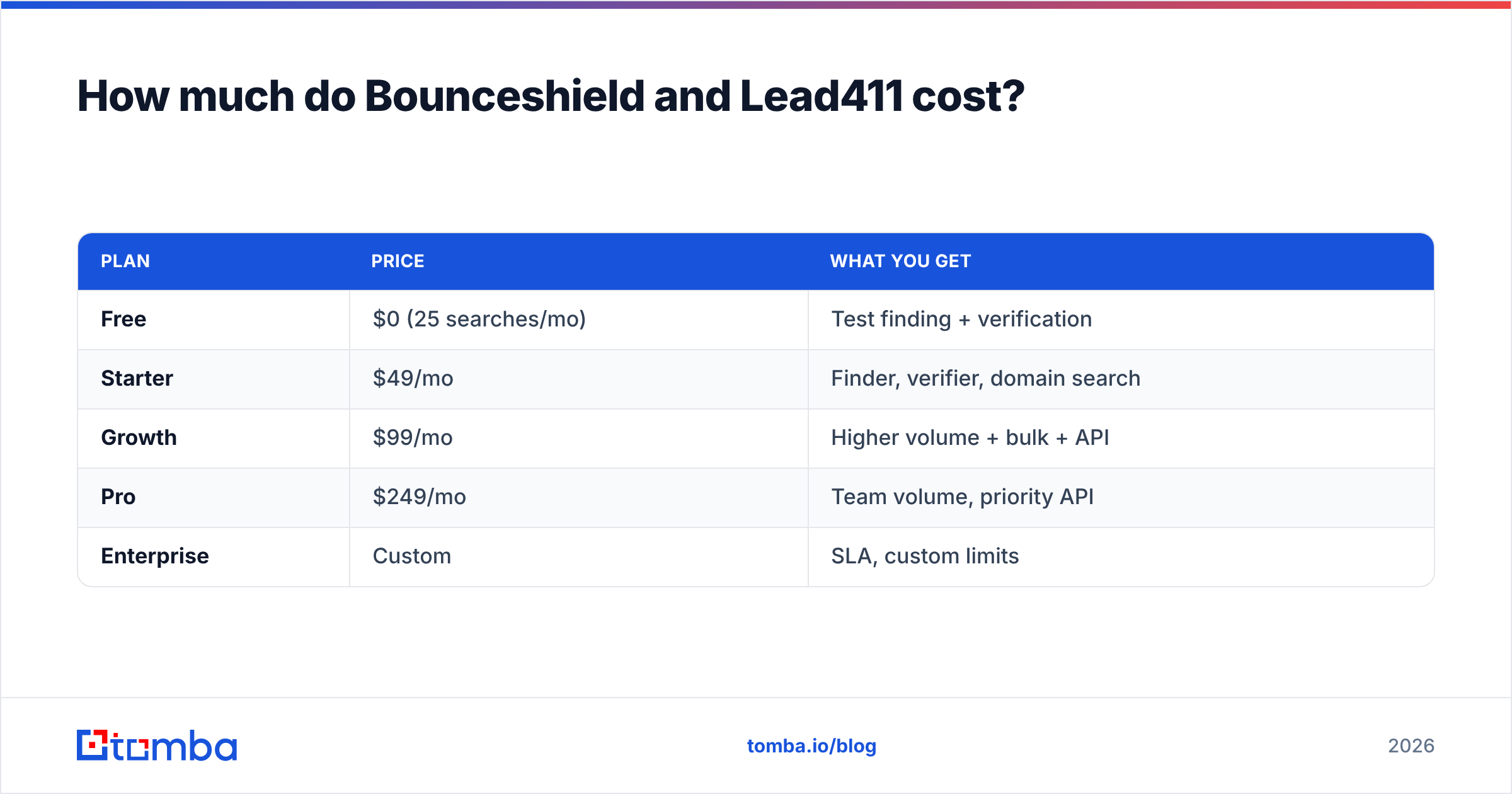
This is exactly where a combined finder-and-verifier changes the math. Tomba's pricing bundles finding and verification into the same credit pool:
| Plan | Price | What you get |
|---|---|---|
| Free | $0 (25 searches/mo) | Test finding + verification |
| Starter | $49/mo | Finder, verifier, domain search |
| Growth | $99/mo | Higher volume + bulk + API |
| Pro | $249/mo | Team volume, priority API |
| Enterprise | Custom | SLA, custom limits |
Because the same credits cover both finding emails and verifying them, you are not paying for a database seat and a separate verification subscription. For SMB and mid-market teams that do not need deep intent data, that consolidation is usually the cheaper path.
When should you choose a dedicated finder-plus-verifier instead?#
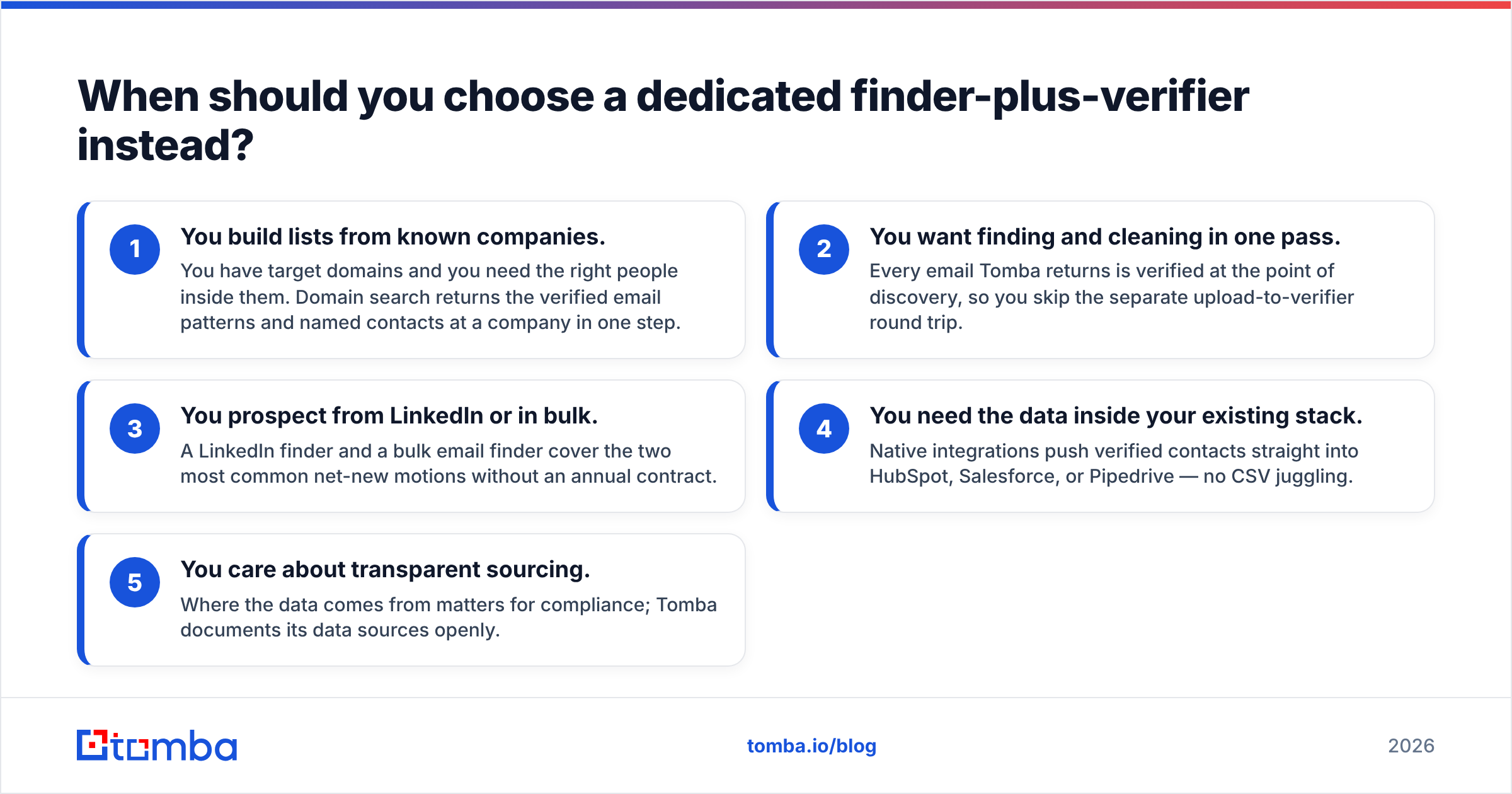
Choose a combined tool like Tomba when your workflow looks like this:
- You build lists from known companies. You have target domains and you need the right people inside them. Domain search returns the verified email patterns and named contacts at a company in one step.
- You want finding and cleaning in one pass. Every email Tomba returns is verified at the point of discovery, so you skip the separate upload-to-verifier round trip.
- You prospect from LinkedIn or in bulk. A LinkedIn finder and a bulk email finder cover the two most common net-new motions without an annual contract.
- You need the data inside your existing stack. Native integrations push verified contacts straight into HubSpot, Salesforce, or Pipedrive — no CSV juggling.
- You care about transparent sourcing. Where the data comes from matters for compliance; Tomba documents its data sources openly.
The honest exception: if your entire go-to-market depends on intent timing and direct dials at the enterprise level, a dedicated sales-intelligence platform like Lead411 (or a heavier alternative) earns its seat. For that specific job, intent data is a feature a pure finder doesn't replicate. Be clear-eyed about whether you actually use intent signals, though — many teams pay for them and never build a play around them.
Which tool is right for you?#
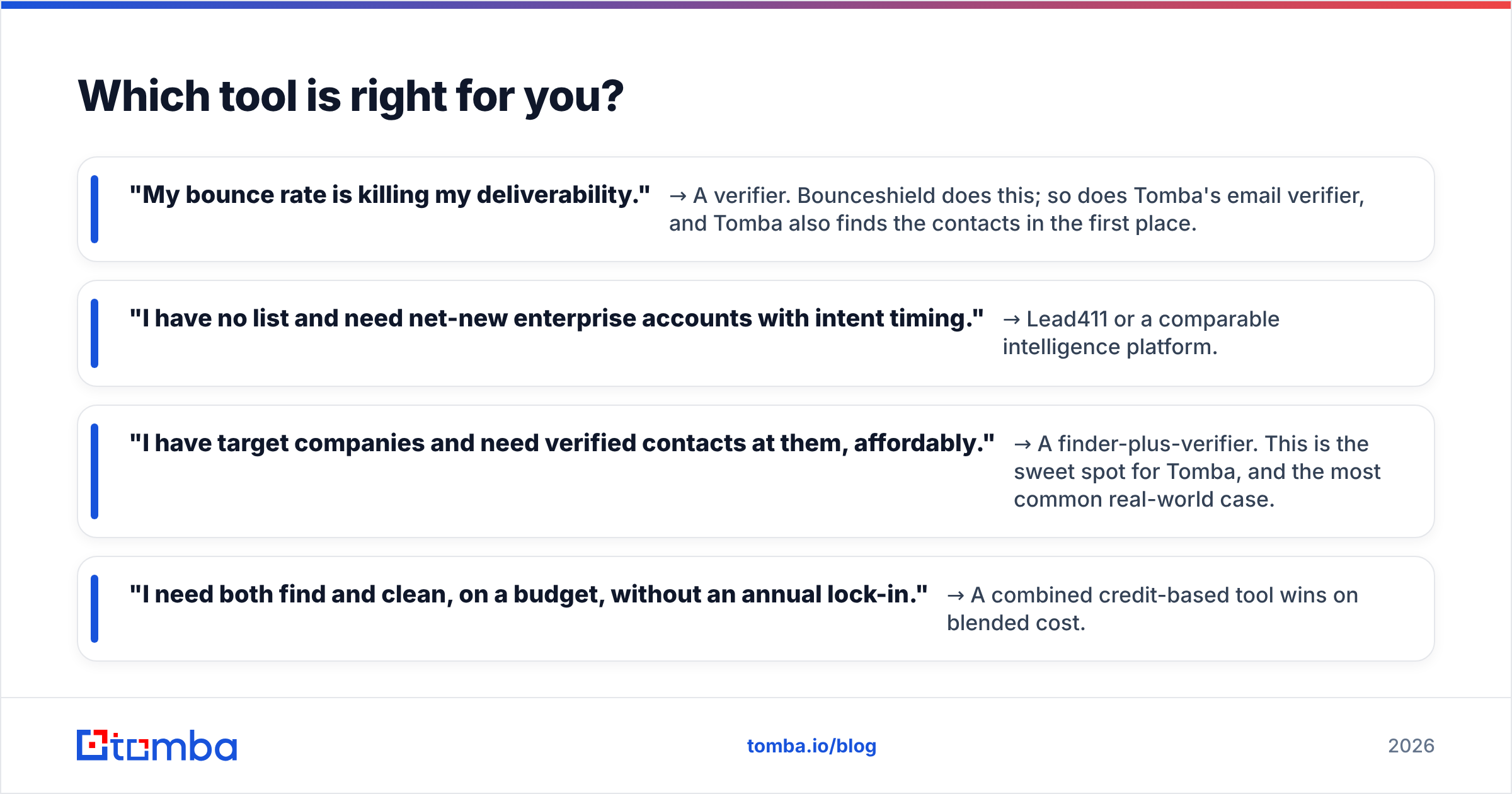
Match the tool to the actual bottleneck:
- "My bounce rate is killing my deliverability." → A verifier. Bounceshield does this; so does Tomba's email verifier, and Tomba also finds the contacts in the first place.
- "I have no list and need net-new enterprise accounts with intent timing." → Lead411 or a comparable intelligence platform.
- "I have target companies and need verified contacts at them, affordably." → A finder-plus-verifier. This is the sweet spot for Tomba, and the most common real-world case.
- "I need both find and clean, on a budget, without an annual lock-in." → A combined credit-based tool wins on blended cost.
Most teams searching "bounceshield vs lead411" are in that third bucket and don't realize it. They think they're choosing between two products when they actually need the job both gestures at — verified contacts at known companies — done in one place.
If you want to compare specialist databases more broadly, neutral directories like Capterra list dozens of options with user reviews, and it is worth reading those before committing to any annual seat.
The bottom line#
Bounceshield and Lead411 are not rivals — they are different floors of the same building. Bounceshield keeps your existing lists clean and your deliverability healthy. Lead411 builds net-new pipeline with intent and direct dials, at an annual-contract price with export caps. Pick Bounceshield when hygiene is the problem; pick Lead411 when net-new enterprise prospecting with intent timing is the problem.
But if your real need is finding verified business emails at companies you already care about — without paying for two tools — start with the Tomba Email Finder. It finds contacts by domain, name, or company and verifies each one in the same step, on a credit-based plan that starts free at 25 searches a month and scales to $49/mo when you're ready. You get the faucet and the filter in one pool of credits, which is the cheapest way to move from "I think this email works" to "I know it does."
// get started
Find, verify and enrich your first contacts today
Start on the free plan with 25 searches a month, then scale when your team is ready.
Free plan · No credit card required · GDPR & CCPA
// about the author