Bounceshield vs Nymeria 2026: Email Data Tools Compared
Bounceshield protects your sender reputation; Nymeria finds and enriches contacts. Here's how the two stack up in 2026 — accuracy, pricing, and which one your outbound stack actually needs.
Choosing between Bounceshield and Nymeria is a bit like comparing a smoke detector to a grocery delivery service. Both are useful, both touch your email program, but they solve completely different problems. One guards the emails you already have; the other goes out and finds new ones. If you've landed here trying to pick "the winner," the honest answer is that most teams need the job both do — not necessarily either specific tool.
This guide breaks down what each platform actually does, where they overlap, what they cost, and how to decide which (if either) belongs in your 2026 outbound stack.
TL;DR#
- Bounceshield is an email verification and bounce-protection tool. Its job is to clean lists and stop bad addresses from torching your sender reputation.
- Nymeria is a contact-finding and enrichment tool. Its job is to source emails, phone numbers, and social profiles — often from LinkedIn.
- They're not direct competitors: verification vs. discovery. Many teams that "compare" them actually need one of each.
- On pricing, both are affordable for individuals but get murky at team scale; neither bundles finding and verifying as a first-class workflow.
- If you want one platform that finds, verifies, and enriches in a single workflow, a consolidated tool like Tomba removes the need to glue two products together.
What is Bounceshield?#
Bounceshield is an email verification platform. You feed it a list of addresses — exports from your CRM, a cold-email list, a newsletter signup file — and it checks each one for validity before you hit send. The goal is simple: keep hard bounces low so mailbox providers keep trusting you.
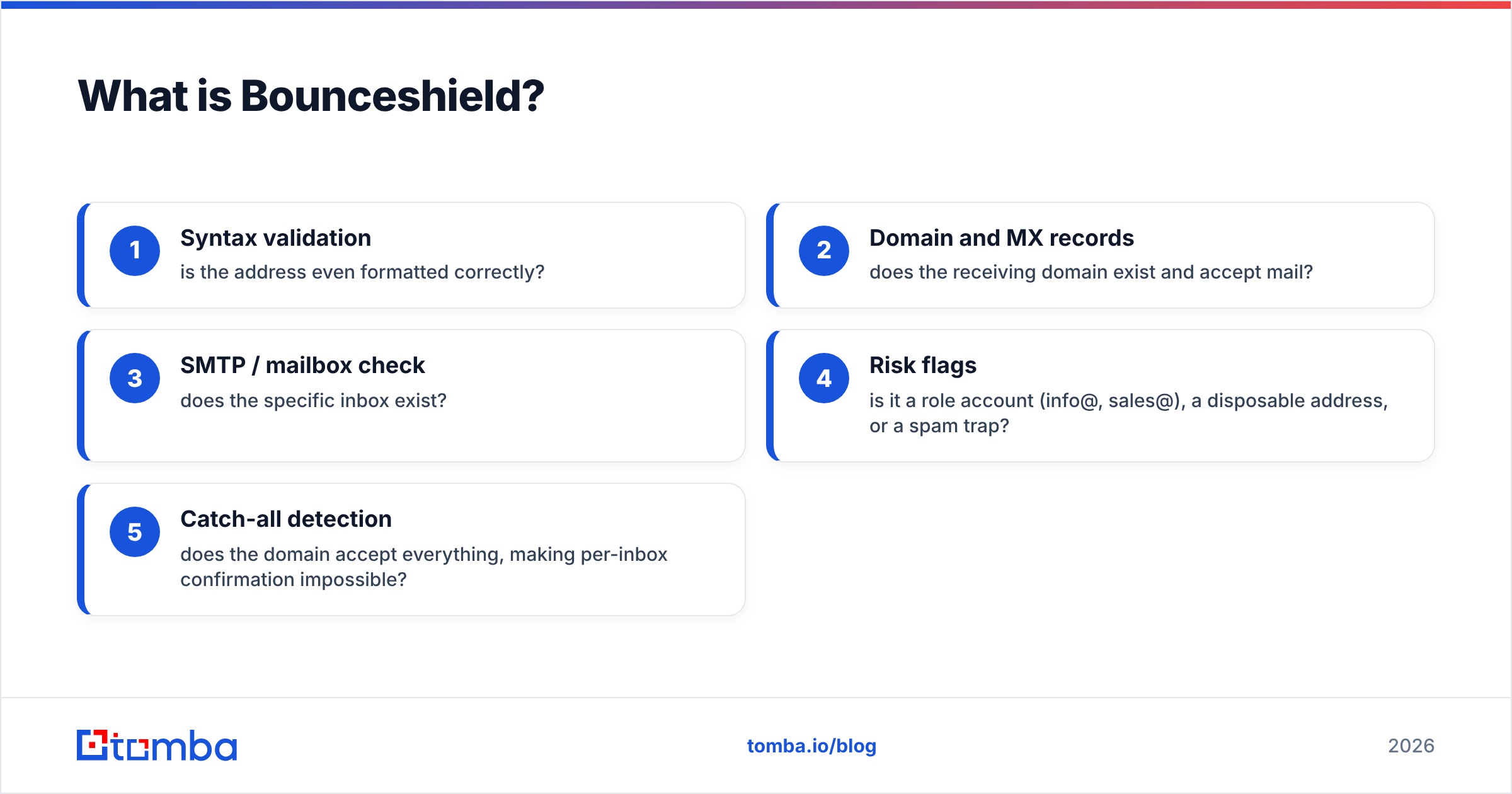
A good verifier runs several checks per address:
- Syntax validation — is the address even formatted correctly?
- Domain and MX records — does the receiving domain exist and accept mail?
- SMTP / mailbox check — does the specific inbox exist?
- Risk flags — is it a role account (info@, sales@), a disposable address, or a spam trap?
- Catch-all detection — does the domain accept everything, making per-inbox confirmation impossible?
Why does this matter? Because every hard bounce is a black mark on your sender reputation. Send to enough dead addresses and Gmail, Outlook, and Yahoo start routing you to spam — not just for that campaign, but for everything. Verification is insurance against that slow-motion deliverability collapse.

What Bounceshield does not do is find new contacts. If your list is empty, a verifier has nothing to verify.
What is Nymeria?#
Nymeria sits on the other side of the funnel. It's a contact-discovery and data enrichment tool, best known for pulling professional emails and phone numbers — frequently via a browser extension that works over LinkedIn profiles and company pages.
Nymeria's core jobs:
- Find emails for a person or company you already have a name/profile for
- Enrich an existing record with phone numbers, job titles, and social links
- Export contacts into your CRM or outreach tool
- Bulk lookups for building prospect lists at volume
In other words, Nymeria answers the question "How do I reach this person?" while Bounceshield answers "Is this address I already have safe to email?" That's the whole distinction in one sentence.
The catch: data discovery tools live and die by accuracy and freshness. People change jobs, companies rebrand, and a contact you found six months ago may now bounce — which loops you right back to needing verification anyway.

Bounceshield vs Nymeria: how do they compare?#
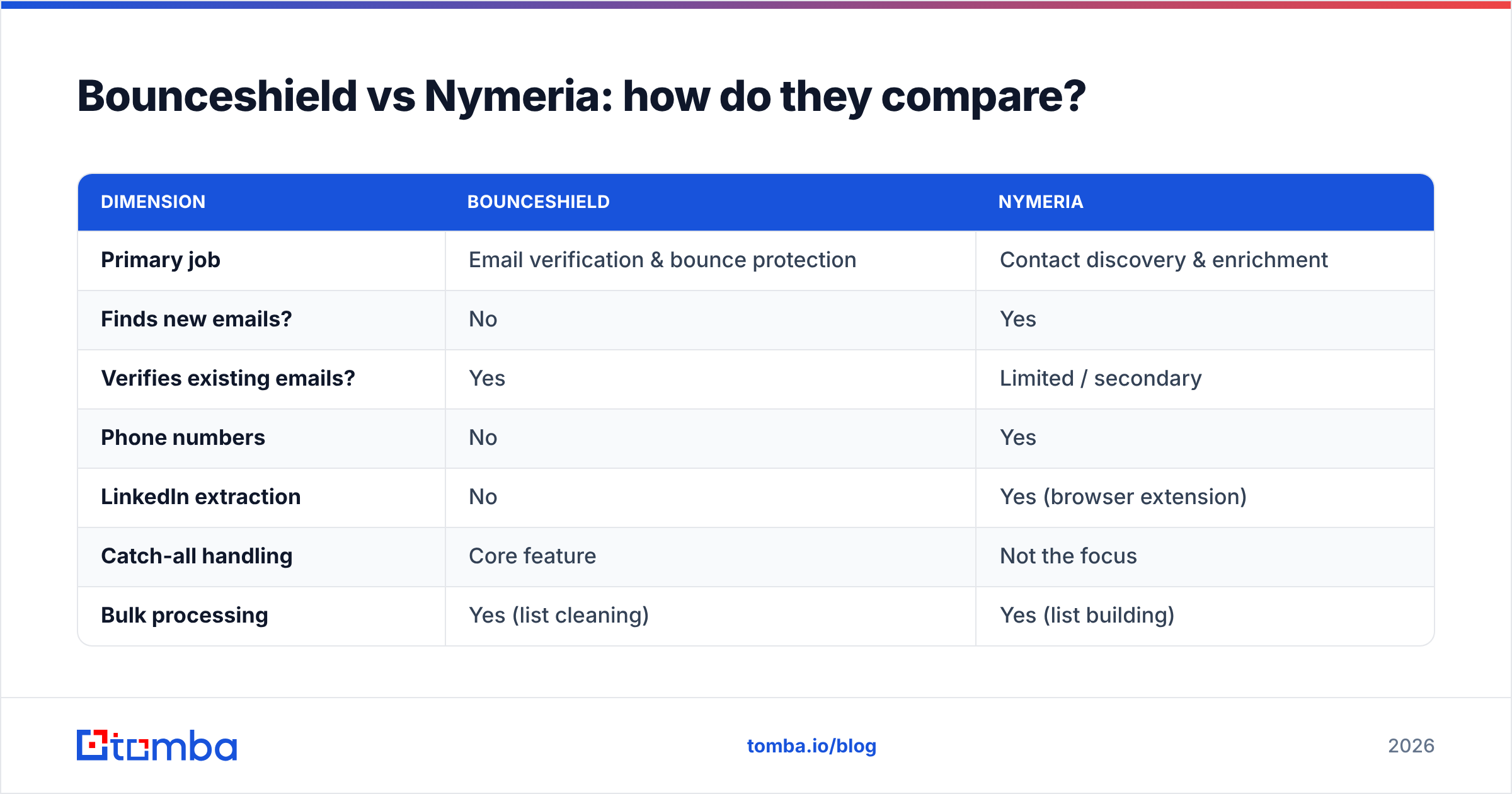
Here's the head-to-head on the dimensions that matter when you're scoping a stack. Treat any specific price as a starting point — verification and enrichment vendors both change packaging often, so confirm on their official sites before buying.

| Dimension | Bounceshield | Nymeria |
|---|---|---|
| Primary job | Email verification & bounce protection | Contact discovery & enrichment |
| Finds new emails? | No | Yes |
| Verifies existing emails? | Yes | Limited / secondary |
| Phone numbers | No | Yes |
| LinkedIn extraction | No | Yes (browser extension) |
| Catch-all handling | Core feature | Not the focus |
| Bulk processing | Yes (list cleaning) | Yes (list building) |
| Best for | Protecting deliverability | Sourcing prospects |
| Where it fits in funnel | After you have a list | Before you have a list |
The key takeaway: these tools are sequential, not substitutable. A realistic workflow is find with a discovery tool → verify with a cleaning tool → send. If you only buy one, you've solved half the problem and left the other half to chance.
Which problem do you actually have?#
Conclusion first: pick based on where your pipeline is leaking, not on which brand you've heard of.
Run yourself through this quick diagnostic:
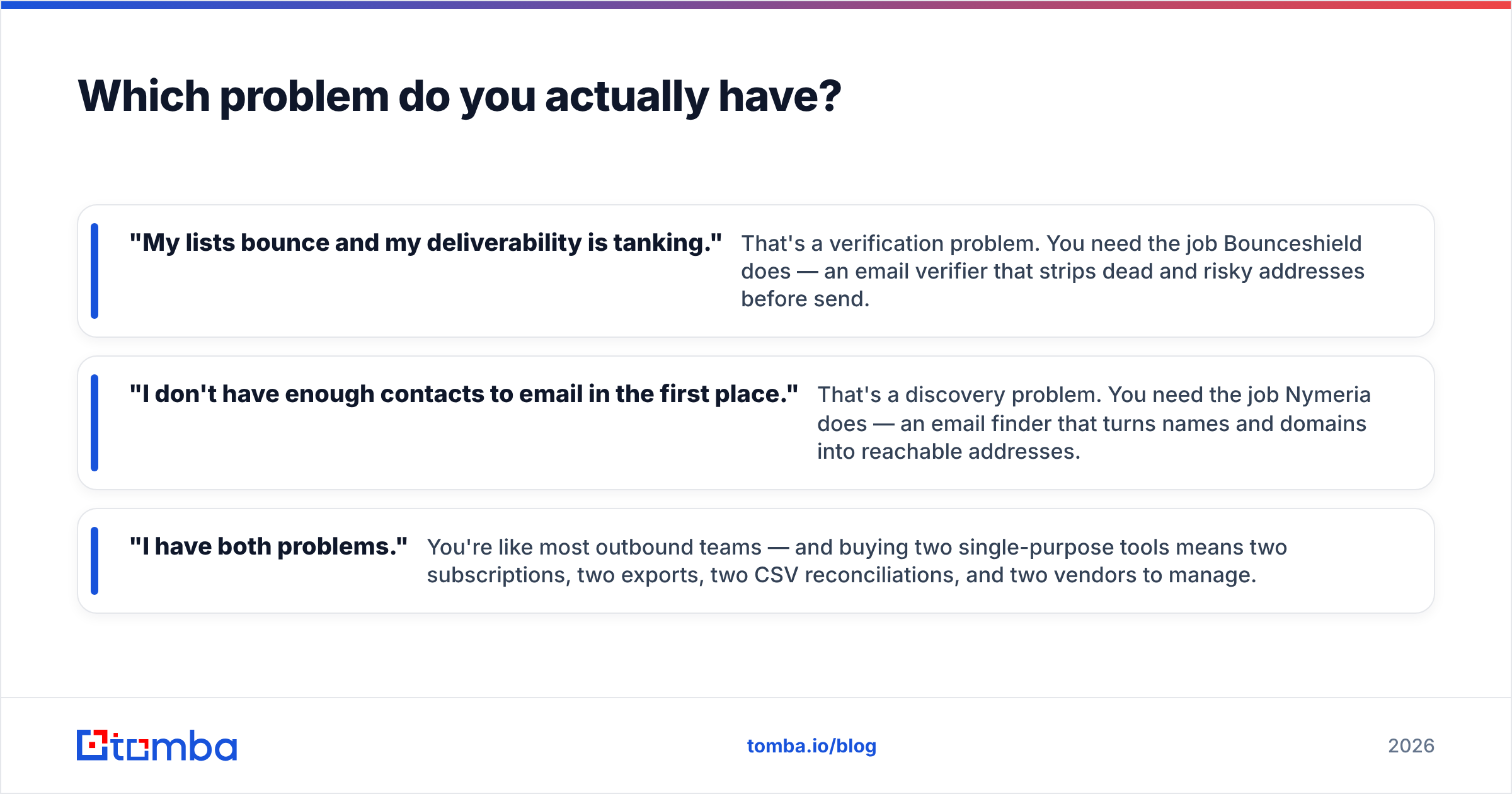
- "My lists bounce and my deliverability is tanking." That's a verification problem. You need the job Bounceshield does — an email verifier that strips dead and risky addresses before send.
- "I don't have enough contacts to email in the first place." That's a discovery problem. You need the job Nymeria does — an email finder that turns names and domains into reachable addresses.
- "I have both problems." You're like most outbound teams — and buying two single-purpose tools means two subscriptions, two exports, two CSV reconciliations, and two vendors to manage.

That third case is where the "Bounceshield vs Nymeria" framing breaks down. You're not really choosing between them — you're choosing whether to assemble a multi-tool pipeline or run a single platform that does both.
How accurate is each tool — and why does it matter?#
Accuracy is the whole ballgame, and it means something different for each tool.
For a verifier like Bounceshield, accuracy means correctly classifying an address as valid, invalid, risky, or catch-all. The expensive failure modes are false "valid" results (you send, it bounces, your reputation drops) and over-aggressive false "invalid" results (you delete a real prospect). Catch-all domains are the hardest case — a plain SMTP check can't confirm a single inbox, so weaker verifiers either guess or punt. A dedicated catch-all verifier handles this with deeper signals.
For a finder like Nymeria, accuracy means the email it returns actually belongs to the person and actually receives mail. Discovery tools draw from crawled data, contributed datasets, and pattern inference. The freshness of that data is what separates a 95%-deliverable list from a 70%-deliverable one. This is also why even great finders should hand off to a verifier before you send at volume — found ≠ verified.
The uncomfortable truth: if you run a finder and a verifier from two different vendors, you're trusting two separate datasets to agree. When the finder and verifier share one data foundation, you get fewer contradictions and a cleaner final list. You can read more about where contact data comes from and why source quality drives everything downstream.
What does Bounceshield vs Nymeria cost in 2026?#
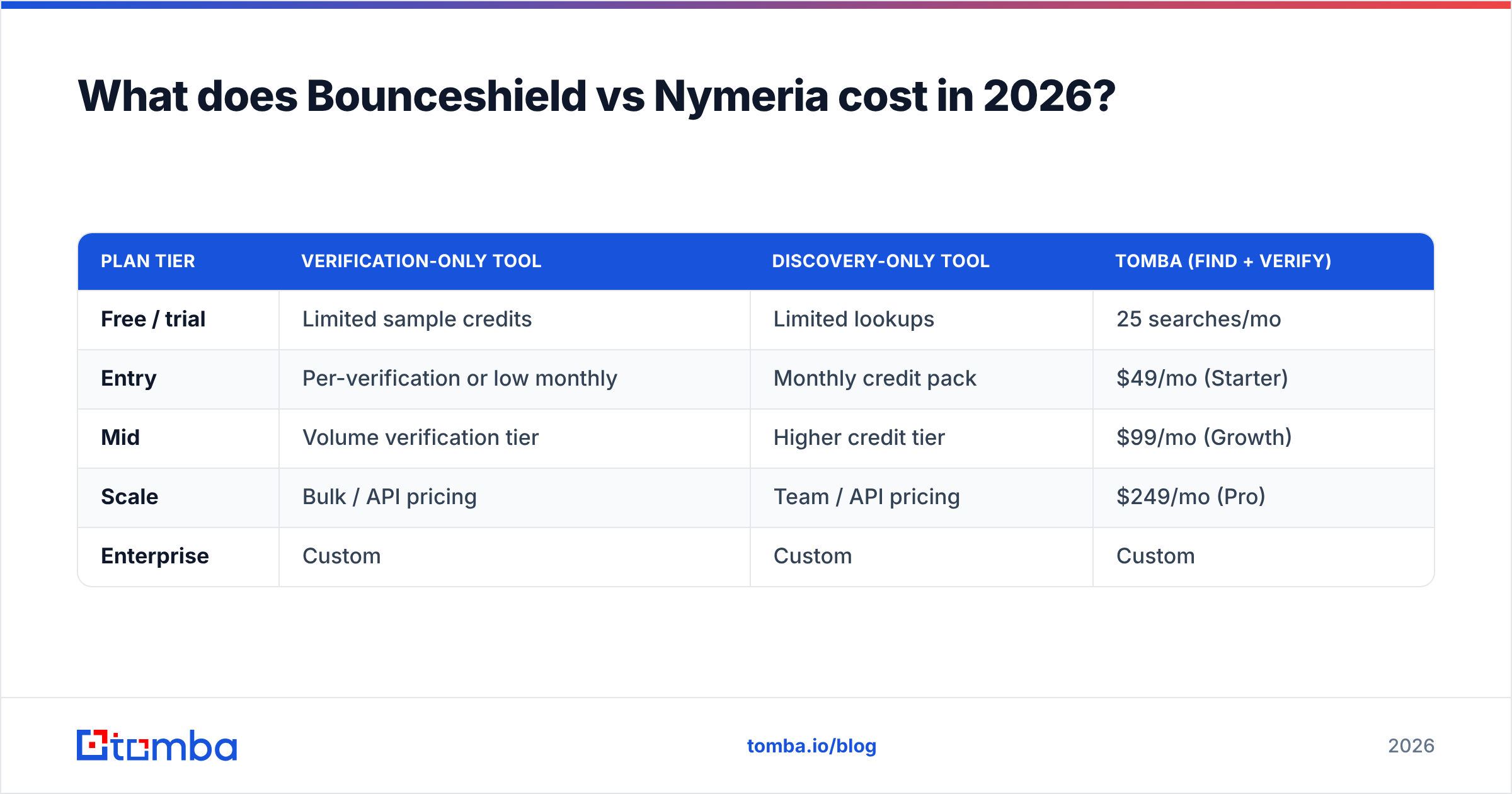
Both tools target individuals and small teams with entry pricing, then scale by volume — verifications for one, lookups/credits for the other. Below is a structure comparison (not a quote), plus where a consolidated platform lands so you can see the all-in-one tradeoff.
| Plan tier | Verification-only tool | Discovery-only tool | Tomba (find + verify) |
|---|---|---|---|
| Free / trial | Limited sample credits | Limited lookups | 25 searches/mo |
| Entry | Per-verification or low monthly | Monthly credit pack | $49/mo (Starter) |
| Mid | Volume verification tier | Higher credit tier | $99/mo (Growth) |
| Scale | Bulk / API pricing | Team / API pricing | $249/mo (Pro) |
| Enterprise | Custom | Custom | Custom |
The math that surprises people: buying a separate finder and a separate verifier often costs more combined than one platform that does both — before you even count the time spent moving data between them. You can see full Tomba pricing for the consolidated option, including the free tier to test accuracy before paying.
A few buying rules regardless of vendor:
- Watch the credit definition. A "credit" for a find vs. a verify vs. an enrich can mean very different things. Read the fine print.
- Test on your own list. Vendor-published accuracy numbers are best-case. Run 100 of your real prospects through a free tier and measure bounces yourself.
- Price the whole workflow. The cheapest finder is not cheap if it feeds a separate verifier you also pay for.
When should you use a finder, a verifier, or both?#
Here's a practical decision frame for your 2026 stack:
- Inbound-heavy team with a CRM full of signups → lead with verification. Your contacts already exist; they just decay. Clean quarterly with a verifier and protect email deliverability.
- Outbound team building cold lists from scratch → lead with discovery, but never skip verification before send. Found addresses bounce more than you'd expect.
- RevOps standardizing a full motion → consolidate. Use one platform's domain search to find contacts by company, verify in the same workflow, and push clean records straight to your CRM via integrations. Fewer tools, fewer handoff errors.
The recurring theme: discovery and verification are two halves of one job. Treating them as a "versus" choice is what leads to half-clean lists and mysterious deliverability dips.
Is there a better alternative to running both tools?#
Yes — and this is the part the "Bounceshield vs Nymeria" question usually misses. Instead of stitching a discovery tool to a verification tool, you can run both functions on a single data foundation.
That's the gap Tomba fills. It finds professional emails by name, domain, or company; verifies them with a built-in email verifier; handles catch-all domains; enriches records with extra firmographic and contact data; and processes everything in bulk when you're working at list scale. One vendor, one dataset, one export — instead of reconciling two.
Independent reviews are a useful sanity check before you commit to any of these tools. Cross-reference user ratings on G2 and Capterra, and read each vendor's own documentation — for example Nymeria's site — so you're comparing current capabilities, not last year's marketing.
The verdict#
Bounceshield and Nymeria aren't really rivals — they're two specialists for two different jobs. Bounceshield keeps your existing list clean so you don't burn your sender reputation. Nymeria goes out and finds the contacts you don't have yet. If you genuinely only have one of those problems, buy the specialist that solves it and move on.
But most B2B teams have both problems, and that's where two single-purpose subscriptions start to feel like overhead. Finding contacts you can't verify wastes spend; verifying a list you can't grow stalls pipeline. The cleaner play in 2026 is a platform that does the whole loop — find, verify, enrich — without you playing data courier between tools.
If that's you, start with the Tomba Email Finder. Use the free tier to run your real prospects through both the finder and the verifier, measure the bounce rate yourself, and decide based on your numbers — not a vendor's. It's the fastest way to replace a two-tool pipeline with one workflow that actually talks to itself.
// get started
Find, verify and enrich your first contacts today
Start on the free plan with 25 searches a month, then scale when your team is ready.
Free plan · No credit card required · GDPR & CCPA
// about the author