Bounceshield vs Salesbot: Which Tool Wins in 2026?
Bounceshield protects your sender reputation while Salesbot automates outreach at scale. Here is an honest, side-by-side breakdown of which one your team actually needs in 2026.
You typed "Bounceshield vs Salesbot" into Google because two vendors are circling your budget and you only have room for one. Here is the short version: they are not actually competitors. Bounceshield vs Salesbot is a comparison between a deliverability-and-verification layer and a sales-automation engine — and most teams that pick wrong do so because they treat them as interchangeable. They are not.
This breakdown shows you what each tool really does, where they overlap, where they don't, and the cheaper foundation that makes either one worth paying for.
TL;DR#
- Bounceshield is a bounce-prevention and email-verification tool. Its job is to keep bad addresses out of your sends so your sender reputation survives.
- Salesbot is an outreach-automation platform. Its job is to send sequences, follow up, and book meetings at volume.
- They solve different problems. Buying Salesbot without clean data just helps you bounce faster.
- If you can only afford one first, fix your data quality — verification and accurate contacts — before you scale automation.
- Tomba sits underneath both: it finds and verifies the contacts that feed whatever sending tool you choose.
What is Bounceshield and what does it actually do?#
Bounceshield is positioned as a deliverability guardrail. Before an email ever leaves your outbox, it checks the address against SMTP responses, syntax rules, MX records, and known spam-trap patterns, then flags anything risky. Think of it like a bouncer at a club door: it does not throw the party, it just stops the people who will cause trouble from getting in.
The core features usually marketed under a Bounceshield-style product are:
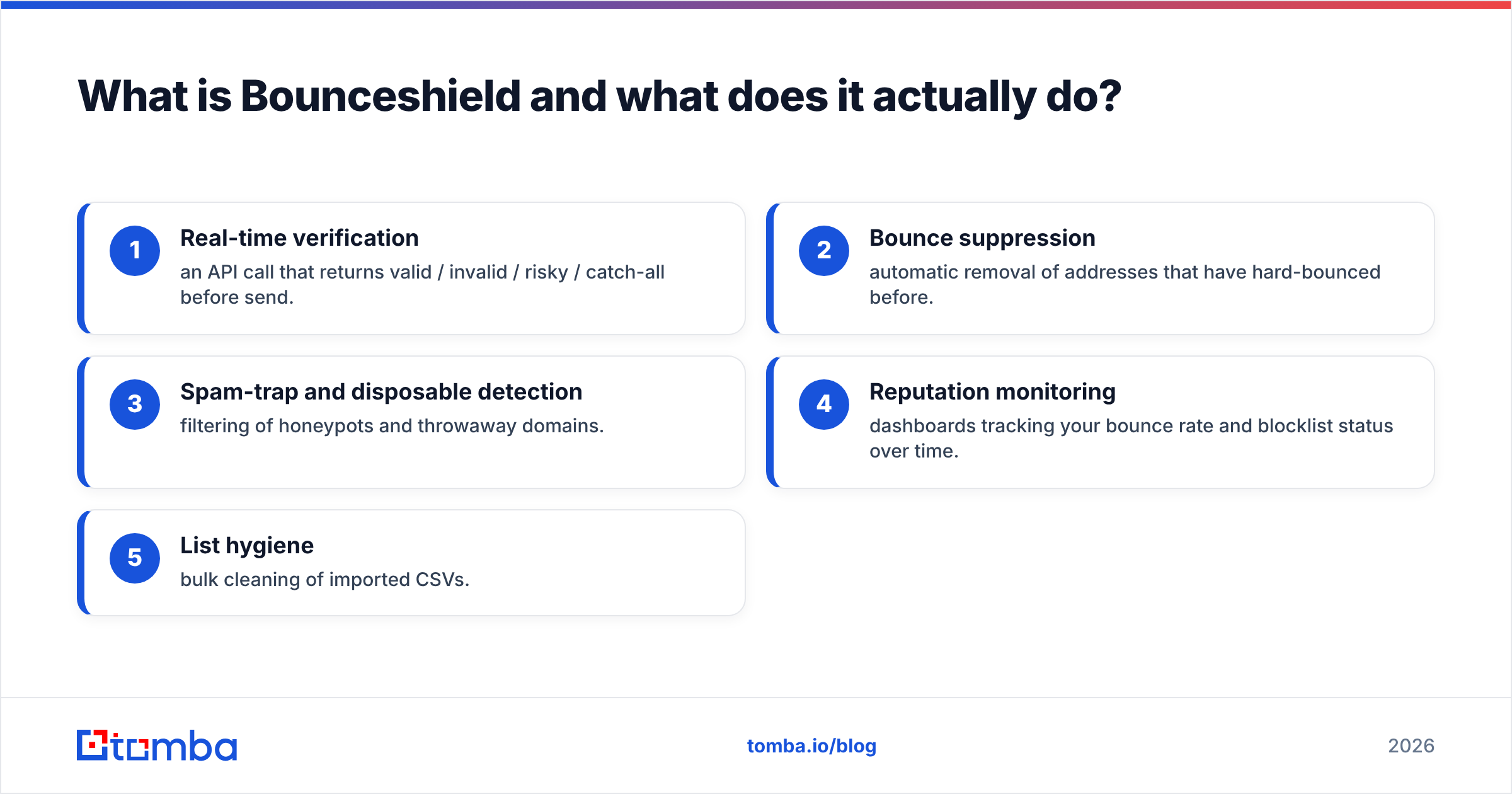
- Real-time verification — an API call that returns valid / invalid / risky / catch-all before send.
- Bounce suppression — automatic removal of addresses that have hard-bounced before.
- Spam-trap and disposable detection — filtering of honeypots and throwaway domains.
- Reputation monitoring — dashboards tracking your bounce rate and blocklist status over time.
- List hygiene — bulk cleaning of imported CSVs.
What it does not do: find new contacts, write copy, or send sequences. It is a defensive layer. That is the whole point — and a good email verifier is exactly this kind of layer, baked in rather than bolted on.
)
What is Salesbot and where does it win?#
Salesbot is an offensive tool. It assumes you already have a list of people worth contacting and its job is to contact them efficiently — multi-step sequences, automatic follow-ups, A/B-tested subject lines, inbox rotation, and reply detection that pulls hot leads out of the queue.
Where Salesbot wins:
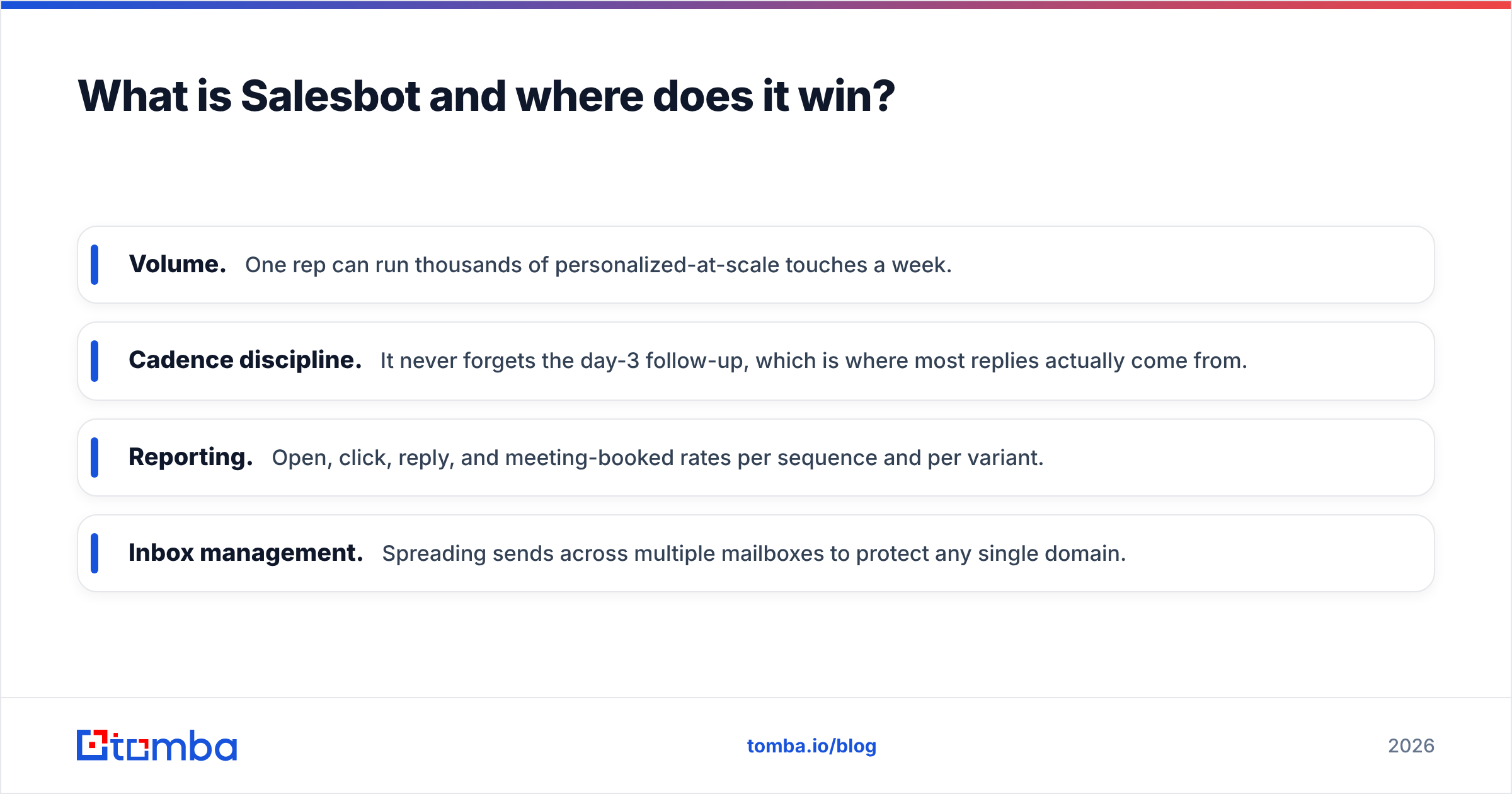
- Volume. One rep can run thousands of personalized-at-scale touches a week.
- Cadence discipline. It never forgets the day-3 follow-up, which is where most replies actually come from.
- Reporting. Open, click, reply, and meeting-booked rates per sequence and per variant.
- Inbox management. Spreading sends across multiple mailboxes to protect any single domain.
But Salesbot has a hard dependency: it is only as good as the addresses you load into it. Feed it a dirty list and it will cheerfully blast spam traps until your domain lands on a blocklist. Automation amplifies whatever you give it — including garbage. According to HubSpot's research on email engagement, deliverability and list quality remain the single biggest lever on outbound performance, ahead of copy or timing.
Bounceshield vs Salesbot: the side-by-side comparison#
Here is the honest feature-by-feature view. Pricing figures below are representative tiers for this category, not official quotes — confirm current numbers on each vendor's own site.
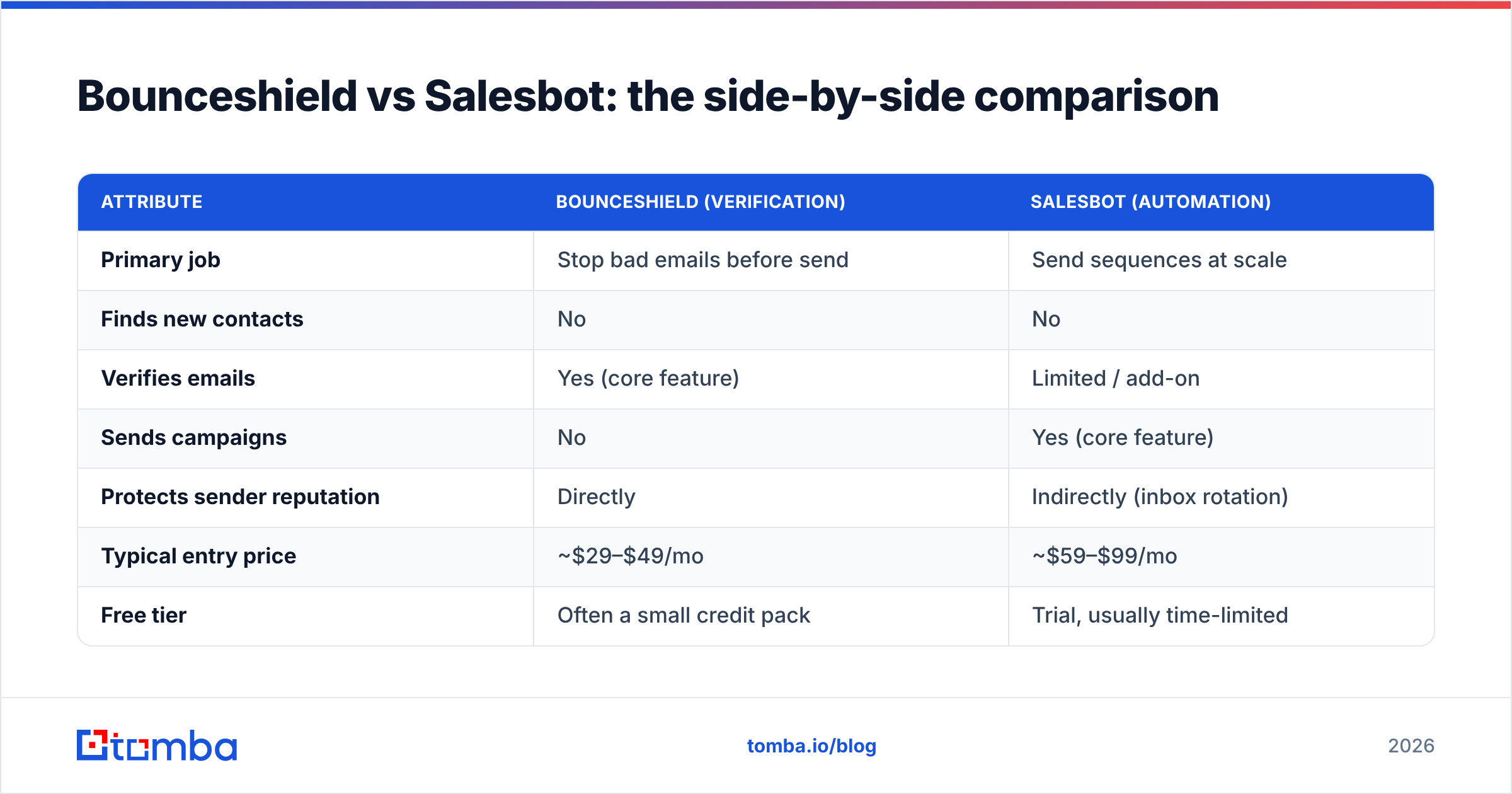
| Attribute | Bounceshield (verification) | Salesbot (automation) |
|---|---|---|
| Primary job | Stop bad emails before send | Send sequences at scale |
| Finds new contacts | No | No |
| Verifies emails | Yes (core feature) | Limited / add-on |
| Sends campaigns | No | Yes (core feature) |
| Protects sender reputation | Directly | Indirectly (inbox rotation) |
| Typical entry price | ~$29–$49/mo | ~$59–$99/mo |
| Free tier | Often a small credit pack | Trial, usually time-limited |
| Best for | Teams with bounce problems | Teams with clean lists and volume goals |
| Risk if used alone | Clean list, nobody contacted | Fast bounces, blocklist risk |
The table makes the real takeaway obvious: these tools are complements, not substitutes. A verification layer with no sender is a clean list nobody emails. A sender with no verification layer is a fast track to a damaged domain.
Is Bounceshield better than Salesbot for cold outreach?#
Neither is "better" — they answer different questions. Ask yourself which failure you are experiencing right now:
- Your bounce rate is above 3% and opens are dropping. That is a data problem. A Bounceshield-style verifier is the urgent buy. Mailbox providers read high bounce rates as a spammer signal, and once your sender reputation drops, even your good emails go to spam.
- Your bounce rate is healthy but you only touch 40 prospects a week by hand. That is a throughput problem. Salesbot is the urgent buy.
The trap is buying the offensive tool to fix a defensive problem. Plenty of teams sign up for automation, watch their reply rates crater, and blame the copy — when the real issue is that 18% of their list never existed. Verify first, automate second.
Where does contact data fit into Bounceshield vs Salesbot?#
This is the part both vendors quietly assume you have already solved: the contacts themselves. Bounceshield verifies addresses you already possess. Salesbot emails addresses you already possess. Neither one generates the list.
That is the gap a dedicated finder fills. With an email finder you start from a name and a company domain and get a verified professional address — so the data entering your stack is clean from the first step instead of being scrubbed after the damage is done.
The healthiest outbound stack looks like this:
- Find — pull verified contacts by company with domain search or enrich a list of names.
- Verify — confirm each address is deliverable, including tricky catch-all verification on domains that accept everything.
- Send — load the clean, verified list into your automation tool of choice.
Do those in order and the Bounceshield-vs-Salesbot question gets smaller, because most of what Bounceshield protects against never enters your pipeline to begin with.
)
How much do Bounceshield and Salesbot cost in 2026?#
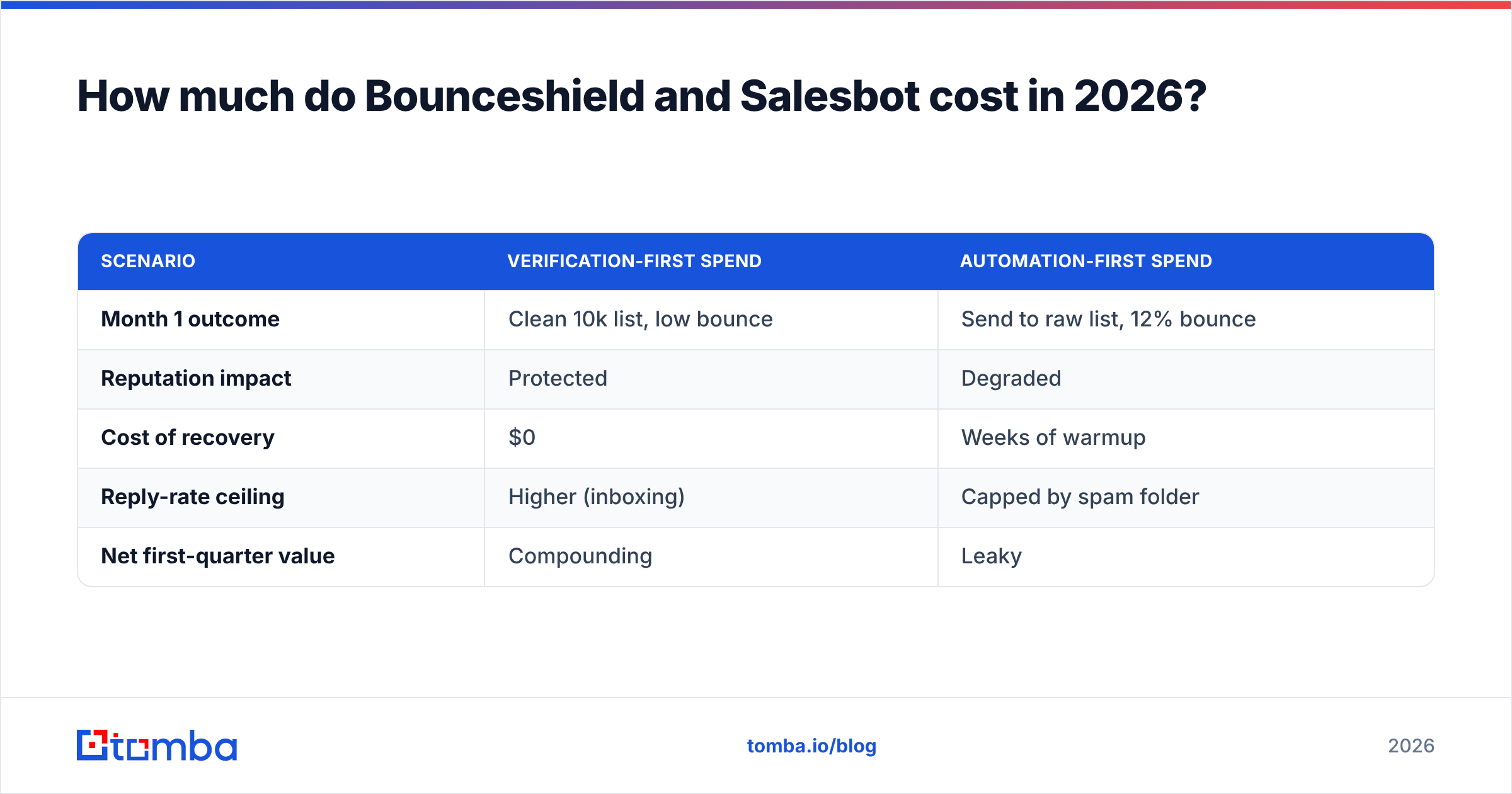
Pricing in this category is moving toward credit-based and seat-based hybrids. Verification tools generally bill per address checked; automation tools bill per seat or per active mailbox. Here is how the value math tends to shake out for a small team.
| Scenario | Verification-first spend | Automation-first spend |
|---|---|---|
| Month 1 outcome | Clean 10k list, low bounce | Send to raw list, 12% bounce |
| Reputation impact | Protected | Degraded |
| Cost of recovery | $0 | Weeks of warmup |
| Reply-rate ceiling | Higher (inboxing) | Capped by spam folder |
| Net first-quarter value | Compounding | Leaky |
If you are comparing total cost of ownership, factor in the hidden cost of a damaged domain. A blocklisted sending domain can take weeks to rehabilitate, and during that time your automation spend is pure waste. That is why most experienced operators treat verification as non-negotiable and automation as the thing you scale after the data is trustworthy. You can see how a verification-plus-finder stack is priced on the Tomba pricing page, which starts free at 25 searches a month and moves to a $49/mo Starter plan.
For independent feature breakdowns of both categories, G2's grid reports are a useful neutral reference before you commit — they separate verification vendors from sending platforms so you are not comparing two different jobs as if they were one.
Bounceshield vs Salesbot: which should you buy first?#
Buy in this order, and revisit as you scale:
- If your list is dirty or unknown quality: verification first. A Bounceshield-style layer — or a finder with verification built in — pays for itself the moment it saves your domain from one bad campaign.
- If your list is already clean and small: automation first. Salesbot turns 40 manual touches into 4,000 disciplined ones.
- If you have neither contacts nor a sender: start with the finder. You cannot verify or automate addresses you do not have yet.
The mistake to avoid is buying both, loading raw scraped data, and wondering why deliverability is terrible. Tools do not fix process. Clean data does.
What is the verdict on Bounceshield vs Salesbot?#
Bounceshield and Salesbot are not rivals — they are two stages of the same pipeline. Bounceshield keeps you out of the spam folder; Salesbot gets you into the inbox at volume. Run them together and they reinforce each other. Run either one on bad data and you waste both.
But the stage upstream of both — finding and verifying the contacts in the first place — is where the real leverage is. Get accurate, deliverable addresses into your stack from the start and you spend less on cleanup, protect your reputation by default, and give your automation a list worth sending to.
That is exactly what the Tomba Email Finder is built for: find professional email addresses by domain, name, or company, with verification baked in so the contacts you hand to Bounceshield or Salesbot are already clean. Start free with 25 searches a month, scale to the $49/mo Starter plan when outreach picks up, and stop paying other tools to clean up data that should have been accurate from the first search. Your sender reputation — and your reply rate — will thank you.
// get started
Find, verify and enrich your first contacts today
Start on the free plan with 25 searches a month, then scale when your team is ready.
Free plan · No credit card required · GDPR & CCPA
// about the author