Bounceshield vs Saleshandy 2026: Deliverability Compared
Bounceshield verifies and protects your list; Saleshandy finds, verifies, and sends. Here's which tool actually fits your cold email stack in 2026 — and where a dedicated verifier beats both.
Bounceshield vs Saleshandy: Which Protects Your Cold Email in 2026?
You found these two tools on the same shortlist for a simple reason: both promise fewer bounces and better inbox placement. But they solve different halves of the problem. Picking the wrong one means you either pay for a sending platform you don't need or bolt verification onto a workflow that was supposed to handle it for you.
TL;DR
- Bounceshield is a focused email verification and bounce-protection layer. Its job is to scrub lists and stop bad sends before they hurt your reputation.
- Saleshandy is a full cold email sending platform — sequences, multi-inbox rotation, a built-in lead finder, and verification baked in. It does more, but verification is one feature among many.
- If you only need clean lists, a dedicated verifier (Bounceshield, or a higher-accuracy alternative) wins on price and precision.
- If you need to find, verify, and send from one dashboard, Saleshandy is the broader fit — though its native verification is rarely best-in-class.
- The smartest stack in 2026 separates concerns: find and verify with a specialist, then send with a sequencer.
What is Bounceshield?#
Bounceshield is an email verification and deliverability-protection tool. Think of it as the bouncer at the door of your email list — it checks every address before it's allowed onto a campaign, rejecting fakes, typos, role accounts, and spam traps that would otherwise trigger a hard bounce.
Its core jobs are narrow and deep:
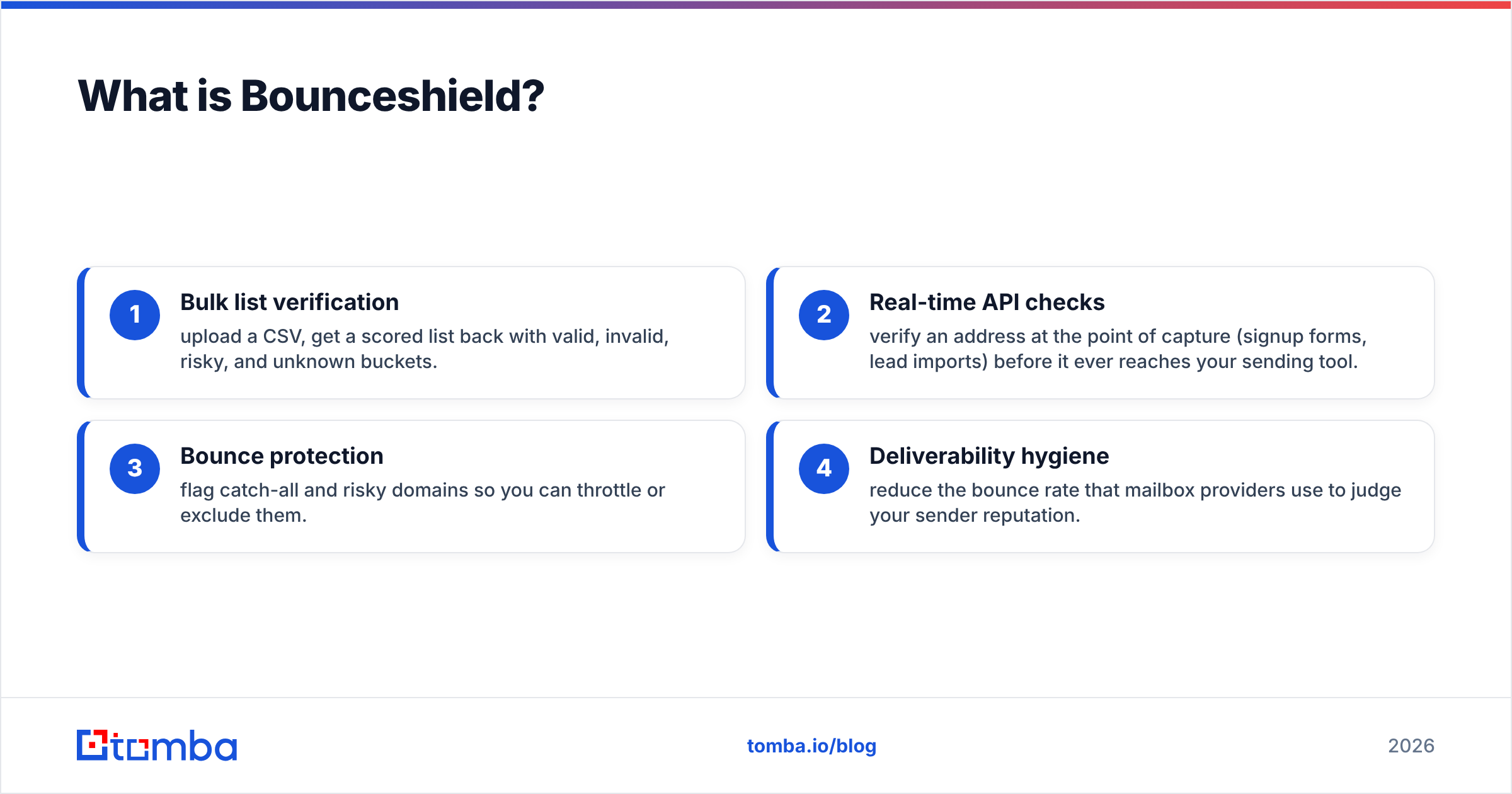
- Bulk list verification — upload a CSV, get a scored list back with valid, invalid, risky, and unknown buckets.
- Real-time API checks — verify an address at the point of capture (signup forms, lead imports) before it ever reaches your sending tool.
- Bounce protection — flag catch-all and risky domains so you can throttle or exclude them.
- Deliverability hygiene — reduce the bounce rate that mailbox providers use to judge your sender reputation.
What Bounceshield deliberately does not do: it won't find new prospects, write sequences, rotate inboxes, or send a single email. It's a hygiene layer, not an outreach engine.
)
What is Saleshandy?#
Saleshandy is a cold email outreach platform built to run sequences at scale. Where Bounceshield is one job done well, Saleshandy is a suite: it finds leads, verifies them, schedules multi-step sequences, rotates across multiple sending inboxes, and reports on replies and opens.
The platform's pillars:
- Lead Finder — a B2B contact database to source prospect emails directly inside the tool.
- Email verification — a native step that scrubs your list before a sequence sends.
- Sequences & automation — multi-step, multi-day cadences with conditional follow-ups.
- Inbox rotation & warmup — spread volume across many mailboxes to protect email deliverability.
- Unified analytics — opens, clicks, replies, and bounce tracking in one place.
In short, Saleshandy wants to be the whole cockpit. Verification is a gauge on the dashboard, not the engine. If you're evaluating it against Bounceshield, you're really asking: do I need a scalpel or a Swiss Army knife?
How do Bounceshield and Saleshandy compare head to head?#
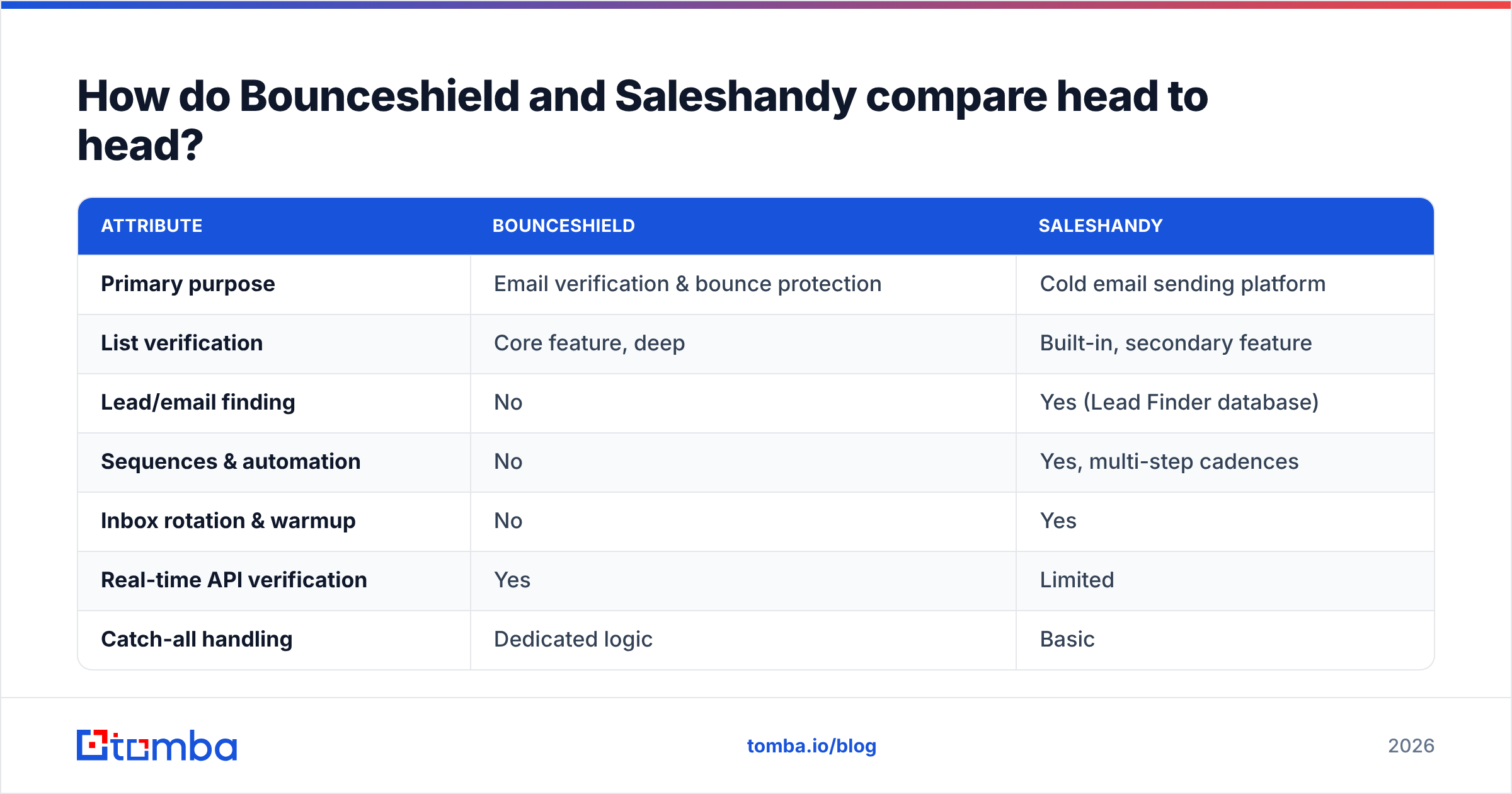
The cleanest way to see the difference is to line up what each tool actually delivers. One is a verification specialist; the other is a sending platform that happens to include verification.
| Attribute | Bounceshield | Saleshandy |
|---|---|---|
| Primary purpose | Email verification & bounce protection | Cold email sending platform |
| List verification | Core feature, deep | Built-in, secondary feature |
| Lead/email finding | No | Yes (Lead Finder database) |
| Sequences & automation | No | Yes, multi-step cadences |
| Inbox rotation & warmup | No | Yes |
| Real-time API verification | Yes | Limited |
| Catch-all handling | Dedicated logic | Basic |
| Best for | Cleaning lists before any send | End-to-end outreach in one tool |
| Pricing model | Per-verification credits | Per-seat / per-slot plans |
The takeaway: these tools overlap on exactly one row — verification — and diverge everywhere else. If verification is your only gap, paying for a full sending platform is overkill. If you have no outreach stack at all, a standalone verifier leaves you needing four more tools.
Where each one genuinely wins#
- Bounceshield wins when your sending and sequencing are already handled (by Instantly, Smartlead, HubSpot, or your CRM) and you just need a precise, affordable scrubbing layer in front of them.
- Saleshandy wins when you're starting from zero and want sourcing, verification, and sending under one login — and you're willing to accept "good enough" verification as part of the bundle.
- Neither wins on raw verification accuracy against a dedicated, multi-source verifier — which is the gap most teams underestimate.
Is Bounceshield more accurate than Saleshandy at verification?#
Generally, a dedicated verifier like Bounceshield will out-resolve a bundled one like Saleshandy's — but the more important question is whether either is accurate enough for your bounce tolerance.
Verification accuracy isn't a single number. It breaks down into how a tool handles the hard cases:
- Catch-all domains — servers that accept every address at the SMTP layer, then bounce silently later. A weak verifier marks these "valid"; a strong one flags them "risky" and tells you the real deliverability odds. Tomba's catch-all verifier is built specifically for this failure mode.
- Spam traps & disposable addresses — recycled or honeypot addresses that tank your reputation. Specialist verifiers maintain trap databases; bundled tools often don't.
- Role accounts — info@, sales@, support@ — technically valid but low-engagement and complaint-prone.
- Greylisting and temporary failures — addresses that return "unknown" on first check and need a retry to resolve.
Bundled verification inside a sending platform tends to optimize for speed (so it doesn't slow your send), not depth. That's the trade-off you accept with Saleshandy. A focused tool — whether Bounceshield or a higher-accuracy email verifier — spends more compute per address and resolves more of the "unknown" bucket into confident verdicts.
If your bounce rate is creeping above 2-3%, that "unknown" bucket is where your problem usually hides.
What does each tool cost in 2026?#
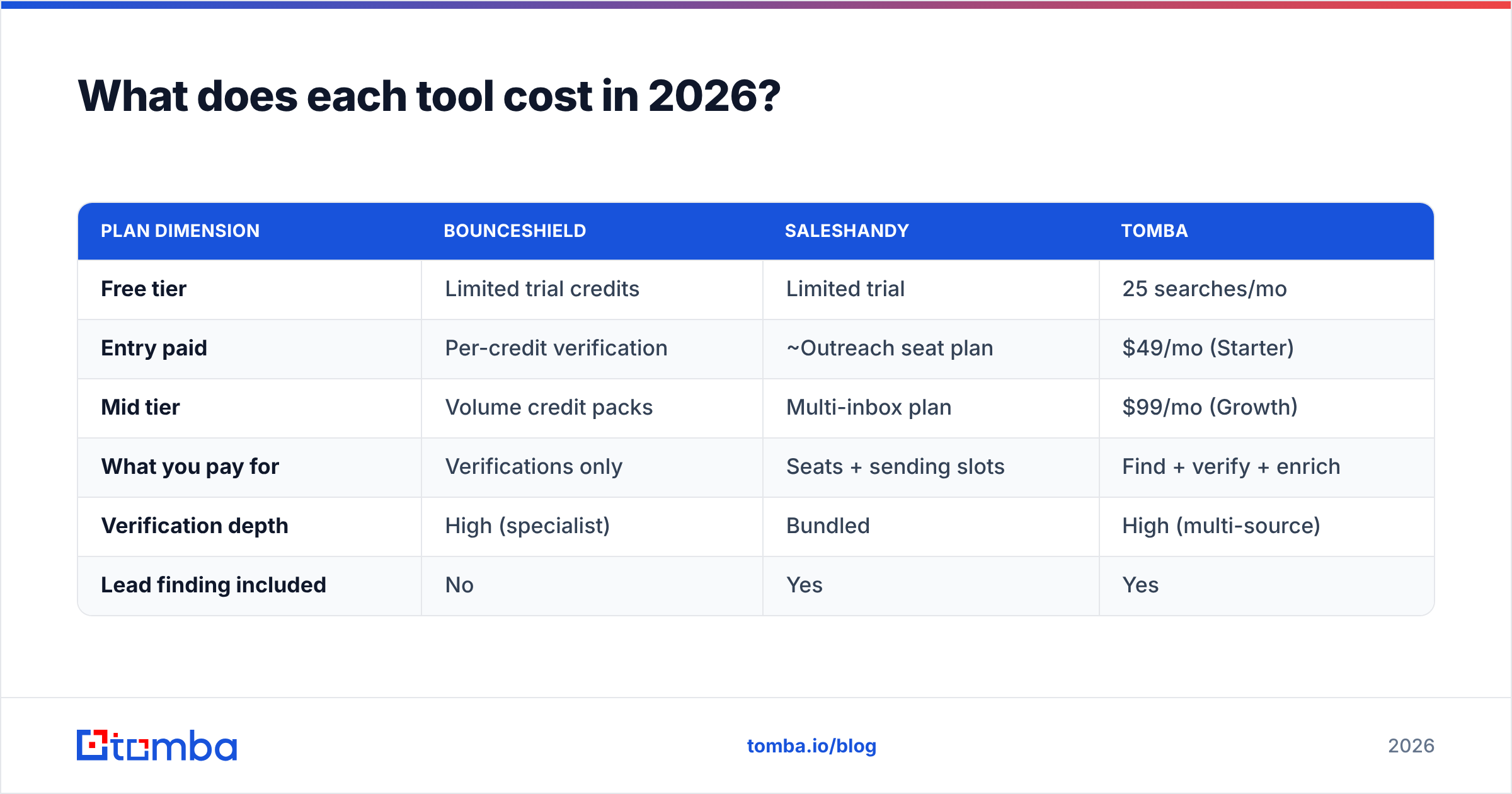
Pricing reflects the two different shapes. Bounceshield sells verification credits; Saleshandy sells outreach seats and sending slots. Comparing them dollar-for-dollar is apples to oranges — you have to weigh the whole job-to-be-done.
| Plan dimension | Bounceshield | Saleshandy | Tomba |
|---|---|---|---|
| Free tier | Limited trial credits | Limited trial | 25 searches/mo |
| Entry paid | Per-credit verification | ~Outreach seat plan | $49/mo (Starter) |
| Mid tier | Volume credit packs | Multi-inbox plan | $99/mo (Growth) |
| What you pay for | Verifications only | Seats + sending slots | Find + verify + enrich |
| Verification depth | High (specialist) | Bundled | High (multi-source) |
| Lead finding included | No | Yes | Yes |
A few honest notes:
- Vendor pricing changes often. Confirm current numbers on the Saleshandy site and Bounceshield's own page before you commit — don't trust a comparison post (including this one) as a live price sheet.
- If you only verify occasionally, a credit-based verifier is cheaper than a monthly seat.
- If you send daily across many inboxes, a platform's per-slot pricing can be more economical than stitching point tools together.
- For teams that want sourcing and verification without a full sending platform, a find-plus-verify tool covers more of the workflow per dollar. See Tomba pricing for that middle path.
)
Which tool fits your workflow?#
Match the tool to the gap you actually have, not the feature list that looks most impressive. Here's the decision in plain terms.
Choose Bounceshield if:
- Your sending/sequencing tool is already chosen and you're happy with it.
- Your only recurring pain is bounces and list hygiene.
- You want real-time API verification at the point of lead capture.
- You'd rather pay per verification than per seat.
Choose Saleshandy if:
- You have no outreach stack and want one tool to find, verify, and send.
- You run multi-step sequences across several inboxes.
- You value a single dashboard over best-in-class accuracy on any one feature.
- Your team is small enough that consolidation beats specialization.
Choose a dedicated finder + verifier (the third path) if:
- You source new prospects regularly and need accurate emails and clean verification.
- You want to feed verified contacts into whatever sender you already use.
- You care about catch-all resolution and multi-source data confidence.
That third path is where many teams land in 2026. A bulk email finder plus verification feeds your existing sequencer with contacts that are both real and reachable — without paying for an entire second sending platform you'd only half-use.
How do you build a deliverability-safe stack around these tools?#
The best stack treats finding, verifying, and sending as three jobs and assigns each to the tool that does it best. Bolting everything onto one platform is convenient until one weak link drags your whole bounce rate down.
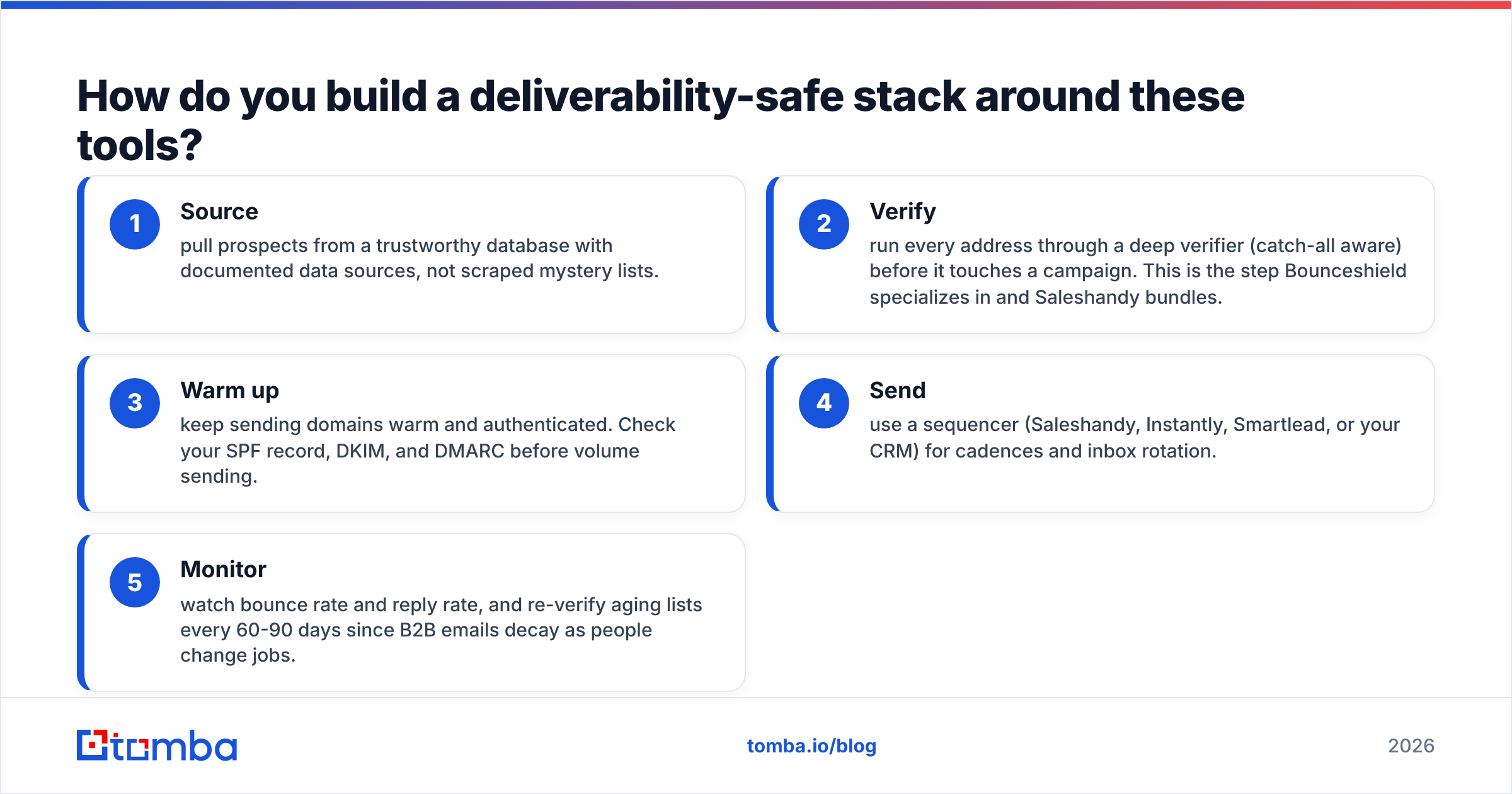
A reliable 2026 setup looks like this:
- Source — pull prospects from a trustworthy database with documented data sources, not scraped mystery lists.
- Verify — run every address through a deep verifier (catch-all aware) before it touches a campaign. This is the step Bounceshield specializes in and Saleshandy bundles.
- Warm up — keep sending domains warm and authenticated. Check your SPF record, DKIM, and DMARC before volume sending.
- Send — use a sequencer (Saleshandy, Instantly, Smartlead, or your CRM) for cadences and inbox rotation.
- Monitor — watch bounce rate and reply rate, and re-verify aging lists every 60-90 days since B2B emails decay as people change jobs.
The lesson from comparing Bounceshield and Saleshandy is that neither alone is a complete answer for a serious outbound team. Bounceshield nails step 2 but ignores 1 and 4. Saleshandy covers 1, 2, and 4 but compromises on the depth of step 2. The strongest teams keep verification specialized and sending separate.
For independent benchmarks on how these categories of tools score with real users, G2's email verification and sales engagement grids are a useful sanity check before you trust any vendor's own claims.
So, Bounceshield or Saleshandy?#
Conclusion first: pick Bounceshield if verification is your only gap, Saleshandy if you need an all-in-one sender, and a dedicated finder-plus-verifier if you source new prospects often. They're not really competitors — they're tools for different stages of the same pipeline, and the "versus" framing hides that one team frequently needs more than one of them.
The mistake to avoid is assuming a bundled verification feature inside a sending platform will protect your reputation as well as a specialist. It usually won't, and the cost of that gap — spam folder placement, blacklisting, a torched domain — dwarfs the price difference.
If your real bottleneck is finding accurate, verified contacts to feed whatever you send with, start at the source. The Tomba Email Finder locates professional emails by name, domain, or company and pairs with built-in verification and data enrichment, so the contacts entering your sequences are real before Bounceshield or Saleshandy ever sees them. Spin up the free tier (25 searches a month), test the accuracy against your own domain list, and decide where the specialist beats the bundle.
// get started
Find, verify and enrich your first contacts today
Start on the free plan with 25 searches a month, then scale when your team is ready.
Free plan · No credit card required · GDPR & CCPA
// about the author