Bounceshield vs Tomba 2026: Email Finder & Verifier Compared
Bounceshield protects your sends from bounces, but Tomba finds and verifies the emails in the first place. Here's the honest 2026 breakdown of where each tool wins.
You found two tools with overlapping pitches and you need to know which one actually solves your problem. Bounceshield and Tomba both touch email quality, but they sit at opposite ends of the pipeline. Picking the wrong one means paying for a feature you don't need while the gap you actually have stays open.
This is a straight comparison: what each tool does, where it wins, what it costs, and which workflow fits your team.
TL;DR — Bounceshield vs Tomba at a glance#
- Bounceshield is bounce-protection and list-hygiene focused — it screens addresses to stop hard bounces before you hit send. It assumes you already have the emails.
- Tomba is a full email-finder and verification platform — it discovers professional addresses by name or domain, then verifies them, so you build the list and clean it in one place.
- If you already own a clean list and only fear bounces, a verification-only tool covers you. If you need to source new contacts at all, Tomba removes a separate step.
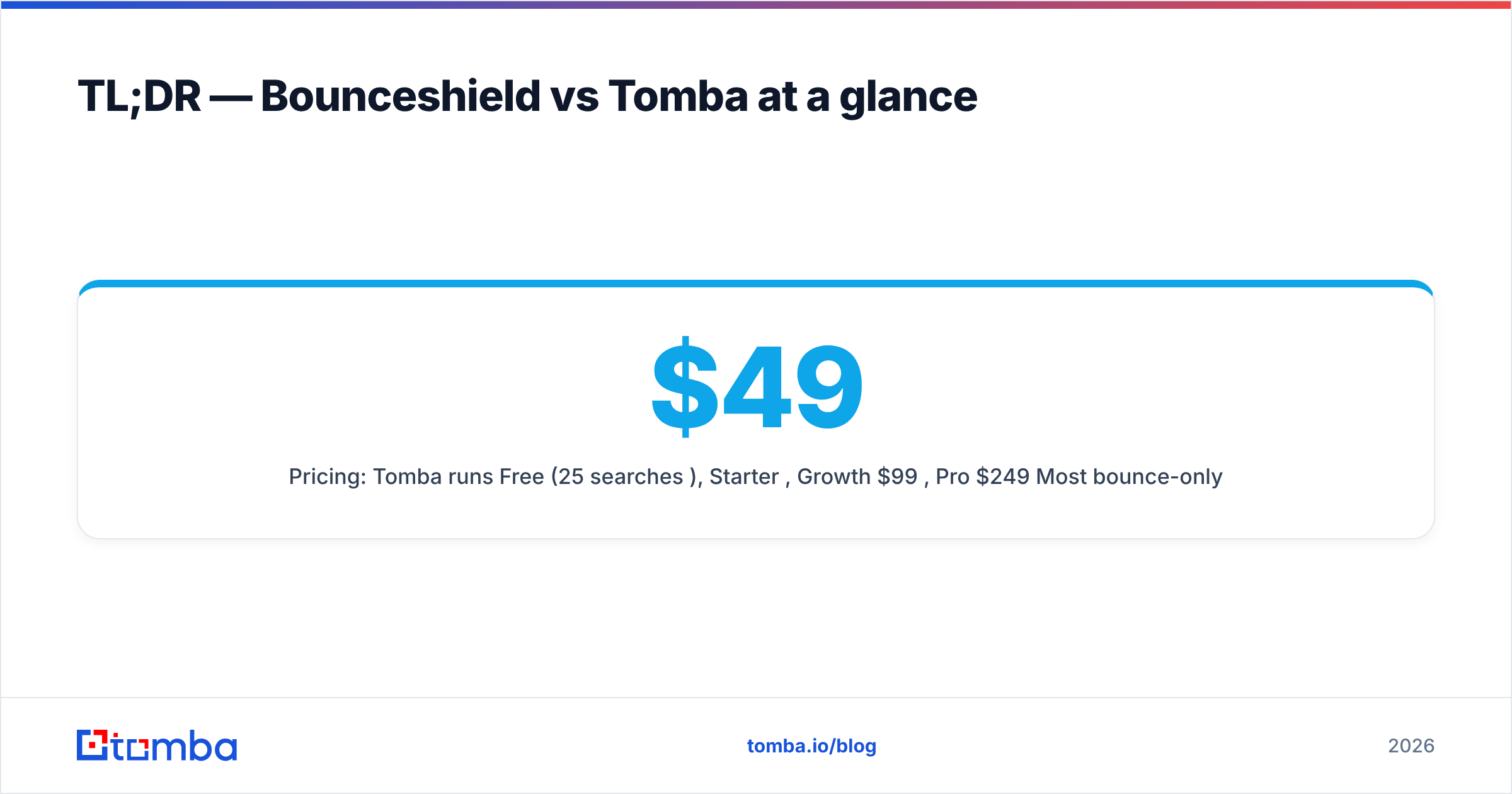
- Pricing: Tomba runs Free (25 searches/mo), Starter $49/mo, Growth $99/mo, Pro $249/mo. Most bounce-only verifiers price per-credit on volume.
- Bottom line: verification is one feature inside Tomba, not the whole product — so for most outbound teams Tomba is the broader buy.
What is Bounceshield?#
Bounceshield is an email verification and bounce-prevention service. Its job is hygiene: you bring a list of addresses, it pings each one and tells you which are deliverable, which are risky, and which will hard-bounce. The value proposition is protecting your sender reputation by keeping invalid addresses out of your campaigns.
That matters. A high bounce rate signals mailbox providers that you're not maintaining your list, and that drags down inbox placement for everyone on your domain. Tools in this category exist because one bad import can tank a warmed-up domain.
But notice the assumption baked in: you already have the emails. Bounce protection starts after sourcing is done. If your real bottleneck is finding the right contact at a target account, a verifier doesn't help you — it just grades what you already collected.

What is Tomba?#
Tomba is a B2B email finder and lead-enrichment platform. You give it a name and a company, or just a domain, and it returns the professional email address — then verifies it before handing it over. Verification isn't a separate purchase; it's wired into the same flow.
Around the core finder sit related tools: domain search to pull every public address at a company, an email verifier for lists you already own, a catch-all verifier for the domains that accept everything, plus phone finding and data enrichment. The point is that the whole top-of-funnel — discover, verify, enrich — happens under one roof and one API.
So the honest framing is this: Tomba and Bounceshield aren't really the same product. Bounceshield is a hygiene layer. Tomba is the layer that creates the list, with hygiene built in.
How does the verification differ between Bounceshield and Tomba?#
Both tools verify, but the scope is different.
A dedicated verifier like Bounceshield typically runs the standard checks: syntax validation, MX-record lookup, SMTP handshake, and disposable/role-account flags. That's solid and it's what you want from a hygiene pass.
Tomba runs those same checks, but because it also found the address, it has more context to score confidence — the source pattern, how many places confirm the format, and whether the domain is catch-all. For catch-all domains (where the server accepts any address and SMTP checks come back inconclusive) you need a catch-all verifier with its own logic, because a plain SMTP ping can't separate real mailboxes from accept-all noise. This is the case where verify-only tools most often return "unknown" and leave you guessing.

The practical effect: with a verifier, accuracy is only as good as the list you feed it. With Tomba, accuracy is managed end to end, so fewer bad addresses get into your list in the first place. Garbage in, garbage out still applies — and a verifier can only sort the garbage, not replace it.
Bounceshield vs Tomba: feature and pricing comparison#
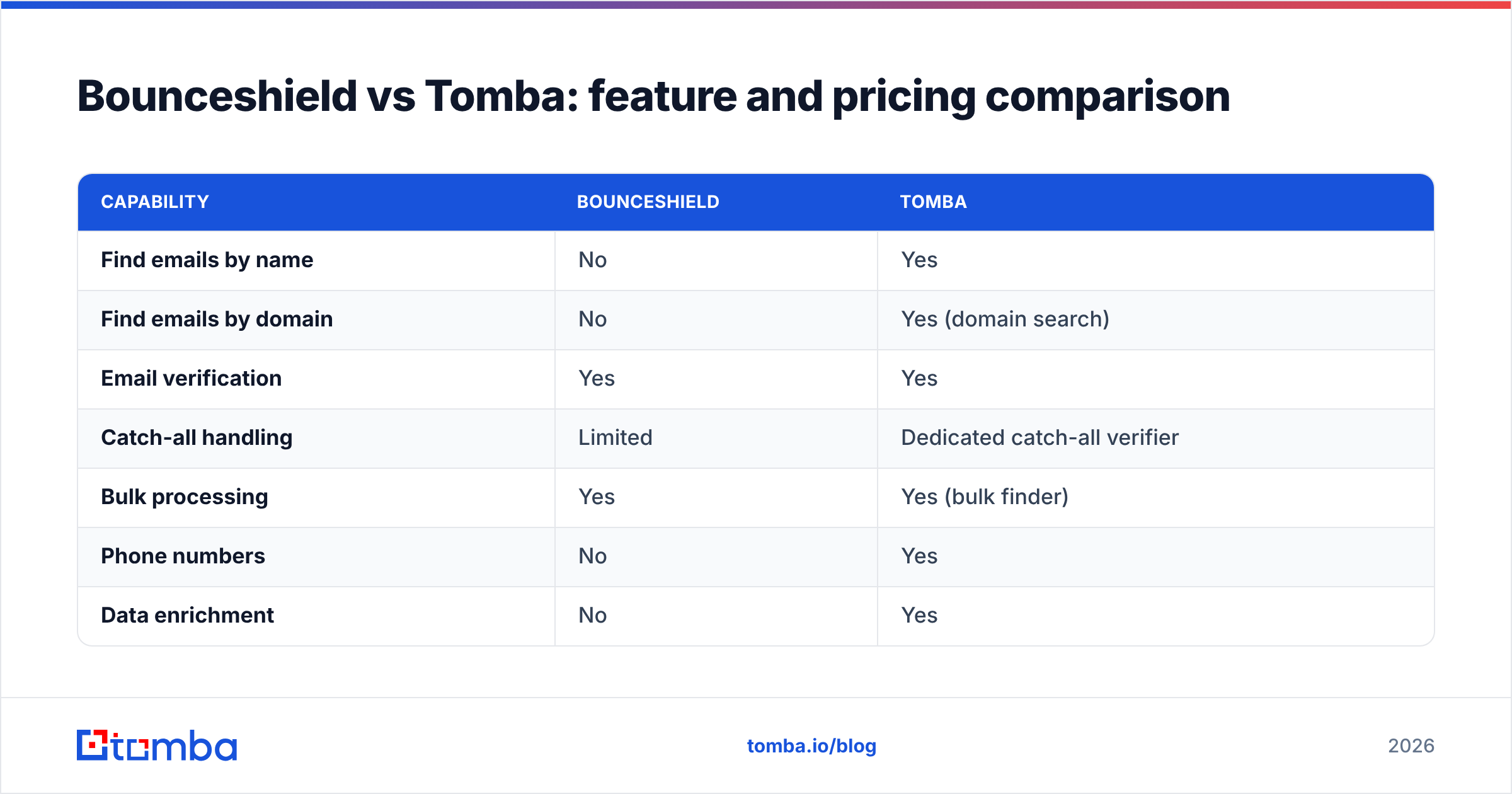
Here's the side-by-side. Note where the rows simply don't apply — that's the real story of this comparison.
| Capability | Bounceshield | Tomba |
|---|---|---|
| Find emails by name | No | Yes |
| Find emails by domain | No | Yes (domain search) |
| Email verification | Yes | Yes |
| Catch-all handling | Limited | Dedicated catch-all verifier |
| Bulk processing | Yes | Yes (bulk finder) |
| Phone numbers | No | Yes |
| Data enrichment | No | Yes |
| API access | Verification only | Full find + verify + enrich |
| Free tier | Limited trial | 25 searches/mo |
| Entry paid price | Per-credit volume | $49/mo Starter |
The verification row is the only one where both say "Yes." Everything above and below it is where a finder-plus-verifier pulls ahead of a hygiene-only tool. If you want the full plan breakdown, see Tomba pricing.
Which tool is better for cold outreach?#
For cold outreach specifically, Tomba is the stronger fit — because cold outreach starts with not having the contact yet.
Walk through a typical sequence. You identify 200 target accounts. You need a decision-maker email at each. A bounce-protection tool has nothing to do until you've already gathered those 200 addresses by hand — copying from LinkedIn, guessing formats, scraping. That sourcing work is the expensive part, and it's exactly what Tomba automates. You run the domains through domain search or feed a name list into the bulk finder, and verified addresses come back.
Then verification happens automatically on the way out. You never assembled a dirty list that needs a separate cleaning pass, so email deliverability is protected from the start rather than rescued at the end.
If your outreach motion is purely re-engaging an existing CRM list — addresses you already captured months ago and want to re-validate before a send — then a verify-only pass is genuinely all you need, and any competent verifier does that. That's the narrow lane where Bounceshield's single focus is fine.
When does a verify-only tool like Bounceshield make sense?#
Be fair to the single-purpose option. There are real cases where you don't need a finder:
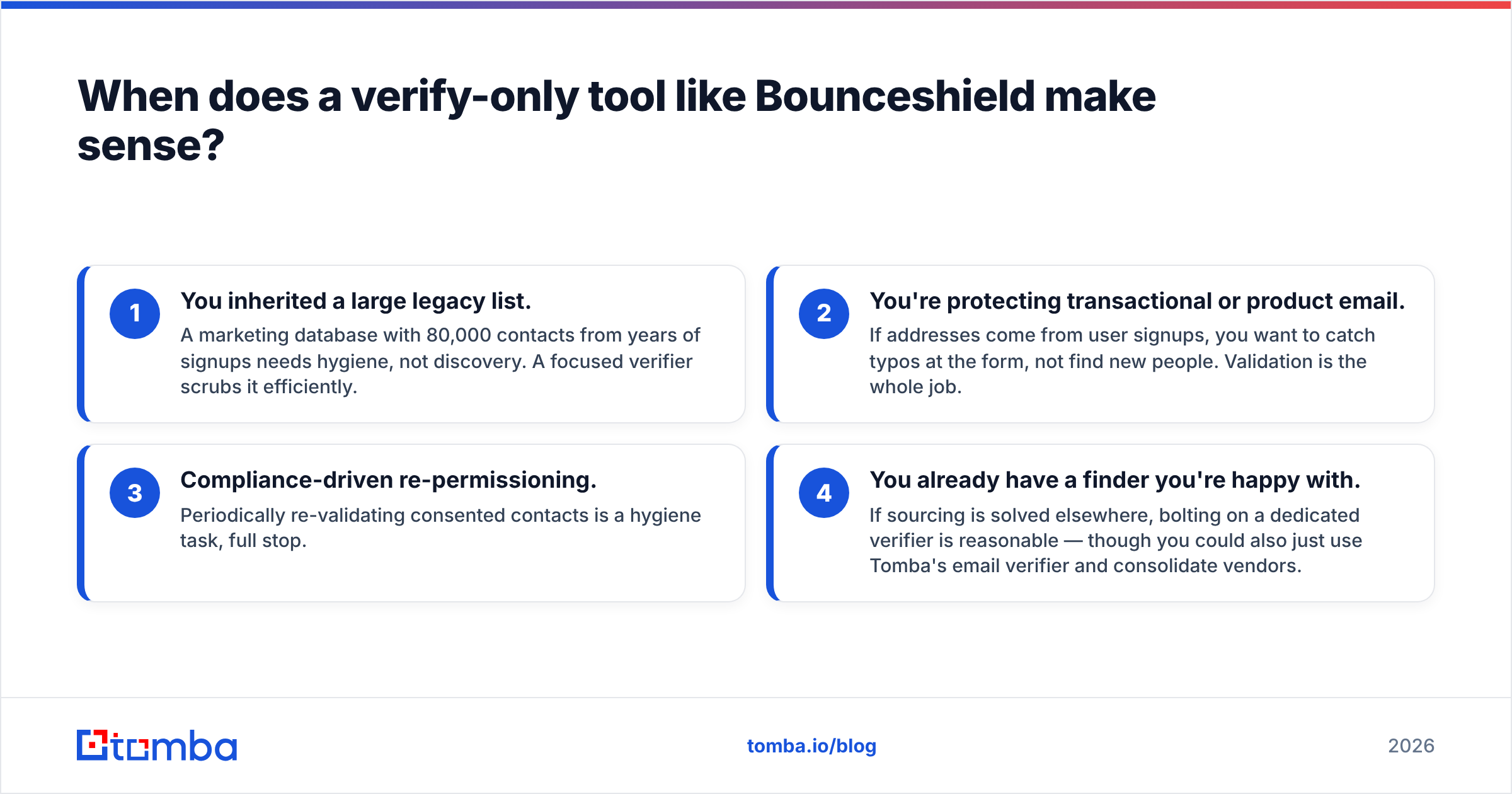
- You inherited a large legacy list. A marketing database with 80,000 contacts from years of signups needs hygiene, not discovery. A focused verifier scrubs it efficiently.
- You're protecting transactional or product email. If addresses come from user signups, you want to catch typos at the form, not find new people. Validation is the whole job.
- Compliance-driven re-permissioning. Periodically re-validating consented contacts is a hygiene task, full stop.
- You already have a finder you're happy with. If sourcing is solved elsewhere, bolting on a dedicated verifier is reasonable — though you could also just use Tomba's email verifier and consolidate vendors.
The common thread: these are all situations where the list already exists. The moment your job includes building the list, a verify-only tool leaves the hardest part undone.
How do the data sources and accuracy compare?#
Accuracy claims are cheap, so look at where the data comes from. A verification-only service doesn't maintain a contact dataset — it validates whatever you submit in real time against mail servers. That's appropriate for its scope, but it means it has no opinion on who you should be emailing, only on whether a string is deliverable.
Tomba maintains its own B2B dataset and is transparent about where the data comes from, which is what lets it find an address rather than just grade one. Independent reviews are the sane way to sanity-check vendor claims here — cross-reference user ratings on G2 or Capterra rather than trusting any single marketing page, including this one.

For a deeper primer on the mechanics behind deliverability and why list quality drives it, HubSpot's email deliverability guide is a solid neutral reference.
Does pricing favor Bounceshield or Tomba?#
It depends on whether you count sourcing as a cost.
Per-credit verification pricing looks cheap in isolation — you pay only for the addresses you check. But that math ignores the labor of getting those addresses. If a researcher spends hours per week manually collecting emails so a verifier can grade them, the verifier's low sticker price hides a large hidden cost.
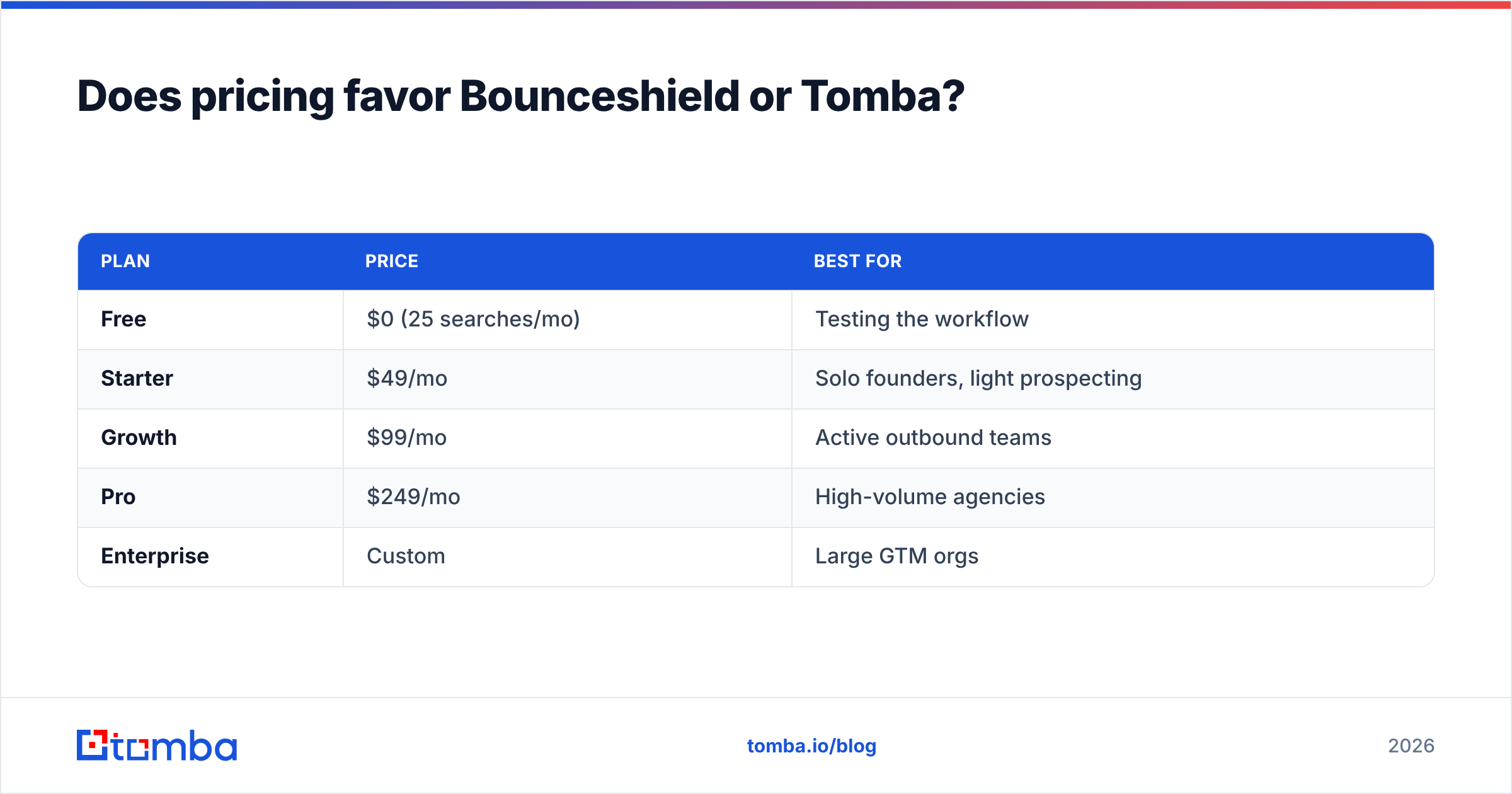
Tomba's plans bundle finding and verifying together:
| Plan | Price | Best for |
|---|---|---|
| Free | $0 (25 searches/mo) | Testing the workflow |
| Starter | $49/mo | Solo founders, light prospecting |
| Growth | $99/mo | Active outbound teams |
| Pro | $249/mo | High-volume agencies |
| Enterprise | Custom | Large GTM orgs |
When you price the whole job — source plus verify — a combined tool at $49 to $99/mo usually beats a verify-only credit pack plus the manual sourcing it silently assumes. If your volume is genuinely just re-checking an owned list, the credit model can win on raw cost. Match the pricing model to your actual workflow, not the headline number.
Bounceshield vs Tomba: the verdict#
Choose based on the bottleneck you actually have:
- Pick a verify-only tool like Bounceshield if your only job is cleaning lists you already own, you have a steady source of addresses elsewhere, and you want the narrowest possible tool for that one task.
- Pick Tomba if you need to find contacts at all — by name, by domain, or in bulk — and want verification, catch-all handling, data enrichment, and phone lookup in the same platform and the same API.
For most B2B sales and outbound teams, the bottleneck is sourcing, not hygiene — and that's the half a verifier can't do. Tomba covers both halves, which is why it's the broader fit for teams building pipeline rather than just maintaining a list.
Ready to stop guessing email formats and stitching tools together? Start with the Tomba Email Finder — find verified professional addresses by name, company, or domain, with verification built into every result. The free tier gives you 25 searches a month to test it against your own target accounts before you pay a cent. Find the contact and confirm it's deliverable in one step, then send with confidence.
// get started
Find, verify and enrich your first contacts today
Start on the free plan with 25 searches a month, then scale when your team is ready.
Free plan · No credit card required · GDPR & CCPA
// about the author