Bounceshield vs Zintlr 2026: Which B2B Data Tool Wins?
Bounceshield protects deliverability through email verification; Zintlr sells prospecting intelligence. Here is an honest 2026 breakdown of which one your sales stack actually needs.
You typed "Bounceshield vs Zintlr" into a search bar because two tools landed on your shortlist and you cannot tell which problem each one actually solves. Here is the short version before the long one.
TL;DR#
- Bounceshield is a deliverability play: it verifies email addresses and screens out risky contacts so your bounce rate stays low and your sender reputation survives.
- Zintlr is a prospecting-intelligence play: it surfaces B2B contacts, company data, and personality insights so your team builds lists and personalizes outreach faster.
- They are not really the same category — picking "the winner" depends on whether your bottleneck is finding people or not burning your domain emailing them.
- If you need both in one bill, a combined finder-plus-verifier stack (like Tomba) usually beats running two single-purpose tools.
- Pricing, accuracy, and real fit are broken down in the comparison table below.
What is Bounceshield?#
Bounceshield is built around one job: keeping bad addresses out of your sends. Think of it as the bouncer at the door of your email list — it checks every address against syntax rules, mail-server (MX) records, SMTP responses, and known-risk patterns before you ever hit send.
The practical payoff is deliverability. Every hard bounce is a small ding to your sender reputation, and mailbox providers like Google and Microsoft watch that number closely. A tool in this lane typically offers:
- Single and bulk verification — paste one address or upload a list of 100,000.
- Risk scoring — valid, invalid, accept-all (catch-all), disposable, role-based.
- API access — verify at the point of form submission so junk never enters your CRM.
- List hygiene reports — what share of your database is decayed and should be suppressed.
What Bounceshield does not do is hand you net-new contacts. It cleans what you already have. That is a critical distinction, and it is exactly where Zintlr lives.
What is Zintlr?#
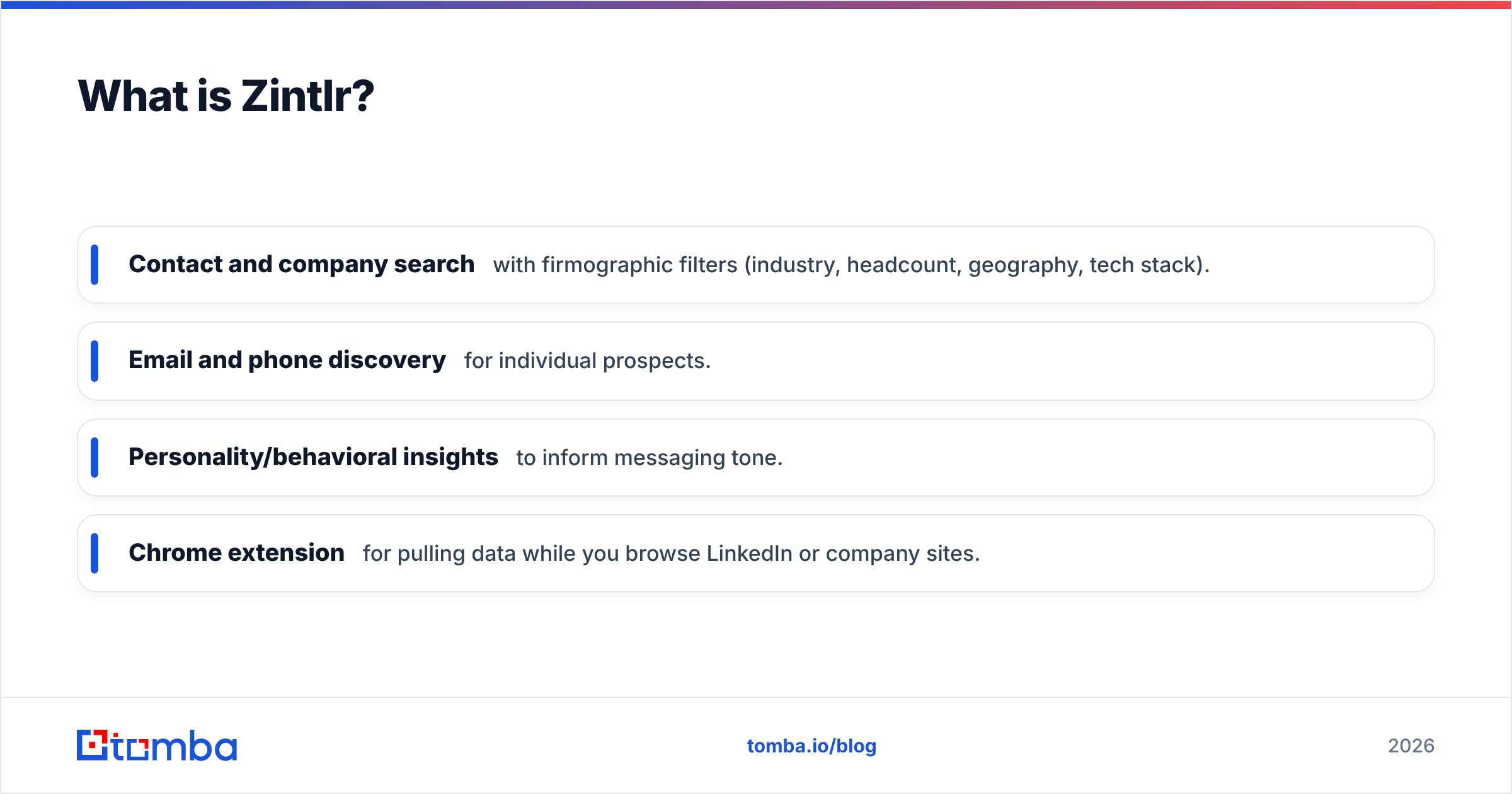
Zintlr is a B2B sales-intelligence platform. Its pitch is the opposite end of the funnel: it helps you discover prospects, pull their contact details and firmographics, and — its signature feature — layer on personality intelligence (DISC-style behavioral profiles) so reps can tailor their pitch to how a buyer thinks.
If Bounceshield is the bouncer, Zintlr is the scout. A platform in this lane usually bundles:
- Contact and company search with firmographic filters (industry, headcount, geography, tech stack).
- Email and phone discovery for individual prospects.
- Personality/behavioral insights to inform messaging tone.
- Chrome extension for pulling data while you browse LinkedIn or company sites.
The catch: prospecting databases are only as good as their freshness, and almost none of them verify deliverability to the standard a dedicated verifier hits. You can have a beautiful list of 5,000 "matched" contacts and still see a 12% bounce rate because the data was scraped months ago.

Bounceshield vs Zintlr: how do they actually compare?#
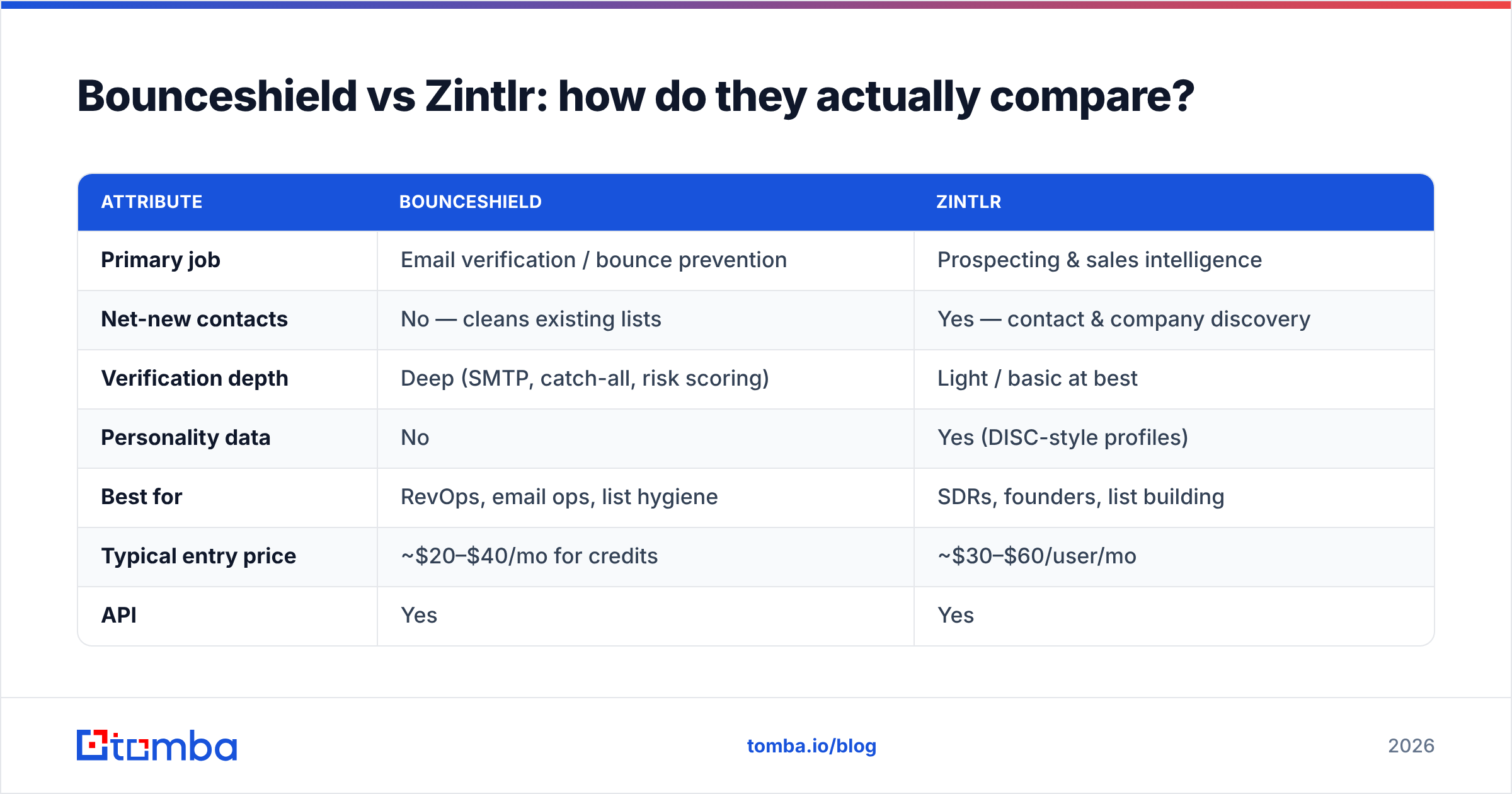
Because these tools sit at different stages of the pipeline, a head-to-head table is less "who wins" and more "what each is for." Treat the pricing below as representative tiers — always confirm current numbers on each vendor's site, since plans shift.
| Attribute | Bounceshield | Zintlr |
|---|---|---|
| Primary job | Email verification / bounce prevention | Prospecting & sales intelligence |
| Net-new contacts | No — cleans existing lists | Yes — contact & company discovery |
| Verification depth | Deep (SMTP, catch-all, risk scoring) | Light / basic at best |
| Personality data | No | Yes (DISC-style profiles) |
| Best for | RevOps, email ops, list hygiene | SDRs, founders, list building |
| Typical entry price | ~$20–$40/mo for credits | ~$30–$60/user/mo |
| API | Yes | Yes |
| Where it fails | Won't find anyone | Bounce rates on stale data |
The honest read: these two only land on the same shortlist when someone is fuzzy on what they're buying. If your problem is "my emails bounce," Bounceshield is the closer match. If your problem is "I have no one to email," Zintlr is. Most teams eventually need both capabilities — which is why bundling matters (more on that below).
Which problem do you actually have?#
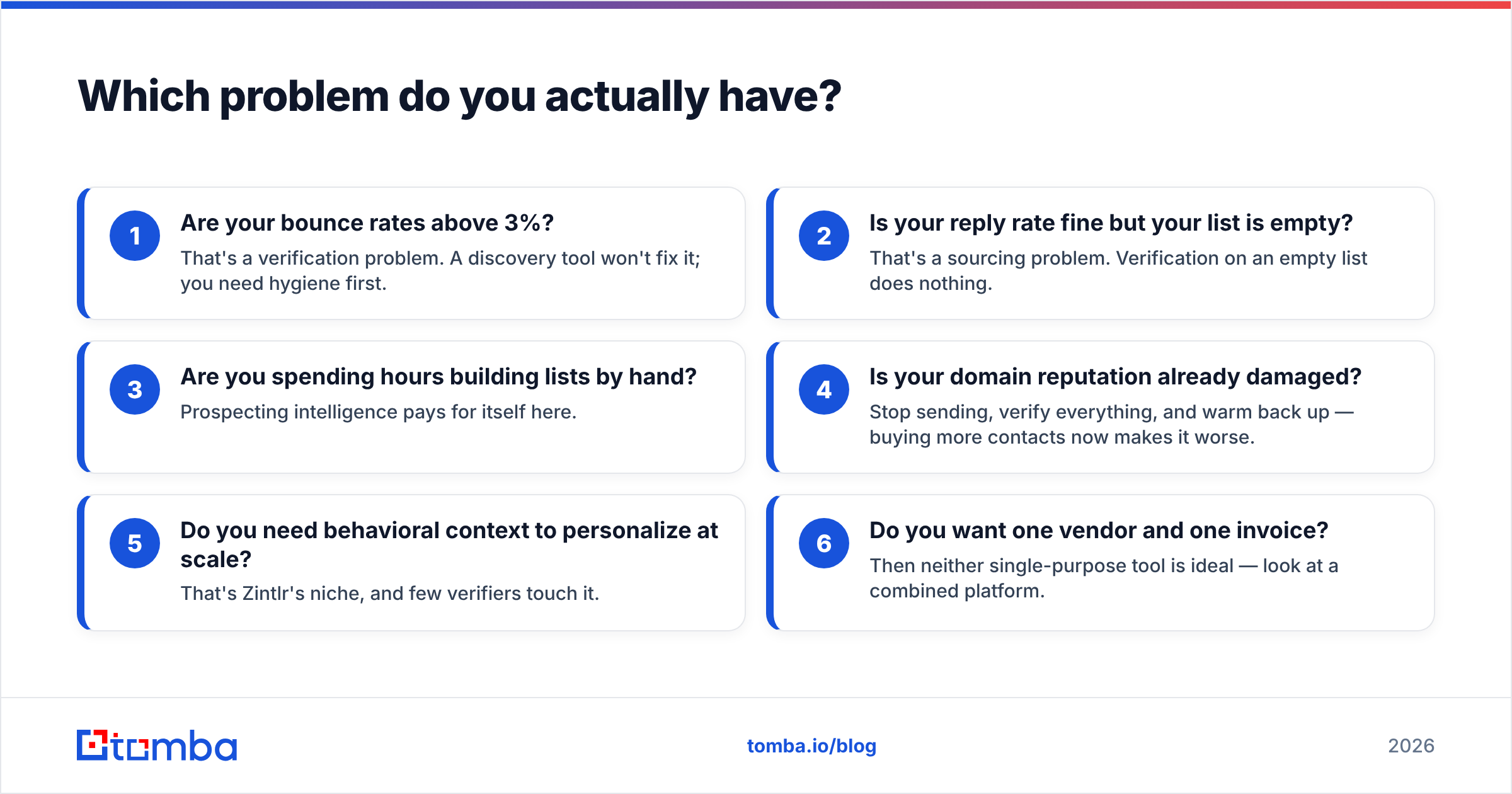
Before you compare features, diagnose your bottleneck. Run through this short checklist — the answer usually makes the decision for you.
- Are your bounce rates above 3%? That's a verification problem. A discovery tool won't fix it; you need hygiene first.
- Is your reply rate fine but your list is empty? That's a sourcing problem. Verification on an empty list does nothing.
- Are you spending hours building lists by hand? Prospecting intelligence pays for itself here.
- Is your domain reputation already damaged? Stop sending, verify everything, and warm back up — buying more contacts now makes it worse.
- Do you need behavioral context to personalize at scale? That's Zintlr's niche, and few verifiers touch it.
- Do you want one vendor and one invoice? Then neither single-purpose tool is ideal — look at a combined platform.
If you answered yes to 1, 2, and 6, you're describing the most common scenario: a team that needs accurate discovery and verification without juggling two subscriptions.
Is verification or prospecting more important for deliverability?#
Verification wins for deliverability, full stop — but only because prospecting is upstream of it. You cannot verify your way out of a list you never built, and you cannot send to a great list that's full of dead addresses.
The mechanics matter. Email deliverability is governed by how mailbox providers score your sending behavior. Every hard bounce signals that you don't maintain your list. According to email-industry guidance compiled by vendors like HubSpot, keeping your bounce rate under roughly 2% is table stakes for staying in the inbox. A dedicated verifier — or Tomba's email verifier — is what gets you there.
The trap with prospecting-first tools is that their built-in verification is usually a quick syntax-and-MX check, not a full SMTP handshake. That's where catch-all domains slip through. If you're pulling contacts from a discovery platform, run the export through a real catch-all verifier before your first send. The extra step costs cents and saves your domain.
How does a combined approach compare?#
Here's the option neither vendor's landing page will mention: you can collapse both jobs into one workflow. The reason "Bounceshield vs Zintlr" is a hard question is that it forces a false choice between finding and verifying. A platform that does both removes the choice.
That's the lane Tomba sits in. Instead of one subscription for discovery and another for hygiene, you find the address and verify it in the same pass:
- Find with the email finder — search by name, company, or domain and get the most likely professional address.
- Verify inline so you never export a risky contact.
- Scale with the bulk email finder when you're processing thousands of rows at once.
- Enrich with firmographic and company data, similar to what a prospecting platform provides.
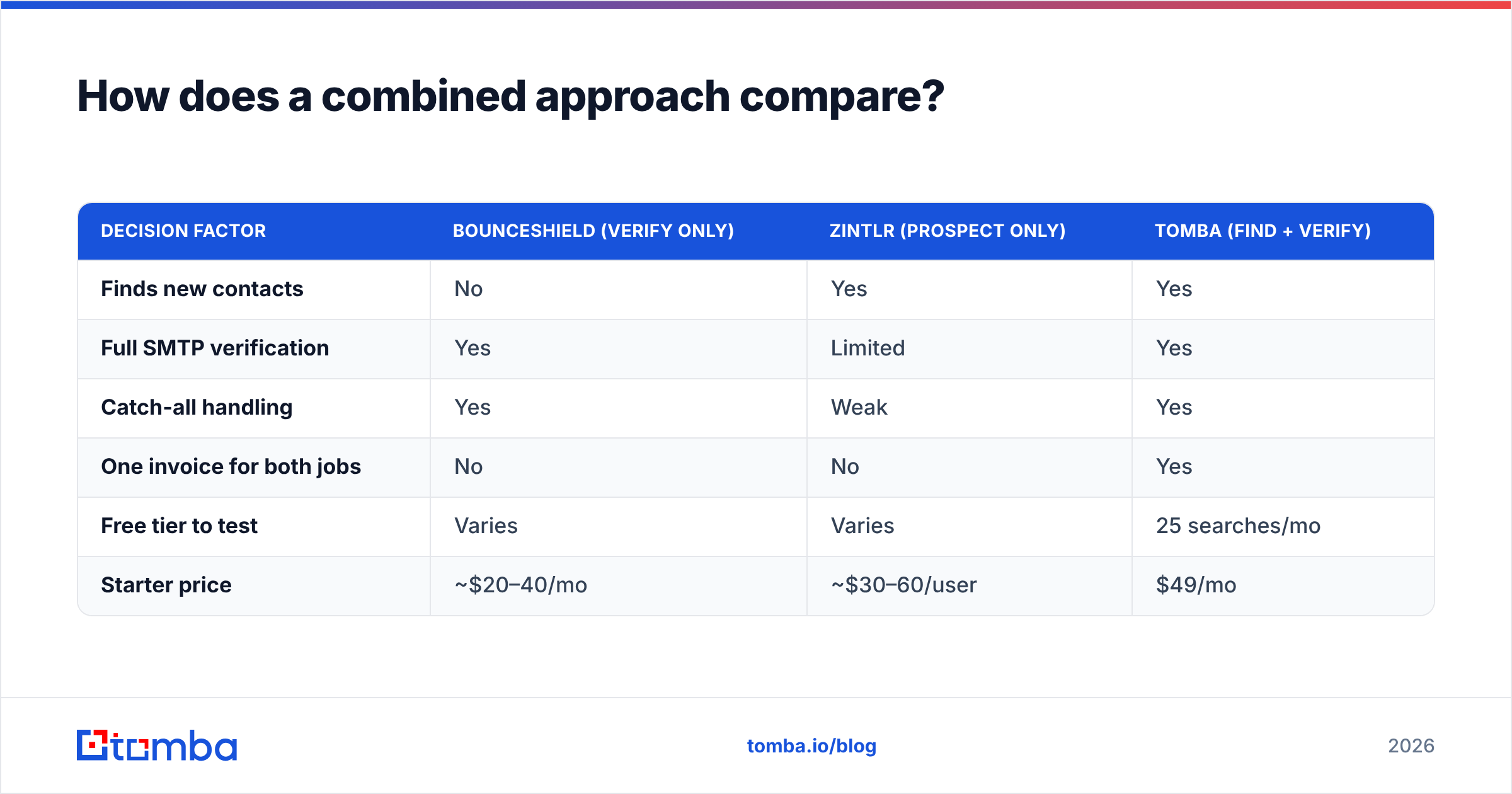
Here's how the three approaches stack up on the dimensions that actually drive a buying decision:
| Decision factor | Bounceshield (verify only) | Zintlr (prospect only) | Tomba (find + verify) |
|---|---|---|---|
| Finds new contacts | No | Yes | Yes |
| Full SMTP verification | Yes | Limited | Yes |
| Catch-all handling | Yes | Weak | Yes |
| One invoice for both jobs | No | No | Yes |
| Free tier to test | Varies | Varies | 25 searches/mo |
| Starter price | ~$20–40/mo | ~$30–60/user | $49/mo |
Transparency on Tomba's numbers, since the prompt is comparison-heavy: the Free tier gives 25 searches/month, Starter is $49/mo, Growth is $99/mo, and Pro is $249/mo, with Enterprise priced on request. You can see the full breakdown on the Tomba pricing page.
What about data accuracy and sources?#
Accuracy is where the "vs" gets real, because a contact you can't reach is worth zero regardless of which logo sold it to you. Two questions cut through the marketing:
First: where does the data come from? Scraped-once-and-cached databases decay fast — roughly 25–30% of B2B contact data goes stale every year as people change jobs. Tools that re-validate at query time beat tools that serve from a frozen index. Tomba documents its approach on the data sources page; you should expect any vendor you shortlist to be equally explicit.
Second: is the address verified at the moment you get it, or just "matched"? A "match" means an algorithm thinks the pattern is right (jane.doe@company.com). A verified address means a server confirmed the mailbox exists. Prospecting platforms often report the former while implying the latter. That gap is your future bounce rate.
You can sanity-check any tool's claims yourself: independent reviews on G2 and verified-buyer ratings on Capterra usually surface the real bounce-rate complaints that case studies hide. Read the 3-star reviews, not the 5-star ones — that's where deliverability problems get named.
Who should pick which?#
Quick routing, no hedging:
- Pick Bounceshield if you already have a large list, your only pain is bounces, and you want a focused verification tool with an API. You'll still need a separate source for new contacts.
- Pick Zintlr if your team's bottleneck is sourcing and you specifically value personality/behavioral intelligence for personalization, and you're willing to verify exports elsewhere before sending.
- Pick a combined platform like Tomba if you want net-new discovery and genuine SMTP verification on one bill, with a free tier to test before you commit. This is the right call for most small-to-mid sales teams who don't want to stitch two tools together with a Zapier duct-tape.
There's no shame in running two specialists if you're at enterprise scale and each tool is best-in-class for its job. But for the majority of teams reading a "vs" post, the consolidation math wins: fewer seats, fewer integrations, one data model.
Frequently asked questions#
Is Bounceshield or Zintlr better for cold email? Neither alone is complete. Cold email needs both a fresh source (Zintlr's strength) and rigorous verification (Bounceshield's strength). A combined tool covers the full loop in one workflow.
Can I use Zintlr's data without a separate verifier? You can, but you shouldn't on cold lists. Run exports through a dedicated verifier first to protect deliverability — built-in checks on prospecting tools rarely catch catch-all domains.
Does Tomba replace both? For most teams, yes — it finds addresses and verifies them in one pass, with data enrichment alongside. Heavy users of behavioral/personality data may still want a specialist for that specific layer.
What bounce rate should I aim for? Under 2% is the safe target most providers cite. Above 3–5% and you risk throttling or blacklisting.
The bottom line#
"Bounceshield vs Zintlr" is really "verification vs prospecting" — two halves of the same pipeline dressed up as competitors. Diagnose your actual bottleneck first. If you only bounce, get a verifier. If you only lack contacts, get a prospecting tool. If you're like most teams and need both without two invoices, consolidate.
Start by putting your real targets through one finder-plus-verifier flow. The Tomba Email Finder lets you find professional addresses by name, company, or domain and verify them in the same step — and the free tier gives you 25 searches a month to test it against your own list before you pay a cent. Build a clean, reachable list once, instead of paying twice to find people and then find out they bounce.
// get started
Find, verify and enrich your first contacts today
Start on the free plan with 25 searches a month, then scale when your team is ready.
Free plan · No credit card required · GDPR & CCPA
// about the author