Bouncify vs BrandNav: Email Verifier Showdown 2026
Bouncify vs BrandNav, compared on accuracy, pricing, speed, and data coverage—plus where Tomba's verifier beats both for B2B teams in 2026.
Choosing between Bouncify vs BrandNav comes down to one question: which tool actually keeps your bounce rate under 2% without draining your budget? Both promise clean lists and high accuracy. Only one fits how your team works—and for a lot of B2B senders, neither is the obvious winner once you factor in catch-all handling and data enrichment.
This is a neutral, hands-on breakdown. No fluff, no "synergy." Just where each tool is strong, where it cracks, and how to decide.
TL;DR — Bouncify vs BrandNav at a glance#
- Bouncify is a lean, pay-as-you-go email verifier built for one job: bulk list cleaning at a low per-email price. Simple, fast, cheap.
- BrandNav bundles verification with email/phone enrichment and lead data, so it leans toward teams that want validation and contact discovery in one place.
- Accuracy is close on standard mailboxes; the real gap shows up on catch-all domains, where guesswork inflates "valid" results.
- Pricing models differ: Bouncify sells credits per verification; BrandNav prices around enrichment-style plans, which gets pricier at scale.
- If you need verification plus finding real B2B emails, a dedicated email verifier paired with an email finder usually beats a single jack-of-all-trades tool.

What do Bouncify and BrandNav actually do?#
Bouncify and BrandNav both sit in the "clean my list before I hit send" category, but they were built with different center-of-gravity.
Bouncify is a focused email verification service. You upload a CSV (or call the API), it runs syntax, MX, SMTP, and role/disposable checks, then hands back a deliverability verdict per address. Its appeal is brutal simplicity: pay for what you verify, get results fast, move on. See their own positioning on Bouncify's site and reviews on G2.
BrandNav is positioned more broadly as a data and enrichment platform that includes verification. Alongside validating addresses, it pushes phone numbers, contact enrichment, and lead-building features. That makes it attractive if you want one subscription doing several jobs—but it also means verification is one feature among many rather than the whole product.
Here's the practical translation:
- Pick Bouncify when you already have a list and just need it scrubbed cheaply and quickly.
- Pick BrandNav when you want verification stapled to enrichment and don't mind paying for the bundle.
- Pick a dedicated stack (verifier + finder) when accuracy on tricky domains and source transparency matter more than convenience.
How do they compare on features and pricing?#
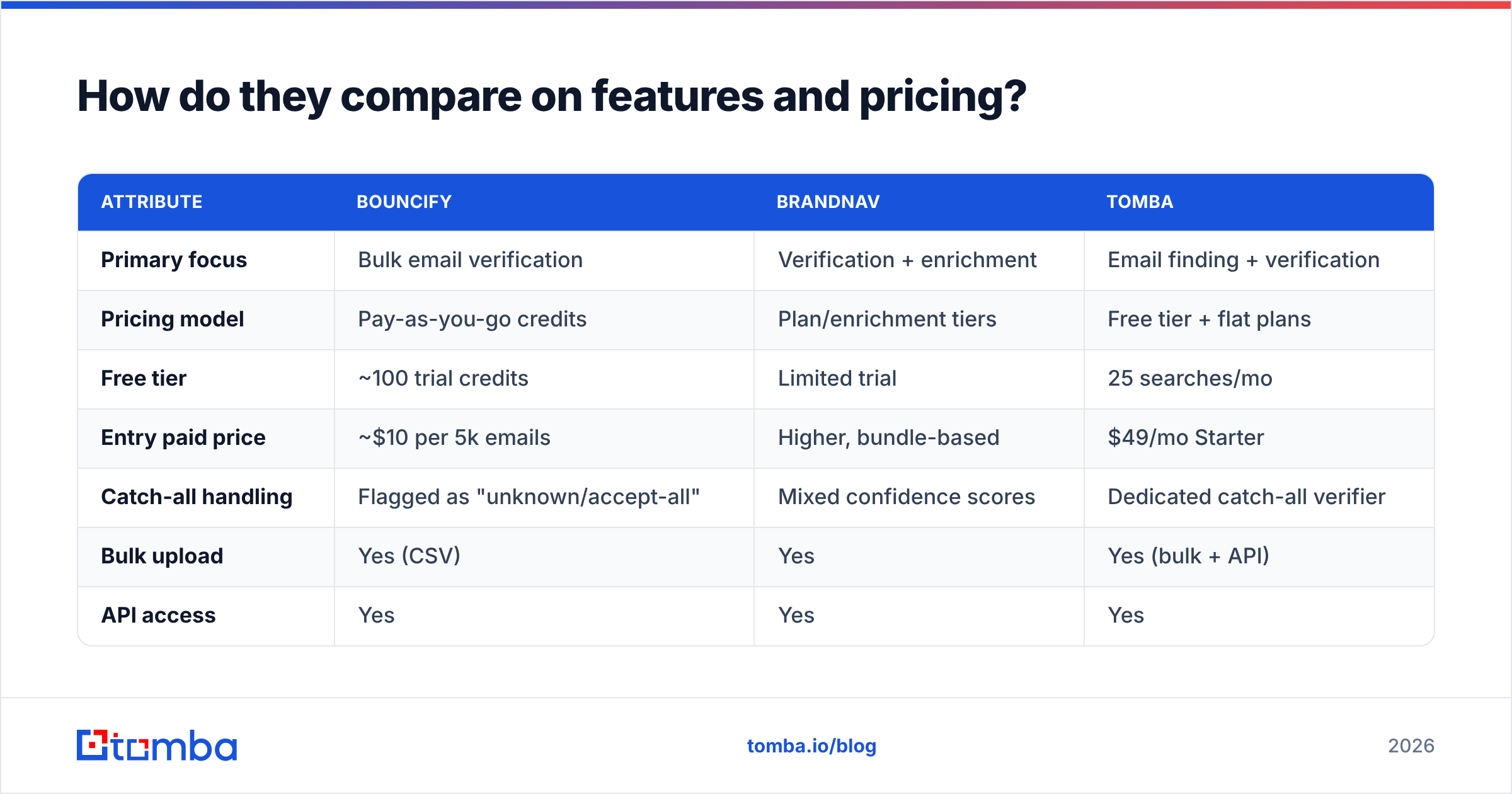
The fastest way to see the gap is side by side. Prices and limits shift, so treat figures as directional and confirm on each vendor's pricing page before you buy.
| Attribute | Bouncify | BrandNav | Tomba |
|---|---|---|---|
| Primary focus | Bulk email verification | Verification + enrichment | Email finding + verification |
| Pricing model | Pay-as-you-go credits | Plan/enrichment tiers | Free tier + flat plans |
| Free tier | ~100 trial credits | Limited trial | 25 searches/mo |
| Entry paid price | ~$10 per 5k emails | Higher, bundle-based | $49/mo Starter |
| Catch-all handling | Flagged as "unknown/accept-all" | Mixed confidence scores | Dedicated catch-all verifier |
| Bulk upload | Yes (CSV) | Yes | Yes (bulk + API) |
| API access | Yes | Yes | Yes |
| Phone data | No | Yes | Yes (phone finder) |
| Best for | Cheap one-off cleaning | All-in-one data buyers | B2B prospecting teams |
Two honest takeaways. First, Bouncify almost always wins on raw per-email cost for plain verification—if that's all you need, it's hard to beat. Second, BrandNav's value depends entirely on whether you use the enrichment side; if you ignore the extra data features, you're overpaying for verification alone.
For context on Tomba's side of the table, the full Tomba pricing breakdown shows a flat-plan model that bundles finding and verifying, which is a different trade-off than paying per verification.
Which is more accurate on catch-all domains?#
This is where the Bouncify vs BrandNav decision actually gets interesting—and where most verifiers quietly fail.
A catch-all (or "accept-all") domain accepts mail to any address at the SMTP layer, so a standard verification ping can't tell whether jane@company.com is a real inbox or a black hole. Honest tools return "unknown" or "accept-all." Less honest tools mark these as "valid" to inflate their pass rate.
Bouncify is generally transparent here: catch-alls come back flagged rather than disguised as deliverable. BrandNav applies confidence scoring, which can be helpful but is harder to audit—a "70% likely valid" doesn't tell your deliverability team much when a bounce spike hits.
The cleaner approach is a purpose-built catch-all verifier that runs deeper checks instead of a single SMTP guess. On catch-all-heavy B2B lists (most enterprise domains are accept-all), this difference alone can swing your real bounce rate by several points.
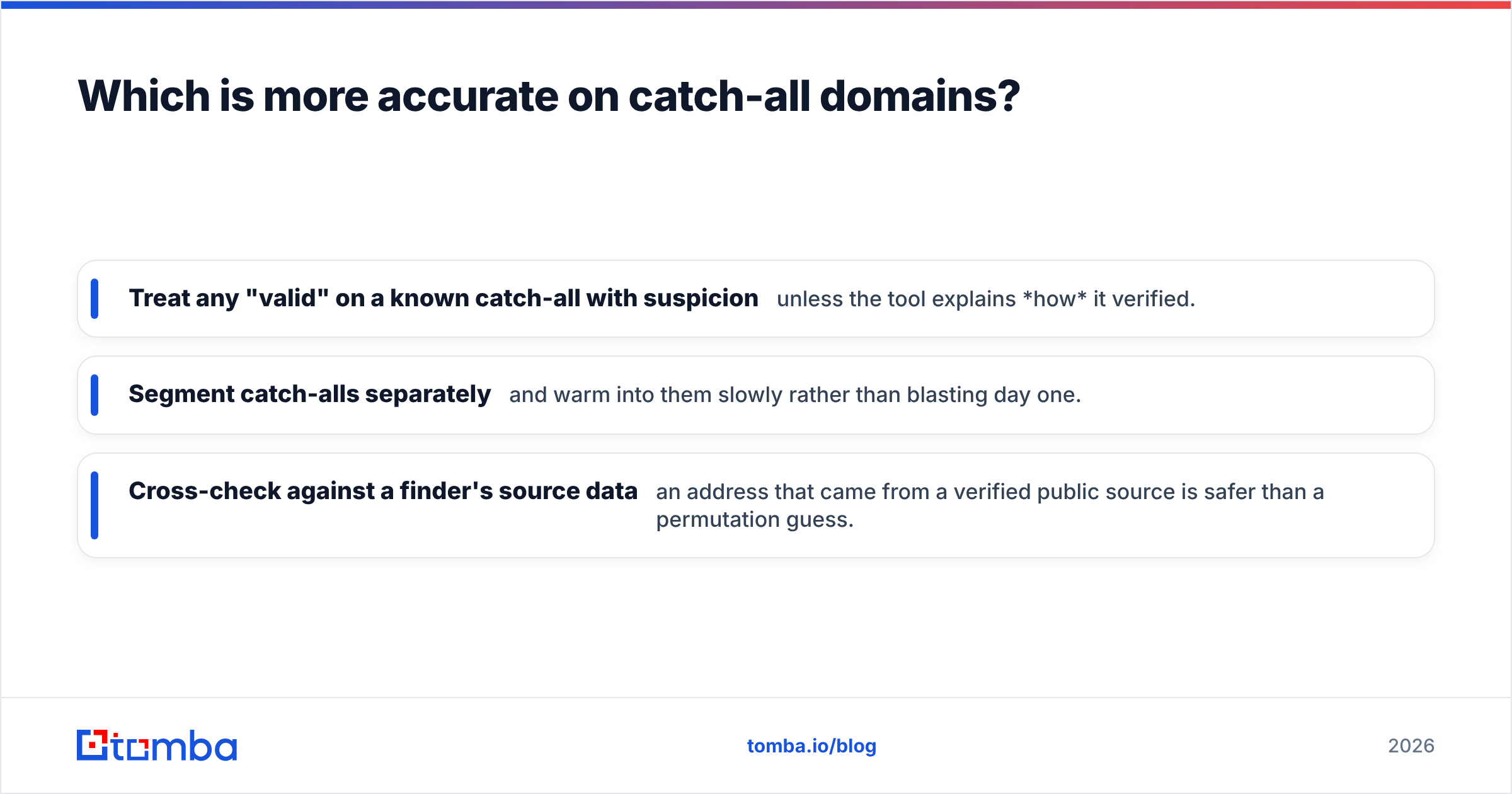
A few rules that hold regardless of vendor:
- Treat any "valid" on a known catch-all with suspicion unless the tool explains how it verified.
- Segment catch-alls separately and warm into them slowly rather than blasting day one.
- Cross-check against a finder's source data—an address that came from a verified public source is safer than a permutation guess.
What about speed, bulk processing, and the API?#
For high-volume senders, throughput and integration matter as much as accuracy.
Bouncify is built for bulk. Large CSV uploads process quickly, the dashboard is minimal, and the API is straightforward to wire into a sending workflow. If your job is "clean 200k addresses tonight," it does that without ceremony.
BrandNav handles bulk too, but because it's juggling enrichment, the experience is heavier—more fields, more configuration, more surface area. That's a feature if you want enrichment inline, and friction if you don't.
If your verification needs to live inside an existing pipeline, look closely at the developer experience. A well-documented email verification API that returns clear statuses (valid, invalid, accept-all, disposable, role) is worth more than a slightly cheaper tool with vague responses. For one-off cleaning, a bulk email finder and verifier combo lets you both discover and validate in the same pass, which removes a whole export-import step.
When should you pick each tool?#
Here's the decision framed by job-to-be-done rather than feature lists:
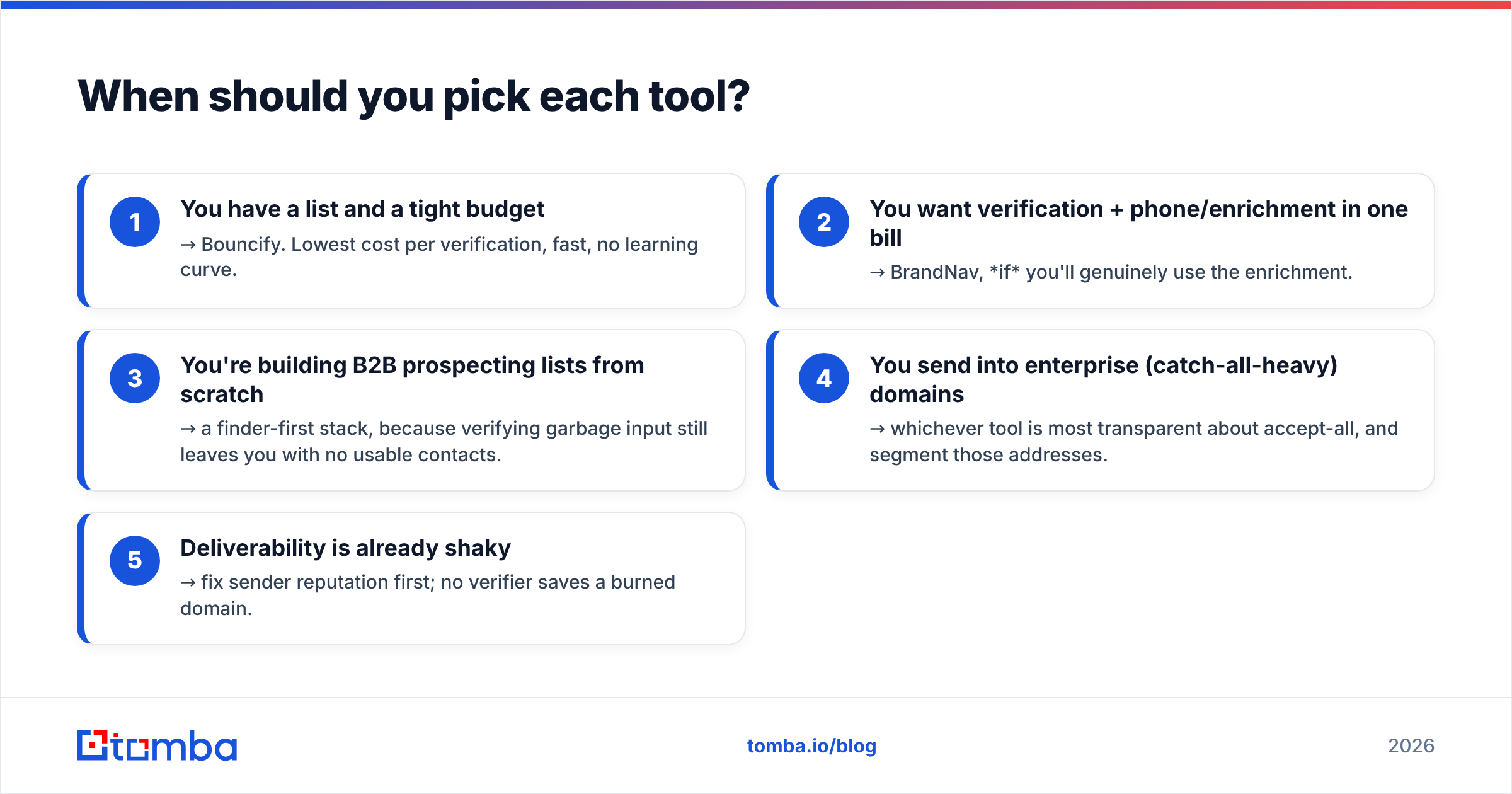
- You have a list and a tight budget → Bouncify. Lowest cost per verification, fast, no learning curve.
- You want verification + phone/enrichment in one bill → BrandNav, if you'll genuinely use the enrichment.
- You're building B2B prospecting lists from scratch → a finder-first stack, because verifying garbage input still leaves you with no usable contacts.
- You send into enterprise (catch-all-heavy) domains → whichever tool is most transparent about accept-all, and segment those addresses.
- Deliverability is already shaky → fix sender reputation first; no verifier saves a burned domain.
That last point matters. Verification reduces hard bounces, but it doesn't repair authentication or warm a cold domain. If your issue is inbox placement rather than invalid addresses, start with email deliverability fundamentals—SPF, DKIM, DMARC, and gradual volume ramp—before blaming the list.
How does Tomba fit into the Bouncify vs BrandNav comparison?#
Tomba plays a different position than either tool, and that's the point. Bouncify cleans lists. BrandNav cleans and enriches. Tomba is built around finding the right B2B email in the first place, then verifying it—so you're not just validating a list someone else gave you, you're generating a clean one.
The practical workflow looks like this:
- Use the email finder or domain search to pull real, sourced contacts for a target company.
- Verify them in the same platform, including dedicated catch-all checks.
- Push the validated contacts straight into your CRM or sequencing tool.
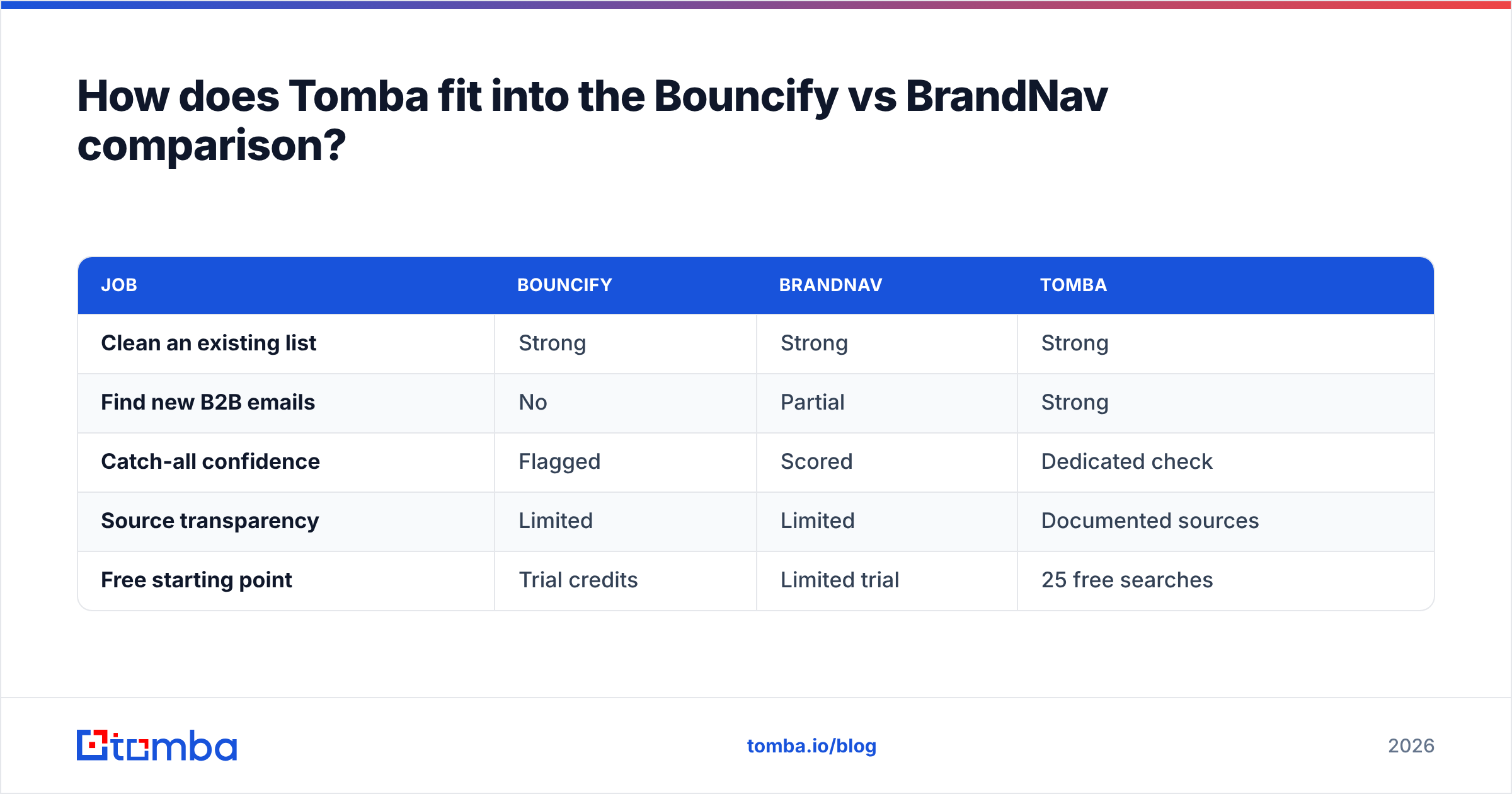
| Job | Bouncify | BrandNav | Tomba |
|---|---|---|---|
| Clean an existing list | Strong | Strong | Strong |
| Find new B2B emails | No | Partial | Strong |
| Catch-all confidence | Flagged | Scored | Dedicated check |
| Source transparency | Limited | Limited | Documented sources |
| Free starting point | Trial credits | Limited trial | 25 free searches |
That doesn't make Tomba the right answer for every scenario. If you literally only ever verify lists handed to you and never prospect, Bouncify's pay-as-you-go pricing may be all you need. The honest dividing line: verification-only shops are well served by Bouncify; bundle buyers can justify BrandNav; prospecting teams that need both discovery and clean data get more from a finder-first platform.
Common mistakes when comparing email verifiers#
A few traps that cost teams money regardless of which vendor they pick:
- Optimizing for pass rate, not accuracy. A tool that marks everything "valid" looks great until your bounce rate proves otherwise.
- Ignoring catch-all share. If 60% of your list is accept-all, the headline accuracy number is mostly noise.
- Verifying once and forgetting. Email data decays ~2–3% per month; a list clean in January is dirty by spring.
- Skipping disposable/role filtering.
info@and throwaway addresses pass syntax checks but tank engagement. - Confusing verification with deliverability. Clean lists help, but reputation and authentication decide the inbox.
A quick way to sanity-check any verifier is to run a known sample—addresses you've already confirmed as live or dead—and compare verdicts. The tool that's honest about "unknown" is usually the one you can trust on the rest.
The verdict: Bouncify vs BrandNav in 2026#
Conclusion first: for cheap, no-frills list cleaning, Bouncify wins; for verification bundled with enrichment, BrandNav makes sense; for building and validating B2B contacts end to end, neither beats a finder-first platform.
- Choose Bouncify if cost-per-verification is your only metric.
- Choose BrandNav if you'll actually use the enrichment and phone data you're paying for.
- Choose a dedicated finder + verifier if your real bottleneck is getting accurate contacts, not just scrubbing them.
If your goal in 2026 is fewer bounces and more real prospects, start where the data originates. The Tomba Email Finder discovers verified professional emails by name, company, or domain—and validates them in the same workflow, including catch-all checks that trip up most verifiers. Begin with 25 free searches a month, no card required, and see how a clean list feels when it's clean from the source. Try the Tomba Email Finder and stop paying to verify guesses.
Ready to find emails that actually work?
Join 150,000+ professionals who stopped guessing and started sending. Free credits on signup — no credit card required.
Get the Tomba newsletter
Practical outbound tactics and product updates — once every two weeks.
About the author