Bouncify vs DiscoverOrg (2026): Email Verify vs B2B Data
Bouncify cleans your list, DiscoverOrg builds it. Here's how the two tools actually compare in 2026 — and where a cheaper hybrid beats both.
Bouncify vs DiscoverOrg: Which One Does Your Pipeline Actually Need?
If you're comparing Bouncify vs DiscoverOrg, you're probably comparing the wrong two things — and that's the most useful thing to know before you spend a dollar. These tools sit at opposite ends of the outbound workflow. One cleans the list you already have. The other sells you the list in the first place. Picking between them isn't a feature fight; it's a question of which problem is actually bleeding your pipeline right now.
This guide breaks down what each tool does, where it wins, what it costs in 2026, and why a lot of teams end up needing a third option that covers both jobs without the enterprise price tag.
TL;DR#
- Bouncify is an email verification tool. It takes a list of addresses and tells you which ones will bounce. It does not find new contacts.
- DiscoverOrg (now part of ZoomInfo) is a B2B data and sales-intelligence platform. It builds contact lists, org charts, and intent data — but it's an enterprise purchase with enterprise pricing and annual contracts.
- They solve different problems. Comparing them head-to-head only makes sense if you're deciding where to spend a limited budget: list hygiene or list building.
- Most teams need both functions — find verified contacts and keep the list clean — which is why a combined finder-plus-verifier stack often beats buying either tool in isolation.
- Budget reality: Bouncify is cheap and narrow; DiscoverOrg is powerful and expensive. A hybrid like Tomba lands in the middle and covers both jobs.
What is Bouncify?#
Bouncify is a single-purpose email verification service. You upload a list, it pings mail servers, checks syntax, detects disposable domains, flags catch-all addresses, and returns a clean file marked deliverable, risky, or undeliverable. Think of it as a spell-checker for your contact list — it doesn't write the essay, it just catches the mistakes before you hit send.
That focus is its strength. Verification is a commodity job, and Bouncify does it at a low per-email cost with a usable bulk uploader and an API. Cold-email senders use it to protect sender reputation and keep bounce rates under the 2% threshold that inbox providers punish.
What Bouncify cannot do: give you a single new email address. If your list is empty, Bouncify has nothing to verify. It assumes you already sourced your contacts somewhere else.

What is DiscoverOrg?#
DiscoverOrg is the opposite. It's a B2B data and intelligence platform built to generate contact lists — direct dials, verified emails, org charts, technographics, and buying-intent signals. After its merger, DiscoverOrg's technology now lives inside ZoomInfo, one of the largest sales-intelligence vendors on the market.
DiscoverOrg's pitch is depth. Instead of just an email, you get the person's role, their reporting line, the tools their company uses, and signals that suggest they're in-market. For large sales teams running account-based plays, that context is the product. It's less a tool and more a B2B database with a research layer bolted on.
The catch is cost and commitment. DiscoverOrg/ZoomInfo is sold through annual contracts, sales-rep negotiation, and seat-based licensing that routinely runs into five figures a year. There's no quick self-serve signup-and-go for a two-person team.
Bouncify vs DiscoverOrg: side-by-side comparison#
Here's the honest split. These aren't competitors so much as neighbors on the workflow.
| Attribute | Bouncify | DiscoverOrg (ZoomInfo) |
|---|---|---|
| Primary job | Email verification / list hygiene | Contact data + sales intelligence |
| Finds new contacts? | No | Yes |
| Verifies emails? | Yes (core feature) | Partial (data is pre-validated) |
| Org charts / intent data | No | Yes |
| Pricing model | Pay-as-you-go / low monthly | Annual enterprise contract |
| Typical entry cost | ~$10–$30 per batch | Often $15k+/year |
| Free tier | Limited trial credits | No real free tier |
| Best for | Cleaning lists you already have | Building lists from scratch |
| Setup time | Minutes | Sales call + onboarding |
| API access | Yes | Yes (higher tiers) |
The pattern is clear. If you already have contacts and just need them clean, Bouncify is overkill-free and cheap. If you have nothing and need a research-grade data engine, DiscoverOrg is built for that — at a price that assumes a real sales org behind it.
Is Bouncify better than DiscoverOrg?#
Wrong question — but here's the answer anyway: Bouncify is better at exactly one thing, and DiscoverOrg is better at everything else it does. Neither replaces the other.
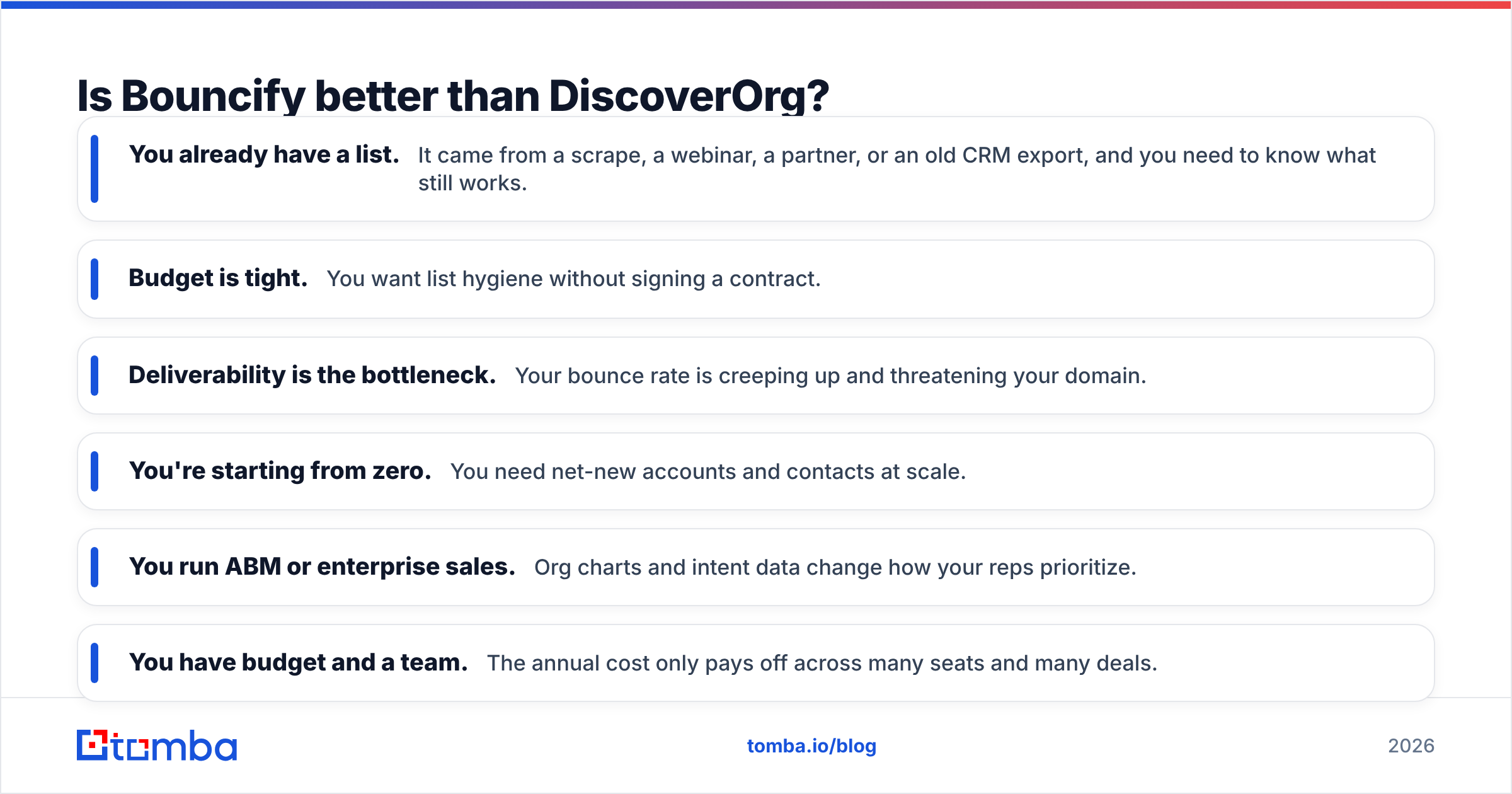
Choose Bouncify when:
- You already have a list. It came from a scrape, a webinar, a partner, or an old CRM export, and you need to know what still works.
- Budget is tight. You want list hygiene without signing a contract.
- Deliverability is the bottleneck. Your bounce rate is creeping up and threatening your domain.
Choose DiscoverOrg when:
- You're starting from zero. You need net-new accounts and contacts at scale.
- You run ABM or enterprise sales. Org charts and intent data change how your reps prioritize.
- You have budget and a team. The annual cost only pays off across many seats and many deals.
The trap teams fall into: buying DiscoverOrg's heavy platform when all they needed was a cleaner list, or buying Bouncify and discovering they still have no one to email. The two tools expose a gap — most outbound motions need both finding and verifying — and buying them separately is expensive and clunky.
What if you need both — finding and verifying?#
This is where the Bouncify-vs-DiscoverOrg framing falls apart, because the real workflow is a loop: find contacts, verify them, enrich them, send, repeat. Splitting that across a cheap verifier and a five-figure data platform is the most expensive way to solve it.
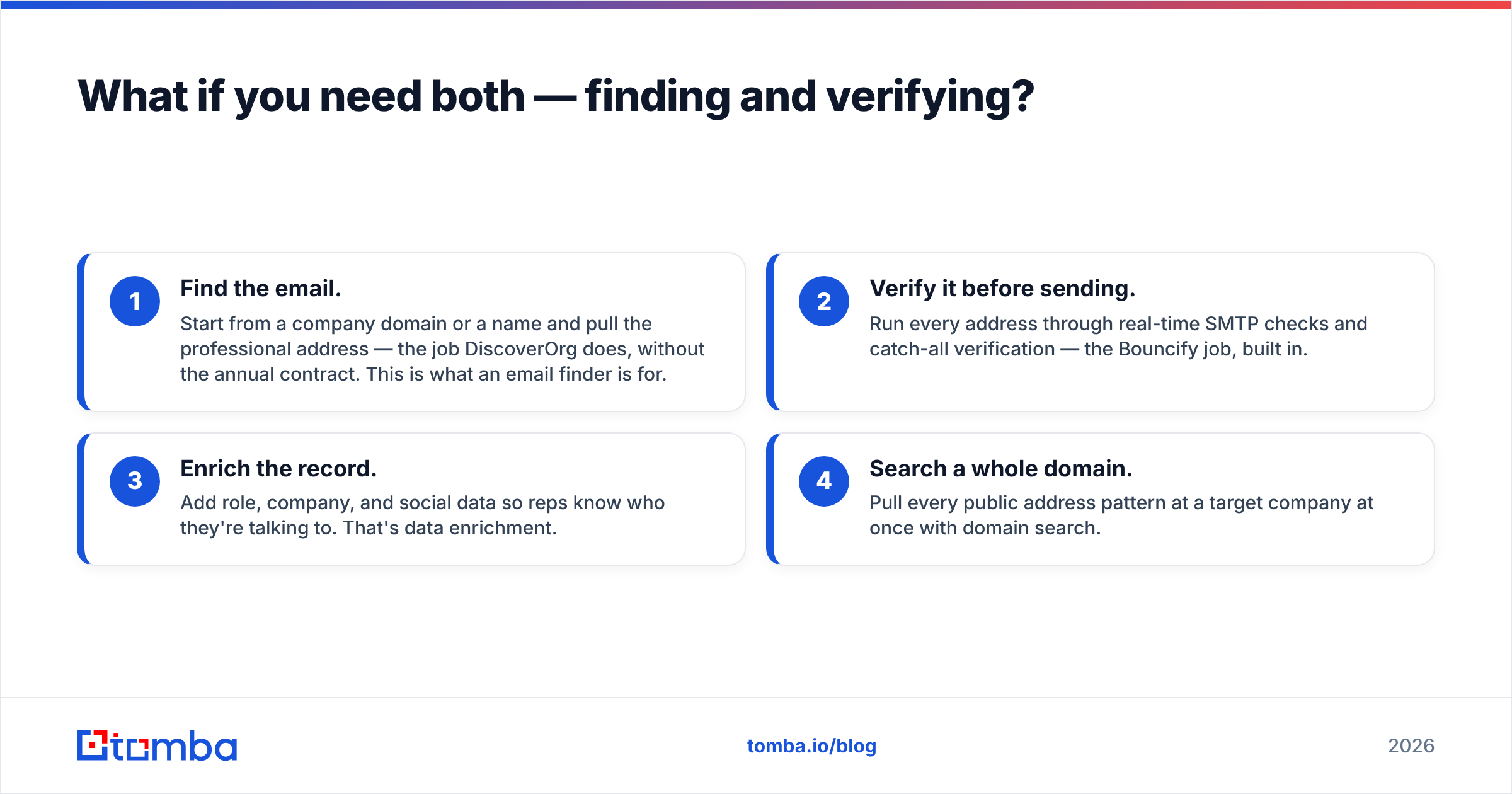
A combined approach handles the whole loop in one place:
- Find the email. Start from a company domain or a name and pull the professional address — the job DiscoverOrg does, without the annual contract. This is what an email finder is for.
- Verify it before sending. Run every address through real-time SMTP checks and catch-all verification — the Bouncify job, built in.
- Enrich the record. Add role, company, and social data so reps know who they're talking to. That's data enrichment.
- Search a whole domain. Pull every public address pattern at a target company at once with domain search.
When find-and-verify live in the same tool, you stop paying two vendors and stop exporting CSVs between them. That's the case for a hybrid like Tomba.

How does Tomba compare on price and scope?#
Tomba is an email-finder-first platform with verification, domain search, catch-all checks, phone finding, and enrichment built alongside it. In the Bouncify-vs-DiscoverOrg map, it covers both columns: it finds contacts like DiscoverOrg's data engine and verifies them like Bouncify — at a self-serve price closer to the verifier than the enterprise platform.
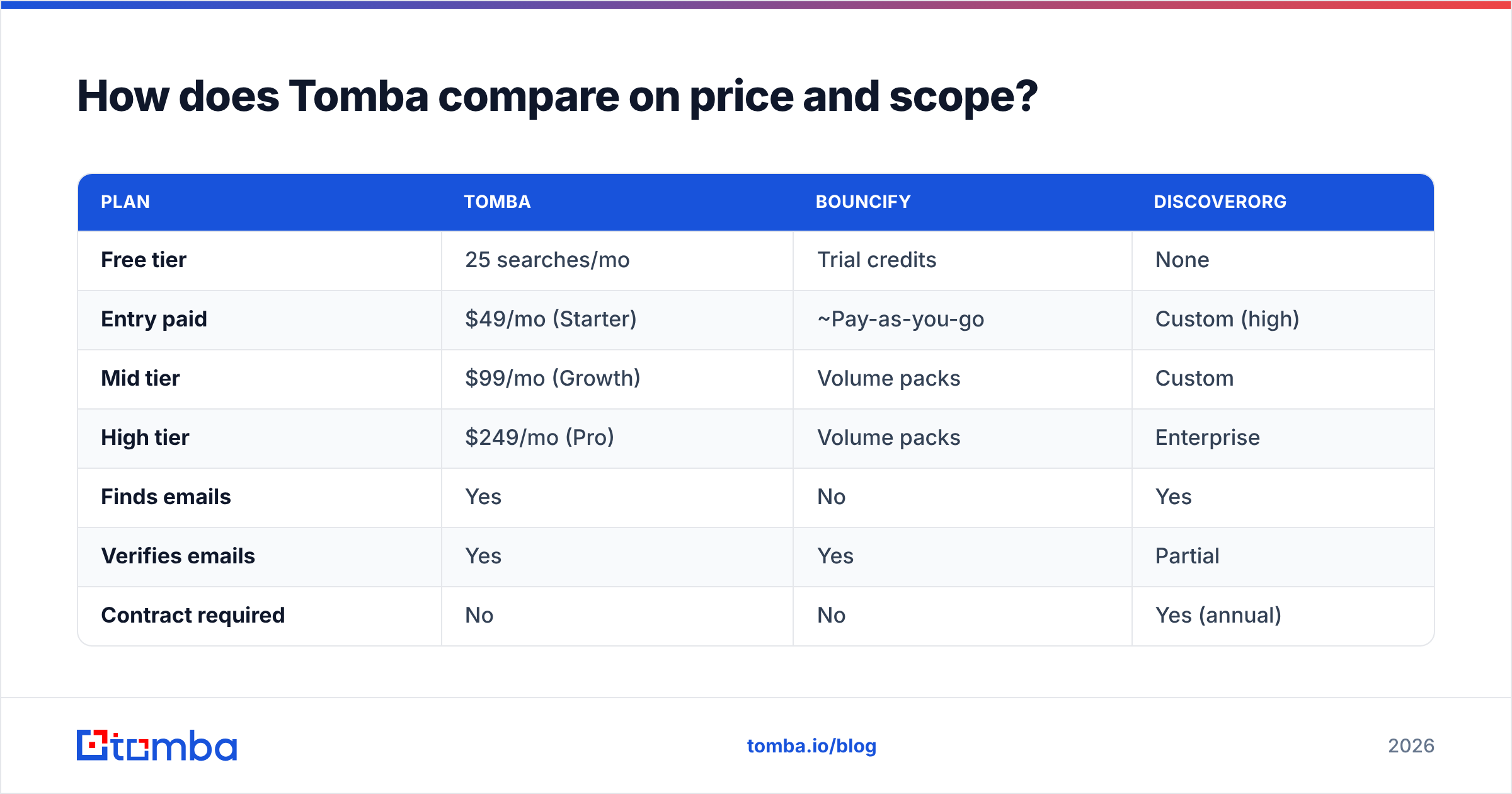
| Plan | Tomba | Bouncify | DiscoverOrg |
|---|---|---|---|
| Free tier | 25 searches/mo | Trial credits | None |
| Entry paid | $49/mo (Starter) | ~Pay-as-you-go | Custom (high) |
| Mid tier | $99/mo (Growth) | Volume packs | Custom |
| High tier | $249/mo (Pro) | Volume packs | Enterprise |
| Finds emails | Yes | No | Yes |
| Verifies emails | Yes | Yes | Partial |
| Contract required | No | No | Yes (annual) |
You can see full Tomba pricing without a sales call. The point isn't that Tomba beats DiscoverOrg on raw data depth — ZoomInfo's intent and org-chart data is genuinely deeper if that's your use case. The point is that for the common job — find verified B2B emails and keep the list clean — you don't need an enterprise contract or two separate subscriptions.
Independent reviews on G2 are a good sanity check here: read how teams describe their actual use case before you assume the biggest platform is the right one for yours.
Which tool should you pick?#
Decide by the problem in front of you, not the feature list:
- You have a dirty list and nothing else to solve. Bouncify, or Tomba's email verifier if you'd rather not add a second tool later.
- You're an enterprise ABM team with budget and need intent data. DiscoverOrg/ZoomInfo earns its price here.
- You need to find verified contacts and keep them clean, on a startup or SMB budget. A hybrid finder-plus-verifier is the lowest-friction, lowest-cost path.
The mistake is letting tool branding pick your workflow. Verification and data intelligence are different jobs. Map your actual bottleneck first — empty list, or dirty list — and the choice makes itself.
The bottom line#
Bouncify and DiscoverOrg aren't rivals; they're two stops on the same outbound assembly line. Bouncify cleans, DiscoverOrg sources, and most teams quietly need both. If you're tired of stitching a cheap verifier to an expensive data platform — or signing an annual contract for data depth you won't fully use — start with a tool that does the whole loop.
Try Tomba's Email Finder free with 25 searches a month: find professional emails by domain, name, or company, verify them in the same dashboard, and enrich the records before they hit your sequence. No contract, no sales call, and a starter plan at $49/mo when you're ready to scale. It's the find-and-verify half of your stack in one place — so you can stop comparing two tools that were never really the same tool.
// get started
Find, verify and enrich your first contacts today
Start on the free plan with 25 searches a month, then scale when your team is ready.
Free plan · No credit card required · GDPR & CCPA
// about the author