Bouncify vs Pubrio (2026): Which Tool Actually Wins?
Bouncify verifies email lists; Pubrio finds and enriches B2B leads. Here's an honest 2026 breakdown of pricing, accuracy, and which one your pipeline actually needs.
You found two tools with overlapping marketing copy and you want to know which one to pay for. The short answer is that Bouncify and Pubrio solve different problems, and picking between them depends on whether your bottleneck is cleaning a list you already have or building a list from scratch. This breakdown gives you the honest version — pricing, accuracy claims, data coverage, and where each one quietly falls short.
TL;DR — Bouncify vs Pubrio in 30 seconds#
- Bouncify is a focused email verification tool. You upload a list, it scrubs invalids, catch-alls, and spam traps, and hands it back. That's the whole job, and it does it cheaply.
- Pubrio is a B2B prospecting and data-enrichment platform. It finds contacts, pulls company data, and includes verification as one feature among many.
- They are not direct competitors. Comparing them is like comparing a car wash to a car dealership — both touch your vehicle, but you visit them for opposite reasons.
- Pricing: Bouncify is pay-as-you-go credits for verification; Pubrio sells monthly seats with credit limits for finding contacts.
- If you want one tool that finds and verifies without stitching two vendors together, a combined platform like Tomba usually ends up cheaper and simpler than running both.
What is Bouncify?#
Bouncify is an email verification service. Its entire purpose is to take a list of email addresses you already collected — from a signup form, a scraped export, a CRM dump — and tell you which ones are safe to send to.
A solid verifier runs each address through several checks: syntax validation, domain and MX-record lookups, SMTP handshake testing, and detection of disposable domains, role accounts (like info@ or sales@), and known spam traps. Bouncify covers these basics and emphasizes speed and bulk processing. You feed it a CSV, it returns a scored file with deliverable, undeliverable, risky, and unknown buckets.
The value is narrow but real: sending to a dirty list tanks your sender reputation, and once mailbox providers flag you, even your good emails land in spam. Verifying first keeps your bounce rate low enough that providers keep trusting you.
What Bouncify does not do is find emails for you. If you have a name and a company but no address, Bouncify is useless — it has nothing to verify yet.

What is Pubrio?#
Pubrio is a B2B lead-generation and data platform. Where Bouncify starts with your list, Pubrio starts with no list and helps you build one. You search by job title, industry, company size, or technology used, and it returns matching contacts with emails, company details, and enrichment data.
Pubrio's pitch is closer to the Apollo / ZoomInfo end of the market: a searchable B2B database plus enrichment, with email verification bundled in so the contacts it surfaces are (in theory) ready to send. It's built for SDRs and growth teams who need to generate prospects, not just sanitize an existing file.
That bundling is the key difference. Pubrio includes verification because a finder that hands you dead addresses is worthless — but verification is a supporting feature, not the product. Bouncify, by contrast, is only verification and tends to be more configurable and cheaper for that single task.
Bouncify vs Pubrio: the core differences#
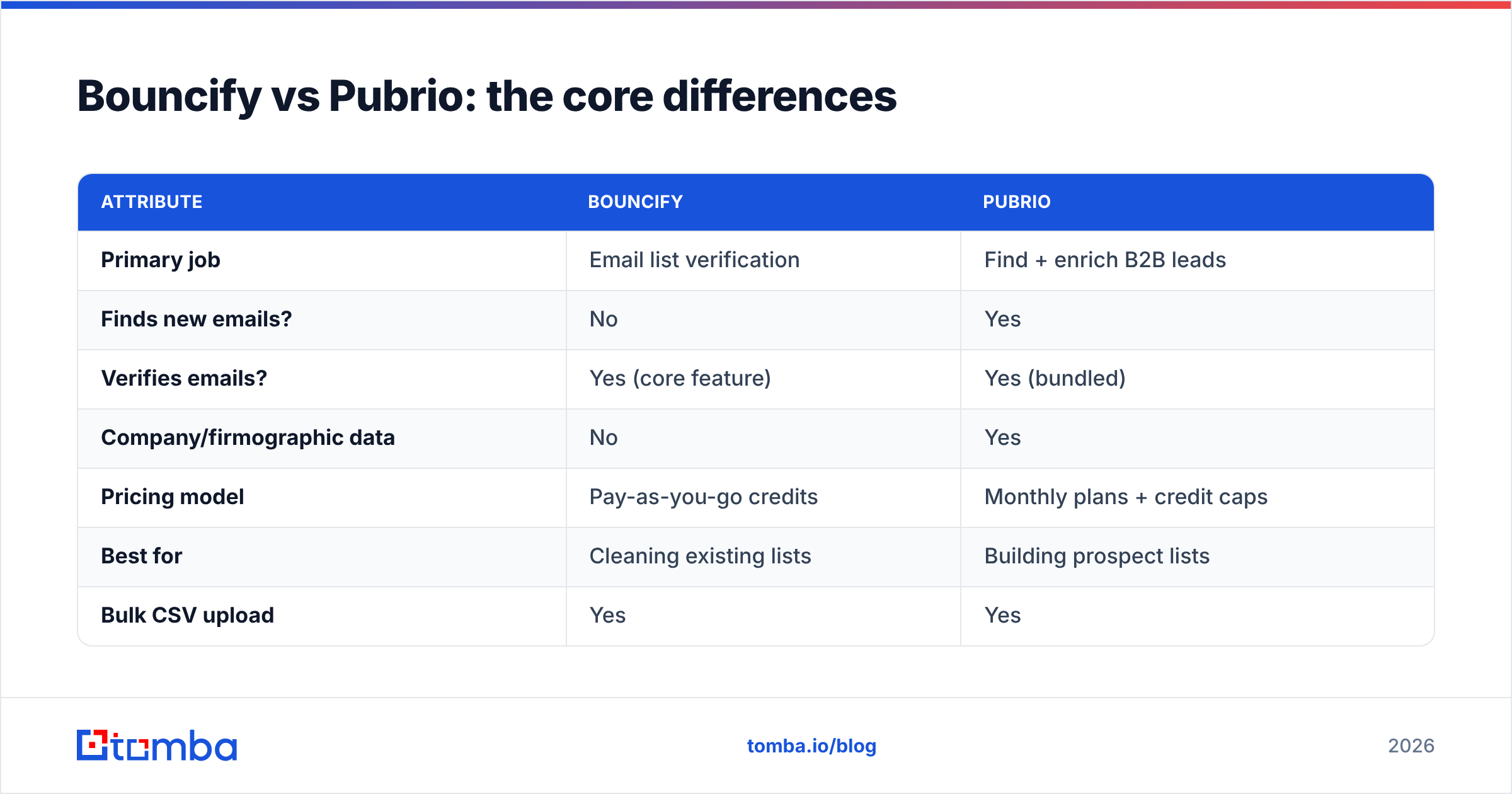
Here's the side-by-side. Read it as "different jobs" rather than "one is better."
| Attribute | Bouncify | Pubrio |
|---|---|---|
| Primary job | Email list verification | Find + enrich B2B leads |
| Finds new emails? | No | Yes |
| Verifies emails? | Yes (core feature) | Yes (bundled) |
| Company/firmographic data | No | Yes |
| Pricing model | Pay-as-you-go credits | Monthly plans + credit caps |
| Best for | Cleaning existing lists | Building prospect lists |
| Bulk CSV upload | Yes | Yes |
| API access | Yes | Yes |
| Free tier | Limited free credits | Limited free credits |
The pattern is clear: Bouncify is a specialist, Pubrio is a generalist. If you already have addresses and just need them clean, the specialist wins on price and simplicity. If you're starting from a blank sheet, the verifier alone can't help you.
Which one is more accurate?#
Accuracy means two different things here, so be careful when you read either vendor's marketing.
For Bouncify, accuracy = how reliably it labels a known address as deliverable or not. Verification accuracy is bounded by reality: any honest verifier will return a chunk of "unknown" or "risky" results on catch-all domains, because catch-all servers accept every address at the SMTP layer and reveal nothing. A verifier claiming 99%+ certainty on catch-alls is overselling. Judge Bouncify on how it handles the ambiguous cases, not on a headline percentage.
For Pubrio, accuracy = how often the emails it finds are real and current. That depends entirely on how fresh its underlying database is. B2B data decays fast — people change jobs constantly, and roughly a third of business contact data goes stale every year. A finder is only as good as its last refresh.
The practical takeaway: don't trust a single accuracy number from either tool. Run a sample. Export 100 contacts (or verify 100 known-good addresses) and check the results against your own send data. Vendors publish best-case figures; your list is not their best case.
A verification tool that says "yes" to everything is not accurate — it's just agreeable. Always test catch-all handling before you commit.
How does pricing compare?#
Bouncify and Pubrio price for their different jobs, which makes a head-to-head dollar comparison misleading unless you know what you actually need.
- Bouncify charges per verification, usually as credit packs that don't expire quickly. You pay roughly per thousand emails checked. For an occasional list cleanup, this is cheap — you might spend a few dollars to scrub a few thousand addresses.
- Pubrio charges monthly for access to its database and finder, with credits that reset each cycle. You're paying for the ability to discover contacts, not just to check them. That's a higher floor because the data itself is the expensive part.
The hidden cost most teams miss: if you use Bouncify, you still need a separate tool to find emails. So your real spend is Bouncify plus an email finder. If you use Pubrio, you get both — but you're locked into its database quality and monthly seat pricing whether you use the volume or not.
This is exactly where buying two single-purpose tools quietly becomes more expensive than one platform that does both.
When should you choose Bouncify?#
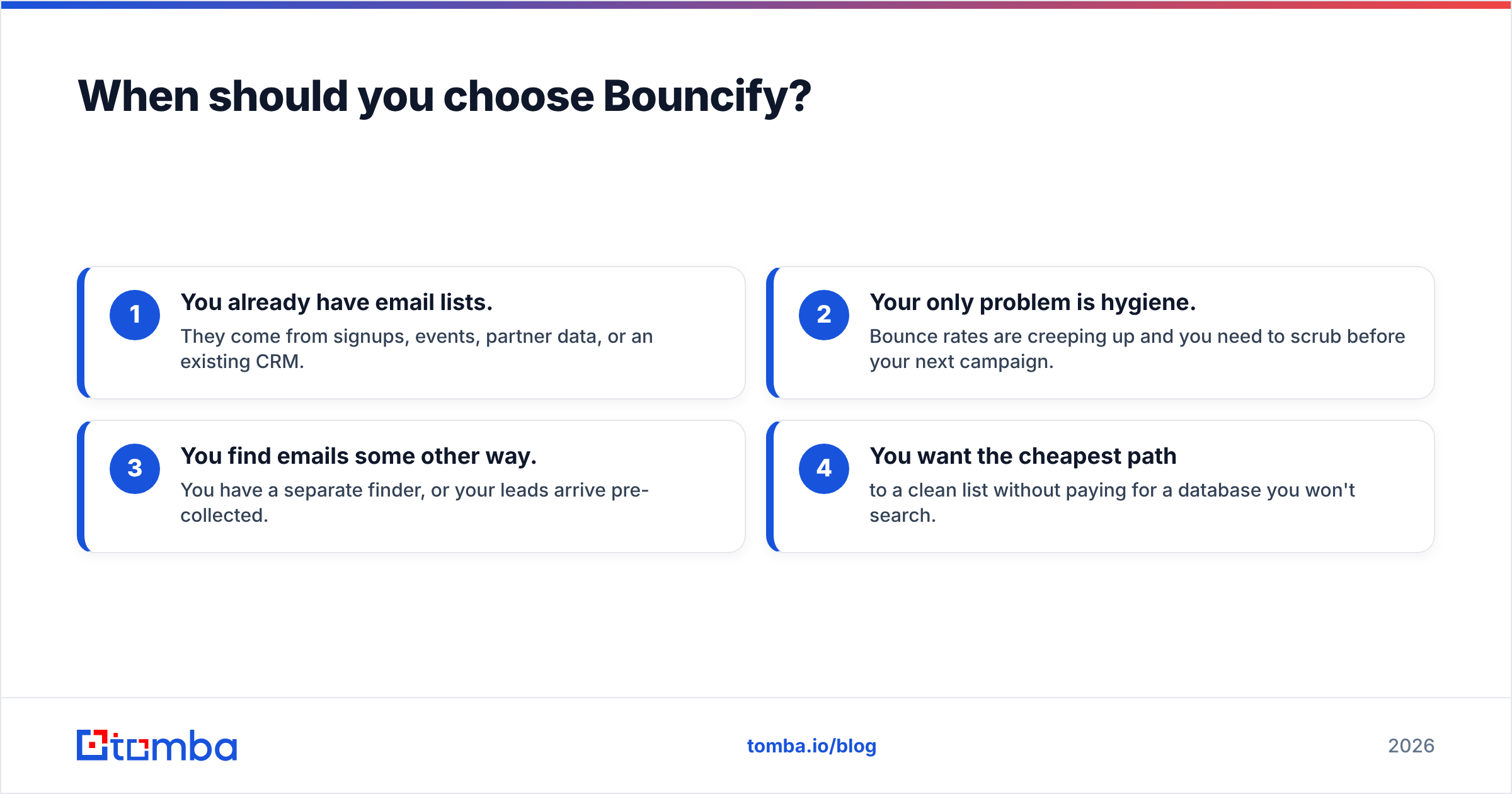
Choose Bouncify if all of these are true:
- You already have email lists. They come from signups, events, partner data, or an existing CRM.
- Your only problem is hygiene. Bounce rates are creeping up and you need to scrub before your next campaign.
- You find emails some other way. You have a separate finder, or your leads arrive pre-collected.
- You want the cheapest path to a clean list without paying for a database you won't search.
Bouncify is the right call for a marketer who exports a list quarterly and just wants it clean before importing into Mailchimp or HubSpot. It's a sharp, affordable tool for one specific cut.
When should you choose Pubrio?#
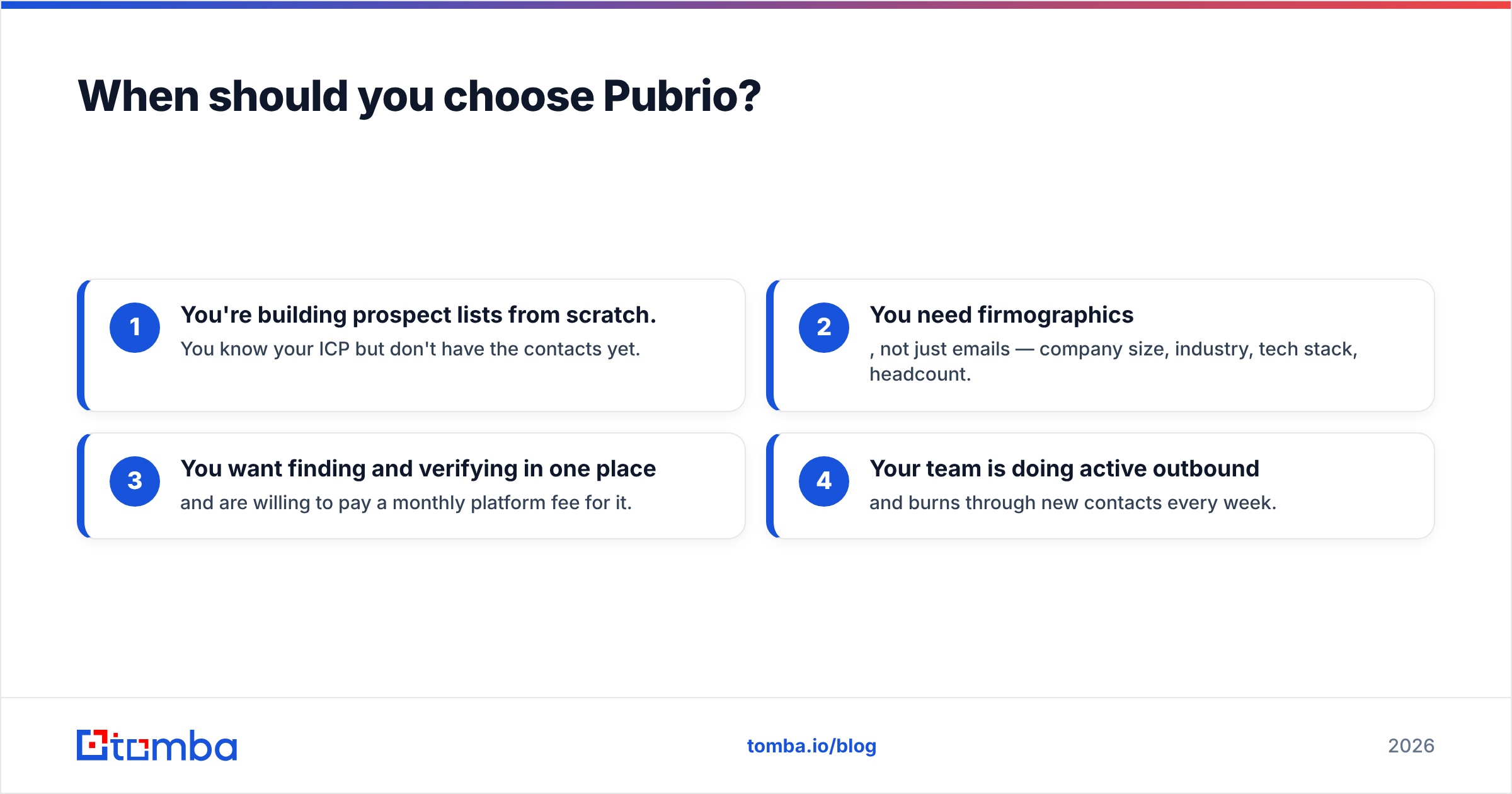
Choose Pubrio if all of these are true:
- You're building prospect lists from scratch. You know your ICP but don't have the contacts yet.
- You need firmographics, not just emails — company size, industry, tech stack, headcount.
- You want finding and verifying in one place and are willing to pay a monthly platform fee for it.
- Your team is doing active outbound and burns through new contacts every week.
Pubrio fits an SDR team that needs a constant supply of fresh, enriched leads and doesn't want to glue together a finder, an enrichment provider, and a verifier. The trade-off is database lock-in and a higher monthly commitment.
Is there a better option than both?#
For most teams running outbound, yes — a unified find-and-verify platform beats running a standalone verifier and a separate finder. This is where Tomba is worth a look, because it collapses the exact gap that Bouncify-plus-a-finder or Pubrio-by-itself leaves open.
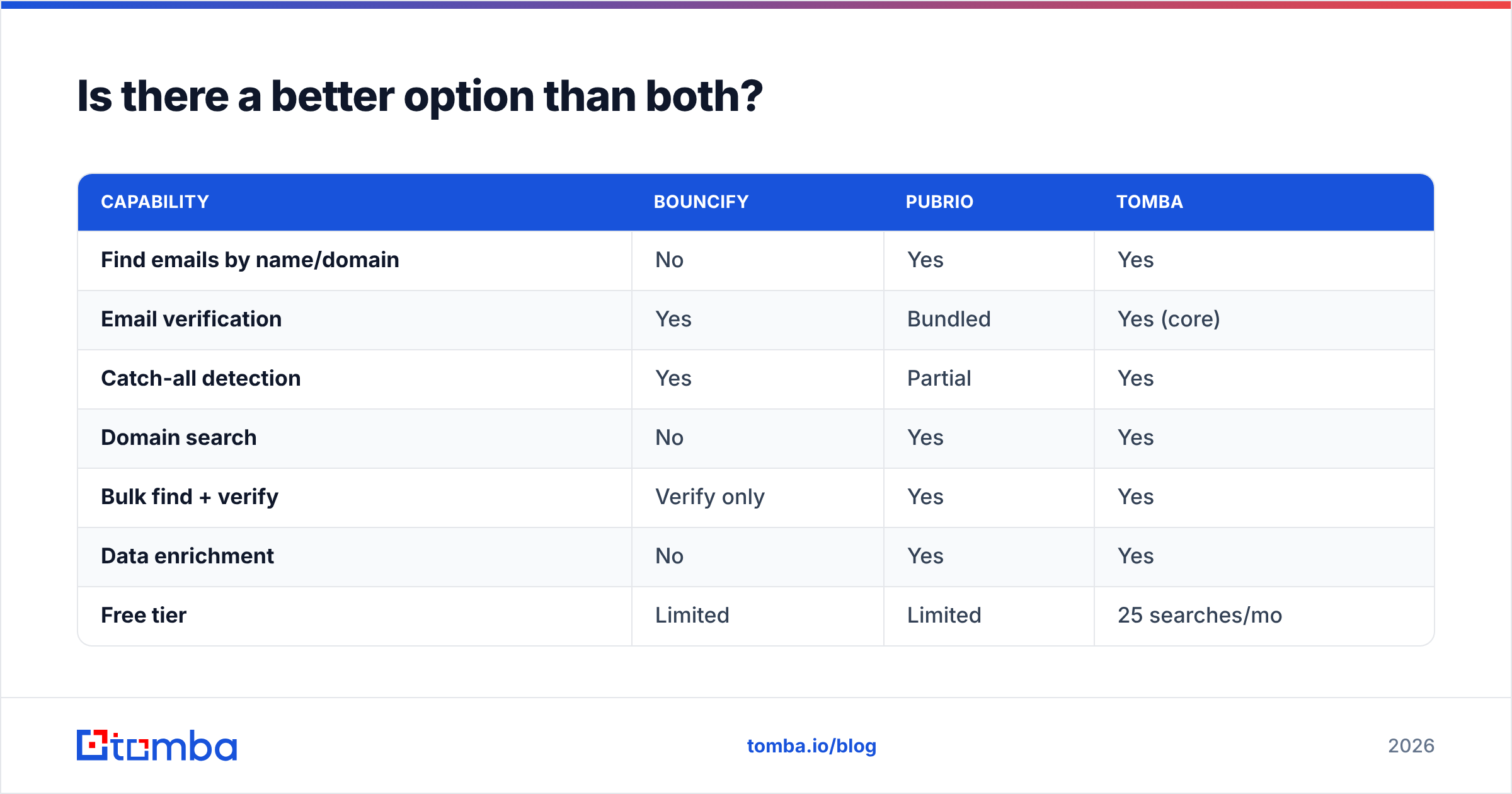
Here's the honest comparison across the three:
| Capability | Bouncify | Pubrio | Tomba |
|---|---|---|---|
| Find emails by name/domain | No | Yes | Yes |
| Email verification | Yes | Bundled | Yes (core) |
| Catch-all detection | Yes | Partial | Yes |
| Domain search | No | Yes | Yes |
| Bulk find + verify | Verify only | Yes | Yes |
| Data enrichment | No | Yes | Yes |
| Free tier | Limited | Limited | 25 searches/mo |
| Starter price | PAYG credits | Monthly seat | $49/mo |
Tomba's approach is to give you the email finder, domain search, verifier, catch-all handling, and data enrichment under one roof, with a real free tier (25 searches a month) so you can test accuracy before paying. Pricing is transparent — Free, then Starter at $49/mo, Growth at $99/mo, Pro at $249/mo, and Enterprise — which you can see in full on the Tomba pricing page.
The reason this matters isn't feature-counting. It's that find and verify are two halves of the same workflow. When you find an email, you want it verified in the same step, not exported, re-uploaded to a second tool, and re-imported. A single platform removes that handoff — and the duplicate billing that comes with it.
If you're a data engineer or you want this in your own pipeline, all of it is available through the Tomba API, so you can find and verify programmatically instead of through dashboards.
How to decide in practice#
Skip the feature spreadsheets and answer one question: do you have a list, or do you need one?
- Have a list, just need it clean? Bouncify is the cheapest specialist. Buy a credit pack, scrub, move on.
- Need to build lists and want enrichment? Pubrio is a legitimate finder-plus-database play — just test its data freshness on your ICP first.
- Doing both, repeatedly, and tired of two bills? A combined platform wins on cost and workflow. Run the same 50 prospects through each tool's free tier and compare the deliverable count — that's the number that actually predicts your reply rate.
One more honest note: whichever tool you pick, verification is not optional. Even the best finder produces some dead addresses, and even a clean list goes stale. Build verification into your routine, not as a one-time event. If you want to understand the mechanics behind why this protects your inbox placement, the fundamentals of email deliverability are worth ten minutes of reading.
For broader context on how the major data vendors stack up, independent review sites like G2 and Capterra are useful for cutting through vendor marketing — read the verified reviews, not the star averages. And if you're tuning your sending setup more deeply, HubSpot's deliverability guidance is a solid neutral primer.
The verdict#
Bouncify wins if your only job is cleaning a list. Pubrio wins if your job is finding and enriching leads. Neither is "better" in the abstract — they're built for opposite ends of the same workflow, and forcing a winner ignores what you actually need them to do.
But if you're like most outbound teams — finding contacts and verifying them, week after week — paying two vendors for two halves of one job is the expensive path. A unified tool that finds, verifies, and enriches in one place is almost always the smarter buy.
Ready to stop stitching tools together? Start free with the Tomba Email Finder — 25 searches a month, no card required — and find and verify your next 50 prospects in a single workflow. If the deliverable count beats your current stack, you'll know exactly which tool to keep.
Ready to find emails that actually work?
Join 150,000+ professionals who stopped guessing and started sending. Free credits on signup — no credit card required.
Get the Tomba newsletter
Practical outbound tactics and product updates — once every two weeks.
About the author