Bouncify vs Tomba 2026: Email Verifier Comparison Guide
Bouncify verifies lists; Tomba finds and verifies them. See how the two stack up on accuracy, pricing, and features so you pick the right tool for 2026.
Choosing between Bouncify and Tomba usually means you are at one of two stages: you already have a list and want it cleaned, or you are still building the list and need addresses in the first place. That distinction decides almost everything here.
TL;DR
- Bouncify is a focused, pay-as-you-go email verification service. It cleans lists you already own and does it cheaply.
- Tomba is a full prospecting platform: it finds business emails by name or domain, then verifies them, plus enriches and exports.
- If your only job is scrubbing an existing list, Bouncify is lean and inexpensive. If you need to source contacts and verify them in one workflow, Tomba covers the whole pipeline.
- Pricing models differ: Bouncify sells one-off credit packs, while Tomba pricing runs on monthly subscriptions starting at $49/mo with a free tier.
- For most outbound and lead-gen teams, the find-and-verify combination wins on total cost and fewer tools to manage.
What is Bouncify?#
Bouncify is a dedicated email verification tool. You upload a list (CSV, or paste addresses, or hit the API), and it checks each address against syntax rules, MX records, SMTP responses, and known bounce patterns, then hands back a status: deliverable, undeliverable, risky, or unknown.
Its appeal is simplicity. There is no prospecting layer, no CRM, no finder. You bring the emails; Bouncify tells you which ones are safe to send to. Pricing is credit-based and pay-as-you-go, which suits teams that verify in occasional batches rather than continuously. You can read its current feature set on the official Bouncify site.
Where Bouncify stops is also clear: it cannot generate an address you do not already have. If your spreadsheet is empty, Bouncify has nothing to work with.
What is Tomba?#
Tomba is a B2B email-finder and lead-enrichment platform. Its core job is the opposite starting point from Bouncify: you give it a name and a company (or just a domain), and it returns the professional email address. Then it verifies that address before you ever load it into a sequence.
Around that core sit several tools: an email verifier for cleaning lists you already have, domain search for pulling every public address at a company, a catch-all verifier for the tricky domains that accept everything, plus phone finding and data enrichment. The point is that finding and verifying live in the same place.
So the honest framing is not "which tool is better" but "which problem are you solving." Bouncify solves one slice. Tomba solves the slice plus everything upstream of it.

How do Bouncify and Tomba compare head-to-head?#
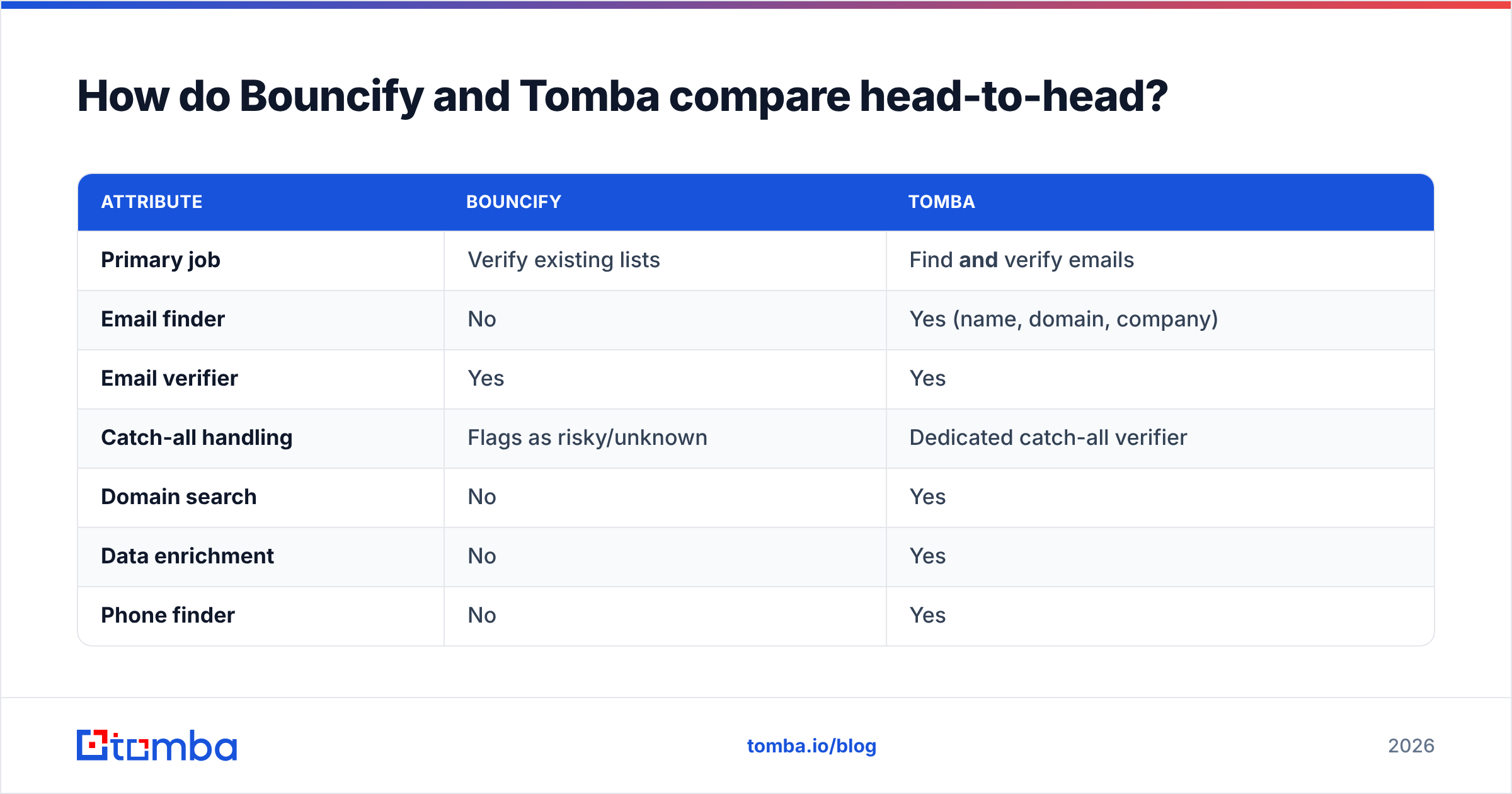
Here is the side-by-side on the attributes that actually change your buying decision.
| Attribute | Bouncify | Tomba |
|---|---|---|
| Primary job | Verify existing lists | Find and verify emails |
| Email finder | No | Yes (name, domain, company) |
| Email verifier | Yes | Yes |
| Catch-all handling | Flags as risky/unknown | Dedicated catch-all verifier |
| Domain search | No | Yes |
| Data enrichment | No | Yes |
| Phone finder | No | Yes |
| Pricing model | Pay-as-you-go credits | Monthly plans + free tier |
| Free option | Trial credits | 25 searches/mo, ongoing |
| API access | Yes | Yes (REST API) |
| Best for | Pure list cleaning | End-to-end prospecting |
The table makes the split obvious. Bouncify wins on focus and a low entry cost for one-off verification. Tomba wins on coverage: it replaces both a finder and a verifier, which is where the real cost savings show up if you currently pay for two products.
Is Tomba better than Bouncify for accuracy?#
For verification accuracy alone, both tools do the same fundamental work: SMTP checks, MX lookups, syntax validation, role-account detection, and disposable-domain flagging. Neither has a magic trick the other lacks at the raw protocol level.
The meaningful difference is catch-all domains. A catch-all server accepts every address at the domain, so a normal SMTP check returns "ok" even for an address that does not exist. Most verifiers, Bouncify included, flag these as "risky" or "unknown" and leave the judgment to you. Tomba runs a separate catch-all verification step that uses additional signals to estimate validity rather than dumping everything into an "unknown" bucket.
That matters because catch-alls are common in enterprise domains. If a large share of your list is "unknown," your effective accuracy drops even when the verifier is technically correct. Resolving more of those addresses is where Tomba pulls ahead in practice.
The second accuracy factor is upstream: Tomba verifies at the moment of finding. An address that was sourced and validated together tends to be fresher than one sitting in a spreadsheet for six months. You can compare independent user accuracy reports for both categories on G2 before committing.
How does pricing compare?#
Pricing is where the two diverge most, because the models are built for different buyers.
Bouncify sells credits in packs. You pay once, verify a batch, and the credits sit until you use them. This is genuinely cheaper if you verify, say, one 50,000-row list per quarter and do nothing else. There is no recurring charge to forget about.
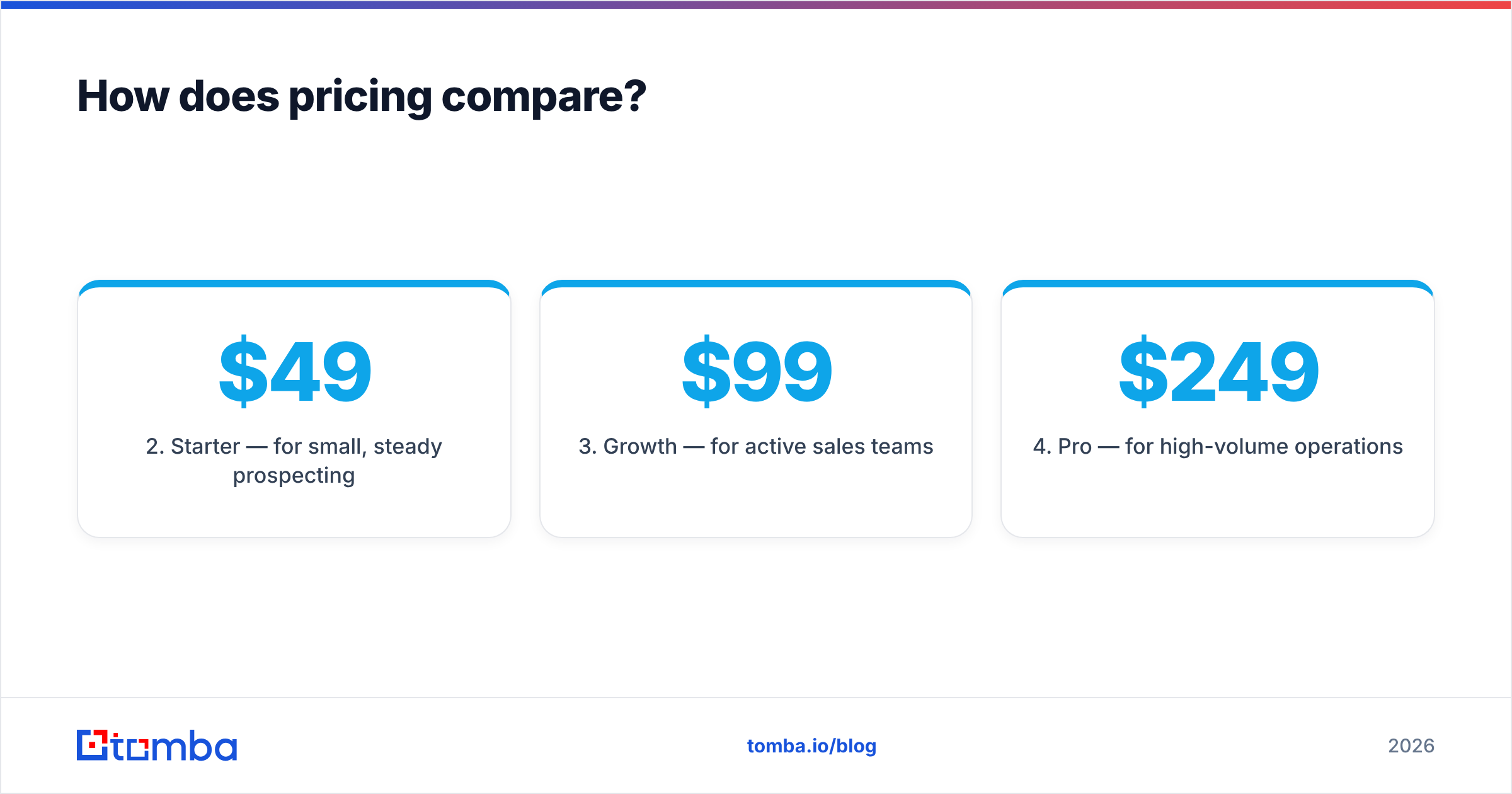
Tomba runs on monthly subscriptions because finding is a continuous activity, not a one-off. Here is the structure:
- Free — 25 searches per month, ongoing, good for testing.
- Starter — $49/mo for small, steady prospecting.
- Growth — $99/mo for active sales teams.
- Pro — $249/mo for high-volume operations.
- Enterprise — custom pricing for large teams and data contracts.
The comparison is not apples to apples. If you only verify, Bouncify's pay-as-you-go can undercut a subscription. But if you are paying separately for an email finder (Apollo, Hunter, RocketReach) and a verifier (Bouncify, ZeroBounce), Tomba's single subscription usually costs less than the two combined, and you manage one tool instead of two. Run your own numbers against the Tomba plans before deciding.
When should you choose Bouncify?#
Pick Bouncify when all of the following are true:
- You already have the emails. Your list comes from sign-ups, events, an existing CRM export, or a partner — you are not sourcing new contacts.
- Verification is occasional. You clean lists in batches a few times a year, not daily.
- You want zero subscription overhead. Credit packs that never expire fit irregular usage better than a monthly bill.
- You need one job done well. No interest in finders, enrichment, or CRM features — just clean addresses.
In that scenario Bouncify is a sharp, cost-effective tool and adding a platform like Tomba would be overkill.
When should you choose Tomba?#
Pick Tomba when any of the following apply:
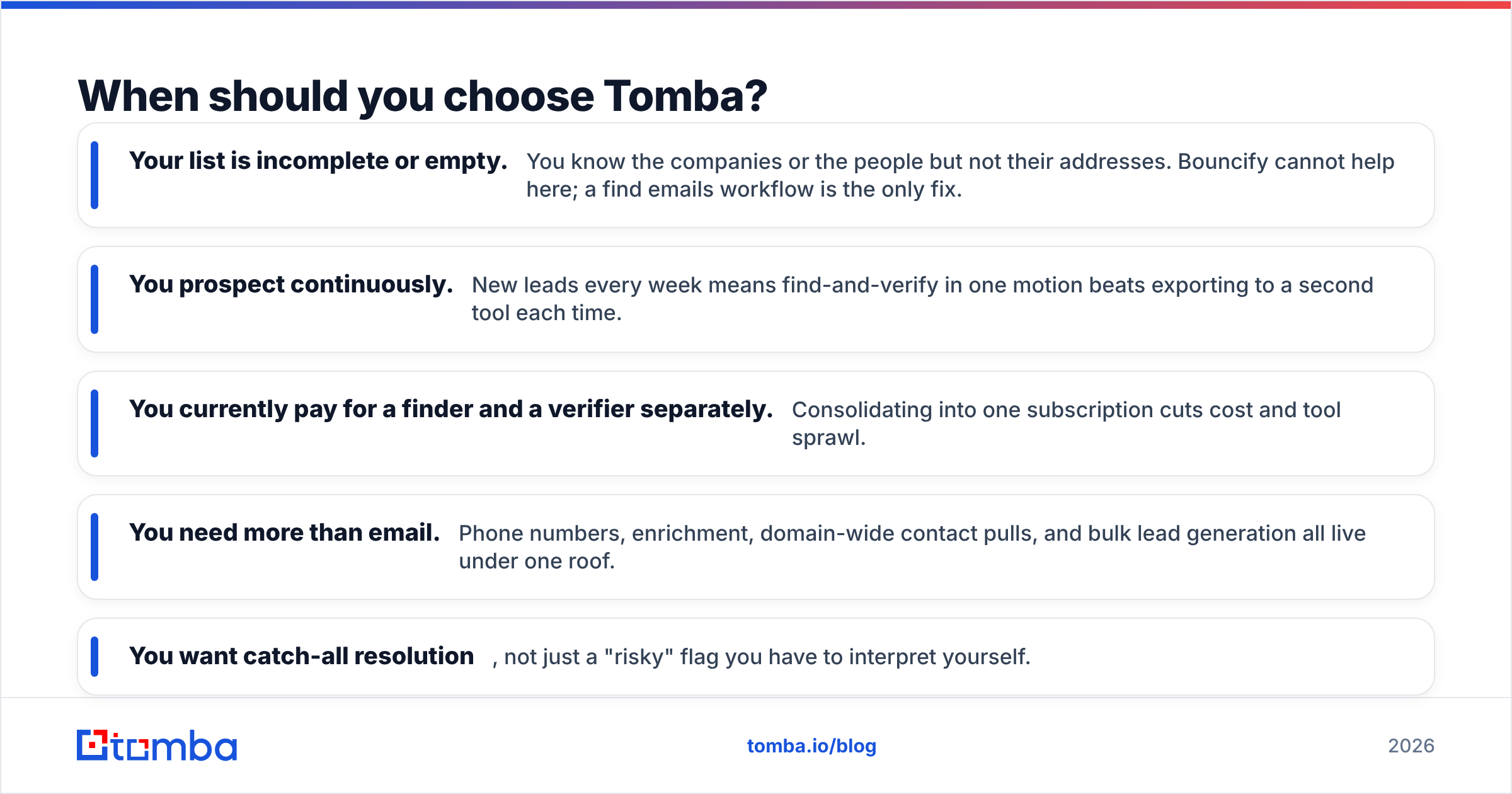
- Your list is incomplete or empty. You know the companies or the people but not their addresses. Bouncify cannot help here; a find emails workflow is the only fix.
- You prospect continuously. New leads every week means find-and-verify in one motion beats exporting to a second tool each time.
- You currently pay for a finder and a verifier separately. Consolidating into one subscription cuts cost and tool sprawl.
- You need more than email. Phone numbers, enrichment, domain-wide contact pulls, and bulk lead generation all live under one roof.
- You want catch-all resolution, not just a "risky" flag you have to interpret yourself.
For most sales, recruiting, and lead-gen teams in 2026, the second list describes the real workflow.
What about the verification step specifically?#
If you are leaning Tomba but worry it is "a finder that bolts on verification as an afterthought," it is worth being precise: Tomba's email verification is a first-class feature, not a checkbox. It runs the same SMTP and MX checks Bouncify does, supports bulk uploads, and exposes an API so you can verify programmatically inside your own pipeline.
So you do not lose verification quality by choosing Tomba; you gain the finding layer on top. The only thing you give up versus Bouncify is the pure pay-as-you-go pricing — and that only matters if verification is genuinely all you will ever do.
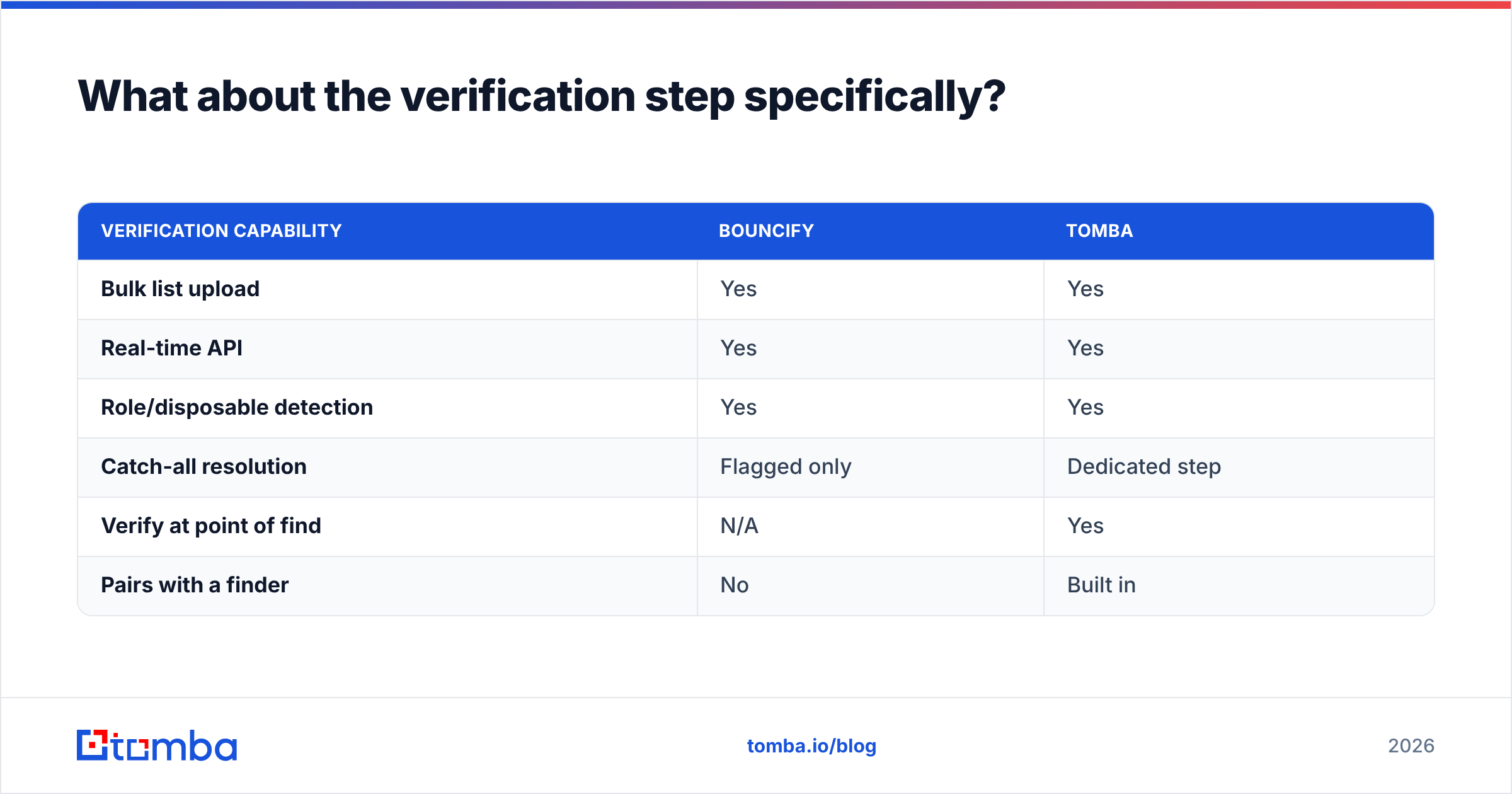
| Verification capability | Bouncify | Tomba |
|---|---|---|
| Bulk list upload | Yes | Yes |
| Real-time API | Yes | Yes |
| Role/disposable detection | Yes | Yes |
| Catch-all resolution | Flagged only | Dedicated step |
| Verify at point of find | N/A | Yes |
| Pairs with a finder | No | Built in |
Can you use both together?#
Yes, and some teams do — but it is usually redundant. The common pattern is using a finder to source contacts, then routing the output through Bouncify before sending. That works, but it is exactly the two-tool setup Tomba is designed to collapse. If you already own Bouncify credits, there is no harm in finishing them. When they run out, the question becomes whether a second verification subscription earns its place next to a platform that already verifies.
The cleaner long-term setup for most teams is a single platform that finds, verifies, and enriches, with the verifier available standalone for the occasional imported list. That removes the export-import handoff where data goes stale and addresses get dropped.
The verdict: Bouncify vs Tomba#
Bottom line: match the tool to your starting point. If you have a list and only need it cleaned occasionally, Bouncify is a lean, affordable verifier and a perfectly good choice. If you need to build lists, verify them, and keep prospecting week after week, Tomba does the whole job and typically replaces two separate subscriptions in the process.
The decision is rarely about verification quality, since both do that competently. It is about scope. Bouncify is a scalpel for one task. Tomba is the workbench for the entire find-verify-enrich pipeline.
If your real bottleneck is getting the right addresses rather than just cleaning the ones you have, start with the Tomba Email Finder. The free tier gives you 25 searches a month to test accuracy on your own target accounts before you commit to a plan — find the contacts, verify them in the same step, and skip the second tool entirely.
// get started
Find, verify and enrich your first contacts today
Start on the free plan with 25 searches a month, then scale when your team is ready.
Free plan · No credit card required · GDPR & CCPA
// about the author