Bouncify vs UpLead 2026: Verify or Prospect First?
Bouncify cleans your email list; UpLead builds it. They solve opposite problems. Here's which one your pipeline actually needs in 2026 — and why most teams pick wrong.
Most "Bouncify vs UpLead" comparisons treat these as rival products. They aren't. One verifies emails you already have; the other sells you contacts you don't. Picking between them without understanding that gap is how teams end up paying for the wrong half of their pipeline.
This breakdown shows what each tool actually does, where they overlap (barely), what they cost, and when a single platform that does both makes more sense than stitching two subscriptions together.
TL;DR — Bouncify vs UpLead at a glance#
- Bouncify is an email verifier. It takes a list you already own and tells you which addresses are deliverable. It does not find new contacts.
- UpLead is a B2B prospecting database. It hands you contacts, company data, and intent signals. Verification is a built-in step, not the core product.
- They sit at opposite ends of the funnel. Bouncify = list hygiene. UpLead = list building. You can use both; they rarely replace each other.
- Pricing models differ sharply. Bouncify is pay-as-you-go per verification (cheap at low volume). UpLead is credit-based per revealed contact (expensive at scale).
- If you want finding, verifying, and enrichment in one place, a consolidated platform like Tomba usually beats running a verifier and a data vendor side by side.
What is Bouncify and who is it for?#
Bouncify is a dedicated email verification service. You upload a CSV or hit the API, and it runs each address through syntax checks, MX-record lookups, SMTP handshakes, and spam-trap/disposable detection. The output is a deliverability verdict — deliverable, undeliverable, risky, or unknown — so you can scrub a list before you send.
That's the whole job. Bouncify doesn't generate leads, enrich records with firmographics, or tell you who to email. It assumes you already have addresses from a CRM export, a webinar signup list, a scraped source, or another tool.
Bouncify fits you if:
- You run high-volume email campaigns and need to protect sender reputation.
- You already have a steady inbound source of addresses to clean.
- You want a no-frills, low-cost verifier with a simple API.
It does not fit you if your actual problem is "I don't have enough contacts to email." That's a sourcing problem, and a verifier can't solve it.
What is UpLead and who is it for?#
UpLead is a B2B contact and company database. You filter by industry, title, location, company size, technology used, and intent signals, then reveal verified contact details — emails, sometimes direct dials — spending a credit per contact. Its pitch is real-time email verification at the point of reveal, so the data you pull is checked before it lands in your CRM.
UpLead is a list-building tool first. Verification is bundled, but you're paying primarily for access to its database of companies and people, not for hygiene on lists you already own.
UpLead fits you if:
- You're starting outbound from scratch and need net-new contacts.
- You want firmographic and technographic filters to target accounts.
- You value verified-on-reveal data over importing and cleaning separately.
It does not fit you if you already have a large list and just need it cleaned — paying per-contact reveal credits to re-verify owned data is the wrong tool for that job.

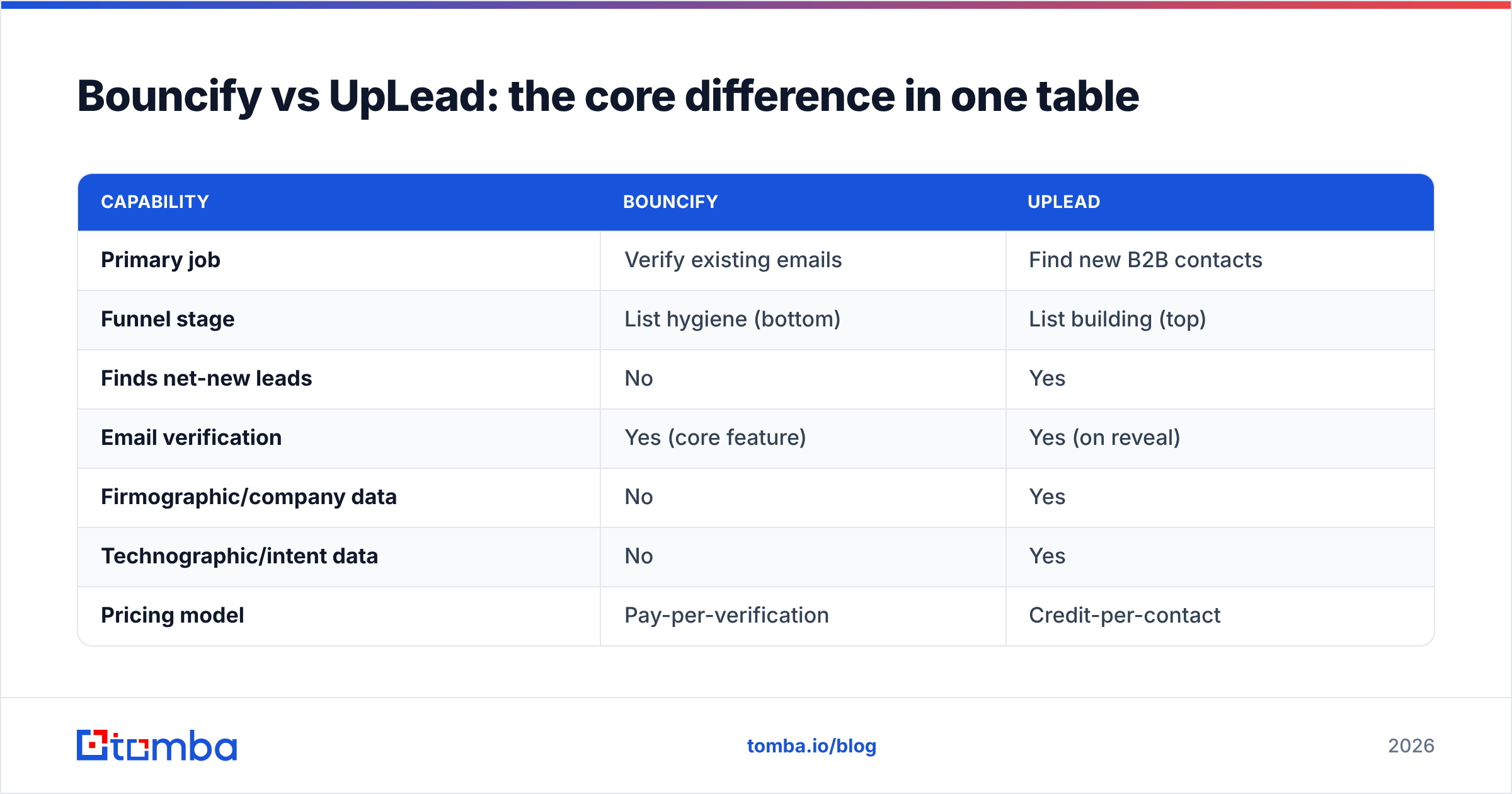
Bouncify vs UpLead: the core difference in one table#
The cleanest way to see why these tools aren't interchangeable is to line up what each one is built to do.
| Capability | Bouncify | UpLead |
|---|---|---|
| Primary job | Verify existing emails | Find new B2B contacts |
| Funnel stage | List hygiene (bottom) | List building (top) |
| Finds net-new leads | No | Yes |
| Email verification | Yes (core feature) | Yes (on reveal) |
| Firmographic/company data | No | Yes |
| Technographic/intent data | No | Yes |
| Pricing model | Pay-per-verification | Credit-per-contact |
| Best entry price | ~$0.0004–$0.005/email | From ~$99/mo (credits) |
| API access | Yes | Yes |
| Catch-all handling | Flags as risky | Flags as risky |
Read that table top to bottom and the verdict writes itself: Bouncify is what you run after you have a list; UpLead is what you run to get one. Asking "which is better" is like asking whether a dishwasher beats a grocery store.
How do they compare on accuracy and data quality?#
Accuracy means different things for each tool, so judge them on their own job.
For Bouncify, accuracy is the verification verdict's reliability. The hard case for every verifier is the catch-all domain — a server configured to accept mail for any address, so an SMTP probe can't confirm a specific mailbox exists. Bouncify flags these as "risky" or "unknown," which is honest but leaves you to decide. If catch-alls are a large share of your list (common in enterprise B2B), you'll want a dedicated catch-all verifier that goes deeper than a binary flag.
For UpLead, accuracy is whether the contact it sells you is real and current. Verified-on-reveal is a genuine strength — you're not importing stale rows and discovering the bounce later. The trade-off is database coverage. No B2B data vendor has every contact, and coverage skews toward larger US companies and common roles. Niche industries, non-US regions, and unusual titles get thinner.
A practical reality: even verified-on-reveal data decays. People change jobs every few years, so a list pulled in January is measurably worse by June. That's exactly why verification and enrichment are ongoing processes, not one-time events — and why owning both capabilities matters more than which single vendor you start with.
Bouncify vs UpLead pricing: which is cheaper?#
It depends entirely on the job, because the two meter completely differently.
Bouncify charges per verification on a pay-as-you-go or subscription basis, with per-email cost dropping as volume rises — often a fraction of a cent each. For cleaning a large owned list, this is cheap. You pay only for what you verify.
UpLead charges credits, where one credit roughly equals one revealed contact. Plans start around $99/month for a credit bucket. That's reasonable for targeted prospecting but expensive if you try to use it as a bulk verifier, since you'd burn reveal credits on data you already own.
The mistake teams make is comparing the headline prices. Verifying 100,000 owned emails through Bouncify might cost a few hundred dollars. Revealing 100,000 contacts through UpLead would cost vastly more — but you'd be acquiring 100,000 contacts, not cleaning them. Different value, different price. Compare cost-per-job, not cost-per-month.
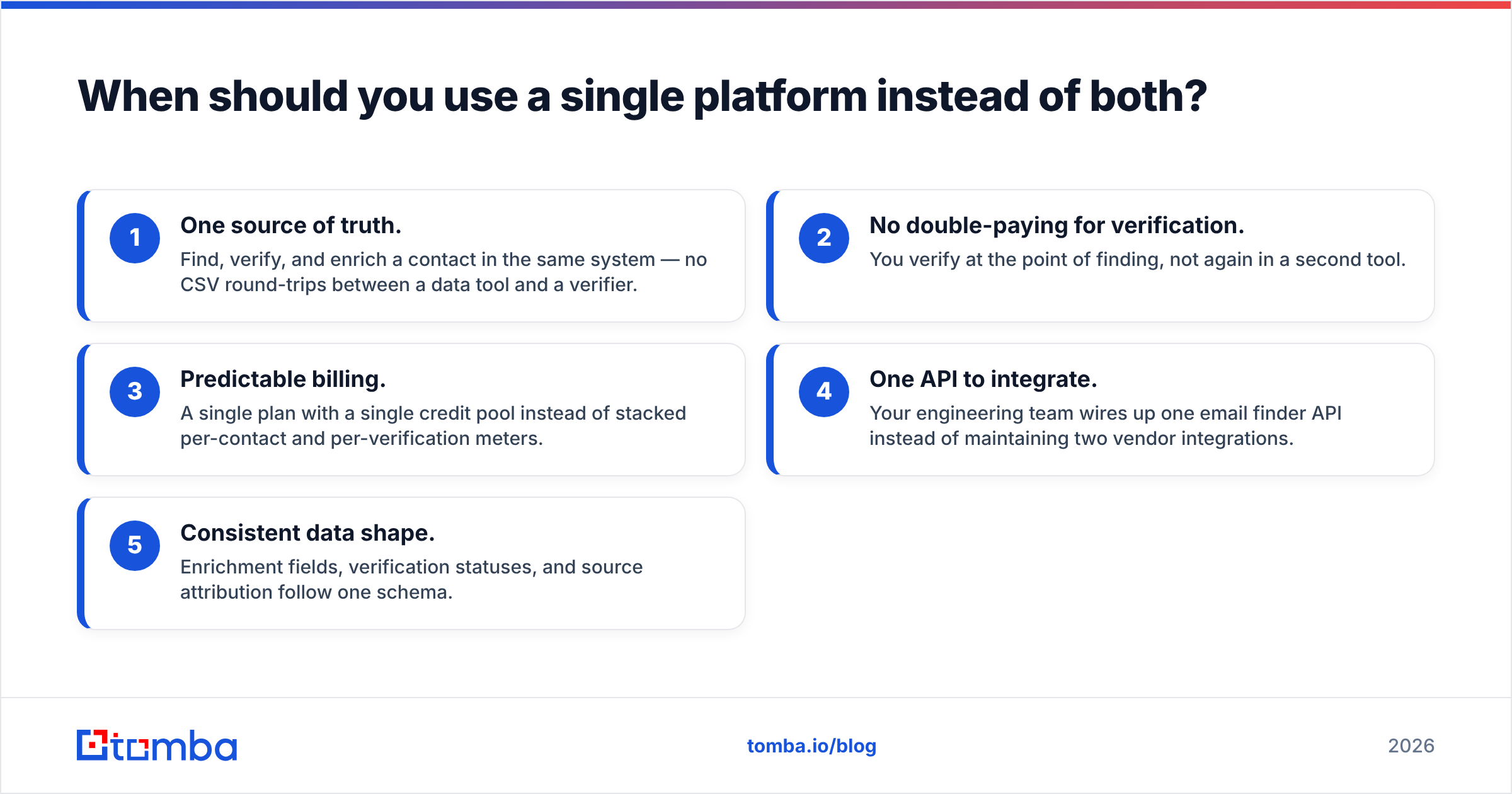
When should you use a single platform instead of both?#
When you find yourself paying for a data vendor and a separate verifier and maybe an enrichment tool, the integration tax starts to outweigh the best-of-breed benefit. Three logins, three billing cycles, three APIs, and data that has to be reconciled across all of them.
This is where a consolidated platform earns its place. Here's what running one stack instead of three changes, in practice:
- One source of truth. Find, verify, and enrich a contact in the same system — no CSV round-trips between a data tool and a verifier.
- No double-paying for verification. You verify at the point of finding, not again in a second tool.
- Predictable billing. A single plan with a single credit pool instead of stacked per-contact and per-verification meters.
- One API to integrate. Your engineering team wires up one email finder API instead of maintaining two vendor integrations.
- Consistent data shape. Enrichment fields, verification statuses, and source attribution follow one schema.
Tomba is built for exactly this overlap. It finds professional emails by name or domain, verifies them, runs catch-all verification, and enriches records with company and contact data — the jobs Bouncify and UpLead split between them, in one workflow.
How does Tomba compare to Bouncify and UpLead?#
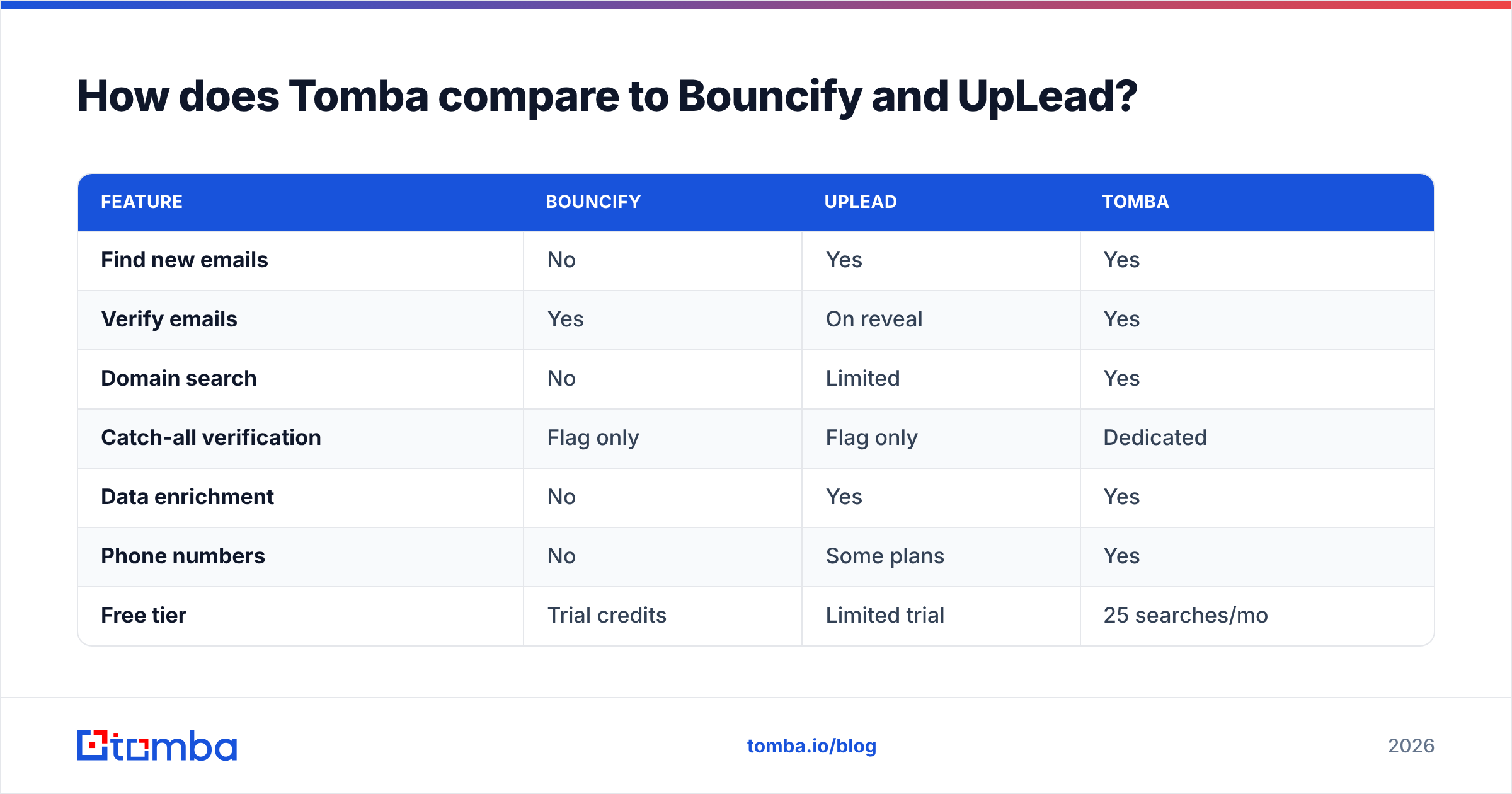
Tomba covers both ends of the funnel that Bouncify and UpLead each handle separately. Here's the honest three-way breakdown.
| Feature | Bouncify | UpLead | Tomba |
|---|---|---|---|
| Find new emails | No | Yes | Yes |
| Verify emails | Yes | On reveal | Yes |
| Domain search | No | Limited | Yes |
| Catch-all verification | Flag only | Flag only | Dedicated |
| Data enrichment | No | Yes | Yes |
| Phone numbers | No | Some plans | Yes |
| Free tier | Trial credits | Limited trial | 25 searches/mo |
| Starter price | Pay-as-you-go | ~$99/mo | $49/mo |
| Bulk processing | Yes | Credit-limited | Yes |
A few honest caveats. If your only job is verifying a massive list and nothing else, a pure-play verifier like Bouncify at fractions of a cent per email can be marginally cheaper at extreme volume. And if you need the deepest possible intent-and-technographic targeting filters, a dedicated data platform may surface signals a generalist won't. Tomba's argument isn't "best at every single sub-task" — it's "covers the realistic end-to-end job of most outbound teams without three subscriptions."
You can see the full Tomba pricing tiers — Free (25 searches/mo), Starter at $49/mo, Growth at $99/mo, Pro at $249/mo, and Enterprise — and run bulk email finding and verification from the same dashboard. For teams currently stitching a verifier to a data vendor, that consolidation is usually the real win.
Which one should you actually choose?#
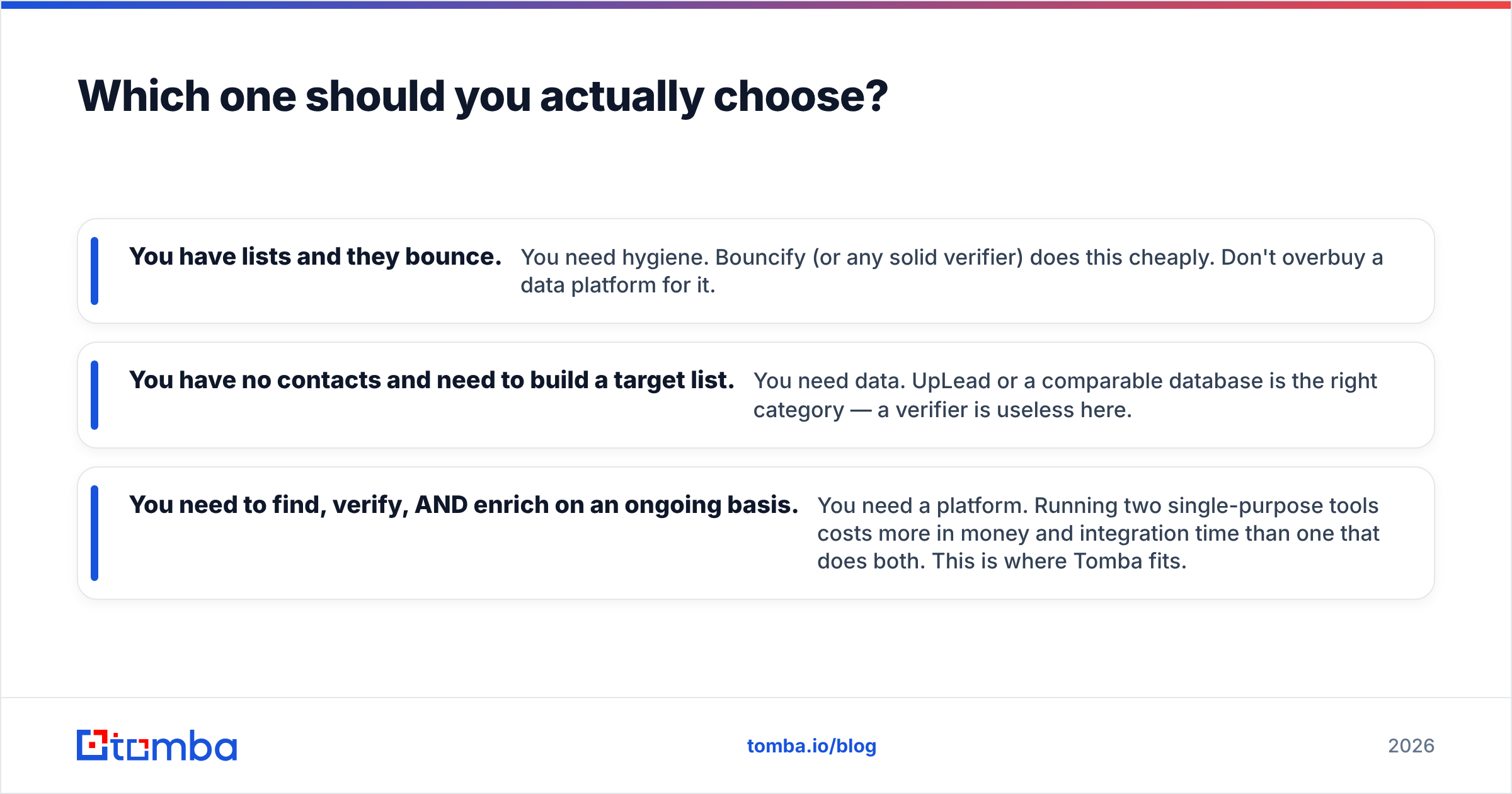
Match the tool to the problem, not the brand:
- You have lists and they bounce. You need hygiene. Bouncify (or any solid verifier) does this cheaply. Don't overbuy a data platform for it.
- You have no contacts and need to build a target list. You need data. UpLead or a comparable database is the right category — a verifier is useless here.
- You need to find, verify, AND enrich on an ongoing basis. You need a platform. Running two single-purpose tools costs more in money and integration time than one that does both. This is where Tomba fits.
The framing trap is treating "Bouncify vs UpLead" as a winner-take-all fight. It isn't. They're complementary point solutions. The real decision is whether your team is better served by assembling point solutions or by consolidating into one platform — and for most outbound teams running modern pipelines, consolidation wins on cost, speed, and sanity.
Check vendor reviews on G2 and trial each tool against your own list before committing; published accuracy numbers are marketing until they survive contact with your data.
The bottom line#
Bouncify cleans lists. UpLead builds them. Neither replaces the other, and comparing their prices head-to-head is comparing two different jobs. If you only ever do one of those jobs, buy the specialist for it. If you do both — and most growing sales teams do — a single platform that finds, verifies, and enriches will out-perform a two-vendor stack on total cost and operational drag.
Ready to stop paying two subscriptions for one workflow? The Tomba Email Finder finds professional emails by name, company, or domain, verifies them on the spot, and enriches the record — list-building and list-hygiene in one place. Start free with 25 searches a month and see whether one tool can replace the two you're juggling.
Ready to find emails that actually work?
Join 150,000+ professionals who stopped guessing and started sending. Free credits on signup — no credit card required.
Get the Tomba newsletter
Practical outbound tactics and product updates — once every two weeks.
About the author