Bouncify vs Zintlr (2026): Verification vs Intelligence
Bouncify cleans your list; Zintlr finds the contacts. We break down pricing, accuracy, and use cases so you know which one (if either) your 2026 stack actually needs.
You typed "Bouncify vs Zintlr" into a search bar expecting a head-to-head. Here is the uncomfortable truth up front: these two tools barely compete. One scrubs bad addresses out of a list you already own. The other tries to build that list for you in the first place. Choosing between them without understanding that gap is how teams end up paying for two subscriptions that still leave a hole in the middle of their workflow.
This guide treats both honestly, shows where each one earns its price, and explains why a single platform often replaces the awkward Bouncify-plus-Zintlr pairing.
TL;DR#
- Bouncify is an email verification tool. It validates addresses you already have and reduces bounce rates. It does not find new contacts.
- Zintlr is a sales intelligence / prospecting platform. It surfaces contact data and company info. Verification depth is a secondary feature, not the core.
- They solve different problems. "Bouncify vs Zintlr" is really "cleaning vs sourcing" — most teams need both functions, not one tool.
- Pricing models differ sharply: Bouncify charges per verification credit; Zintlr sells seat-based intelligence plans.
- An all-in-one finder + verifier (like Tomba Email Finder) often covers both jobs at a lower combined cost.
What is Bouncify?#
Bouncify is a dedicated email verification service. You upload a list — exports from your CRM, a webinar signup sheet, an old newsletter database — and it checks each address against SMTP servers, syntax rules, and known spam-trap and disposable-domain databases. The output is a clean list segmented into deliverable, risky, and undeliverable buckets.
Think of Bouncify like a bouncer at a club door. It does not bring guests to the party; it only decides who already standing in line gets let in. That is genuinely useful work. A 3% bounce rate can wreck your sender reputation, and mailbox providers punish senders who repeatedly hit dead addresses.
Where Bouncify is strong:
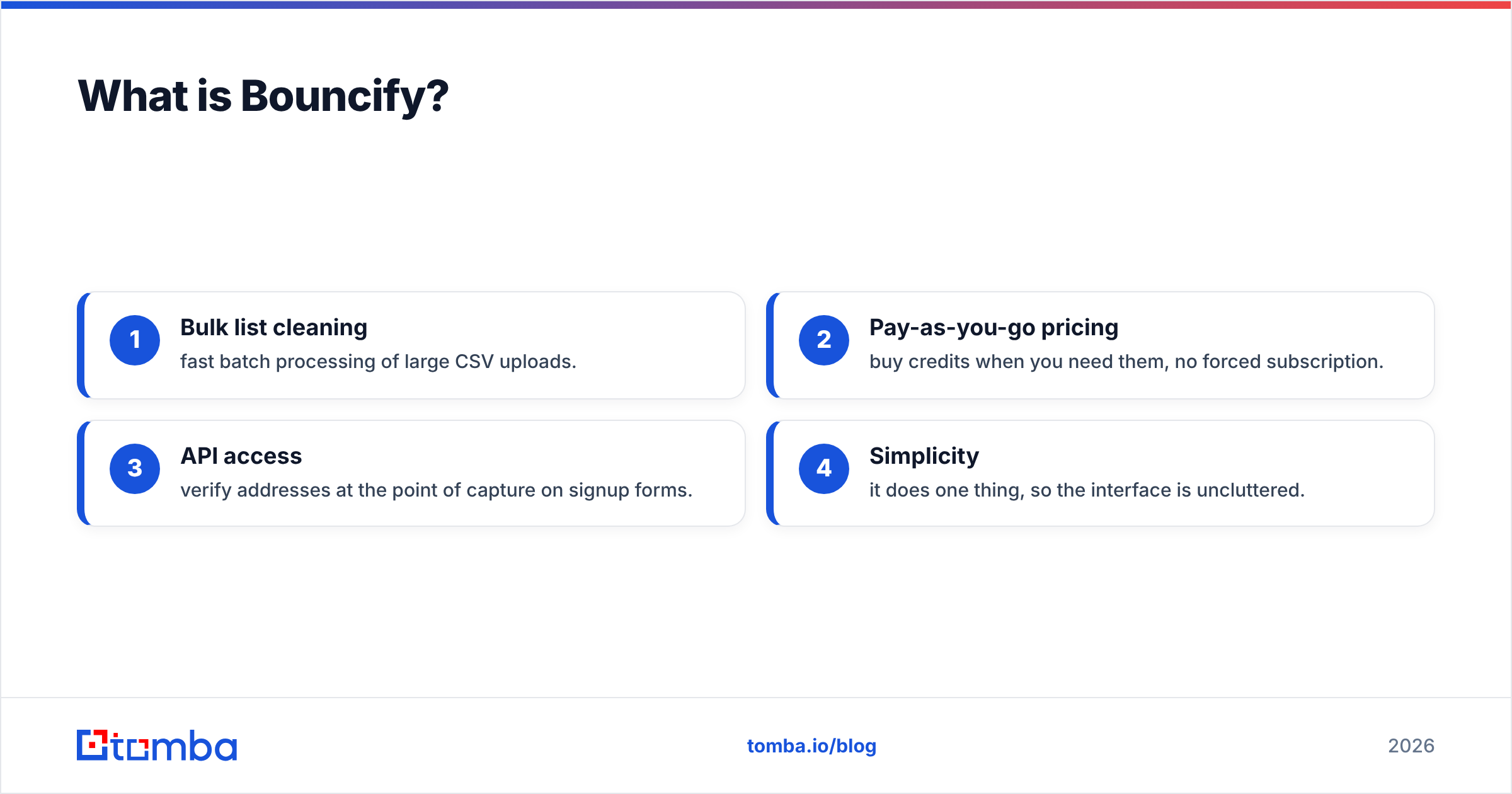
- Bulk list cleaning — fast batch processing of large CSV uploads.
- Pay-as-you-go pricing — buy credits when you need them, no forced subscription.
- API access — verify addresses at the point of capture on signup forms.
- Simplicity — it does one thing, so the interface is uncluttered.
Where it stops: Bouncify will never tell you the email of a VP of Marketing you have never contacted. It assumes you already have the addresses. That is the entire limitation, and it matters for what comes next.
)
What is Zintlr?#
Zintlr sits on the opposite side of the funnel. It is a B2B sales intelligence platform built to find prospects — company data, decision-maker contacts, firmographics, and in some tiers personality or behavioral insights meant to help you tailor outreach. You search by company, role, or industry and Zintlr returns contact records you can push into your sequence.
If Bouncify is the bouncer, Zintlr is the talent scout walking the city looking for people to invite. The jobs are complementary, not interchangeable.
Where Zintlr is strong:
- Prospecting from scratch — building target lists when you start with nothing but an ICP.
- Company-level enrichment — adding firmographic context to thin records.
- Sales-team workflows — seat-based access designed for reps, not list-ops admins.
Where it gets weaker: data freshness and verification rigor vary by record. Intelligence platforms optimize for coverage — having a record for as many people as possible — which often trades against accuracy. A contact that exists in the database is not the same as a contact whose email will actually deliver today. That is precisely the gap a tool like Bouncify is meant to plug, which is why people compare the two even though they are different categories.
Bouncify vs Zintlr: how do they actually compare?#
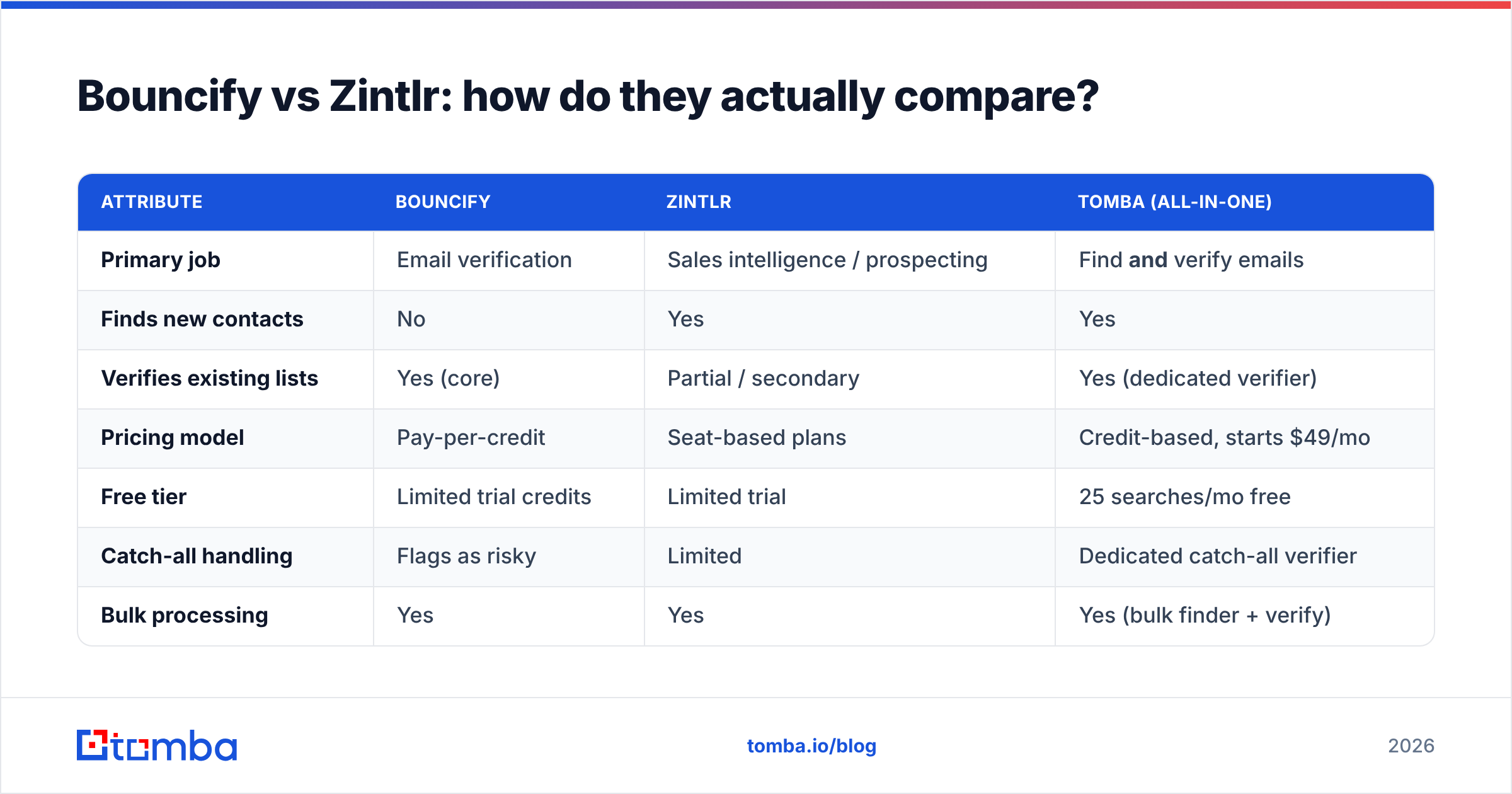
Here is the side-by-side. Note how few rows show genuine overlap — that absence is the real story.
| Attribute | Bouncify | Zintlr | Tomba (all-in-one) |
|---|---|---|---|
| Primary job | Email verification | Sales intelligence / prospecting | Find and verify emails |
| Finds new contacts | No | Yes | Yes |
| Verifies existing lists | Yes (core) | Partial / secondary | Yes (dedicated verifier) |
| Pricing model | Pay-per-credit | Seat-based plans | Credit-based, starts $49/mo |
| Free tier | Limited trial credits | Limited trial | 25 searches/mo free |
| Catch-all handling | Flags as risky | Limited | Dedicated catch-all verifier |
| Bulk processing | Yes | Yes | Yes (bulk finder + verify) |
| API / integrations | Yes | Yes | API, CRM, Sheets, Zapier |
| Best for | Cleaning owned lists | Building lists | Full find-to-verify pipeline |
The pattern is clear. If you only ever needed to clean lists, Bouncify is a clean, cheap choice. If you only ever needed to source contacts, Zintlr does that. But almost no real outbound workflow is "only one of those." You find a prospect, then you verify the address before you send. Splitting that across two vendors means two bills, two integrations, and a manual hand-off between them.
Which one should you choose for verification accuracy?#
Choose based on where your bottleneck is, not on which brand name you saw first.
If your problem is bounce rates — your campaigns are getting throttled, addresses are going stale — verification is your bottleneck. Bouncify handles this well, and so does a dedicated email verifier. The thing to watch is catch-all domains: company servers that accept every address whether or not the mailbox exists. Generic verifiers flag these as "risky" and leave you guessing. A purpose-built catch-all verifier digs deeper and gives you a usable verdict instead of a shrug.
If your problem is empty pipeline — you do not have enough contacts to clean in the first place — then no amount of verification helps. You need sourcing, which is Zintlr's lane (or a domain search tool that pulls every email pattern at a target company).
Accuracy is not one number. It is "did the tool find the right person" and "will the email deliver." Bouncify answers only the second question. Zintlr leans on the first and is softer on the second. The strongest setups answer both with the same verified dataset, so you are not stitching a fresh contact from one vendor onto a verification verdict from another.
)
What does Bouncify vs Zintlr cost in 2026?#
Pricing is where the two tools diverge most, and where the "two-subscription tax" becomes obvious.
Bouncify uses a credit model. You buy a block of verifications — pricing scales down per credit as volume rises. This is efficient if you verify in bursts (a quarterly list clean) and wasteful if you verify continuously, because credits expire or sit unused.
Zintlr uses seat-based intelligence pricing. You pay per user for access to the database and its prospecting features. That is sensible for a sales team where each rep prospects daily, but expensive if you only need occasional data pulls.
Run the combined math and the problem appears: a team that needs both sourcing and cleaning pays a Zintlr seat plan plus a Bouncify credit pack. For comparison, a consolidated platform folds both into one bill. You can see how a credit-based model handles mixed find-and-verify work on the Tomba pricing page — the Starter plan is $49/mo, Growth is $99/mo, and the free tier gives you 25 searches to test before paying anything.
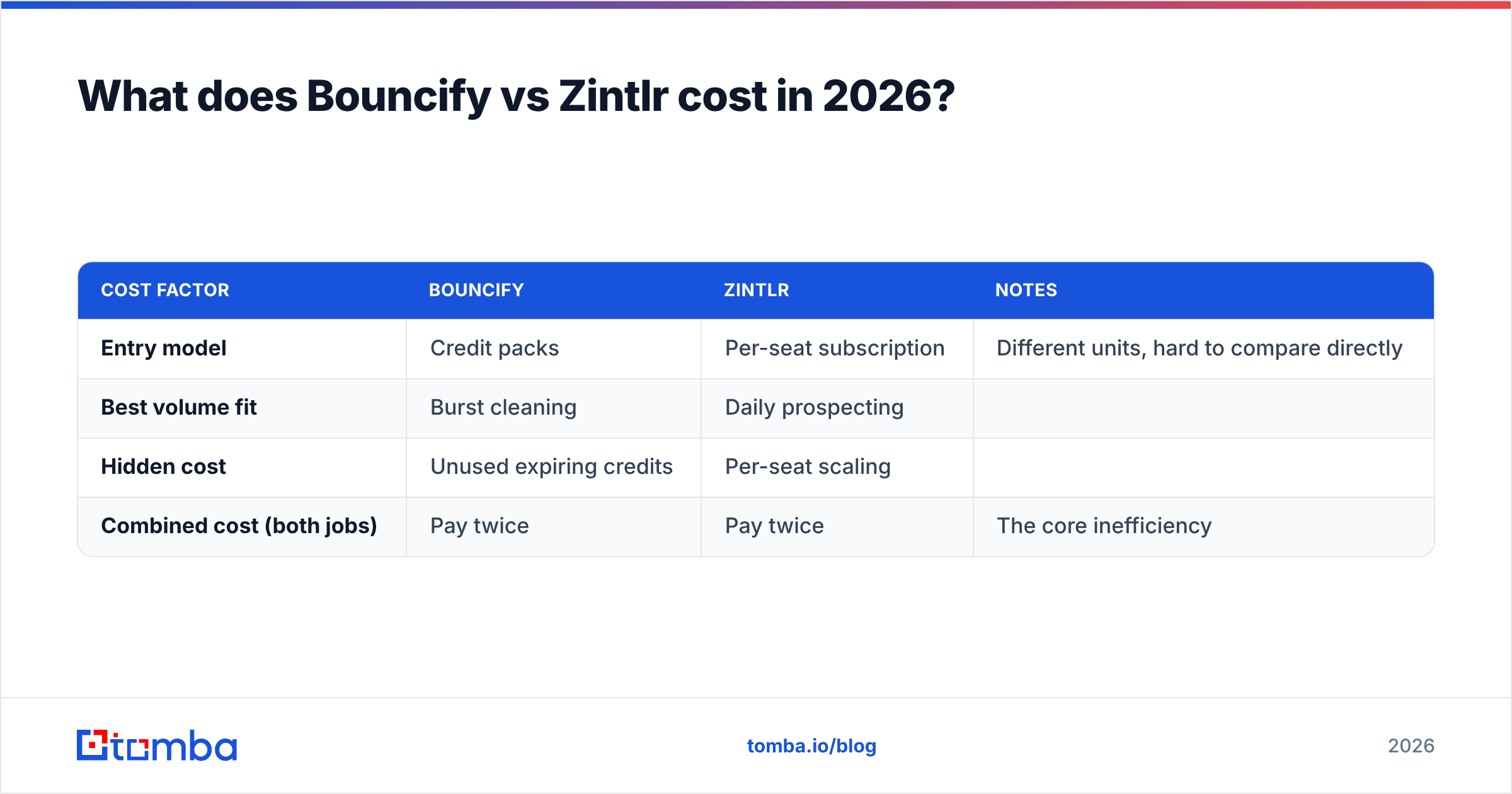
| Cost factor | Bouncify | Zintlr | Notes |
|---|---|---|---|
| Entry model | Credit packs | Per-seat subscription | Different units, hard to compare directly |
| Best volume fit | Burst cleaning | Daily prospecting | |
| Hidden cost | Unused expiring credits | Per-seat scaling | |
| Combined cost (both jobs) | Pay twice | Pay twice | The core inefficiency |
The honest takeaway: if you genuinely only do one job, the specialist tool is fine. The moment you do both, two specialists cost more than one generalist that does both jobs well.
When does a single all-in-one tool make more sense?#
Most B2B teams should consolidate. Here is the reasoning, not just the pitch.
Your outbound motion is a pipeline: identify a company, find the right person, get their email, verify it delivers, then send. Bouncify owns one stage. Zintlr owns one or two earlier stages. Between them sits a manual hand-off — export from Zintlr, import to Bouncify, re-export, push to your sequencer. Every hand-off is a place where data goes stale, formats break, and someone forgets a step.
An integrated platform collapses that pipeline. With one system you can:
- Run a domain search to pull every contact at a target account in one query.
- Find a specific person's email by name and company, with confidence scoring.
- Verify the result instantly — including catch-all domains — before it ever enters a campaign.
- Enrich and push to your CRM through native integrations instead of CSV gymnastics.
This is where Tomba fits. It is built as a find-to-verify pipeline rather than a single stage, with an email finder, verifier, domain search, catch-all checks, and data enrichment under one roof. You are not replacing Bouncify and Zintlr with two new tools — you are replacing both with one.
That said, consolidation is not automatically right. If you already own a mature sales-intelligence contract your team loves, and you just need cheap bulk cleaning a few times a year, keeping Bouncify as a point solution is defensible. Match the tool to the bottleneck.
How do you decide in five minutes?#
Use this quick decision filter:
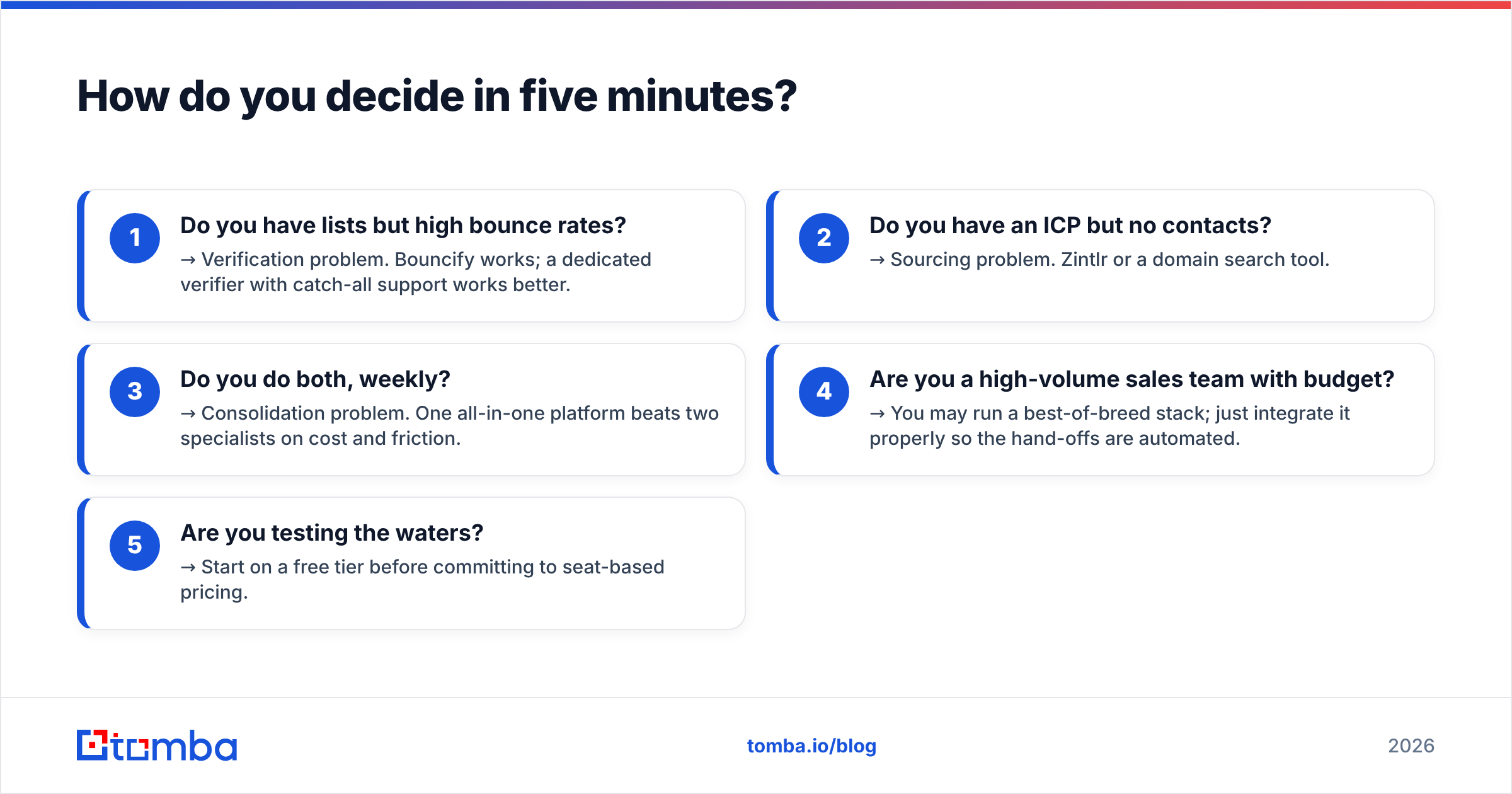
- Do you have lists but high bounce rates? → Verification problem. Bouncify works; a dedicated verifier with catch-all support works better.
- Do you have an ICP but no contacts? → Sourcing problem. Zintlr or a domain search tool.
- Do you do both, weekly? → Consolidation problem. One all-in-one platform beats two specialists on cost and friction.
- Are you a high-volume sales team with budget? → You may run a best-of-breed stack; just integrate it properly so the hand-offs are automated.
- Are you testing the waters? → Start on a free tier before committing to seat-based pricing.
The biggest mistake is buying a sourcing tool to fix a deliverability problem, or buying a verifier to fix an empty pipeline. They are not substitutes. Diagnose the bottleneck first, then pick.
The verdict on Bouncify vs Zintlr#
There is no single winner, because they are not really competitors — and any "vs" article that crowns one is selling you something. Bouncify is a solid, no-frills email verifier with fair pay-as-you-go pricing. Zintlr is a competent sales intelligence platform for building lists. If you only need exactly one of those jobs, buy the specialist that matches.
But if your workflow runs end to end — find the contact, then confirm it delivers — paying two vendors to cover one pipeline is the expensive path. That is the case for consolidating into a platform that finds, verifies, and enriches in a single flow.
Want to skip the two-subscription tax? Start with the Tomba Email Finder and its built-in verifier. Find professional emails by domain, name, or company, confirm deliverability (catch-all included) before you hit send, and push clean records straight into your CRM — all on a free tier of 25 searches before you pay a cent. One pipeline, one bill, no hand-offs. Compare the full Tomba pricing against what a Bouncify-plus-Zintlr pairing would cost you, and let the math decide.
For deeper background on the deliverability side of this equation, G2's email verification category and HubSpot's guidance on email bounce rates are worth a read before you commit budget.
// get started
Find, verify and enrich your first contacts today
Start on the free plan with 25 searches a month, then scale when your team is ready.
Free plan · No credit card required · GDPR & CCPA
// about the author