Boundo Pricing in 2026: Plans, Costs, and Best Alternatives
A neutral breakdown of Boundo pricing in 2026 — how the plans are structured, where the hidden costs hide, and how the value stacks up against a $49 email finder before you commit budget.
Pricing pages are designed to make a decision feel easy. The real work happens after you read past the headline number — when you count credits, check what each tier actually unlocks, and ask whether you are paying for software you will use. This is a practical, vendor-neutral look at Boundo pricing in 2026, the costs that do not appear on the marketing page, and how the math compares to a lean email-finding stack.
TL;DR#
- Boundo pricing is credit-based, so the headline monthly fee matters less than the cost per usable contact you actually pull.
- The true cost includes hidden line items — overage rates, seat fees, annual lock-in, and credits burned on invalid or unverified records.
- Always normalize to cost-per-verified-contact before comparing any two tools; a "cheaper" plan with a low credit cap is often more expensive in practice.
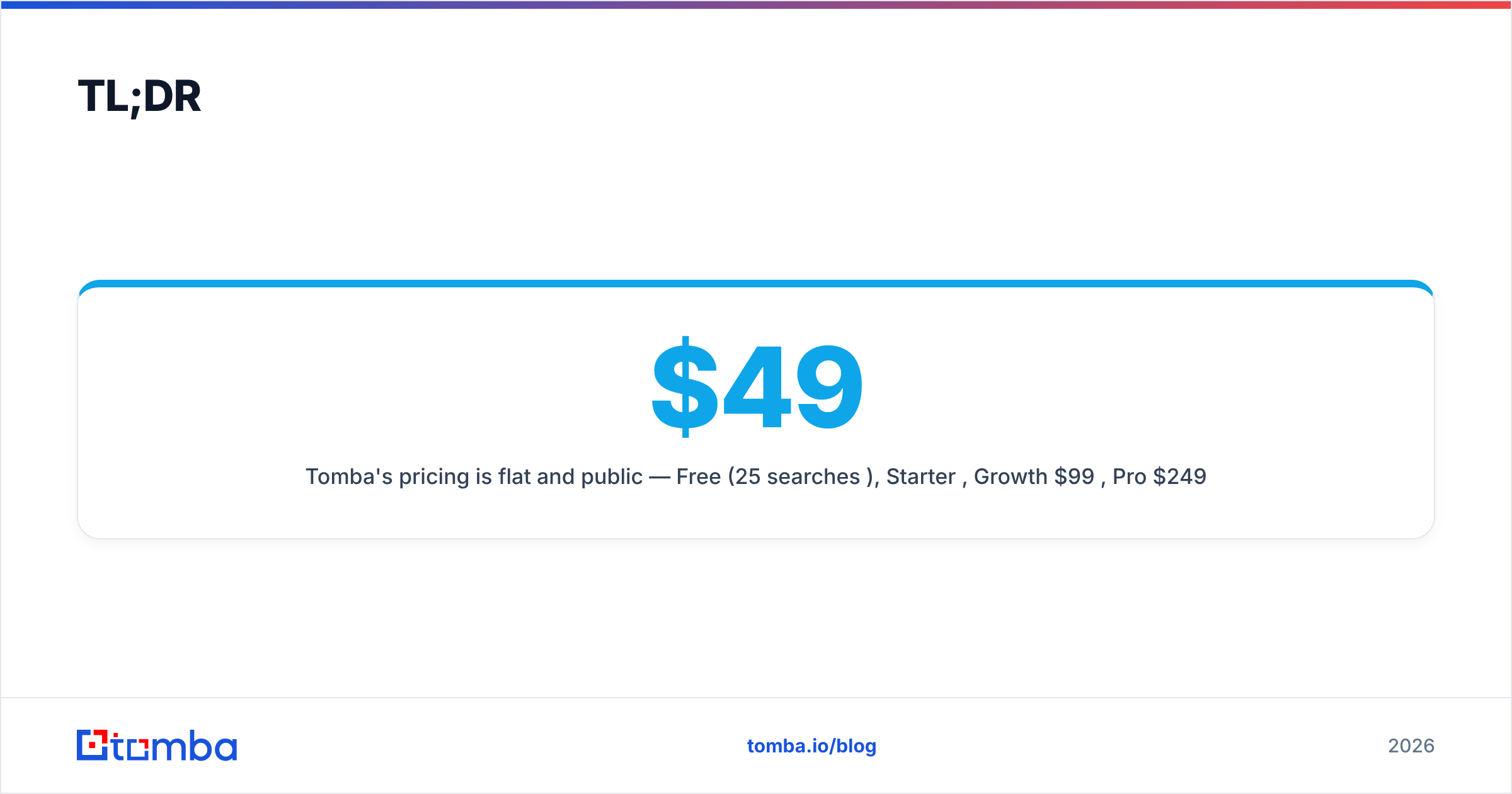
- Tomba's pricing is flat and public — Free (25 searches/mo), Starter $49/mo, Growth $99/mo, Pro $249/mo — which makes the per-contact math simple to run.
- Verify every published number on the vendor's own site before you buy; SaaS pricing changes often, and this guide is a framework, not a quote.
What is Boundo and who is it for?#
Boundo positions itself as a B2B sales and outreach tool aimed at teams that need to find, contact, and manage prospects in one place. Tools in this category usually bundle some mix of contact data, email or multichannel sending, and light CRM-style tracking. That bundling is exactly why pricing gets confusing: you are paying one price for several features, and you rarely use all of them equally.
Before you evaluate any Boundo pricing tier, get specific about your job-to-be-done. Are you primarily a prospector who needs accurate contact data at volume? A sender who needs deliverability and sequencing? Or a manager who needs reporting across a team? Most buyers overpay because they buy a suite to solve a single problem — typically "I need verified email addresses" — when a focused tool would cost a fraction.
Honesty note: SaaS vendors change plans, credits, and add-ons frequently. Treat every figure below as a framework to apply against Boundo's current published page, and confirm the live numbers before you commit budget.
)
How is Boundo pricing structured?#
Most tools in Boundo's category use one of three pricing models, and the model drives your real cost far more than the sticker price does.
- Credit-based — You buy a monthly allotment of credits and spend them on searches, verifications, or enrichments. The risk: credits expire monthly and invalid results can still consume them.
- Seat-based — You pay per user. The risk: costs scale with headcount even if usage is uneven, and "inactive" seats still bill.
- Hybrid (credits + seats) — The most common and the hardest to forecast, because two variables move at once.
- Add-on gated — Core features (API access, integrations, phone data, verification) sit behind higher tiers or paid add-ons.
When you read the Boundo pricing page, map each plan to this list first. The single most useful number is not the monthly fee — it is the cost per verified, usable contact after waste. A plan at a low monthly price with a tight credit cap and no included verification often costs more per good lead than a higher sticker price with generous, verified credits.
The hidden costs to budget for#
- Overage rates — what you pay once monthly credits run out, often at a premium.
- Annual lock-in — the advertised price is frequently the annual-prepay rate; month-to-month can be 20–40% higher.
- Verification gaps — if results are not verified, you pay again (in a separate tool or in bounced sends) to clean them.
- Seat creep — per-user fees that grow silently as the team expands.
- Export and API limits — caps that force an upgrade the moment you try to scale or automate.
How does Boundo pricing compare to Tomba?#
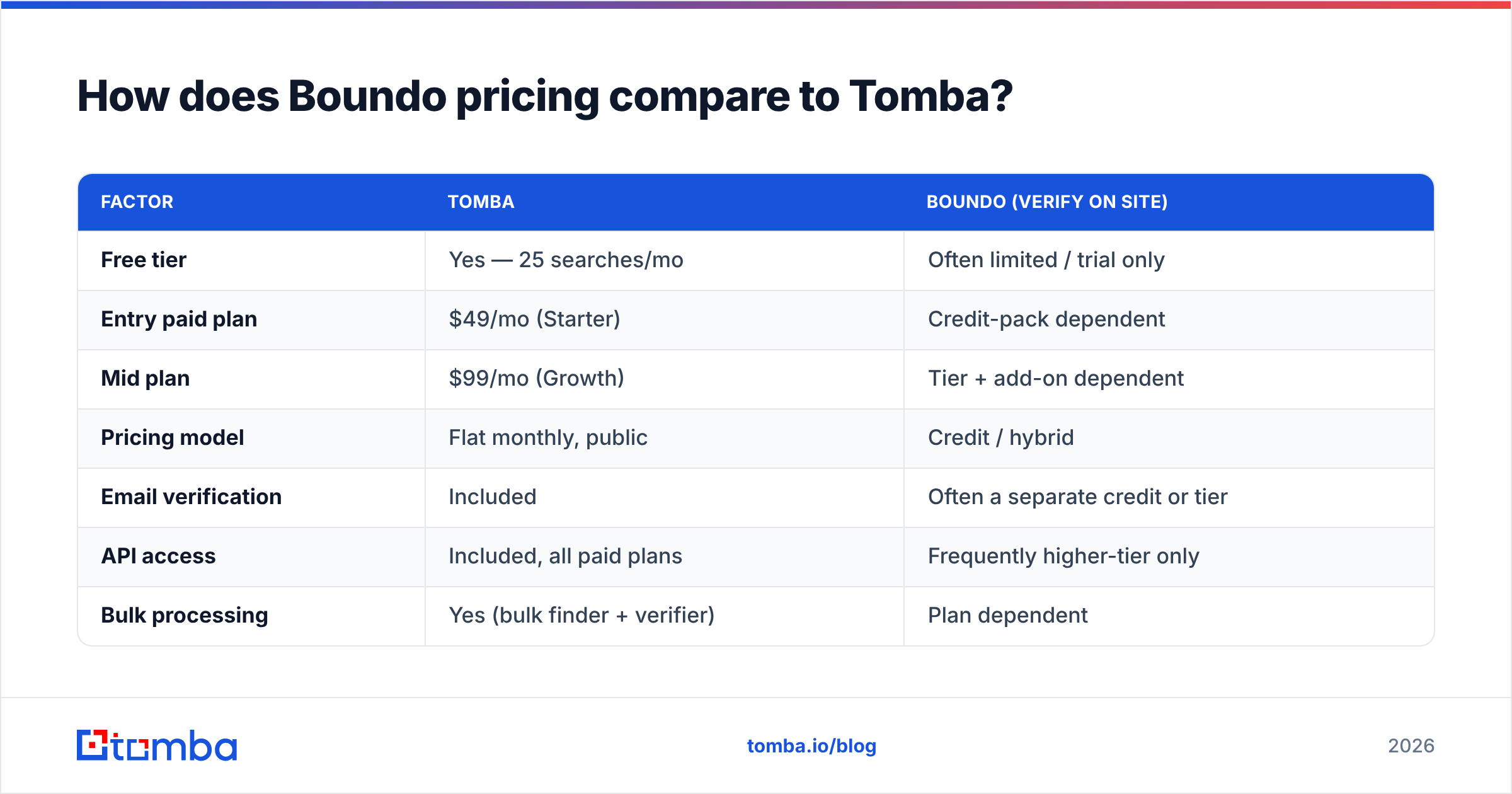
Here is the part buyers actually want: a side-by-side. Tomba's numbers below are its published, flat plans. The Boundo column reflects the type of structure common to this category — confirm the exact live figures on Boundo's own page, since credit-based pricing shifts often.
| Factor | Tomba | Boundo (verify on site) |
|---|---|---|
| Free tier | Yes — 25 searches/mo | Often limited / trial only |
| Entry paid plan | $49/mo (Starter) | Credit-pack dependent |
| Mid plan | $99/mo (Growth) | Tier + add-on dependent |
| Pricing model | Flat monthly, public | Credit / hybrid |
| Email verification | Included | Often a separate credit or tier |
| API access | Included, all paid plans | Frequently higher-tier only |
| Bulk processing | Yes (bulk finder + verifier) | Plan dependent |
| Annual lock-in to hit list price | No | Common |
The takeaway is not "Tomba wins every category." It is that flat, public pricing is easier to forecast than credit-and-add-on pricing, and predictable cost is itself a feature when you are budgeting a quarter of outbound.
If your core need is finding and verifying business emails, you can map that directly to discrete tools: an email finder for discovery, an email verifier to keep bounce rates down, and domain search to pull every contact at a target company. Buying those as focused functions, rather than a broad suite, is usually where the savings come from.
For independent buyer signal beyond any vendor's own claims, cross-check reviews on G2 and Capterra — both list verified user feedback on value-for-money and support, which a pricing page never shows.
Is Boundo worth the price?#
"Worth it" is a ratio, not a number. Run this quick test against any plan:
- Estimate monthly volume. How many contacts do you genuinely need per month?
- Estimate waste. What share of results will be invalid, duplicate, or catch-all? Subtract it.
- Divide. Total monthly cost ÷ usable contacts = your real cost per lead.
- Compare apples to apples. Add the cost of any tool you would need alongside Boundo (a verifier, an enrichment source) to the total.
A suite can absolutely be worth it when you will use most of the bundle. It is rarely worth it when you are paying for sequencing, a mini-CRM, and reporting just to access the contact-finding feature you actually came for. In that scenario, a specialized stack wins on both price and accuracy.
)
What should you check before buying any pricing tier?#
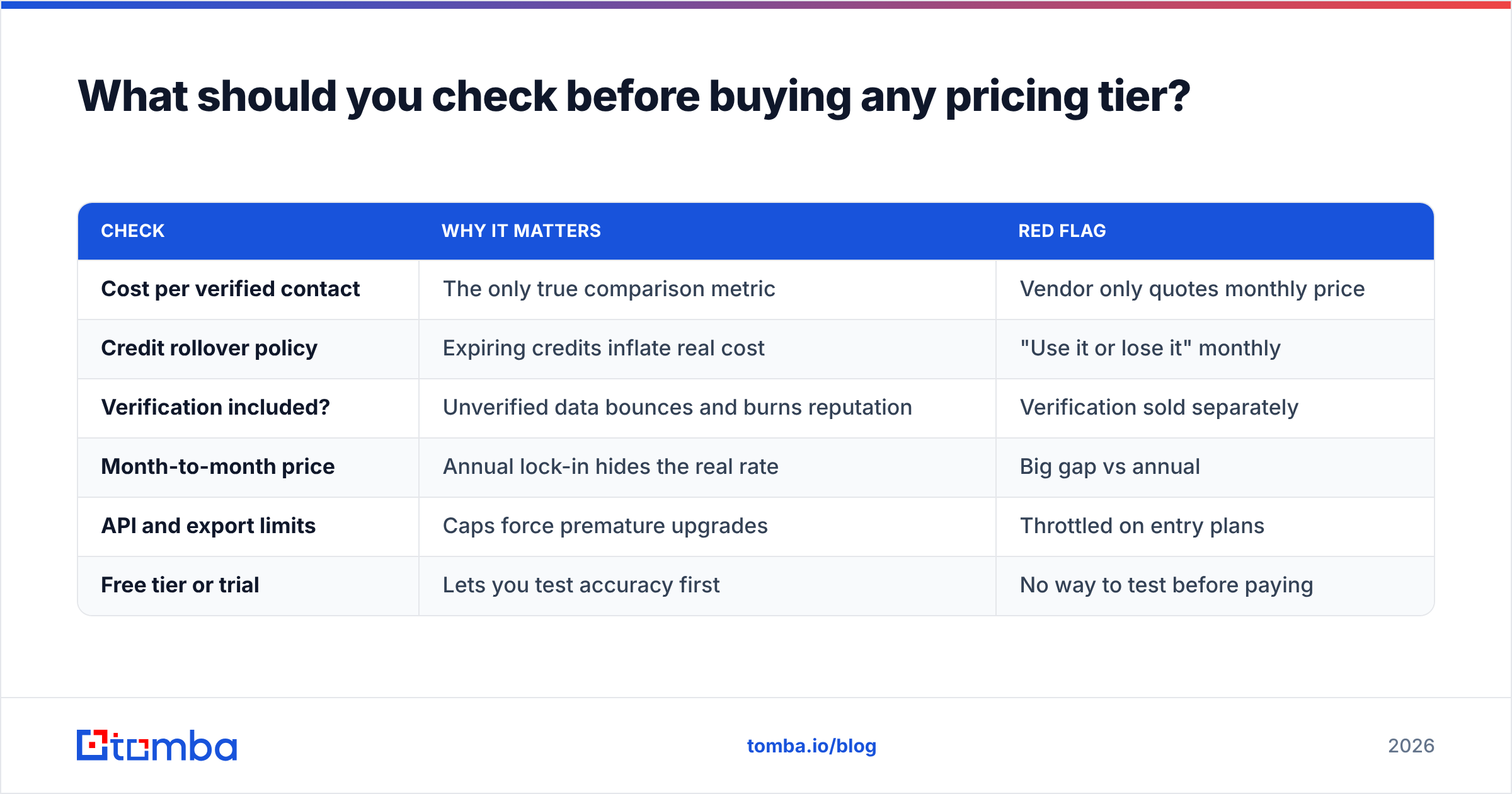
Use this as a pre-purchase checklist — it applies to Boundo and to every competitor on your shortlist.
| Check | Why it matters | Red flag |
|---|---|---|
| Cost per verified contact | The only true comparison metric | Vendor only quotes monthly price |
| Credit rollover policy | Expiring credits inflate real cost | "Use it or lose it" monthly |
| Verification included? | Unverified data bounces and burns reputation | Verification sold separately |
| Month-to-month price | Annual lock-in hides the real rate | Big gap vs annual |
| API and export limits | Caps force premature upgrades | Throttled on entry plans |
| Free tier or trial | Lets you test accuracy first | No way to test before paying |
On the data-quality point specifically, ask where the contacts come from and how fresh they are. Vendors that are transparent about data sources and verification methodology tend to bounce less, which directly lowers your cost per usable lead. A cheap credit is expensive if half of them are dead.
What are the best Boundo alternatives by use case?#
Match the tool to the job rather than buying the biggest suite by default.
- You mainly need verified emails: A focused finder-plus-verifier stack. Run discovery, verify before sending, and skip the features you would not touch.
- You enrich existing lists: Look at data enrichment and bulk processing rather than per-search credits, which get expensive at volume.
- You work inside a CRM: Prioritize native integrations (HubSpot, Salesforce, Pipedrive) so data flows without manual CSV exports.
- You are technical / automating: A clean, included email finder API beats paying to unlock API access on a premium tier.
- You research companies: Domain search to map an org's contacts in one pull is often cheaper than finding people one at a time.
For broader context on building a cost-efficient sales stack, HubSpot's research library is a useful neutral starting point — see HubSpot's sales resources for benchmarks on outreach performance and tooling ROI.
How do you calculate your real cost per lead?#
Here is a worked example so the framework is concrete. Say a plan costs $99/month and includes 1,000 search credits. If 30% of results are invalid or catch-all and unverified, you keep 700 usable contacts. Your real cost is $99 ÷ 700 = about $0.14 per usable contact — not the $0.099 the credit math implies.
Now apply the same formula to a flat plan with included verification, where waste is lower because results are checked before they reach you. Even at an identical monthly price, fewer wasted credits means a lower true cost per lead. This is exactly why "which plan is cheaper" is the wrong question and "which plan delivers more verified contacts per dollar" is the right one.
Run this calculation for Boundo's current tier, then for two alternatives. The winner is almost never the one with the lowest sticker price — it is the one with the lowest cost per verified contact at your real monthly volume.
Frequently asked questions#
Is there a free version of Boundo? Check the live pricing page — many tools in this category offer a limited trial rather than a permanent free tier. For comparison, Tomba includes a permanent free plan with 25 searches per month, which lets you test accuracy before paying.
Why is credit-based pricing hard to compare? Because two tools can advertise the same monthly price while one expires credits monthly and the other verifies results before charging you. Always normalize to cost per verified contact.
Does Boundo include email verification? This varies by tier and changes over time — confirm on their site. If verification is a separate cost, add it to your total before comparing, since unverified data bounces and damages sender reputation.
What is the cheapest reliable way to find B2B emails? A focused finder-plus-verifier stack usually beats a broad suite on price when contact discovery is your only real need. Compare flat plans like Tomba's pricing against credit packs on a per-verified-contact basis.
The bottom line#
Boundo pricing, like most credit-based tools, is only as good as its cost per usable contact. Read past the headline fee, count what each tier truly unlocks, budget for the hidden line items, and always confirm the current numbers on the vendor's own page before you buy.
If your real job is finding and verifying business emails — not running a full outreach suite — start with a focused, flat-priced tool. The Tomba Email Finder gives you verified professional emails by name, domain, or company, includes verification and API access on paid plans, and starts at $49/month with a free tier so you can test accuracy before spending a dollar. Run your cost-per-verified-contact math, then pick the stack that wins it.
// get started
Find, verify and enrich your first contacts today
Start on the free plan with 25 searches a month, then scale when your team is ready.
Free plan · No credit card required · GDPR & CCPA
Get the Tomba newsletter
Product and data updates
// about the author