Boundo Reviews 2026: Features, Pricing & Best Alternatives
An honest, neutral look at Boundo in 2026 — what it does well, where it falls short, real pricing considerations, and the alternatives worth testing before you commit.
You are evaluating Boundo because someone on your team needs more contacts, cleaner data, or both — and you want to know if it earns a line item in next quarter's budget. This review skips the marketing gloss and looks at how Boundo actually performs as a B2B prospecting and email tool in 2026, where it wins, where it stumbles, and which alternatives deserve a side-by-side trial.
TL;DR#
- Boundo is a B2B contact and email-finding tool aimed at sales and lead-gen teams who want to turn company names and domains into reachable contacts.
- Strengths: straightforward UI, decent coverage on mid-market accounts, and a workflow that newcomers pick up quickly.
- Weaknesses: accuracy and verification can lag behind specialist tools, and pricing transparency varies — always confirm current rates on their site before you buy.
- Best for: small teams running light, manual prospecting who value simplicity over raw data depth.
- Worth comparing against: Tomba, RocketReach, and Apollo — each beats Boundo on at least one dimension (accuracy, price, or scale).
What is Boundo?#
Boundo is a lead-generation and contact-discovery tool that helps sales reps and marketers find business email addresses and build outreach lists. The core promise is familiar in this category: feed it a person, company, or domain, and it returns contact data you can drop into a cold-email or CRM workflow.
In practice, tools like Boundo live or die on three things — how much data they have, how accurate that data is, and how painless it is to get data out and into your stack. A clean interface is nice, but it is the deliverable contacts that pay the bill.
If you are new to this category, think of an email-finding tool like a phone book that rebuilds itself every week. The value is not the cover or the binding (the UI) — it is whether the number you dial actually rings the right desk. That is the lens this review uses throughout.
How accurate is Boundo's data?#
Accuracy is the metric that separates a tool you trust from one you babysit. In B2B prospecting, every bad address costs you twice: once in wasted send volume and again in damaged sender reputation when bounces pile up.
Boundo performs acceptably on well-documented mid-market companies, but reviewers on platforms like G2 and Capterra frequently note two recurring gaps: thinner coverage on smaller or non-US organizations, and inconsistent handling of catch-all domains. A catch-all domain accepts mail to any address, so a finder that does not flag them will happily hand you "valid" addresses that never reach a human.
This is where dedicated accuracy tooling matters. Pairing any finder with a strong email verifier and a proper catch-all verifier is the difference between a 2% bounce rate and a 15% one. If Boundo's built-in verification is light, you will end up bolting one of these on anyway.

The takeaway: treat Boundo's "found" status as a starting point, not a guarantee. Run a verification pass before any high-volume campaign.
How much does Boundo cost?#
Pricing in this category is rarely flat, and Boundo is no exception — tiers usually scale by monthly search or credit volume, with steep jumps once you cross into team usage. Because vendor pricing changes often, confirm the live numbers on Boundo's own site rather than trusting a screenshot from a year-old blog.
What matters more than the sticker price is cost per usable contact. A cheap plan that returns unverified or stale data is more expensive than a slightly pricier plan with high accuracy, because you pay again in bounces, rework, and reputation damage.
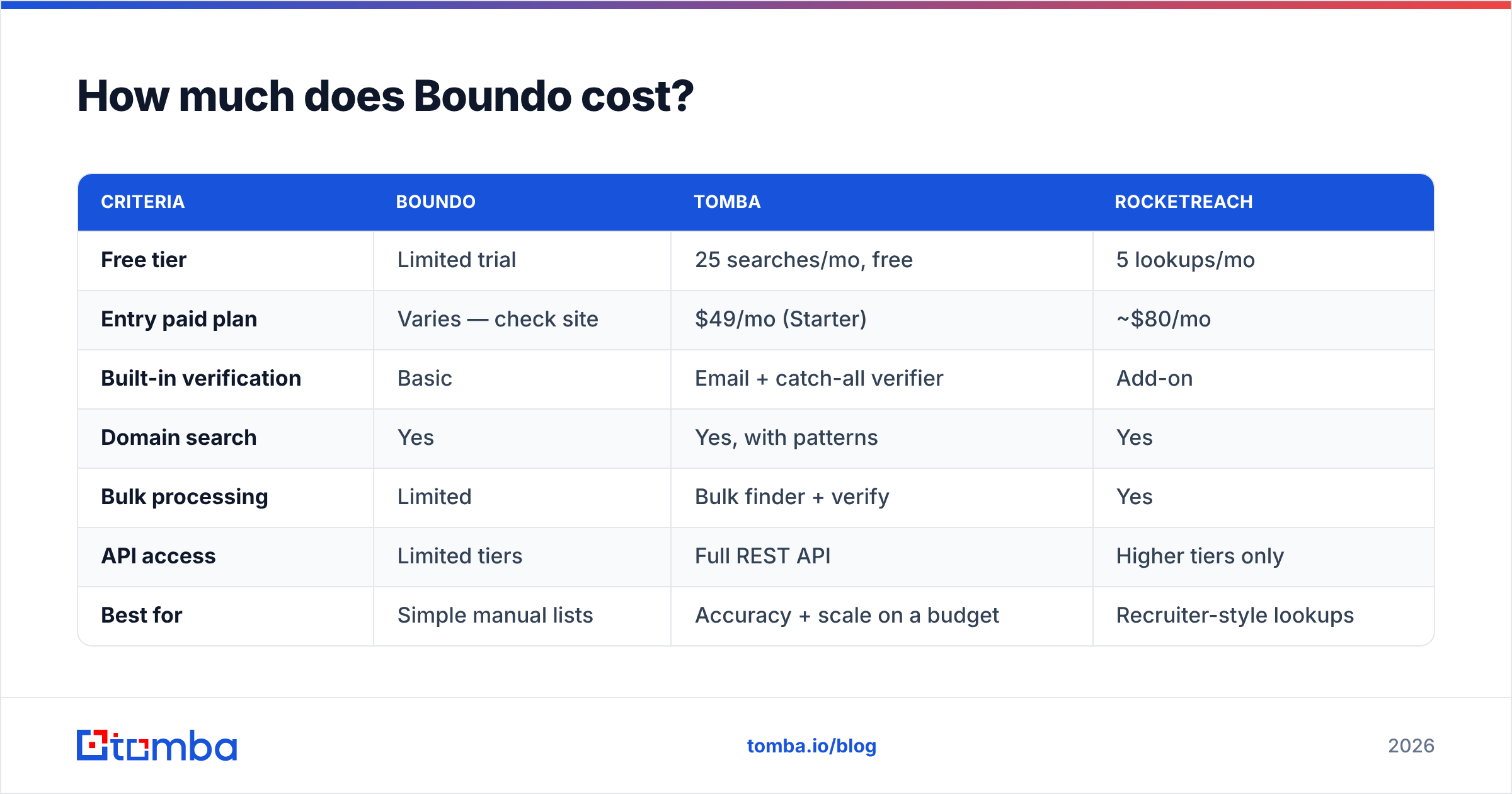
Here is how Boundo stacks up against two common alternatives on the dimensions buyers actually weigh:
| Criteria | Boundo | Tomba | RocketReach |
|---|---|---|---|
| Free tier | Limited trial | 25 searches/mo, free | 5 lookups/mo |
| Entry paid plan | Varies — check site | $49/mo (Starter) | ~$80/mo |
| Built-in verification | Basic | Email + catch-all verifier | Add-on |
| Domain search | Yes | Yes, with patterns | Yes |
| Bulk processing | Limited | Bulk finder + verify | Yes |
| API access | Limited tiers | Full REST API | Higher tiers only |
| Best for | Simple manual lists | Accuracy + scale on a budget | Recruiter-style lookups |
For the full breakdown of how a transparent, tier-based model works, the Tomba pricing page is a useful benchmark — the Free tier gives 25 searches a month, Starter is $49/mo, Growth $99/mo, and Pro $249/mo, with no hidden verification upcharge.
What features does Boundo offer?#
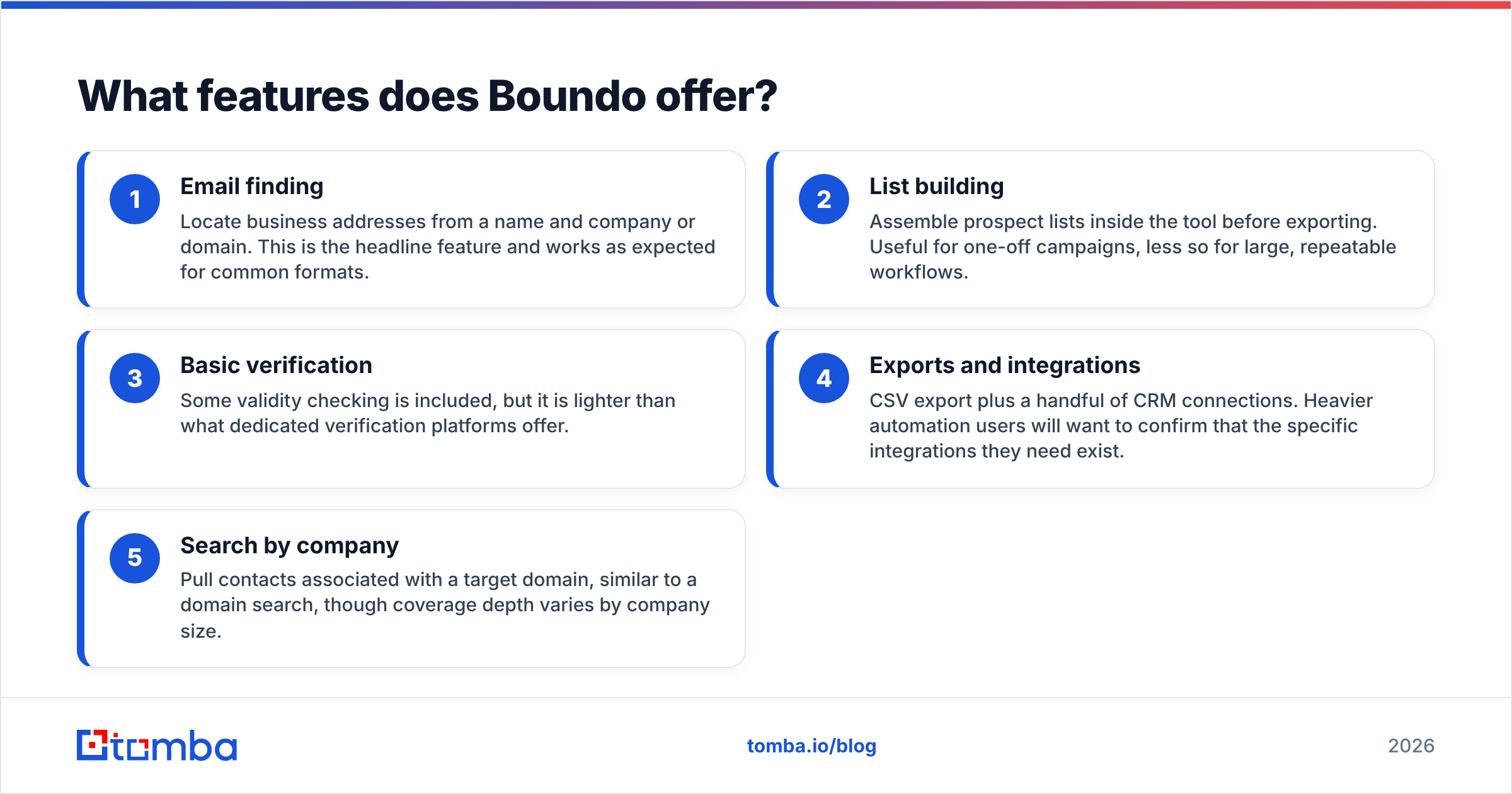
Boundo covers the table-stakes feature set for a contact tool. The question is depth, not presence. Here is how its core capabilities break down:
- Email finding — Locate business addresses from a name and company or domain. This is the headline feature and works as expected for common formats.
- List building — Assemble prospect lists inside the tool before exporting. Useful for one-off campaigns, less so for large, repeatable workflows.
- Basic verification — Some validity checking is included, but it is lighter than what dedicated verification platforms offer.
- Exports and integrations — CSV export plus a handful of CRM connections. Heavier automation users will want to confirm that the specific integrations they need exist.
- Search by company — Pull contacts associated with a target domain, similar to a domain search, though coverage depth varies by company size.
Where Boundo keeps things simple, specialist platforms layer on extras that mature teams rely on: bulk processing, phone discovery, data enrichment, and browser extensions that find contacts while you browse LinkedIn or a company site. If those are on your roadmap, factor them into the comparison now rather than re-buying later.

Is Boundo better than the alternatives?#
Short answer: for a small team that wants a no-frills list builder, Boundo is fine — but it rarely wins a head-to-head on the metric that matters most, which is verified accuracy per dollar.
Here is how the main alternatives differentiate:
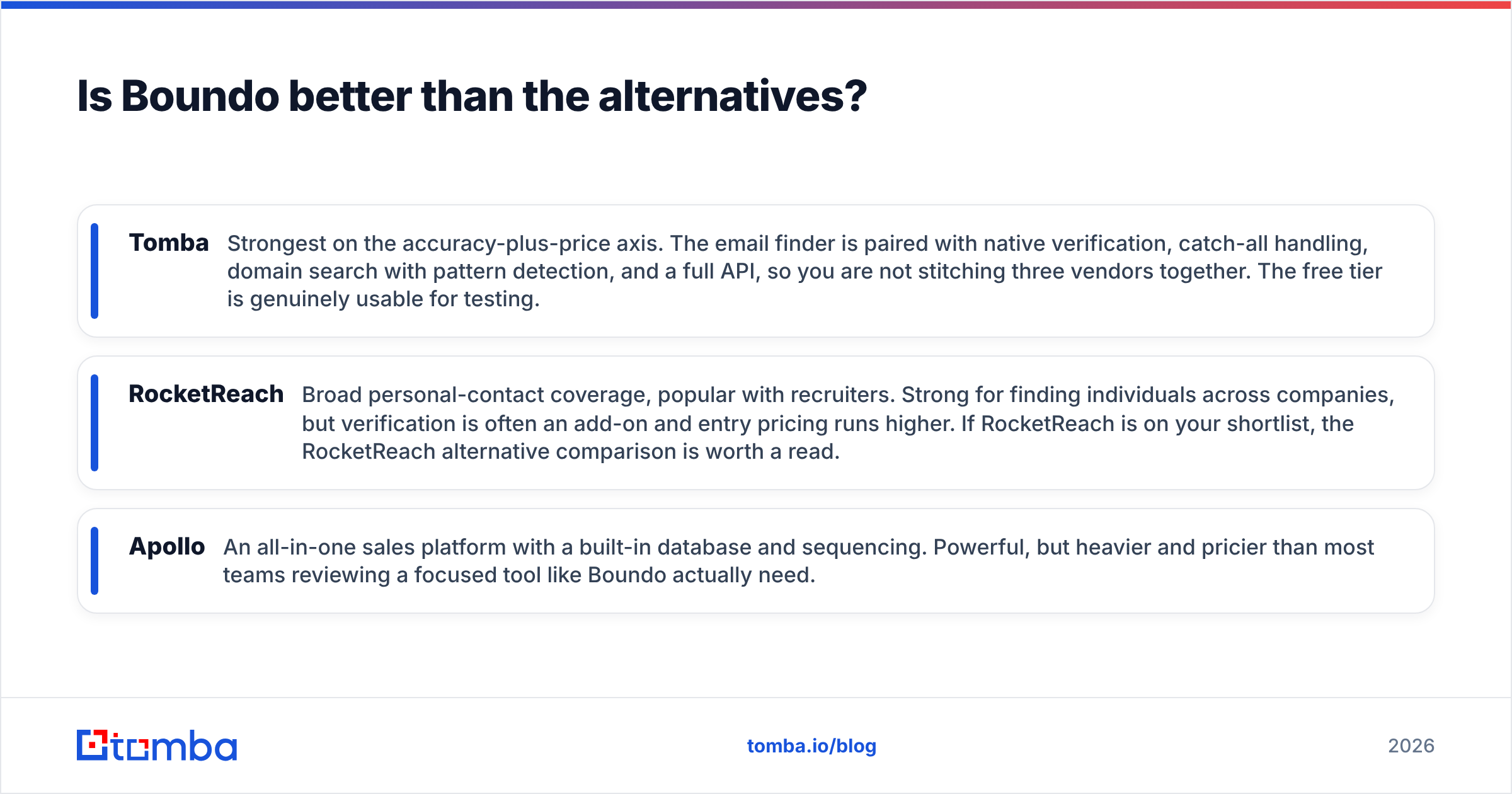
- Tomba — Strongest on the accuracy-plus-price axis. The email finder is paired with native verification, catch-all handling, domain search with pattern detection, and a full API, so you are not stitching three vendors together. The free tier is genuinely usable for testing.
- RocketReach — Broad personal-contact coverage, popular with recruiters. Strong for finding individuals across companies, but verification is often an add-on and entry pricing runs higher. If RocketReach is on your shortlist, the RocketReach alternative comparison is worth a read.
- Apollo — An all-in-one sales platform with a built-in database and sequencing. Powerful, but heavier and pricier than most teams reviewing a focused tool like Boundo actually need.
The right pick depends on your job to be done. If you mostly need accurate emails at volume without overpaying, a focused finder-plus-verifier beats both a bare-bones tool and a bloated all-in-one suite.

What do real Boundo reviews say?#
Aggregating sentiment from public review sites and prospecting communities, a few themes repeat across Boundo reviews:
The positives:
- Easy onboarding — reps are productive within an hour.
- Clean, uncluttered interface that does not overwhelm beginners.
- Reasonable results on common, well-indexed US companies.
The criticisms:
- Coverage drops noticeably outside North America and on smaller firms.
- Verification is light, leading to higher-than-expected bounce rates if you skip a second pass.
- Bulk and automation workflows feel constrained compared with category leaders.
- Some users report friction getting clarity on plan limits before purchase.
None of this makes Boundo a bad tool. It makes it a simple tool — and simplicity is a real feature for some buyers. The mistake is assuming simple equals accurate. They are independent variables.
Who should actually use Boundo?#
Choose Boundo if you check most of these boxes:
- You run light, manual prospecting — dozens of contacts a week, not thousands.
- Your targets are mainstream US-based companies where coverage is strong.
- You value a fast learning curve over deep configurability.
- You already have a separate verification step in your workflow.
Look elsewhere if you need high-volume bulk processing, international coverage, phone numbers, enrichment, or a dependable API. In those cases, a tool built for accuracy and scale will pay for itself quickly. For teams in that bucket, running contacts through a bulk email finder with verification baked in removes the biggest source of wasted spend: bad data reaching your sending domain.
How to evaluate any email tool before you buy#
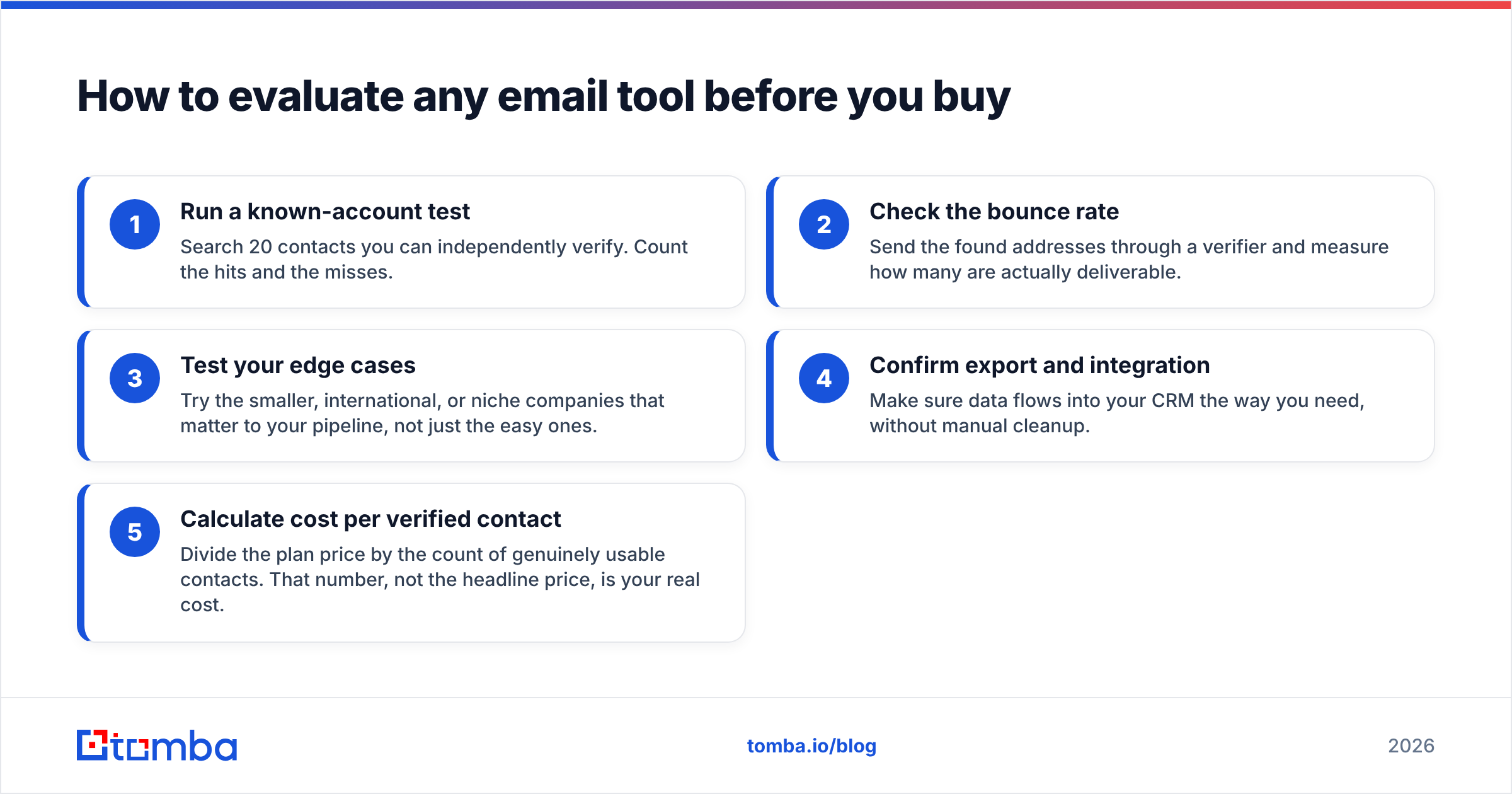
Whether you land on Boundo or an alternative, run the same five-step test so you are comparing reality, not marketing copy:
- Run a known-account test — Search 20 contacts you can independently verify. Count the hits and the misses.
- Check the bounce rate — Send the found addresses through a verifier and measure how many are actually deliverable.
- Test your edge cases — Try the smaller, international, or niche companies that matter to your pipeline, not just the easy ones.
- Confirm export and integration — Make sure data flows into your CRM the way you need, without manual cleanup.
- Calculate cost per verified contact — Divide the plan price by the count of genuinely usable contacts. That number, not the headline price, is your real cost.
This process takes an afternoon and routinely saves teams from a year locked into the wrong tool.
The bottom line on Boundo#
Boundo is a competent, beginner-friendly contact tool that suits small teams doing simple, US-centric prospecting. It is not the most accurate, the most scalable, or the most transparent option in 2026 — and for many buyers, those gaps tip the decision toward a specialist alternative.
If accuracy, verification, and predictable pricing top your list, test Tomba's Email Finder alongside Boundo. You get a free tier of 25 searches a month to run the exact known-account test above, native verification so your bounce rate stays low, domain search, bulk processing, and a full API — all on transparent pricing that starts at $49/mo. Run both on your own target accounts, compare verified hits per dollar, and let the data pick your tool.
Ready to find emails that actually work?
Join 150,000+ professionals who stopped guessing and started sending. Free credits on signup — no credit card required.
Get the Tomba newsletter
Practical outbound tactics and product updates — once every two weeks.
About the author