BrandNav vs Apolloio 2026: Which B2B Data Tool Wins?
BrandNav and Apollo.io both promise clean B2B contact data, but they solve different problems. Here's an honest 2026 breakdown of accuracy, pricing, and fit.
Choosing between BrandNav and Apollo.io usually means you have one of two problems: you need to clean and enrich a messy lead list, or you need a full prospecting engine that finds, sequences, and tracks contacts. Those are not the same job, and picking the wrong tool wastes budget fast.
This is a neutral breakdown of where each platform actually wins in 2026 — and where a focused email finder beats both for the specific task of getting verified contact addresses.
TL;DR#
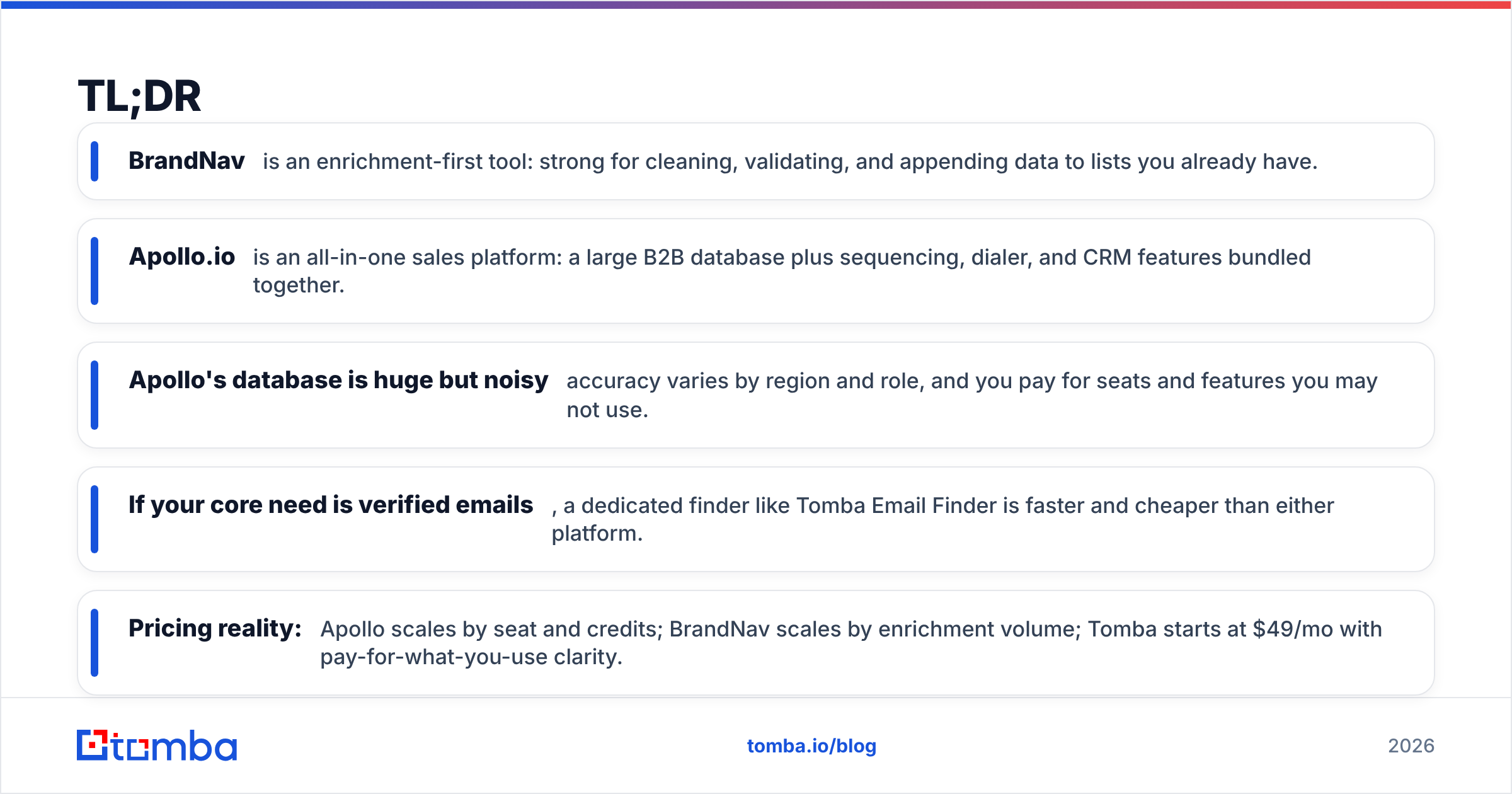
- BrandNav is an enrichment-first tool: strong for cleaning, validating, and appending data to lists you already have.
- Apollo.io is an all-in-one sales platform: a large B2B database plus sequencing, dialer, and CRM features bundled together.
- Apollo's database is huge but noisy — accuracy varies by region and role, and you pay for seats and features you may not use.
- If your core need is verified emails, a dedicated finder like Tomba Email Finder is faster and cheaper than either platform.
- Pricing reality: Apollo scales by seat and credits; BrandNav scales by enrichment volume; Tomba starts at $49/mo with pay-for-what-you-use clarity.
What is BrandNav?#
BrandNav is a data enrichment and validation platform. You feed it a list — emails, domains, or partial records — and it returns appended fields: company size, social profiles, phone numbers, and validation status on the emails you supply. Think of it as a cleanup crew for lists you have already built, rather than a tool that goes out and discovers new prospects from scratch.
That makes BrandNav a good fit when you already own raw data (from a form, an event, a scraped list) and you need it standardized before it hits your CRM. It is less useful as a starting point when you have nothing but an ICP and need to build a list from zero.
What is Apollo.io?#
Apollo.io is a sales intelligence and engagement platform. It combines a self-reported B2B contact database (hundreds of millions of records) with prospecting filters, email sequencing, a dialer, and lightweight CRM functionality. The pitch is "everything in one tab" — find a lead, get their email, drop them into a sequence, and track replies without leaving the app.
The trade-off is that you are buying a suite. If you only need one slice — say, accurate email addresses — you still pay for the platform, and the data quality underneath the slick interface is inconsistent. Apollo's own community threads on G2 regularly flag bounce rates and stale records, especially outside North America.
BrandNav vs Apolloio: How do they compare?#
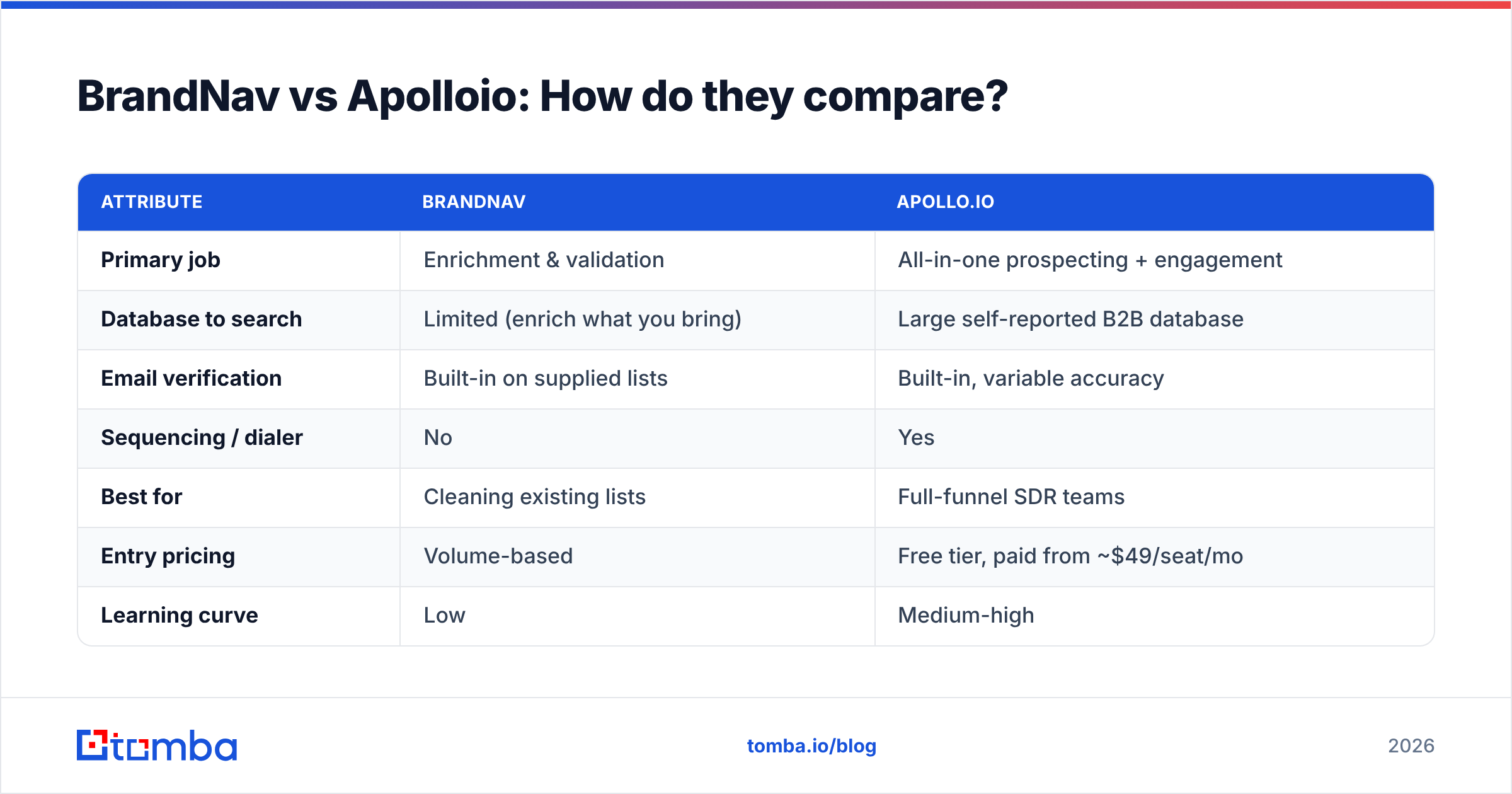
Here is the head-to-head on the attributes that actually drive a buying decision. Prices reflect publicly listed 2026 tiers and shift with promotions, so confirm on each vendor's page before committing.
| Attribute | BrandNav | Apollo.io |
|---|---|---|
| Primary job | Enrichment & validation | All-in-one prospecting + engagement |
| Database to search | Limited (enrich what you bring) | Large self-reported B2B database |
| Email verification | Built-in on supplied lists | Built-in, variable accuracy |
| Sequencing / dialer | No | Yes |
| Best for | Cleaning existing lists | Full-funnel SDR teams |
| Entry pricing | Volume-based | Free tier, paid from ~$49/seat/mo |
| Learning curve | Low | Medium-high |
| API access | Yes | Yes |
The pattern is clear: BrandNav is narrow and deep on data hygiene, Apollo is wide and shallow across the whole outbound stack. Neither is "better" in the abstract — it depends on which job you are hiring the tool to do.
Which one has better data accuracy?#
Accuracy depends on the task, and this is where most teams get burned. Apollo's strength is breadth: you can pull thousands of matching contacts in minutes. Its weakness is that breadth comes from crowd-sourced and self-reported data, so a meaningful share of emails bounce or point to people who changed jobs. If you run cold campaigns, those bounces hammer your sender reputation.
BrandNav is better at telling you whether the data you already have is valid, because validation is its core function. But it cannot conjure accurate records for contacts it has never seen — it enriches what you feed it.

For the specific job of "find one decision-maker's verified email at a target company," a dedicated finder usually beats both. A purpose-built email verifier runs SMTP-level checks and flags risky, catch-all, and disposable addresses before you ever send. If you understand where your data comes from, you can trust it — Tomba publishes its data sources openly, which is more transparency than most bundled databases offer.
How does pricing compare?#
Pricing models differ enough that a flat "X is cheaper" claim is misleading. Apollo charges per seat plus credit limits, so a five-person team adds up quickly even on mid tiers. BrandNav charges by enrichment volume, which is efficient if you process lists in bursts and idle in between. A focused finder charges for searches and verifications you actually run.
Here is how the three approaches map to a small outbound team doing roughly 2,000 lookups a month:
| Plan element | Apollo.io | BrandNav | Tomba |
|---|---|---|---|
| Model | Per seat + credits | Per enrichment volume | Per search/verify |
| Free tier | Limited credits | Trial-based | 25 searches/mo |
| Entry paid | ~$49/seat/mo | Volume-quoted | $49/mo (Starter) |
| Mid tier | Scales by seat | Scales by volume | $99/mo (Growth) |
| Heavy use | $$$ (seats stack) | $$ (volume) | $249/mo (Pro) |
| Best cost fit | Whole-team suite | Burst enrichment | Targeted finding |
The honest takeaway: if you need Apollo's whole suite, its bundle can be worth the seat price. If you only need verified contact data, paying for sequencing and a dialer you will not use is waste. You can see full Tomba pricing for the finder-only path, which avoids per-seat math entirely.
When should you pick a dedicated email finder instead?#
Pick a finder when contact data is the bottleneck — not sequencing, not dialing, not CRM. Most teams overbuy on platform features and underinvest in the one thing that determines whether outreach lands: a real, deliverable email address.
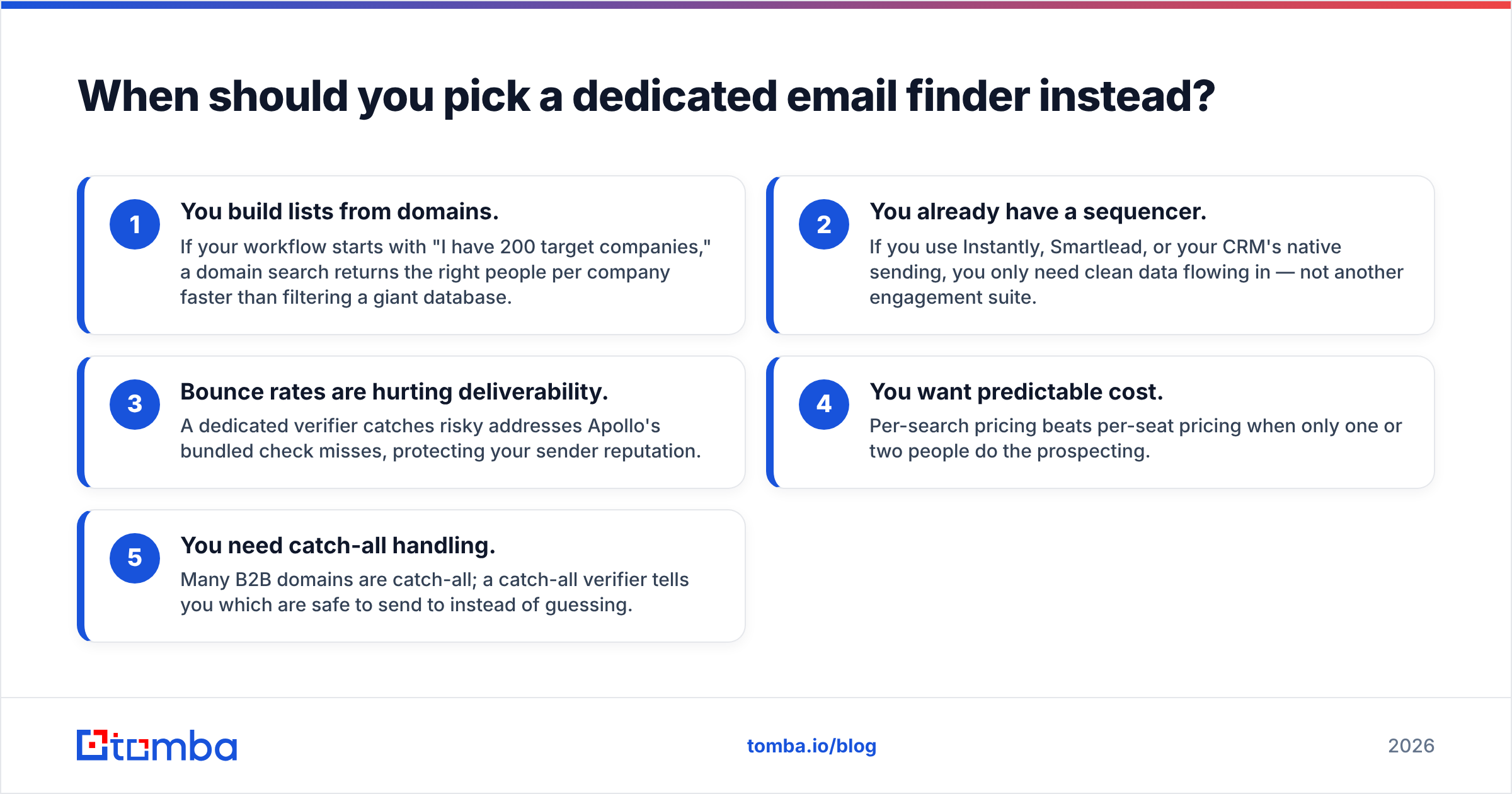
Signs you should skip both BrandNav and Apollo for a focused tool:
- You build lists from domains. If your workflow starts with "I have 200 target companies," a domain search returns the right people per company faster than filtering a giant database.
- You already have a sequencer. If you use Instantly, Smartlead, or your CRM's native sending, you only need clean data flowing in — not another engagement suite.
- Bounce rates are hurting deliverability. A dedicated verifier catches risky addresses Apollo's bundled check misses, protecting your sender reputation.
- You want predictable cost. Per-search pricing beats per-seat pricing when only one or two people do the prospecting.
- You need catch-all handling. Many B2B domains are catch-all; a catch-all verifier tells you which are safe to send to instead of guessing.
For the email comparison itself, here is how the dedicated-finder approach stacks against the two suites on the data task alone:

What about integrations and workflow fit?#
Apollo wins on native breadth — it talks to most major CRMs and has its own sequencer, so a team can live inside it. BrandNav slots into data pipelines through its API and works well as a validation step before records sync to your CRM. Both are viable depending on whether you want a destination app (Apollo) or a processing step (BrandNav).
A finder fits a different shape: it sits at the top of the funnel and pushes verified records out to wherever you already work. Tomba connects through a HubSpot integration, Google Sheets add-on, and a documented email finder API so you can wire verified data into the stack you already run instead of migrating to a new home base. The right question is not "which tool has more integrations" but "do I want to move my workflow, or feed my existing one?"
Is Apollo.io worth it for small teams?#
For a solo founder or a two-person sales team, Apollo's per-seat model and feature depth often exceed what you need. You are paying for a dialer, sequencing, and analytics that a small team rarely uses fully in the first months. The free tier is genuinely useful for testing, but the jump to meaningful credit volume gets expensive once you scale outreach.
BrandNav is leaner for small teams that primarily clean lists, but it does not solve list-building. If your real problem is "I need to find and reach 50 qualified prospects this week," neither bundle is the most direct path — a finder plus your existing email tool covers it for less.
What's the verdict on BrandNav vs Apolloio?#
There is no universal winner — there is a best fit per job:
- Choose Apollo.io if you want one platform to find, sequence, and track outbound, and you have the seats and budget to use the whole suite.
- Choose BrandNav if your main pain is dirty, incomplete lists that need validation and enrichment before they enter your CRM.
- Choose a dedicated finder if verified contact data is the actual bottleneck and you already have a way to send.
Most teams that think they need Apollo really need clean data flowing into tools they already own. Before you commit to a per-seat suite or a volume enrichment contract, test whether a focused finder closes the gap at a fraction of the cost.
Get verified B2B emails without the bundle tax#
If your real need is accurate, deliverable contact data — not another platform to learn — start with the Tomba Email Finder. Find professional email addresses by domain, name, or company, verify them before you send, and push clean records straight into your CRM or sequencer. The free tier gives you 25 searches a month to test accuracy on your own target accounts, and paid plans start at $49/mo with no per-seat math. Skip the suite you'll half-use and fix the data problem directly.
// get started
Find, verify and enrich your first contacts today
Start on the free plan with 25 searches a month, then scale when your team is ready.
Free plan · No credit card required · GDPR & CCPA
// about the author