Brandnav vs Byteplant: Email Verification Compared (2026)
Brandnav vs Byteplant, broken down by accuracy, catch-all handling, pricing, and API quality — plus where a third option quietly beats both for B2B teams in 2026.
Brandnav vs Byteplant: Which Email Verification Tool Wins in 2026?
Choosing between Brandnav and Byteplant comes down to one question: do you need a broad data-and-enrichment layer, or a focused, high-volume validation engine? This guide breaks both down on accuracy, catch-all handling, pricing, and API quality — and flags where a third option quietly outperforms both for B2B teams.
TL;DR#
- Brandnav leans toward data and lead tooling with verification bundled in — convenient if you want enrichment and validation under one login.
- Byteplant (Email Validator) is a focused, batch-and-API verification engine built for high-volume list cleaning with strong syntax and MX checks.
- Accuracy is close on clean lists; the real gap shows on catch-all domains, where confidence scoring matters more than a pass/fail flag.
- Pricing favors Byteplant for raw volume, but per-credit math changes fast once you add enrichment or finder features.
- If you also need to find emails (not just verify them), neither is a complete answer — a combined finder + verifier like Tomba covers both jobs without a second subscription.
What do Brandnav and Byteplant actually do?#
Think of email data work as a kitchen. Finding an email is sourcing the ingredients; verifying it is checking they haven't gone off before you cook. Brandnav and Byteplant sit mostly on the verifying side, but they approach the job from different angles.
Brandnav positions itself as a data and outreach platform — verification is one feature alongside lead lists, enrichment, and outbound tooling. The pitch is consolidation: clean your data in the same place you source it.
Byteplant, marketed as Email Validator, is a specialist. It does one thing — validate email addresses at scale — through bulk uploads and a documented API. It checks syntax, domain and MX records, mailbox existence via SMTP probing, and flags disposable or role-based addresses.
The distinction matters because it changes what "good" looks like. A specialist is judged on throughput, uptime, and how honestly it scores ambiguous addresses. A platform is judged on whether the bundle saves you money versus buying best-of-breed tools separately.
How does email verification work under the hood?#
Both tools run the same core pipeline. Understanding it tells you where accuracy is won or lost:
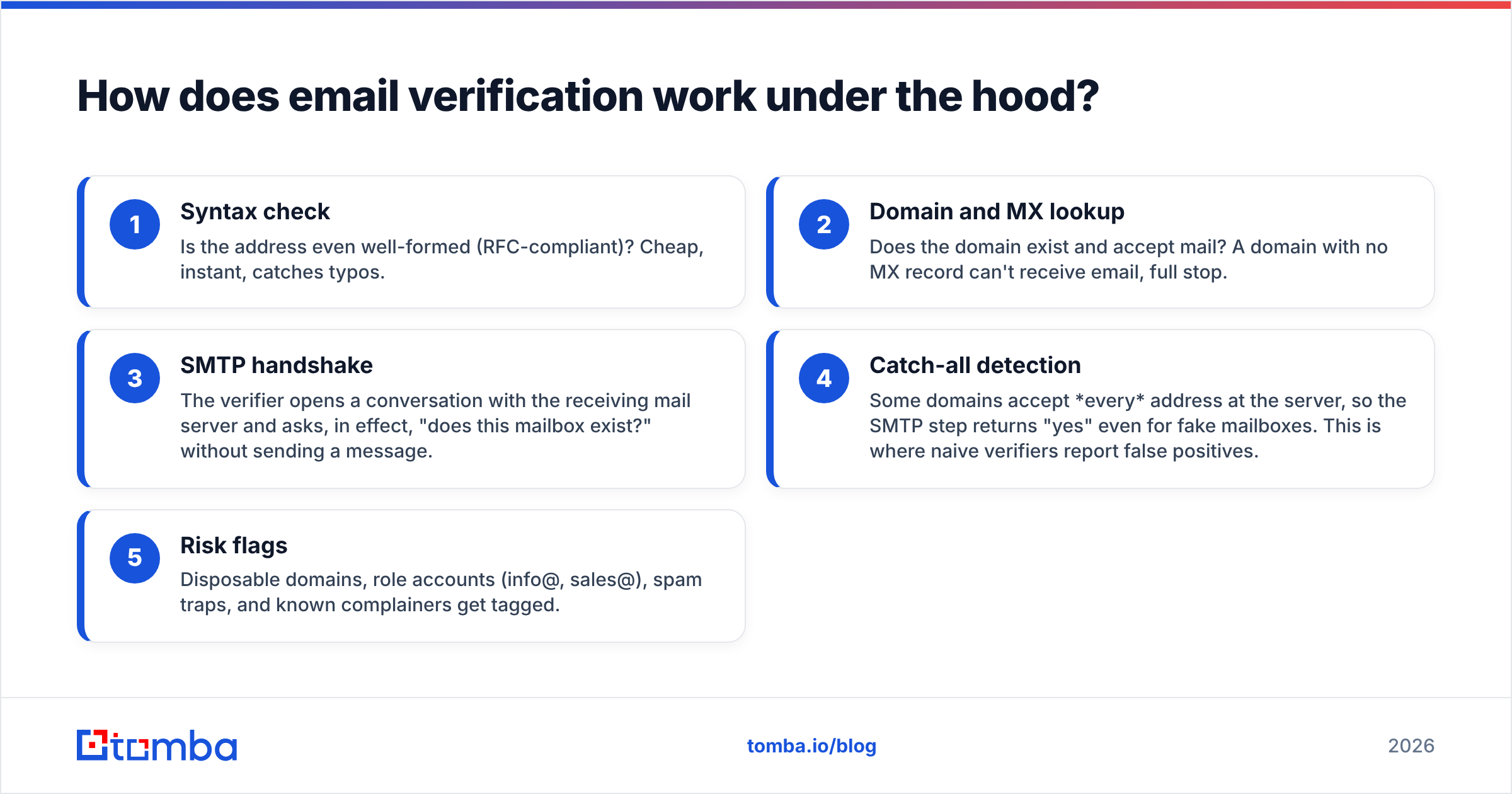
- Syntax check — Is the address even well-formed (RFC-compliant)? Cheap, instant, catches typos.
- Domain and MX lookup — Does the domain exist and accept mail? A domain with no MX record can't receive email, full stop.
- SMTP handshake — The verifier opens a conversation with the receiving mail server and asks, in effect, "does this mailbox exist?" without sending a message.
- Catch-all detection — Some domains accept every address at the server, so the SMTP step returns "yes" even for fake mailboxes. This is where naive verifiers report false positives.
- Risk flags — Disposable domains, role accounts (info@, sales@), spam traps, and known complainers get tagged.
The first three steps are commoditized; almost everyone gets them right. The last two — catch-all handling and risk scoring — are where Brandnav, Byteplant, and every serious competitor separate. A tool that simply marks catch-all domains as "valid" inflates your deliverable rate on paper and torches your sender reputation in practice. If you want the deeper mechanics, our catch-all verifier breakdown explains why a confidence score beats a binary flag.
Brandnav vs Byteplant: the core comparison#

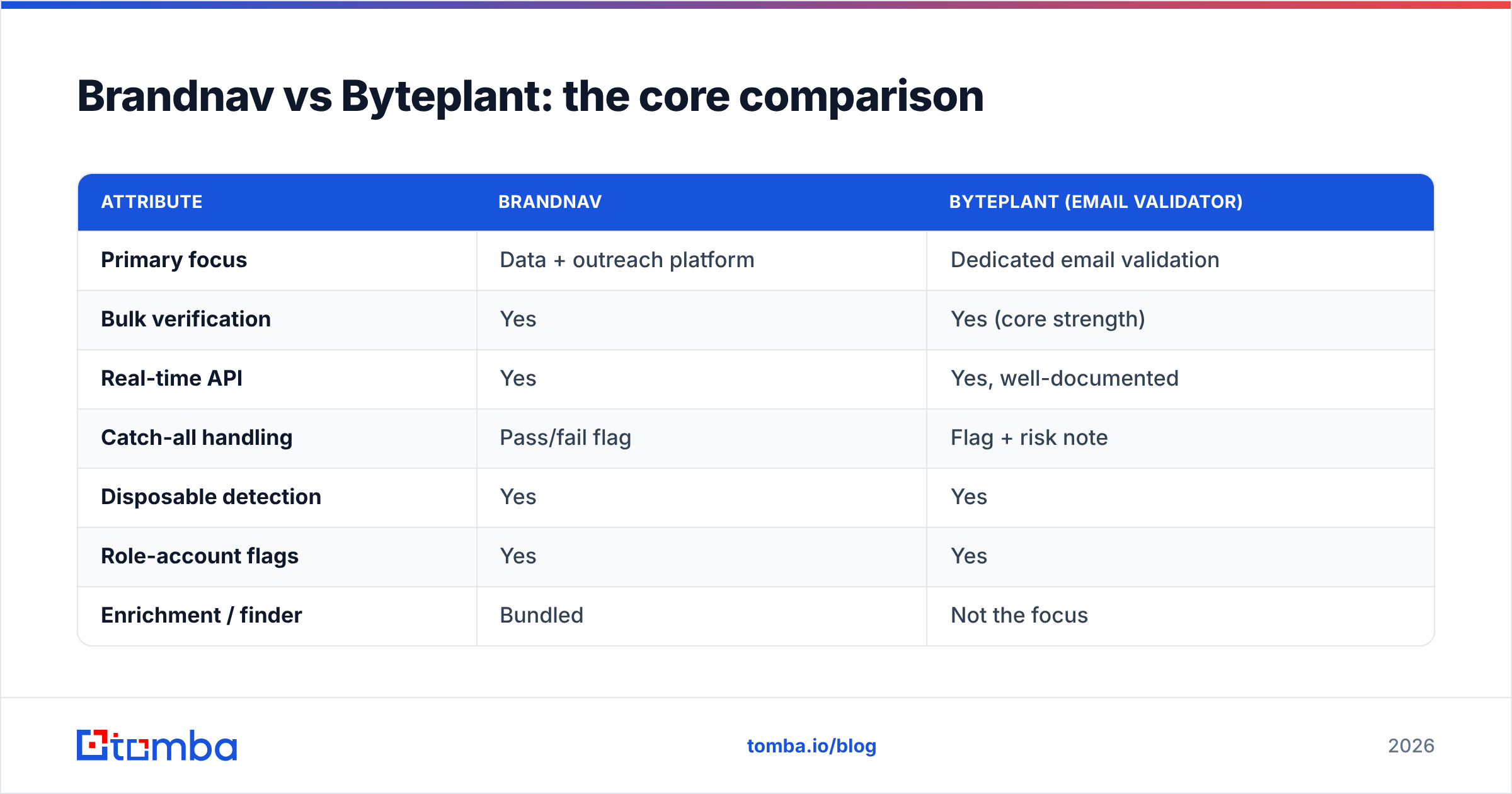
On a clean, recently-sourced list, both tools land in a similar accuracy band — the differences live in edge cases. Here's how they stack up on the attributes that actually drive a buying decision.
| Attribute | Brandnav | Byteplant (Email Validator) |
|---|---|---|
| Primary focus | Data + outreach platform | Dedicated email validation |
| Bulk verification | Yes | Yes (core strength) |
| Real-time API | Yes | Yes, well-documented |
| Catch-all handling | Pass/fail flag | Flag + risk note |
| Disposable detection | Yes | Yes |
| Role-account flags | Yes | Yes |
| Enrichment / finder | Bundled | Not the focus |
| Best for | Teams wanting one tool | High-volume list cleaning |
| Pricing model | Plan / credit mix | Pay-per-volume tiers |
| Free trial | Limited | Trial credits |
The headline: Byteplant is the better pure verifier, Brandnav is the better bundle if you're already buying its data. Neither is wrong — they're answers to different questions.

Is Brandnav or Byteplant more accurate?#
Accuracy is the wrong word to argue about in isolation — the honest metric is how a tool behaves when it isn't sure.
A verifier that returns only "valid" or "invalid" forces a guess on ambiguous addresses. Catch-all domains, greylisting servers, and temporarily-down mailboxes don't fit a binary. The better design returns a graded result — valid, invalid, accept-all, unknown, risky — so you decide your risk tolerance per campaign.
- Byteplant does well here for a specialist. It separates accept-all and unknown states rather than forcing everything into valid/invalid, which keeps your real bounce rate predictable.
- Brandnav verifies competently, but because verification is one feature among many, its catch-all reporting tends to be coarser. Fine for warm lists, riskier for cold scraped data.
The practical test: run a known catch-all domain (most large enterprises run them) through both. If a tool confidently says "valid" on an address you invented, it's guessing. Pair whichever tool you pick with disciplined list hygiene and a strong sender reputation, because no verifier fully substitutes for warmed-up sending infrastructure.
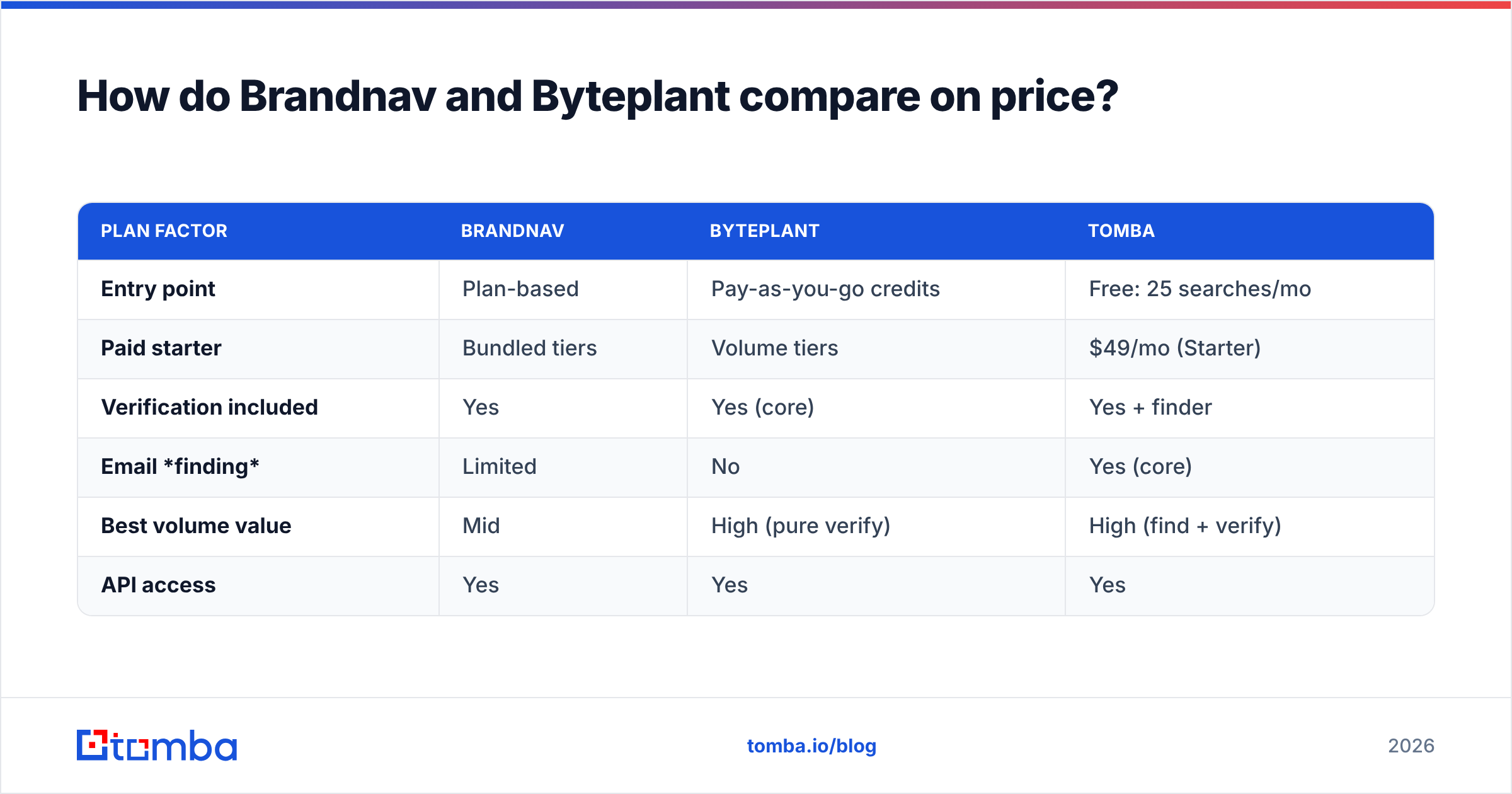
How do Brandnav and Byteplant compare on price?#
Pricing is where "it depends" earns its keep. Byteplant's pay-per-volume model is straightforward and cheap at scale if all you do is validate. Brandnav's value depends entirely on whether you use the surrounding data features — if you're paying for enrichment you don't touch, the effective cost per verified email climbs.
Here's a simplified view (always confirm live rates on each vendor's site, since tiers shift):
| Plan factor | Brandnav | Byteplant | Tomba |
|---|---|---|---|
| Entry point | Plan-based | Pay-as-you-go credits | Free: 25 searches/mo |
| Paid starter | Bundled tiers | Volume tiers | $49/mo (Starter) |
| Verification included | Yes | Yes (core) | Yes + finder |
| Email finding | Limited | No | Yes (core) |
| Best volume value | Mid | High (pure verify) | High (find + verify) |
| API access | Yes | Yes | Yes |
Two takeaways. First, if your only job is cleaning a list you already have, Byteplant's per-volume pricing is hard to beat. Second, if your job is building a list and then cleaning it, you're now paying for two categories of tool — and that's the gap where a combined platform changes the math. Compare the bundled numbers against transparent Tomba pricing before you commit to two subscriptions.
What about the API and developer experience?#
If verification feeds an app, a CRM sync, or a signup flow, the API is the product. Three things matter: latency, documentation quality, and how the response models uncertainty.
- Byteplant ships a clean, well-documented REST API with both real-time single-checks and batch endpoints. Response codes distinguish the states (valid, invalid, accept-all, unknown), which is exactly what you want for programmatic decisions.
- Brandnav exposes API access too, but as part of a wider data platform — fine if you're already integrating its other endpoints, slightly more surface area than you need if you only want validation.
For high-volume programmatic work, also weigh rate limits and batch ceilings. A tool that throttles aggressively turns a 100k-row cleanup into an overnight job. If you're wiring verification into a stack, an email verification API with predictable batch limits and graded responses saves more engineering time than a few cents per credit ever will.
When should you pick a finder-plus-verifier instead?#
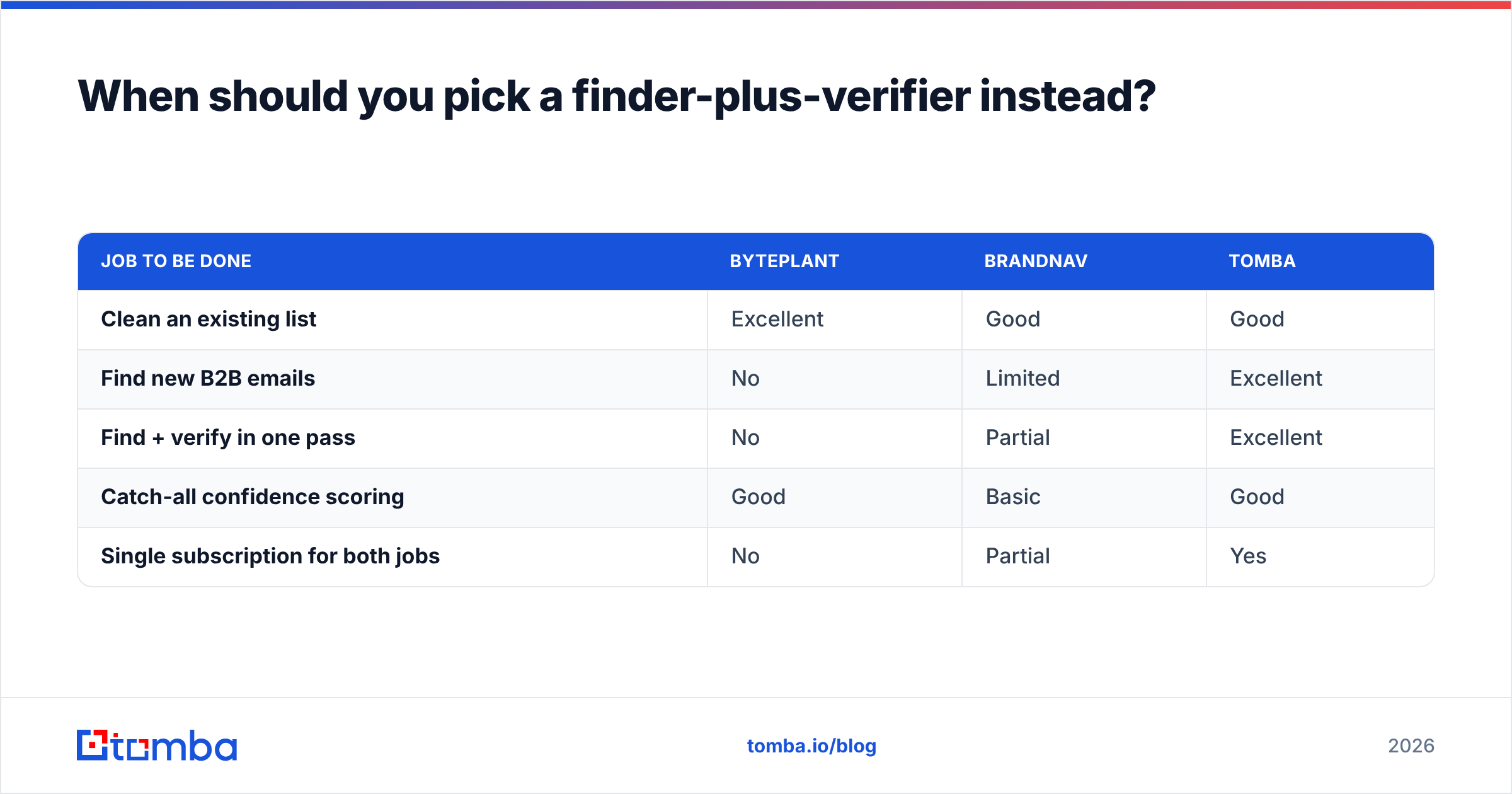
Here's the scenario neither Brandnav nor Byteplant fully solves: you don't have the emails yet.
Verification assumes a list. But most B2B teams start from a company, a name, or a domain — not a clean CSV of addresses. In that workflow, a pure verifier is step two of a two-step problem, and you're left sourcing emails somewhere else first.
This is where a combined platform earns its place. Tomba runs the email finder and the email verifier on the same data backbone, so the address you discover is scored the moment it's found — no export, no second tool, no reconciling two credit systems. For list-scale work, bulk email finder and verification run together rather than as a hand-off.
| Job to be done | Byteplant | Brandnav | Tomba |
|---|---|---|---|
| Clean an existing list | Excellent | Good | Good |
| Find new B2B emails | No | Limited | Excellent |
| Find + verify in one pass | No | Partial | Excellent |
| Catch-all confidence scoring | Good | Basic | Good |
| Single subscription for both jobs | No | Partial | Yes |
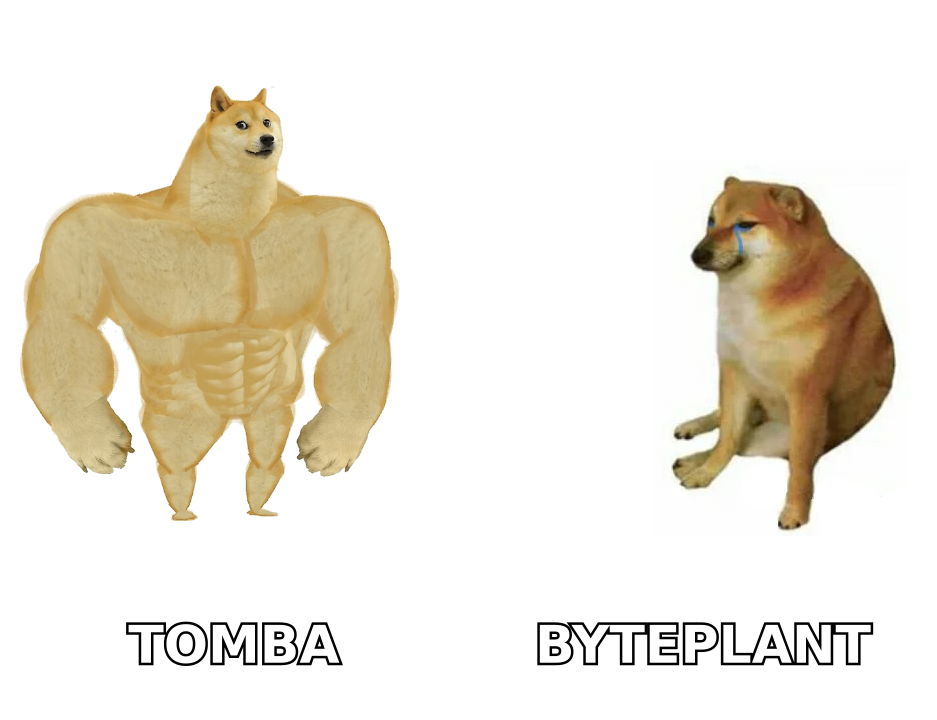
The point isn't that Tomba beats Byteplant at pure validation throughput — Byteplant is a fine specialist. It's that most teams have both jobs, and paying two vendors to cover them is the avoidable cost.
How to choose: a quick decision framework#
Match the tool to the actual shape of your work, not the feature list:
- You only verify lists you already own, at high volume → Byteplant. The pay-per-volume model and focused API are the cleanest fit.
- You already pay for Brandnav's data/outreach features → use its bundled verification; a second tool is redundant.
- You source emails and clean them → a finder-plus-verifier removes the hand-off and the second invoice.
- You integrate verification into software → prioritize graded API responses and batch limits over headline price; read the docs before you trust the marketing.
- You run cold outbound → whatever you pick, verification is necessary but not sufficient — protect email deliverability with warmup and authentication too.
Before committing, validate the vendors yourself: check independent reviews on G2 and read the verification methodology on the official Byteplant Email Validator site rather than taking any comparison — including this one — at face value. For a primer on how validation fits the broader email ecosystem, Wikipedia's email address overview is a neutral reference.
Frequently asked questions#
Is Byteplant better than Brandnav for cold email? For cleaning a cold list at volume, Byteplant's focused validation and per-volume pricing usually win. But cold email also needs finding emails and protecting deliverability — verification alone doesn't carry a campaign.
Does Brandnav verify catch-all domains? It flags them, but with coarser reporting than a verification specialist. For cold, scraped lists where catch-all domains are common, prefer a tool that returns a confidence score rather than a binary valid/invalid.
Can I use one tool to both find and verify emails? Yes. Combined platforms like Tomba run finding and verification on the same dataset, so you skip the export-and-reupload loop and pay one subscription instead of two.
Which is cheaper, Brandnav or Byteplant? For pure verification at scale, Byteplant's volume tiers are typically cheaper. Brandnav's value depends on whether you use its surrounding data features — if you don't, your effective cost per verified email rises.
The bottom line#
Brandnav and Byteplant aren't really competing for the same buyer. Byteplant is the sharper pure-play verifier; Brandnav is the more sensible pick only if you're already inside its data ecosystem. The trap is paying for one to verify and a different tool to find — that's two bills for one workflow.
If your real job is build-a-list-then-clean-it, start with a platform that does both. The Tomba Email Finder discovers professional emails by name, domain, or company and verifies them in the same pass — and the free tier (25 searches a month) lets you test accuracy on your own targets before you spend a cent. Find, verify, and ship your outreach without juggling two subscriptions.
Ready to find emails that actually work?
Join 150,000+ professionals who stopped guessing and started sending. Free credits on signup — no credit card required.
Get the Tomba newsletter
Practical outbound tactics and product updates — once every two weeks.
About the author