Brandnav vs Cufinder 2026: Which B2B Data Tool Wins?
A neutral, hands-on breakdown of Brandnav vs Cufinder in 2026 — coverage, accuracy, pricing, and which B2B data tool actually fits your outbound stack.
Brandnav vs Cufinder: The 2026 B2B Data Showdown
Choosing between Brandnav and Cufinder usually comes down to one question: do you need a focused, affordable data layer for outbound, or a sprawling company database with dozens of enrichment endpoints? Both promise clean B2B contacts, but they solve slightly different problems — and paying for the wrong one quietly burns budget every month.
This is a neutral, hands-on comparison. No marketing gloss, just where each tool is strong, where it falls short, and how to decide. We mention Tomba where it's honestly the better fit, but the goal here is to help you pick correctly.
TL;DR — Brandnav vs Cufinder at a glance#
- Brandnav leans toward affordable email discovery and brand/contact data for smaller teams that want a simple, low-cost workflow.
- Cufinder is a broader B2B database and enrichment engine with many API endpoints (company, contact, technographic, and lookup APIs) aimed at developers and data ops.
- Accuracy is the real differentiator. Both publish optimistic numbers; your own bounce rate after verification is the only metric that matters.
- Pricing models differ. Cufinder sells credits across plan tiers; Brandnav targets the budget end. Neither is the cheapest at scale once you factor verification.
- If accuracy-per-dollar and a clean email-finder workflow matter most, a focused tool like Tomba often beats both — more on that below.
What is Brandnav?#
Brandnav is a B2B contact and brand-data tool built around finding business emails and basic company information quickly. Its pitch is simplicity and price: get email addresses and company context without the enterprise overhead or a steep learning curve.
In practice, teams reach for Brandnav when they want a no-friction way to turn a domain or a name into a contact. It suits solo founders, small agencies, and lean SDR teams who care more about getting something usable fast than about deep firmographic filtering or a programmable data pipeline.
The trade-off is depth. Brandnav covers the common case well, but you'll feel the ceiling when you need large-scale enrichment, technographics, or tight CRM-native automation.

What is Cufinder?#
Cufinder (cufinder.io) is a larger B2B data platform that combines a prospecting interface with a stack of enrichment APIs. Beyond email lookup, it offers company-to-domain, domain-to-company, contact enrichment, technographic data, and several lookup endpoints designed to be wired into your own systems.
That breadth is Cufinder's identity. If you're a RevOps or data engineer who wants to enrich records programmatically — say, take a list of company names and return domains, employee counts, industries, and contacts — Cufinder gives you the building blocks. It positions itself as both a UI tool for sales reps and an API for builders.
The cost of breadth is complexity and credit math. With many endpoints, each consuming credits differently, forecasting spend takes effort, and the all-in-one surface can feel heavier than a team that just needs verified emails actually requires.
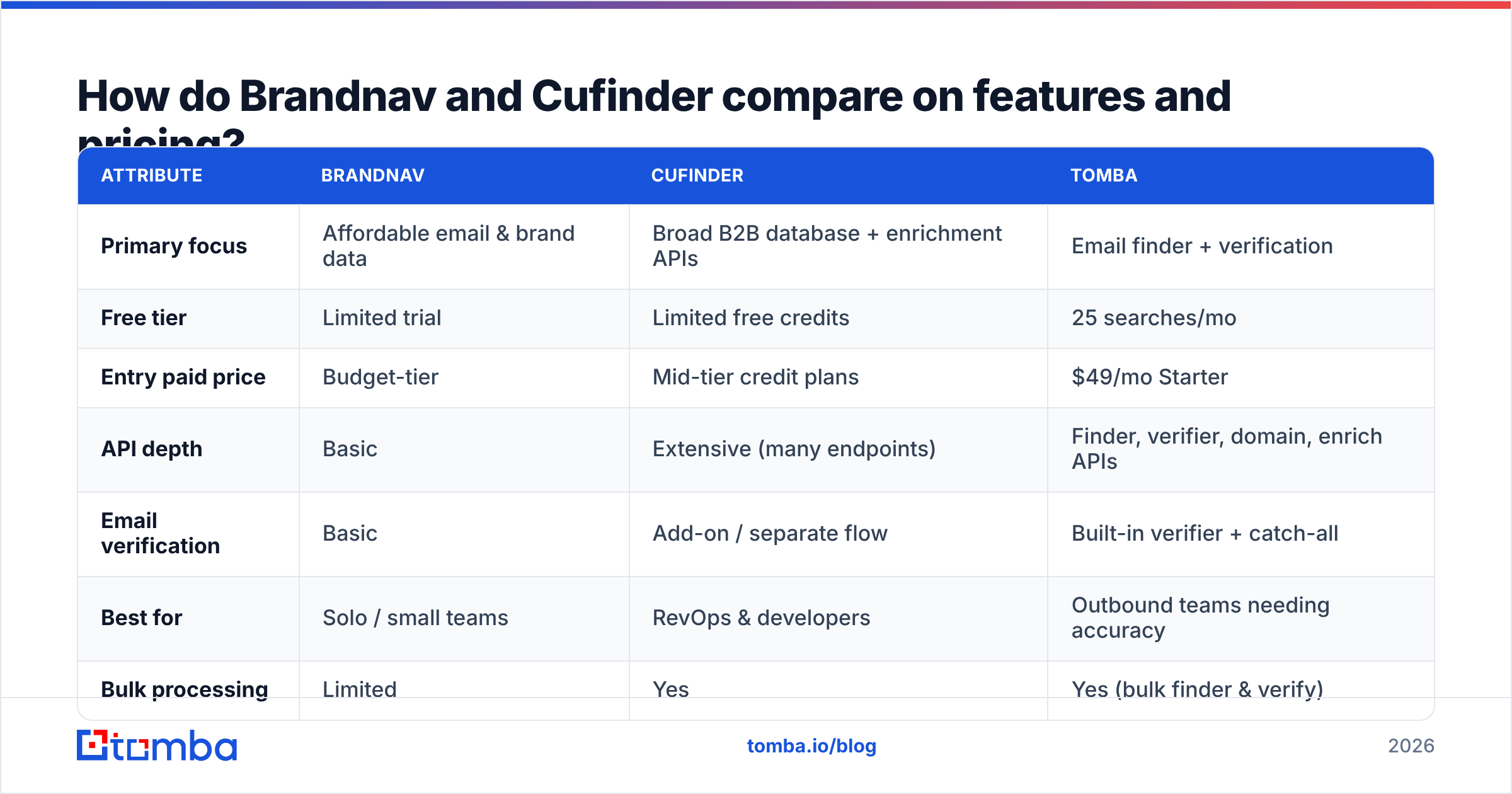
How do Brandnav and Cufinder compare on features and pricing?#
Here's the side-by-side. Treat vendor-published accuracy claims skeptically — they're best-case lab numbers, not what you'll see on a cold list.
| Attribute | Brandnav | Cufinder | Tomba |
|---|---|---|---|
| Primary focus | Affordable email & brand data | Broad B2B database + enrichment APIs | Email finder + verification |
| Free tier | Limited trial | Limited free credits | 25 searches/mo |
| Entry paid price | Budget-tier | Mid-tier credit plans | $49/mo Starter |
| API depth | Basic | Extensive (many endpoints) | Finder, verifier, domain, enrich APIs |
| Email verification | Basic | Add-on / separate flow | Built-in verifier + catch-all |
| Best for | Solo / small teams | RevOps & developers | Outbound teams needing accuracy |
| Bulk processing | Limited | Yes | Yes (bulk finder & verify) |
| Catch-all handling | Minimal | Partial | Dedicated catch-all verifier |
A few honest takeaways from the table:
- Brandnav wins on simplicity and entry cost. If your monthly volume is small and you don't need an API, it's an easy on-ramp.
- Cufinder wins on breadth. The number of endpoints is genuinely useful if you're enriching at scale or building internal tooling.
- Neither leads on verification depth. Both treat verification as secondary, which is exactly where deliverability problems start.
- Credit forecasting favors focused tools. The more endpoints and pricing dimensions, the harder it is to predict spend — Cufinder's flexibility is also its budgeting headache.
For a deeper look at how providers source and refresh records, it's worth understanding where data accuracy comes from before you trust any single vendor's headline percentage.
Which is more accurate — Brandnav or Cufinder?#
Accuracy is where comparisons get slippery, because the honest answer is: it depends on your target segment, and you must measure it yourself.
Both tools draw from a mix of public sources, crawled data, partner feeds, and pattern inference. For well-known companies with predictable email formats (firstname.lastname@domain), both perform fine. The gap widens on harder cases:
- Catch-all domains, where the server accepts every address and SMTP checks can't confirm validity.
- Smaller or newer companies with thin public footprints.
- Role and generic inboxes that inflate "found" counts but kill reply rates.

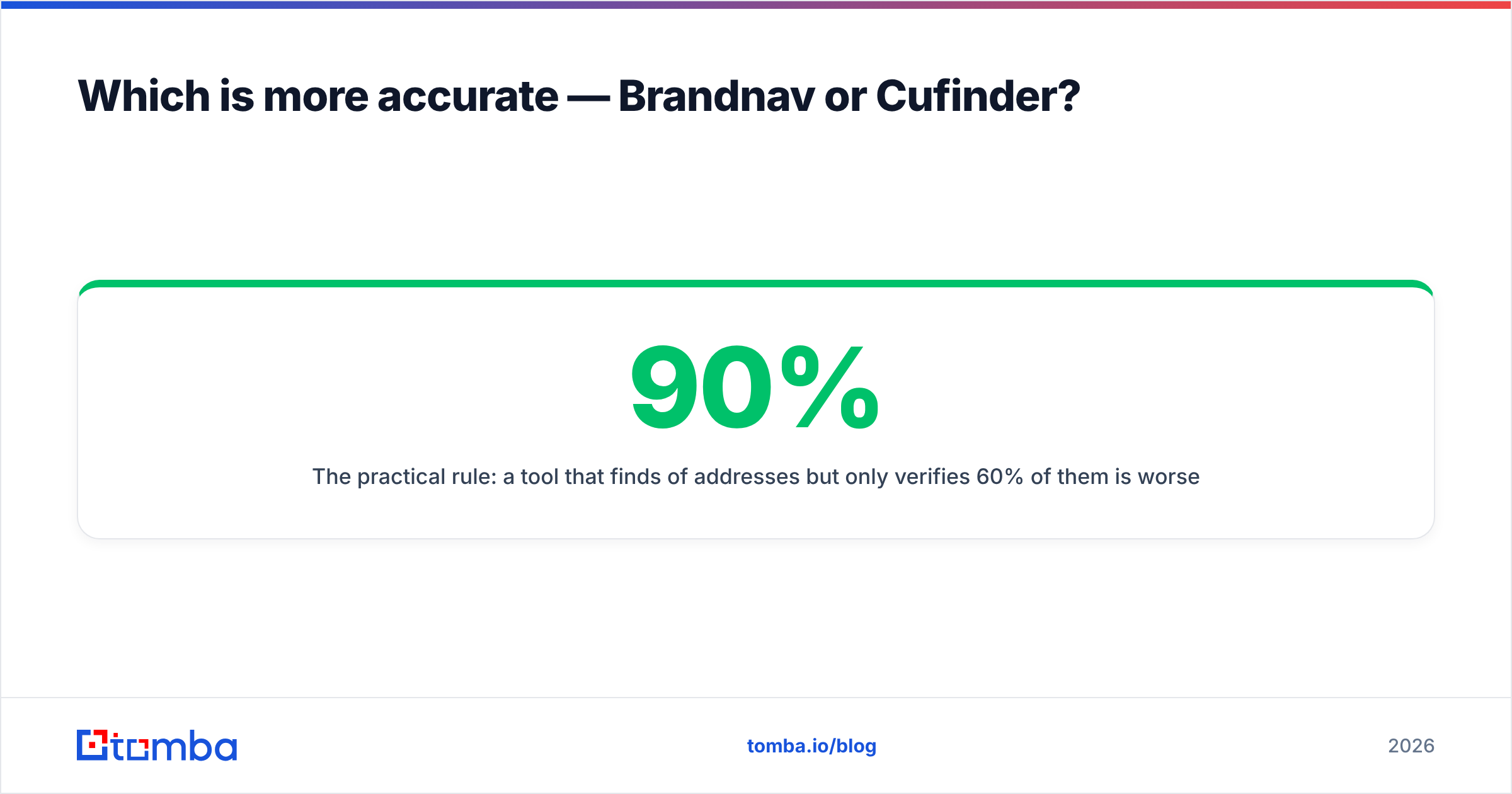
The practical rule: a tool that finds 90% of addresses but only verifies 60% of them is worse than a tool that finds 75% and verifies 95%. Bounces hurt your sender reputation, which depresses inbox placement for every future campaign — including the good addresses.
That's why a dedicated email verifier layer matters more than a slightly higher discovery rate. Whichever tool you pick, run found emails through verification before you send. Brandnav's verification is basic; Cufinder treats it as a separate flow; both leave room for a stronger verification step.
To test fairly: pull 200 contacts from the same target list through each tool, verify all results with one neutral verifier, then send a small warmed batch and measure actual bounce and reply rates. The winner on your data is the only winner that counts.
Is Brandnav or Cufinder better for developers and RevOps?#
Cufinder, clearly — if API breadth is your priority. Its endpoint variety (company lookups, domain resolution, contact and technographic enrichment) makes it a natural fit for teams stitching data into a warehouse, CRM, or custom app. If you think in terms of "enrich this list of 50,000 companies programmatically," Cufinder speaks your language.
Brandnav is the lighter option. It can support small automations, but it isn't built to be the backbone of a data pipeline.
That said, "more endpoints" isn't automatically "better for you." Many teams over-buy capability they never wire up. If your real need is find verified emails by domain and push them to a CRM, a focused email finder API with predictable credits and built-in verification is simpler to operate than a sprawling endpoint catalog. Map your actual integration to the tools you'll genuinely use before paying for surface area.
What are the pros and cons of each?#
Brandnav — pros:
- Low entry cost, friendly for solo users and small teams
- Fast, simple workflow with little setup
- Reasonable for low-volume, common-domain prospecting
Brandnav — cons:
- Shallow enrichment and limited firmographic filtering
- Basic verification — expect to add a separate verifier
- Not designed for large-scale or API-heavy workflows
Cufinder — pros:
- Wide range of enrichment and lookup APIs
- Good fit for RevOps, data ops, and developers
- Handles bulk and programmatic use cases
Cufinder — cons:
- Credit math across many endpoints is hard to forecast
- Heavier surface than a pure email-finding team needs
- Verification isn't the core strength
Both are legitimate tools. Cross-check current user sentiment on a neutral site like G2 and the vendor's own homepage at brandnav.com before committing — review patterns shift quarter to quarter.
When should you choose a focused alternative like Tomba?#
Choose a focused alternative when your core job is finding verified emails and not bouncing — which describes most outbound and lead-gen teams.
Tomba sits deliberately in that lane. Instead of competing on endpoint count, it pairs a strong email finder with a built-in verifier and a dedicated catch-all verifier, so discovery and validation happen in one place rather than across two tools and two invoices. For account-based work, domain search returns the contacts behind a company in one query, and data enrichment fills in the firmographic gaps.
Here's how the decision usually shakes out:
| Your situation | Best pick |
|---|---|
| Tiny budget, occasional lookups | Brandnav |
| Building a data pipeline, many endpoints | Cufinder |
| Outbound team that lives or dies by deliverability | Tomba |
| Need find + verify in one predictable workflow | Tomba |
| Large bulk lists with catch-all domains | Tomba |
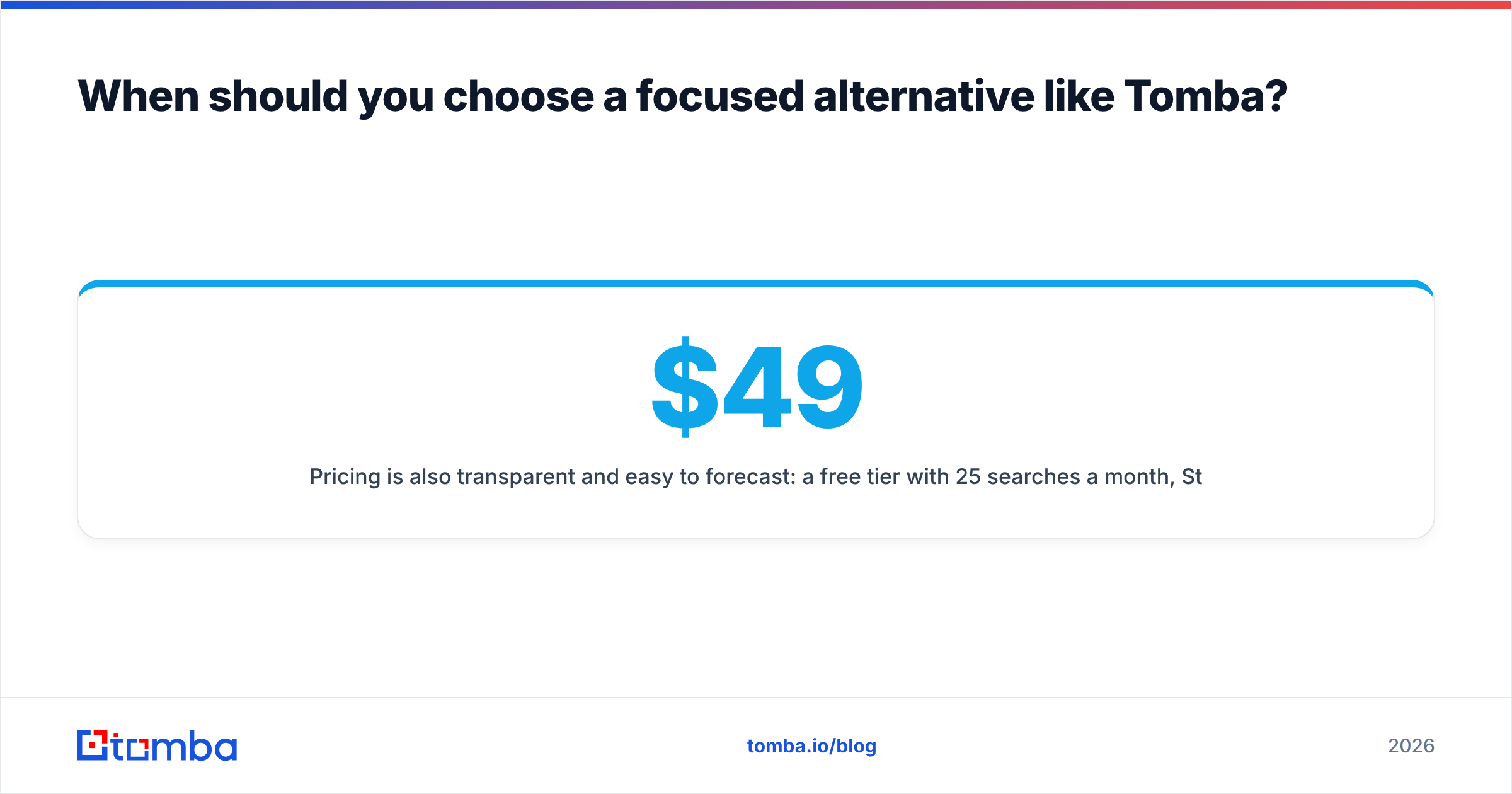
Pricing is also transparent and easy to forecast: a free tier with 25 searches a month, Starter at $49/mo, Growth at $99/mo, and Pro at $249/mo. You can see full Tomba pricing without decoding per-endpoint credit tables.

How do you actually decide between Brandnav and Cufinder?#
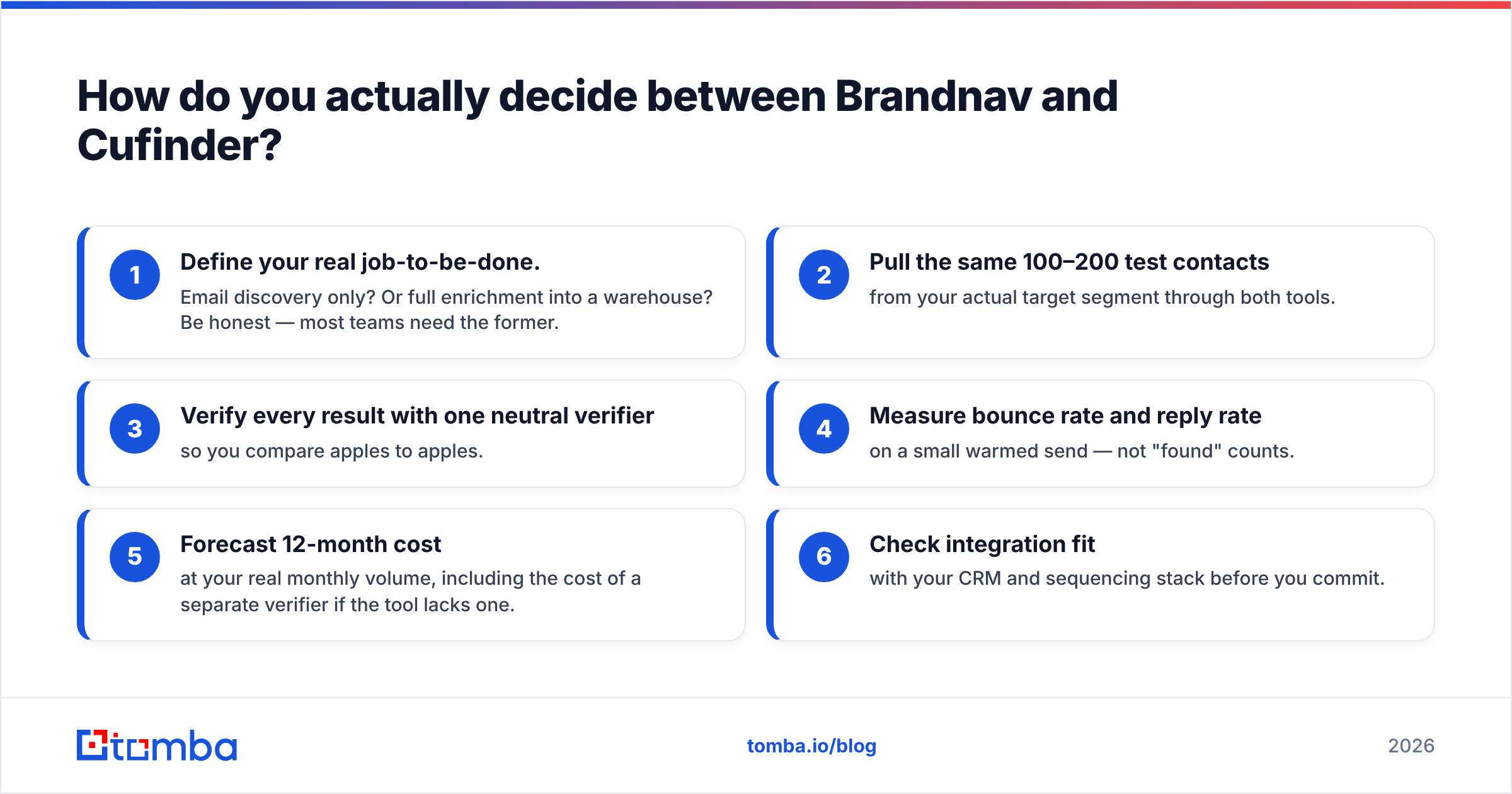
Run a structured 30-minute evaluation instead of trusting any blog (including this one) at face value:
- Define your real job-to-be-done. Email discovery only? Or full enrichment into a warehouse? Be honest — most teams need the former.
- Pull the same 100–200 test contacts from your actual target segment through both tools.
- Verify every result with one neutral verifier so you compare apples to apples.
- Measure bounce rate and reply rate on a small warmed send — not "found" counts.
- Forecast 12-month cost at your real monthly volume, including the cost of a separate verifier if the tool lacks one.
- Check integration fit with your CRM and sequencing stack before you commit.
If Brandnav clears your accuracy bar at a price you like, it's a fine budget choice. If you need programmatic breadth, Cufinder earns its keep. If the test exposes bounce problems — the most common outcome — that's your signal to consolidate find-and-verify into one accuracy-first tool.
Frequently asked questions#
Is Brandnav cheaper than Cufinder? Generally Brandnav targets the lower end on entry pricing, while Cufinder uses credit-based plans across tiers. Real cost depends on volume and how many endpoints you use, so model it against your monthly numbers rather than the sticker price.
Does Cufinder verify emails? Cufinder offers verification, but it's handled as a separate flow rather than a deep, built-in core feature. For high-volume sending, plan to run results through a dedicated verifier regardless.
Can I use either tool for bulk lead generation? Cufinder handles bulk and programmatic use cases better than Brandnav. If bulk is central, also compare against a bulk email finder that bundles verification.
Which has the better API? Cufinder has the broader API surface. Whether that's "better" depends on whether you'll use those endpoints — breadth you don't integrate is just spend.
The bottom line#
Brandnav is the simple, budget-friendly pick for small teams doing light email discovery. Cufinder is the broad, developer-friendly database for RevOps and enrichment at scale. Both are reasonable in their lane — and both treat verification as a secondary concern, which is exactly where cold-email programs quietly fail.
If your success metric is verified emails that land in the inbox, evaluate an accuracy-first tool alongside them. Try the Tomba Email Finder — start free with 25 searches, run your own bounce test against Brandnav and Cufinder, and let the data on your list make the call. The right tool isn't the one with the longest feature page; it's the one that keeps your reply rate up and your sender reputation clean.
Ready to find emails that actually work?
Join 150,000+ professionals who stopped guessing and started sending. Free credits on signup — no credit card required.
Get the Tomba newsletter
Practical outbound tactics and product updates — once every two weeks.
About the author