Brandnav vs DiscoverOrg 2026: B2B Data Tools Compared
Brandnav vs DiscoverOrg in 2026: a neutral breakdown of pricing, data accuracy, coverage, and contract terms to help you pick the right B2B data tool.
Choosing between Brandnav and DiscoverOrg is really a choice between two philosophies of B2B data: lightweight, self-serve email discovery versus heavyweight enterprise sales intelligence with a sales rep and an annual contract attached. They overlap on paper, but they solve different problems for different buyers.
This guide breaks down what each tool actually does, where the data comes from, what you pay, and which one fits your team in 2026 — plus where a focused alternative like Tomba beats both on cost-per-contact.
TL;DR: Brandnav vs DiscoverOrg at a glance#
- Brandnav is a budget-friendly email and lead-data tool aimed at SMBs, agencies, and solo founders who want contacts fast without a sales call.
- DiscoverOrg is now part of ZoomInfo — it sells deep org charts, intent data, and technographics to mid-market and enterprise revenue teams, usually on a multi-thousand-dollar annual contract.
- Pick Brandnav if you want cheap, quick email lists and can tolerate variable accuracy. Pick DiscoverOrg/ZoomInfo if you need rich account intelligence and have the budget plus a real RevOps function.
- Neither is ideal if you mostly need verified emails at predictable cost — that's where a finder-plus-verifier like Tomba lands, starting at $49/mo with a free tier.
- Always test accuracy on your target accounts before committing. Vendor-reported coverage numbers rarely survive contact with a niche ICP.
What is Brandnav?#
Brandnav is a B2B data platform built around email and contact discovery. The pitch is straightforward: give it a domain, a name, or a list, and get back business email addresses and basic company data you can drop into outreach. It leans toward the self-serve, credit-based model that SMBs and lead-gen agencies prefer — sign up, buy credits, export, go.
Its strengths are accessibility and price. You don't talk to a salesperson, you don't sign an annual contract, and you can start small. For a freelancer building a 500-contact prospecting list or an agency spinning up campaigns for clients, that low friction matters more than enterprise-grade org charts.
The trade-off is depth. Brandnav is a contact-and-email tool, not a full sales-intelligence suite. You won't get the layered intent signals, detailed reporting hierarchies, or technographic filtering that enterprise platforms sell. Accuracy also tends to vary by region and industry, so verification on your own list is non-negotiable before you hit send. If deliverability matters to you, run exports through a dedicated email verifier regardless of which finder you choose.
What is DiscoverOrg?#
DiscoverOrg is enterprise sales intelligence. Historically known for human-researched org charts and remarkably detailed account profiles, it merged with ZoomInfo and now operates inside the ZoomInfo platform. When people shop "DiscoverOrg" in 2026, they're effectively evaluating ZoomInfo's data and intelligence stack.
What you're buying is breadth and depth at the account level: decision-maker hierarchies, direct dials, buying-intent signals, technographics (what software a company runs), funding and hiring triggers, and CRM/enrichment integrations that keep your Salesforce or HubSpot records fresh. For an enterprise SDR team running account-based plays, that context is the product — knowing who reports to whom and when an account is in-market is worth more than a raw email.
The cost of that depth is, well, cost — and commitment. DiscoverOrg/ZoomInfo is sold through sales reps on annual contracts that typically run into five figures, often with per-seat pricing and usage caps. It's a platform you adopt, onboard, and operationalize, not a tool you try on a Tuesday afternoon. You can read more about the combined offering on ZoomInfo's site and weigh real buyer feedback on G2.
How do Brandnav and DiscoverOrg compare on features and price?#
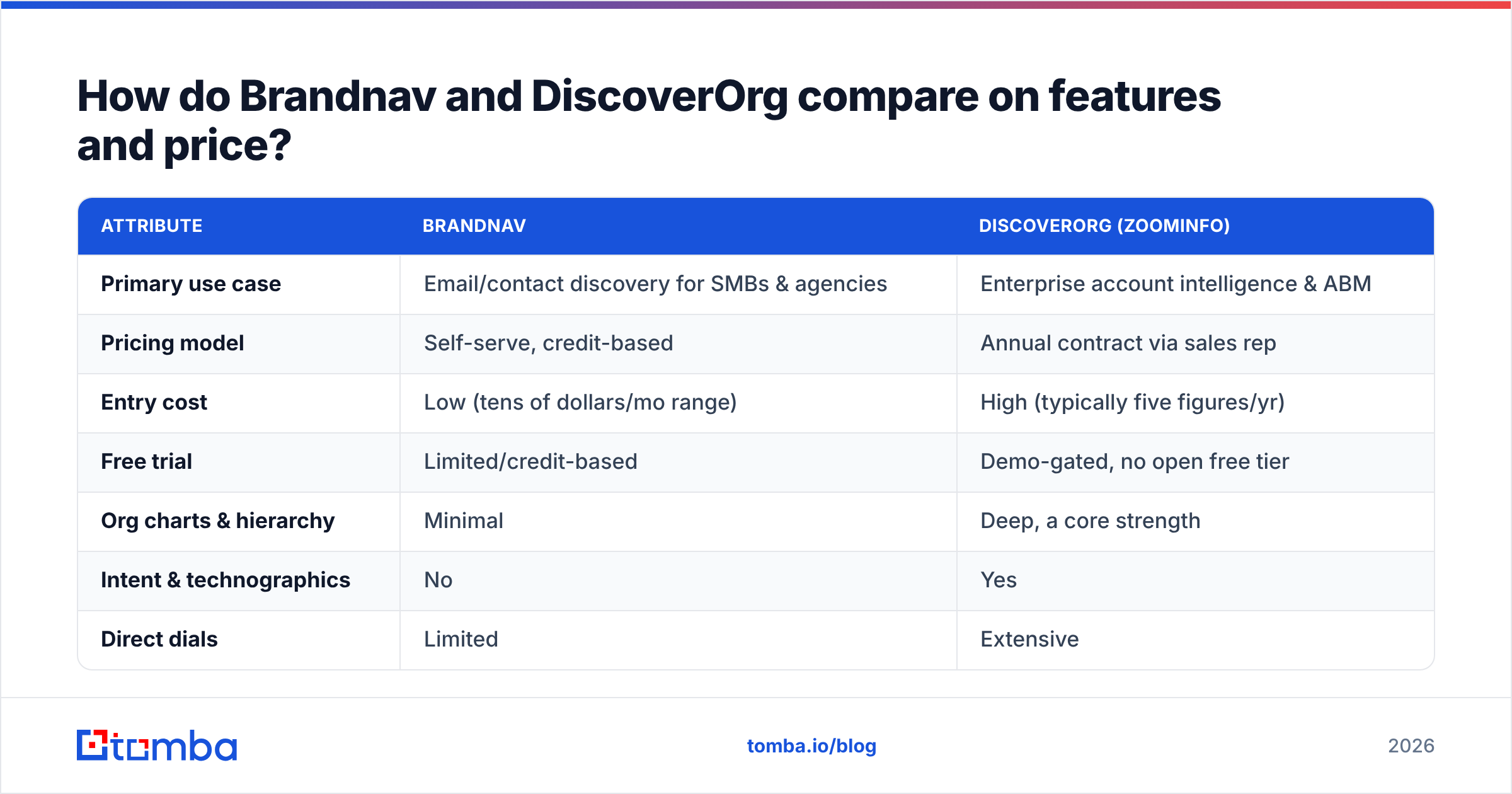
The clearest way to see the gap is side by side. The two tools aren't really competing for the same dollar — one is a self-serve utility, the other an enterprise commitment — but buyers often shortlist both, so here's how they stack up.
| Attribute | Brandnav | DiscoverOrg (ZoomInfo) |
|---|---|---|
| Primary use case | Email/contact discovery for SMBs & agencies | Enterprise account intelligence & ABM |
| Pricing model | Self-serve, credit-based | Annual contract via sales rep |
| Entry cost | Low (tens of dollars/mo range) | High (typically five figures/yr) |
| Free trial | Limited/credit-based | Demo-gated, no open free tier |
| Org charts & hierarchy | Minimal | Deep, a core strength |
| Intent & technographics | No | Yes |
| Direct dials | Limited | Extensive |
| CRM enrichment | Basic | Robust, native integrations |
| Contract commitment | None | Annual, per-seat |
| Best for | Founders, freelancers, lead-gen agencies | Mid-market & enterprise RevOps |
Read this table as a budget-and-depth axis. If your buying motion is "I need contacts this week and a card, not a contract," Brandnav's column wins. If it's "I'm running ABM across 2,000 target accounts and need to know who the VP of Engineering reports to," DiscoverOrg's column is the only one that answers the question.
Which has better data accuracy and coverage?#
DiscoverOrg generally wins on raw account depth; the accuracy question depends entirely on your segment. This is the part where vendor marketing and reality diverge most, so treat every coverage claim — from either side — as a hypothesis to test, not a fact.
A few principles hold across both tools:
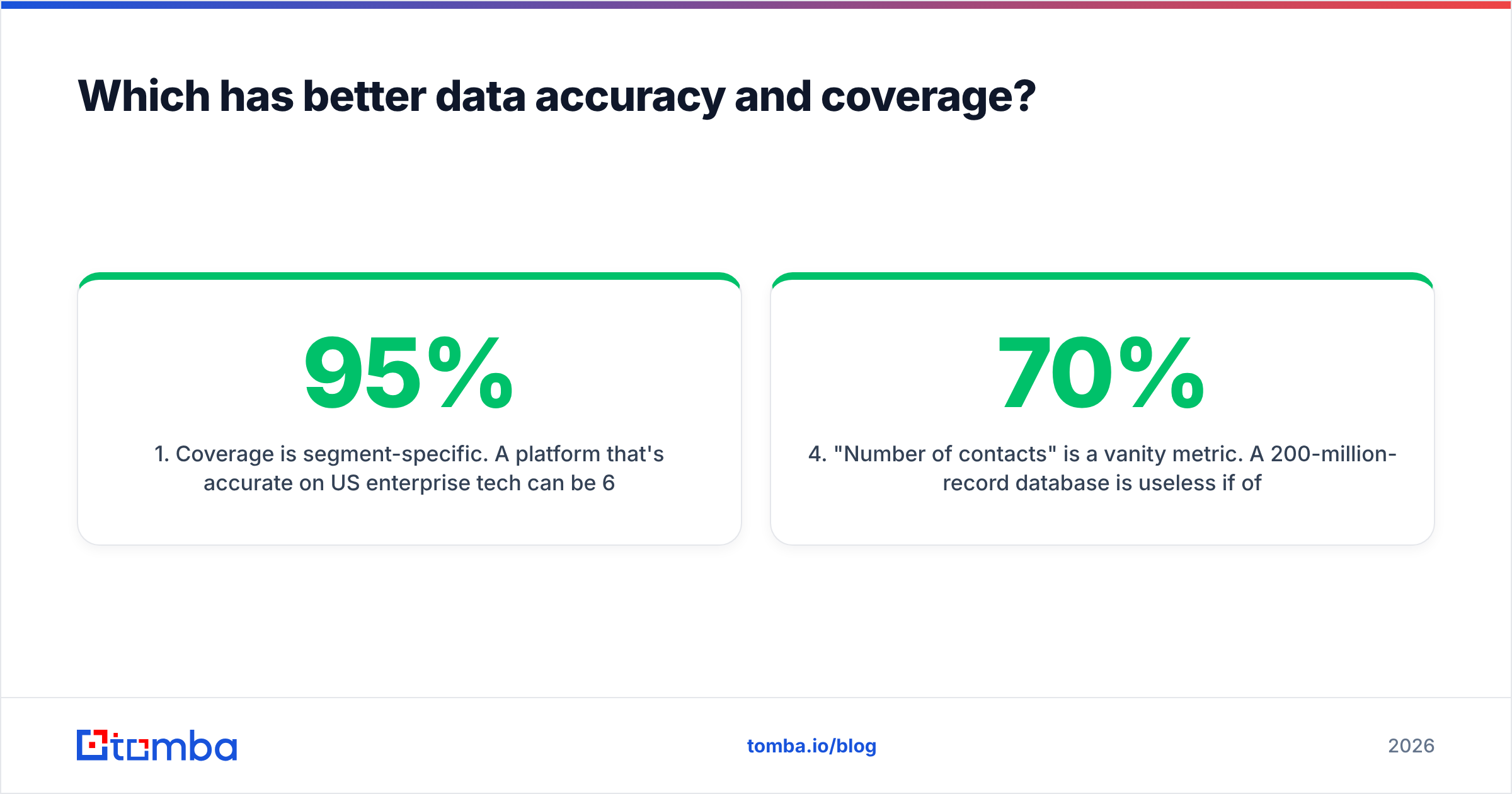
- Coverage is segment-specific. A platform that's 95% accurate on US enterprise tech can be 60% on European SMBs or APAC manufacturing. Your ICP is the only benchmark that matters.
- Direct dials decay fastest. Phone numbers and job titles go stale quickly as people change roles. Enterprise platforms invest more in refresh cycles, which is part of what you pay for.
- Emails need verification regardless of source. No provider is immune to catch-all domains, role accounts, and outdated records. Run a verification pass before any send — see Tomba's data sources for how a verified-first pipeline is built.
- "Number of contacts" is a vanity metric. A 200-million-record database is useless if 70% of your slice is unreachable. Test reachability on a 100-contact sample from your real target list.
Independent analyst coverage from firms like Gartner consistently makes the same point: data quality is a per-buyer outcome, not a universal score. Run a paid pilot or trial credits against the same 50–100 target accounts in both tools, then compare valid-email rate, bounce rate, and title accuracy. The winner on your list is the one to buy.
Is DiscoverOrg worth the price over Brandnav?#
It's worth it when account intelligence drives revenue and you have the team to use it. DiscoverOrg/ZoomInfo earns its five-figure contract for organizations where:
- ABM is the core go-to-motion and org charts directly shape territory and account plans.
- Intent and technographic signals feed lead scoring and timing — see how marketing qualified lead workflows depend on those signals.
- A RevOps or sales-ops function exists to operationalize the data, maintain integrations, and prove ROI.
- The deal sizes justify the spend — a single closed enterprise deal can pay for the platform.
It's not worth it when you're a small team that mostly needs verified emails and a few firmographic fields. Paying enterprise rates for capabilities you won't operationalize is the most common buyer regret in this category. If org charts and intent data would sit unused, you're funding shelfware.
Where does Tomba fit in this comparison?#
Tomba sits in the gap both tools leave open: predictable, verified contact data without enterprise pricing or contract lock-in. Where Brandnav competes on cheap-but-variable and DiscoverOrg competes on deep-but-expensive, Tomba focuses on the job most outbound teams actually need done — find a correct, deliverable email, confirm it's valid, and move on.
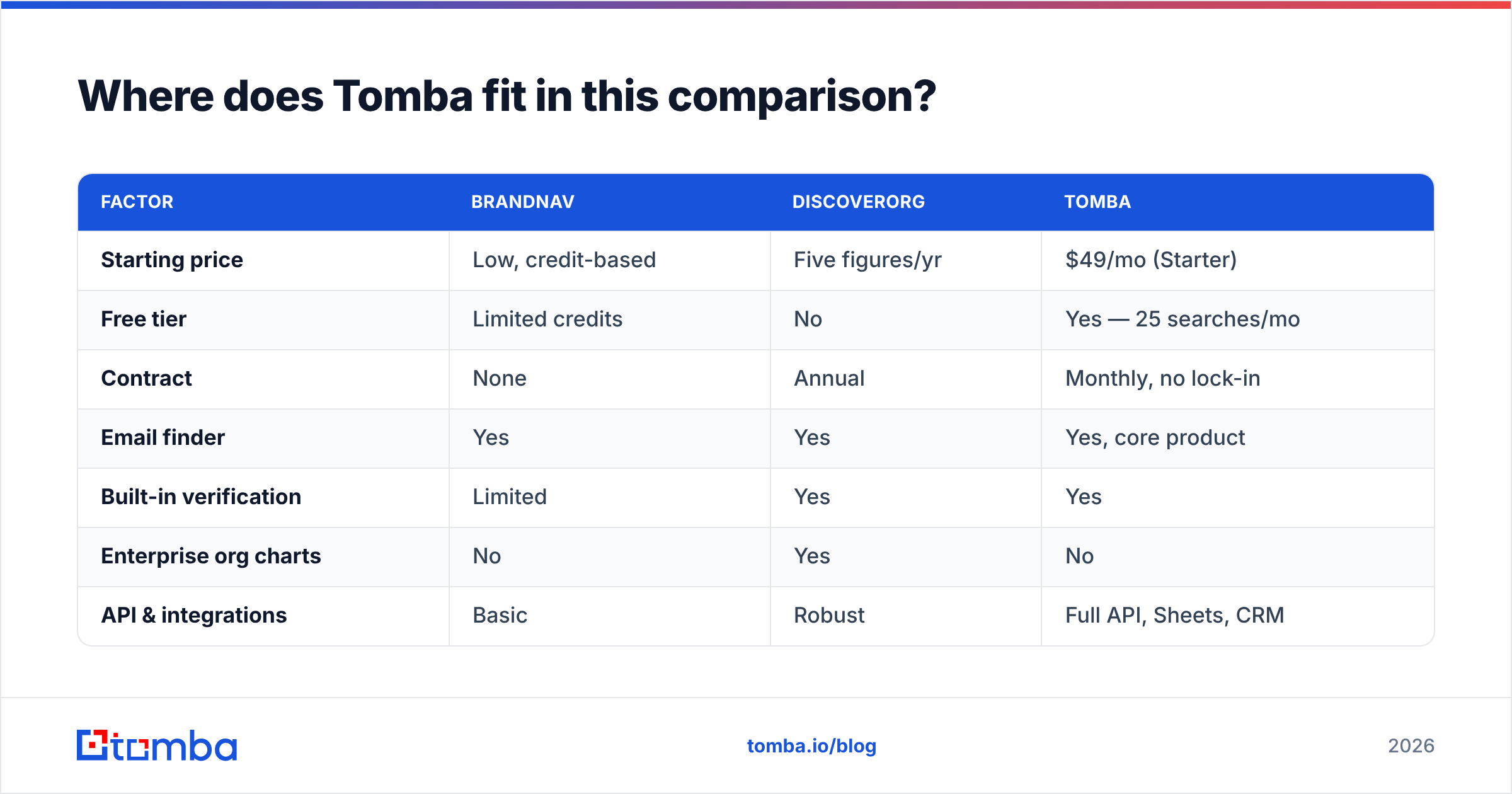
Here's how the three compare on the dimensions that decide most purchases:
| Factor | Brandnav | DiscoverOrg | Tomba |
|---|---|---|---|
| Starting price | Low, credit-based | Five figures/yr | $49/mo (Starter) |
| Free tier | Limited credits | No | Yes — 25 searches/mo |
| Contract | None | Annual | Monthly, no lock-in |
| Email finder | Yes | Yes | Yes, core product |
| Built-in verification | Limited | Yes | Yes |
| Enterprise org charts | No | Yes | No |
| API & integrations | Basic | Robust | Full API, Sheets, CRM |
| Best fit | Quick SMB lists | Enterprise ABM | Verified outreach at scale |
Tomba's plans are transparent and self-serve: a Free tier with 25 searches/mo, Starter at $49/mo, Growth at $99/mo, Pro at $249/mo, and custom Enterprise. You can see the full breakdown on the Tomba pricing page. The email finder pairs with a built-in verifier, data enrichment, and a searchable B2B database, so the find-verify-enrich loop happens in one place instead of three tools.
To be fair about the boundaries: Tomba is not trying to replace DiscoverOrg's enterprise intelligence. If your entire GTM strategy is built on intent data, technographics, and detailed reporting hierarchies, ZoomInfo's platform does things Tomba doesn't. But for the very common case — "I need verified emails for my prospecting, at a price I can predict" — Tomba is usually the more rational spend than either competitor.
How should you choose between them?#
Match the tool to your motion, not to the feature list. Run through this quick decision path:
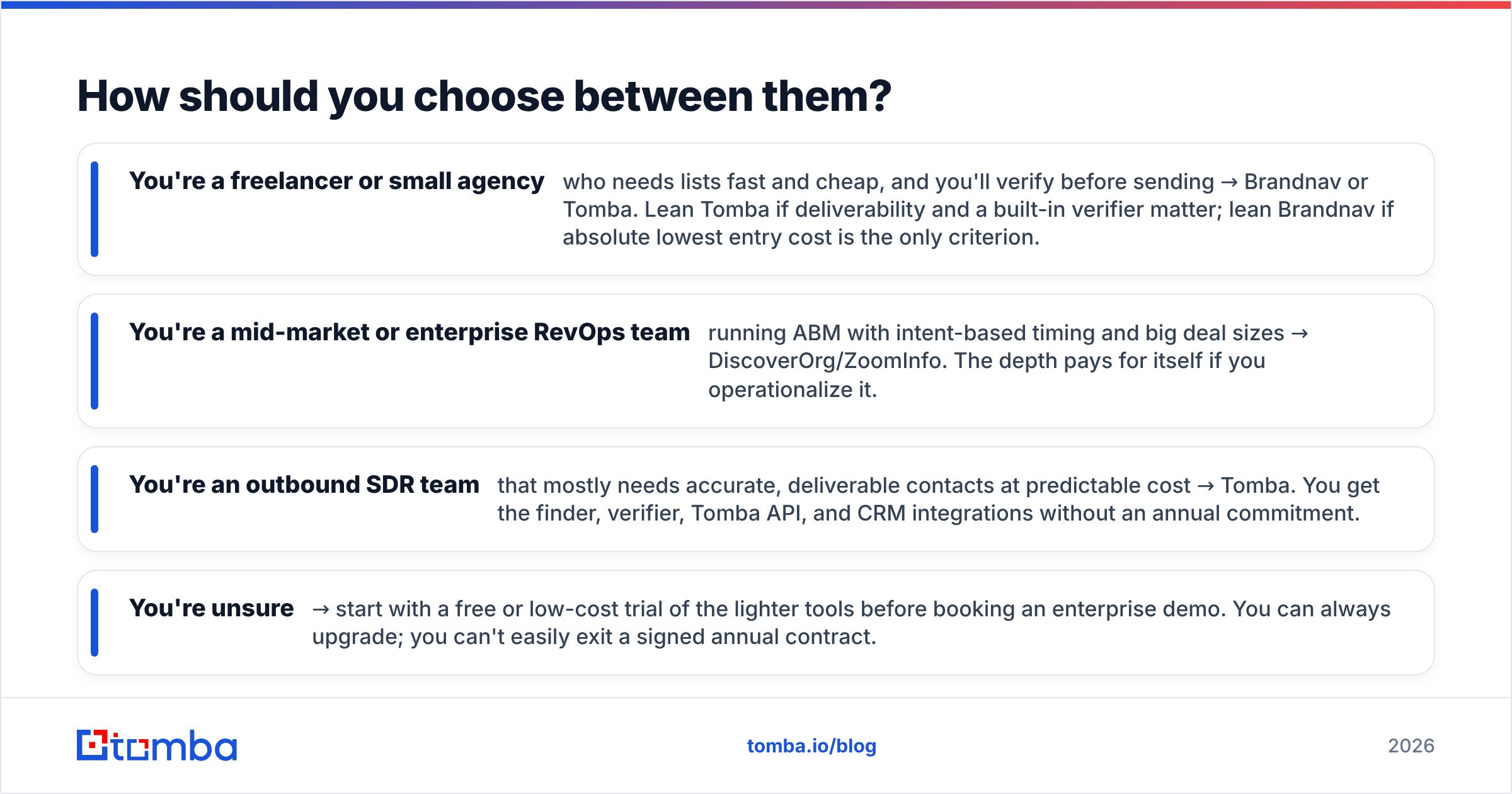
- You're a freelancer or small agency who needs lists fast and cheap, and you'll verify before sending → Brandnav or Tomba. Lean Tomba if deliverability and a built-in verifier matter; lean Brandnav if absolute lowest entry cost is the only criterion.
- You're a mid-market or enterprise RevOps team running ABM with intent-based timing and big deal sizes → DiscoverOrg/ZoomInfo. The depth pays for itself if you operationalize it.
- You're an outbound SDR team that mostly needs accurate, deliverable contacts at predictable cost → Tomba. You get the finder, verifier, Tomba API, and CRM integrations without an annual commitment.
- You're unsure → start with a free or low-cost trial of the lighter tools before booking an enterprise demo. You can always upgrade; you can't easily exit a signed annual contract.
Whatever you shortlist, run the same accuracy test on all of them against your real target accounts. The vendor that wins on your ICP — measured by valid-email rate and bounce rate, not by total database size — is the correct choice. Everything else is marketing.
The bottom line#
Brandnav and DiscoverOrg solve different problems: one is a low-cost, self-serve email tool for small teams, the other is an enterprise intelligence platform for account-based revenue orgs with the budget and headcount to use it. Neither is "better" in the abstract — they're better for different buyers.
If your real need is verified, deliverable contact data without enterprise pricing or a year-long contract, skip the false choice. Try the Tomba Email Finder free — 25 searches a month, no card, no sales call — and see whether its accuracy on your target accounts beats both. Start free, verify the data yourself, and only pay when the results prove out.
Ready to find emails that actually work?
Join 150,000+ professionals who stopped guessing and started sending. Free credits on signup — no credit card required.
Get the Tomba newsletter
Practical outbound tactics and product updates — once every two weeks.
About the author