Brandnav vs Exellius: Which Email Finder Wins in 2026?
Brandnav and Exellius both promise verified B2B emails, but they take very different paths to get there. Here's a neutral breakdown of accuracy, pricing, and fit—plus how Tomba compares.
Choosing between Brandnav and Exellius usually comes down to one question: which tool puts more verified, deliverable contacts into your sequence per dollar? Both pitch themselves as B2B data and email-finding platforms, but they make different trade-offs on accuracy, coverage, and pricing transparency. This is a neutral, hands-on style breakdown so you can pick the right fit—and see where a third option like Tomba changes the math.
TL;DR — Brandnav vs Exellius at a glance#
- Brandnav leans toward an all-in-one data suite: email finding, enrichment, and outreach features bundled together, with pricing that scales by contacts and seats.
- Exellius positions more as a sourcing and lead-research service, often favored by teams that want done-for-you list building rather than a self-serve tool.
- Accuracy is the real battleground. Bundled "millions of contacts" claims mean little if bounce rates climb past 5%. Always test on your own domain list before committing.
- Pricing transparency differs. Self-serve, published tiers beat "contact sales" quotes when you're a small team trying to forecast cost-per-lead.
- If neither fits, Tomba offers a published free tier (25 searches/mo) and a $49/mo Starter plan with verification built in—worth benchmarking against both.
What do Brandnav and Exellius actually do?#
Both tools live in the same broad category—B2B contact data and prospecting—but they emphasize different parts of the workflow.
Brandnav markets itself as a contact intelligence platform: you search by company or person, get back an email address, and often layer on enrichment fields (title, company size, social profiles) plus some outreach tooling. Think of it as a Swiss Army knife where the email finder is one blade among several.
Exellius reads more like a lead-generation partner. The emphasis is on sourcing targeted lists—frequently with a managed or semi-managed element—rather than a pure pay-as-you-go API you hammer yourself. If Brandnav is the toolbox, Exellius is closer to hiring someone who already owns the toolbox.
That distinction matters because it changes who each tool is for. A self-serve SDR team that wants to find emails on demand has different needs than a founder who wants a finished list delivered. Before you compare line items, be honest about which of those you are.
How accurate are Brandnav vs Exellius?#
Accuracy is where most email-finder comparisons are won or lost, and it's the number you should weight highest. A tool that returns 1,000 addresses at 80% deliverability is worse than one that returns 700 at 97%—the second list protects your sender reputation and keeps you out of spam folders.
Here's the problem: vendors rarely publish a like-for-like accuracy figure, and when they do, the testing methodology is opaque. Brandnav and Exellius both advertise large databases, but database size and match accuracy on your specific targets are not the same thing. A database can be huge and still miss the 200 mid-market SaaS CFOs you actually care about.

The only reliable test is your own. Take a sample of 50–100 real target accounts, run them through each tool, and then push the results through an independent email verifier before you judge. Measure three things:
- Hit rate — of your 100 targets, how many returned an email at all?
- Verified rate — of those hits, how many pass SMTP verification as valid (not catch-all, not risky)?
- Real bounce rate — send a small warm batch and measure actual bounces, because verification and reality sometimes diverge.
A tool that wins on raw hit rate but loses on verified rate is quietly costing you deliverability. Run this test on Brandnav, Exellius, and at least one control tool so you have a baseline. Tomba publishes its data sources openly, which makes that kind of apples-to-apples test easier to interpret.
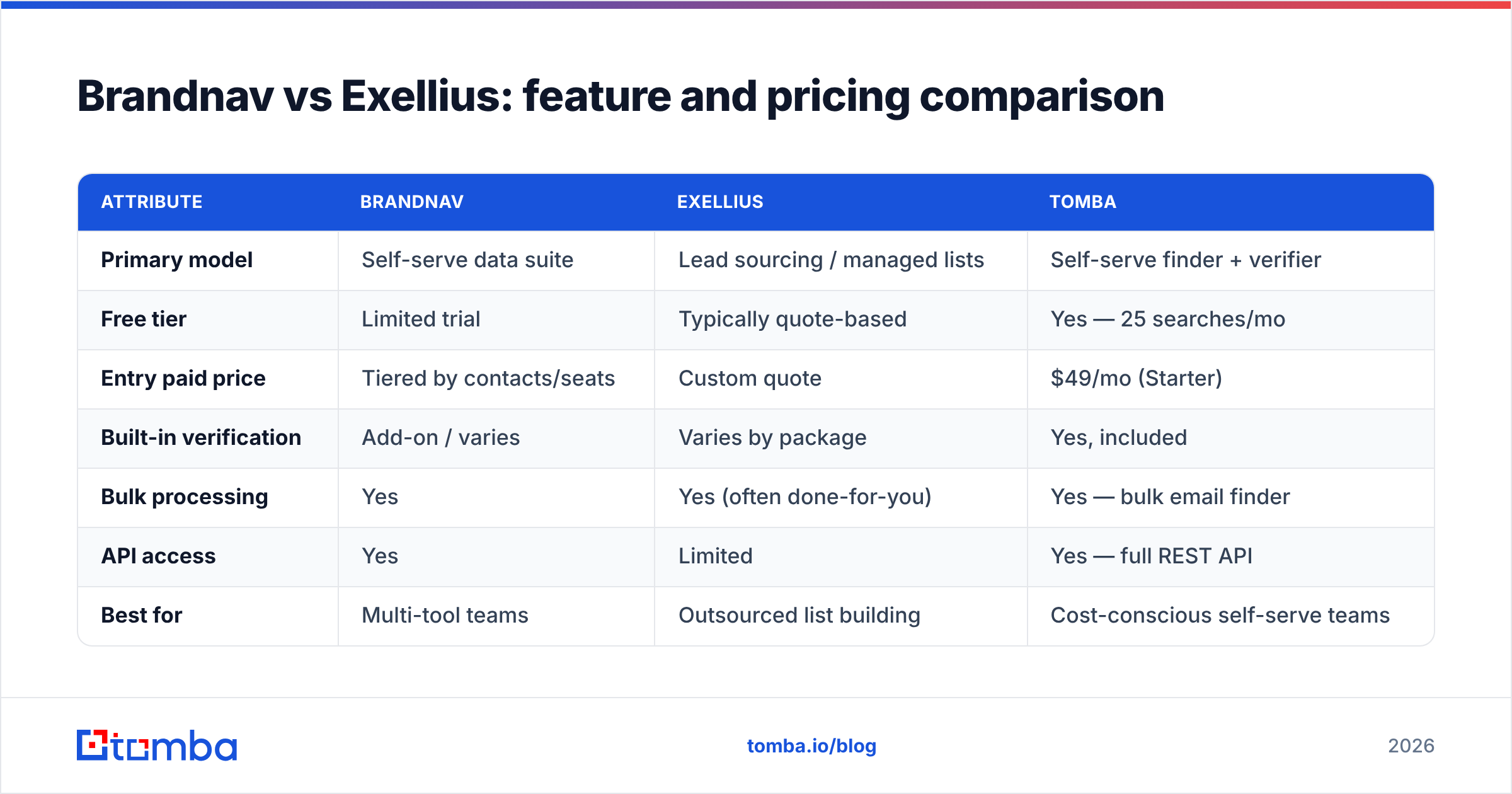
Brandnav vs Exellius: feature and pricing comparison#
Here's a side-by-side on the attributes that usually drive the decision. Treat published numbers as a starting point and confirm against current vendor quotes, since pricing in this category changes often.

| Attribute | Brandnav | Exellius | Tomba |
|---|---|---|---|
| Primary model | Self-serve data suite | Lead sourcing / managed lists | Self-serve finder + verifier |
| Free tier | Limited trial | Typically quote-based | Yes — 25 searches/mo |
| Entry paid price | Tiered by contacts/seats | Custom quote | $49/mo (Starter) |
| Built-in verification | Add-on / varies | Varies by package | Yes, included |
| Bulk processing | Yes | Yes (often done-for-you) | Yes — bulk email finder |
| API access | Yes | Limited | Yes — full REST API |
| Best for | Multi-tool teams | Outsourced list building | Cost-conscious self-serve teams |
A few things stand out. First, pricing transparency: a published self-serve tier lets a two-person team forecast cost-per-lead on a spreadsheet. Quote-based pricing forces a sales call before you even know if the tool clears your budget. Neither model is wrong, but they suit different buyers.
Second, verification bundling. If verification is a separate add-on or a manual step, your true cost-per-verified-email is higher than the headline price suggests. Tools that verify inside the same workflow remove a step and a line item.
Third, API depth. If you plan to wire prospecting into your own systems, a documented, full-featured email finder API is non-negotiable. Managed-list services like Exellius can be excellent for one-off campaigns but awkward when you want continuous, programmatic enrichment.
Which is better for cold outreach deliverability?#
For cold email, the winner is whichever tool keeps your bounce rate under control. Mailbox providers treat high bounces as a signal that you're not managing your list, and that tanks inbox placement fast.
This is where the "find" step and the "verify" step have to work together. Finding an address is only half the job; confirming it resolves to a real, active mailbox is the half that protects you. If you're comparing Brandnav vs Exellius purely on how many emails each surfaces, you're optimizing the wrong metric.
A practical deliverability checklist before you trust any list:
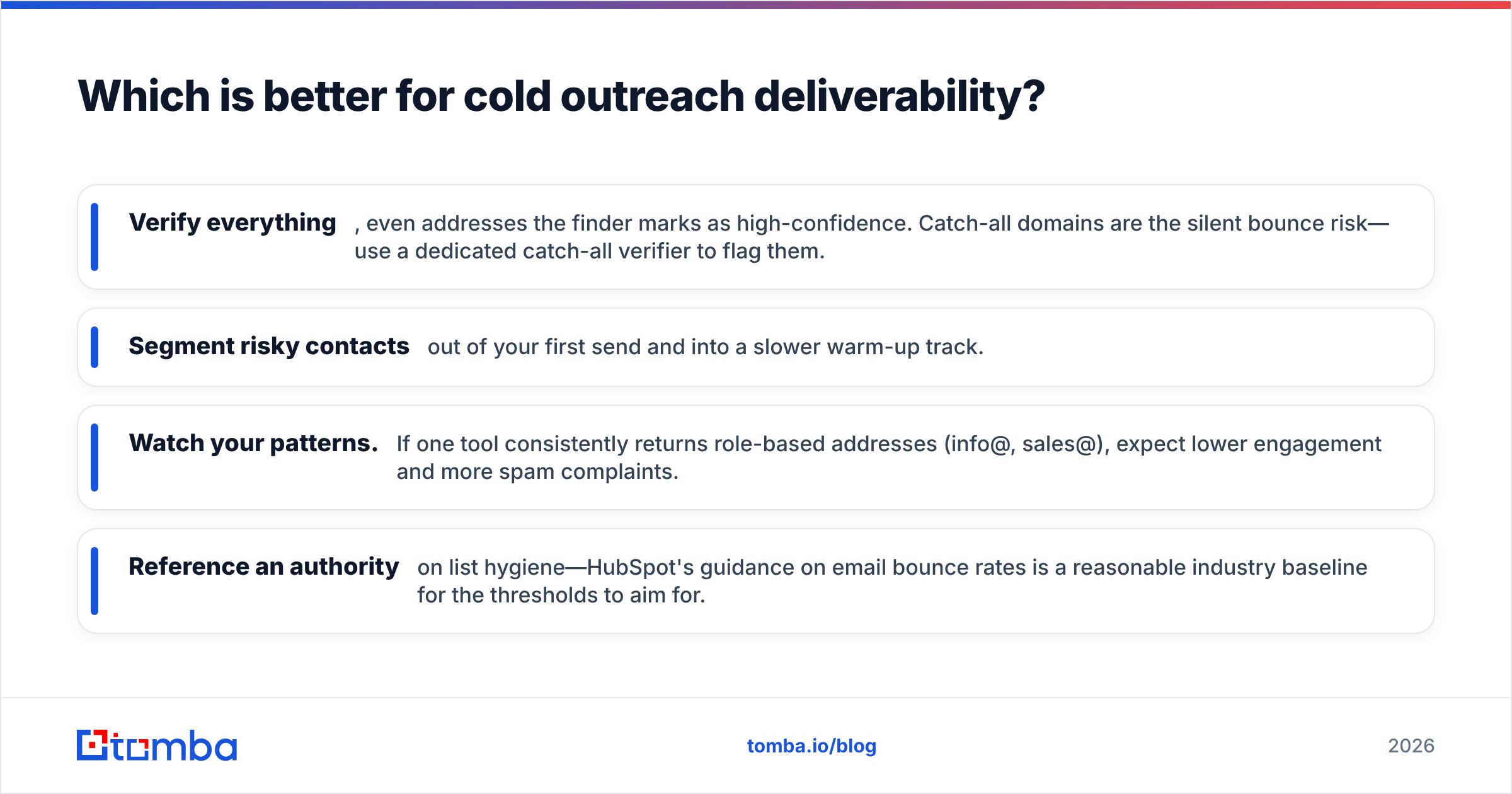
- Verify everything, even addresses the finder marks as high-confidence. Catch-all domains are the silent bounce risk—use a dedicated catch-all verifier to flag them.
- Segment risky contacts out of your first send and into a slower warm-up track.
- Watch your patterns. If one tool consistently returns role-based addresses (info@, sales@), expect lower engagement and more spam complaints.
- Reference an authority on list hygiene—HubSpot's guidance on email bounce rates is a reasonable industry baseline for the thresholds to aim for.
Neither Brandnav nor Exellius can save a campaign if the underlying data is stale. The discipline of find-then-verify matters more than the logo on the dashboard.
Brandnav vs Exellius: pros and cons#
Brandnav — strengths
- All-in-one suite reduces tool sprawl for teams that want enrichment and outreach in one place.
- Self-serve search suits SDRs who prospect daily.
- API access supports automation.
Brandnav — watch-outs
- Bundled features can mean you pay for modules you don't use.
- Verification depth varies—confirm it's included, not an upsell.
- Per-seat scaling gets expensive as the team grows.
Exellius — strengths
- Managed/sourced lists save time for teams without an in-house researcher.
- Good fit for targeted, campaign-by-campaign list builds.
- Less hands-on effort to get a usable list.
Exellius — watch-outs
- Quote-based pricing makes cost-per-lead hard to forecast.
- Less suited to continuous, programmatic use.
- You're dependent on their sourcing cadence rather than searching on demand.
You can cross-check both reputations on independent review sites like G2 and Capterra before you buy—look specifically at recent reviews mentioning data accuracy and bounce rates, not just overall star counts.
Where does Tomba fit in the comparison?#
Tomba is worth putting on the same shortlist because it removes two of the biggest friction points above: pricing opacity and separate verification.
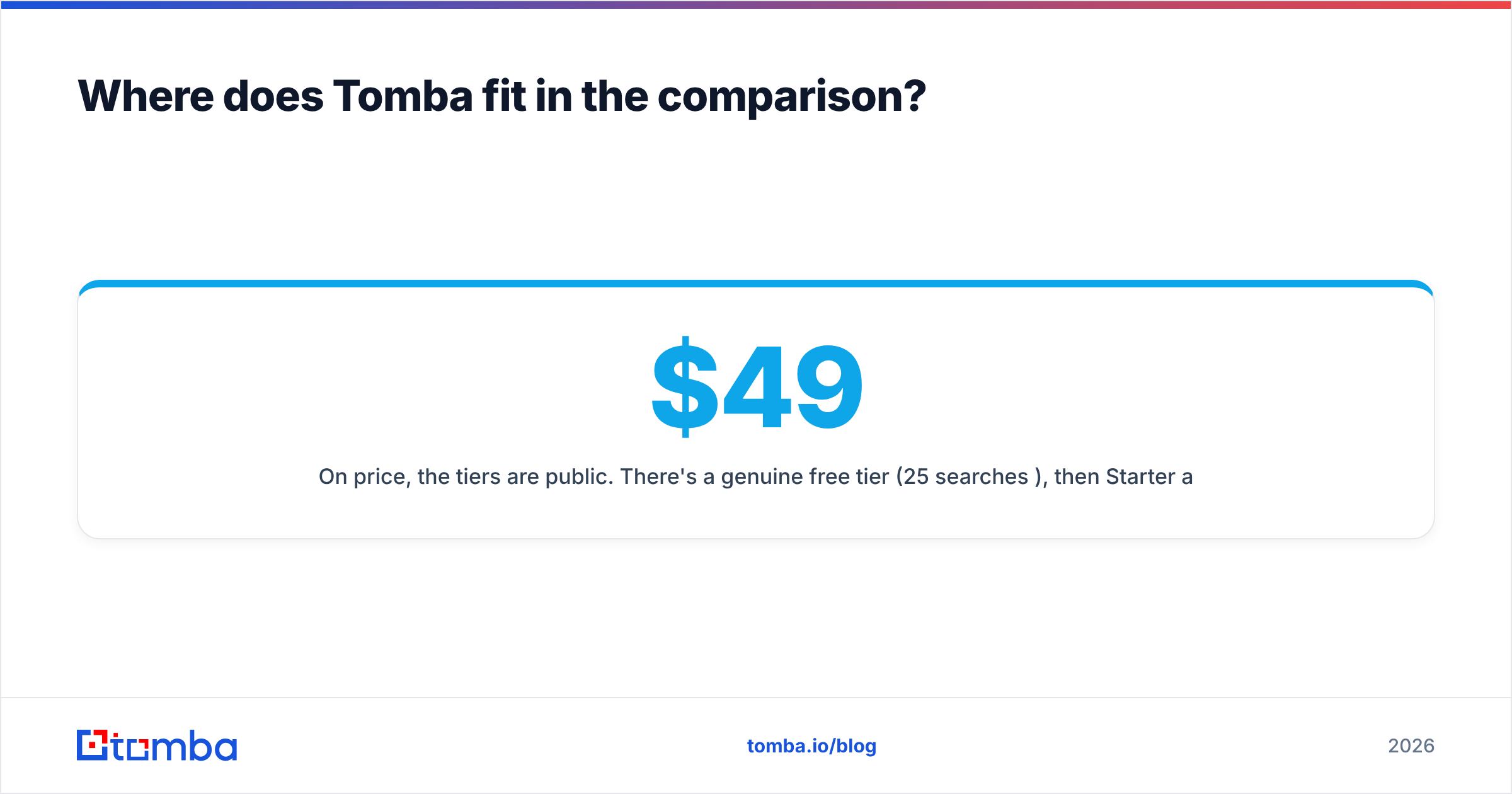
On price, the tiers are public. There's a genuine free tier (25 searches/mo), then Starter at $49/mo, Growth at $99/mo, Pro at $249/mo, and custom Enterprise. You can see the full Tomba pricing before talking to anyone, which makes cost-per-verified-lead easy to model against Brandnav and Exellius quotes.
On workflow, finding and verifying live in the same place. You can search by domain to pull every email pattern for a company, find individual contacts, and verify them—without exporting to a second tool. For teams scaling outbound, the bulk email finder and full API mean you can run this continuously instead of campaign-by-campaign.
That doesn't make Tomba automatically "better" for every team. If you specifically want done-for-you list research with no self-serve component, a managed service may suit you. But if you want predictable pricing and built-in verification, Tomba closes the gaps that often push buyers away from bundled suites and quote-only services.
How should you choose between Brandnav, Exellius, and Tomba?#
Decide based on how you actually work, not on database-size claims. A quick decision framework:
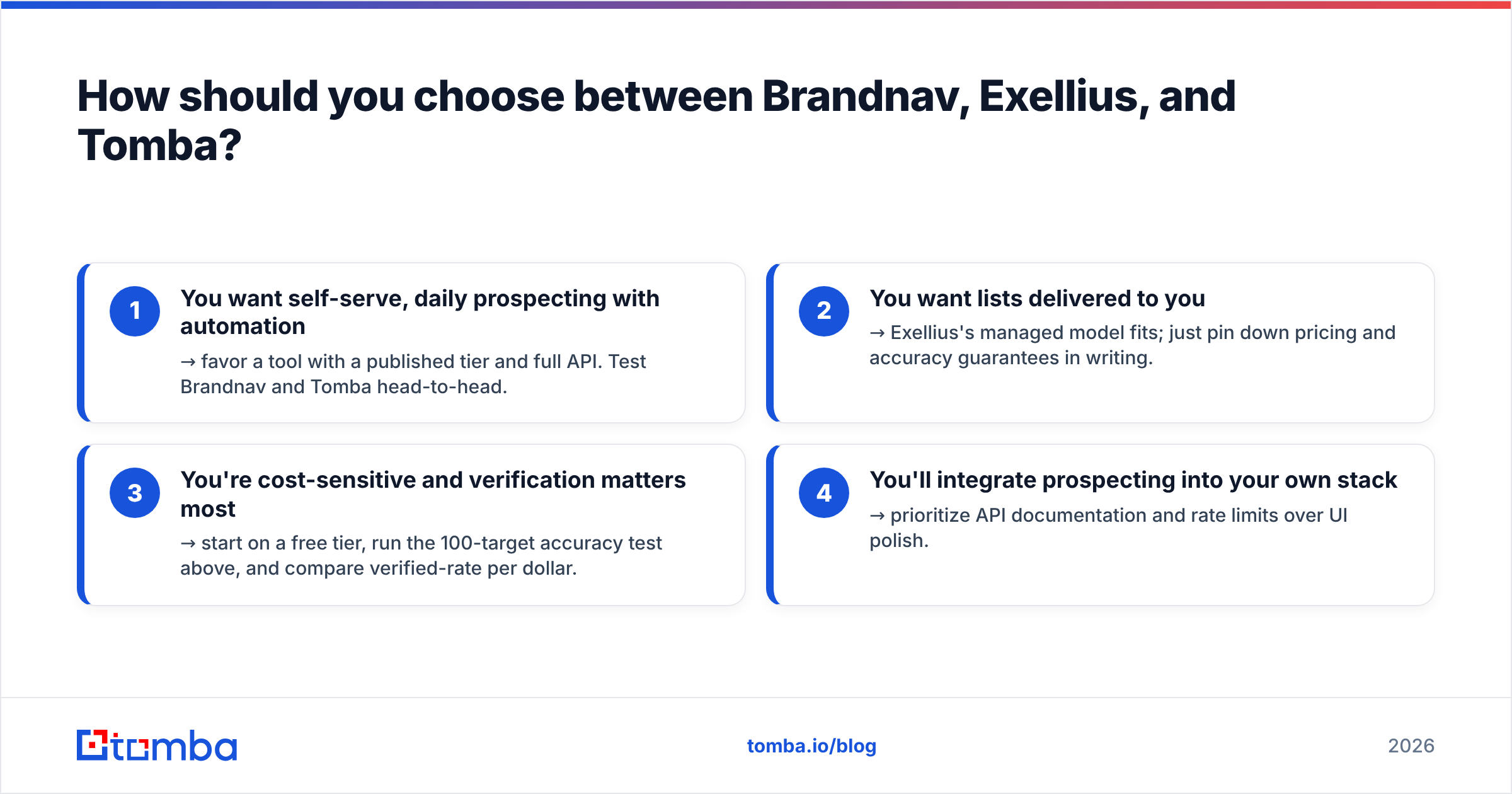
- You want self-serve, daily prospecting with automation → favor a tool with a published tier and full API. Test Brandnav and Tomba head-to-head.
- You want lists delivered to you → Exellius's managed model fits; just pin down pricing and accuracy guarantees in writing.
- You're cost-sensitive and verification matters most → start on a free tier, run the 100-target accuracy test above, and compare verified-rate per dollar.
- You'll integrate prospecting into your own stack → prioritize API documentation and rate limits over UI polish.
Whatever you pick, run the same controlled test on each. The vendor that wins on your target list—measured by verified deliverable contacts, not raw matches—is the right answer, regardless of marketing.
The bottom line#
Brandnav vs Exellius isn't a clean "one tool wins" story—it's a fit question. Brandnav suits self-serve teams that want a bundled suite; Exellius suits teams that want sourcing handled for them. Both deserve a real-data test before you commit a budget.
If you want the predictability of published pricing, a free tier to test on, and verification built into the same workflow, put Tomba's Email Finder on the shortlist alongside them. Start with the free 25 searches, run your own 100-contact accuracy test, and let the verified-rate-per-dollar number make the decision for you.
// get started
Find, verify and enrich your first contacts today
Start on the free plan with 25 searches a month, then scale when your team is ready.
Free plan · No credit card required · GDPR & CCPA
// about the author