Brandnav vs Gamalogic: Which Email Finder Wins in 2026?
Brandnav vs Gamalogic, compared head-to-head on accuracy, pricing, verification, and API depth — plus where a third option quietly beats both in 2026.
Choosing between Brandnav and Gamalogic comes down to one question most comparison pages dodge: does the tool actually return a deliverable email, or just a plausible-looking string you'll burn your sender reputation testing? Both platforms promise email discovery and validation. They differ in how they source data, how they verify it, and how much you pay to scale.
This breakdown is vendor-neutral. We mention where Tomba fits because it's an honest third option in this category, not because either of these tools is bad. Read to the end before you commit a budget.
TL;DR#
- Brandnav leans toward bulk lead lists and enrichment workflows; it's fine for volume but verification depth is its weak spot.
- Gamalogic positions around real-time verification and LinkedIn-adjacent discovery, with a developer-friendly API but a thinner B2B database.
- Accuracy is the whole game. A "found" email that bounces costs you more than a blank — bounces wreck sender reputation.
- Pricing favors Gamalogic at low volume, Brandnav at mid volume, but neither publishes a free tier as generous as you'd expect in 2026.
- The alternative worth pricing: Tomba pairs a large B2B database with built-in catch-all verification at a $49/mo starter — covered in the comparison table below.
What do Brandnav and Gamalogic actually do?#
Both are email-finding-and-verification tools — the same broad category as Hunter, Apollo, or RocketReach. You give them a name and a domain (or a company, or a LinkedIn profile), and they return a business email address plus a confidence signal.
The category splits into four jobs, and how a tool performs each one is where Brandnav and Gamalogic diverge:
- Discovery — finding that an email exists for a person at a company.
- Pattern resolution — figuring out the format (
first.last@,flast@,first@) the company uses. - Verification — confirming the mailbox actually accepts mail without sending a test message.
- Enrichment — attaching role, seniority, phone, and social data to the contact.
Brandnav skews toward jobs 1 and 4 (volume discovery and enrichment). Gamalogic skews toward jobs 2 and 3 (resolution and verification). Neither is wrong — they're tuned for different buyers.

Which is more accurate, Brandnav or Gamalogic?#
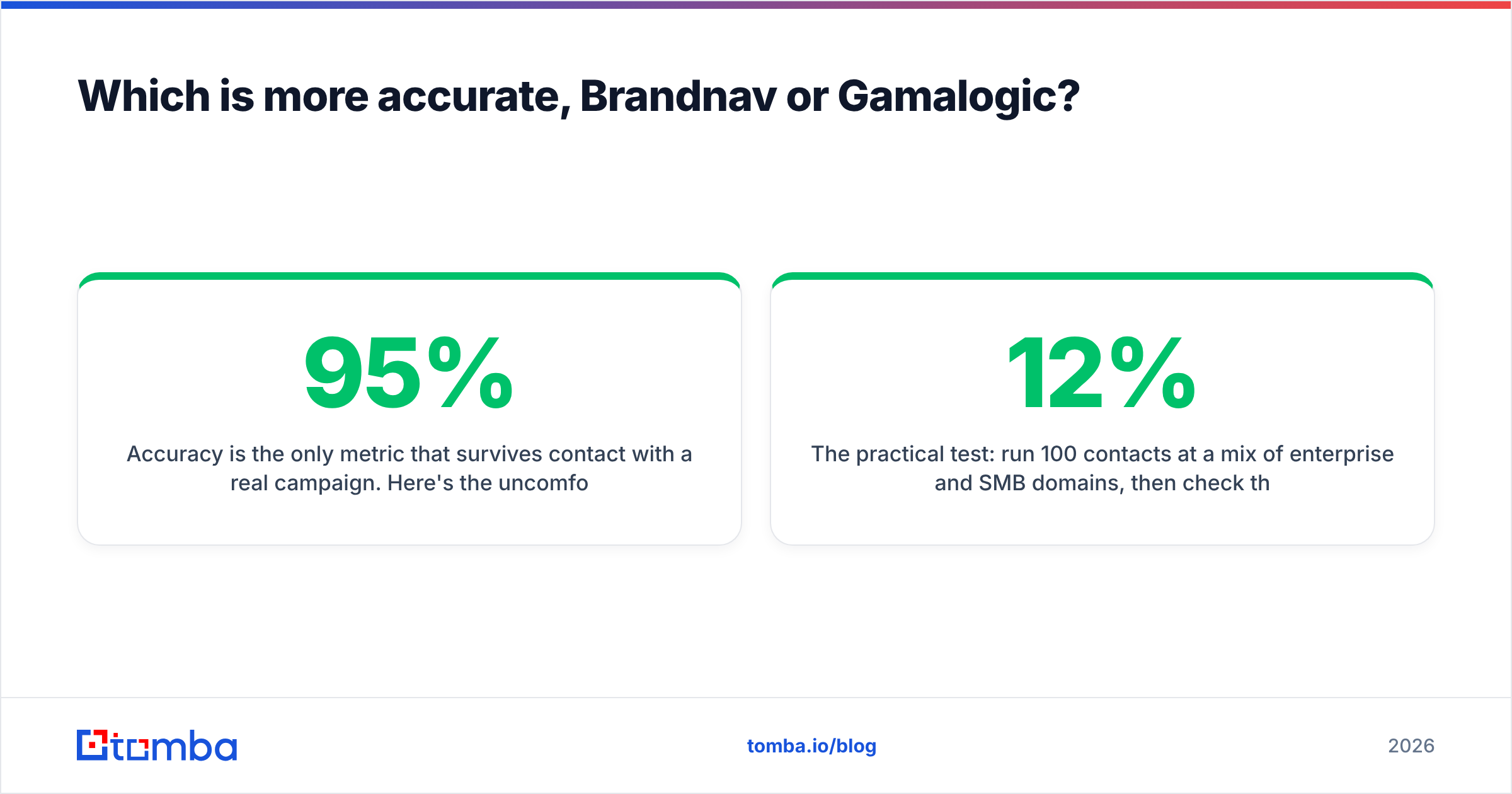
Accuracy is the only metric that survives contact with a real campaign. Here's the uncomfortable truth: every vendor in this space quotes a headline accuracy number (95%+, 98%+) measured on easy domains — large companies with public, consistent email patterns. The number that matters is accuracy on catch-all domains and small companies, where guessing falls apart.
- Gamalogic runs SMTP-style checks at lookup time, which catches obvious dead mailboxes but struggles to give a verdict on catch-all servers (servers that accept everything, then bounce silently later).
- Brandnav relies more on pattern inference and historical data, so it returns more results — but a higher share of those results are unverified guesses dressed up as finds.
The practical test: run 100 contacts at a mix of enterprise and SMB domains, then check the real bounce rate after sending. A tool that returns 90 emails at a 12% bounce rate is worse than one that returns 70 at a 2% bounce rate. If you can't run a catch-all verifier on the output, you're flying blind.

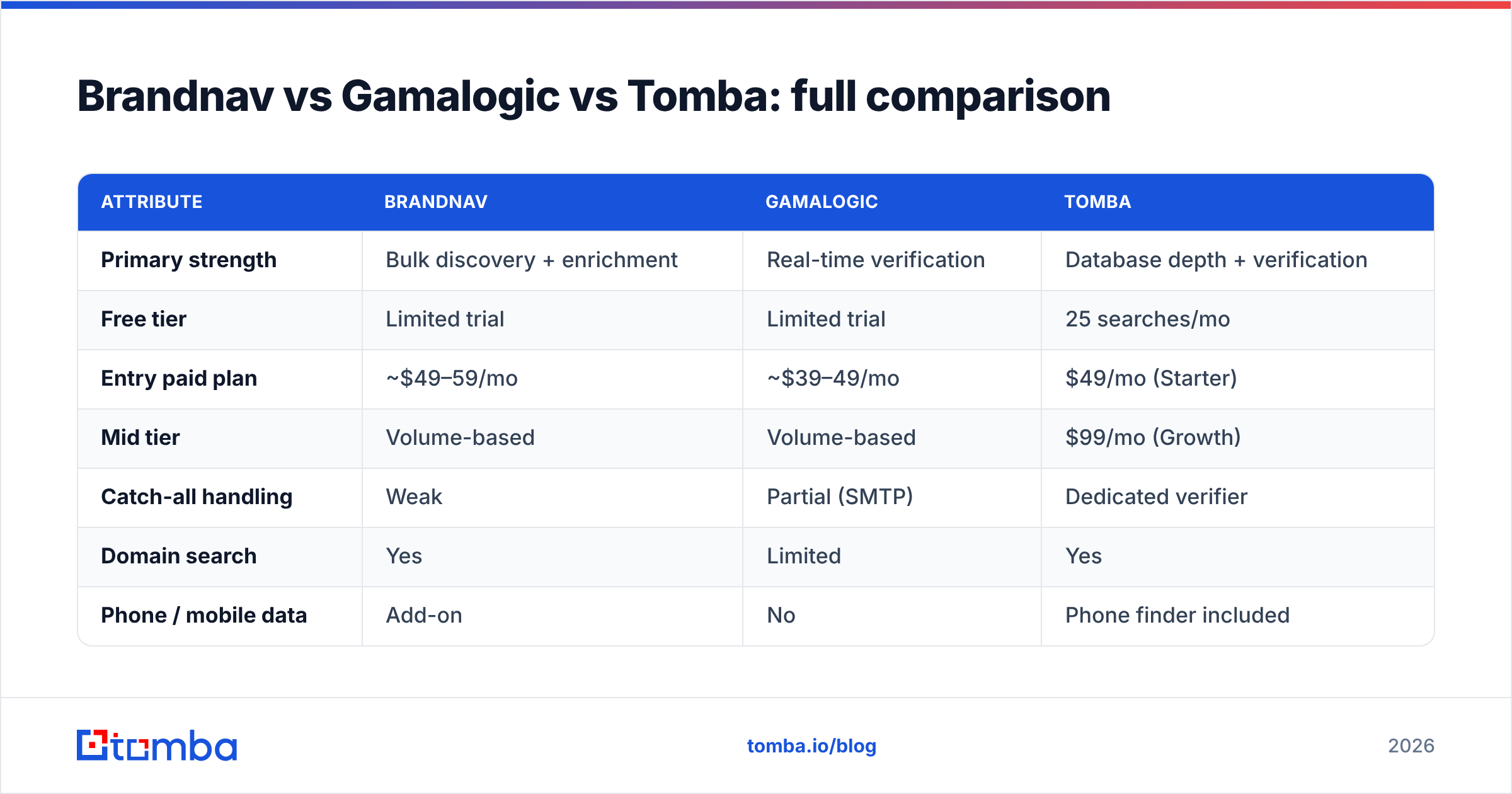
Brandnav vs Gamalogic vs Tomba: full comparison#
Here's the head-to-head. Prices and tiers reflect publicly listed plans at time of writing; always confirm on each vendor's pricing page since this category changes fast.
| Attribute | Brandnav | Gamalogic | Tomba |
|---|---|---|---|
| Primary strength | Bulk discovery + enrichment | Real-time verification | Database depth + verification |
| Free tier | Limited trial | Limited trial | 25 searches/mo |
| Entry paid plan | ~$49–59/mo | ~$39–49/mo | $49/mo (Starter) |
| Mid tier | Volume-based | Volume-based | $99/mo (Growth) |
| Catch-all handling | Weak | Partial (SMTP) | Dedicated verifier |
| Domain search | Yes | Limited | Yes |
| Phone / mobile data | Add-on | No | Phone finder included |
| Native API | Yes | Yes (dev-focused) | Yes (REST + CLI + MCP) |
| Bulk processing | Yes | Yes | Bulk finder + verifier |
| Best for | Mid-volume list building | Developers wanting verify-on-call | Teams needing accuracy at scale |
A few honest caveats on this table:
- Gamalogic's developer API is genuinely clean if you're embedding lookups into your own product. That's a real edge for technical teams.
- Brandnav's enrichment is broader than Tomba's on certain firmographic fields, depending on your region.
- Tomba's advantage is that verification isn't a bolt-on — the email verifier and catch-all logic run on the same data the finder uses, which is why bounce rates tend to be lower out of the box.
How does pricing really compare?#
Headline prices mislead because this category bills on credits, and a credit means different things per vendor. One "search" might cost one credit on Brandnav but be split into find + verify (two credits) on another tool.
Score it on cost per verified, deliverable email, not cost per lookup:
- Low volume (under 500/mo): Gamalogic's lower entry price wins on paper, but factor in re-verification of catch-alls.
- Mid volume (500–5,000/mo): Brandnav's tiering tends to be more economical if you don't need tight bounce control.
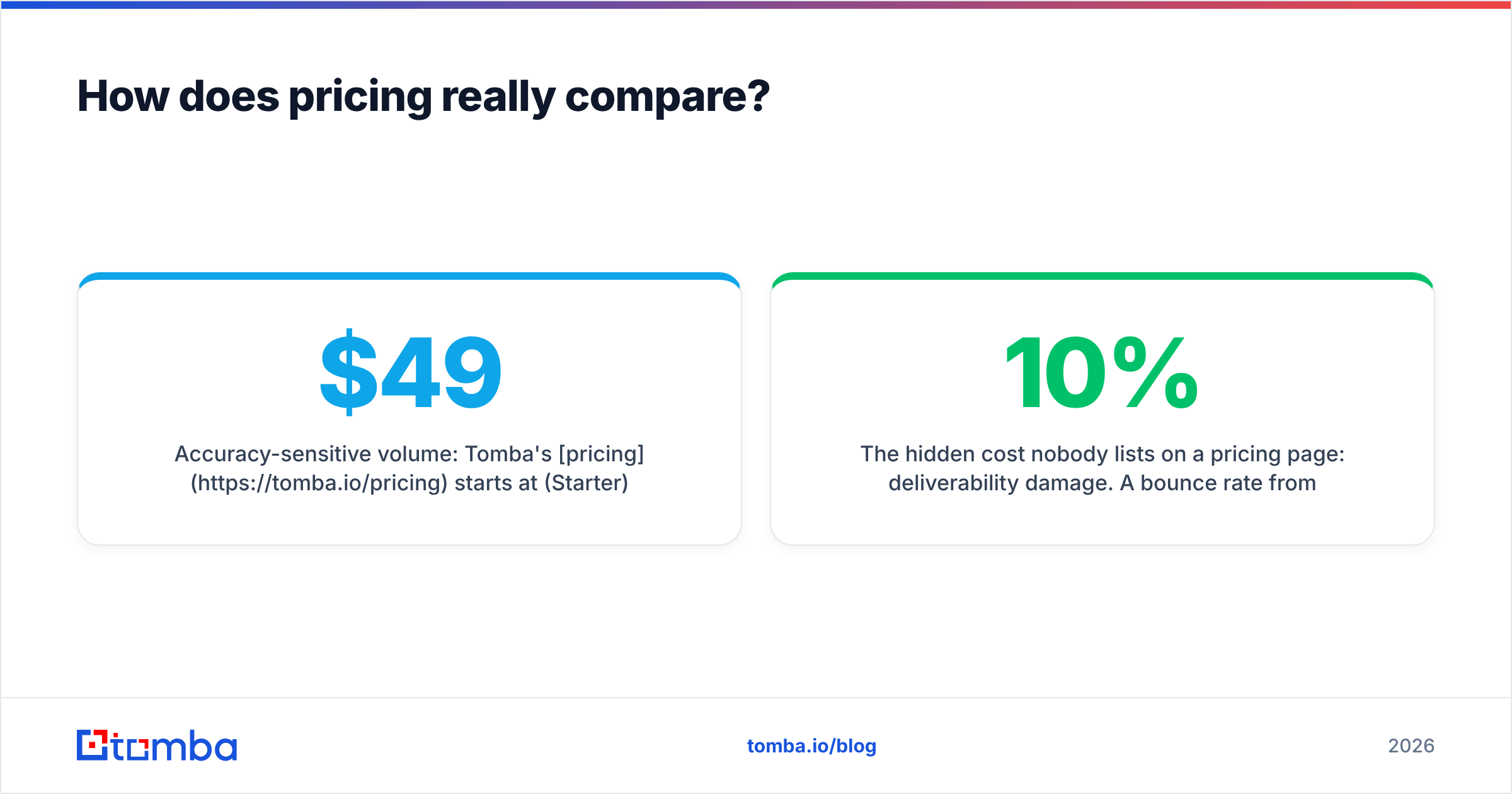
- Accuracy-sensitive volume: Tomba's pricing starts at $49/mo (Starter), $99/mo (Growth), and $249/mo (Pro), with verification baked in so you're not paying a second vendor to clean the list.
The hidden cost nobody lists on a pricing page: deliverability damage. A 10% bounce rate from cheap, unverified data can land your domain on a blocklist, and recovery costs weeks. Cross-reference any tool's output with a free email checker before your first big send.
Which has the better API and integrations?#
If you're a developer, this section may outweigh everything above.
- Gamalogic markets heavily to developers and ships straightforward REST endpoints with predictable response shapes. If your use case is "verify an email the instant a user types it into a signup form," Gamalogic is built for exactly that.
- Brandnav offers an API too, but its center of gravity is the dashboard and bulk uploads, so the API can feel secondary.
- Tomba exposes a REST API plus a CLI and an MCP server, which matters if you're wiring email discovery into an AI agent or an automation in Make/Zapier. It also has native HubSpot, Salesforce, and Google Sheets paths.
For a no-code team, integrations beat raw API quality. Check whether your CRM is supported natively before assuming you'll need middleware — re-keying leads by hand erases any time the tool saved you.
What are the real-world pros and cons?#
Stripped of marketing, here's where each tool earns or loses trust.
Brandnav — pros
- Returns a high volume of candidate emails.
- Solid enrichment fields for building ICP segments.
- Reasonable mid-tier pricing for list builders.
Brandnav — cons
- Verification depth lags; expect to clean the output.
- Catch-all domains often return optimistic verdicts.
Gamalogic — pros
- Clean, developer-first API with real-time checks.
- Lower entry price for small teams.
- Good fit for in-product validation.
Gamalogic — cons
- Thinner B2B contact database for cold discovery.
- Less suited to large bulk prospecting runs.
Where a third option fits
- If you want one tool that does discovery and trustworthy verification without stitching two vendors together, that's the gap Tomba targets. Its domain search pulls every public address pattern for a company, then verifies before you export.
Is there a better alternative to both in 2026?#
For most B2B teams, the deciding factor is verified accuracy per dollar, and that's where it's worth pricing a third tool rather than forcing a binary choice.
Tomba's email finder sits in the same lane as Brandnav and Gamalogic but bundles the verification layer instead of selling it separately:
- 25 free searches/month to test on your own list before paying — a fairer trial than most trials in this category.
- Catch-all verification as a first-class feature, not a guess.
- Phone finder and enrichment alongside email, so one credit stack covers more of the contact.
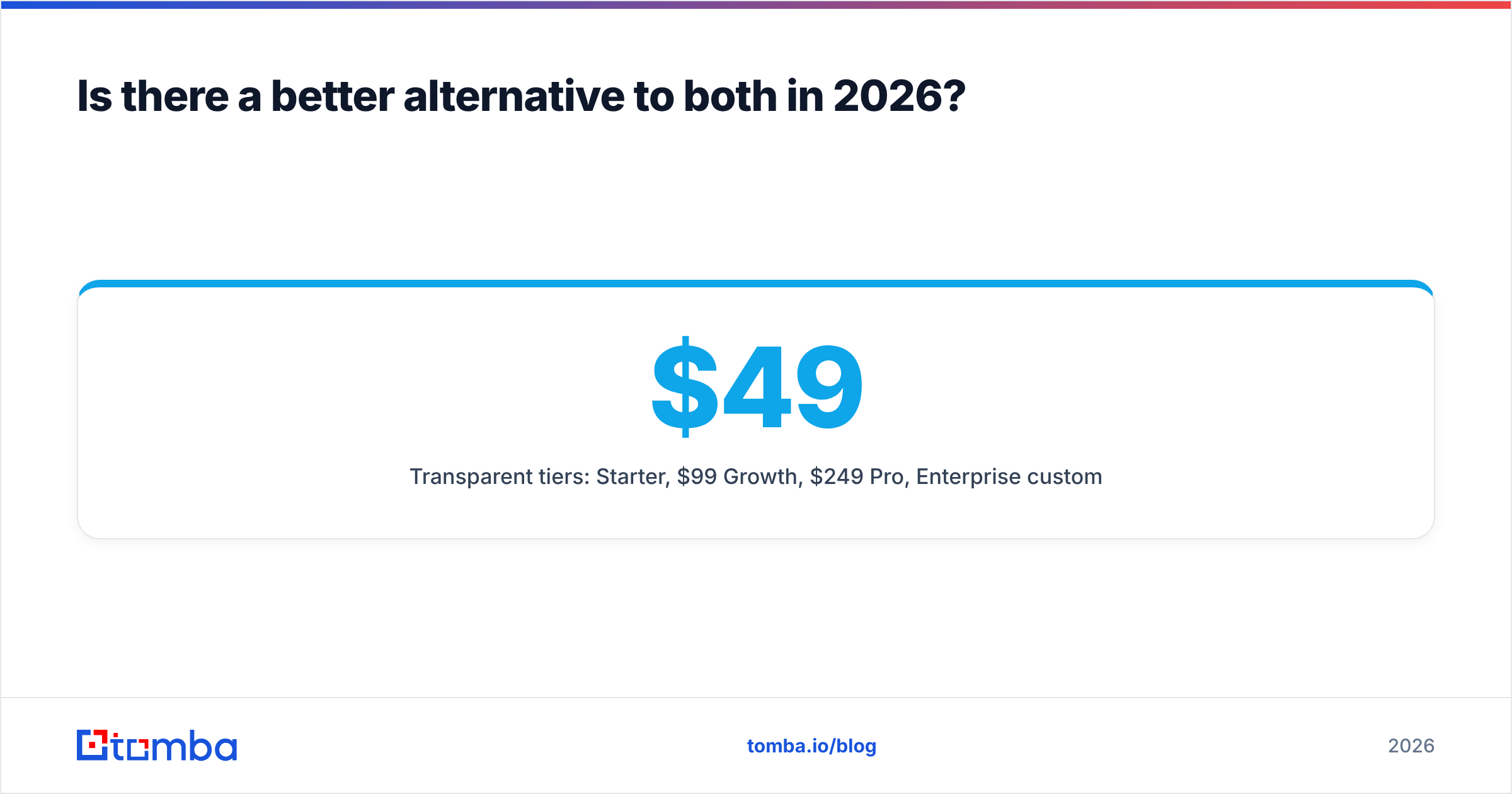
- Transparent tiers: $49 Starter, $99 Growth, $249 Pro, Enterprise custom.
The fair framing: if you're a developer who only needs verify-on-call, Gamalogic may be the cleanest fit. If you're a list builder who tolerates cleanup, Brandnav is workable. If you want the lowest bounce rate at scale with the fewest moving parts, run the same 100-contact test against Tomba and compare bounce rates directly — the data settles the argument better than any blog post.
You can sanity-check vendor claims on independent review sites like G2 and Capterra, and read up on how email deliverability actually works before you scale any of these tools.

How should you decide?#
Run this checklist instead of trusting headline numbers:
- Define your domain mix. Mostly enterprise? Most tools cope. Mostly SMB and catch-all? Verification depth decides everything.
- Test on your own list. Use each free tier; never trust the vendor's demo data.
- Measure bounce rate after sending, not "emails found." A verified 70 beats an unverified 90.
- Price per deliverable email, including any cleanup you'll outsource.
- Check native CRM integration so you're not paying in manual data entry.
Do that and the "Brandnav vs Gamalogic" question usually answers itself — and often points you toward a tool that does both jobs in one pass.
The bottom line#
Brandnav and Gamalogic are both credible tools with opposite biases: Brandnav optimizes for volume and enrichment, Gamalogic for clean real-time verification and a developer API. Your domain mix and team type decide which bias helps you.
But if your real goal is the lowest bounce rate at the lowest total cost — discovery and verification handled together — start your test with the Tomba Email Finder. Pull your 25 free searches, run them against the same list you'd give Brandnav or Gamalogic, and let the bounce rate pick the winner. That's the only benchmark that pays you back.
Ready to find emails that actually work?
Join 150,000+ professionals who stopped guessing and started sending. Free credits on signup — no credit card required.
Get the Tomba newsletter
Practical outbound tactics and product updates — once every two weeks.
About the author