Brandnav vs Goava 2026: Which B2B Data Platform Wins?
Brandnav and Goava both promise smarter B2B prospecting, but they win on different fronts. Here's an honest 2026 breakdown of data coverage, pricing, and team fit.
Choosing between Brandnav and Goava usually comes down to one question: do you want a broad B2B data and lead-generation engine, or a recommendation-driven sales intelligence layer tuned for the Nordic market? Both tools are good at what they do. They are not, however, good at the same things — and picking the wrong one wastes a quarter of pipeline.
This is a neutral, side-by-side breakdown for 2026: what each platform actually does, where the data holds up, how pricing works, and which sales motion each one fits. We'll also be honest about the gap both leave open — getting verified, global email addresses for the contacts these platforms surface.
TL;DR: Brandnav vs Goava at a glance#
- Brandnav is a B2B data and lead-generation platform: large company databases, list building, enrichment, and export into your CRM or outreach stack. Best when you need volume and flexible filtering.
- Goava is a sales intelligence platform built around recommendations and signals (ideal-customer scoring, trigger events, Nordic company data). Best when reps need to be told who to call next, not just handed a list.
- Pricing for both is quote-based and team-oriented — expect meaningful annual commitments, not a $20 self-serve plan.
- Data coverage for both is strongest in the Nordics and broader Europe; global coverage is thinner than US-first tools.
- Neither is primarily an email-finder. Verified, deliverable email at scale is where a dedicated tool like Tomba complements either platform.
)
What is Brandnav?#
Brandnav is a B2B data platform focused on company information, lead lists, and enrichment. The core promise is breadth: you filter a large universe of companies by attributes — industry, size, location, technologies, financials — build a target list, and push it into your workflow. Teams use it to feed outbound campaigns, enrich an existing CRM, and keep account records from going stale.
The strength here is the "build a list from scratch" motion. If your GTM plan starts with "give me every SaaS company in the Nordics with 50–200 employees," Brandnav is built for that kind of query. Enrichment then fills in the gaps on records you already have, which is where it overlaps with classic data enrichment workflows.
The trade-off: a big database is only as useful as the freshness and accuracy of the fields you actually act on — especially contact-level data like email and direct dials, which decay fast.
What is Goava?#
Goava is a sales intelligence platform that leans into recommendations. Instead of just exposing a searchable database, it scores accounts against your ideal customer profile, surfaces buying signals and trigger events, and tells reps which companies deserve attention now. It's particularly strong on Nordic company data, financials, and the kind of local registry information that's hard to get from US-first tools.
Where Brandnav answers "who exists that matches my filters," Goava answers "who should I prioritize today." That's a different job. For inside-sales teams that struggle with prioritization — too many accounts, not enough time — the recommendation engine is the headline feature, not the raw record count.
The trade-off: signal-driven prioritization is most valuable when you already have a defined ICP and a Nordic-heavy territory. Outside that sweet spot, the recommendations have less to work with.
Brandnav vs Goava: full comparison table#
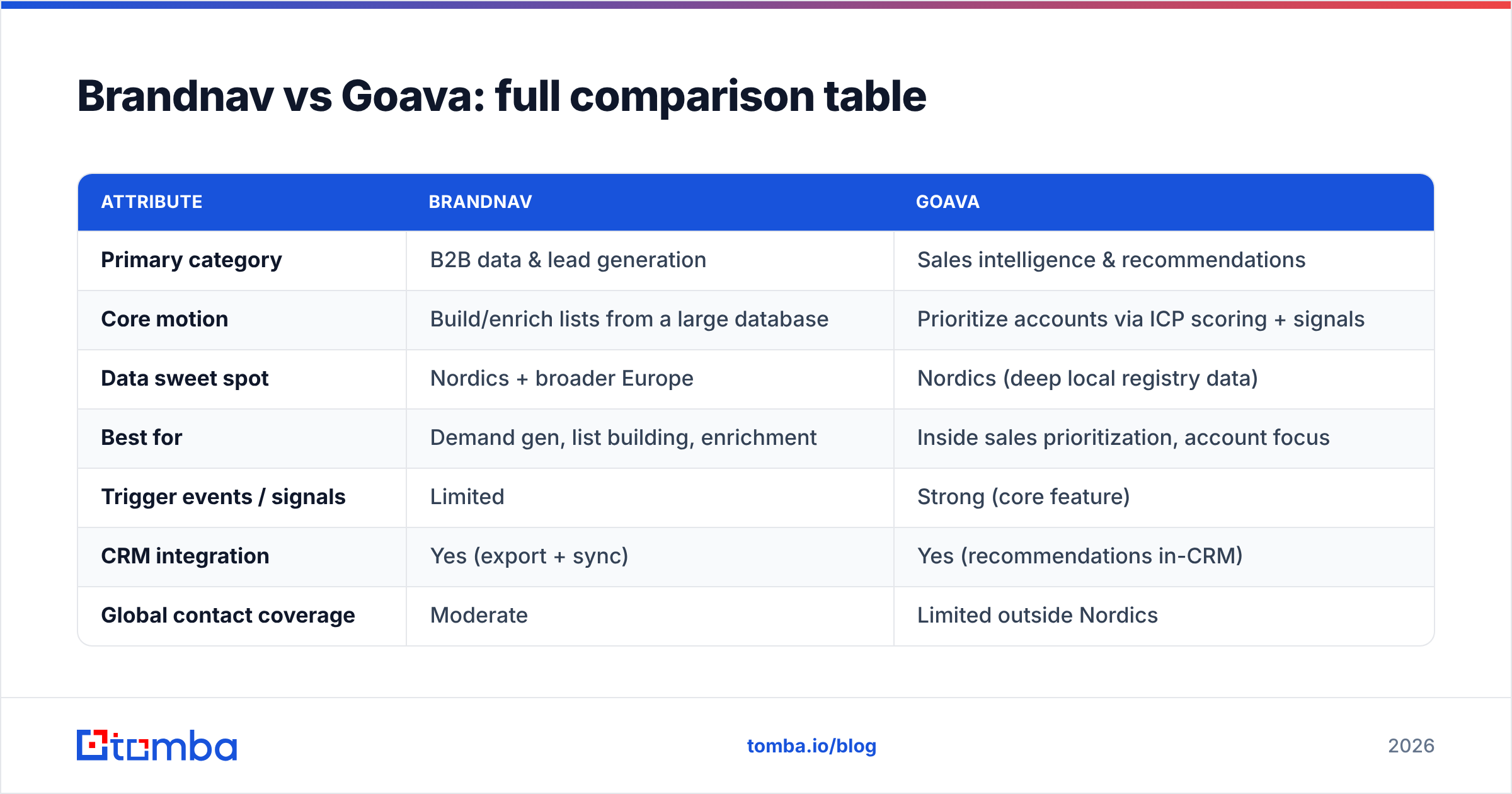
Here is the core-concept comparison. Read it as "different tools for adjacent jobs," not "one is strictly better."
| Attribute | Brandnav | Goava |
|---|---|---|
| Primary category | B2B data & lead generation | Sales intelligence & recommendations |
| Core motion | Build/enrich lists from a large database | Prioritize accounts via ICP scoring + signals |
| Data sweet spot | Nordics + broader Europe | Nordics (deep local registry data) |
| Best for | Demand gen, list building, enrichment | Inside sales prioritization, account focus |
| Trigger events / signals | Limited | Strong (core feature) |
| CRM integration | Yes (export + sync) | Yes (recommendations in-CRM) |
| Global contact coverage | Moderate | Limited outside Nordics |
| Email verification | Not a core focus | Not a core focus |
| Pricing model | Quote-based, team plans | Quote-based, team plans |
| Free self-serve tier | No | No |
Which one has better data?#
It depends on what "data" means for your team. Use this quick decision list:
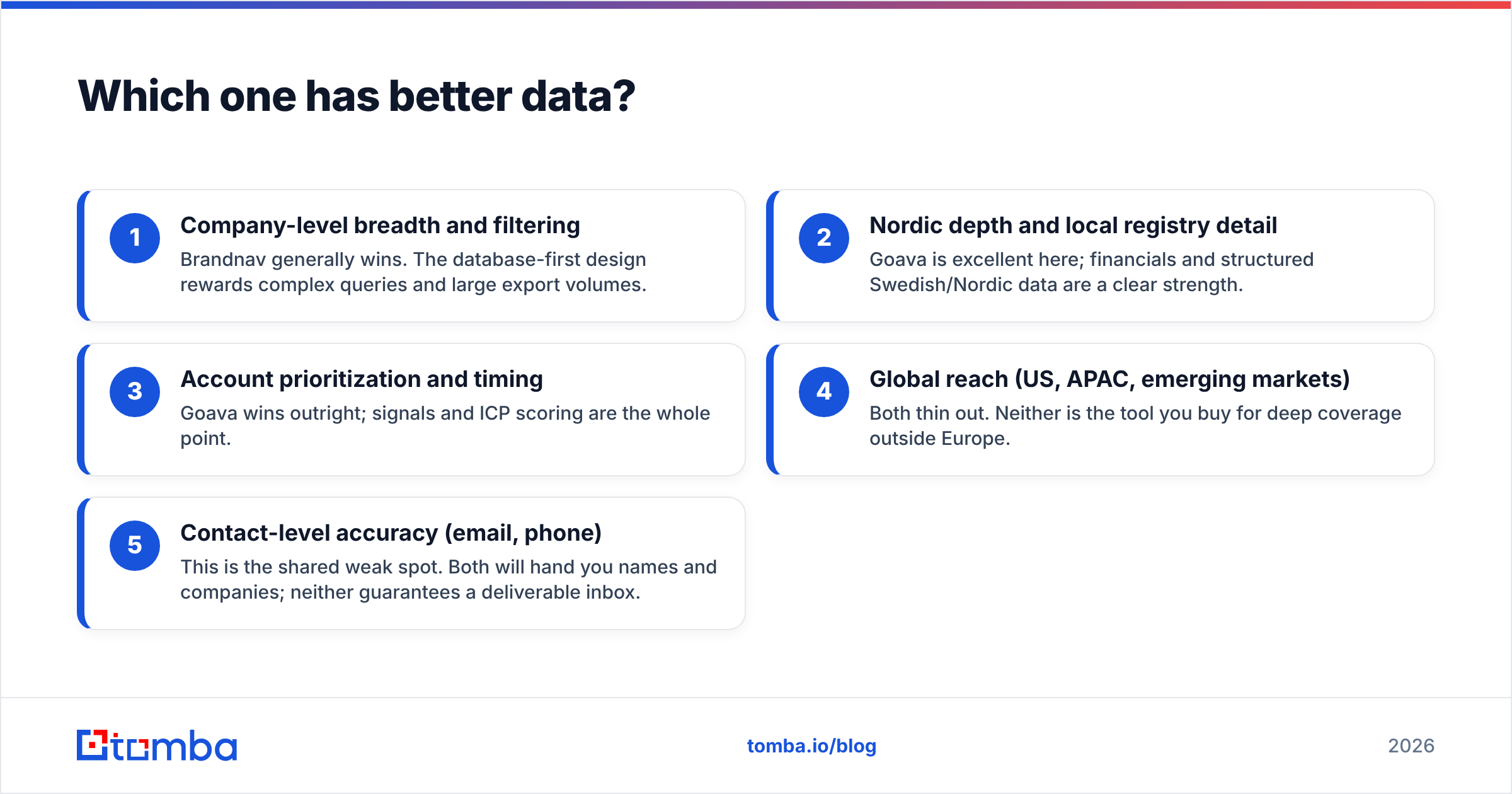
- Company-level breadth and filtering — Brandnav generally wins. The database-first design rewards complex queries and large export volumes.
- Nordic depth and local registry detail — Goava is excellent here; financials and structured Swedish/Nordic data are a clear strength.
- Account prioritization and timing — Goava wins outright; signals and ICP scoring are the whole point.
- Global reach (US, APAC, emerging markets) — Both thin out. Neither is the tool you buy for deep coverage outside Europe.
- Contact-level accuracy (email, phone) — This is the shared weak spot. Both will hand you names and companies; neither guarantees a deliverable inbox.
That last point matters more than it looks. You can build the perfect list in Brandnav or get the perfect prioritized account in Goava and still watch 25–40% of your sends bounce because the email field was scraped, guessed, or simply old. Verifying contacts with a dedicated email verifier before you send is the difference between a campaign that lands and one that torches your sender reputation.
How do Brandnav and Goava price?#
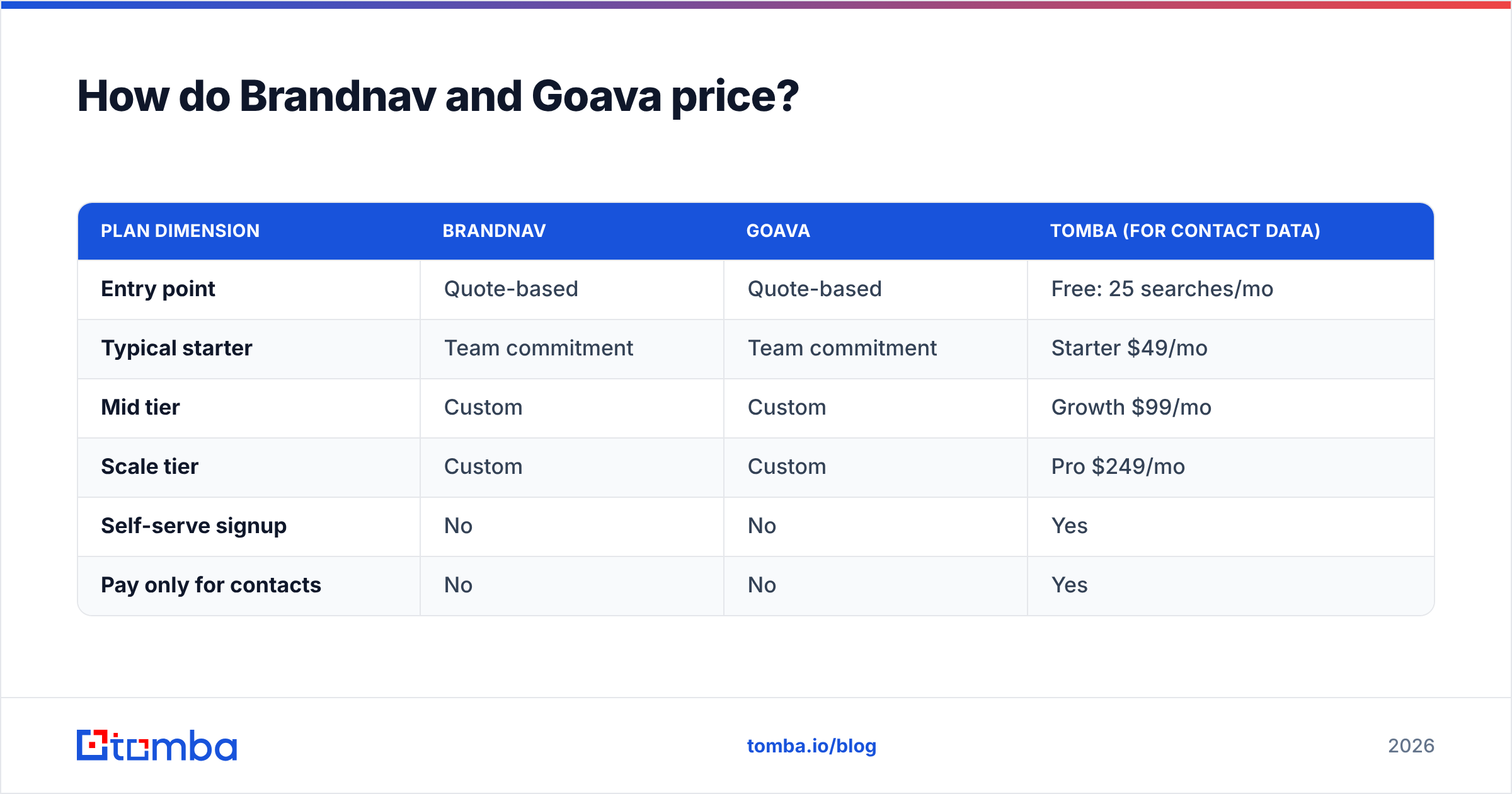
Both follow the European B2B-data norm: quote-based, seat- and volume-tiered, with annual commitments. Neither publishes a low-friction self-serve plan, so expect a sales call and onboarding. That's fine for an established team — it's friction for a solo founder or a lean SDR pod that just needs contacts this week.
This is where the cost conversation gets real. A full sales-intelligence seat can run into four figures per month once you add seats and data volume. If your actual need is "find and verify emails for the accounts I already know," that's a heavy way to buy a light capability.
)
| Plan dimension | Brandnav | Goava | Tomba (for contact data) |
|---|---|---|---|
| Entry point | Quote-based | Quote-based | Free: 25 searches/mo |
| Typical starter | Team commitment | Team commitment | Starter $49/mo |
| Mid tier | Custom | Custom | Growth $99/mo |
| Scale tier | Custom | Custom | Pro $249/mo |
| Self-serve signup | No | No | Yes |
| Pay only for contacts | No | No | Yes |
You can see the full Tomba pricing breakdown if you want to model the contact-data layer separately from a sales-intelligence subscription. The point isn't that Tomba replaces these platforms — it's that you shouldn't pay enterprise sales-intelligence rates for a job a focused tool does for $49/mo.
Is Brandnav better than Goava?#
No — and that framing is the trap. Brandnav is better if your bottleneck is supply: you need to manufacture target lists at volume and enrich a database that's gone stale. Goava is better if your bottleneck is focus: your reps have plenty of accounts but waste time on the wrong ones, and you want signals telling them where to spend the next hour.
Pick by bottleneck:
- "We don't have enough good accounts to work." → Brandnav.
- "We have too many accounts and no prioritization." → Goava.
- "We have the accounts; we just can't reach the right person." → Neither alone. You need verified contact data on top.
Most teams that evaluate these two honestly discover they have the third problem dressed up as the first two. The list isn't the constraint; the deliverable contact is.
Where both tools leave a gap#
Sales intelligence and B2B databases are upstream tools. They tell you which companies and, often, which people to pursue. They are not built to guarantee that the email next to a name will actually deliver. That's a specialized job with its own failure modes: catch-all domains, role accounts, recent job changes, and typo'd records.
This is the layer a tool like Tomba is built for. Once Brandnav or Goava tells you who, you can:
- Run a domain search to pull every known address pattern for a target company.
- Use the email finder to resolve a specific person's verified work email from name plus domain.
- Push the whole thing through bulk verification before it ever touches your sequencer.
That keeps your bounce rate low and your sending domain healthy — something no amount of account scoring fixes on its own. For teams already living in spreadsheets, pairing either platform with a lightweight contact-resolution and verification step is the cheapest pipeline insurance you can buy.
Brandnav vs Goava vs a dedicated email finder#
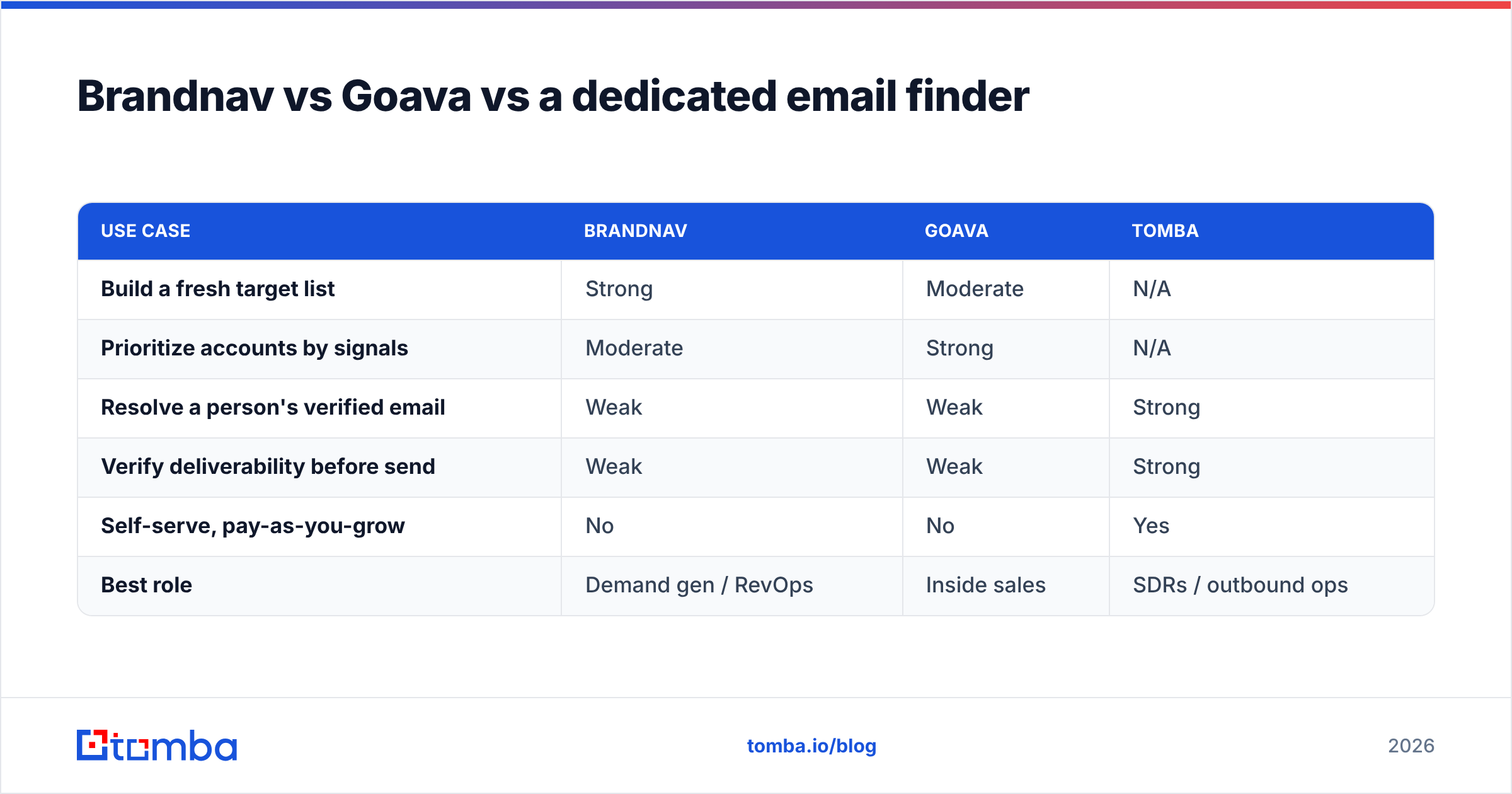
| Use case | Brandnav | Goava | Tomba |
|---|---|---|---|
| Build a fresh target list | Strong | Moderate | N/A |
| Prioritize accounts by signals | Moderate | Strong | N/A |
| Resolve a person's verified email | Weak | Weak | Strong |
| Verify deliverability before send | Weak | Weak | Strong |
| Self-serve, pay-as-you-grow | No | No | Yes |
| Best role | Demand gen / RevOps | Inside sales | SDRs / outbound ops |
The honest read: these aren't really three competitors. They're three layers. Brandnav or Goava sits at the top of the funnel (who to target), and a contact-data tool sits underneath (how to actually reach them).
How to choose in 2026#
Run this short test before you sign anything:
- Name your bottleneck in one sentence. Supply, focus, or reach? That single answer eliminates one of the two platforms immediately.
- Audit your bounce rate. If you're above ~5%, your problem is contact data quality, not intelligence — fix that layer first, it's cheaper and faster.
- Check your geography. Heavily Nordic? Both shine, with Goava's local depth a real edge. Global? Budget for a separate contact-data source regardless of which you pick.
- Match the buying model to your team. Quote-based annual deals fit funded teams with a defined ICP. Lean teams should start with self-serve contact tooling and add intelligence later.
Compare the vendors directly on G2 for current user reviews, and check each official site — Brandnav and Goava — for the latest feature and regional coverage details before committing.
The bottom line#
Brandnav and Goava solve adjacent problems. Brandnav manufactures and enriches lists; Goava tells you which accounts deserve attention now. Pick by bottleneck, weight the Nordic strength heavily if that's your market, and budget for quote-based annual pricing either way.
But before you spend a cent on intelligence, make sure the contacts you act on are real. The fastest, cheapest win for most outbound teams isn't a smarter list — it's a deliverable one. Start free with the Tomba Email Finder: find and verify professional emails by name, company, or domain, run 25 searches a month at no cost, and scale from $49/mo only when you need to. Layer it under whichever platform you choose, and stop paying premium rates for emails that bounce.
// get started
Find, verify and enrich your first contacts today
Start on the free plan with 25 searches a month, then scale when your team is ready.
Free plan · No credit card required · GDPR & CCPA
// about the author