Brandnav vs HitHorizons: Which B2B Data Tool Wins in 2026?
Brandnav and HitHorizons both sell company data, but they solve different problems. Here's an honest, side-by-side breakdown of coverage, pricing, and the contact gap each one leaves behind.
Brandnav vs HitHorizons: Which B2B Data Tool Wins in 2026?
Choosing between Brandnav and HitHorizons usually comes down to one question you don't realize you're asking: do you need company records, or do you need people you can actually email? Both tools are good at the first job. Neither was built for the second. This breakdown shows you where each one wins, where each one leaves a gap, and how to fill that gap without overpaying.
TL;DR#
- Brandnav is a flexible B2B data and enrichment platform aimed at marketers and growth teams who want company plus contact signals wired into their stack.
- HitHorizons is a European-heavy company database built on official business registries — strongest for firmographics, financials, and compliance-grade company records.
- Neither is a dedicated email finder. Company data without verified, reachable contacts stalls your outreach at the most expensive step.
- Pick HitHorizons for registry-grade company intelligence (especially EU coverage), Brandnav for broader enrichment and marketing signals.
- Pair whichever you choose with a verified contact layer like the Tomba Email Finder so your pipeline actually reaches a human.
What is Brandnav?#
Brandnav is a B2B data and lead-enrichment platform. It pulls together company firmographics, technographics, and contact-level data, then pushes that into the tools growth and marketing teams already use. The pitch is breadth: one place to enrich a messy lead list, append missing fields, and score accounts before they hit your CRM.
In practice, teams reach for Brandnav when they have a list — inbound signups, event scans, scraped accounts — and need to turn rows of half-filled data into something a rep can act on. Its strength is the enrichment layer and the flexibility of how data flows out.
The trade-off is that breadth tools tend to be a mile wide and a foot deep on any single dimension. Contact data, in particular, is often inferred rather than verified at the moment you use it, which is exactly where deliverability problems start.
What is HitHorizons?#
HitHorizons is a company database built primarily on official European business registries. If you need the registered name, legal address, industry code, company size band, and financial indicators for a business in Germany, France, or the Nordics, this is the kind of source that holds up under scrutiny.
Because the data originates from registries rather than scraped web profiles, HitHorizons skews toward accuracy and compliance over volume of personal contacts. That makes it a favorite for market research, total-addressable-market sizing, KYC-style checks, and any workflow where "is this a real, legally registered entity?" matters more than "what's the SDR's mobile number?"
You can confirm its registry-first positioning on the HitHorizons site and cross-check user impressions on G2. The honest summary: excellent company records, thin on the individual people you want to start a conversation with.
)
Brandnav vs HitHorizons: the core comparison#
Here's the head-to-head on the attributes that actually change your buying decision.
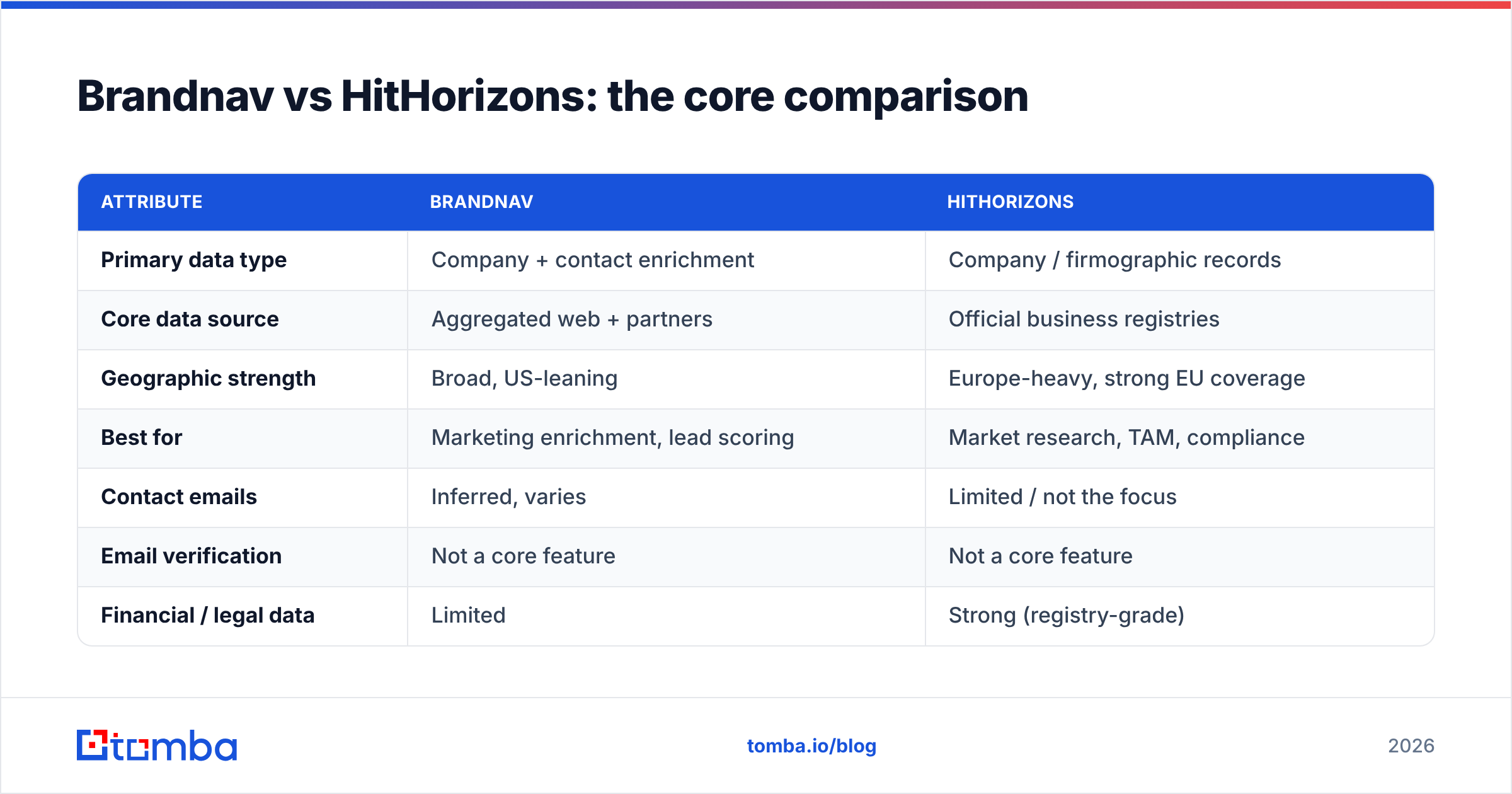
| Attribute | Brandnav | HitHorizons |
|---|---|---|
| Primary data type | Company + contact enrichment | Company / firmographic records |
| Core data source | Aggregated web + partners | Official business registries |
| Geographic strength | Broad, US-leaning | Europe-heavy, strong EU coverage |
| Best for | Marketing enrichment, lead scoring | Market research, TAM, compliance |
| Contact emails | Inferred, varies | Limited / not the focus |
| Email verification | Not a core feature | Not a core feature |
| Financial / legal data | Limited | Strong (registry-grade) |
| Typical buyer | Growth / RevOps | Analysts, research, finance |
The pattern is clear: these tools overlap on "company data" but diverge on why you'd buy them. Neither closes the loop on reachable, verified contacts — and that's the gap that determines whether your outreach lands.
How do they compare on data accuracy?#
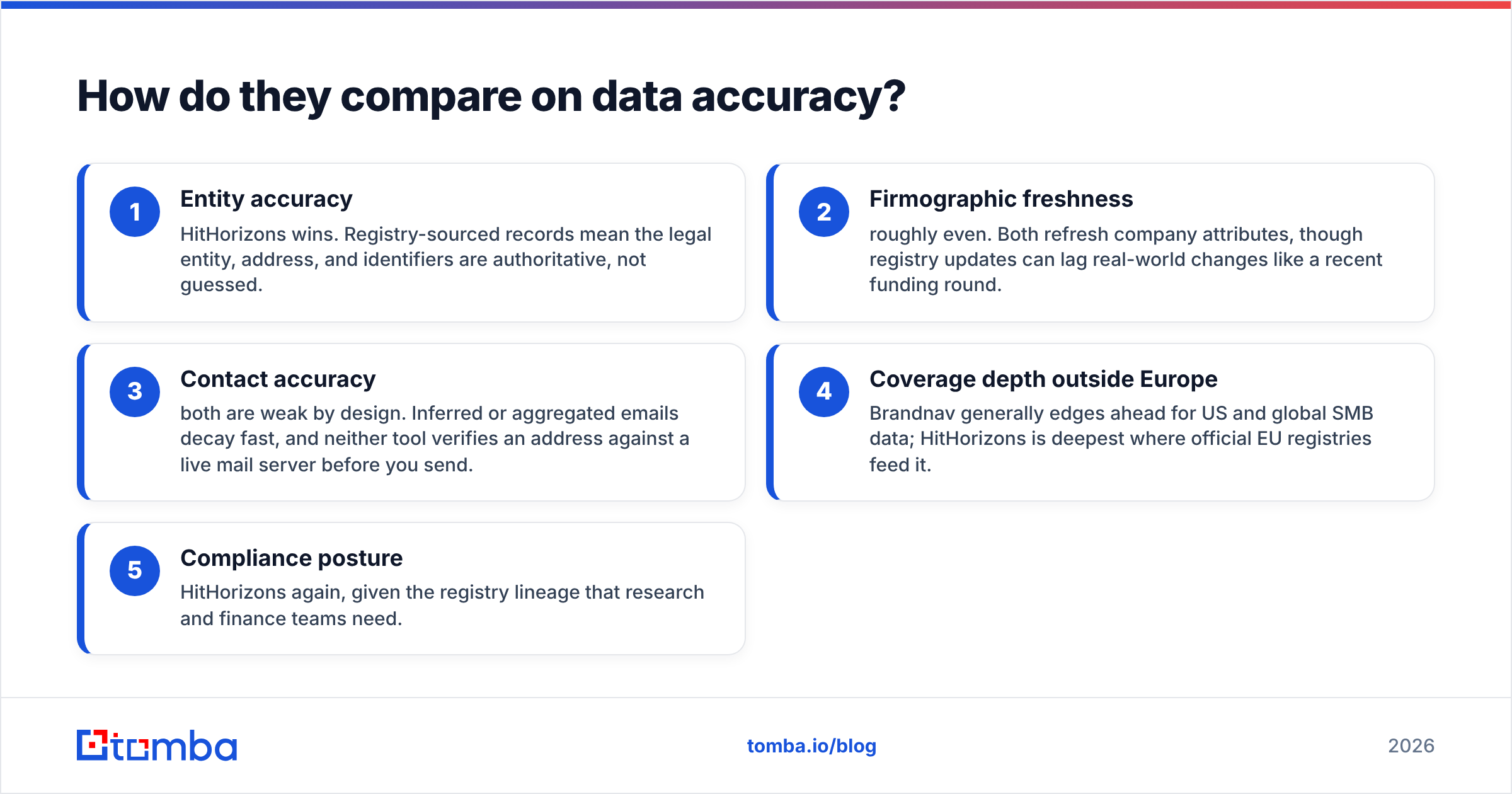
Accuracy means different things for each tool, so compare them on the dimension you'll actually use.
- Entity accuracy — HitHorizons wins. Registry-sourced records mean the legal entity, address, and identifiers are authoritative, not guessed.
- Firmographic freshness — roughly even. Both refresh company attributes, though registry updates can lag real-world changes like a recent funding round.
- Contact accuracy — both are weak by design. Inferred or aggregated emails decay fast, and neither tool verifies an address against a live mail server before you send.
- Coverage depth outside Europe — Brandnav generally edges ahead for US and global SMB data; HitHorizons is deepest where official EU registries feed it.
- Compliance posture — HitHorizons again, given the registry lineage that research and finance teams need.
The takeaway: trust HitHorizons for what a company is and Brandnav for broader signals around it — but trust neither for whether an email will actually deliver. That last mile is its own discipline, and it's where most outreach quietly fails. If you want to understand why bounce rates spike, read up on email deliverability before you blame your copy.
Which one should you choose?#
Use the job, not the brand, to decide.
- Choose HitHorizons if your work is research-led: sizing a European market, vetting entities for compliance, or building an account universe from authoritative records.
- Choose Brandnav if your work is pipeline-led: enriching inbound lists, scoring accounts, and pushing firmographic signals into your marketing and CRM stack.
- Choose both only if you have distinct research and growth functions that each justify a seat — otherwise you're paying twice for overlapping company data.
But here's the move most teams miss: whichever you pick, you still need a verified contact layer on top. A company record is the start of outreach, not the thing you send a message to.
Where both tools leave a gap (and how to fill it)#
Conclusion first: both Brandnav and HitHorizons hand you accounts, not inboxes. To turn a company into a reply, you need a name-to-email step that's verified at the moment of use.
Think of it like having a great map of every office building in a city but no directory of who sits at which desk. The map is necessary. It is not sufficient. The expensive part of outreach is reaching the right person, and that's a contact-data problem, not a company-data problem.
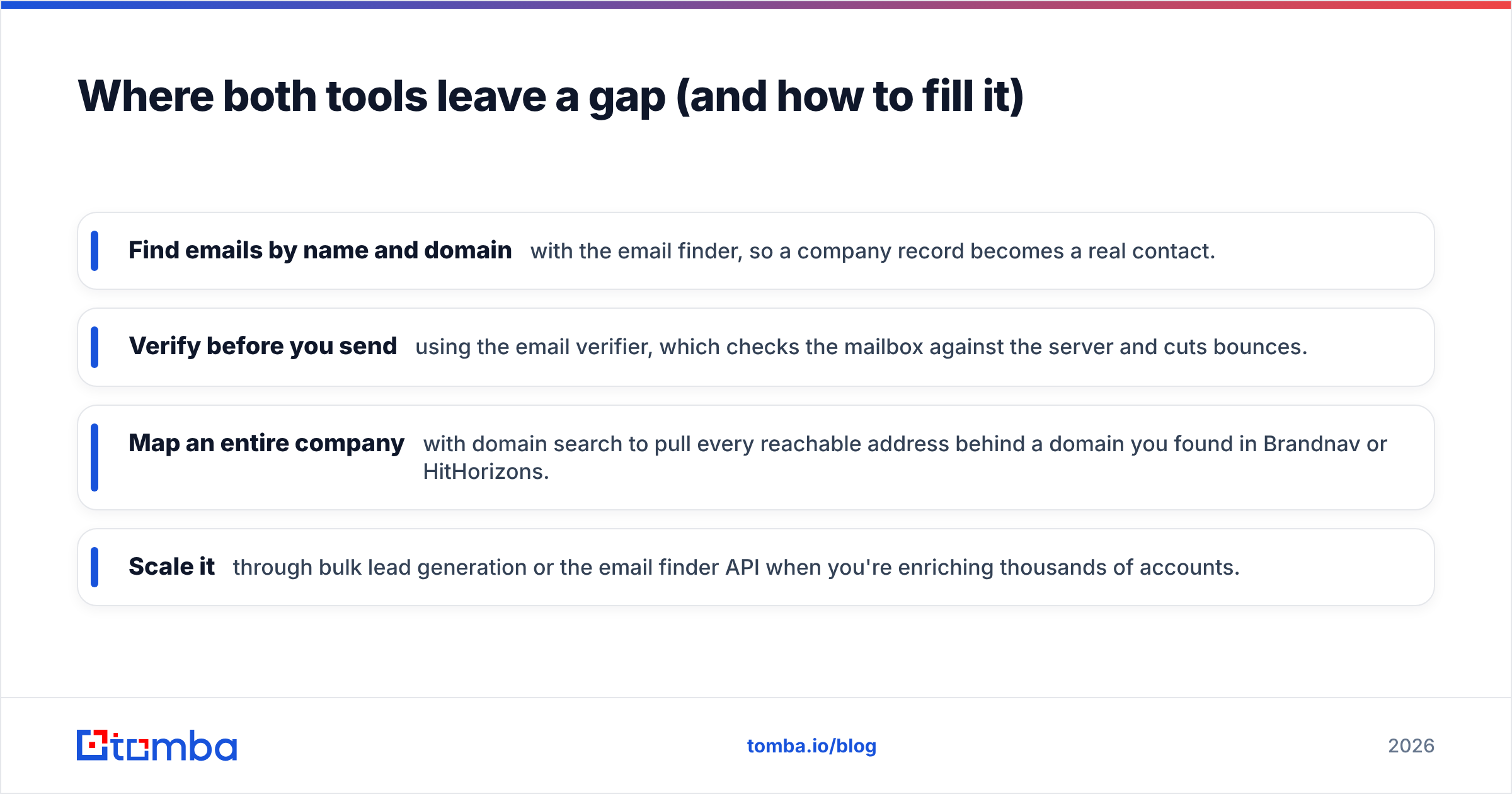
This is where a purpose-built finder beats a general data platform:
- Find emails by name and domain with the email finder, so a company record becomes a real contact.
- Verify before you send using the email verifier, which checks the mailbox against the server and cuts bounces.
- Map an entire company with domain search to pull every reachable address behind a domain you found in Brandnav or HitHorizons.
- Scale it through bulk lead generation or the email finder API when you're enriching thousands of accounts.
)
How does Tomba fit alongside Brandnav or HitHorizons?#
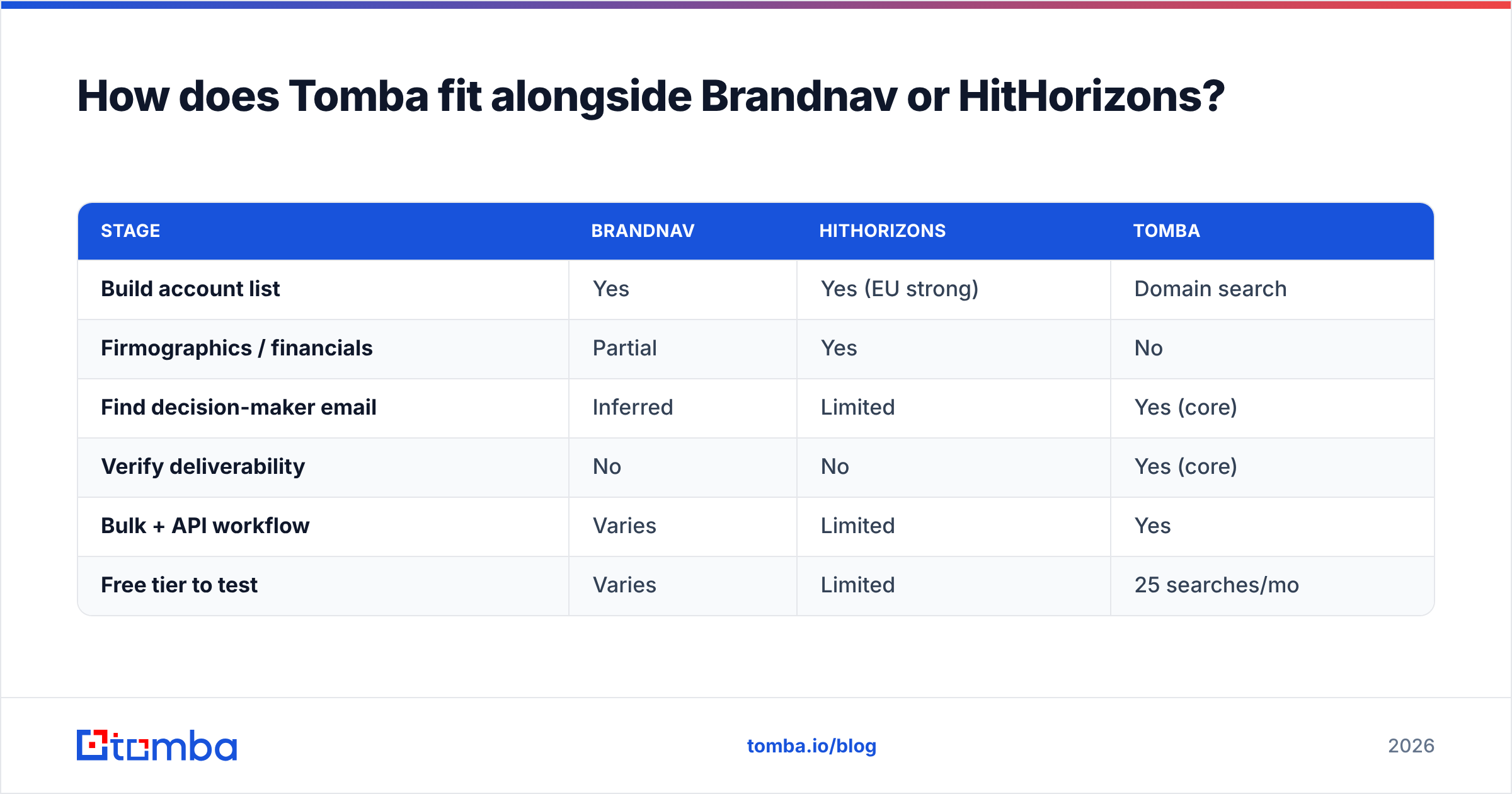
Tomba isn't trying to be your firmographic database — it's the verified-contact layer that makes that database actionable. The clean workflow looks like this:
- Source accounts in Brandnav or HitHorizons (the company list).
- Run domains through Tomba to find and verify the people who actually work there.
- Enrich and dedupe with data enrichment so your CRM rows are complete.
- Send knowing each address was verified, protecting your sender reputation.
Here's how the three tools split the work in a realistic stack:
| Stage | Brandnav | HitHorizons | Tomba |
|---|---|---|---|
| Build account list | Yes | Yes (EU strong) | Domain search |
| Firmographics / financials | Partial | Yes | No |
| Find decision-maker email | Inferred | Limited | Yes (core) |
| Verify deliverability | No | No | Yes (core) |
| Bulk + API workflow | Varies | Limited | Yes |
| Free tier to test | Varies | Limited | 25 searches/mo |
On cost, Tomba is transparent and built to slot in without blowing up your budget. The Tomba pricing runs a Free tier at 25 searches per month, Starter at $49/mo, Growth at $99/mo, and Pro at $249/mo, with Enterprise custom. You're not replacing your company database — you're adding the one capability it lacks.
Frequently asked questions#
Is Brandnav better than HitHorizons? Neither is universally better. HitHorizons wins on registry-grade European company and financial data; Brandnav wins on broader enrichment and marketing signals. Match the tool to whether your work is research-led or pipeline-led.
Can Brandnav or HitHorizons find verified email addresses? Not reliably. Both center on company-level data. Contact emails are inferred or limited, and neither verifies addresses against a live mail server, so you'll see higher bounce rates without a dedicated email verifier.
Do I need a separate email finder if I already use one of these? Usually yes. A company database tells you which accounts to target; an email finder tells you who to contact and whether the address is real. They're complementary, not redundant.
Which is best for European company data? HitHorizons, thanks to its official registry sources. For finding the actual people at those EU companies, layer on a finder that resolves names to verified emails.
The bottom line#
Brandnav and HitHorizons are both solid at what they were built for — Brandnav for flexible enrichment and growth signals, HitHorizons for authoritative, EU-heavy company records. The mistake is expecting either to deliver reachable, verified contacts. They don't, because that was never their job.
Close the loop. Keep your company database for what it's great at, then add a verified contact layer that turns those accounts into conversations. Start free with the Tomba Email Finder — 25 searches a month, no card required — point it at the domains you already pulled from Brandnav or HitHorizons, and watch your bounce rate drop while your reply rate climbs. Company data gets you to the building; Tomba gets you to the person.
Ready to find emails that actually work?
Join 150,000+ professionals who stopped guessing and started sending. Free credits on signup — no credit card required.
Get the Tomba newsletter
Practical outbound tactics and product updates — once every two weeks.
About the author