Brandnav vs Lead411: B2B Data Tools Compared (2026)
Brandnav vs Lead411 in 2026: pricing, data accuracy, intent signals, and email quality compared — plus where a leaner email finder beats both.
You are comparing Brandnav vs Lead411 because both promise the same thing: accurate B2B contact data that fills your pipeline without burning your sender reputation. They get there very differently. One leans on enrichment and brand-level data; the other is a long-running sales-intelligence database with intent signals and a sales-trigger engine. This guide breaks down where each wins, where each leaks budget, and when a focused email finder beats paying for a full data suite.
TL;DR#
- Lead411 is the more mature sales-intelligence platform: company + contact database, verified emails, direct-dial phones, and Bombora-powered intent data, priced for sales teams that live in a CRM all day.
- Brandnav is positioned as a leaner enrichment and contact-data layer — useful if you mostly need emails and firmographics appended to existing records rather than a full prospecting workspace.
- Pricing: Lead411 starts around $99/user/mo (annual) and climbs fast with intent add-ons; Brandnav is cheaper but thinner on intent and trigger data.
- Accuracy matters more than logos. Both inflate "verified" claims. Always run found emails through a dedicated email verifier before you send.
- If your real job is finding and verifying emails by domain or name, a specialist tool like Tomba does that for $49/mo — without forcing you to buy a sales-engagement suite you won't use.
What is Brandnav?#
Brandnav is a B2B data and enrichment tool aimed at teams that already have a list of companies or contacts and want to append missing fields — work emails, firmographics, and basic company attributes. Think of it as a polish layer: you bring the raw records, and it fills the gaps so your CRM isn't full of blanks.
Its strength is simplicity. You're not learning a whole prospecting cockpit with saved searches, cadences, and territory filters. You feed it identifiers, you get enriched rows back. For smaller teams that just need cleaner data feeding a HubSpot or Pipedrive workflow, that narrow scope is a feature, not a limitation.
The trade-off is depth. Brandnav doesn't try to be your sales-trigger engine. You won't get the same volume of intent topics, hiring signals, funding alerts, or technographic filters that a dedicated sales-intelligence platform ships with. If "who should I contact this week and why" is the question, Brandnav answers the who's email part and leaves the why now to you.
What is Lead411?#
Lead411 is one of the older names in B2B sales intelligence. It pairs a contact and company database with verified emails, direct-dial mobile numbers, and intent data sourced through Bombora. The pitch is "unlimited" data within fair-use limits on some plans, plus growth and hiring triggers that tell reps when an account is heating up.
Where Brandnav is an enrichment layer, Lead411 wants to be the daily workspace. Reps build searches by title, industry, revenue, employee count, and location, then layer intent topics on top to prioritize accounts actively researching your category. It pushes contacts into Salesforce, HubSpot, Outreach, and Salesloft, so the data doesn't sit in a silo.
That breadth is also the cost story. Intent data, direct dials, and higher export volumes typically sit behind add-ons or higher tiers. Teams that buy Lead411 for the full feature set — and use it daily — get value. Teams that buy it mostly for emails end up paying sales-intelligence prices for an email finder.

Brandnav vs Lead411: How do they compare?#
Here's the head-to-head on the attributes that actually change your monthly outcomes — not the marketing checklists.
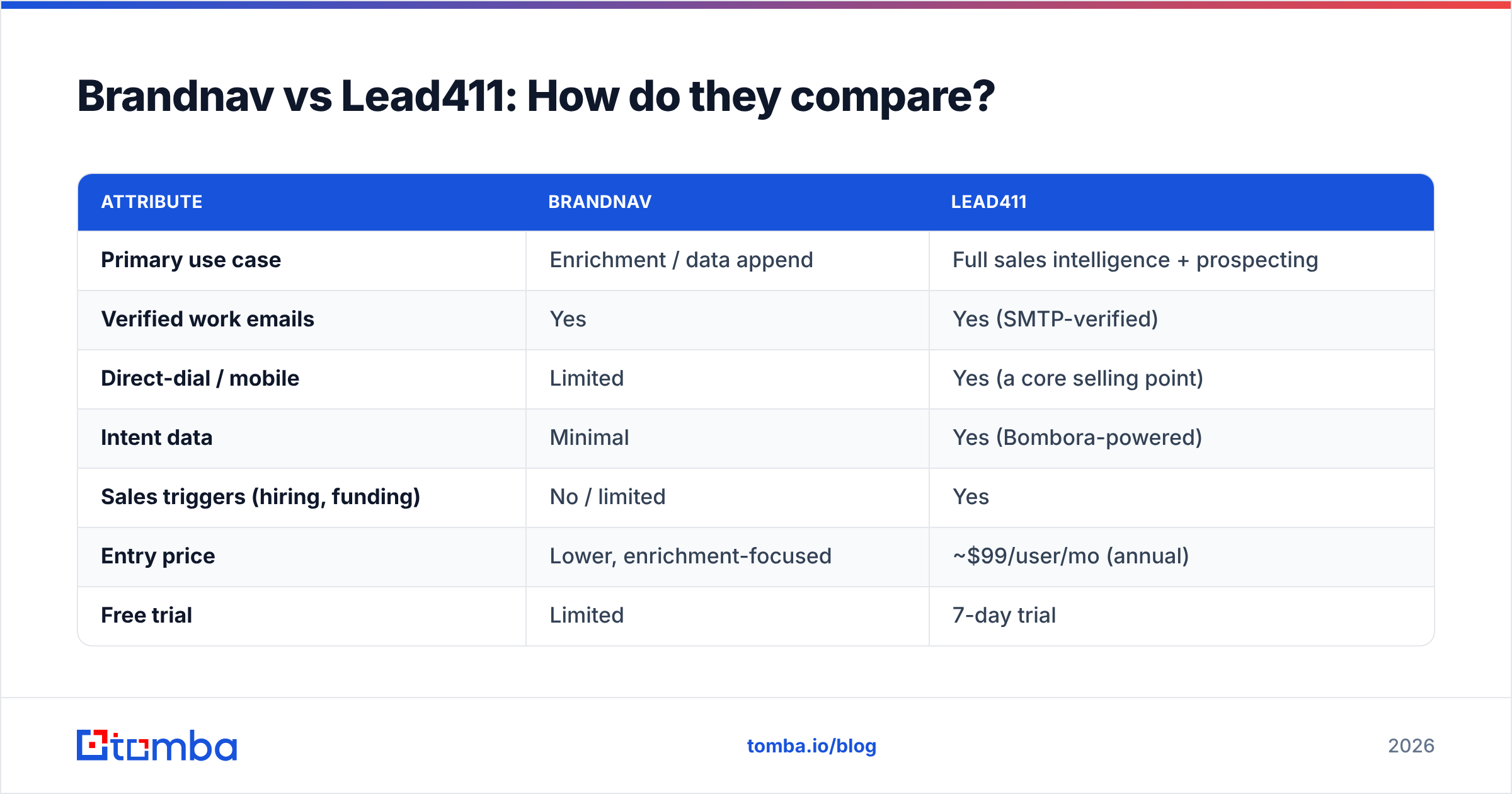
| Attribute | Brandnav | Lead411 |
|---|---|---|
| Primary use case | Enrichment / data append | Full sales intelligence + prospecting |
| Verified work emails | Yes | Yes (SMTP-verified) |
| Direct-dial / mobile | Limited | Yes (a core selling point) |
| Intent data | Minimal | Yes (Bombora-powered) |
| Sales triggers (hiring, funding) | No / limited | Yes |
| Entry price | Lower, enrichment-focused | ~$99/user/mo (annual) |
| Free trial | Limited | 7-day trial |
| Best for | Cleaning existing lists | Reps prospecting net-new daily |
| CRM/sequencer push | Basic integrations | Salesforce, HubSpot, Outreach, Salesloft |
The pattern is clear: Lead411 is broader and pricier; Brandnav is narrower and cheaper. Neither is "better" in the abstract — it depends on whether you're prospecting net-new accounts every morning or just topping up records you already own.

Which has better data accuracy?#
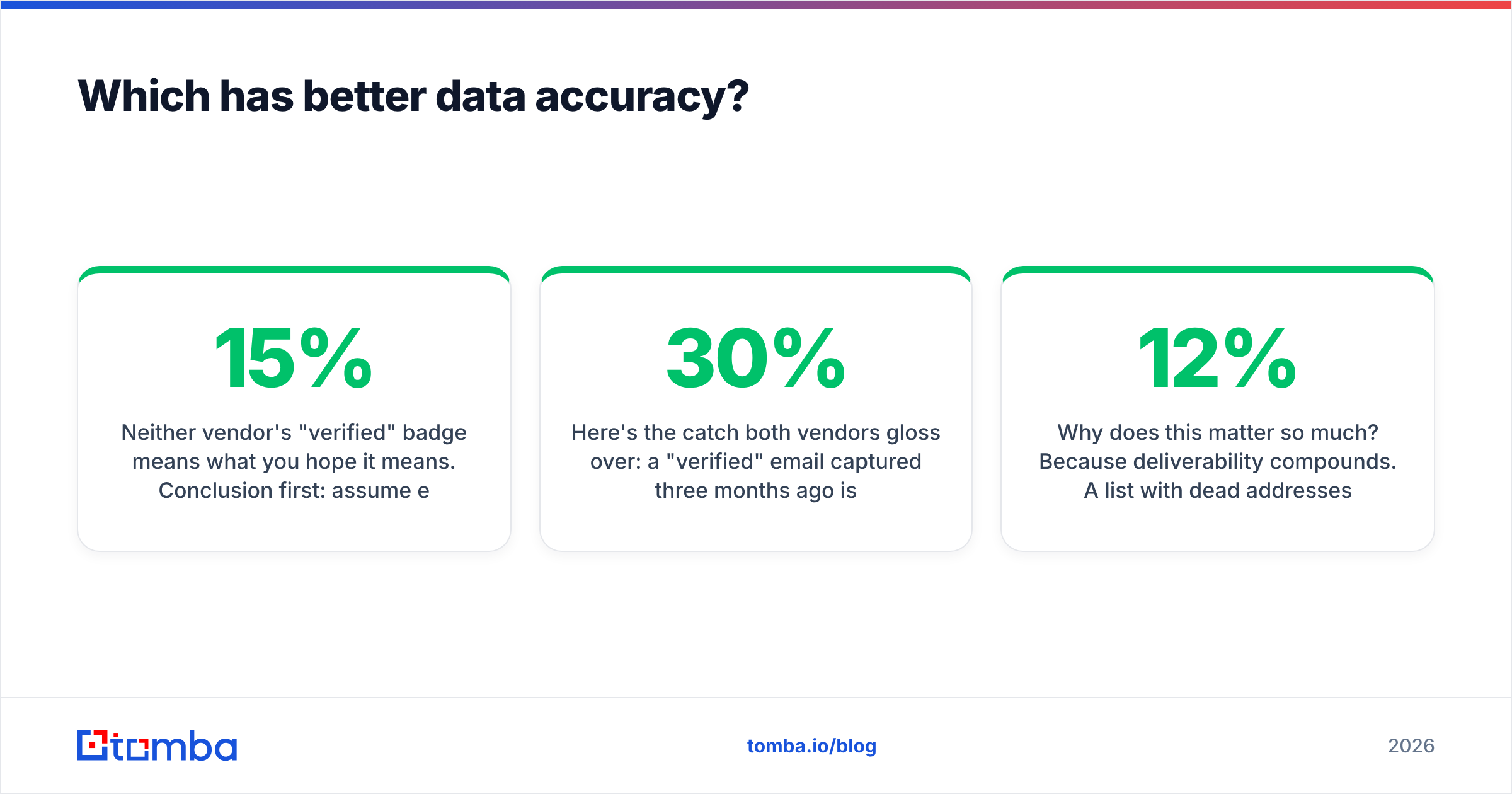
Neither vendor's "verified" badge means what you hope it means. Conclusion first: assume every list you export has 5–15% decay, and verify before you send regardless of which tool produced it.
Lead411 SMTP-verifies emails and refreshes its database on a rolling basis, which generally puts it ahead on contact coverage for mid-market and enterprise accounts in North America. Brandnav's accuracy is competitive on the records it can match, but match rates drop on smaller companies, non-US domains, and anyone without a strong web footprint.
Here's the catch both vendors gloss over: a "verified" email captured three months ago is not verified today. People change jobs at roughly 20–30% per year in tech sales. The fix is a verification step in your workflow, not blind trust in a database timestamp. Run exports through real-time validation, and treat catch-all domains with extra suspicion — they pass basic checks but silently swallow mail. A dedicated catch-all verifier is the only honest way to handle those.
Why does this matter so much? Because deliverability compounds. A list with 12% dead addresses doesn't just waste those 12% of sends — the resulting bounces drag down your sender reputation, which quietly suppresses the other 88% from reaching the inbox. Accuracy isn't a vanity metric; it's the input to whether your campaign lands at all. Industry reviews on G2 reflect this: both tools draw complaints about stale records, which is normal for the category and exactly why a separate verification layer pays for itself.
Which is better for pricing and value?#
The honest answer depends on whether you'll use the expensive parts.
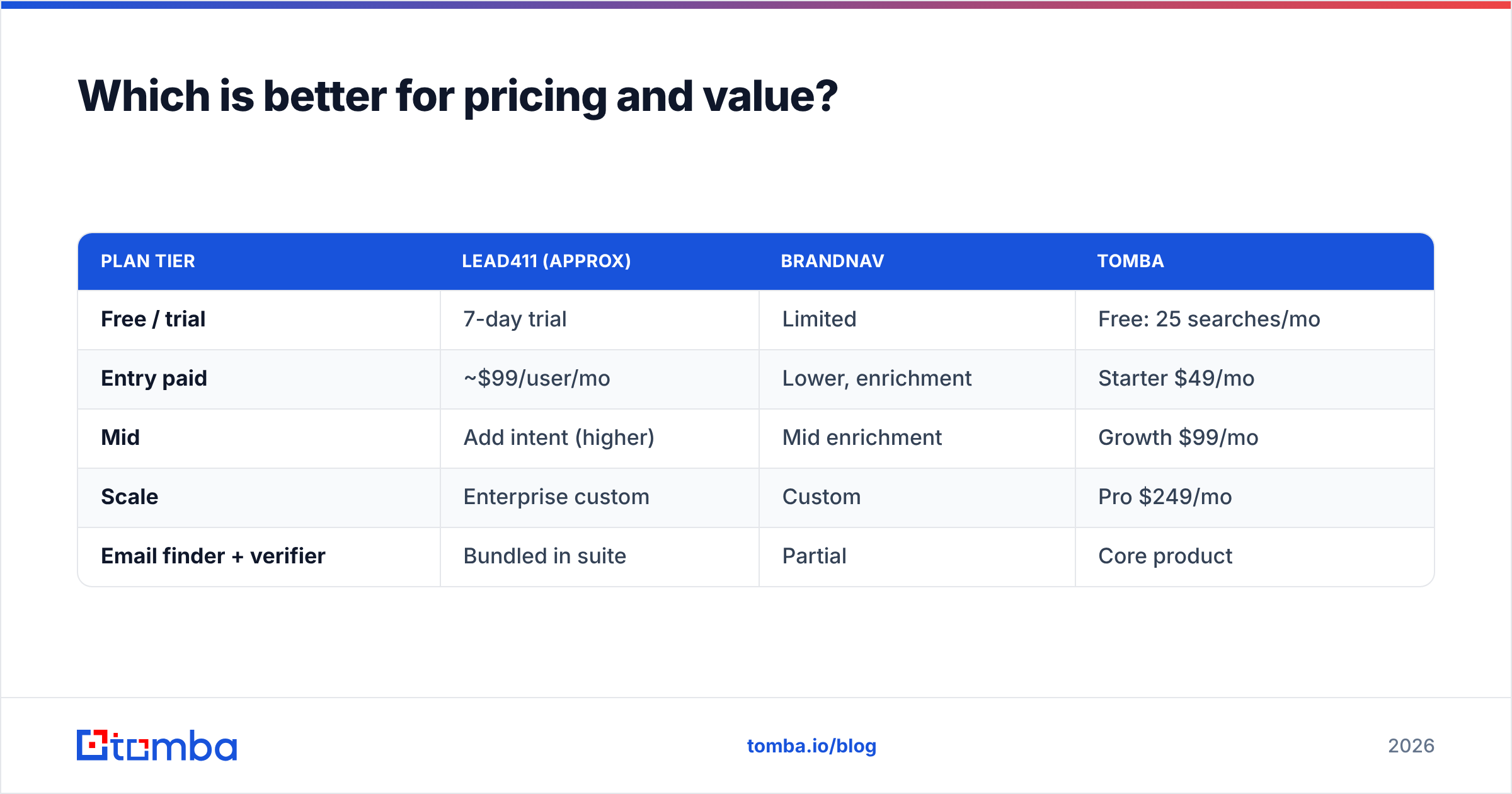
Lead411 lists around $99/user/month billed annually for its base Growth tier, with intent data, higher exports, and enterprise features pushing real-world spend well past that. For a four-rep team using intent and direct dials daily, that's a defensible spend. For a founder doing 200 outbound emails a month, it's overkill.
Brandnav undercuts that with enrichment-focused pricing, which is attractive if emails and firmographics are all you need. But thin intent and trigger data mean you may end up buying a second tool to answer "why now," and now you're stacking subscriptions.
This is the trap in most "vs" decisions: you price the tool instead of pricing the job. If the job is "find and verify professional emails reliably," neither a full sales-intelligence suite nor a partial enrichment layer is the cheapest path to it.
| Plan tier | Lead411 (approx) | Brandnav | Tomba |
|---|---|---|---|
| Free / trial | 7-day trial | Limited | Free: 25 searches/mo |
| Entry paid | ~$99/user/mo | Lower, enrichment | Starter $49/mo |
| Mid | Add intent (higher) | Mid enrichment | Growth $99/mo |
| Scale | Enterprise custom | Custom | Pro $249/mo |
| Email finder + verifier | Bundled in suite | Partial | Core product |
See full Tomba pricing for credit allowances per tier. The point isn't that cheaper always wins — it's that you should match the spend to what you'll actually open every day.
When should you pick a focused email finder instead?#
Pick a specialist when email is the bottleneck — which, for most outbound teams, it is. Here's how to decide in four checks:
- You mostly need emails, not a workspace. If you're not living in intent dashboards and trigger alerts daily, you're paying for shelf-ware. A domain search that returns every address pattern at a company solves the actual problem.
- You already have a sequencer. If Instantly, Smartlead, or Outreach handles your sending, you don't need Lead411's engagement layer — you need clean, verified addresses piped in.
- You prospect by name or domain, not by saved search. When you already know who you want (from LinkedIn, a webinar list, a conference roster), a name-based email finder is faster than building a database query.
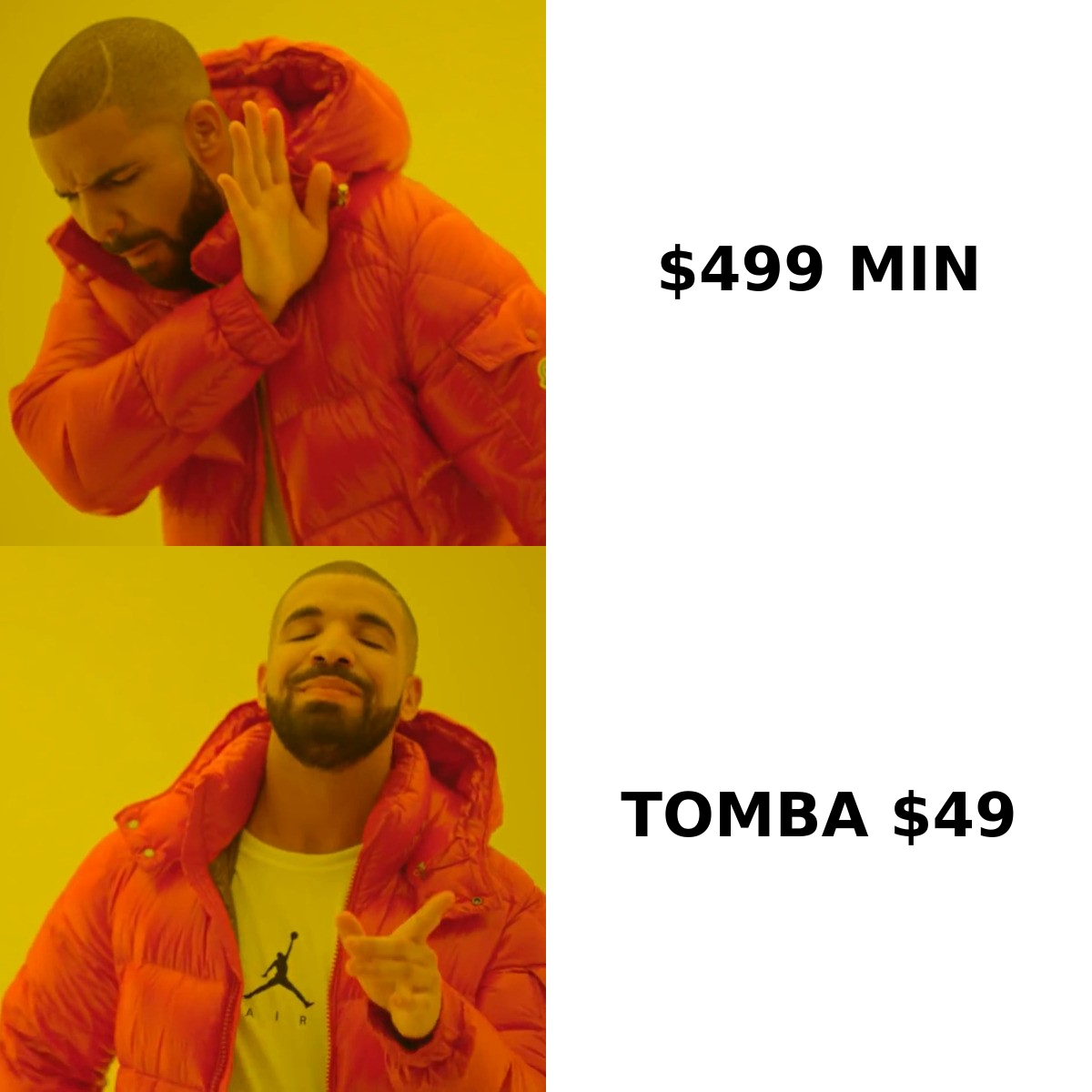
- You're cost-sensitive and bounce-sensitive. A finder-plus-verifier combo at $49/mo protects deliverability without enterprise commitment.
This is exactly the lane Tomba sits in. It's not trying to replace your CRM or your intent vendor — it does the email layer well, then gets out of the way. Tomba's stack includes the email finder, email verification, bulk lead generation, a B2B database, and a clean email finder API for teams that want to automate enrichment in their own pipeline.
How do Brandnav, Lead411, and Tomba stack up for outbound?#
For a pure outbound motion — find target accounts, get the right contact, verify, send — here's the practical breakdown:
- Lead411 wins if intent and direct dials drive your prioritization and you'll use them daily. Strongest for mid-market SDR teams in North America with a real RevOps function.
- Brandnav wins if you have a list and just need fields appended cheaply, and you don't need the "why now" signal layer.
- Tomba wins if email discovery and verification are the job, you want to keep your sequencer/CRM separate, and you care about cost-per-verified-contact. It also covers adjacent needs — LinkedIn email extraction, phone numbers, and data enrichment — without the full-suite price.
| Need | Best pick |
|---|---|
| Intent-driven prospecting | Lead411 |
| Cheap field enrichment | Brandnav |
| Find + verify emails at scale | Tomba |
| Direct-dial mobile numbers | Lead411 |
| Keep stack lean + cheap | Tomba |
| All-in-one daily workspace | Lead411 |
What are the common mistakes when choosing?#
Three mistakes cost teams the most money in this category.
Mistake 1: Buying for features you'll demo but never use. Intent data is genuinely powerful — for teams with the process to act on it within hours. If your reps check intent weekly, not hourly, you're paying for a Ferrari to drive in a parking lot. Be honest about your operating rhythm before you buy the tier that includes it.
Mistake 2: Skipping verification because the vendor said "verified." Covered above, but it bears repeating: a database verification timestamp is a snapshot, not a guarantee. Build a real-time check into your send workflow. This single habit does more for deliverability than switching vendors ever will.
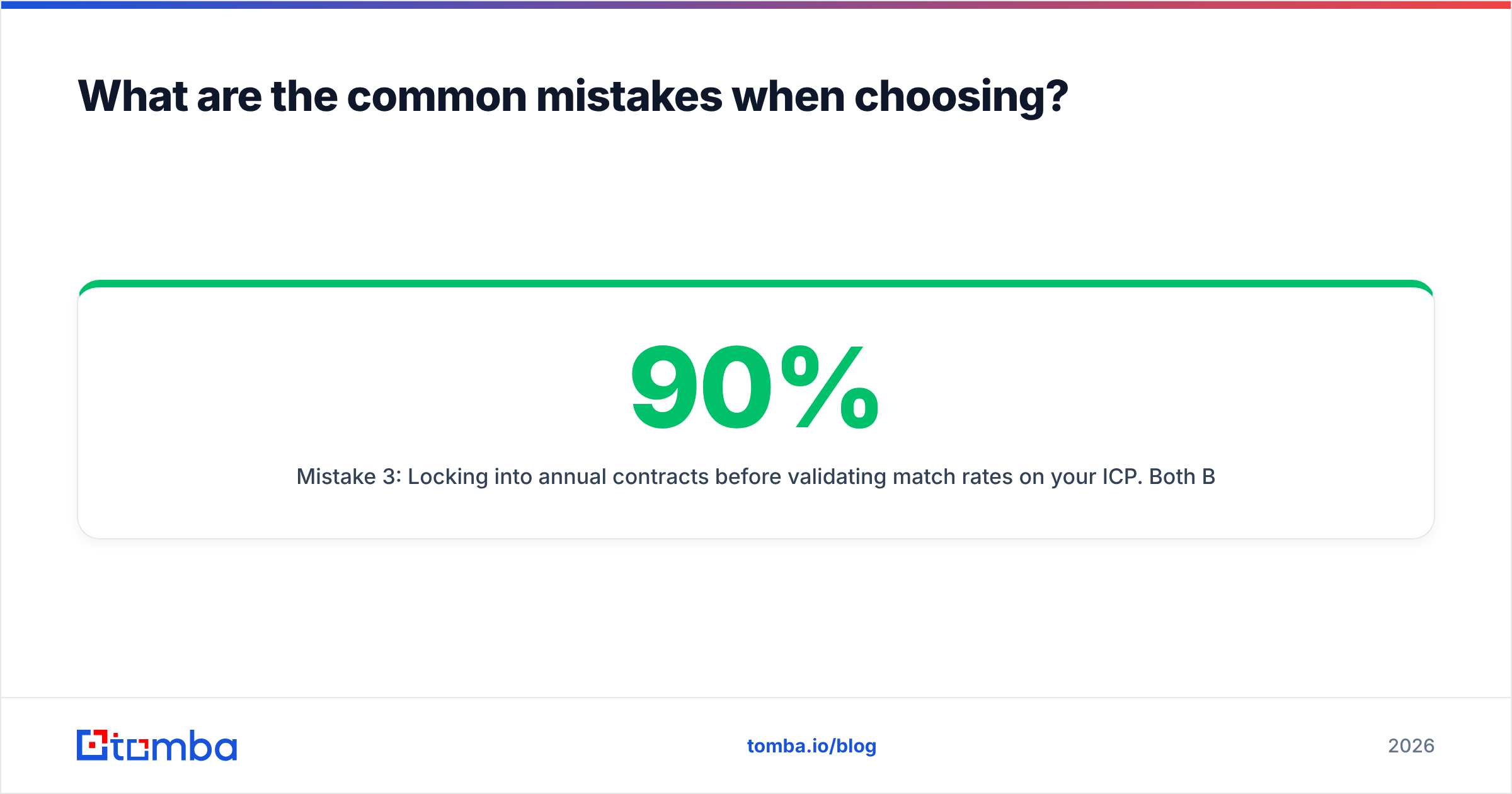
Mistake 3: Locking into annual contracts before validating match rates on your ICP. Both Brandnav and Lead411 perform differently across geographies, company sizes, and industries. Run a trial against a real slice of your target list — same 200 accounts through each — and measure match rate and bounce rate, not just whether the tool returns something. The tool that returns 90% of records at 4% bounce beats the one that returns 95% at 14% bounce, every time.
A quick way to sanity-check any list before import: run it through a free email checker and a spam checker so you catch problems before they hit your sending domain.
Brandnav vs Lead411: which should you choose?#
Choose Lead411 if you're a sales team that prospects net-new every day, acts on intent signals, and needs direct dials in one workspace — and you'll genuinely use the full suite to justify the per-seat cost.
Choose Brandnav if you already own your lists, need affordable enrichment to fill gaps, and don't need an intent or trigger engine bolted on.
Choose a specialist email finder if the actual constraint is finding and verifying professional emails — which it usually is — and you'd rather not pay sales-intelligence prices for that one job. Decoupling email discovery from your engagement and intent stack keeps each layer cheaper, swappable, and easier to reason about.
The bottom line#
Both Brandnav and Lead411 are legitimate tools for different buyers: Lead411 for intent-driven, direct-dial-heavy outbound teams, Brandnav for lean enrichment. But if you strip the decision down to "I need accurate emails I can actually send to," paying for a full suite is the expensive route to a simple outcome.
That's where Tomba fits. Start free with 25 searches a month, then scale to Starter at $49/mo — find emails by name, domain, or company, verify them in the same workflow, and keep your CRM and sequencer exactly as they are. Try the Tomba Email Finder on your next 50 target accounts and compare the verified match rate against whatever you're paying for now. If the cheaper tool finds the same people at a lower bounce rate, the "vs" debate answers itself.
// get started
Find, verify and enrich your first contacts today
Start on the free plan with 25 searches a month, then scale when your team is ready.
Free plan · No credit card required · GDPR & CCPA
// about the author