Brandnav vs Leadzenai: Which Lead Tool Wins in 2026?
Brandnav and Leadzenai both promise clean B2B contact data, but they solve different problems. Here is an honest 2026 breakdown of accuracy, pricing, and the cheaper alternative most teams miss.
Choosing between Brandnav and Leadzenai usually comes down to one question you cannot answer from a pricing page: whose data actually lands in your inbox without bouncing? Both tools sell "verified B2B contacts," both run a credit model, and both look great in a demo. The differences only show up once you push real volume through them.
This is a neutral, side-by-side look at how the two compare in 2026 — coverage, accuracy, pricing, and the specific use cases each one is built for. Where a third option makes more sense, you will see that too.
TL;DR#
- Brandnav is strongest for global email discovery and bulk list building, with a simple credit model aimed at agencies and high-volume outbound teams.
- Leadzenai leans toward India-centric and intent-style B2B data, bundling enrichment and lead intelligence into a heavier platform.
- Accuracy is the real tiebreaker — both publish high "verified" claims, but bounce rates in the wild depend on how aggressively each verifies before delivery.
- Pricing models differ sharply: Brandnav is per-credit and predictable; Leadzenai pushes annual platform tiers that cost more upfront.
- If you mainly need accurate emails without platform bloat, a focused email finder like Tomba often beats both on cost-per-valid-email.
What are Brandnav and Leadzenai?#
Both are B2B contact-data tools, but they grew up solving different problems.
Brandnav is an email-finding and lead-data service. You give it a domain, a name, or a list, and it returns business email addresses with a confidence score. Its pitch is reach and simplicity: a large global index, bulk uploads, and a credit system that does not try to lock you into a full sales-engagement suite.
Leadzenai (Leadzen.ai) positions itself as a lead-intelligence platform rather than a single-purpose finder. It blends contact discovery with enrichment, filtering, and "intent"-style signals, with notably deep coverage of the Indian market. It is closer to a mini-database you query than a lookup utility you call.
The mental model: Brandnav is a precise drill, Leadzenai is a Swiss Army knife. A drill is faster and cheaper when you only need holes. The knife is handy when you need ten tools and accept that none is best-in-class.

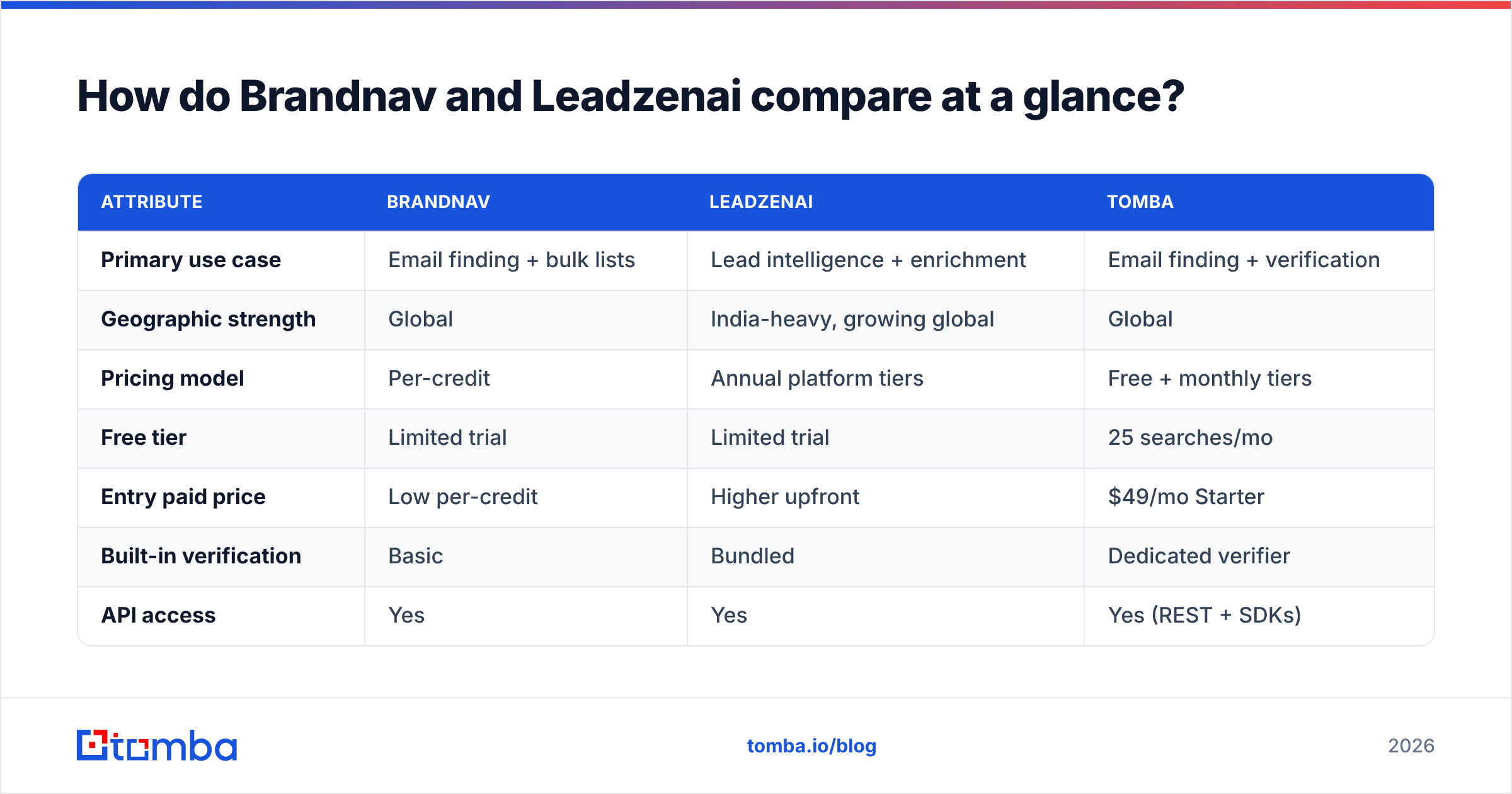
How do Brandnav and Leadzenai compare at a glance?#
Here is the side-by-side on the attributes that actually drive a buying decision.
| Attribute | Brandnav | Leadzenai | Tomba |
|---|---|---|---|
| Primary use case | Email finding + bulk lists | Lead intelligence + enrichment | Email finding + verification |
| Geographic strength | Global | India-heavy, growing global | Global |
| Pricing model | Per-credit | Annual platform tiers | Free + monthly tiers |
| Free tier | Limited trial | Limited trial | 25 searches/mo |
| Entry paid price | Low per-credit | Higher upfront | $49/mo Starter |
| Built-in verification | Basic | Bundled | Dedicated verifier |
| API access | Yes | Yes | Yes (REST + SDKs) |
| Best for | Agencies, volume outbound | Mid-market RevOps | SDRs, founders, recruiters |
Treat any vendor's headline "95%+ accuracy" as a starting hypothesis, not a guarantee. The number you care about is your bounce rate on your segment — which is why a free trial that lets you export and verify a real sample matters more than the marketing figure.
Which has more accurate data?#
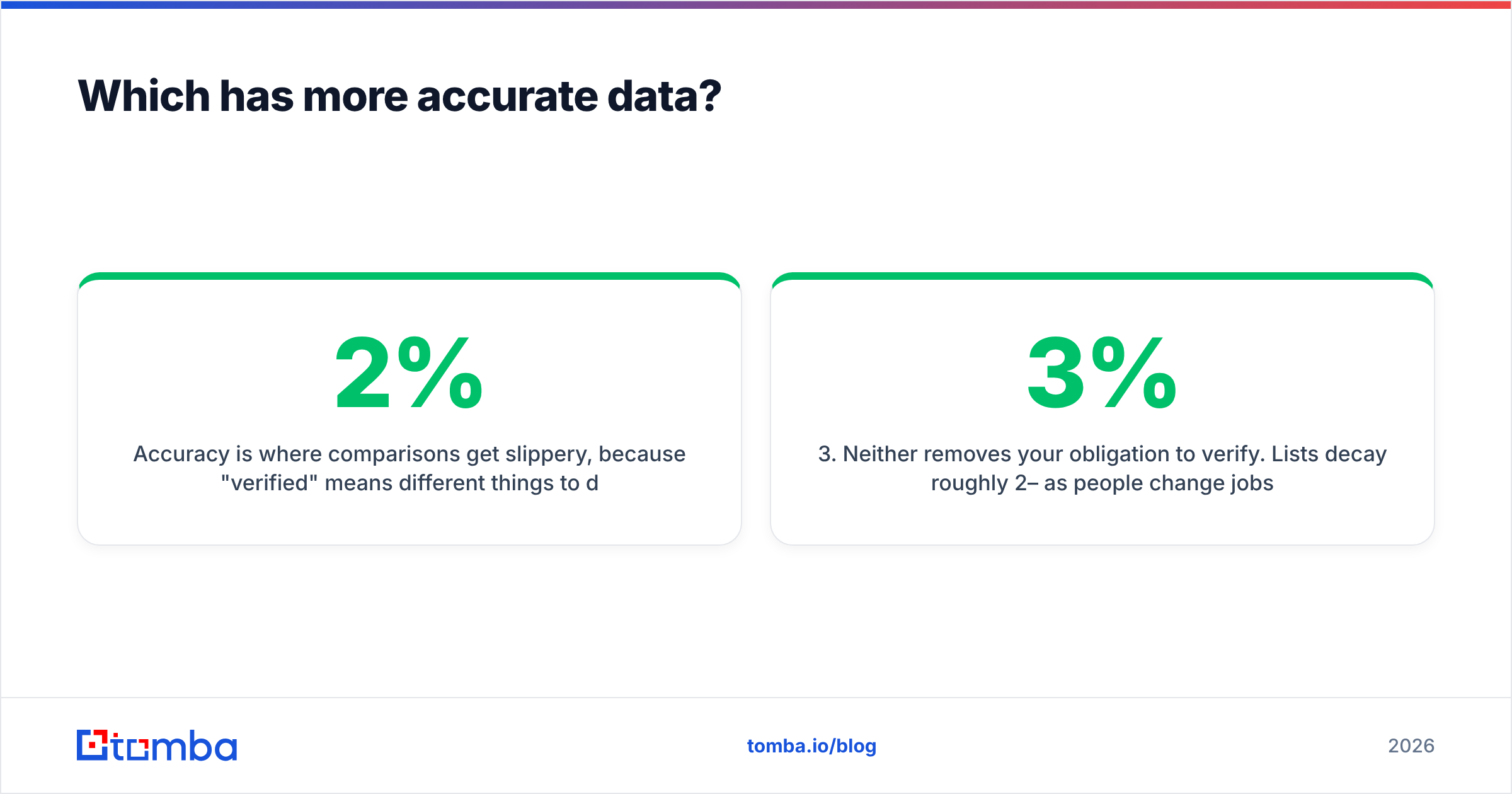
Accuracy is where comparisons get slippery, because "verified" means different things to different vendors. Some tools count an email as verified if the syntax and domain are valid; others run a full SMTP handshake before they hand it to you. That gap is the difference between a 2% and a 12% bounce rate.
A few practical truths:
- Brandnav tends to optimize for coverage. You will find more contacts on obscure domains, but a slice of them will be catch-all addresses that no tool can fully confirm. Run those through a catch-all verifier before you send.
- Leadzenai tends to optimize for enriched profiles. When it has a record, the surrounding data (title, company size, location) is rich — but coverage thins out fast outside its core regions.
- Neither removes your obligation to verify. Lists decay roughly 2–3% per month as people change jobs, so even a perfect export goes stale.
The honest takeaway: do not pick based on the accuracy number on the website. Export 100 contacts from each on the exact segment you sell to, run them through an independent email verifier, and compare valid-rate and cost-per-valid-email. That single test beats a month of reading reviews.

How does pricing compare?#
The pricing philosophies are genuinely different, and that matters more than the sticker numbers.
Brandnav uses a credit model. You buy credits, each lookup spends some, and unused credits behave predictably. This is friendly to agencies and spiky workloads: a big campaign month costs more, a quiet month costs less, and you are never paying for seats you do not use.
Leadzenai leans on platform tiers, often billed annually. You get the intelligence features bundled, but you commit upfront and pay for the whole suite even if you only use the finder. For a RevOps team that will use enrichment, filtering, and exports daily, that bundle can be worth it. For a two-person SDR team that just needs emails, it is overkill.
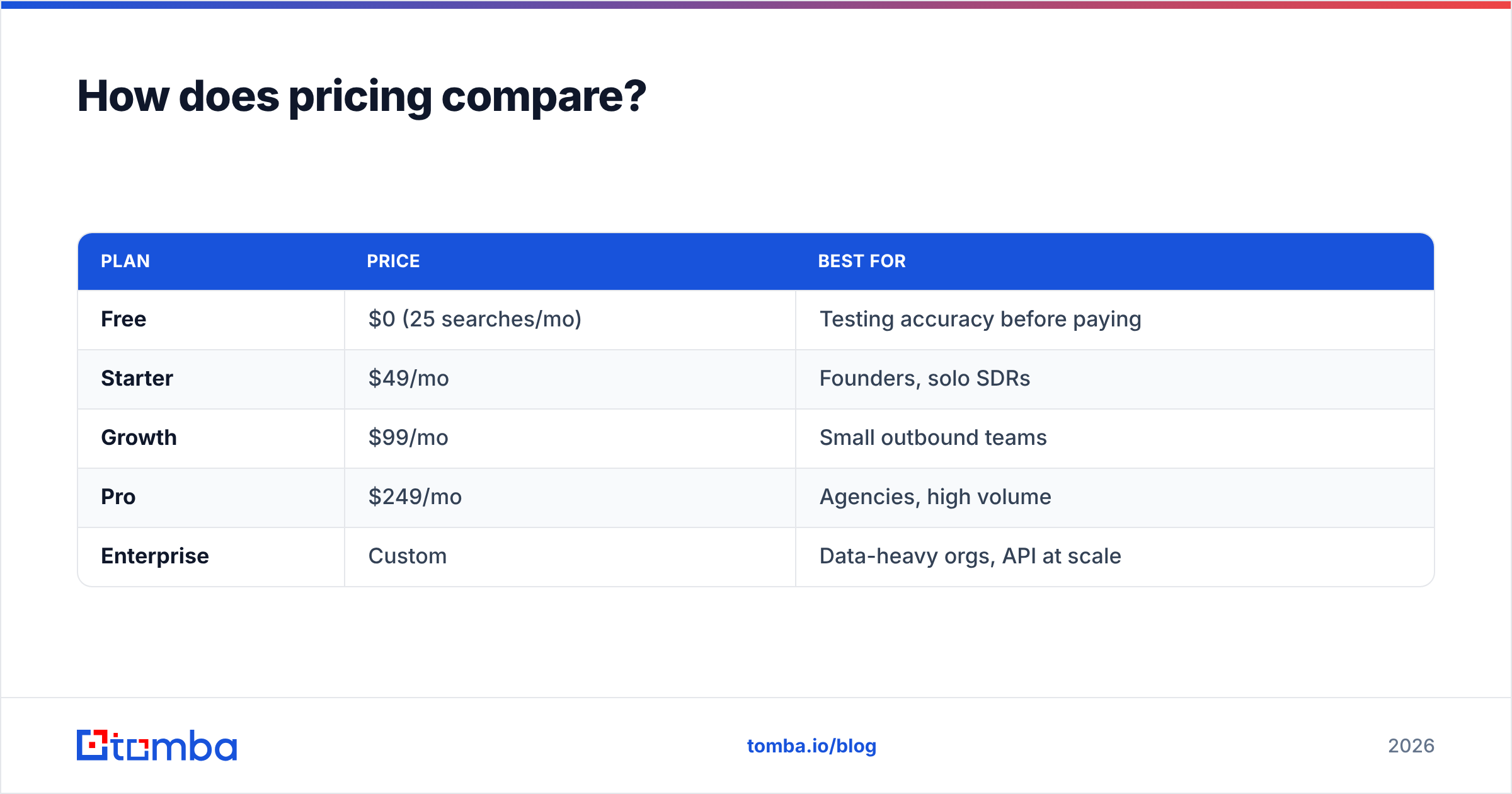
Where does Tomba sit? Between them, deliberately. The Tomba pricing ladder is monthly and transparent:
| Plan | Price | Best for |
|---|---|---|
| Free | $0 (25 searches/mo) | Testing accuracy before paying |
| Starter | $49/mo | Founders, solo SDRs |
| Growth | $99/mo | Small outbound teams |
| Pro | $249/mo | Agencies, high volume |
| Enterprise | Custom | Data-heavy orgs, API at scale |
The Free tier is the part that quietly matters: 25 searches is enough to run the accuracy test above before you spend a cent. Neither competitor's trial is built to be that generous-but-honest about letting you benchmark before you commit.
Which tool fits which team?#
Match the tool to the motion, not the marketing.
- Pick Brandnav if you run high-volume, multi-geo outbound and want a simple credit meter you can scale up and down. Agencies billing clients per-campaign like this model.
- Pick Leadzenai if your ICP is concentrated in India or you want enrichment and lead intelligence inside one platform, and you will actually use the broader feature set.
- Pick a focused finder (Tomba) if your core need is "give me accurate, verified emails by domain or name" without paying for a suite you will not touch — and you want a real free tier to test first.
There is no shame in the third path. Most teams over-buy platform when what they needed was a reliable domain search plus verification.
What about data coverage and compliance?#
Coverage is not just "how many records" — it is which records and how legally they were gathered.
Brandnav's global index is broad, which helps when you sell into many markets. Leadzenai's depth in India is a genuine edge if that is your market, and a non-factor if it is not. Both should be evaluated against your specific territories, not a global total.
Compliance is the part buyers skip and regret. If you sell into the EU or UK, you are bound by GDPR regardless of where your data vendor sits. Ask each vendor three questions: where does the data come from, can you honor deletion requests, and do they document a lawful basis for processing. A tool that cannot answer those clearly is a liability dressed as a shortcut. Independent review sites like G2 are useful for sanity-checking how real customers describe data freshness and support responsiveness.
For teams that need to enrich beyond email, look at whether your finder also offers data enrichment and a phone finder, so you are not stitching three vendors together to build one complete contact record.
What do the pros and cons look like?#
A blunt summary, with no vendor doing your homework for you.
Brandnav
- Pros: simple credit pricing, strong global reach, fast bulk processing, low cost-per-lookup at volume.
- Cons: verification is basic, so catch-all noise can slip through; lighter on enrichment and intelligence.
Leadzenai
- Pros: rich enriched profiles, strong India coverage, bundled intelligence features, useful for RevOps workflows.
- Cons: higher upfront cost, annual commitment, heavier than teams that only need emails, thinner coverage outside core regions.
Tomba (the alternative)
- Pros: dedicated verifier alongside the finder, honest 25-search free tier, transparent monthly pricing, full Tomba API plus extensions for Sheets and Chrome.
- Cons: focused on contact data and verification rather than a full sales-engagement suite — if you want sequencing and dialer baked in, you will pair it with a separate tool.

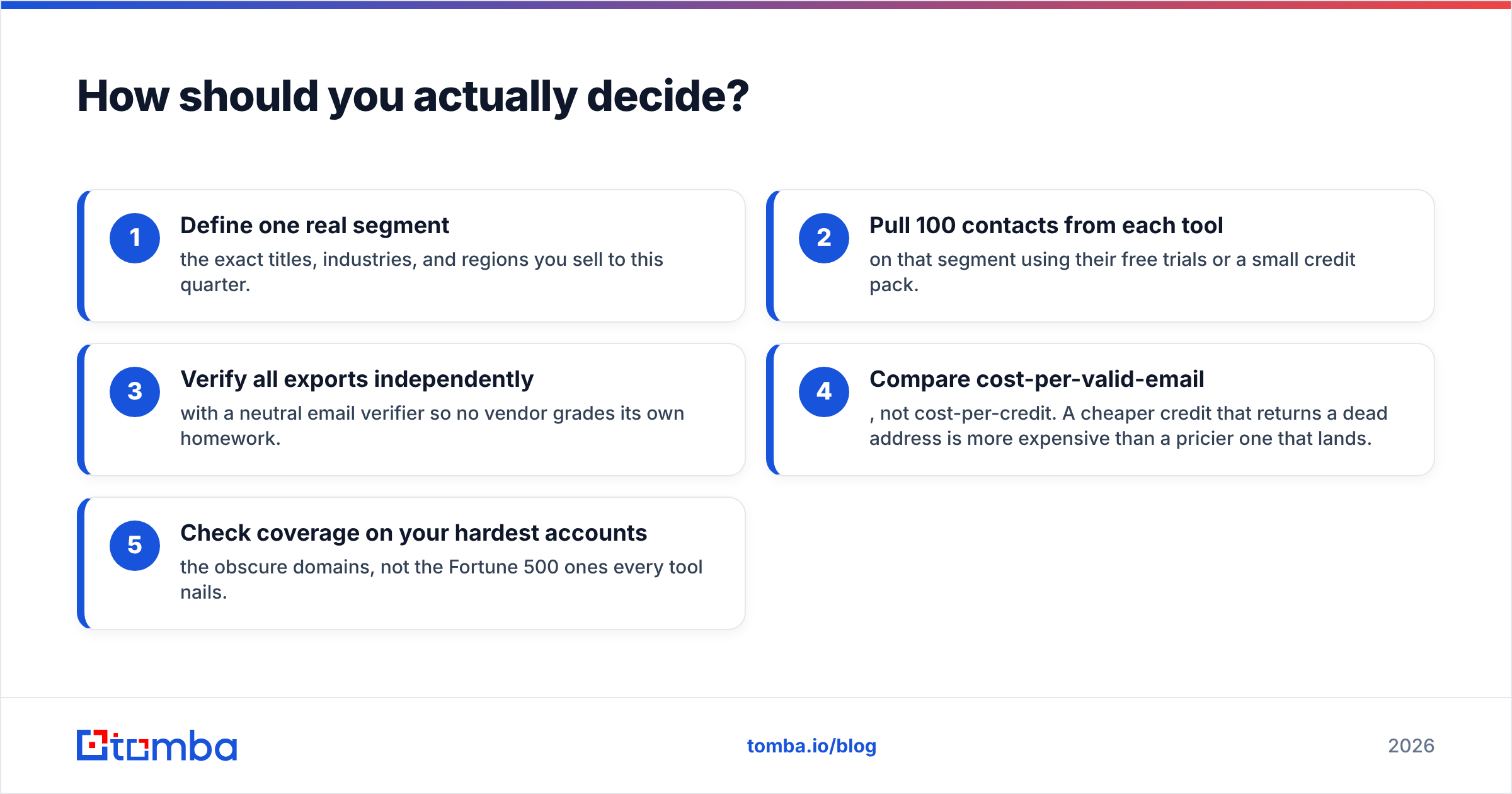
How should you actually decide?#
Run a 30-minute bake-off instead of arguing about feature lists.
- Define one real segment — the exact titles, industries, and regions you sell to this quarter.
- Pull 100 contacts from each tool on that segment using their free trials or a small credit pack.
- Verify all exports independently with a neutral email verifier so no vendor grades its own homework.
- Compare cost-per-valid-email, not cost-per-credit. A cheaper credit that returns a dead address is more expensive than a pricier one that lands.
- Check coverage on your hardest accounts — the obscure domains, not the Fortune 500 ones every tool nails.
Whichever tool wins that test for your market is your answer. It might be Brandnav, it might be Leadzenai, and for a large share of teams it will be a focused finder that does the core job cheaper.
Frequently asked questions#
Is Brandnav better than Leadzenai? Neither is universally better. Brandnav wins on simple, high-volume, global email finding with predictable credit pricing. Leadzenai wins when you need enriched lead intelligence and your market skews toward India. Match the tool to your motion.
Which is cheaper, Brandnav or Leadzenai? Brandnav's per-credit model is usually cheaper for spiky or low-volume use, since you pay only for what you look up. Leadzenai's annual platform tiers cost more upfront but bundle enrichment features. For pure email finding, a monthly plan like Tomba's $49 Starter is often the lowest cost-per-valid-email.
Can I use both tools together? Yes. Some teams use one tool for discovery and another for verification or enrichment. Just make sure your verification step is independent of the source so you are measuring true deliverability, not a vendor's own scoring.
What is the most important metric when comparing them? Cost-per-valid-email after independent verification. Headline accuracy percentages and credit prices are both misleading on their own.
The bottom line#
Brandnav and Leadzenai are both legitimate choices — they just serve different teams. Brandnav is the lean, global, credit-metered finder for volume outbound. Leadzenai is the heavier, enrichment-rich platform for RevOps teams concentrated in its core markets. The only way to know which fits is to test both on your real segment and compare valid emails, not promises.
If your honest need is "accurate, verified business emails without paying for a suite I won't use," start with the free tier. The Tomba Email Finder gives you 25 searches a month at no cost, a dedicated verifier so your bounce rate stays low, and transparent $49/mo pricing when you scale — enough to run the exact bake-off above before you commit a budget to anyone.
// get started
Find, verify and enrich your first contacts today
Start on the free plan with 25 searches a month, then scale when your team is ready.
Free plan · No credit card required · GDPR & CCPA
// about the author