Brandnav vs Listclean 2026: Which Email Verifier Wins?
Brandnav vs Listclean compared on accuracy, catch-all handling, pricing, and speed for 2026 — plus where a finder-first stack beats a pure list cleaner.
Choosing between Brandnav vs Listclean usually comes down to one boring-but-expensive question: how many of your "clean" emails still bounce after you pay for verification? Both tools promise to scrub your list. The difference is what they do with the hard cases — catch-all domains, role accounts, and stale records that look fine until your mailbox provider flags you.
This guide breaks down both tools on the metrics that actually move deliverability, then shows where a finder-first platform changes the math entirely.
TL;DR#
- Brandnav leans toward bulk brand and contact data cleaning, with verification bundled into a wider data workflow. Good if you live inside large, messy CRM exports.
- Listclean is a focused list-hygiene tool: upload, verify, download. Simpler, faster to learn, fewer moving parts.
- Accuracy on catch-all domains is where most verifiers — including both of these — quietly lose points. Test this before you commit.
- Pricing models differ: pay-as-you-go credits vs subscription tiers change your real cost per 100k emails more than the sticker price suggests.
- If you also need to find verified emails (not just clean a list you already have), neither tool is built for that — a finder-plus-verifier like Tomba covers both jobs from one credit pool.
What do Brandnav and Listclean actually do?#
Both sit in the email verification category, but they solve slightly different shapes of the same problem.
Listclean is a classic list-hygiene tool. You hand it a CSV of addresses, it runs syntax checks, MX-record lookups, SMTP probes, and bounce-risk scoring, then returns the list tagged as valid, invalid, risky, or unknown. The mental model is a car wash: dirty list in, clean list out, no relationship with the data afterward.
Brandnav positions itself more broadly around brand and contact data — deduplication, enrichment, and verification as part of a larger cleanup pass. If Listclean is a car wash, Brandnav is closer to a full detailing service that also checks your tires and tops up the fluids. That breadth is useful when your problem is "this whole export is a mess," and overkill when your problem is "just tell me which of these 5,000 emails will bounce."
The practical takeaway: pick the tool whose default workflow matches your actual job. Verification accuracy matters in both, so that's where we start.
Which is more accurate on catch-all domains?#
Catch-all domains are the single biggest reason "verified" lists still bounce. A catch-all server accepts mail for any address at the domain during the SMTP handshake — so a naive verifier marks nonsense@company.com as valid because the server said yes. Then your real send bounces or lands in a spam trap.
Here's the honest state of play: no verifier is perfect on catch-alls, because the information simply isn't exposed at SMTP time for many domains. What separates good tools from mediocre ones is whether they:
- Flag catch-all domains explicitly instead of silently calling them "valid."
- Use historical and pattern data to estimate deliverability on those domains.
- Let you decide how aggressive to be (drop all risky, or keep with a confidence score).
Both Brandnav and Listclean detect catch-all domains, but their handling of the "unknown" bucket differs, and that bucket is where your money leaks. Before you trust either, run a catch-all verifier test on a known sample — a few hundred addresses where you already know which are live — and compare the false-positive rate. That single test tells you more than any vendor benchmark.
For the underlying mechanics of why mail bounces in the first place, the bounce message reference on Wikipedia is a solid primer.
Brandnav vs Listclean: head-to-head comparison#
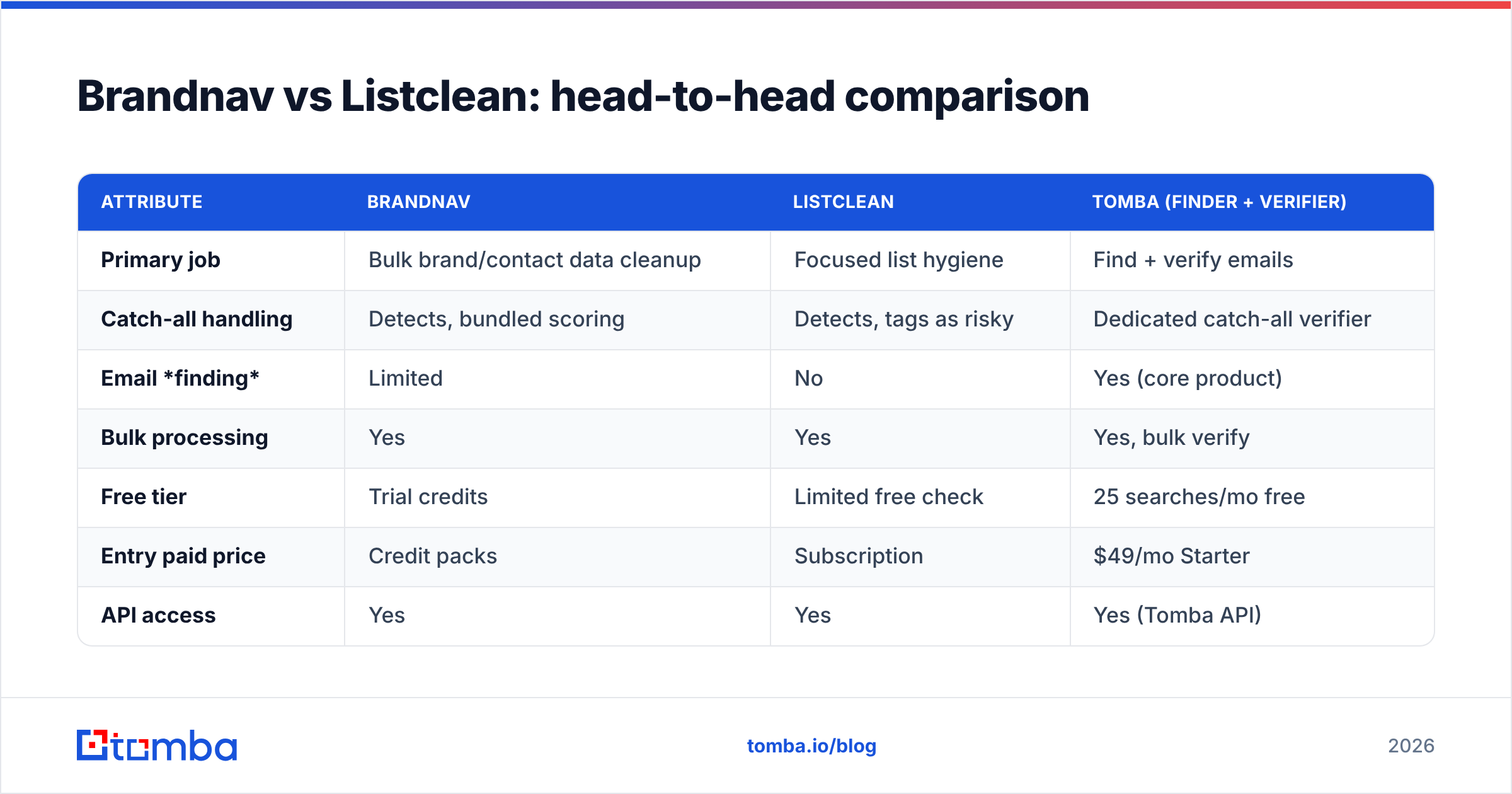
Here's the side-by-side on the attributes that decide most purchases. Treat vendor-published accuracy numbers as marketing until you've run your own sample.
| Attribute | Brandnav | Listclean | Tomba (finder + verifier) |
|---|---|---|---|
| Primary job | Bulk brand/contact data cleanup | Focused list hygiene | Find + verify emails |
| Catch-all handling | Detects, bundled scoring | Detects, tags as risky | Dedicated catch-all verifier |
| Email finding | Limited | No | Yes (core product) |
| Bulk processing | Yes | Yes | Yes, bulk verify |
| Free tier | Trial credits | Limited free check | 25 searches/mo free |
| Entry paid price | Credit packs | Subscription | $49/mo Starter |
| API access | Yes | Yes | Yes (Tomba API) |
| Best for | Messy CRM exports | Simple clean-and-send | Building lists from scratch |
The column that surprises people is the last one. If your real workflow is "I have a list, clean it," a pure verifier is fine. If your workflow is "I need 2,000 verified contacts at companies in this segment," you're going to bolt a finder onto your verifier anyway — and paying two vendors for two credit pools is how SaaS budgets quietly balloon.
How should you think about pricing?#
Conclusion first: compare cost per 100,000 verifications, not the headline monthly price. Subscription tools look cheap until you hit the tier ceiling; credit packs look cheap until you realize unused credits expire.
A few rules that hold across vendors:
- Pay-as-you-go credits win when your verification volume is spiky — a big quarterly list scrub, then nothing.
- Subscriptions win when you verify continuously and predictably (e.g., every inbound signup).
- Watch the "unknown" billing: some tools charge full price for results they can't confidently verify. Read that clause.
- Bundle math matters: if finding and verifying come from one credit pool, your effective cost per usable contact drops, because you're not paying a finder vendor and a verifier vendor separately.
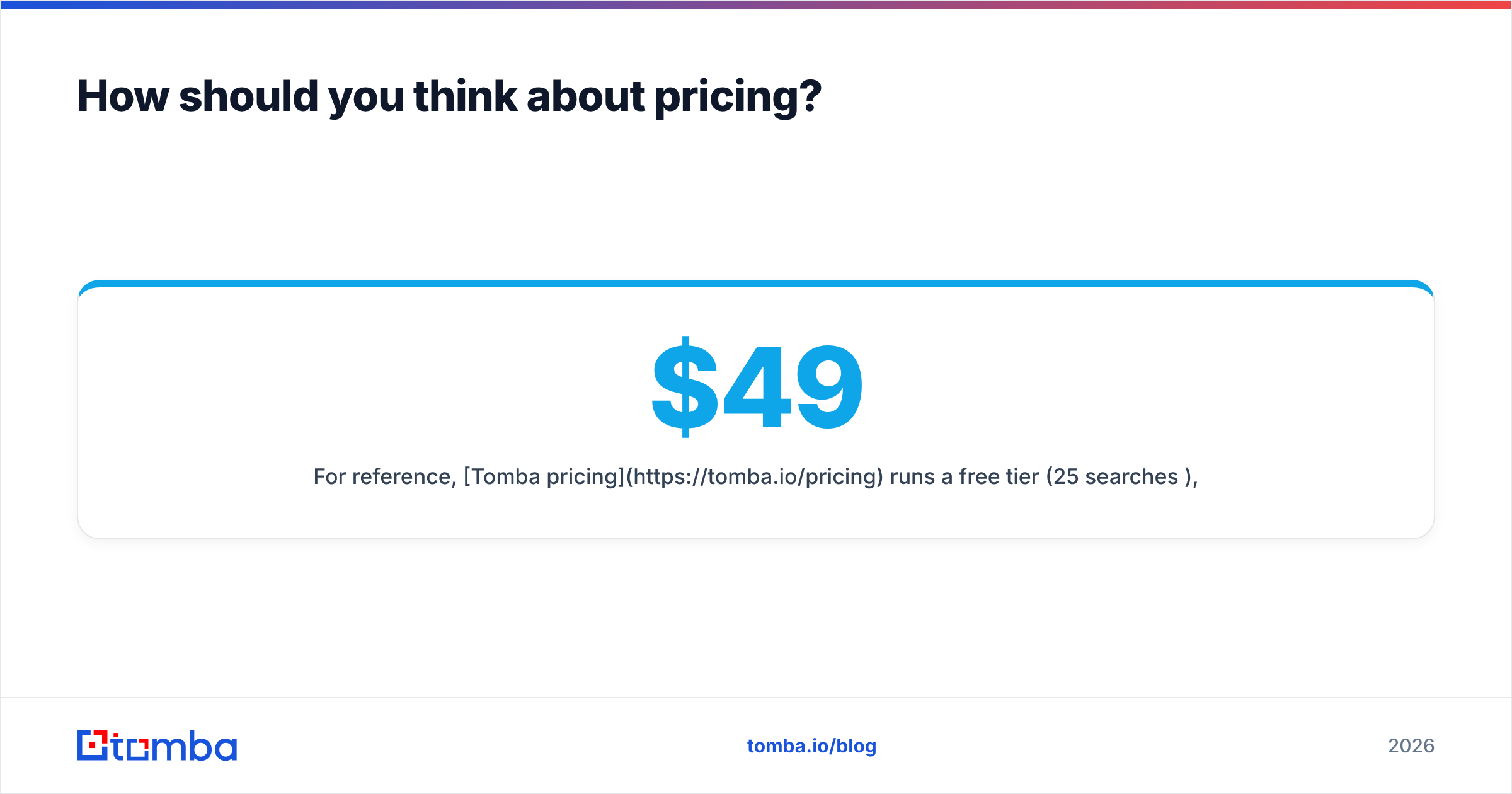
For reference, Tomba pricing runs a free tier (25 searches/month), Starter at $49/mo, Growth at $99/mo, and Pro at $249/mo, with finding and verification drawing from the same allowance. The point isn't that one number beats another — it's that you should model your monthly volume against each tool's tier before signing anything.
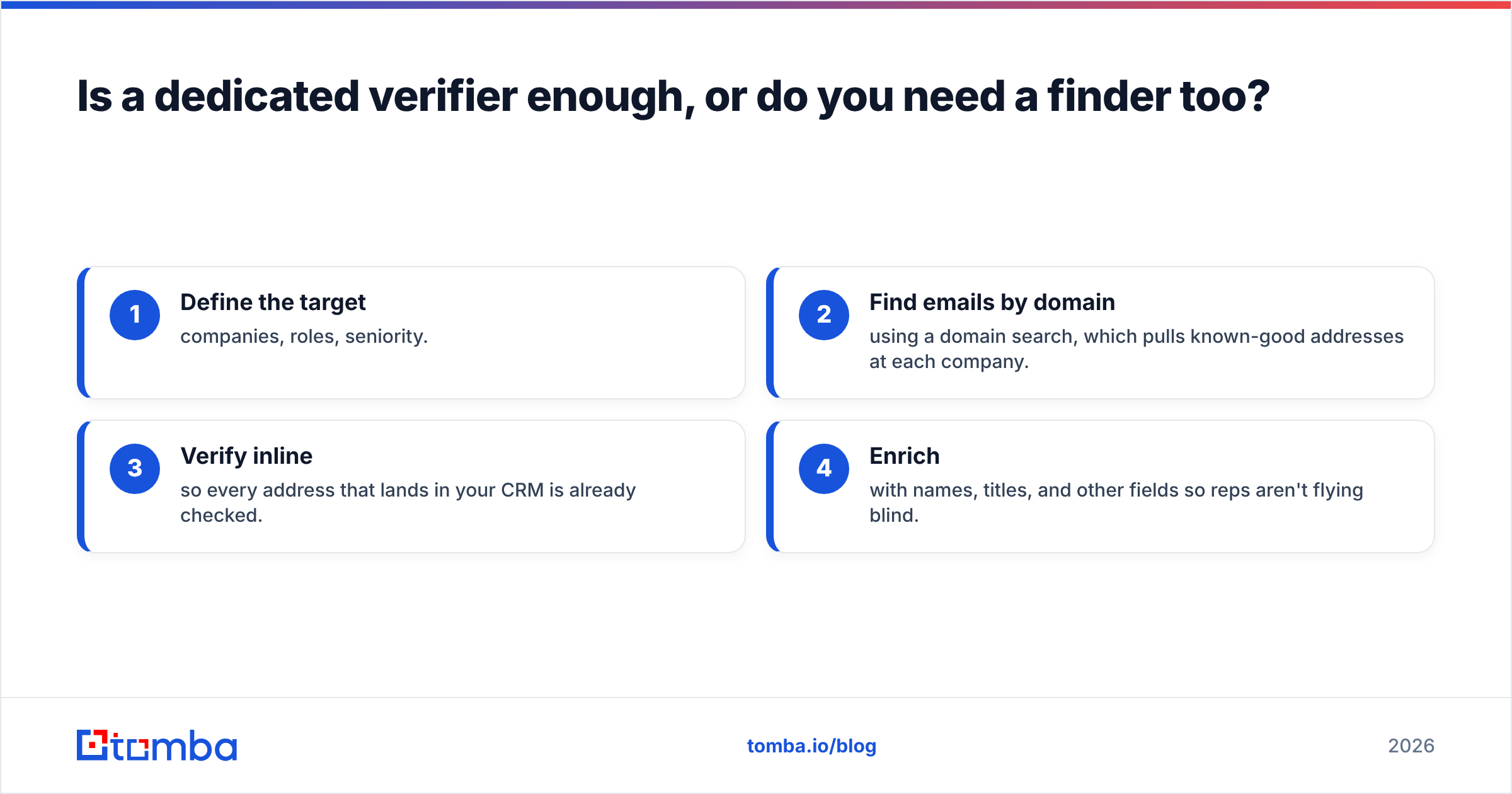
Is a dedicated verifier enough, or do you need a finder too?#
This is the question Brandnav vs Listclean doesn't answer, because neither is built to find new contacts.
Think about where your list comes from. If it's an export from an existing system, a verifier is the right and only tool. But most teams hit a different wall: they need more contacts than they have, and the ones they scrape or buy are low quality. Cleaning a bad list just gives you a smaller bad list.
That's where the finder-first approach pays off. Instead of starting with a junk list and scrubbing it down, you:
- Define the target — companies, roles, seniority.
- Find emails by domain using a domain search, which pulls known-good addresses at each company.
- Verify inline so every address that lands in your CRM is already checked.
- Enrich with names, titles, and other fields so reps aren't flying blind.
You end up with a list that's clean because it was built clean — not because you power-washed a dirty one. For teams running cold outbound, that difference shows up directly in deliverability and reply rates.
None of this means Brandnav or Listclean are bad tools. It means "which verifier wins" is sometimes the wrong question. If your bottleneck is list quality at the source, a verifier alone can't fix it.
What do real reviews say about both tools?#
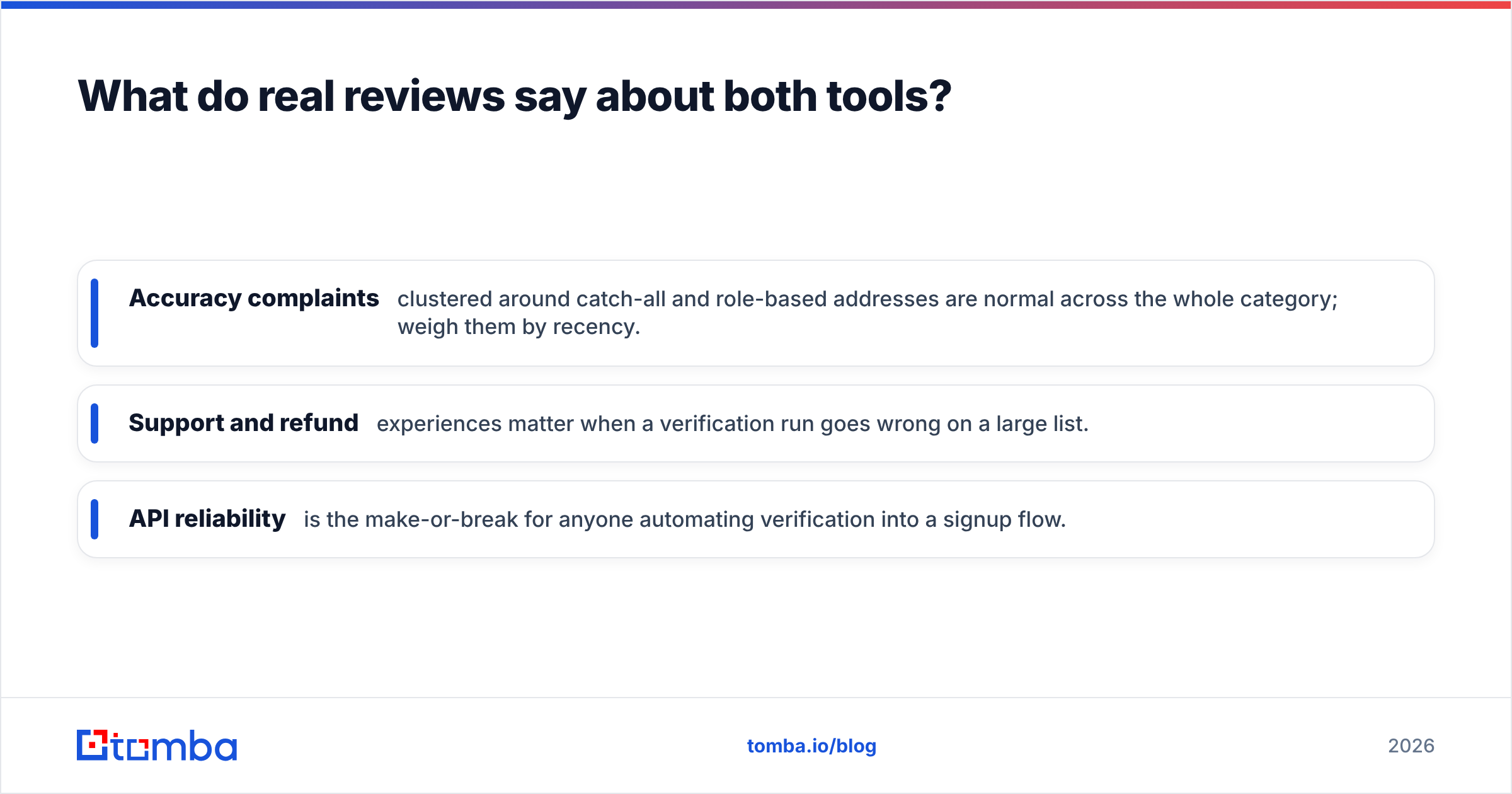
Vendor sites are not neutral, so cross-check on third-party review platforms before you trust any claim — yours included. Look for patterns across many reviews rather than the single glowing or scathing one:
- Accuracy complaints clustered around catch-all and role-based addresses are normal across the whole category; weigh them by recency.
- Support and refund experiences matter when a verification run goes wrong on a large list.
- API reliability is the make-or-break for anyone automating verification into a signup flow.
G2 and similar directories are the standard place to read these. Filter to reviews from the last 12 months — verification engines change fast, and a 2023 complaint may already be fixed. Pair that with a hands-on test on your own sample data, because no aggregate score predicts how a tool performs on your specific domains.
For broader context on how verification fits into a clean go-to-market data stack, HubSpot publishes solid material on list hygiene and email health that applies regardless of which tool you pick.
How to choose between Brandnav and Listclean#
Here's the decision in plain terms:
- Choose Listclean if you want the simplest possible clean-and-download workflow, you verify occasionally, and you don't need enrichment or finding.
- Choose Brandnav if your real problem is messy, multi-field CRM exports that need dedup and enrichment alongside verification, and you're comfortable with a heavier tool.
- Choose a finder-plus-verifier if you need to build targeted lists, not just clean existing ones — and you'd rather not pay two vendors for two halves of the same job.
Run the same 300–500 address sample through whichever finalists you shortlist. Measure false positives (addresses called valid that actually bounce) and false negatives (good addresses wrongly dropped). That 30-minute test beats every comparison table, including this one.
A quick sanity step before any verification run: use a free email checker on a handful of addresses to confirm a tool's basic syntax and MX logic matches your expectations. If it stumbles on obvious cases, it'll stumble on the hard ones too.
The bottom line#
Brandnav and Listclean both verify email lists competently, and the better pick depends on whether your problem is "clean this messy export" (Brandnav) or "scrub this list fast" (Listclean). Test both on catch-all-heavy sample data before you commit, and compare cost per 100k verifications rather than the headline price.
But if your underlying need is more contacts — verified, enriched, and ready to send — a pure list cleaner only solves half of it. Tomba's Email Finder finds professional emails by domain, name, or company and verifies them from the same credit pool, so the list you build is clean at the source instead of power-washed after the fact. Start on the free tier with 25 searches a month, test it against your own sample, and see whether finding-then-verifying beats cleaning-then-hoping for your next campaign.
// get started
Find, verify and enrich your first contacts today
Start on the free plan with 25 searches a month, then scale when your team is ready.
Free plan · No credit card required · GDPR & CCPA
// about the author