Brandnav vs Listkit 2026: B2B Lead Data & Email Finder Compared
Brandnav vs Listkit, broken down by data accuracy, pricing, verification, and workflow fit — plus where a dedicated email finder beats both for cold outreach.
Choosing between Brandnav and Listkit usually comes down to one question: do you want a broad B2B data layer, or a fast lead-list builder wired straight into cold email? Both promise contacts that convert. Both charge for credits. And both leave a gap that a dedicated email finder fills better than either.
This breakdown compares Brandnav vs Listkit on the things that actually move reply rates — data accuracy, verification, pricing, export friction, and how each one behaves when you push it past a demo. No fluff, no leaderboard theatrics.
TL;DR — Brandnav vs Listkit in 30 seconds#
- Brandnav leans toward enrichment and a wider attribute set (firmographics, technographics, intent signals). Good when you already have a CRM to feed.
- Listkit leans toward speed: build a targeted list, verify, and pipe it into a sequencer in minutes. Good for solo SDRs and lean agencies.
- Neither verifies as aggressively as a specialist tool. Catch-all domains and stale records still slip through, and that hits your sender reputation.
- Pricing favors Listkit at entry level, but per-credit math flips as volume grows.
- For pure email accuracy on cold outbound, pairing either tool with a dedicated email finder and email verifier beats relying on one all-in-one platform.
What is Brandnav?#
Brandnav is a B2B data and enrichment platform. Its pitch is breadth: pull a company, get firmographics, contact roles, technographic signals, and in some tiers intent data, then push it into your CRM or outreach tool. Think of it less as a list-builder and more as a data faucet you plumb into an existing pipeline.
That breadth is the appeal and the catch. If you run revenue operations and you're enriching inbound leads or cleaning a CRM, the wide attribute set earns its keep. If you just need 500 verified emails for a campaign by Friday, you're paying for surface area you won't touch this week.
What is Listkit?#
Listkit is a lead-list builder aimed at cold email teams. You filter by title, industry, headcount, and geography, it builds the list, runs verification, and hands you something you can drop into a sequencer. The whole product is shaped around one job: go from "I want HR directors at 50–200 person SaaS firms" to a clean CSV fast.
The trade-off is depth. You get the contact and the basics, not a rich enrichment profile. For most cold outbound sales motions that's fine — you don't need a technographic dossier to send a good first email. You need the right person, a real inbox, and a reason to reach out.
Brandnav vs Listkit: the core comparison#
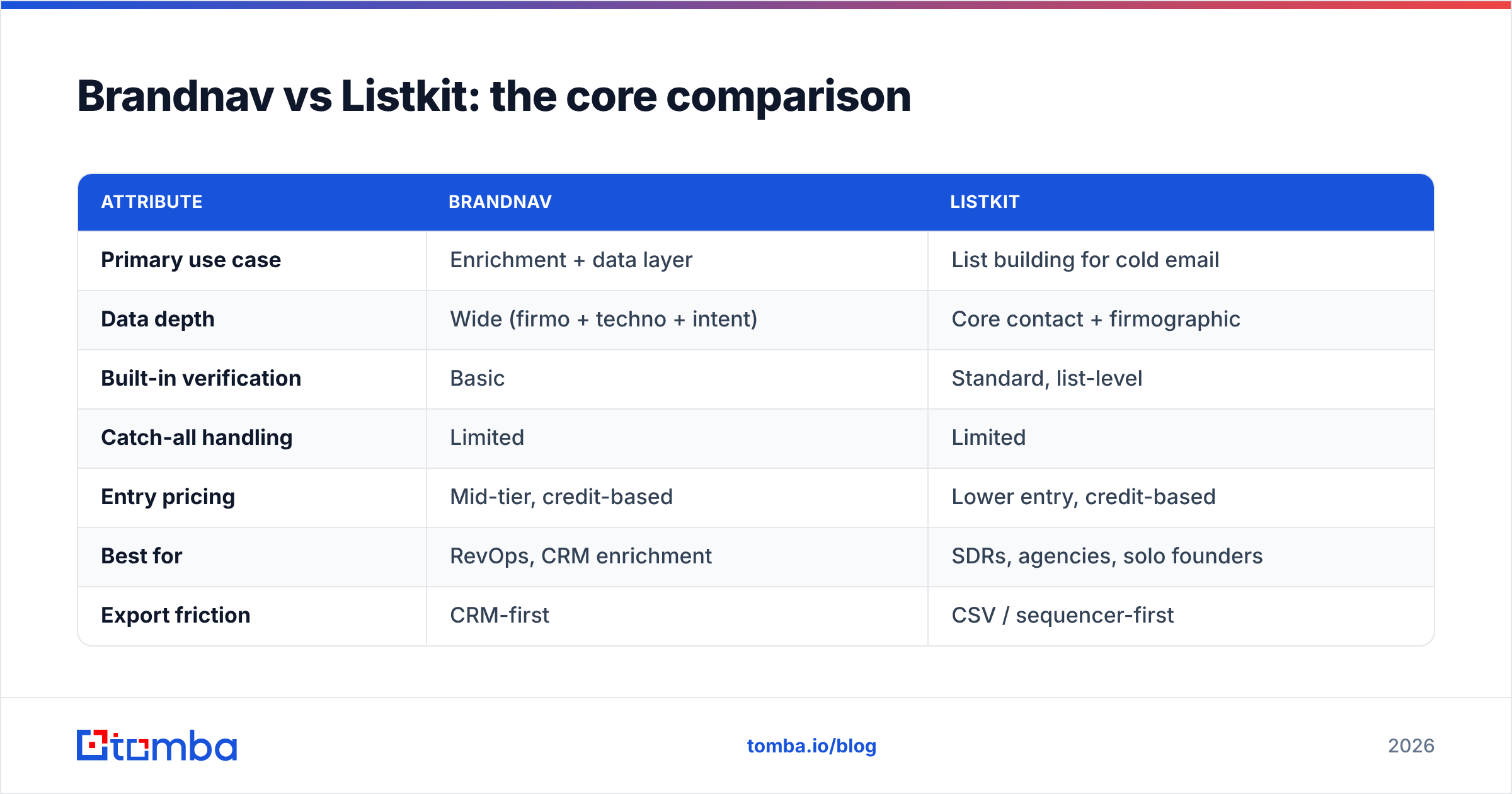
Here's the head-to-head on the attributes that decide which tool fits your motion. The numbers below reflect typical positioning in 2026; always confirm current limits on each vendor's pricing page before you commit.
| Attribute | Brandnav | Listkit |
|---|---|---|
| Primary use case | Enrichment + data layer | List building for cold email |
| Data depth | Wide (firmo + techno + intent) | Core contact + firmographic |
| Built-in verification | Basic | Standard, list-level |
| Catch-all handling | Limited | Limited |
| Entry pricing | Mid-tier, credit-based | Lower entry, credit-based |
| Best for | RevOps, CRM enrichment | SDRs, agencies, solo founders |
| Export friction | CRM-first | CSV / sequencer-first |
| Learning curve | Steeper | Shallow |
The short read: Brandnav is a platform you integrate, Listkit is a tool you run. Your team structure decides which framing wins. A RevOps function with a CRM admin will get more from Brandnav. A founder doing their own prospecting will move faster with Listkit.
Which has better data accuracy?#
Accuracy is where all-in-one tools quietly lose points, and it's the metric that actually shows up in your bounce rate. Both Brandnav and Listkit source from a mix of public data, partnerships, and user contributions, then apply their own verification pass. The problem isn't the find — it's the freshness and the catch-all blind spot.
Two failure modes hit B2B data hardest:
- Role churn. A contact who was VP of Sales six months ago changed jobs. The record looks valid; the person is gone. Neither platform re-checks aggressively enough on its own.
- Catch-all domains. A server that accepts every address at a domain returns "valid" to a basic SMTP check, so a single-pass verifier marks it deliverable when it isn't. This is the single biggest source of phantom-valid emails in B2B lists.
A dedicated catch-all verifier exists precisely because general tools treat catch-alls as a coin flip. If a meaningful share of your target accounts run catch-all servers — common in mid-market and enterprise — you want a layer that resolves them rather than guessing.

The practical takeaway: treat either platform's "verified" label as a first pass, not a final verdict. Run the export through an independent verification step before it touches your sending domain. The cost of a re-verify is trivial next to the cost of a blacklisted domain.
Brandnav vs Listkit pricing — what you actually pay#
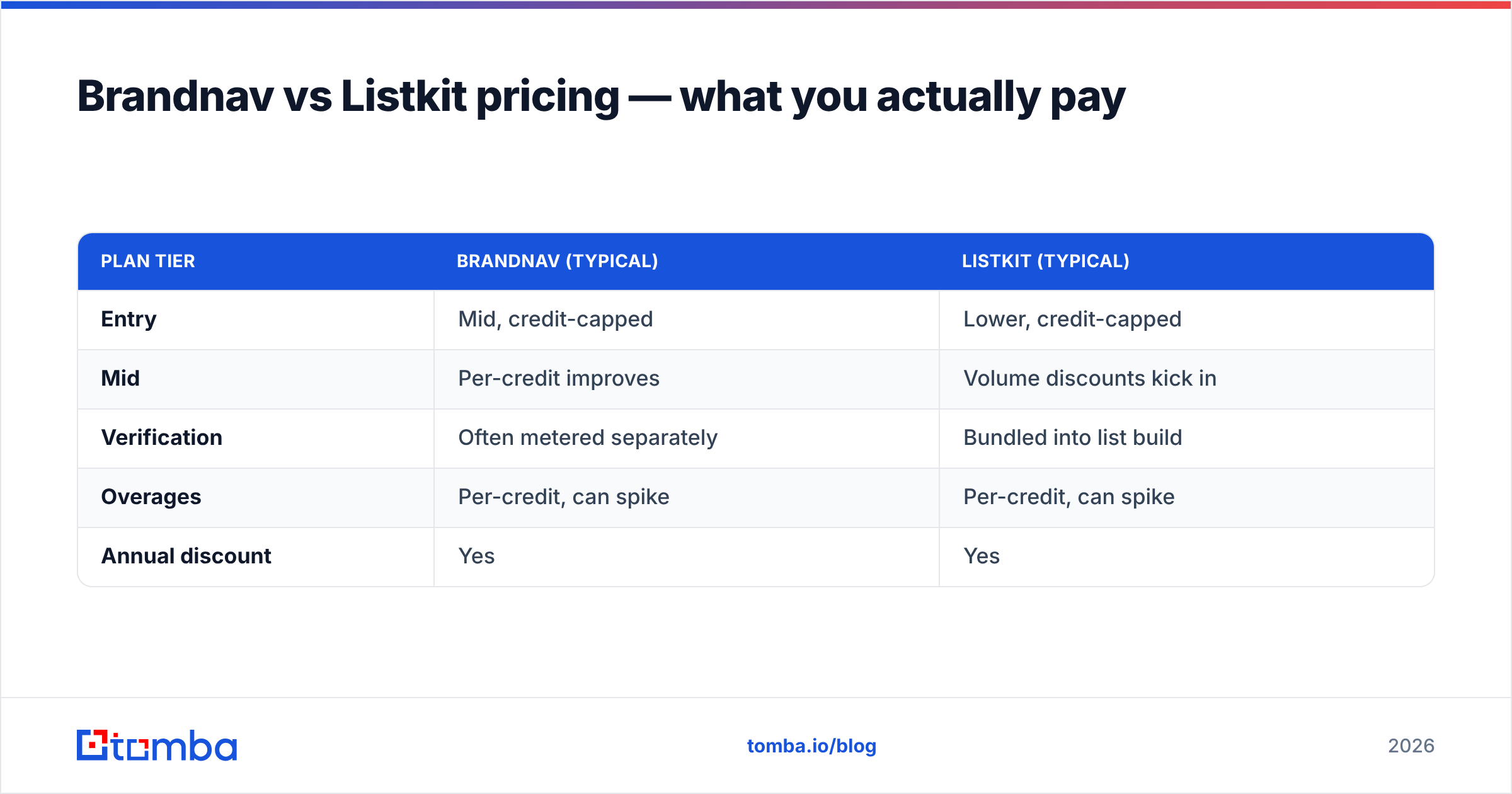
Both tools price on credits, which makes headline numbers misleading. A "1,000 credits" plan means different things depending on whether enrichment, verification, and exports each burn separate credits. Read the consumption model, not the sticker.
| Plan tier | Brandnav (typical) | Listkit (typical) |
|---|---|---|
| Entry | Mid, credit-capped | Lower, credit-capped |
| Mid | Per-credit improves | Volume discounts kick in |
| Verification | Often metered separately | Bundled into list build |
| Overages | Per-credit, can spike | Per-credit, can spike |
| Annual discount | Yes | Yes |
Listkit usually wins on entry price and simplicity — what you see is close to what you pay. Brandnav's value improves at scale if you genuinely use the enrichment, but the per-credit overage on enrichment-heavy workflows is where surprise bills live. Model your real monthly volume against both before signing anything.
For reference on how transparent credit pricing can look, compare both against published Tomba pricing: Free (25 searches/mo), Starter $49/mo, Growth $99/mo, Pro $249/mo, and Enterprise. Flat, readable tiers make it easier to predict spend than enrichment-metered credit pools.
Is there a better alternative for cold outreach?#
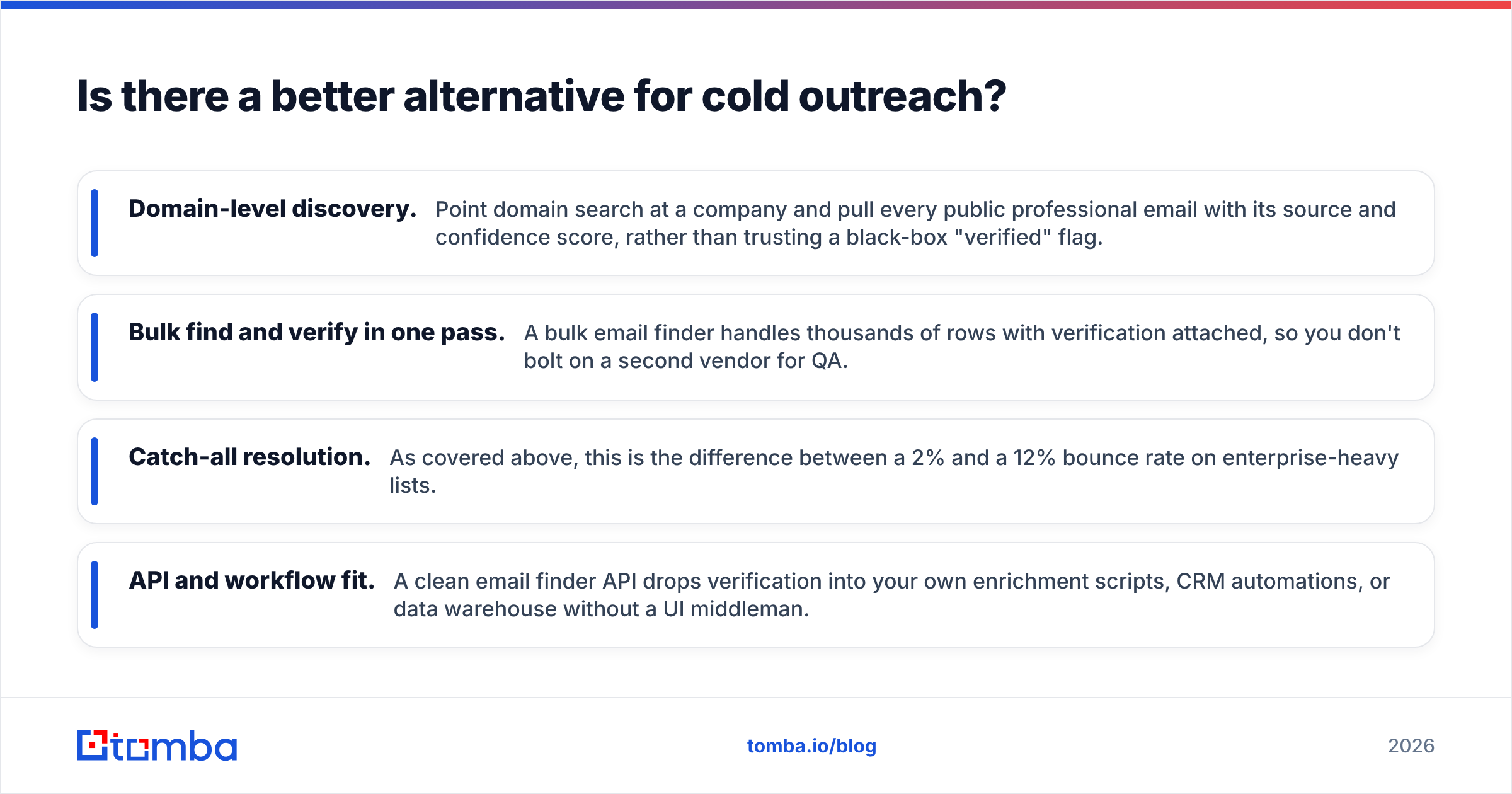
Yes — if your goal is specifically deliverable emails for outbound, a focused finder-plus-verifier stack outperforms a single all-in-one. The reason is structural: tools that try to do enrichment, intent, list-building, and sending all at once optimize for breadth, and verification depth is the first thing to get diluted.
Here's where a specialist layer earns its place alongside (or instead of) Brandnav and Listkit:
- Domain-level discovery. Point domain search at a company and pull every public professional email with its source and confidence score, rather than trusting a black-box "verified" flag.
- Bulk find and verify in one pass. A bulk email finder handles thousands of rows with verification attached, so you don't bolt on a second vendor for QA.
- Catch-all resolution. As covered above, this is the difference between a 2% and a 12% bounce rate on enterprise-heavy lists.
- API and workflow fit. A clean email finder API drops verification into your own enrichment scripts, CRM automations, or data warehouse without a UI middleman.
This isn't an argument to ditch list-building. It's an argument to stop treating "the platform said it's valid" as ground truth.
How to choose between Brandnav, Listkit, and a dedicated finder#
Match the tool to the job, not the marketing. Use this decision frame:
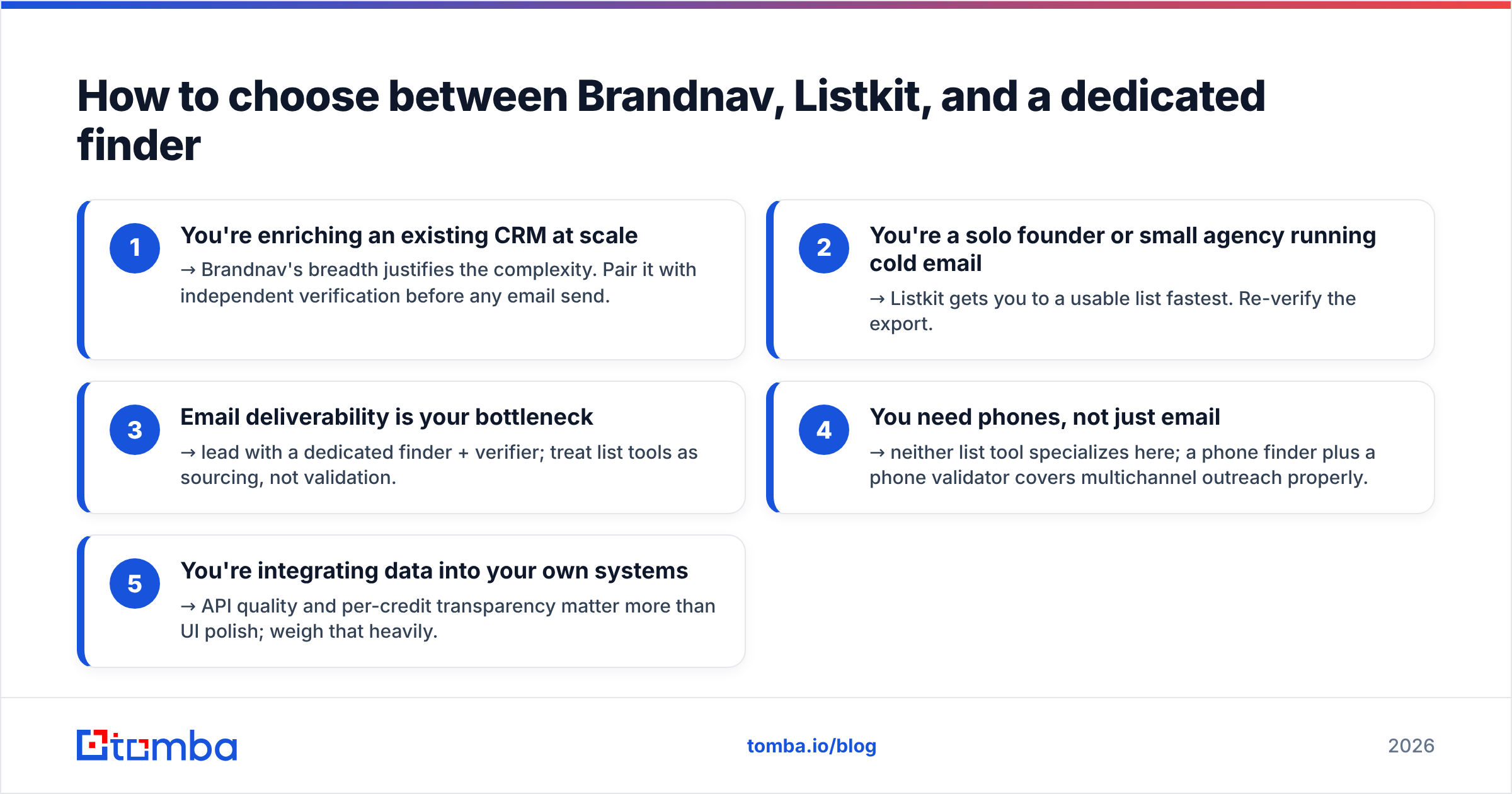
- You're enriching an existing CRM at scale → Brandnav's breadth justifies the complexity. Pair it with independent verification before any email send.
- You're a solo founder or small agency running cold email → Listkit gets you to a usable list fastest. Re-verify the export.
- Email deliverability is your bottleneck → lead with a dedicated finder + verifier; treat list tools as sourcing, not validation.
- You need phones, not just email → neither list tool specializes here; a phone finder plus a phone validator covers multichannel outreach properly.
- You're integrating data into your own systems → API quality and per-credit transparency matter more than UI polish; weigh that heavily.
The teams that get the best return rarely rely on a single platform. They source with one tool, verify with another, and protect their sending domain religiously. Protecting email deliverability is cheaper than rebuilding sender reputation after a blacklist.
Quick verdict#
If you want the one-line answer: Listkit wins on speed and entry price for cold email; Brandnav wins on data breadth for enrichment-heavy RevOps. But the win that compounds is verification discipline. Whichever you pick, run the output through an independent finder-and-verifier pass so your "valid" emails are actually valid.
For independent benchmarks on how data tools stack up on accuracy and price, third-party review sites like G2 and Capterra collect real-user reports worth reading before you commit budget. Vendor case studies are marketing; peer reviews are signal.
Ready to stop guessing on deliverability?#
Brandnav and Listkit get you a list. Whether the emails on it actually land is a separate question — and it's the one that decides your campaign. Run your next export through the Tomba Email Finder to find and verify professional addresses with source-level confidence and proper catch-all handling. Start free with 25 searches a month, scale to Starter at $49/mo when you're ready, and send to inboxes that are real. Your sender reputation will thank you.
// get started
Find, verify and enrich your first contacts today
Start on the free plan with 25 searches a month, then scale when your team is ready.
Free plan · No credit card required · GDPR & CCPA
// about the author