Brandnav vs Morphymail: Email Finder Accuracy Compared (2026)
Brandnav vs Morphymail compared on accuracy, pricing, verification, and data coverage—plus where each tool fits and the stronger alternative for 2026 outbound teams.
Choosing between Brandnav and Morphymail comes down to one question most buyers skip: do you need a polished bulk-verification workflow, or raw email discovery you can trust at scale? Both tools touch the same job—turning a name and a domain into a deliverable address—but they solve different slices of it, and neither is the obvious default for a modern outbound team.
This is a neutral breakdown. We'll compare accuracy, pricing, verification depth, and data coverage, show where each tool earns its keep, and be honest about where a broader platform fits better.
TL;DR: Brandnav vs Morphymail at a glance#
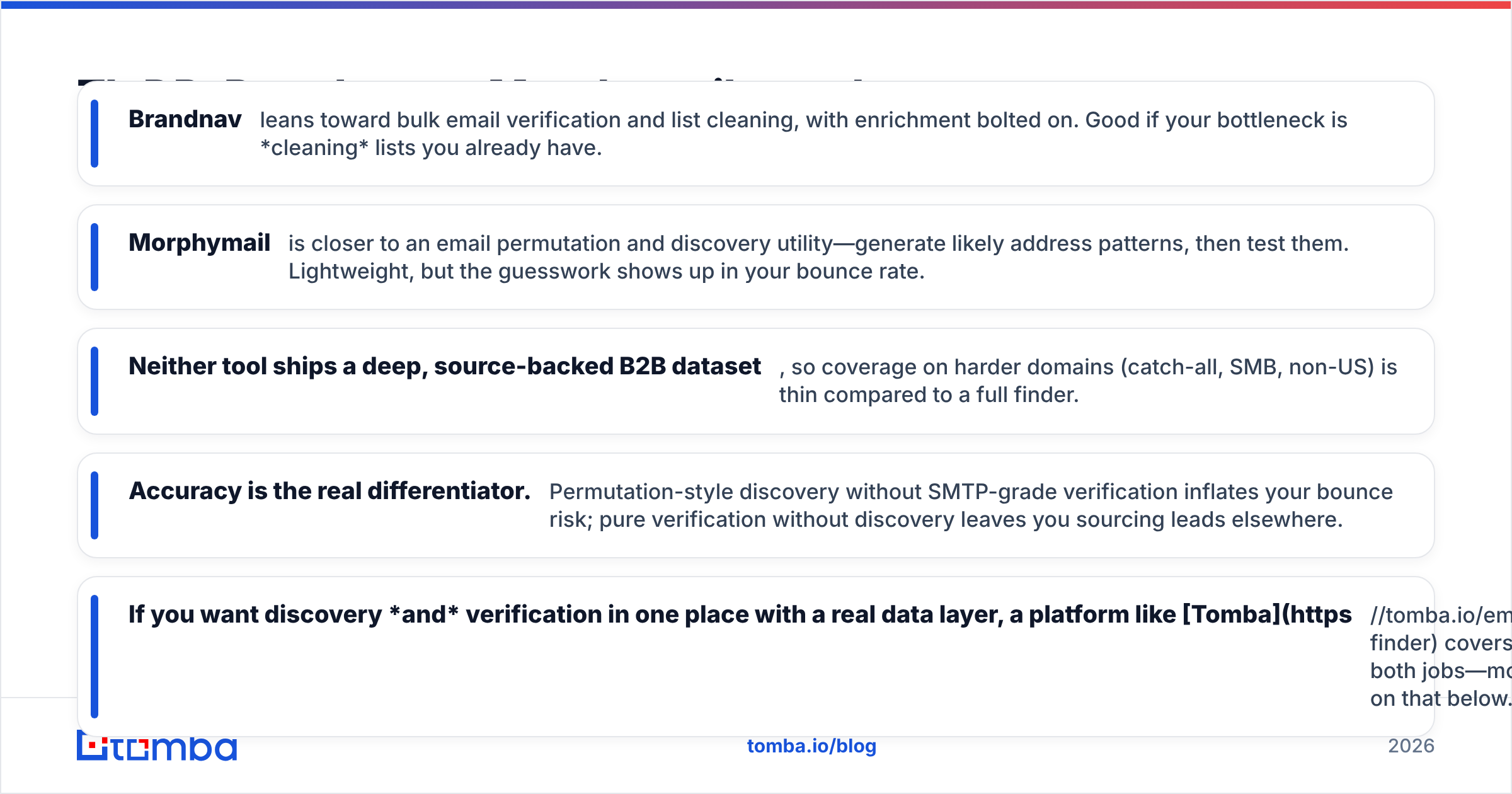
- Brandnav leans toward bulk email verification and list cleaning, with enrichment bolted on. Good if your bottleneck is cleaning lists you already have.
- Morphymail is closer to an email permutation and discovery utility—generate likely address patterns, then test them. Lightweight, but the guesswork shows up in your bounce rate.
- Neither tool ships a deep, source-backed B2B dataset, so coverage on harder domains (catch-all, SMB, non-US) is thin compared to a full finder.
- Accuracy is the real differentiator. Permutation-style discovery without SMTP-grade verification inflates your bounce risk; pure verification without discovery leaves you sourcing leads elsewhere.
- If you want discovery and verification in one place with a real data layer, a platform like Tomba covers both jobs—more on that below.
What is Brandnav and who is it for?#
Brandnav positions itself as an email verification and validation service with some contact enrichment features. The core value is hygiene: you upload a list, it flags invalid, risky, and catch-all addresses, and hands back a cleaner file ready for your sending tool.
That's a legitimate, narrow job. Teams running large cold-email programs burn sender reputation fast when bounce rates creep above 3-4%, so a dedicated cleaner has obvious value. Brandnav's sweet spot is the marketer or SDR who already has contacts—scraped, exported, or purchased—and needs them scrubbed before they hit a sequence.
Where it gets thinner is discovery. Brandnav is not built to source net-new contacts from scratch the way a domain-first finder is. You bring the list; it grades the list. If your pipeline problem is "I don't have enough verified prospects yet," verification alone won't fix it.
What is Morphymail and how does it work?#
Morphymail works on a different principle: permutation. Give it a first name, last name, and domain, and it generates the common address formats—jane.doe@, jdoe@, jane@, doej@—then attempts to confirm which one resolves.
This is the same logic behind any email permutator, and it's genuinely useful for one-off lookups when you know exactly who you're targeting. The catch is structural: permutation guesses patterns, it doesn't know them. When a company uses a non-obvious format (initials plus a number, a nickname, a legacy domain), the guess misses, and a "best effort" verification on a catch-all server can return a false positive.
So Morphymail is fast and cheap for low-volume, high-certainty targets. At scale, the pattern-guessing approach is exactly what drives the kind of bounce creep that gets sending domains throttled.
Brandnav vs Morphymail: feature and pricing comparison#
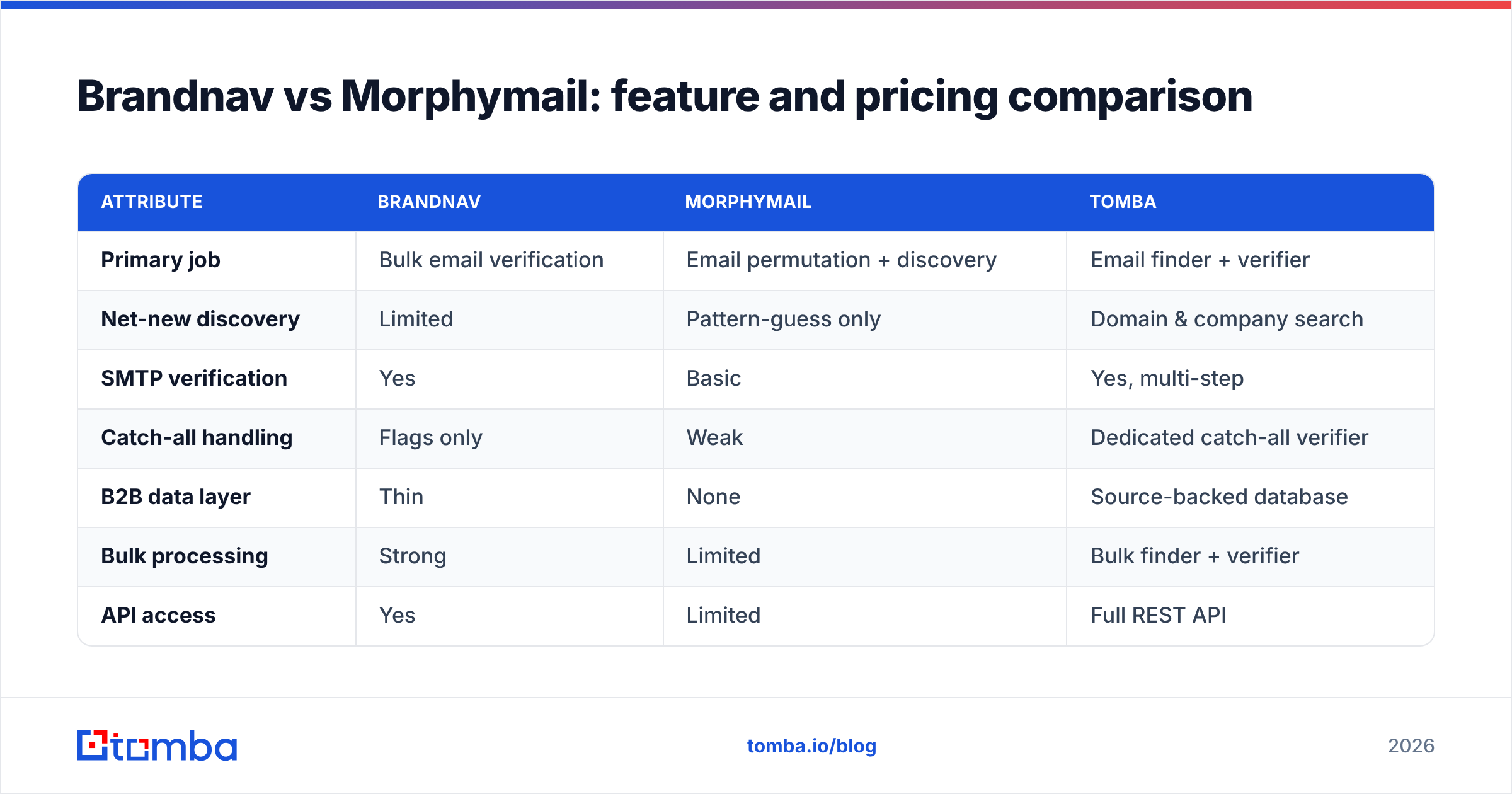
Here's the head-to-head on the attributes that actually change your results. Both vendors adjust plans frequently, so confirm live numbers before you buy.
| Attribute | Brandnav | Morphymail | Tomba |
|---|---|---|---|
| Primary job | Bulk email verification | Email permutation + discovery | Email finder + verifier |
| Net-new discovery | Limited | Pattern-guess only | Domain & company search |
| SMTP verification | Yes | Basic | Yes, multi-step |
| Catch-all handling | Flags only | Weak | Dedicated catch-all verifier |
| B2B data layer | Thin | None | Source-backed database |
| Bulk processing | Strong | Limited | Bulk finder + verifier |
| API access | Yes | Limited | Full REST API |
| Free tier | Limited trial | Limited | 25 searches/mo |
| Entry paid price | Varies | Low/one-off | $49/mo Starter |
| Integrations | Few | Few | HubSpot, Sheets, Zapier, more |
The pattern is consistent: each competitor is strong in one column and weak across the rest. Brandnav verifies well but discovers poorly; Morphymail discovers cheaply but verifies weakly. Neither carries a real B2B dataset underneath, which is what determines whether you can find the address in the first place.
Which tool is more accurate?#
Accuracy is where the comparison stops being academic. An email tool has two failure modes: it can fail to find an address (low coverage), or it can hand you an address that bounces (low precision). Brandnav and Morphymail each protect against only one.

Morphymail's permutation approach is precision-at-risk: it produces plausible addresses, but on catch-all domains—where the mail server accepts everything—a guessed address can pass a shallow check and still bounce on send. That's the worst outcome, because it looks valid until your reputation pays for it. A proper catch-all verifier treats those domains as a separate problem instead of waving them through.
Brandnav's verification is the stronger half of the equation, but it only grades addresses you supply. If your source list was built by guessing, Brandnav cleans the guesses—it doesn't replace the missing 40% of contacts it never saw.
The accuracy ceiling for both tools is set by their data. Without a maintained source-backed dataset (the kind documented in a vendor's data sources page), you're either guessing patterns or cleaning someone else's guesses. According to independent review sites like G2, the verification tools that score highest pair SMTP checks with real coverage rather than relying on one or the other.
How do they handle bulk and API workflows?#
If you're sending to lists in the hundreds or thousands, bulk throughput and an API matter more than the single-lookup UX.
- Brandnav handles bulk verification competently—upload a CSV, get a graded file. That's its core loop, and it does it. The limitation is upstream: it can clean a big list but can't build one.
- Morphymail is built around individual or small-batch permutation. It's not designed as a high-volume pipeline component, and the lack of a deep API limits automation.
- A unified platform runs discovery and verification through the same bulk email finder and a single email finder API, so you find, verify, and enrich in one pass instead of stitching two vendors together.
The hidden cost of the two-tool approach is integration tax. When discovery lives in one product and verification in another, someone on your team becomes the CSV courier—exporting, reformatting, re-importing. That's slow, error-prone, and exactly the work automation is supposed to delete.
Brandnav vs Morphymail: pros and cons#
Brandnav — pros
- Solid bulk verification and list hygiene
- Reasonable for cleaning lists you already own
- API available for verification workflows
Brandnav — cons
- Weak at sourcing net-new contacts
- Thin underlying B2B data
- Catch-all handling flags but doesn't resolve
Morphymail — pros
- Cheap, fast single lookups
- Useful permutation logic for known targets
- Low barrier for occasional use
Morphymail — cons
- Pattern-guessing inflates bounce risk at scale
- No real dataset behind it
- Limited bulk and API capability
Where does Tomba fit in this comparison?#
Tomba is the option you reach for when you want one tool to do the whole job—discovery, verification, and enrichment—on top of a real B2B data layer instead of pattern guesses.
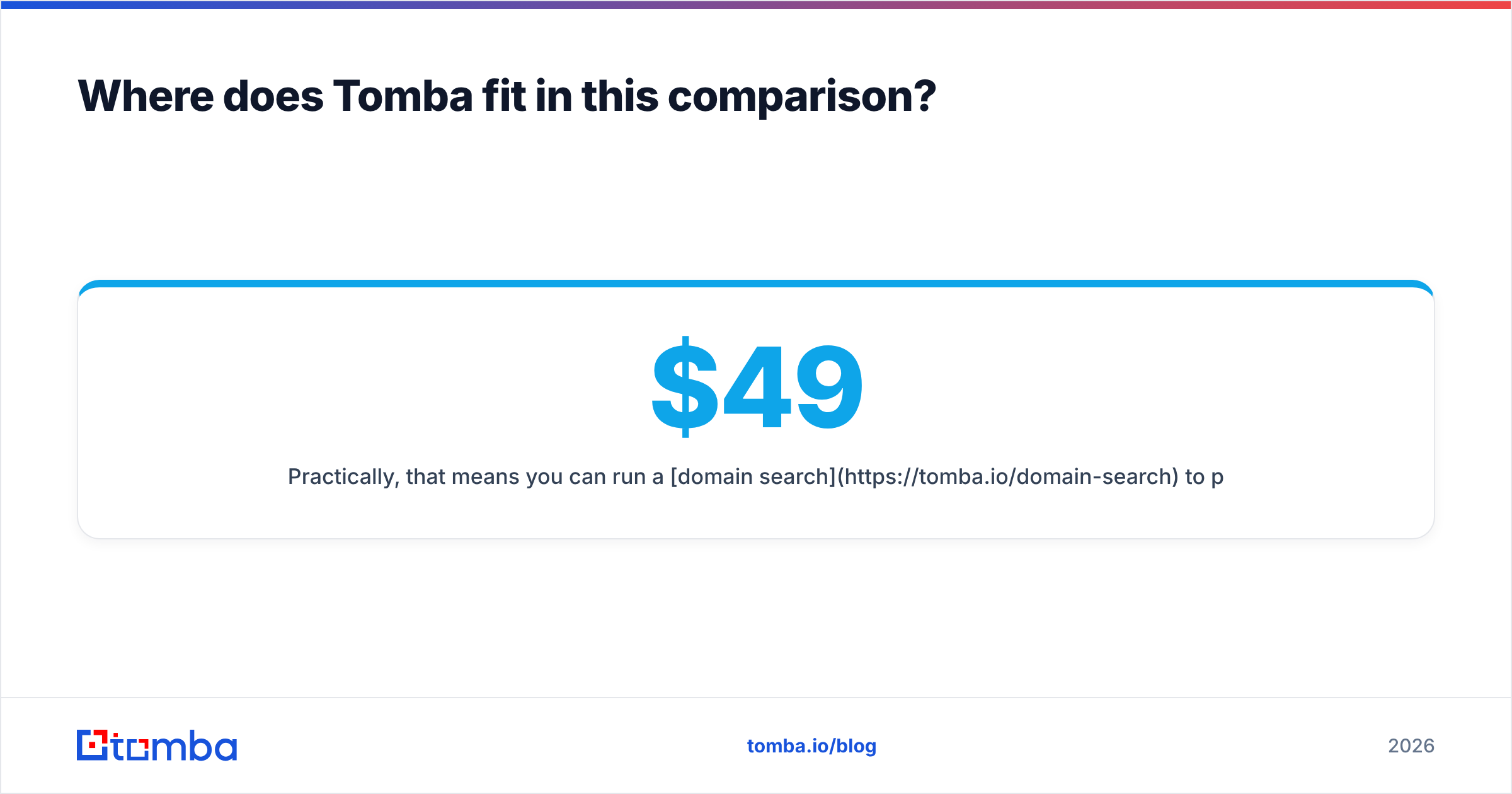
Practically, that means you can run a domain search to pull every known address at a company, confirm each one through a multi-step verifier, and flag catch-all domains separately rather than gambling on them. The same workflow runs in bulk and through an API, so it slots into your CRM and sequencing tools without the CSV shuffle. Pricing is transparent: a free tier with 25 searches a month, then Starter at $49/mo, Growth at $99/mo, and Pro at $249/mo—full Tomba pricing is public.

The honest framing: if your only problem is cleaning an existing list, a dedicated verifier like Brandnav can do that, and if you just need a one-off guess, Morphymail's permutator is fine. But most teams have both problems—find and verify—and paying two vendors to half-solve each one rarely beats a single platform that does both with better data underneath. Tomba isn't magic; it's just scoped to the actual job most outbound teams are trying to do.
Which should you choose in 2026?#
Decide by your bottleneck, not by the cheapest line item.
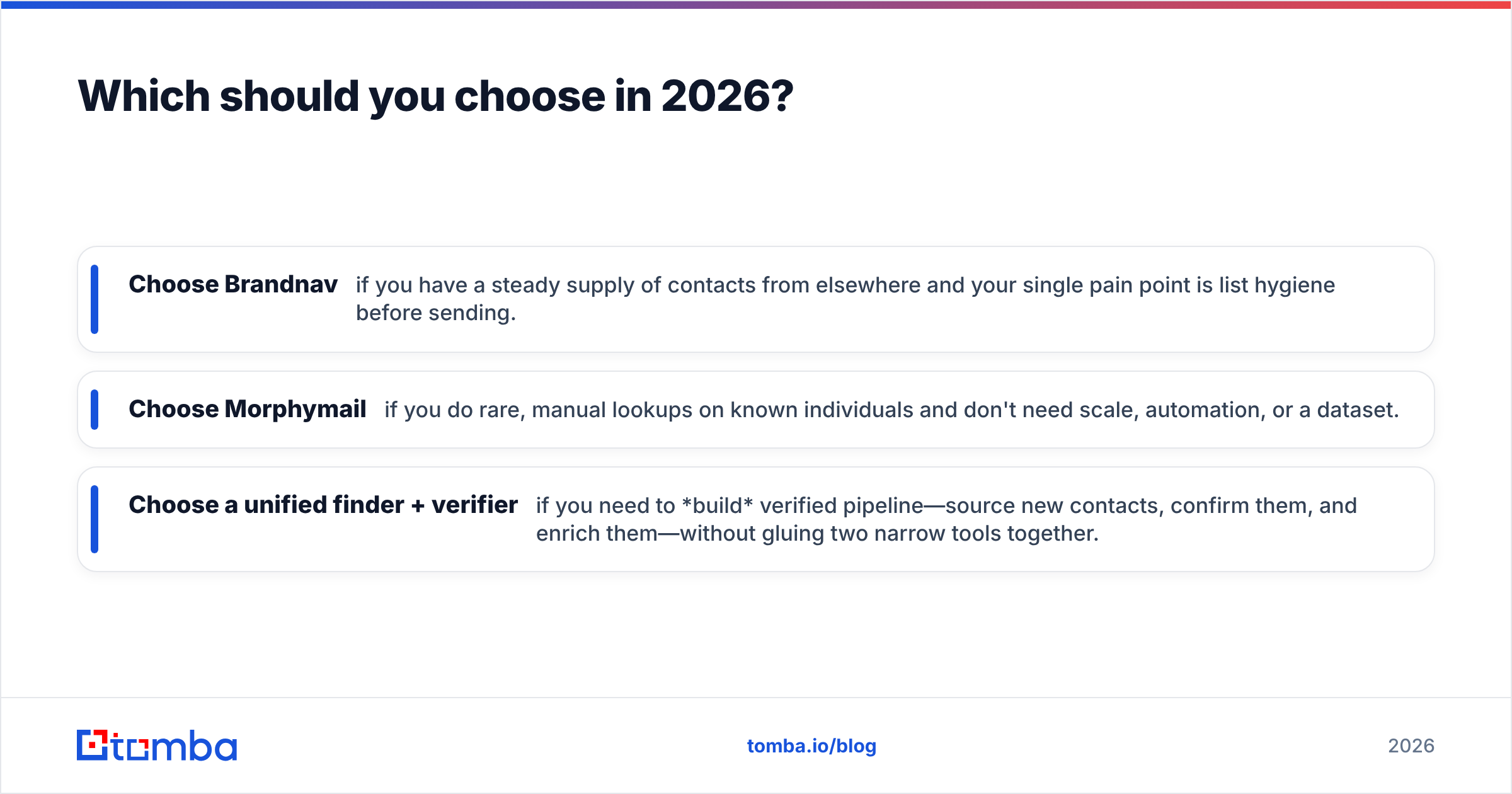
- Choose Brandnav if you have a steady supply of contacts from elsewhere and your single pain point is list hygiene before sending.
- Choose Morphymail if you do rare, manual lookups on known individuals and don't need scale, automation, or a dataset.
- Choose a unified finder + verifier if you need to build verified pipeline—source new contacts, confirm them, and enrich them—without gluing two narrow tools together.
For comparison shoppers still weighing options, it's worth checking how each stacks up against the broader market of email verification and discovery tools rather than treating Brandnav and Morphymail as the only two choices. They're niche players; the category is much wider.
A useful gut check: if you mapped your last quarter's bounces, were they "couldn't find the person" misses or "found the wrong address" misses? Brandnav fixes the second, Morphymail risks causing it, and a real finder addresses both.
The bottom line#
Brandnav vs Morphymail isn't a fight for the same crown—they're solving adjacent problems, each well enough in its lane and poorly outside it. Brandnav cleans; Morphymail guesses. Both leave the data problem unsolved, which is the part that actually decides whether your campaigns land.
If you want discovery, verification, catch-all handling, and enrichment from one source-backed platform—with a free tier to test before you commit—start with the Tomba Email Finder. Run your hardest domains through it, compare the verified hit rate against what you're getting today, and let the bounce numbers settle the argument. That's the only benchmark that pays your sending reputation back.
// get started
Find, verify and enrich your first contacts today
Start on the free plan with 25 searches a month, then scale when your team is ready.
Free plan · No credit card required · GDPR & CCPA
// about the author